DESIGN ISSUES IN DISTRIBUTED MANAGEMENT INFORMATION SYSTEMS by
JACOB AKOKA
B.S., Faculte des Sciences-Paris (1970)
S.M., University of Paris VI (1971)
Doctorat 3eme Cycle, University of Paris VI (1975)
SUBMITTED IN PARTIAL FULFILLMENT OF THE REQUIREMENTS FOR THE
DEGREE .OF
DOCTOR OF PHILOSOPHY at the
MASSACHUSETTS INSTITUTE OF TECHNOLOGY May 4, 1978
Signature of Author ... Sloan School of Management, May 4, 1978
Certified by ... Thesis Supervisor
Accepted by ... Chairman, Department Committee
DESIGN ISSUES IN DISTRIBUTED MANAGEMENT INFORMATION SYSTEMS by
Jacob Akoka
Submitted to the Department of Management
on May 4, 1978 in partial fulfillment of the requirements for the Degree of Doctor of Philosophy
ABSTRACT
Due to the advances in computer network technology and the steadily decreasing cost of hardware, distributed information systems have become a potential alternative to centralized information systems.' This thesis analyzes issues related to the design of distributed information systems. Most of the research done in the past can be characterized by a piece-meal approach since it tends to consider the computer network design issue and the distributed data base design issue separately. The
critical survey presented in Chapter 2 points out the need to integrate both issues in an overall design approach. In an attempt to incorporate most of the factors that compose distributed information systems, we
present a global model in which network topology, communication channels capacity, size of computer hardware, pricing schemes, and routing dis-ciplines are interrelated in an optimal design. In addition, we show how
to derive from the global model a design model for distributed database systems. To solve the two distributed information system models (integer nonlinear programming models), we propose a mathematical programming algorithm that has the following characteristics: - it takes advantage
bounded branch and bound method which limits a priori the number of the nodes of the tree.
Comparing with previous work in this area, the algorithm is more efficient than traditional branch and bound techniques and can avoid the disadvantages of heuristic methods which were widely used in the
optimi-zation of computer networks and distributed database systems.
The global model and the solution procedure are used to design the distributed information system for a large bank in Europe. Our solution proved to be-better in terms of optimal configuration than the bank's
experimental network. In addition, our model for the design of distri-buted database systems performed better than past models.
An efficient computer code allowing to solve real-life distributed information system problems, with little programming effort for the users, was developed and tested.
An extension of our global model to the issue of centralization versus decentralization of information systems is presented. The inform-ation system is divided in three components (systems operinform-ations,
systems development, and systems management), and a specific submodel is used to facilitate the decision for each component. Finally, further research in the area of design models for distributed information
systems is discussed.
ACKNOWLEDGEMENTS
I would like to express my gratitude to my thesis advisor, Pro-fessor P.P.S. Chen, for his careful guidance and his valuable comments; his patience and constructive criticism helped me to integrate many
concepts within a coherent frame. His encouragement has been invaluable. Thank you so much Peter!
I would also like to thank Professors J.D.C. Little and S.E. Madnick for their insightful comments. Their suggestions contributed to broaden my view of the distributed management information system design problem. Thank you for your help and encouragement.
I am very grateful to Maitre Olivier, General Director of ESSEC (Ecole Superieure des Sciences Economiques et Commerciales) for his moral support and for facilitating my staying at the Sloan School of Management (M.I.T.). I would like to thank the following for the financial aid received in support of this doctoral program: l'Ecole Superieure des Sciences Economiques et Commerciales (ESSEC), La
Fondation Nationale Pour l'Enseignement de la Gestion des Entreprises (FNEGE), and l'Institut de Recherche d'Informatique et d'Automatique (IRIA).
Thanks to my colleagues, D. Briolat, H. Dayan, R. Thietart, G. Viens and B. Yon for their help.
I wish to express my personal appreciation to Judith Mason for her excellent typing.
5 Vivi, and my children Karen and Nathalie, for their encouragement and understanding during all phases of this work.
6
TABLE OF CONTENTS
Page CHAPTER ONE -- INTRODUCTION
I. Toward Distributed Information Systems II. Statement of the Research . . . . . . . . III. Research Methodology . . . . . . . IV. Outline of Dissertation . . . . . . .
12 14 17 18 CHAPTER TWO -- DISTRIBUTED INFORMATION SYSTEMS: A STATE OF THE
ARTS STUDY
I. Introduction . . . .. . . . . . . . . . . . . . 24
II. Major Arguments Used for Distributed Information Systems . 25 A. Economy of Scale . . . . . . . . 25
B. Sophistication of Applications . . . . . . . .. . . . . 29
C. Quality of Systems Development . . . . . . . ,.... 30
III. Computer Network: A Survey . . . . . . . . 32
A. Network Topologies . . . . .. . . . . . . 32
B. Communication Systems . . . . . . .. ... 39
C. Computer Network Design Principles.... . . . ..43
D. Solutions for the Optimum Design . . .. . . . . . 46
IV. Distributed Database Systems: An Overview . . . . . . . ..52
A. Introduction . . . . . . . . . . .. . . . .. . 52
B. Classification of Distributed Databases... . . ..54
C. Design Models for Distributed Database Systems V. Conclusion . . . . . . . . . CHAPTER THREE -- DESIGN AND OPTIMIZATION OF DISTRIBUTED INFORMATION SYSTEMS I. Introduction . . . . . . . . . II. The Global Model . . . . . . ... A. Assumptions and Modelling Aspects . . -B. The Objective Function . . . . . . . . . . . C. The Constraints . . . . . . . . . . . . D. Final Formulation of the Problems . . . . E. Model Type . . . . . . . . . . . . 59 . . . . 66 76 81 82 87 95 100 .. . . 104
F. Relevances of the Model . . . . . . . (i) Relevance to the Computer Network
Design Problem . . . . . . . . (ii) Relevance to the
Centralization-Decentralization Issue . . . . . . ... (iii) Relevance to the Distributed Databases
Design Problem . . . . . . . . . III. The Optimal Distributed Database Systems Model . . . IV. Possible Extensions of the Model . . . . . . . . . . A. Access Time Constraints . . . . . . . . B. Reliability Constraints . . . . . . . . . . V. Conclusion . . . . . . . . . . . . . CHAPTER FOUR -- A MATHEMATICAL PROGRAMMING ALGORITHM FOR
DISTRIBUTED INFORMATION SYSTEMS
I. Introduction ... . . . . . . . . . . . . . . . . . . II. The Algorithm: A Brief Outline . . . . . . . . . . . III. Detailed Description of the Algorithm . . . . IV. The Computer Implementation of the Algorithm . . . . . V. Conclusion . . . . . . . . . . . . . . . CHAPTER FIVE -- APPLICATION OF THE DESIGN MODELS FOR
DISTRIBUTED INFORMATION SYSTEMS
I. Introduction . . . . . . . . . . II. Application of the Global Model for the Design of a
Distributed Information System for a Large Bank . . . A. The Settings . . . . . . . . . B. The Data Processing Group . . . . C. The Decentralization . . . . . . D. The Bank's Experimental Network . . . . E. Application of our Model . . . . F. Sensitivity Analysis . . . . . III. Optimal Distributed Database Systems: An Application
of the Second Model . . . . . . A. First Case - No Return Flow of Information and
no Storage Cost of Database . . . . . . .
Page . 104 104 105 106. 107 . 111 . 111 . 112 113 116 122 124 132 137 140 141 141 . . . 142 144 . . . 145 . . . 151 . . 168 . . 177 184
Page B. Second Case - Existence of Storage Cost for
Database . . . . . . . . . . . . . . . . . . . . . . . 187
C. Third Case - Existence of the Return Flow of Information . . . . . . . . . . . . . . . . . . . . 192
IV. Conclusion . . . . . . . . . . . . . . . . . . . . . . . . 198
CHAPTER SIX -- APPLICATION OF THE GLOBAL MODEL TO THE ISSUE OF CENTRALIZATION VERSUS DECENTRALIZATION OF INFOR-MATION SYSTEMS I. Introduction . . . . . . . . . . . . . . . . . . . . . . . 200
II. A Critical Survey of the Methods used in the Past to Solve the Issue of Centralization Versus Decentrali-zation of Information Systems . . . . . . . . . . . . . . 201
III. The Decision Support Model . . . . . . . . . . . . . . . . 212
A. Introduction . . . . . . . . . . . . . . . . . . . . . 212
B. System Operations: An Optimization Model . . . . . . . 214
C. System Development: A Decision Table . . . . . . . . . 221
D. System Management: Guidelines ... ... 226
IV. ConLclusion . . . 229
CHAPTER SEVEN -- SUMMARY, PERSISTING PROBLEMS AND DIRECTIONS FOR FURTHER RESEARCH I. Summary . . . 233
A. The Design and Optimization of Distributed Systems . . 233
B. The Solution Procedure . . . . . . . . . . . .. . . . .
234-C. The Computer Code . . . . . . . . . . . . . . . . . . 236
D. Real-Life Applications . . . . . . . . . . . . . . . . 236
E. The Issue of Centralization Versus Decentralization of Information Systems . . . . . . . . . . . .. .*. . 237
II. Persisting Problems in Distributed Information Systems . . 239
III. Directions for Further Research . . . . . . . . . . . . . 242
APPENDICES A. Mathematical Description of Step 3 of our Algorithm . 247 B. Advantages and Disadvantages of Centralized and Decentralized Information Systems . . . . . . . . . . 263
C. Detailed Version of the Computer and Communica-tion Lines Constraints ... ... 270
LIST OF FIGURES
Figure 1 -- Total Annual Spending on Data Process
-- Grosch's Law . . . .. .. . .. .. -- A Communication Computer Network . -- A Homogeneous Computer Network . . . -- The ARPA Network . . . . . . . . . . -- A Star Network . . . . . . . . . . . -- A Set of Stars Network . . . . . . . -- A Distributed Network . . . . . . .
-- Some Examples of Real-Life Networks -- Cost of a Computer Network .
-- Cost Breakdown of Computer Network
Page ing .. . . . . . .. 13 .. .. . . 27 .. .. . . 33 .... . . 35 .... . . 36 .... . . 38 . . .. . . 40 . . .. .'. . . 44 .. .. . . 50 .. .. . . 51 Figure Figure Figure Figure Figure Figure Figure Figure Figure Figure Figure Figure Figure Figure Figure Figure Figure Figure Figure Figure Figure Figure . . . . .. .... .. 52 55 .. . . . 56 . . . 77
-- A Distributed Database System and Computer Network -- A Hypothetical Network . . . . . . . . . . . . . . -- Hierarchical Structure of the Computer Model . . . -- The Bank's Distributed Network . . . . . . . . . . -- The Bank's Dtal-Processor Message Switching System -- The Message-Switching Network . . . . .. . . . . -- A Multilevel Distributive Processing Network . . . -- Our Solution . . . . . . . . . . . . . . . . . . . . . 81 . . 91 . 133 . 146 . 147 . 148 149 . 158 -- Computing Cost Estimation With or Without
Computer Network . . . . . . . . -- A Homogeneous Distributed Database System
-- A Heterogeneous Distributed Database System
-- Areas of Research . . . . . . . . . . . . . 10 11 12 13 14 15 16 17 18 19 20 21 22 23
Figure 24 -- The Recommended Bank's Network . . . Figure 25 -- Comparison of the Solutions . . . . Figure 26 -- Sensitivity Analysis Results . . . . Figure 27 -- Cost of Database Assignment: Case 1
Figure 28 -- Cost of Database Assignment: Case 2
Figure 29 -- Different Storage Cost at the Nodes
Figure 30 -- Cost of Database Assignment: Case 3
Page .160 .161 . . . . . 171 . . 184 . . .187 . . 190 .193
CHAPTER ONE INTRODUCTION
I. Toward Distributed Information Systems
For almost two decades people have argued the comparative merits of centralizing or decentralizing data processing activities. There are
several good reasons why this has been a subject of perpetual concern. Certainly one of the primary reasons is the large and increasing invest-ment and operation budget alloted to EDP, as shown in Figure 1. This has drawn management attention to the need to make full use of this resource. Also, the increasingly wide-spread use of data processing systems has caused substantial dependence of many organizational units on their information systems. Because of this dependence, many authori-ties (2) perceive control of information systems to be synonymous with political power in the organization. While discussions of the advantages and disadvantages of both structures continue, the fact that a great many data processing operations are simply not performing up to expectations becomes alarmingly clear (3).
In the past, centralization has been the major trend in EDP systems architecture (4). However, the advent of cost efficient mini and micro computers as well as recent breakthroughs in network technology have added credence to the realities of distributed processing, which can be seen as a significant and realistic system alternative.. Although a strong argument can still be made for serving distributed users with
Distribution of Spending
$ Billions
I
tem
1973
Personnel
Computer Hardware and Maintenance
Purchased Computing and Other Services
Data Communications
Supplies
Total Direct Costs
Indirect Costs
Total Data Processing Spending in
the U.S.
Average Annual Increase
7.07
7.53
2.46
1.22
.82
19.1
2.6_
21.7
1976
9.99
11.88
4.35
2.55
1.23
30.0
4.1
34.1
% of Total
1973
32.6
34.7
11.3
5.6
3.8
88.0
12.0
100.0
29.3
34.8
12.8
7.5
3.6
88.0
12.0
100.0
16.5%
Total Annual Spending on Data Processing in
the United States
in
Current 1973 and 1976 Dollars. Adapted from (1).
1976
centralized systems, we now witness an increasing number of systems in which information processing and storage function are distributed among
several computers. The aim of this thesis is to study the design aspects of such systems.
II. Statement of the Research
The objective of this thesis is to propose optimization models and solution procedures for the design of distributed information systems. A distributed information system is defined as "a combination of informa-tion processing facilities, data communicainforma-tion facilities, and end point facilities. Together these support the movement and prpcessing of files, programs, data, messages and transactions." (5)
Information processing facilities include a collection of pro-cessors, located at various stations. Data communication facilities
include the transmission lines, coupling devices such as modems, and concentration devices such as multiplexors. The end point facilities
include mostly terminal devices.
As we can see, two important.components of a distributed informa-tion system are:
1. A computer network
2. A distributed database system
A computer network is composed of several computer systems connected by a communication network and used through terminals. A distributed base system is viewed as "a logical integration of several related data-bases localized in individual computing facilities." (6) In previous
work, most of the research focused on the following two separate prob-lems:
- optimal distribution of files over a network of computer systems (7), (8), (9)
- design of a network of computer systems (10), (11), (12)
In the first group of problems, all the studies mentioned assumed that a network topology is given and that at each node of the network a computer of unlimited capacity is available. In the second group of problems, particular attention is devoted to the design of a computer network without taking into account the problems of files assignment. So far, network design and files allocation problems have been characterized by a piece-meal approach. This can lead to a suboptimal system. Our strategy is to unify all these approaches.
The objectives of the thesis are the following:
1. To propose a global model for the design of-.distributed infor-mation systems. This model will include design issues related to both computer networks and distributed database systems. Network topology, communication channels capacity and size of computer hardware, pricing schemes and routing disciplines are interrelated in an optimal design. Our assumption is, by encompassing all the aspects of distributed sys-tems, we can attain an optimal configuration. This is fundamentally different from the previous approaches which dealt only with one aspect of the problem, therefore leading to a partial solution. Our intention is to incorporate in an overall design model, most of the factors that compose distributed information systems.
2. To derive from the global model for distributed information systems, an optimization model for the design of distributed database systems only. This is useful primarily for organizations having al-ready access to a computer network without data sharing. The purpose of such a model is to find the optimal allocation of databases and pro-grams over the network, and also to define the optimal routing discip-lines for the messages flowing in the network.
3. To develop a solution procedure that can lead to optimal solutions of the models. In the past, most of the methods used to solve either computer network design models or distributed database system design models are heuristics. The mnain disadvantage of such methods is that they do not necessarily
lead to the "true" optimal solutions. They usually provide only "accept-able solutions." Such heuristic methods, can lead to costly suboptimal
solutions, when they are applied to real-life examples. Our objective is to develop a pure mathematical programming algorithm, allowing to solve exactly the design models for distributed information systems.
4. To provide an efficient computer code allowing to solve real-life distributed information systems problems, with a minimum programming efforts for the users. This can allow us to evaluate the efficiency of the mathematical programming algorithm proposed for the solution of the design models.
5. To apply our models and the solution procedure in real-life settings. The global model will be applied to design a distributed
information systems for a large bank. The design model for distributed database systems will be applied using the same set of data as previous authors (8), (9). This can allow us to compare their results with ours.
6. To investigate to what extent the global model for the design of distributed information systems can be expanded to be used in the issue of centralization versus decentralization of information systems: in the past, the approach taken to solve this issue was mainly qualitative. It is our intention to indicate how management science techniques in general, and the global design model of this thesis in particular, can be applied to help solve the issue of centralization versus decentrali-zation of information systems. Since it is beyond the scope of this thesis, we will not attempt to apply this model in real-life settings.
7. To provide a basis for further research in the area of design models for distributed information systems.
In order to attain the objectives described above, we will use the following research methodology.
III. Research Methodology
Since the main purpose of this thesis is to propose design models for distributed information systems, we shall first develop theoretical optimization models which take into account most of the factors involved in such systems. This will be done by investigating previous work and by relaxing most of the assumptions that have been made in the past when the design problems of computer networks and
distributed database systems were studied separately. Then, we will bring into the models some aspects more pertinent to real-life settings such as security constraints and the return flow of information in
dis-*
tributed systems.
The data needed to run the models will be gathered from a large bank designing its distributed information systems, and from an example used by Casey (8) and Levin-Morgan (9). A FORTRAN computer code of the algorithm solving the models will be developed and tested on several sets of data. Finally, to test the validity of the models, a sensitivity analysis will be preformed.
IV. Outline of the dissertation
This dissertation will be organized as follows:
Chapter Two is a survey of the literature related to distributed information systems. It included a critical survey of the two components of distributed information systems described in paragraph I of this
chapter, namely:
1. Computer networks and data communications 2. Distributed database systems
In this chapter, an attempt is made to identify major concepts, modelling issues, and assumptions, on the basis of which a critical literature survey is conducted. This is important since our design models 0- their solution complement other approaches and draw some concepts of them.
*
Chapter Three will address the issue of modelling, designing, and optimizing distributed information systems. We will first present a global model for the design of distributed systems which contains most of the factors relevant to computer networks and distributed database systems. The model will include computation power allocation, databases allocation, link capacities, message routing, and program sharing. A method to derive the design model of only distributed database systems
(under the assumption of the existence of a computer network) will be described. This model will allow us to find the optimal allocation of databases and programs, given the network topology. A particular
attention will be given to the issues of the return flow of information and storage cost of databases, and their consequences on the optimal
allocation of databases. Some comparisons with previous work will also be made. Finally, some possible extensions of the models will be
indica-ted.
The aim of Chapter Four is to develop a mathematical programming algorithm which can allow us to solve optimally distributed systems
models. In this chapter, we argue that, given the important cost figures involved when designing distributed-systems, the traditional heuristic methods can lead to costly suboptimal solutions. To avoid this dis-advantage, we propose a pure mathematical algorithm leading to an optimal solution, regardless of the nature of the objective functions and the constraints (i.e., linear or non linear). Based on a revised version of the traditional branch and bound techniques, this algorithm has the following characteristics:
It limits a priori the number of nodes of the graph, therefore allowing to solve large scale problems
- It converges rapidly, even though the objective function is nonlinear and non convex.
In this chapter, we will also describe the computer implementation of this algorithm.
The aim of Chapter Five is to apply the design models using the algorithm, in real-life settings. The global model will be applied using data gathered from a large bank designing an experimental distributed information system. The distributed database system model will be applied using data from Casey and Levin-Morgan's example. In this chapter, we will also focus on the differences existing between our solution and the bank's experimental distributed system. Some sensitiv-ity analysis will be performed. Similarly, a comparison between Casey/ Levin-Morgan's results and our solution will be made. Finally, some conclusions related to the optimal location of databases will be drawn.
The purpose of Chapter Six is to show some possible extensions of the first model of Chapter Three and its utilization in the issue of centralization versus decentralization of information systems. We
will first give some background description of the issue and the concepts involved, then we will present the decision model for the issue of
centralization-decentralization. No attempt will be made to apply the model, since it is beyond the scope of this thesis.
All the results obtained will be summarized and discussed in Chapter Seven. This chapter will provide also a good basis for further
21 research aimed at establishing a complete framework for distributed
information systems. Some persistent and still unsolved problems related to distributed systems will be described.
REFERENCES
Chapter One
(1) EDP In-Depth Reports, November 1976.
(2) ARGYRIS, J., "Management Information Systems: The Challenge to Rationality and Emotionality," Management Science, Vol. 17, No. 6, February 1971.
(3) McKINSEY, Report on Computer Utilization, 1968, in Management Information Systems, Edited by T.W. McRAE, Penguin Books, 1971. (4) International Data Corporation, "Distributed Data Processing:
Prelude to the Eighties," I.D.C. Conference Proceedings, Phoenix, April 1977.
(5) BOOTH, G.M., "Distributed Information Systems," AFIPS, Vol. 45, 1976, pp. 789-794.
(6) CHANDRA, A.N., "Some Considerations in the Design of Homogeneous Distributed Databases," IBM Research, R.C. 4125, 1972.
(7) CHU, W.W., "File Allocation in a Multiple Computer System," IEEE Trans. Computer, C. 19 (10), 1959.
(8) CASEY, R.G., "Allocation of Copies of a File in an Information Network," AFIPS Conference Proceedings, 40, 1972
(9) MORGAN, H.L. and K.D. LEVIN, "Optimal Program and Data Locations in Computer Networks," Communications of the ACM, Vol. 20, No. 5, 1977.
(10) CHANG, S.K., "A Model for Distributed Computer System Design," IEEE Transactions on Systems, Man and Cybernetics, Vol. CMC-5,
23 May 1976.
(11) FRANK, H. and W. CHOU, "Topological Optimization of Computer Networks," Proceedings of the IEEE, Vol. 60, No. 11, November 1972.
(12) FRANK, H., R.E. KAHN and L. KLEINROCK, "Computer Communication Network Design - Experiment with Theory and Practice,"
CHAPTER TWO
DISTRIBUTED INFORMATION SYSTEMS A STATE OF THE ART STUDY
I. Introduction
The literature dealing with distributed information systems is rapidly expanding. This literature may be classified in three catego-ries:
- The management-oriented literature which is concerned with the issue of centralization versus decentralization of information systems and the management of distributed processing.~ [(1),
(2)].
- The literature related to the issues of modelling, designing and optimizing distributed systems, including computer networks, distributed data communications and distributed database sys-tems.
- The software-oriented literature which deals with issues such as protocol and currency dontrol in distributed computer net-works. [(3)].
This survey deals only with the second aspects of distributed information systems. The purpose of this survey is to establish the context of.our approach and to set the terminology for our modelling issues. It is intended to identify major concepts used in distributed information systems, to describe modelling approaches usedin the past,
and to present most of the assumptions on which previous works are based. This is important since our approach in modelling distributed
systems and the solution procedure used, complement other approaches. The plan of this survey will be as follows: in Section II, we present the major arguments used to justify the shift toward distributed information systems. This will involve an analysis of the previous centralized trend and the benefits expected from the new distributed trend. This background information is essential to understand the surge of interest in distributed information systems and their development as a potential alternative to centralized systems. In Section III, we describe relevant issues in computer networks, including network
topologies, data communication systems, and networking design principles. In Section IV, we present an overview of distributed database systems which include the definition of major concepts and a presentation of past design models.
II. Major Arguments Used for Distributed Information Systems
Since the early 1950's, the trend -in EDP installations has been toward centralization. There were several reasons for this trend, pri-marily economically motivated. Usually, three major arguments were used in favor of centralized systems: economy of scale, sophistication of applications, and quality of systems development.
A. Economy of Scale
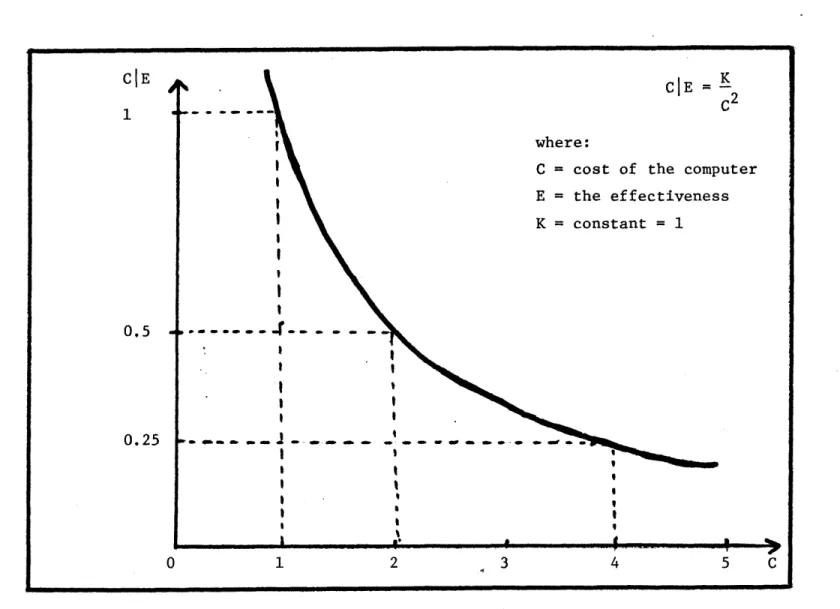
systems. It means that a large computer is more cost effective than a small computer. This conclusion was derived from "Grosch's Law" (4), which states that "the performance of a computer increases as the square of its cost," as shown in Figure 2. There were several reasons which justified the economy of scale. First of all, decentralized small
computers may have unused capacity. Centralization on a large computer could eliminate such costs. In addition, individual small computers may be overloaded, generating pressure for upgrading equipment or purchasing expensive service bureau time. Centralization on a large computer could absorb this overload. While the arguments above can be valid for a part-icular centralized systems, many researchers and practitioners have
questioned the validity of "Grosch's Law." *They argue that "Grosch's Law" was valid during the 1950's and the 1960's when the CPU cluster was the dominant element in a computer. Today a dramatic change has
occurred in the sense that the cost of the CPU is less than 40 percent of the total cost. Another argument used against "Grosch's Law" is the
fact that the latter assumes that the power of a computer is proportional to its price. This is a very simplistic assumption, especially when one considers the structure of a machine, the variety of channels and their speeds, and the characteristics of secondary storages. Studies which invalidate "Grosch's Law" can be found in Littrel (6), Reynolds (7), and Lussato, et al. (8). These authots mainly argue that with the con-tinuous reduction of hardware costs (20 percent yearly), the economy
*
CIE
CIE
K
C2 where:
C = cost of the computer
E = the effectiveness
K = constant =1
0.5 .+- --- -.-.-
-0 2 3 4 5 C
of scale is becoming less and less important. The increasing amount of data being transferred between the central node and the dispersed users joined to the stability of communication costs are changing the shape of the economies of scale curve. Finally, the overhead associated with very large computers and the potential for under-utilizing the capacity of a large centralized computer combine to diminish the validity of
"Grosch's Law."
. An argument related to the concept of economies of scale and used in favor of centralized systems is the one stating that in terms of floor space, electricity, air conditioning and other facility costs, a single large installation is less costly than multiple smaller installa-tions. Although this argument may still be valid, the changing technology of minicomputers and the intrusion of microcomputers can lead to a less important economy of scale. In fact, some minicomputers when used in distributed systems and most of the microcomputers do not need important
facilities, and can use only very limited floor space, electricity and other facilities. An additional argument related to the economy of scale
and used to justify centralization is the following: "The number of support personnel is lower for a large installation than for multiple small installations." This argument is true if one assumes that the complexity of minicomputers and microcomputers is as big as the complex-ity of large systems. In fact, mini and micro computers are fairly easy to operate (8). Besides, the development of new concepts like decision support systems (9), where systems are being tailored to the particular requirements of managers, favors the reduction of support and special-ized personnel.
In summary, the advances in the computer technology and the
development of new concepts reduce the importance of economies of scale, therefore clearing the way for distributed systems.
B. Sophistication of Applications
To justify the centralization of information systems, other
arguments besides the economy of scale have been used. An important one is related to the sophistication of applications. In other words, there may exist certain applications which need high internal speed, great
storage capacity and specialized personnel. These kinds of applications are not feasible in smaller installations. Some examples may include scientific computation, database management systems, and the access to hierarchically structured files for manufacturing systems. In such cases, the application would justify the larger computer, which would, in turn, justify the elimination of smaller computers in the organization in order to utilize the excess capacity of the large machine. The logic behind this type of argument is that decentralized systems are incapable of pro-viding this service. A careful investigation of the capabilities of mini computers can show that: "like the mainframes, minis provide high performance processing, data and file handling capabilities, large amounts of on-line main storage, and high level languages like COBOL, RPG, and BASIC." (10)
The argument about database systems and hierarchical files is not valid anymore since the concepts of distributed files and distributed databases systems has shown to be viable and efficient. (11.) In fact,
the degree of sophistication of applications does not depend entirely on the equipment used.
C. Quality of Systems Development
This is the third major argument used to justify centralized systems. The latter are said to establish and enforce systems documen-tation standards, to regulate standards for user documendocumen-tation, to avoid redundant development of similar systems for different divisions of organization, and to allow an evaluation of projects from an overall organization perspective.
Although from a theoretical point of view, these advantages can be achieved, in reality, the huge centralized systems lead to an enormous complexity (12). This complexity is due to the necessity of handling large volumes of batch work. The resulting consequence can be a system failure or some difficulties to maintain a coherent system standard.
A related factor which has been argued in favor of centralization is the substantial difference between the abilities of large and small installations to attract and retain highly qualified technical personnel. It is argued that the smaller installation will frequently suffer a
higher turnover rate as talented individuals outgrow the opportunities available. The retention of highly qualified personnel provided the centralized group with the capability to apply a higher level of ex-pertise to the solution of problems. This personnel can then provide a greater range of alternative solutions to the problems for evaluation
further maintenance of the systems. However, behavioral scientists such as Herzberg (13) and Maslow (14) argue that one of the real factors that can contribute to attract highly
quali-fied personnel is motivation rather than the size of the companies. In decentralized systems, the possibility of being associated to the deci-sion-making process can be a real factor to motivate skilled personnel. Proponents of centralization have argued their case on additional grounds ranging from the benefits of company-wide consolidation of operat-ing results to the ease of control by corporate executives. Many of
these arguments, however, boil down to matters of management style. This adds additional confusion to the issue because styles change as the pendulum of management philosophy swings to and fro. All these and other such arguments have contributed to make a persuasive case for centraliza-tion. Indeed, centralization has been the major trend in EDP systems architecture for the last twenty years. Lately, however, a new and innovative approach to systems architecture has appeared. Distributed processing has bloomed into major prominence as a technique for increasing the efficiency of EDP operations. This is not meant to assert that dis-tributed processing optimally satisfies every organization's EDP needs. As with most technologies, certain tradeoffs must be considered between efficiency and effectiveness.
But, the advent of cost efficient mini and micro computers as well as recent breakthroughs in network technology have clearly added credence to the realities of distributed processing. Let us precisely describe these technology advances and the underlying concepts.
III. Computer Networks: A Survey
A large body of literature has been published on the subject of computer networks. The computer systems section of the Institute of Computer Science and Technology, National Bureau of Standards (15) has published a fully annotated bibliography on the subject. The biblio-graphy consists of references with critical annotations to the litera-ture on computer networks. Instead of duplicating the effort made in the above Institute, we will concentrate on several aspects that were incompletely covered by the bibliography.
The aim of this section is to clarify usage of terminology and to provide an analysis of the characteristics of computernetworks
models. The aspects of networking that will be surveyed are the follow-ing:
- network topologies - communication systems
- networking design principles
A. Network Topologies
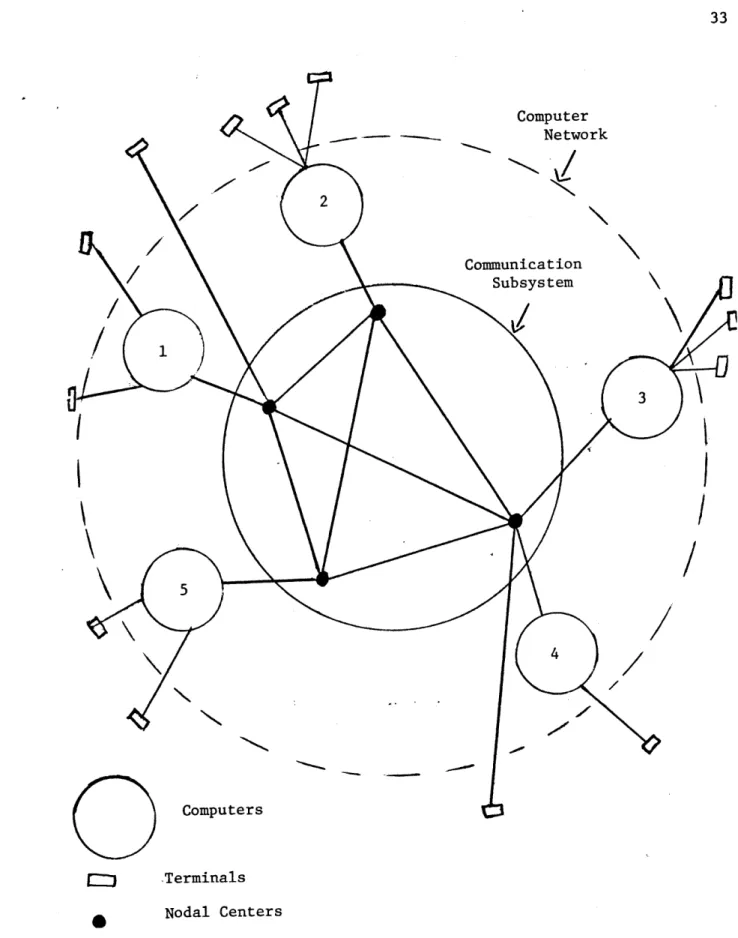
A computer network is composed of several computer systems (called "hosts" following ARPA (16) terminology) connected by a communication network, and used through terminals: terminals can be connected directly
to one of the hosts or to the communication network (17), described in Figure 3.
One of the most important functions of a computer network is to give to each user the possibility of using computing resources in the
Computer Network Communication Subsystem Computers -Terminals Nodal Centers
FIGURE 3. A Communication Computer Network
K
7
-network regardless of their geographical sites (18). By resources we mean CPU's, peripheral devices, program libraries and databases.
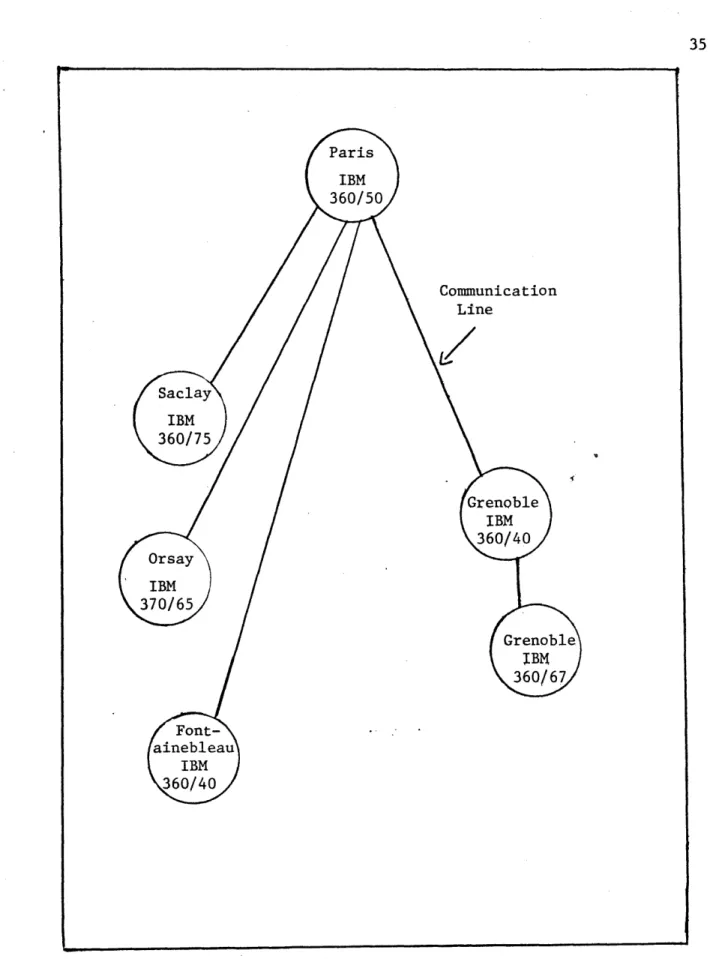
There are two different types of computer networks: homogeneous and heterogeneous. Homogeneous computer networks are made up with the
same brand of machines and operating systems. A typical example is described in Figure 4. It represents the SOC (Systems d'Ordinateurs Connectes) project which is a joint study carried out by IBM France and
the computing centers of four French participants.
Except for internal corporate networks, homogeneous computer net-works are the exception rather than the rule. Most computer netnet-works are heterogeneous since organizations have to start out existing installa-tions. A typical example of heterogeneous networks is described in
Figure 5.
When one looks at the different possibilities of network sharing, there exist three functional forms of computer networks: remote-access networks, value-added networks, and mission-oriented networks (respectively RAN, VAN, MON). Remote-access networks are designed to support interaction between an end user and a given host computer. The service provided by remote-access networks can be divided into two categories: terminal access and remote batch. Examples of such networks are TYMSSHARE (19), and CYBERNET (20). A value-added network does not support interaction between an end user and individual host computers. Instead, it supports communication directly between host computers. Therefore, it includes the possibility of file transfers, purging of remote databases, and geographically dispersed multiprocessing. An example of such added-value
Communication Line
o MP
0 TIP
FIGURE 5, The ARPA Network. A logical map.
Adapted from (78),
network is the ARPA network (16). A mission-oriented network exists when -there is a closer organizational coupling of the host computers and the
subnet providing communication resources. Therefore, the difference between VAN and MON is organizational but not technological.
In fact, a MON is a value-added network in which host computers are under the control of a single administrative organization. Accord-ing to Kimbleton et.al.
C78),
this organizational distinction "permits allocation and control of programs, data, and their interaction within the network thereby maximizing the efficiency of the organizational information processing function."In summary, the distinction between a RAN and a NON is reflected in enhanced technological capabilities, while the difference between a VAN and a MON is primarily organizational.
A variety of network technologies is possible. These topologies can be classified according to the extent to which processing power is distributed among the host computers. There are mainly three basic network topologies (32):
- Centralized network - Decentralized network - Distributed network
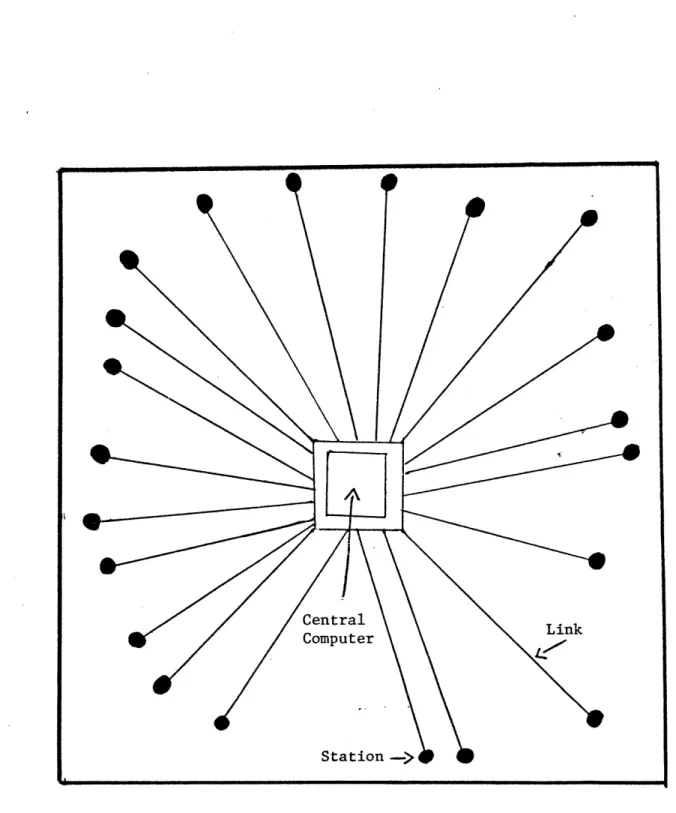
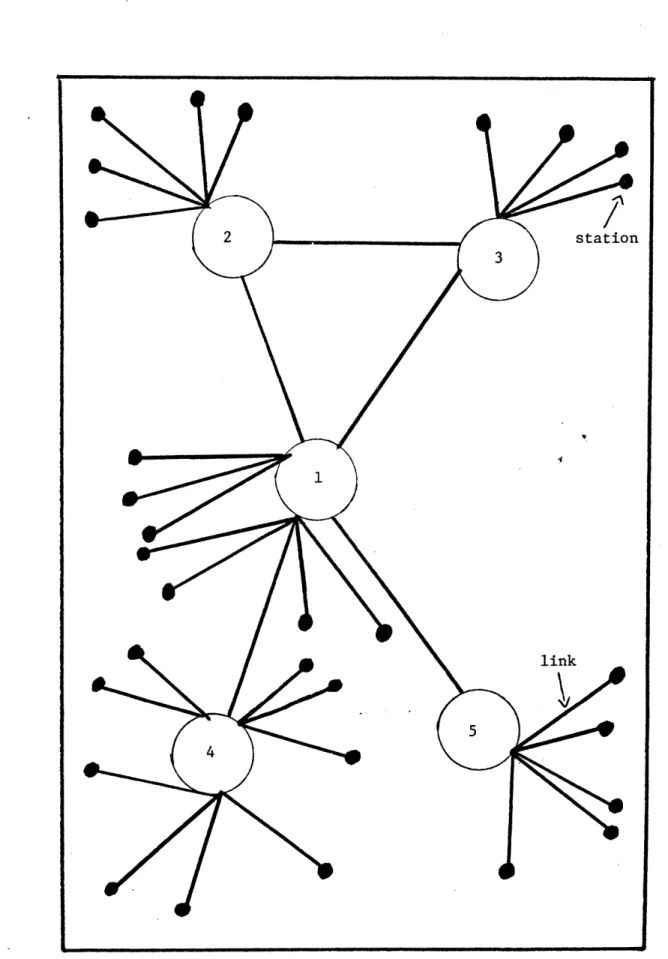
In a centralized network (often called star network), all terminal stations are centrally connected to a central node, and the topology of the network represents a star as depicted in Figure 6. As can be seen, the network is composed of a single host computer which services all users.
Remote-access networks such as TYMSSHARE (19) are typically implemen-ted in this form.
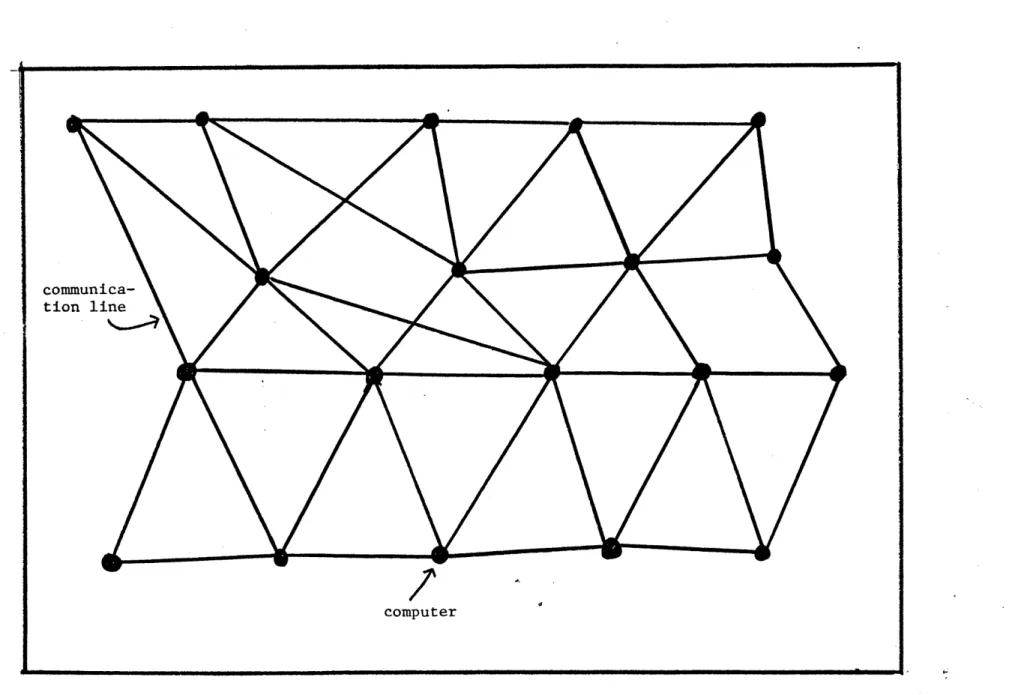
In decentralized networks, there is a topological structure of sets of stars connected in a form of a larger star with an additional link forming a loop. The main characteristic of such a network is that the reliance upon a single point is not always required, as described in Figure 7. In distributed networks, a variety of host computers may be accessed by network users. Subscribers of the networks are served by many switching centers distributed throughout the network. The center
in such networks may be either a multiplexer, concentrator or communica-tion processors associated with the required computer. Figure 8 depicts a typical distributed network. It should be noted that the topologies presented are very general and often used. But, there exist other
topologies which are a sub-variety of those described above.
Bf. Communication Systems
Various techniques may be considered when it comes to setting up some communication systems between computers. At present, there exist three distinct techniques:
1. circuit switching 2. message switching 3. packet switching
The main distinction between these techniques resides in the manner in which resources are allocated in support of communication.
station
link
computer
1. Circuit switching
Circuit switching is the conventional method used in the telephone networks wherein a discrete path is established between a sender and
receiver and the path is held open for the duration of the transmission. The nodes of the network perform only a switching operation between the input lines and the output lines according to the distribution of the messages. Effective utilization of circuit switching requires careful matching of circuit bandwidth against the transmission requirements to
improve this efficiency multiplexing technique [21]. The design for such networks has been studied by Chu [22] and Martin [24].
2. Message switching
In message switching networks, the messages between two nodes are "stored" in a queue at any intermediate node and sent "forward" to the next node on the route only when the channel is free. So, at each node,
there are different pieces, one for each output channel. A description of a major message switching network (AUTODIN) is given by Paoletti [24]. Although it is largely used in computer networks, the message-switching
technique has not been proved to be more convenient than circuit-swit-ing techniques (25). Kleinrock (26) has provided a detailed study of message-switching networks.
3. Packet switching
In packet-switching networks, a message is subdivided into packets with a pre-established maximum size (typically on the order of 1000 bits) prefaced with suitable address information. Single packet mess-ages can then be transmitted with a minimum of delay.
In a packet-switched system:
- Much of the use is interactive, exploiting the rapid response, so the loss of a packet is easily corrected by -he users;
- Storage in the network is kept low to reduce transit delays; - Terminal users are not involved with packet headings and will
usually be unaware of the packet-switching aspect;
- Some of the users of the network are computers with exchange packets with many other terminals, so their connection to the network interweaves packets from several connections.
The packet-switching method was adopted by ARPA in 1968 and is presently used by the CYCLADES [27] network. Some networks, like SITA [28] use a combination of packet and message switching. Analysis of the tradeoffs which must be considered in evaluating circuit, message, and packet switched technologies was made by Miyahara et. al. [29] and Wood [30].
The packet-switching technology seems to make the best use of existing technologies and it can be supported by telephone, radio, or satellite transmission. Besides, it permits simultaneous support of multi-nodal (real-time, interactive and file transfer) traffic.
C. Computer network design principles
The requirement of minimizing the overall cost of a network and of better utilization of the available resources are becoming the prime factors of interest. The design of an optimal computer communication. network covers many elements of which the following will affect the cost and performance of the system: end users, terminals, data sets, communi-cation lines, multiplexers, concentrators, transmission control units, communication processors and computing facility. It is essential for
the network designer to obtain the following design data:
- Geographical location of each terminal or set of terminals, - Amount of data transmitted and received from each geographical
location,
- Required response time,
- Growth rates in terms of number of locations and traffic, - Security restrictions in the selection of terminal types, - Cost limit.
Most of the research considers that the topological allocation of the computers to be connection by the network and the traffic required
be-tween any pair of them are assigned. Therefore, the parameters that are not imposed by the problem are:
- The network topology: the structure of the network connecting the computers.
- Capacity assignment: the choice of the capacity of each link in the network.
- Routing procedure: the decision needs which routes a message from one node to another.
- Queue discipline: the priority rule which determines a message's relative position in the queue.
- Message delay: the total time that a message spends in the network.
- Network cost: the total cost of the system which is given by the sum of channels and terminals cost.
The expression of the problem is generally the following:
A very similar formulation is the following:
It has been shown by Fratta et. al. (31) that the two previous form-ulations are dual one to each other, that is the optimal solution for the first problem is also the optimum for the second problem. Most of the research done in this area takes the above approach (26)' (33) often using different expressions for the objective function and the constraints. Various network designs have been studied in (34), (35), (36). Chang (37)
the constraint related to the topology of the network. His model is formulated as a problem of deciding transaction allocations, routing, processor allocation, and line allocation to satisfy certain performance
requirements. Although more complete than the preceding network design approaches, Chang's model does not fully take into account the issue of distributed database systems and their integration in the overall
design approach. A tentative toward more complete approach was taken by Modiano (38). He studied a simultaneous distribution of computation
power, file allocation, and link capacities. But, his paper ignores the issues of "data sharing" and the routing disciplines.
D. Solutions for the optimum design
In general, a computationally feasible algorithmic solution for determination of the optimum design is not available. This is due to the complexity of the formulation and the large size of the problem. Algorithmic solutions which can guarantee the obtainment of an optimal solution are very often computationally expensive. This may explain why most of the solutions proposed are heuristic. Most of the problems of network design are in fact a multicommodity flow problem. White (39) classified the solutions in two categories:
- decomposition techniques - partitionning techniques
It seems that the decomposition approach leads to a more efficient solution.
Some design problems are unconstrained multicommodity flow problems with non linear costs. A good algorithm to solve this kind of problem
is provided by Cantor and Gerla (40). Their method, called the flow-deviation method, is very similar to the gradient method for functions of continuous variables. But, the concept of gradient is replaced by the concept of shortest route. The application of successive flow deviations can lead to a local minima.
A heuristic that can lead to an acceptable solution was presented by Chou and Frank (34). Other heuristics have been developed especially for the issue of distributed database systems and will be surveyed later on. Kleitman and Claus (41) and Chang (37) developed different heuristics to determine the network topology. Some solution approaches have been
presented by Frank (42), (43), (44).
A comparison of network topology optimization algorithms is provided by Whitney (45). He compares the following five algorithms: minimal spanning tree (46), constrained minimal spanning tree (47), sectoring (47), reversed CMST (46), and steepest ascent hill climbing (48).
The five procedures have been uniformly coded and applied to a variety of test configurations. The results show that the steepest ascent hill climbing procedure is better than the other algorithms. De Backer (49) compared the following four algorithms used in the design of centralized networks: Kruskal (50), Prim (51), Esaul William (52), and Vam (53). He found that the Vam's algorithm generates the best solution.
Most of the algorithms described in this section have a common characteristic: they are heuristic methods. The main advantage is that they generate "acceptable solutions" in a very small computing time. But, these procedures, when applied in real life situations (like, for a corporation, decentralizing their information systems), lead to very
costly suboptimal solutions.
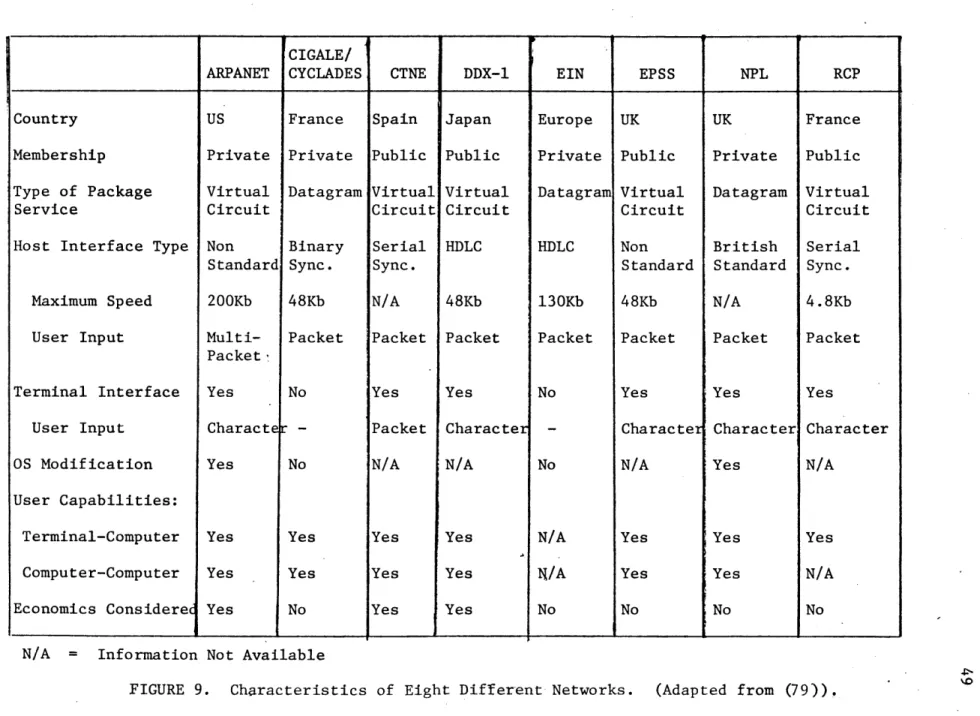
Before ending this review on computer networks, let us give some examples of private and public networks. Figure 9 describes eight different networks and some of their characteristics. The reader should be aware that these networks represent only a few examples of existing networks.
Finally, there are only a few indications for the amount of expenses to realize a computer network. As far as networks were constructed
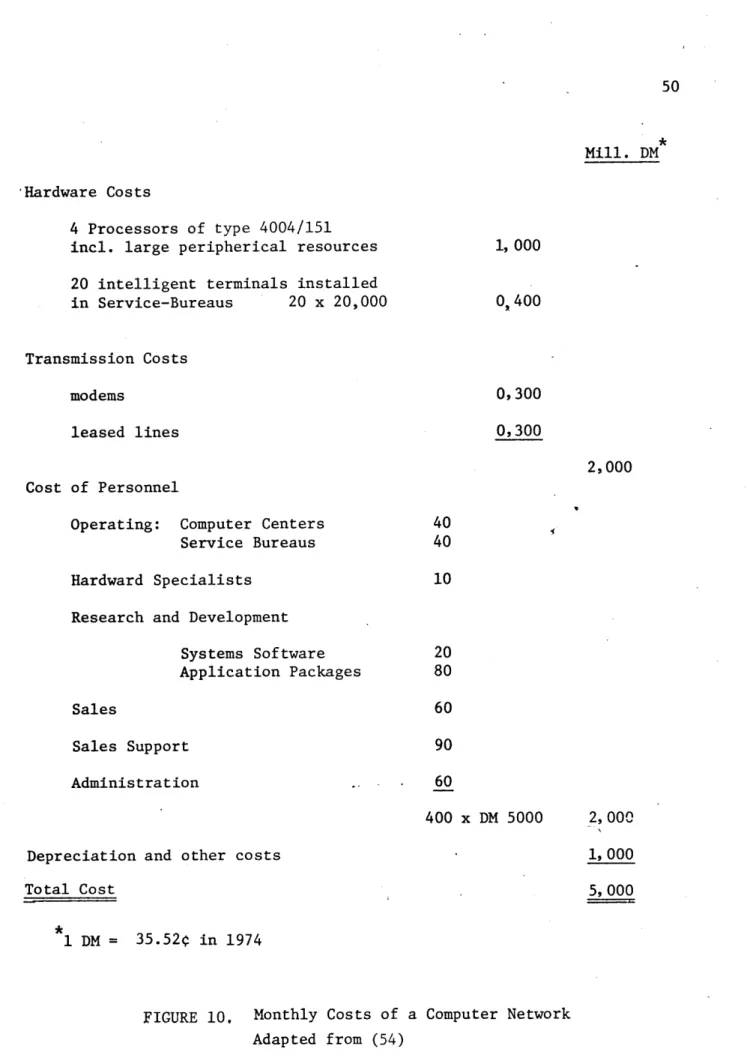
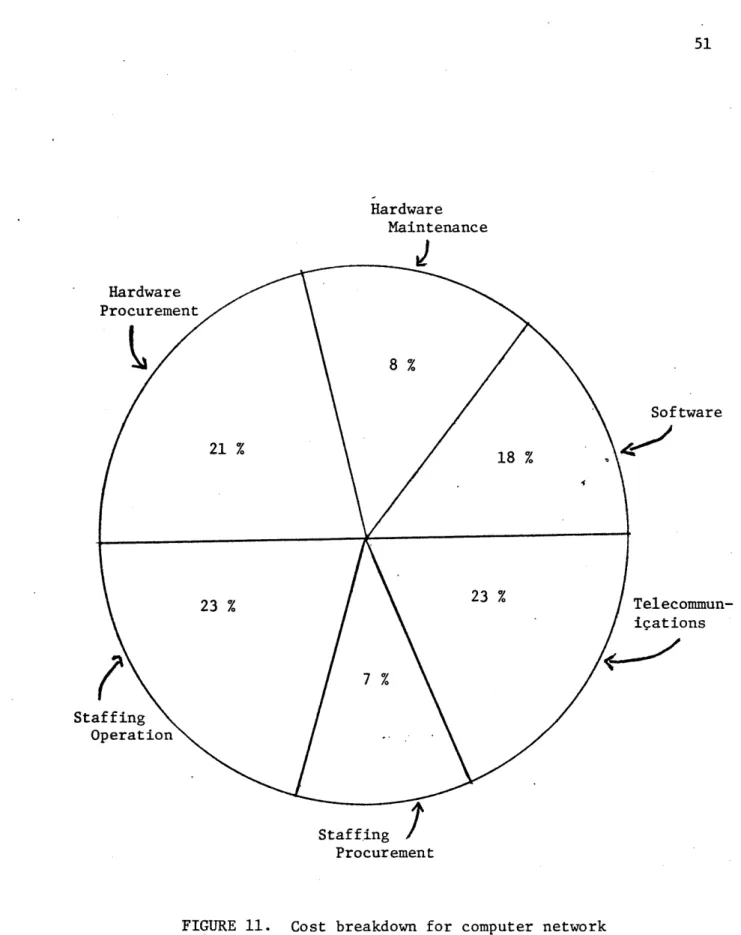
and built up in scientific institutions, it is not possible to givfe an analysis of investment costs. The reasons are due to the fact that activities of scientific institutions are sponsored by government and industrial foundations. The people involved in such a project must not earn their salaries out of the returns of the network. However, we can evaluate an approximate cost of a computer network. Kreuzberger (54) summarized the monthly costs of the Infonet computer network. His evaluation is given in Figure 10. Hughes and Mann (55) give their breakdown of total cost in Figure 11. The benefit (in terms of hard dollars) that can be obtained through the use of a computer network is very difficult to evaluate.
For the ARPA network, several contracters were making substantial use of the network for a majority of their computing resources. Several of the computing centers on the network had grown to become substantial
suppliers of computer service. At that time, an accounting was made of the total computer usage obtained through the network, and an estimate was made for each user of the cost of purchasing comparable time on
Country Membership Type of Package
Service
Host Interface Type
Maximum Speed User Input Terminal Interface User Input OS Modification User Capabilities: Terminal-Computer Computer-Computer Economics Considered
CIGALE/
ARPANET I CYCLADES CTNE DDX-1 EIN EPSS NPL RCP
US Private Virtual Circuit Non Standard 200Kb Multi-Packet Yes Characte Yes Yes Yes Yes France Private Datagram Binary Sync. 48Kb Packet No No Yes Yes No Spain Public Virtual Circuit Serial Sync. N/A Packet Yes Packet N/A Yes Yes Yes Japan Public Virtual Circuit HDLC 48Kb Packet Yes Character N/A Yes Yes Yes Europe Private Datagram HDLC 130Kb Packet No No N/A N/A No UK Public Virtual Circuit Non Standard 48Kb Packet Yes Character N/A Yes Yes No UK Private Datagram. British Standard N/A Packet Yes Character Yes Yes Yes No France Public Virtual Circuit Serial Sync. 4.8Kb Packet Yes Character N/A Yes N/A No
N/A = Information Not Available
*
Mill. DM Hardware Costs
4 Processors of type 4004/151 incl. large peripherical resources 20 intelligent terminals installed in Service-Bureaus 20 x 20,000 Transmission Costs modems leased lines 1, 000 OA400 0,300 0,300 Cost of Personnel
Operating: Computer Centers 40
Service Bureaus 40
Hardward Specialists 10
Research and Development
Systems Software 20 Application Packages 80 Sales 60 Sales Support 90 Administration 60 400 x DM 5000 Depreciation and other costs
Total Cost
*
1 DM = 35.520 in 1974
FIGURE 10. Monthly Costs of a Computer Network Adapted from (54)
2,000
2, 000
1,000 5, 000
Hardware Maintenance
Staffing / Procurement
FIGURE 11. Cost breakdown for computer network Adapted from (55)
52 do the same job apparently being done through the network. Roberts (56) tabulated this information by user organization, identifying both the cost of computing with and without the network. His results are re-ported in Figure 12. Additional studies in economics of computer net-works can be found in (57) and (58).
In summary, and as is apparent, the computer network design pro-blem is a very rich one and has not been solved in all its generality. Especially, the closely related issue of distributed database systems has not been adequately taken into account in most of the models sur-veyed. This is due to the fact that the viability of distributed
database systems has not been emerging until very recently. The purpose of the following section is precisely to describe the main
character-istics of distributed database systems and past approaches taken to design such systems.
IV. Distributed Database Systems: An Overview
A. Introduction
One important and valuable feature of distributed processing is the distributed database application. There are two aspects of distributed database systems:
1. The distribution of data base management (i.e., the control and manipulation of data)
2. The distribution of the content of the database (i.e., the data itself)
User Organization Remote Usage, in Activity thousands Projected Cost for Local Re-placement, in thousands University of Illinois
NASA Ames Research Center
Rand Corporation
Mass. Computer Associates Lawrence Livermore Laboratory Stanford University
Rome Air Development Center
ARPA
seismic Array Analysis Center Mitre Corporation
National Bureau of Standards Bolt Beranek and Newman Inc. Xerox Palo Alto Research Center University of Southern California
Image Processing Lab
University of Califonria, Los Angeles Systems Control, Inc.
University of California, Santa Barbara
US Air Force Range Measurements Lab
Institute for the Future Miscellaneous
Parallel processing research Air foil design and ILLIAC
Numerical climate modeling ILLIAC IV compiler development
TENSOR code on ILLIAC
Artificial intelligence research Text manipulation and resource
evaluation
On-line management Seismic data processing
Distributed file network research Network research
TENEX system support
Computer science research Picture processing research Network measurement
Signal processing research Network research
ARPANET management
Teleconferencing research Computer research
Annual remote computer usage cost is based on March 1973 data.
FIGURE 12. Cost of computing with and without the ARPA network.
$
360
328 210 151 94 91 81 77 76 60 58 55 47 $1,100 570 650 470 370 180 450 370 300 240 200 80 100 22 17 13 192 70 60 40 580 Total $2,018 $6,060 (Adapted from (56))54 The need for data sharing shows up in many application areas, such as:
- on-line banking - order entry - retail sales
- reservation systems
The suggested need f'or data sharing between computers is found in large geographically distributed organizations. This is especially true when the data is processed locally but there also exists frequent exchange of information between sites.
Chandra (59) defines a distributed data base as "a logical inte-gration of several related databases localized in individual icomputing facilities." He made a distinction between homogeneous distributed data-bases and heterogeneous distributed datadata-bases. A homogeneous distributed
data base is composed of several databases having the same DBMS. For example, several IMS databases residing on a network form an homogeneous distributed database. (See Figure 13). An heterogeneous distributed database is composed of several different DBMS. An example is depicted in Figure 14.
Mullery (60) discusses in detail many of the problems that must be solved before such distributed databases can become viable in organiza-tions.
B. Classification of distributed databases
Aschim (61) proposes the following classifications:
1. Classification according to geographical location of sites and directories.
database
= Information Management System (IBM's DBMS)
FIGURE 13. A homogeneous distributed database system
IMS
communication
line i
computer
database