Open Access
Peer-Reviewed
RESEARCH ARTICLE
Cite as:Suchéras-Marx B, Giraud F, Simionovici A, Tucoulou R, and Daniel I (2020). Evidence of high Sr/Ca in a Middle Jurassic murolith coccolith species.
PaleorXiv, dcfuq, version 7, peer-reviewed by PCI Paleo. DOI: 10.31233/osf.io/dcfuq
Published:20 October 2020
Recommender: Antonino Briguglio
Reviewers:
Kenneth De Baets and an anonymous reviewer
Correspondence: [email protected]
Open Data
Open Peer Review
© 2020 Author(s) CC-BY 4.0
This work is licensed under the Creative Commons Attribution 4.0 International License.
Evidence of high Sr/Ca in a Middle Jurassic
murolith coccolith species
Baptiste Suchéras-Marx
1, Fabienne Giraud
2,3, Alexandre Simionovici
2,3,*, Rémi
Tucoulou
4, & Isabelle Daniel
51Aix-Marseille Université, CNRS, IRD, Collège de France, CEREGE UM34 – Aix-en-Provence, France 2Université Grenoble-Alpes, ISTerre – Grenoble, France
3CNRS, ISTerre – Grenoble, France
4ESRF – The European Synchrotron Radiation Facility – Grenoble, France
5UMR CNRS 5276 LGL, Université Claude Bernard Lyon 1, Ecole Normale Supérieure de Lyon – Villeurbanne, France *Institut Universitaire de France (IUF)
THIS ARTICLE HAS BEEN PEER-REVIEWED BY PCI PALEO
Read the Editor’s recommendation and Referees’ reports at DOI:10.24072/pci.paleo.100006
Abstract
Paleoceanographical reconstructions are often based on microfossil geochemical analyses. Coccoliths are the most ancient, abundant and continuous record of pelagic photic zone calcite producer organisms. Hence, they could be valuable substrates for geochemically based paleoenvironmental reconstructions but only Sr/Ca is exploited even if it remains poorly understood. For example, some murolith coccoliths species have very high Sr/Ca compared to the common 1-4 mmol/mol recorded in placolith coccoliths. In this study, we analyzed the elemental composition of the Middle Jurassic murolith Crepidolithus crassus by synchrotron-based nanoXRF (X-ray Fluorescence Spectroscopy) mapping focusing on Sr/Ca and compared the record to two placolith species, namely Watznaueria contracta and Discorhabdus striatus. In C. crassus, Sr/Ca is more than ten times higher than in both placoliths and seems higher in the proximal cycle. By comparison with the placoliths analyzed in the same analytical set-up and from the same sample, we exclude the impact of the diagenesis and seawater Sr/Ca to explain the high Sr/Ca in C. crassus. Based on comparisons to Pontosphaera discopora and Scyphosphaera
apsteiniiwhich also have high Sr/Ca, it seems more likely that high Sr/Ca in C. crassus is either due to the vertical elongation of the R-units of the proximal cycle or related to the action of the special polysaccharide controlling the growth of those vertically elongated R-units that may have affinities to Sr2+. In order to apply the Sr/Ca proxy to muroliths, further investigations are needed on cultured coccoliths.
Introduction
Paleoceanography partly relies on the application of geochemical proxies – i.e. chemical changes of fos-sils or sediments composition induced by chemical, physical or biological parameters changing through time. Many geochemical proxies are based on elemental ratios in planktic or benthic foraminifera e.g. Mg/Ca (temperature;Elderfield and Ganssen, 2000), B/Ca (pH,Yu et al., 2007), U/Ca (carbonate satura-tion,Raitzsch et al., 2011), Cd/Ca (paleonutrient,Rickaby and Elderfield, 1999). Conversely, calcareous nannofossils – the micrometric platelets called coccoliths produced by the photosynthetic unicellular al-gae called coccolithophores and other micrometric calcite incertae sedis – are rarely used for geochem-istry in paleoceanography. The rarity of nannofossil-based geochemical paleoproxies is linked to the very small size of calcareous nannofossils – i.e.
∼
1-15µ
m – increasing the difficulty to isolate them from the rest of the sediment (Stoll and Ziveri, 2002;Minoletti et al., 2009;Stoll and Shimizu, 2009; Suchéras-Marx et al., 2016b). The only proxy commonly based on the calcareous nannofossil chemical composition is the Sr/Ca ratio used as a paleoproductivity proxy (Stoll and Schrag, 2000).The most important factors influencing Sr/Ca ratios in biogenic carbonates is outlined inUllmann et al. (2013)and are: i) the composition of the liquid from which they are precipitated (
∼
8 mmol/mol for modern oceans according toLebrato et al., 2020;∼
5 mmol/mol for the Middle Jurassic according toUllmann et al., 2013); ii) the calcium carbonate polymorph; iii) the species specific fractionation of the Sr/Ca ratio; iv) metabolic controls on this fractionation factor; and v) water temperature. The Sr/Ca ratio in calcareous nannofossils is a relative proxy which has no quantitative calibration. The process underlying the positive relation between Sr/Ca and productivity stands on the observation that more Sr is incorporated in calcite with high calcification rates which positively correlates with high cell physiological rates. This proxy is also species-dependent or, at least, group-dependent (Stoll and Ziveri, 2004). The latter is discussed, the species-dependency may be related to different calcification physiologies (Payne et al., 2008;Suchéras-Marx et al., 2016a) or to different partitioning coefficients in relation to different ultrastructure organizations and more precisely between V- and R- crystals in coccoliths (Young et al., 1992) theoretically possible (Paquette and Reeder, 1995) but still not observed (Stoll and Ziveri, 2004).Recently, analyses on the cultured murolith Scyphosphaera apsteinii showed Sr/Ca
∼
22 mmol/mol, an order of magnitude higher than the common∼
1-4 mmol/mol measured in placoliths such asGephyro-capsa oceanica, Gephyrocapsa huxleyi, Calcidiscus leptoporus, Coccolithus pelagicus or Helicosphaera carteri (Stoll et al., 2007;Hermoso et al., 2017).Hermoso et al. (2017)also highlight observations of high Sr/Ca in fossil muroliths Pontosphaera (Pliocene) and Crepidolithus (Lower Jurassic) but points out that
Scyphos-phaera, Pontosphaera and Crepidolithus have different crystal organizations and growth directions and thus crystal organization cannot explain murolith high Sr/Ca.
The present study aims to map Sr and Ca in Crepidolithus crassus and to compare the calculated Sr/Ca with the crystal growth directions in order to explain the murolith Sr anomaly. This study will discuss then the range of applicability and limitation of the Sr/Ca proxy in coccoliths.
Material and methods
Material
The coccolith analyzed in this study comes from sample CM35, a marlstone from the lower Bajocian (Middle Jurassic) of Cabo Mondego (Portugal; section inSuchéras-Marx et al., 2012). This section was selected because it is the Aalenian-Bajocian boundary GSSP (Pavia and Enay, 1997). A total of three coccoliths from three different species were studied, namely the murolith Crepidolithus crassus and two placoliths Discorhabdus striatus and Watznaueria contracta.
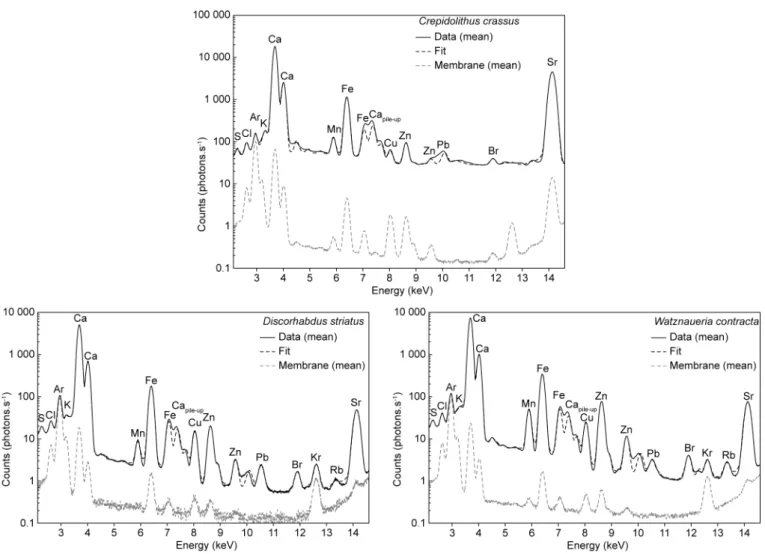
Figure 1. Mean XRF spectra of C. crassus, D. striatus and W. contracta coccoliths and associated membrane spectra.Capile-upcorresponds to the quantification of two Ca energy summed arriving at the same time in the captor. Ar is the same in coccolith and membrane because it corresponds to the air in the experimental hutch. In the three coccoliths, membrane contribution in Ca, Fe, Cu and Zn and in Sr in C. crassus is observed. However, it is always two order of magnitude below the concentration in the coccolith thus membrane contribution represents less than 1% in those elements.
Sample preparation
The three coccoliths were picked usingSuchéras-Marx et al. (2016b)protocol which consists in a hand-picking procedure. Rock powder is smeared on a cover slide in order to isolate particles from each other. Coccoliths are then observed with an optical microscope Leica DM750P with a x200 magnification (x20 dry objective) under cross-polarized light. Coccoliths are identified with a x400 magnification (x40 dry objec-tive) and a
λ
/4 gypsum filter may be used if further optical criteria of recognition are needed. Once picked, each coccolith is mounted on 500 nm-thick silicon nitride (Si3N4) TEM windows (Silson Ltd. Southam, UK) using a drop of ethanol to detach the coccolith from the needle. No other chemical or physical treatment were made.NanoXRF 17 keV mapping at ID22NI
The XRF analyses were performed at beamline ID22NI (currently ID16b) at the European Synchrotron Radiation Facility (ESRF), Grenoble, France. All three coccoliths were analyzed at an incident X-ray beam energy of 17 keV to ensure the measure of Sr (K
α
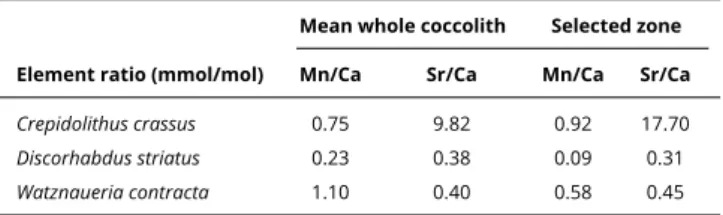
= 14.165 keV). The beam spot was focused by an ESRF custom-made Kirkpatrick-Baez double multilayer mirror device to a 100 nm x 100 nm size. Each spot wasTable 1.Mn/Ca and Sr/Ca ratios.Mn/Ca and Sr/Ca (mmol/mol) of whole coccoliths of C. crassus, D. striatus and W.
contractaor a selected region (seeSupplementary Figure S2), depleted in Mn and Fe.
Mean whole coccolith Selected zone Element ratio (mmol/mol) Mn/Ca Sr/Ca Mn/Ca Sr/Ca
Crepidolithus crassus 0.75 9.82 0.92 17.70
Discorhabdus striatus 0.23 0.38 0.09 0.31
Watznaueria contracta 1.10 0.40 0.58 0.45
analyzed for 2 s. The detectors were high-count rate twin SII™vortex SDD (silicon drift diode) detectors, capable of counting up to 200 kcps with no saturation and no peak shift or FWHM broadening, when operated below 10% dead time. The sample is orthogonal to the incident beam and the detector is placed at a 15° angle relative to the sample surface. The three coccoliths were mapped. Each pixel corresponds to a spot of analysis and spots are adjacent providing a full map of each coccolith. Crepidolithus crassus map is 136 x 120 pixels large, D. striatus is 60 x 34 pixels large and W. contracta map is 100 x 74 pixels large. The XRF analysis being penetrative, the element counting sum up the membrane, the coccolith and the air surrounding the coccolith. The contribution of the air is negligible, and the contribution of the membranes are estimated inFigure 1based on quantification in zones without the coccolith in the maps. All calculations were made using PyMCA 5.1.1. (Solé et al., 2007). This beam line set-up, analysis procedure and calculation fit are the same as inSuchéras-Marx et al. (2016a).
Results
XRF spectrum
The three spectra shown inFigure 1represent the mean spectrum for each coccolith. Because XRF anal-ysis is penetrative, the spectra also record the membrane holding the coccolith and thus the spectrum of zones with only the membrane is also presented. The fit presented for each spectrum is the modeled reconstruction used for the calculation and the map reconstruction (cps and mmol/mol). In D. striatus and W. contracta, 14 elements are recorded namely: S, Cl, Ar, K, Ca, Mn, Fe, Cu, Zn, Br, Kr, Rb, Sr and Pb whereas in C. crassus only 12 are recorded (same elements except Kr and Rb) (Fig. 1). The rare gases Ar and Kr are present in the air in the experimental hutch. The contribution of the membrane is lower than 1% for Ca and Sr and thus is negligible for the Sr/Ca calculation. Nevertheless, membrane contribution was excluded inTable 1. Those results are similar to already published for W. britannica and D. striatus (Suchéras-Marx et al., 2016a, 2020).
Element and ratio maps
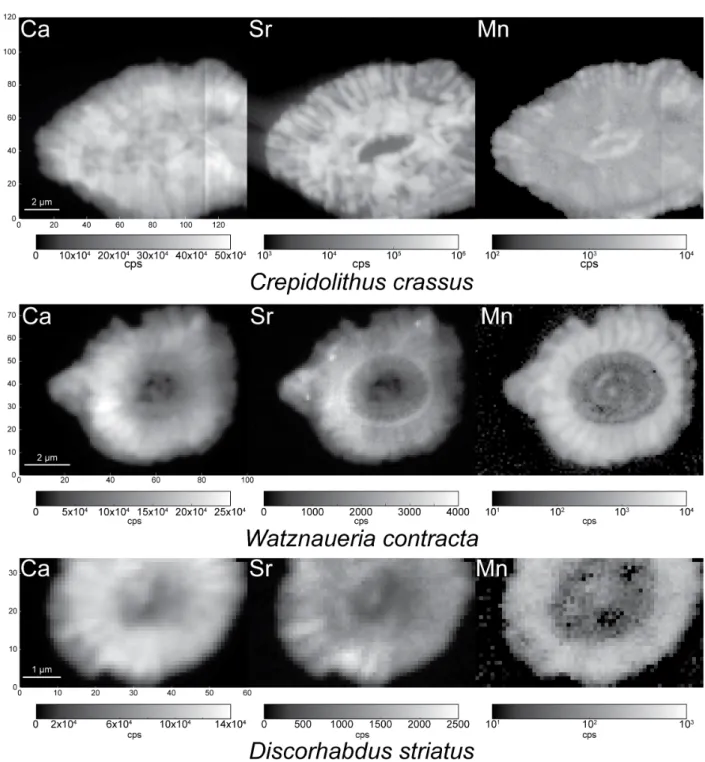
For the three coccoliths, element maps of Ca, Mn and Sr are presented inFigure 2(cps) and the three maps together in color inSupplementary Figure S1. Direct comparison of Ca and Sr is possible in both placoliths whereas Mn is quite different although crystal organization is also observed in this element map. In W. contracta, the Ca maps are precise enough to recognize the shield crystal orientations, espe-cially the outer radial growth from the tube ring. The tube structures are difficult to recognize but still, crystals can be seen in the rim around the central area. In the Sr map of the same species, the outer rim with radial crystals of the shields are easily observed too. A ring with slightly more Sr marks a boundary between the outer rim and the inner rim structures. These inner rim structures are composed of two concentric rings of crystal assemblages. The outermost one may correspond to the mid tube elements
Figure 2.Ca, Sr and Mn maps (cps) of C. crassus, D. striatus and W. contracta.
whereas the innermost one may correspond to the inner tube elements. The mid tube elements form a clear rim whereas one shield crystal assemblage is nicely depicted in the Mn map (Suchéras-Marx et al., 2016a). In D. striatus, the Sr seems less abundant in the tube units in comparison to the shield elements. For the same species, the Mn is scarce in the central area and the tube structures but more abundant in the shields.
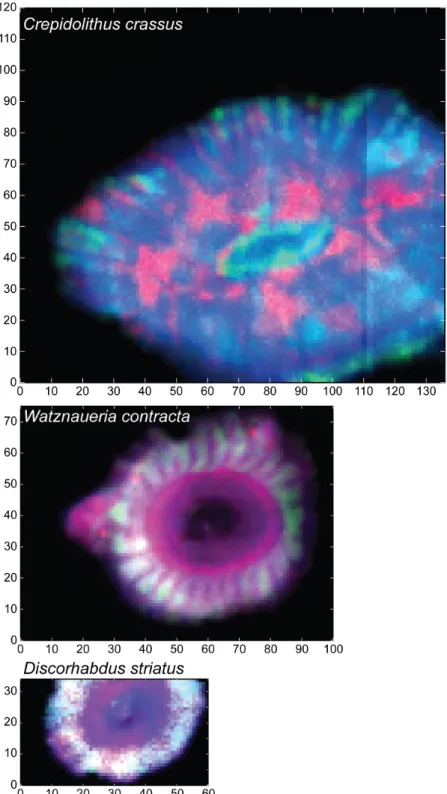
Conversely to the placoliths, in C. crassus, the Ca and Sr maps are slightly different. In Sr maps, the central area is easily visible. Around the central area, an inner concentric rim of more abundant Sr is observed. A concentric outer rim up to the lateral border is observed with Sr concentrated in radial rays. In the Ca map, the outer rim is also observed in radial structures but the inner rim is distinguished from
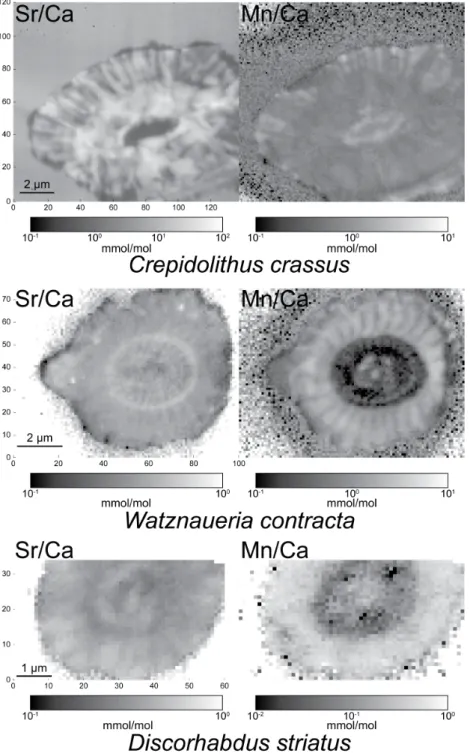
Figure 3.Sr/Ca and Mn/Ca maps (mmol/mol) of C. crassus, D. striatus and W. contracta.
the outer only by a discontinuity. Finally, another discontinuity separates the central area from the inner rim.
For all species, the Sr/Ca maps have the same patterns as Sr and similarly, the Mn/Ca maps have the same patterns as Mn (Fig. 3). In C. crassus then, the Sr/Ca is higher in a ring around the central area and in radially oriented crystals in the outer ring. In the most concentrated area, the Sr/Ca ranges between 10 and 100 mmol/mol and tends to be two orders of magnitude higher than in W. contracta and D. striatus. Finally, the area with higher Sr/Ca is neither enriched nor depleted in Mn/Ca.
Discussion
A previous study already discussed the Sr/Ca signal in Watznaueria (Suchéras-Marx et al., 2016a), discus-sion that likely applies to Discorhabdus. The presence of other elements such as Cl, Fe or Zn will not be discussed here to focus on Sr/Ca. Nevertheless, according toSuchéras-Marx et al. (2016a)Cl and S may be incorporated in the coccolith during coccolithogenesis whereas K, Fe, Cu, Zn, Br and Rb are incorpo-rated during diagenesis or are contaminant from clays. Recently,Bottini et al. (2020)studied coccolith from controlled cultures confirmed that V, Fe, Ni, Zn and Pb are not incorporated in coccolith calcite ; they also proposed that Cl is a contaminant from seawater not present in the coccolith crystal composition. Finally, the presence of Mn is related to overgrowth and diagenesis in both Watznaueria and Discorhabdus (Suchéras-Marx et al., 2016a, 2020). The three coccoliths are coming from the same sample and were analyzed with the same set-up, thus the very high Sr/Ca in C. crassus compared to W. contracta and D.
striatusis not related to analytical biases and to seawater Sr/Ca. Moreover, the Sr-rich rim in C. crassus is not enriched in Mn and thus the high Sr/Ca in C. crassus is not related to diagenesis. Finally, the calculated Sr/Ca for the lower Bajocian seawater ranges between 4 mmol/mol and 6.8 mmol/mol (Ullmann et al., 2013) below most modern oceanic environments (Lebrato et al., 2020) and thus cannot explain the high Sr/Ca in C. crassus. This result is coherent with a previous study observing that diagenesis tends to lower Sr/Ca in calcareous nannofossils (Dedert et al., 2014) as Sr concentrations are relatively high in seawater and are low in diagenetic fluids (Veizer, 1974;James and Jones, 2015).
The Sr anomaly in C. crassus is then related to either: i) an ion pump concentrating the Sr2+inside the cell to higher concentrations than other species; ii) the use of a polysaccharide that tends to increase Sr/Ca in comparison to other species; or iii) the crystal organization and growth directions which are controlled by the cell but the high concentration in Sr would then be a by-product of the coccolith con-struction. Obviously, C. crassus being a fossil occurring only during the Jurassic, the cell biology of the species cannot be explored. Nevertheless, this species is a large murolith like the extant Pontosphaera
discoporaand has a similar shape to the extant Scyphosphaera apsteinii’s lopadolith, both having also higher Sr/Ca than the common placolith signature of 1-4 mmol/mol (Hermoso et al., 2017).
The first two hypotheses (i.e. Sr2+ion pump or special polysaccharide) could be that high Sr/Ca is inherited in descendant species from C. crassus. Both Pontosphaera and Scyphosphaera are very closely related in the coccolithophore phylogeny (family Pontosphaeraceae;De Vargas et al., 2007). Crepidolithus is within the family Chiastozygaceae, whose position is unknown, but could be the ancestor of the family Zygodiscaceae and its descendants, the families Pontosphaeraceae and Helicosphaeraceae (Bown and Young, 1998). Thus, the high Sr/Ca in both Pontosphaera and Scyphosphaera could be an ancestral char-acter inherited from Crepidolithus. This hypothesis may be challenged by Helicosphaera carterii which has a Sr/Ca ratio around 2-3 mmol/mol (Stoll and Ziveri, 2004) and is from the family Helicosphaeraceae, the sister group of the family Pontosphaeraceae (Bown and Young, 1998). The low Sr/Ca in H. carterii could then be a derived character in the phylogeny, arguing for a phyletic heritage of Pontosphaera and
Scyphosphaerafrom Crepidolithus or this character is ancestral in the family Helicosphaeraceae and the Sr/Ca is not linked to the phylogeny. The current knowledge on coccolithophore phylogeny and Sr/Ca cannot exclude one or the other solutions, hence a possible ion pump or polysaccharide could have fa-vored the high Sr/Ca in C. crassus. Recently,Meyer et al. (2020)observed that Sr2+and Ca2+fluxes in the coccolith vesicle for coccolithogenesis does not solely govern Sr incorporation in the coccolith speculat-ing than that possible species-specific polysaccharides dedicated to a peculiar coccolith morphology may act in the high Sr/Ca observed in Scyphosphaera.
The last hypothesis relies on the fact that C. crassus, P. discopora and S. apsteinii have the same shape (i.e. murolith and lopadolith) and are very large coccoliths, thus the shape and size may influence the Sr incorporation in coccolith calcite. The large size of those coccoliths cannot be the main reason of high
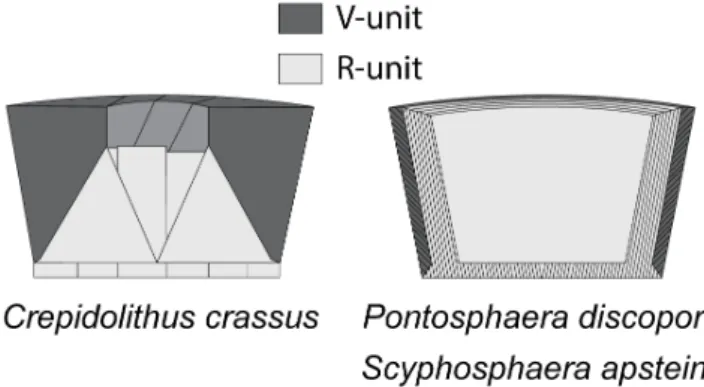
Figure 4. Crystal assembly of Crepidolithus, Pontosphaera and Scyphosphaera. R-units (light grey) and V-units (dark grey), derived fromBown and Young (1998).
Sr/Ca because Coccolithus braarudii, a very large placolith, has Sr/Ca equivalent to very small placoliths (i.e. G. huxleyi;Müller et al., 2011). The basic crystal organization of heterococcoliths is explained by the V/R model which describes the crystal growth in the c-axis whether radially (i.e. R- unit) or vertically (i.e. V-unit) from a primary ring of crystals called protococcolith (Young et al., 1992). In C. crassus, the V-units are more developed than the R-units (Fig. 4), whereas in P. discopora and S. apsteinii V-units represent only the narrow outer part of the rim wall (Young and Bown, 1997;Fig. 4). According toHermoso et al. (2017), the growth of calcite in the same direction as the c-axis should favor Sr2+incorporation but the R-units in P. discopora and S. apsteinii actually grow longer in the vertical axis hence grow orthogonally to the c-axis. In the case of C. crassus, the Sr/Ca is higher around the central area which corresponds to the proximal cycle formed by R-units. Counterintuitively for these three species with thick vertical walls, the Sr is concentrated in the R-units. Surprisingly, C. crassus R-units are, like P. discopora and S. apsteinii, more elongated vertically than radially, thus the growth seems orthogonal to the c-axis (Fig. 4). Then, either the orthogonal to c-axis growth actually favors Sr2+contradictingHermoso et al. (2017)or the biomolecule acting in this growth direction has more affinities with Sr2+than the other polysaccharides.
Conclusion
Despite the very high and continuous fossil record of coccoliths since the Late Triassic, the use of geo-chemical analyses on these calcite platelets for paleoenvironmental reconstructions remain rare. So far, coccolith Sr/Ca is the only coccolith-based geochemical proxy commonly used in paleoceanography. Yet, there are many unknown features about this productivity proxy such as the very high Sr/Ca (i.e. above
∼
10 mmol/mol) in some species namely S. apsteinii, P. discopora and C. crassus. In this study, we com-pared Sr/Ca of C. crassus to contemporaneous placoliths using synchrotron-based nanoXRF and observed that:• C. crassus has higher Sr/Ca than contemporaneous placoliths; • C. crassus Sr/Ca map is different than the Mn/Ca map;
• Sr/Ca in C. crassus is higher in the proximal cycle than in the distal cycle.
Hence, high C. crassus Sr/Ca, is not linked to diagenetic overgrowth or seawater Sr/Ca but may be related to vertical elongation of R-units and/or affinity to Sr2+of the polysaccharide responsible for the growth of those peculiar R-units. The use of murolith’s Sr/Ca in the future may be interesting due to their high values, easier to measure and to the large size of these coccoliths, easier to separate from the bulk placoliths. Nevertheless, in order to apply the Sr/Ca productivity proxy to muroliths in the future,
new culture studies should test the relation between Sr incorporation and growth rate. The study of
Pontosphaeraor Scyphosphaera with 3D nanoXRF will directly link Sr/Ca relative concentration with coc-colith crystal organization and thus would clearly improve the understanding of the Sr anomaly in those coccoliths.
Acknowledgements
We acknowledge the ESRF for providing access to synchrotron radiation on the ID22NI beamline through proposal EC811. We deeply thank the recommender Antonino Briguglio and the reviewer Kenneth De Baets as well as the anonymous reviewer for suggestions that clearly improved the manuscript. BSM is particularly proud to be recommended by PCI Paleo and hope this editorial model will develop in the future. This study is a contribution to the Cerege’s team ‘Climat’.
Additional information
Funding
No funding information.
Competing interests
The authors declare they have no personal or financial conflict of interest relating to the content of this study.
Author contributions
BSM, FG and ID designed the study with later contribution from AS. BSM, FG, ID, AS and RT did the analyses. BSM performed the data treatment with help from AS. BSM wrote the manuscript with comments from all contributors.
Data availability
Data presented in this study are freely accessible on the PANGAEA database: • DOI: 10.1594/PANGAEA.913826
Related data produced with similar material and during the same ESRF experiment (project EC811) are also accessible on PANGAEA:
• DOI: 10.1594/PANGAEA.913813 fromSuchéras-Marx et al. (2016a) • DOI: 10.1594/PANGAEA.913811 fromSuchéras-Marx et al. (2020) • DOI: 10.1594/PANGAEA.914203 (unpublished data)
Supplementary information
• Analyzed data are openly available on PANGAEA (see above) • Supplementary Figures S1–S2appear at the end of this PDF
References
Bottini C, Dapiaggi M, Erba E, Faucher G, and Rotiroti N (2020). High resolution spatial analyses of trace elements in coccoliths reveal new insights into element incorporation in coccolithophore calcite.
Sci-entific Reports10, 9825. doi: 10.1038/s41598-020-66503-x.
Bown PR and Young JR (1998). Introduction. In: Calcareous Nannofossil Biostratigraphy. Ed. by Bown PR. British Micropalaeontological Society Publication Series. Dordrecht: Chapman and Hall (Kluwer Aca-demic Publishers), pp. 1–15. isbn: 978-94-010-6056-1.
De Vargas C, Aubry MP, Probert I, and Young J (2007). Origin and evolution of coccolithophores: from coastal hunters to oceanic farmers. In: Evolution of Primary Producers in the Sea. Ed. by Falkowski PG and Knoll A. San Diego: Academic Press, pp. 251–285. isbn: 978-0-12-370518-1.
Dedert M, Stoll H, Kars S, Young JR, Shimizu N, Kroon D, Lourens L, and Ziveri P (2014). Temporally variable diagenetic overgrowth on deep-sea nannofossil carbonates across Palaeogene hyperthermals and implications for isotopic analyses. Marine Micropaleontology 107, 18–31. doi: 10.1016/j.marmicro. 2013.12.004.
Elderfield H and Ganssen G (2000). Past temperature and
δ
18O of surface ocean waters inferred from foraminiferal Mg/Ca ratios. Nature 405, 442–445. doi: 10.1038/35013033.Hermoso M, Lefeuvre B, Minoletti F, and Rafélis M de (2017). Extreme strontium concentrations reveal specific biomineralization pathways in certain coccolithophores with implications for the Sr/Ca pale-oproductivity proxy. PLOS ONE 12, e0185655. doi: 10.1371/journal.pone.0185655.
James NP and Jones B (2015). Origin of carbonate sedimentary rocks. Chichester: Wiley & Sons, Ltd. isbn: 978-1-118-65267-1.
Lebrato M, Garbe-Schönberg D, Müller MN, Blanco-Ameijeiras S, Feely RA, Lorenzoni L, Molinero JC, Bre-mer K, Jones DOB, Iglesias-Rodriguez D, Greeley D, Lamare MD, Paulmier A, Graco M, Cartes J, Barce-los e Ramos J, Lara A de, Sanchez-Leal R, Jimenez P, Paparazzo FE, Hartman SE, Westernströer U, Küter M, Benavides R, Silva AF da, Bell S, Payne C, Olafsdottir S, Robinson K, Jantunen LM, Korablev A, Webster RJ, Jones EM, Gilg O, Bailly du Bois P, Beldowski J, Ashjian C, Yahia ND, Twining B, Chen XG, Tseng LC, Hwang JS, Dahms HU, and Oschlies A (2020). Global variability in seawater Mg:Ca and Sr:Ca ratios in the modern ocean. Proceedings of the National Academy of Sciences 117, 22281–22292. doi: 10.1073/pnas.1918943117.
Meyer EM, Langer G, Brownlee C, Wheeler GL, and Taylor AR (2020). Sr in coccoliths of Scyphosphaera
apsteinii: Partitioning behavior and role in coccolith morphogenesis. Geochimica et Cosmochimica Acta 285, 41–54. doi: 10.1016/j.gca.2020.06.023.
Minoletti F, Hermoso M, and Gressier V (2009). Separation of sedimentary micron-sized particles for palaeoceanography and calcareous nannoplankton biogeochemistry. Nature Protocols 4, 14–24. doi: 10.1038/nprot.2008.200.
Müller MN, Kısakürek B, Buhl D, Gutperlet R, Kolevica A, Riebesell U, Stoll H, and Eisenhauer A (2011). Re-sponse of the coccolithophores Emiliania huxleyi and Coccolithus braarudii to changing seawater Mg2+ and Ca2+concentrations: Mg/Ca, Sr/Ca ratios and
δ
44/40Ca,δ
26/24Mg of coccolith calcite. Geochimicaet Cosmochimica Acta75, 2088–2102. doi: 10.1016/j.gca.2011.01.035.
Paquette J and Reeder RJ (1995). Relationship between surface structure, growth mechanism, and trace element incorporation in calcite. Geochimica et Cosmochimica Acta 59, 735–749. doi: 10.1016/0016-7037(95)00004-J.
Pavia G and Enay R (1997). Definition of the Aalenian-Bajocian Stage boundary. Episodes 20, 16–22. Payne VE, Rickaby REM, Benning LG, and Shaw S (2008). Calcite crystal growth orientation: implications
for trace metal uptake into coccoliths. Mineralogical Magazine 72, 269–272. doi: 10.1180/minmag. 2008.072.1.269.
Raitzsch M, Kuhnert H, Hathorne EC, Groeneveld J, and Bickert T (2011). U/Ca in benthic foraminifers: A proxy for the deep-sea carbonate saturation. Geochemistry, Geophysics, Geosystems 12, Q06019. doi: 10.1029/2010GC003344.
Rickaby REM and Elderfield H (1999). Planktonic foraminiferal Cd/Ca: Paleonutrients or paleotempera-ture? Paleoceanography 14, 293–303. doi: 10.1029/1999PA900007.
Solé VA, Papillon E, Cotte M, Walter P, and Susini J (2007). A multiplatform code for the analysis of energy-dispersive X-ray fluorescence spectra. Spectrochimica Acta Part B: Atomic Spectroscopy 62, 63–68. doi: 10.1016/j.sab.2006.12.002.
Stoll H, Shimizu N, Arevalos A, Matell N, Banasiak A, and Zeren S (2007). Insights on coccolith chemistry from a new ion probe method for analysis of individually picked coccoliths. Geochemistry, Geophysics,
Geosystems8, Q06020. doi: 10.1029/2006GC001546.
Stoll HM and Schrag DP (2000). Coccolith Sr/Ca as a new indicator of coccolithophorid calcification and growth rate. Geochemistry, Geophysics, Geosystems 1, 1006. doi: 10.1029/1999GC000015.
Stoll HM and Shimizu N (2009). Micropicking of nannofossils in preparation for analysis by secondary ion mass spectrometry. Nature Protocols 4, 1038–1043. doi: 10.1038/nprot.2009.83.
Stoll HM and Ziveri P (2002). Separation of monospecific and restricted coccolith assemblages from sedi-ments using differential settling velocity. Marine Micropaleontology 46, 209–221. doi: 10.1016/S0377-8398(02)00040-3.
Stoll HM and Ziveri P (2004). Coccolithophorid-based geochemical paleoproxies. In: Coccolithophores:
From molecular processes to global impact. Ed. by Thierstein HR and Young JR. Berlin, Heidelberg:
Springer, pp. 529–562. isbn: 978-3-642-06016-8.
Suchéras-Marx B, Giraud F, Simionovici A, Daniel I, and Tucoulou R (2016a). Perspectives on heterococcol-ith geochemical proxies based on high-resolution X-ray fluorescence mapping. Geobiology 14, 390– 403. doi: 10.1111/gbi.12177.
Suchéras-Marx B, Giraud F, Daniel I, Rivard C, Aubry MP, Baumann KH, Beaufort L, Tucoulou R, and Simionovici A (2020). Origin of manganese in nannofossil calcite based on synchrotron nanoXRF and XANES. PaleorXiv, p8cn5. doi: 10.31233/osf.io/p8cn5.
Suchéras-Marx B, Giraud F, Lena A, and Simionovici A (2016b). Picking nannofossils: How and why. Journal
of Micropalaeontology36, 219–221. doi: 10.1144/jmpaleo2016-013.
Suchéras-Marx B, Guihou A, Giraud F, Lécuyer C, Allemand P, Pittet B, and Mattioli E (2012). Impact of the Middle Jurassic diversification of Watznaueria (coccolith-bearing algae) on the carbon cycle and
δ
13C of bulk marine carbonates. Global and Planetary Change 86-87, 92–100. doi: 10.1016/j.gloplacha.2012. 02.007.Ullmann CV, Hesselbo SP, and Korte C (2013). Tectonic forcing of Early to Middle Jurassic seawater Sr/Ca.
Geology41, 1211–1214. doi: 10.1130/G34817.1.
Veizer J (1974). Chemical diagenesis of belemnite shells and possible consequences for paleotemperature determinations. Neues Jahrbuch für Geologie und Paläontologie, Abhandlungen 147, 91–111.
Young JR and Bown PR (1997). Higher classification of calcareous nannofossils. Journal of Nannoplankton
Research19, 15–20.
Young JR, Didymus JM, Brown PR, Prins B, and Mann S (1992). Crystal assembly and phylogenetic evolution in heterococcoliths. Nature 356, 516–518. doi: 10.1038/356516a0.
Yu J, Elderfield H, and Hönisch B (2007). B/Ca in planktonic foraminifera as a proxy for surface seawater pH. Paleoceanography 22, PA2202. doi: 10.1029/2006PA001347.
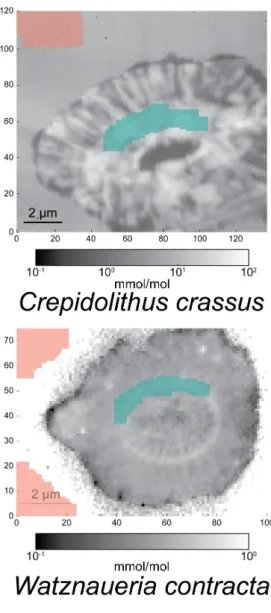
Figure S2.Selected zone (green) and background (red) used for calculations inTable 1over Sr/Ca (mmol/mol) maps for C. crassus, W. contracta and D. striatus.