HAL Id: cea-02509791
https://hal-cea.archives-ouvertes.fr/cea-02509791
Submitted on 17 Mar 2020HAL is a multi-disciplinary open access
archive for the deposit and dissemination of sci-entific research documents, whether they are pub-lished or not. The documents may come from teaching and research institutions in France or abroad, or from public or private research centers.
L’archive ouverte pluridisciplinaire HAL, est destinée au dépôt et à la diffusion de documents scientifiques de niveau recherche, publiés ou non, émanant des établissements d’enseignement et de recherche français ou étrangers, des laboratoires publics ou privés.
Filtration performance test, an innovative lab scale
device for industrial needs
J.-P. Feraud, D. Bourcier, L. Salemi, T. Randriamanenta, D. Ode, E.
Bortolin, D. Chezaud
To cite this version:
J.-P. Feraud, D. Bourcier, L. Salemi, T. Randriamanenta, D. Ode, et al.. Filtration performance test, an innovative lab scale device for industrial needs. WFC 12 - 12th World Filtration Congress, Apr 2016, Taipei, Taïwan. �cea-02509791�
FILTRATION PERFORMANCE TEST, AN INNOVATIVE LAB SCALE
DEVICE FOR INDUSTRIAL NEEDS
J.P. Féraud a, D. Bourcier b, L. Salemi a, T. Randriamanenta a, D. Ode a, E. Bortolin b, D. Chezaud b
a
CEA, DEN, DTEC, SGCS, LGCI, BP 17171, 30207 Bagnols-sur-Cèze, France
b
FlowerSep, Village Entreprises Lasserre, 47310 Estillac, France
ABSTRACT
Monitoring cake behavior for filterability and compressibility is a useful way to follow a solid precipitation process and anticipate solid/liquid issues in the separation stage. In many cases, experimental results have to be obtained in a few minutes with very small samples (just a few grams) of the suspension. Clearly, a need existed for a Filtration Performance Test (FPT) at a very compact scale. Such a tool could find applications in investigating toxic hazardous products such as radioactive materials or pharmaceutical compounds. Filterability and compressibility values can also be very helpful in choosing the best separator device when moving from pilot to industrial scale. The FPT presented here can meet a wide range of these needs. It will be shown that the technology enables cake specific resistance measurement in accordance with a modified Darcy's law at a constant pressure drop. A statistical approach on 1, 1.8 and 3 cm inner diameter test cells showed that wall effects can be ignored with even the smallest test cell. A high level of confidence is ensured for the filterability data obtained. Hydrodynamic modeling of tank, pipe and test cell situations with Openfoam™ CFD software led to an optimized design for the filtration tests. Settling zones are avoided and homogeneous cake construction is guaranteed inside the cell. Moreover, a user friendly tactile graphic display for the FPT enables online control of the suspension behavior, which helps ensure the ideal conditions of the industrial solid-liquid separation step. This development, presented in WFC12, concerns the very first commercial apparatus for the Filterability Pressure Test. The model was designed by FlowerSep company after some years of research and development in the CEA. With the Filtration Performance Test, researchers have obtained suspension behavior results contributing to quality control or to the choice of the most appropriate device for the solid/liquid separation stage (centrifugation, filtration…).
KEYWORDS
1. Introduction
Evaluating the mechanical behavior of the cake during solid/liquid separation is essential in order to orient technological options toward devices suitable for the solid product (Tarleton and Wakeman, 2007a,b). The evaluation consists in measuring the cake flow resistance and compressibility at small scale. Flow resistance is one of the main important parameters in solid/liquid separation. It defines the difficulty of the operation, and can be measured using the filtration device presented here. Porosity and compressibility result in a friable cake, and the residual liquid captured in it cannot be easily eliminated by draining because of the creation of preferential pathways. To improve the dryness of the final product, studies have been done on depth filtration theories and on cake filtration, in order to better understand and master the filtration operation. In this study, the valuable product is the solid phase of the suspension. The technological selection criterion should ultimately enhance the dry solid content of the cake. Decision support in this area is guided in particular by measuring two key parameters; flow resistance and compressibility (Tarleton and Wakeman, 2007a,b). For technological choice-making, this information is supplemented by the need for a scrubbing step. The temperature sensitivity of the product must also be taken into account, among other aspects. The new filterability–compressibility test system presented here can measure both of these parameter values. The analytical method is based on a simplified adaptation of the AFNOR standard (AFNOR, 2006a) to nuclear requirements but can be adapted to a wide range of suspensions. The simplification proposed is to limit the size of the device and use an automatic system with a straightforward design. Particular attention was paid to reducing the quantity of material necessary for the test.
2. Theory
Considering the cake as a solid block (Wakeman and Vince, 1984) crossed by circular capillaries of the same diameter, d, the average velocity of a fluid is given by Poiseuille’s equation: ∆𝑃 = 32𝜇.𝑈.𝑙𝑑2
This law comes from the Navier–Stokes equation, with various assumptions: laminar and stationary flow, incompressible and Newtonian fluid. The Kozeny–Carman model can determine the value of the cake resistance based on experimental data (Léger, 2008). It considers the cake as incompressible, consisting of spherical particles. The value of the resistance comes from an identification of Darcy’s law in filtration:
𝑈0 = −
1 µ. 𝛼.
𝑑𝑝 𝑑𝑤
This equation is known as the modified Darcy’s Law. Combining the previous equations, specific cake resistance can be given by:
𝛼 = 200.(1 − 𝜀) 𝜀3 .
1 𝜑2. 𝐷𝑒2. 𝜌
𝑠
In a constant-pressure filtration process, this relation leads to : 𝑡 𝑣= 𝛼 2. ∆𝑃𝑇. µ𝑤 2. 𝑣 + 𝑅𝑠 ∆𝑃𝑇. 𝜇
This equation is the basis of the entire filterability test. All the parameter values can be determined experimentally, and ˛ can then be extracted. The pressure effect on filter cake properties is given by many empirical equations describing the variation of such as the power law (5) (Tarleton and Wakeman, 2007a,b):
𝛼 = 𝛼0. 𝑃𝑛
A logarithmic approach can linearize this expression. The compressibility coefficient, n, can be deduced and give decisive information on the cake behavior with pressure.
Nomenclature
d :capillary diameter (m), dp : particle diameter (m), De : equivalent sphere diameter (m), l : capillary length (m), n :compressibility, t :time (s), dP P: pressure drop (Pa), U: flow rate of associated liquid (m3/s), U0 : flow rate of associated liquid without solid
(m3/s), v : filtrate volume, w : mass of dry cake per unit area of filter (kg/m²)˛ : specific cake resistance (m/kg)˛ 0 reference specific cake resistance (m/kg), ε:
porosity, sphericity factor, : fluid viscosity (Pa s), s : density of solid (kg/m3), ˝
filter area (m²)
3. Method
The filterability test is performing on a suspension. It implies continual changes in the thickness L of the porous medium, since the cake is formed as the test progresses. Two approaches can be adopted in this case. The test can be performed at a constant flow rate (Iritani et al., 2007) or at constant pressure. Working at constant pressure is particularly interesting because it allows permeability monitoring of the porous medium. Thus the compressibility of the cake versus the pressure can be investigated under satisfactory conditions (Sorensen et al., 1996). In practice, the experimental curve of “t/v” versus “v” is a straight line whose slope can be used to determine (cake resistance).
4. Current practices
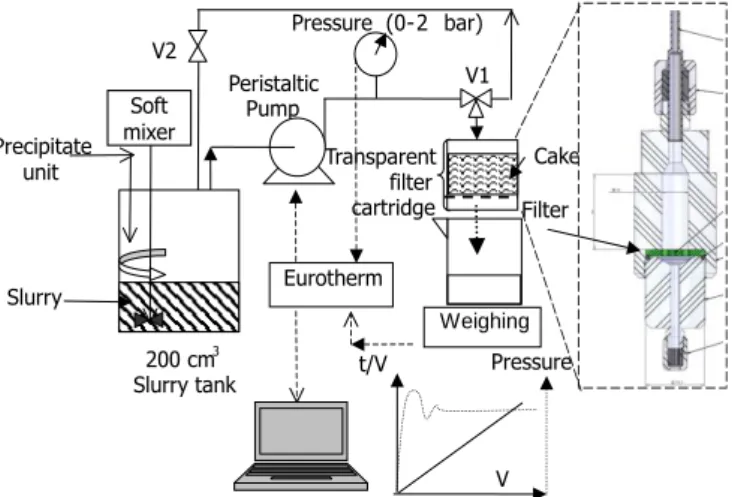
on very small samples of suspension. The experimental aspect is recalled in the next figure:
Figure 1 First experimental set-up for downsizing the test cell from 3 to 1.8 cm of inner diam.
This previous technical choice consisted in using a peristaltic pump with a pressure regulation of 2 bars. The slurry tank guaranteed the homogeneity of the suspension filtrated on Gantois REPS screen with a 6 µm cutoff threshold. Here, the minimum test cell diameter was 1.8cm. The next generation devices were developed with IFTS, to study hazardous compound filterability between 1 to 5 bars in very small test cells with only 1cm of inner diameter. The next figure shows the filterability test implemented in a glove box in the Atalante facility at CEA Marcoule, and an example of a filterability curve obtained on actinide compounds.
Figure 2 Filterability test in glove box
The filterability test in the glove box is an alpha test. That means we can study filterability and compressibility behavior on just a few grams of alpha radioactive elements. To our knowledge, this was the first time in the world that this type of work was done on such highly radiotoxic material. The experiments showed flow resistance of 5 m/Kg (1 bar) and 30 m/kg (4 bars). The increased flow resistance with pressure clearly indicates a high compressibility behavior, because of the solid shape factor.
V t/V Pressure (0 - 2 bar) V2 Filter Weighing Cake V1 Transparent filter cartridge Eurotherm Peristaltic Pump Pressure Slurry Precipitate unit 200 cm 3 Slurry tank Soft mixer filtrate Actinide solide phase (cake)
Filterability curve of actinide compound at 5 bars
Test cell with 1 cm inner diameter
5. Last evolution of filterability test; FPT Lab
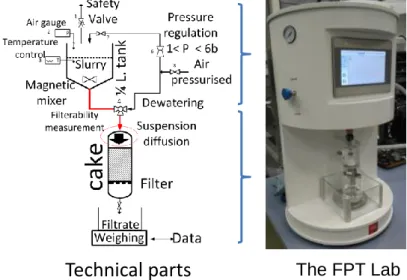
The most recent version of the filterability test is the “FPT”, i.e. Filtration Performance Test, Laboratory (Lab). For commercial reasons the FPT was developed by the CEA in collaboration with FlowerSep. This device is a breakthrough technology that simplifies filterability and compressibility measurement. The next figure illustrates the measurement principle and shows this new tool.
Figure 3 Filtration Performance Test at a glance
The latest generation of this filtration test has been considerably simplified compared to the previous version. The test cell can be removed without any tools by pivoting and pulling it at 90°. The control unit consists of a touch screen and only two valves are used for the different modes of operation. User friendly software gives operating conditions, computes the flow resistance and records the results in a special database. The data can be easily exported in CSV files with a USB key, for excel processing. The FPT is equipped with the latest design of filtration test cell, integrating the head end diffusion system. This special part is used to provide homogeneous cake construction in the cell. Many computational works have shown the interest of this specific design, as indicated in the next figure :
Figure 4 Suspension flow rate with various head end diffusion systems
Technical parts
The FPT Lab Filterability Test Cell Ce oxalate cake8 injection holes 9 injection holes Single injection hole
The computational results obtained with OpenFoam software show the interest of using a multichannel injector. In our case the diffusion system should give a homogeneous cake without preferential flows. In these conditions, the statistic of the filterability measurement is clearly improved and gives reliable results in comparison with older test cell design. In these conditions, the FPT device can be used to study filterability for between 108 m/kg and 1014 m/kg.
6. Conclusion
The work presented here illustrates the different steps of a four-year development which lead to the designing of a new commercial device to measure filterability and compressibility. One of the major points of interest is the downscaling of the test cell, enabling cake construction to be studied on only a few grams of material. This specificity is very useful from the industrial point of view, in the measurement of the filtration behavior of low amounts of new molecules, or of toxic or radioactive products. The next evolution of the FPT proposed on mid 2016 is a high activity device to study filterability of highly radioactive products in hot cells. Then, a FPT Process device with high mobility will be proposed in the end of 2016. This FPT Process could be situated next to the production process. This approach should facilitate access to the filterability parameter before transferring the product to the solid / liquid separation.
7. References
AFNOR NF EN 14701-2 (2006a). Characterization of sludges–Filtrationproperties– Part 2: Determination of the specific resistance to filtration :14.
Feraud, JP, Bourcier, D., Ode, D., Puel, F., New filterability and compressibility test cell design for nuclear products, Nuc. Eng & design 265 (2013) pp 288-293,
Iritani, E., Katagiri, N., et al., 2007. Flux decline behaviors in dead-end microfiltration of activated sludge and its supernatant? J. Membr. Sci. 300 (1-2), 36 – 44.
Léger, B. (2008). Étude de l’essorage en vue d’assister thermiquement le procédé, Université Bordeaux 1
Sorensen, P.B., Agerbaek, M.L., et al., 1996. Predicting cake filtration using specificfiltration flow rate. Water Environ. Res. 68 (7), 1151 – 1155.
Tarleton, S., Wakeman, R. (Eds.), 2007a. Equipment selection and process design.Solid/liquid separation. Elsevier, Kidlington, Oxford, UK.
Tarleton, S.Wakeman, R. (Eds.), 2007b. Principles of Industrial Filtration. Elsevier, Kidlington, Oxford, UK.Wakeman, R. J., Vince A., 1984. Solid–Liquid Separation. London.