Structural properties of methoxy derivatives of benzyl bromide, determined
from powder X-ray diffraction data
Zhigang Pan, Eugene Y. Cheung, and Kenneth D. M. Harrisa兲
School of Chemistry, Cardiff University, Main Building, Park Place, Cardiff CF10 3AT, Wales, United Kingdom
Edwin C. Constable and Catherine E. Housecroft
Department of Chemistry, University of Basel, Spitalstrasse 51, 4056 Basel, Switzerland 共Received 28 June 2005; accepted 12 October 2005兲
Structure determination of 3,5-dimethoxybenzyl bromide and 3,4,5-trimethoxybenzyl bromide has been carried out from laboratory powder X-ray diffraction data using the direct-space Genetic Algorithm technique for structure solution followed by Rietveld refinement. These two compounds are of interest for their potential use as building blocks for the synthesis of dendritic materials. Although the two molecules differ only in the presence/absence of the methoxy group at the 4-position of the aromatic ring, the structural properties of the two materials are significantly different. © 2005 International Centre for Diffraction Data. 关DOI: 10.1154/1.2135789兴
Key words: organic materials, structure solution, genetic algorithm, direct-space techniques
I. INTRODUCTION
The field of powder diffraction has seen many significant advances over the last 40 years or so, and in this special issue of Powder Diffraction dedicated to Daniel Louër, it is appropriate to recognize the wide-ranging contributions that he has made to this field, which encompass new fundamental aspects of powder diffraction methodology as well as the application of powder diffraction techniques to tackle novel and important structural problems共Louër and Louër, 1972; Louër, 1988; Boultif and Louër, 1991; Louër, 1996; Lang-ford and Louër, 1996; Louër, 1998; McCusker et al., 1999; Langford et al., 2000; Giovannini et al., 2001a; 2001b; Louër, 2003; Boultif and Louër, 2004兲. As a result, many practitioners in the powder diffraction field have benefited from the contributions that Professor Louër and his research group have made to this field over the years.
Much of our own current research is focused on struc-ture determination of organic molecular solids from powder diffraction data, and the present paper is focused in this area. Within the last decade or so, new opportunities have opened up for carrying out complete structure determination of or-ganic molecular solids directly from powder diffraction data 共Harris and Tremayne, 1996; Harris et al., 2001; Chernyshev, 2001; Harris and Cheung, 2004; Altomare et al., 2004; Favre-Nicolin and Černý, 2004; Shankland et al., 2004兲, par-ticularly through the development of the direct-space strat-egy for structure solution共Harris et al., 1994兲. Recent meth-odological advances in this field are such that organic molecular crystal structures of moderate complexity can now be determined fairly routinely by this approach. Neverthe-less, structure determination from powder diffraction data is not a black-box technique, and considerable care must be taken to ensure the correctness of the structure obtained.
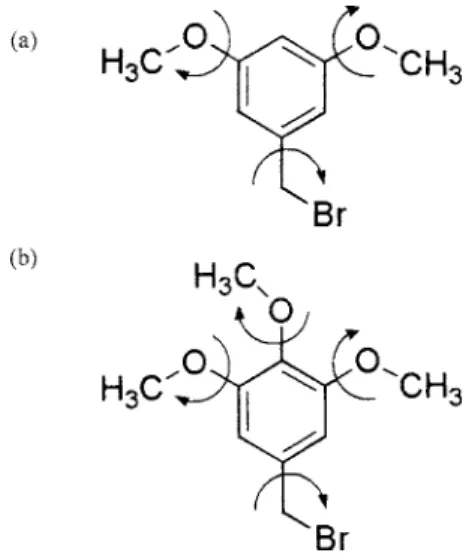
This paper reports the structure determination of two or-ganic molecular materials: 3,5-dimethoxybenzyl bromide 关denoted 3,5-DMBB; Figure 1共a兲兴 and
3,4,5-trimeth-oxybenzyl bromide关denoted 3,4,5-TMBB; Figure 1共b兲兴, car-ried out from powder X-ray diffraction data using the direct-space genetic algorithm technique共Kariuki et al., 1997; Har-ris et al., 1998; Habershon et al., 2003兲 for structure solution followed by Rietveld refinement共McCusker et al., 1999; Ri-etveld, 1969; Young, 1993兲. Both of these materials are of interest in our research on dendritic materials as they serve as precursors for some of the families of dendrimers of interest. The crystal structure of a related molecule 3,5-dimethoxybenzyl alcohol, which is also of interest as a den-drimer precursor, has also been determined from powder X-ray diffraction data共Pan et al., 2004兲. Such organic mo-lecular solids are particularly amenable to structure determi-nation using the direct-space strategy for structure solution because reliable information on specific aspects of molecular geometry 共e.g., standard bond lengths and bond angles兲 is already known, and therefore the structure solution
calcula-a兲Author to whom correspondence should be addressed. Electronic mail:
Figure 1. Molecular structures of共a兲 3,5-DMBB and 共b兲 3,4,5-TMBB. The arrows indicate the variable torsion angles in the structure solution calcula-tion from powder X-ray diffraccalcula-tion data.
tion requires only to establish the position and orientation of the molecule in the asymmetric unit, and the molecular con-formation.
II. BACKGROUND TO STRUCTURE DETERMINATION OF ORGANIC MOLECULAR SOLIDS FROM
POWDER X-RAY DIFFRACTION DATA
The stages involved in crystal structure determination from powder X-ray diffraction data are共i兲 unit cell determi-nation关which, in the work presented here, has been carried out using the DICVOL program 共Louër and Louër, 1972; Boultif and Louër, 1991; 2004兲 developed in the group of Daniel Louër兴; 共ii兲 pattern-decomposition/profile-fitting 关which is commonly carried out using the techniques devel-oped by Pawley共1981兲 and Le Bail et al., 共1988兲兴; 共iii兲 struc-ture solution; and共iv兲 structure refinement. The aim of struc-ture solution is to obtain an initial approximation to the
structure, using knowledge of the unit cell and space group determined in the first two stages, but starting with no knowledge of the actual arrangement of atoms or molecules within the unit cell. If the structure solution is a sufficiently good approximation to the true structure, a good quality structure can then be obtained by structure refinement, which is generally carried out using the Rietveld profile refinement technique.
Among recent developments in techniques for carrying out structure solution from powder X-ray diffraction data, the direct-space strategy is particularly suitable in the case of organic molecular materials. In the direct-space strategy, trial crystal structures are generated in direct space, and the qual-ity of each trial structure is assessed by direct comparison between the powder X-ray diffraction pattern calculated for the trial structure and the experimental powder X-ray diffrac-tion pattern共in our work, this comparison is carried out using the weighted powder profile R-factor Rwp, which takes peak overlap implicitly into consideration兲. In the present paper,
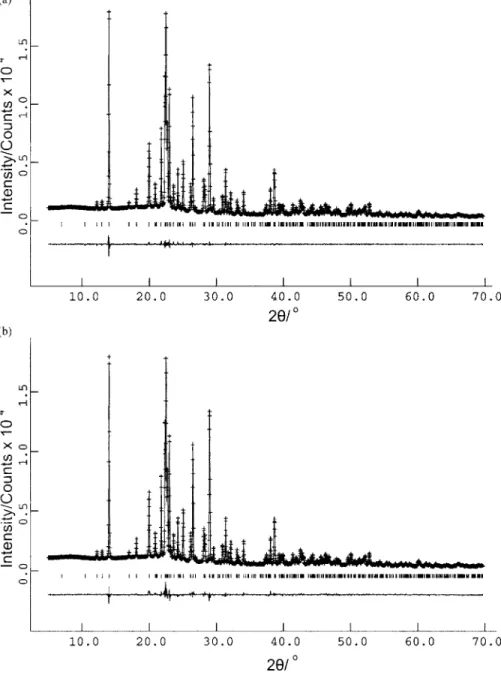
Figure 2.共a兲 Le Bail fit of the powder X-ray diffraction pattern for 3,5-DMBB, showing the experimental powder X-ray diffraction pattern 共⫹ marks兲, calculated powder X-ray dif-fraction pattern共solid line兲, and differ-ence profile 共lower line兲. The tick marks indicate reflection positions.共b兲 Final Rietveld refinement for 3,5-DMBB, showing the experimental powder X-ray diffraction pattern 共⫹ marks兲, calculated powder X-ray dif-fraction pattern共solid line兲, and differ-ence profile 共lower line兲. The tick marks indicate reflection positions.
our genetic algorithm共GA兲 technique was used to search for the structure representing the global minimum in Rwpin the direct-space structure solution calculation.
In the GA technique, a population of trial structures is allowed to evolve subject to rules and operations 共mating, mutation, and natural selection兲 analogous to those that gov-ern evolution in biological systems. Each structure in the population is specified by its “genetic code,” which repre-sents, for each molecule in the asymmetric unit, the position 兵x,y,z其 and orientation 兵,,其 of the molecule in the unit cell, and the molecular conformation, defined by n variable torsion angles兵1,2, . . . ,n其. The quality 共“fitness”兲 of each structure in the population is assessed from its value of Rwp. New structures are generated by the mating and mutation operations. In the natural selection procedure, only the struc-tures of highest fitness共i.e., lowest Rwp兲 are allowed to pass from one generation to the next generation. In the GA struc-ture solution calculation, the population is allowed to evolve for a specified number of generations or until convergence is reached. After the population has evolved for a sufficient number of generations, the best structure in the population 共i.e., the structure with lowest Rwp兲 should be close to the correct crystal structure. Details of the GA technique for structure solution 共Kariuki et al., 1997; Harris et al., 1998; Habershon et al., 2003兲, as implemented in the current work, and examples of the application of this technique共Cheung et
al., 2003; Albesa-Jové et al., 2004; Guo and Harris, 2005兲,
are given in the references cited.
The best structure solution obtained in the GA structure solution calculation is used as the starting structural model for Rietveld refinement. To assess the quality of fit obtained in the final Rietveld refinement, an important issue is to com-pare the difference profile obtained in the Rietveld refine-ment with the difference profile obtained for the same ex-perimental powder X-ray diffraction pattern in the pattern-decomposition/profile-fitting stage of the structure determination process共i.e., from the Pawley or Le Bail fit-ting procedure兲. Clearly, the fit obtained in the pattern-decomposition/profile-fitting procedure establishes a limit to the quality of fit that could be obtained in a Rietveld refine-ment calculation for the same experirefine-mental powder X-ray diffraction pattern共taken over the same 2 range兲.
III. EXPERIMENTAL
Synthesis of 3,5-DMBB and 3,4,5-TMBB was carried out by bromination of the corresponding hydroxy
com-pounds 共3,5-dimethoxybenzyl alcohol and
3,4,5-trimethoxybenzyl alcohol, respectively兲 using phosphorus tribromide at −10 ° C in a sodium chloride ice bath. Both compounds were purified by column chromatography on silica gel, and recrystallized from hexane. Full characteriza-tion was carried out using standard techniques共solution state 1
H and13C NMR and mass spectrometry兲.
For measurement of the powder X-ray diffraction pattern of 3,5-DMBB, the sample was ground and packed between two pieces of transparent tape. The powder X-ray diffraction pattern was recorded at ambient temperature in transmission mode on a Siemens D5000 diffractometer共Cu K␣1radiation, Ge-monochromated; linear position-sensitive detector cover-ing 8° in 2; 2 range 5° to 70°; step size 0.020°; data collection time 15 h兲.
For measurement of the powder X-ray diffraction pattern of 3,4,5-TMBB, the sample was ground and loaded into a borosilicate glass capillary 共0.7 mm diameter兲. The powder X-ray diffraction pattern was recorded at ambient tempera-ture in transmission mode on a Bruker D8 diffractometer共Cu
K␣1 radiation, Ge-monochromated; linear position-sensitive VANTEC detector covering 12° in 2; 2 range 3° to 70°; step size 0.017°; data collection time 12 h兲.
The crystal structures of 3,5-DMBB and 3,4,5-TMBB were determined directly from the powder X-ray diffraction data using our GA technique 关implemented in the program
EAGER共Habershon et al., 2005兲兴 for structure solution, and
using theGSASprogram共Larson and Von Dreele, 1987兲 for Le Bail and Rietveld refinement.
TABLE I. Fractional coordinates for the nonhydrogen atoms in the crystal structure of 3,5-DMBB 关P21/ c; a = 8.4497共4兲 Å, b=4.5123共1兲 Å, c = 25.2799共1兲 Å,= 93.743共1兲°, V=958.32共9兲 Å3兴. Atom x y z Cl 0.5593共1兲 −0.0076共3兲 0.3655共1兲 C2 0.5141共3兲 0.0634共8兲 0.4156共1兲 C3 0.3839共3兲 0.2385共7兲 0.4224共1兲 C4 0.3047共2兲 0.3675共7兲 0.3774共1兲 C5 0.3580共3兲 0.3153共7兲 0.3265共1兲 C6 0.4850共2兲 0.1293共7兲 0.3217共1兲 O7 0.2807共2兲 0.4170共4兲 0.2795共1兲 C8 0.1502共1兲 0.6137共1兲 0.2827共1兲 O9 0.3375共2兲 0.3274共4兲 0.4724共1兲 C10 0.2033共1兲 0.5113共1兲 0.4749共1兲 C11 0.7028共1兲 −0.1896共1兲 0.3624共1兲 Br12 0.9006共1兲 −0.0014共3兲 0.3818共1兲
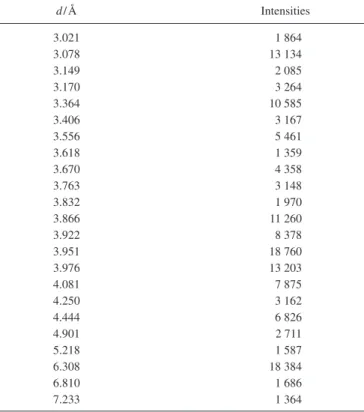
TABLE II. Selected d-spacings and intensities for 3,5-DMBB.
d / Å Intensities 3.021 1 864 3.078 13 134 3.149 2 085 3.170 3 264 3.364 10 585 3.406 3 167 3.556 5 461 3.618 1 359 3.670 4 358 3.763 3 148 3.832 1 970 3.866 11 260 3.922 8 378 3.951 18 760 3.976 13 203 4.081 7 875 4.250 3 162 4.444 6 826 4.901 2 711 5.218 1 587 6.308 18 384 6.810 1 686 7.233 1 364
IV. STRUCTURE DETERMINATION A. Structure determination of 3,5-DMBB
The powder X-ray diffraction pattern of 3,5-DMBB was indexed using the program DICVOL 共Boultif and Louër,
1991兲, leading to the following unit cell with monoclinic metric symmetry: a = 8.45 Å, b = 4.51 Å, c = 25.28 Å,  = 93.73°, V = 962.77 Å3 共M20= 34.0, F20= 81.3兲. Pattern-decomposition/profile-fitting using the Le Bail method 共Le Bail et al., 1988兲 produced a good quality fit 关Figure 2共a兲;
Rwp= 2.75%, Rp= 1.75%, Rexp= 3.07%兴, serving both to con-firm the correctness of the unit cell and to establish suitable profile parameters for use in the subsequent structure solu-tion calculasolu-tion. On the basis of systematic absences, the space group was assigned as P21/ c. Density considerations suggest that there are four molecules of 3,5-DMBB in the unit cell 共Z=4兲. For space group P21/ c, there is therefore one molecule in the asymmetric unit共Z
⬘
= 1兲.For structure solution, each trial structure was defined by a total of nine structural variables: 兵x,y,z,,,,1,2,3其. The three variable torsion angles
are indicated in Figure 1共a兲. The population comprised 100 trial structures, and in the evolution of the population from one generation to the next generation, 50 mating operations and 25 mutation operations were carried out. The best trial structure obtained after 15 generations in the structure solu-tion calculasolu-tion 共i.e., after sampling a total of 1975 trial structures兲 was used as the initial structural model for Ri-etveld refinement. In the RiRi-etveld refinement, bond lengths and bond angles were restrained共soft constraints兲 to standard values, and planar restraints were applied to the aromatic rings. Isotropic displacement parameters were refined for all nonhydrogen atoms. All hydrogen atoms, including those of the methyl groups, were placed at calculated positions with a fixed value共0.05 Å2兲 for the isotropic displacement param-eter. The Rietveld refinement led to a good quality of fit 关Figure 2共b兲; Rwp= 4.06%, Rp= 2.89% for 3236 observations and 37 parameters; RF2= 8.71% for 842 observations; final refined unit cell parameters: a = 8.4497共4兲 Å, b = 4.5123共1兲 Å, c = 25.2799共1兲 Å, = 93.743共1兲°,
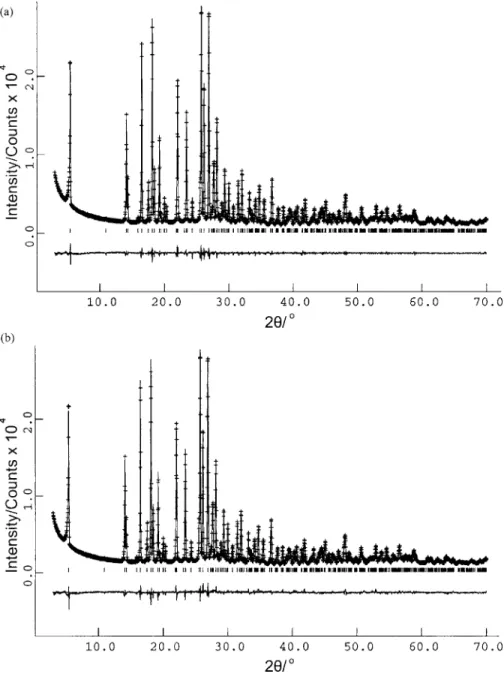
Figure 3.共a兲 Le Bail fit of the powder X-ray diffraction pattern for 3,4,5-TMBB.共b兲 Final Rietveld refinement for 3,4,5-TMBB.
V = 958.32共9兲 Å3兴. Fractional atomic coordinates in the final refined crystal structure are given in Table I and d-spacings and intensities are listed in Table II.
B. Structure determination of 3,4,5-TMBB
The powder X-ray diffraction pattern of 3,4,5-TMBB was indexed using the programDICVOL, leading to the fol-lowing unit cell with monoclinic metric symmetry:
a = 16.52 Å, b = 5.31 Å, c = 12.66 Å, = 103.29°,
V = 1081.27 Å3 共M20= 44.6, F20= 99.6兲. Pattern-decomposition/profile-fitting using the Le Bail method pro-duced a good quality fit 关Figure 3共a兲; Rwp= 4.29%, Rp = 3.23%, Rexp= 1.99%兴. On the basis of systematic absences, the space group was assigned as P21/ c共Z=4兲, and density considerations suggest that there is one molecule of 3,4,5-TMBB in the asymmetric unit共Z
⬘
= 1兲.For structure solution, each trial structure was defined by a total of ten structural variables: 兵x,y,z,,,,1,2,3,4其. The four variable torsion angles are indicated in Figure 1共b兲. The population comprised 100 trial structures, and in the evolution of the population from one generation to the next generation, 50 mating operations and 25 mutation operations were carried out. The best trial structure obtained after 20 generations in the structure solu-tion calculasolu-tion 共i.e., after sampling a total of 2600 trial structures兲 was used as the initial structural model for Ri-etveld refinement, which was carried out using the general procedure discussed in Sec. IV A. The Rietveld refinement led to a good quality of fit 关Figure 3共b兲; Rwp= 4.97%, Rp = 3.93% for 3987 observations and 43 parameters; RF
2 = 6.46% for 944 observations; final refined unit cell param-eters: a = 16.5165共2兲 Å, b=5.31473共8兲 Å, c=12.6675共2兲 Å,
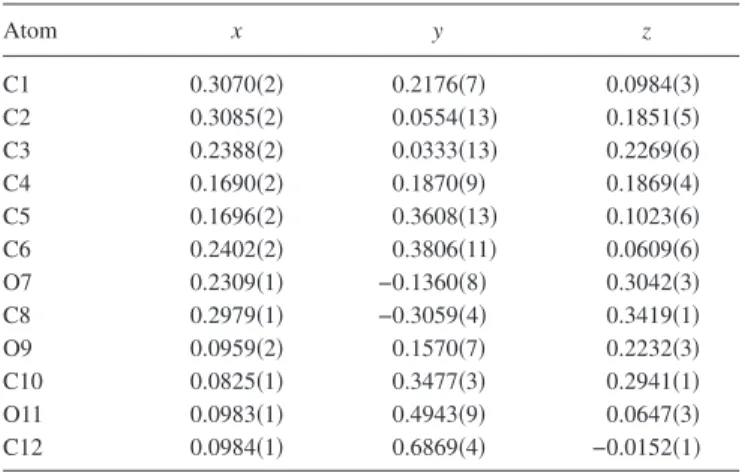
= 103.334共1兲°, V=1081.99共4兲 Å3兴. Fractional atomic coor-dinates in the final refined crystal structure are given in Table III and d-spacings and intensities are listed in Table IV.
V. DISCUSSION
A. Crystal structure of 3,5-DMBB
The conformation adopted by the 3,5-DMBB molecule in the crystal structure is shown in Figure 4共a兲. The bromine
atom of the CH2Br group lies out of the plane of the phenyl ring, and the two O – CH3bonds lie close to the plane of the phenyl ring and are oriented parallel to each other in a
syn,syn conformation关the designations syn and anti refer to
the orientations of the C共3兲O–CH3 and C共5兲O–CH3 bonds relative to the orientation of the C共4兲–H bond兴. With regard to this feature, other molecules containing 3,5-dimethoxyphenyl rings共with hydrogen atoms in the 2-, 4-, and 6-positions兲 display a range of different conformations, including other examples with syn,syn conformations共Lin et
al., 1979; Bartholomew et al., 2000兲, examples of syn,anti
conformations共Lynch et al., 1994; Peters et al., 1993; Pettit
et al., 1988兲, an example with two independent molecules in
the asymmetric unit with anti,anti and syn,anti conforma-tions共Yin et al., 2002兲, and an example with two indepen-dent 3,5-dimethoxyphenyl moieties in a given molecule that adopt syn,syn and syn,anti conformations 共Yin and Zhang, 2002兲.
In the crystal structure 关Figure 4共b兲兴, the 3,5-DMBB molecules are stacked along the b-axis, with adjacent mol-ecules along the stack related to each other by the unit cell translation. Thus, the planes of the phenyl ring of the mol-ecules in the stack are parallel to each other, but there are no significant ¯ stacking interactions between adjacent molecules as a consequence of the tilting of the planes of the phenyl rings relative to the stacking axis. Along the c-axis 关horizontal in Figure 4共b兲兴, there are rows of molecules with relatively short C – H¯O contacts between the C–H bonds of the phenyl ring of one molecule and methoxy groups of neighbouring molecules. Along these rows, pairs of adjacent molecules共A· · ·A兲 lie in the same plane as each other 共and are related across an inversion centre, denoted by the symbol · 兲, whereas the next pair of adjacent molecules 共B· · ·B兲 again lie in the same plane as each other 共and are related across an inversion centre兲, but with the planes of the
A and B molecules almost perpendicular to each other. The
overall arrangement along these rows is thus
¯A· · ·A¯B· · ·B¯A· · ·A¯B· · ·B¯ 关Figure 4共c兲兴. Thus, the structure does not comprise planar sheets of molecules.
TABLE III. Fractional coordinates for the nonhydrogen atoms in the crystal structure of 3,4,5-TMBB 关P21/ c; a = 16.5165共2兲 Å, b=5.31473共8兲 Å, c = 12.6675共2兲 Å,= 103.334共1兲°, V=1081.99共4兲 Å3兴. Atom x y z C1 0.3070共2兲 0.2176共7兲 0.0984共3兲 C2 0.3085共2兲 0.0554共13兲 0.1851共5兲 C3 0.2388共2兲 0.0333共13兲 0.2269共6兲 C4 0.1690共2兲 0.1870共9兲 0.1869共4兲 C5 0.1696共2兲 0.3608共13兲 0.1023共6兲 C6 0.2402共2兲 0.3806共11兲 0.0609共6兲 O7 0.2309共1兲 −0.1360共8兲 0.3042共3兲 C8 0.2979共1兲 −0.3059共4兲 0.3419共1兲 O9 0.0959共2兲 0.1570共7兲 0.2232共3兲 C10 0.0825共1兲 0.3477共3兲 0.2941共1兲 O11 0.0983共1兲 0.4943共9兲 0.0647共3兲 C12 0.0984共1兲 0.6869共4兲 −0.0152共1兲
TABLE IV. Selected d-spacings and intensities for 3,4,5-TMBB.
d / Å Intensities 3.168 1 304 3.222 861 3.308 2 855 3.405 1 497 3.460 2 227 3.651 425 3.790 1 553 4.021 1 872 4.355 381 4.428 473 4.605 1 261 4.797 852 4.884 2 886 5.051 690 5.361 2 298 6.169 657 6.261 1 508
Rather, when viewed along the c-axis, there are two orienta-tions of the molecular planes that are almost perpendicular to each other. The rows of molecules 共along the c-axis兲 are stacked along the b-axis as discussed above, leading to slabs of molecules parallel to the bc-plane. At the interface
be-tween adjacent slabs of this type, the bromine atoms of one molecule come into van der Waals contact with the two me-thyl 共methoxy兲 groups of a neighbouring molecule 共as dis-cussed below, this feature contrasts with the structure of 3,4,5-TMBB兲.
B. Crystal structure of 3,4,5-TMBB
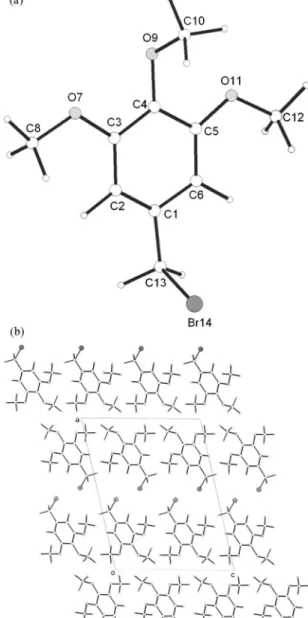
The conformation adopted by the 3,4,5-TMBB molecule in the crystal structure is shown in Figure 5共a兲. The methoxy groups at the 3- and 5-positions lie close to the plane of the phenyl ring, and the C共3兲O–CH3and C共5兲O–CH3bonds are oriented away from each other in an anti,anti conformation 关the designations syn and anti refer to the orientations of the C共3兲O–CH3 and C共5兲O–CH3 bonds relative to the orienta-tion of the C共4兲–O bond兴. For the methoxy group at the 4-position, on the other hand, the methyl group lies out of the plane of the phenyl ring, with the C共4兲O–CH3bond pointing almost perpendicular to the plane of the ring. These confor-mational features are commonly observed in crystal
struc-Figure 4. 共a兲 The conformation adopted by 3,5-DMBB in its crystal struc-ture.共b兲 Crystal structure of 3,5-DMBB viewed along the b-axis. 共c兲 Part of the crystal structure of 3,5-DMBB showing two rows of molecules along the
c-axis共horizontal兲, with these rows of molecules stacked along the b-axis
共into the plane of the page兲.
Figure 5.共a兲 The conformation adopted by 3,4,5-TMBB in its crystal struc-ture.共b兲 Crystal structure of 3,4,5-TMBB viewed along the b-axis.
tures of other molecules containing 3,4,5-trimethoxyphenyl rings共with hydrogen atoms in the 2- and 6-positions兲 共Saad
et al., 1991; Wallet et al., 1995; Lockhart et al., 1987;
Kry-gowski et al., 2001兲. In contrast to the conformational prop-erties discussed above for 3,5-dimethoxyphenyl rings, as found in 3,5-DMBB, it is apparent that there is much less latitude for conformational variation in 3,4,5-trimethoxyphenyl rings. In the 3,4,5-TMBB molecule, the bromine atom of the CH2Br group also lies out of the plane of the phenyl ring, and is oriented outwards from the same face of the phenyl ring as the methoxy group at the 4-position.
In the crystal structure 关Figure 5共b兲兴, the 3,4,5-TMBB molecules are stacked along the b-axis, with adjacent mol-ecules along the stack related to each other by the unit cell translation. The planes of the phenyl rings of the molecules in the stack are parallel to each other, but there are no sig-nificant ¯ stacking interactions between adjacent mol-ecules as a consequence of the tilting of the planes of the phenyl rings relative to the stacking axis. Along the c-axis 关horizontal in Figure 5共b兲兴, there are zigzag rows of mol-ecules with relatively short C – H¯O contacts between the C–H bonds of the phenyl rings of one molecule and the methoxy groups of the neighbouring molecules; along these rows, the molecules alternate between two different orienta-tions共leading to the description as a zigzag row兲. These rows of molecules共along the c-axis兲 are stacked along the b-axis as discussed above, leading to slabs of molecules parallel to the bc-plane. The two surfaces of the slab are different from each other—one surface共the “bromine surface”兲 contains the bromine atoms of all molecules in the slab, whereas the other surface 共the “methoxy surface”兲 contains two methoxy groups from each molecule in the slab 共the other methoxy group of each molecule lies within the slab兲. These slabs are stacked along the a-axis, and within the unit cell there are two different types of interface共parallel to the bc-plane兲 be-tween adjacent slabs. At one interface, the bromine surfaces of adjacent slabs are in van der Waals contact with each other, whereas at the other interface, the methoxy surfaces of adjacent slabs are in van der Waals contact with each other. In contrast, in the structure of 3,5-DMBB discussed above, the two surfaces of a slab of molecules are equivalent by symmetry 共and each surface contains both bromine and methoxy groups兲, and all interfaces between adjacent slabs are also equivalent by symmetry.
ACKNOWLEDGMENTS
We are grateful to EPSRC for general support 共to K.D.M.H.兲 and to Bruker AXS and the University of Bir-mingham for the award of a studentship共to Z.P.兲.
Albesa-Jové, D., Kariuki, B. M., Kitchin, S. J., Grice, L., Cheung, E. Y., and Harris, K. D. M.共2004兲. “Challenges in direct-space structure determi-nation from powder diffraction data: A molecular material with four independent molecules in the asymmetric unit,” ChemPhysChem 5, 414–418.
Altomare, A., Caliandro, R., Camalli, M., Cuocci, C., Giacovazzo, C., Mo-literni, A. G. G., Rizzi, R., Spagna, R., and Gonzalez-Platas, J.共2004兲. “Towards EXPO2005,” Z. Kristallogr. 216, 833–837.
Bartholomew, G. P., Bazan, G. C., Bu, X. H., and Lachicotte, R. J.共2000兲. “Packing modes of distyrylbenzene derivatives,” Chem. Mater. 12, 1422–1430.
Boultif, A. and Louër, D.共1991兲. “Indexing of powder diffraction patterns for low-symmetry lattices by the successive dichotomy method,” J. Appl. Crystallogr. 24, 987–993.
Boultif, A. and Louër, D.共2004兲. “Powder pattern indexing with the di-chotomy method,” J. Appl. Crystallogr. 37, 724–731.
Chernyshev, V. V.共2001兲. “Structure determination from powder diffrac-tion,” Russ. Chem. Bull. 50, 2273–2292.
Cheung, E. Y., Kitchin, S. J., Harris, K. D. M., Imai, Y., Tajima, N., and Kuroda, R.共2003兲. “Direct structure determination of a multi-component molecular crystal prepared by a solid state grinding procedure,” J. Am. Chem. Soc. 125, 14658–14659.
Favre-Nicolin, V. and Černý, R.共2004兲. “A betterFOX: Using flexible mod-eling and maximum likelihood to improve direct-space ab initio struc-ture determination from powder diffraction,” Z. Kristallogr. 216, 847– 856.
Giovannini, J., Ceolin, R., Perrin, M. A., Toscani, S., Louër, D., and Lev-eiller, F.共2001a兲. “Polymorphism and hydration of zopiclone: Determi-nation of crystal structures, and thermodynamic studies as a function of temperature and water vapor pressure,” J. Phys. IV 11, 93–97. Giovannini, J., Ter Minassian, L., Ceolin, R., Toscani, S., Perrin, M. A.,
Louër, D., and Leveiller, F.共2001b兲. “Tetramorphism of fananserine: p, T diagram and stability hierarchy from crystal structure determinations and thermodynamic studies,” J. Phys. IV 11, 123–126.
Guo, F. and Harris, K. D. M.共2005兲. “Structural understanding of a molecu-lar material that is accessed only by a solid-state desolvation process: The scope of modern powder X-ray diffraction techniques,” J. Am. Chem. Soc. 127, 7314–7315.
Habershon, S., Harris, K. D. M., and Johnston, R. L.共2003兲. “Development of a multi-population parallel genetic algorithm for structure solution from powder diffraction data,” J. Comput. Chem. 24, 1766–1774. Habershon, S., Turner, G. W., Kariuki, B. M., Cheung, E. Y., Hanson, A. J.,
Tedesco, E., Albesa-Jové, D., Chao, M.-H., Lanning, O. J., Johnston, R. L., and Harris, K. D. M. 共2005兲. EAGER—A Computer Program for Direct-Space Structure Solution from Powder X-ray Diffraction Data, Cardiff University and University of Birmingham.
Harris, K. D. M. and Cheung, E. Y.共2004兲. “How to determine structures when single crystals cannot be grown: Opportunities for structure deter-mination of molecular materials using powder diffraction data,” Chem. Soc. Rev. 33, 526–538.
Harris, K. D. M. and Tremayne, M.共1996兲. “Crystal structure determination from powder diffraction data,” Chem. Mater. 8, 2554–2570.
Harris, K. D. M., Johnston, R. L., and Kariuki, B. M.共1998兲. “The genetic algorithm: Foundations and applications in structure solution from pow-der diffraction data,” Acta Crystallogr., Sect. A: Found. Crystallogr. 54, 632–645.
Harris, K. D. M., Tremayne, M., and Kariuki, B. M.共2001兲. “Contemporary advances in the use of powder X-ray diffraction for structure determina-tion,” Angew. Chem., Int. Ed. 40, 1626–1651.
Harris, K. D. M., Tremayne, M., Lightfoot, P., and Bruce, P. G.共1994兲. “Crystal structure determination from powder diffraction data by Monte Carlo methods,” J. Am. Chem. Soc. 116, 3543–3547.
Kariuki, B. M., Serrano-González, H., Johnston, R. L., and Harris, K. D. M. 共1997兲. “The application of a genetic algorithm for solving crystal struc-tures from powder diffraction data,” Chem. Phys. Lett. 280, 189–195. Krygowski, T. M., Pindelska, E., Anulewicz-Ostrowska, T., Grabowski, S.
J., and Dubis, A. T.共2001兲. “Angular group-induced bond alternation 共AGIBA兲. Conformation dependence and additivity of the effect: Struc-tural studies of 3,5-dimethoxybenzaldehyde derivatives and related sys-tems,” J. Phys. Org. Chem. 14, 349–354.
Langford, J. I. and Louër, D.共1996兲. “Powder diffraction,” Rep. Prog. Phys.
59, 131–234.
Langford, J. I., Louër, D., and Scardi, P.共2000兲. “Effect of a crystallite size distribution on X-ray diffraction line profiles and whole-powder-pattern fitting,” J. Appl. Crystallogr. 33, 964–974.
Larson, A. C., and Von Dreele, R. B.共1987兲.GSAS, Los Alamos Laboratory Report No. LA-UR-86-748.
Le Bail, A., Duroy, H., and Fourquet, J. L.共1988兲. “Ab initio structure determination of LiSbWO6by X-ray powder diffraction,” Mater. Res.
Bull. 23, 447–452.
Lin, Y., Lang, S. A., Lovell, M. F., and Perkinson, N. A.共1979兲. “New synthesis of 1,2,4-triazoles and 1,2,4-oxadiazoles,” Org. Chem. 44, 4160–4164.
Lockhart, J. C., McDonnell, M. B., Clegg, W., and Hill, M. N. S.共1987兲. “Structure and dynamics of crowns containing the phenyldinaphthyl-methane subunit共a three-bladed propeller兲: Observations of correlated
rotation of the propeller blades and certain ether segments,” J. Chem. Soc., Perkin Trans. 1 2, 639–649.
Louër, D.共1988兲. “Some recent developments and applications of powder diffraction,” Chem. Scr. 28, 89–95.
Louër, D.共1996兲. “Powder X-ray diffraction 100 years after Roentgen,” J. Phys. IV 6, 57–69.
Louër, D.共1998兲. “Advances in powder diffraction analysis,” Acta Crystal-logr., Sect. A: Found. Crystallogr. 54, 922–933.
Louër, D.共2003兲. “Microstructure and profile of X-ray diffraction lines,” J. Phys. IV 103, 321–337.
Louër, D. and Louër, M.共1972兲. “Trial-and-error method for automatic in-dexing of powder diagrams,” J. Appl. Crystallogr. 5, 271–275. Lynch, D. E., Smith, G., Byriel, K. A., and Kennard, C. H. L. 共1994兲.
“3,5-Dimethoxybenzoic acid and the second polymorph of the 2:1 ad-duct of 3,5-dinitrobenzoic acid with ethylenediamine,” Acta Crystallogr., Sect. C: Cryst. Struct. Commun. 50, 1259–1262.
McCusker, L. B., Von Dreele, R. B., Cox, D. E., Louër, D., and Scardi, P. 共1999兲. “Rietveld refinement guidelines,” J. Appl. Crystallogr. 32, 36– 50.
Pan, Z., Cheung, E. Y., Harris, K. D. M., Constable, E. C., and Housecroft, C. E.共2004兲. “Structural aspects of a dendrimer precursor determined directly from powder diffraction data,” Cryst. Growth Des. 4, 451–455. Pawley, G. S.共1981兲. “Unit-cell refinement from powder diffraction scans,”
J. Appl. Crystallogr. 14, 357–361.
Peters, K., Peters, E.-M., von Schnering, H. G., Bringmann, G., and Rolfing,
K. 共1993兲. “Crystal structure of 共E兲-1-共1-bromo-2-naphthyl兲-2-共3,5-dimethoxyphenyl兲ethane,” Z. Kristallogr. 207, 125–127.
Pettit, G. R., Singh, S. B., Schmidt, J. M., Niven, M. L., Hamel, E., and Lin, C. M.共1988兲. “Isolation, structure, synthesis, and antimitotic properties of combretastatins B-3 and B-4 from combretum caffrum,” J. Nat. Prod.
51, 517–527.
Rietveld, H. M.共1969兲. “A profile refinement method for nuclear and mag-netic structures,” J. Appl. Crystallogr. 2, 65–71.
Saad, J. M., Soepadamo, E., Fang, X.-P., McLaughlin, J. L., and Fanwick, P. E.共1991兲. “共⫺兲-Grandisin from cryptocarya crassinervia,” J. Nat. Prod.
54, 1681–1683.
Shankland, K., Markvardsen, A. J., and David, W. I. F.共2004兲. “Powder diffraction based structural studies of pharmaceuticals,” Z. Kristallogr.
216, 857–865.
Wallet, J. C., Molins, E., and Miravitlles, C.共1995兲. “1-Phenyl-3-共3,4,5-trimethoxyphenyl兲-1,3-propanedione,” Acta Crystallogr., Sect. C: Cryst. Struct. Commun. 51, 103–104.
Yin, Q. and Zhang, W. Q.共2002兲. “1-共3,5-Dimethoxyphenyl兲-2-兵2-关共3,5-dimethoxyphenyl兲hydroxymethyl兴-4-methoxyphenyl其ethanol,” Acta Crystallogr., Sect. E: Struct. Rep. Online 58, 1367–1369.
Yin, Q., Shi, Y.-M., Liu, H.-M., Li, C.-B., and Zhang, W. Q. 共2002兲. “共E兲-3,5,4⬘-Trimethoxystilbene,” Acta Crystallogr., Sect. E: Struct. Rep. Online 58, 1180–1181.
Young, R. A., Editor.共1993兲. The Rietveld Method 共International Union of Crystallography, Oxford兲.