1. Introduction
Depending on their affinity for carbon, typical adsor-bates lead to either type I or type V adsorption isotherms. Organic and many inorganic compounds belong to the former category, whereas water is well-known for its sigmoid isotherm. As shown recently,1 both types of isotherms can be described within the framework of Dubinin’s theory for the volume filling of micropores,2-4 which increases the field of applications of this theory. Water is a limiting case and its adsorption by carbons depends essentially on the presence of oxygen-containing surface complexes.5-8Benzene, on the other hand, is not very sensitive to the increase in surface oxygen, as revealed by the analysis of the isotherms and the enthalpy of immersion of carbons with increasing degrees of oxidation. It follows that adsorptives such as alcohols, and in particular methanol and ethanol, should also be sensitive, to some extent, to the presence of oxygen. This problem has already attracted attention in the past, but the different authors9-13have considered possible correlations between the oxygen content of the surface and either the adsorption isotherm or the enthalpy of immersion into the corresponding liquid. However, the combination of the two has never been considered. Consequently, we wish
to examine this problem within the framework of Dubinin’s theory, which includes immersion calorimetry as a thermodynamic consequence.3,4
The fact that the adsorption isotherms of methanol and ethanol are of type I or II suggests that even in the shortest alcohols the organic part of the molecule dominates in the interaction with the solid. However, the combined analysis of the adsorption isotherm and the enthalpy of immersion reveals a substantial influence of the specific interactions involving the -OH groups when the amount of surface oxygen is increased by treatment with agents such as (NH4)2S2O8, HNO3, and H2O2. For benzene, on the other hand, no significant modification is observed, if one takes into account possible structural changes in the carbon, induced by the oxidation process itself. As reported by Robert,14the enthalpy of immersion of carbon blacks with various degrees of oxidation into benzene is practically independent of the oxygen content, as opposed to water, methanol, and ethanol.
In the present paper, we examine the specific and the nonspecific interactions between the shortest alcohols, methanol and ethanol, and microporous carbons with various degrees of oxidation (0.5-15 µmol of oxygen per m2of total surface area). It will be shown that immersion calorimetry combined with the analysis of the isotherms within the framework of Dubinin’s theory leads to a coherent pattern and the average specific interactions of the alcohols with the surface oxygen can clearly be identified. On the other hand, the interactions with the basic surface groups are still uncertain.
2. Theoretical Section
Adsorption by microporous carbons is described by the Dubinin-Astakhov (DA) equation2-4
* To whom correspondence should be addressed. E-mail: [email protected].
†Universidad de Jaen. ‡University of Neuchatel. §Universidad de Granada.
(1) Stoeckli, H. F.; Jakubov, T. S.; Lavanchy, A. J. Chem. Soc., Faraday
Trans. 1994, 90, 783.
(2) Dubinin, M. M. Carbon 1989, 27, 457.
(3) Bansal, R. C.; Donnet, J. B.; Stoeckli, H. F. Active Carbon; Dekker: New York, 1998.
(4) Stoeckli, F. In Porosity in Carbons; Patrick, J., Ed.; Arnold: London, 1995.
(5) Carrasco-Marı´n, F.; Mueden, A.; Centeno, T. A.; Stoeckli, F.; Moreno-Castilla, C. J. Chem. Soc., Faraday Trans. 1997, 93, 2211.
(6) Lo´pez-Ramo´n, M. V.; Stoeckli, F.; Moreno-Castilla, C.; Carrasco-Marı´n, F. Carbon 1999, 37, 1215.
(7) Lo´pez-Ramo´n, M. V.; Stoeckli, F.; Moreno-Castilla, C.; Carrasco-Marı´n, F.; Carbon 2000, 38, 825.
(8) Stoeckli, F.; Lavanchy, A. Carbon 2000, 38, 475.
(9) Bradley, R. H.; Rand, B. Carbon 1991, 29, 1165.
(10) Bradley, R. H.; Rand, B. J. Colloid Interface Sci. 1995, 169, 168. (11) Rodriguez-Reinoso, F.; Molina-Sabio, M.; Mun˜ ecas, M. A. J. Phys.
Chem. 1992, 96, 2707.
(12) Tamon, H.; Okazaki, M. Carbon 1996, 34, 741.
(13) Rodriguez-Reinoso, F.; Molina-Sabio, M.; Gonzalez, M. T.
Langmuir 1997, 13, 2354.
(14) Robert, L. Rev. Ge´n. Caoutchoucs Plast. 1964, 41, 371.
Specific
and Nonspecific Interactions between Methanol and Ethanol and
Active
Carbons
Marı´a
Victoria Lo´pez-Ramo´n,
†Fritz
Stoeckli,
*
,‡Carlos
Moreno-Castilla,
§and
Francisco Carrasco-Marı´n
§Departamento de Quı´mica Inorga´ nica y Orga´ nica, Facultad de Ciencias Experimentales, Universidad de Jae´n, 23071 Jae´n, Spain, Institut de Chimie de l’Universite´, Av. de Bellevaux 51, CH-2000 Neuchaˆ tel, Switzerland, and Departamento de Quı´mica Inorga´ nica, Facultad de Ciencias, Universidad de Granada, 18071 Granada, Spain
The interaction of methanol and ethanol with active carbons of different origins and containing between 0.81 and 7 mmol g-1 surface oxygen has been examined by immersion calorimetry and by vapor adsorption at 293 K, benzene being the reference. The results obtained by these independent techniques are in excellent agreement. With respect to pure carbons, the surface oxygen leads to excess enthalpies of immersion of 5.32 and 2.64 J mmol-1oxygen for methanol and ethanol. Alternatively, it appears that the affinity coefficients β(CH3OH) and β(C2H5OH), which appear in the Dubinin-Astakhov equation, are functions of the oxygen content and of the enthalpy of immersion into benzene. The limiting values, as the oxygen content tends to zero, are respectively 0.40 and 0.62, in agreement with the values quoted in the literature. It is also found that the adsorption of CO2 is not affected by the oxygen content of the surface and β(CO2) ) 0.40.
where Na represents the amount adsorbed at relative pressure p/ps, Nao is the limiting amount filling the micropores, and A ) RT ln(ps/p). The characteristic energy of the system E depends on the adsorbent and on the adsorptive, and it has been shown by Dubinin that E ) βEo, where β is the affinity coefficient of the given adsorptive with respect to benzene, taken as a reference. In the case of pure carbon, which leads exclusively to nonspecific interactions, it is possible to use specific and constant values of β. These coefficients have been listed,2-4,15and various empirical expressions have been proposed to predict them on the basis of molecular properties. On the other hand, if the surface contains atoms or functional groups which can lead to specific interactions (typically hydrogen bonding), the adsorption energy depends on an extra factor. This type of variable is not considered in Dubinin’s theory, where β is a constant and Eoreflects the micropore system. It has been shown that this parameter is related to the average width L of the slit-shaped micropores by4,16
Depending on the heterogeneity of the micropore system,3,17exponent n varies between 3 and 1.5 and the case n ) 2 corresponds to the classical Dubinin-Radush-kevich (DR) equation. The latter describes adsorption by typical active carbons of low and medium activation (burnoff up to 35-40%).
Since eq 1 reflects a process of micropore volume filling, it is convenient to replace the limiting amount Naoby the micropore volume Wo ) NaoVm, where Vmis the molar volume of the adsorbate at the given temperature. This is a first approximation, since it appears from molecular simulations that the density in the adsorbed state can be different from the liquid.
As shown elsewhere,4it is possible to derive from eq 1 an expression for the enthalpy of immersion ∆iH of a microporous carbon into a liquid adsorbate, whose vapor follows the DA equation
or, if one uses volumes
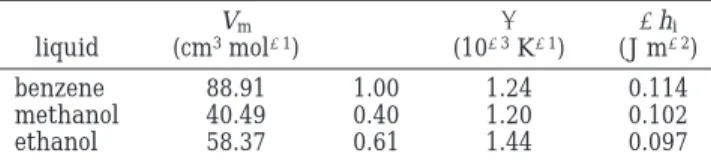
R is the expansion coefficient of the liquid, Γ is the tabulated gamma function, and hi (J m-2), a negative quantity, is the specific enthalpy of wetting of the nonmicroporous surface area Se of the solid. These enthalpies are obtained from experiments with nonporous carbon blacks of known surface areas. Since himay depend on the oxygen content of the surface, we used values obtained from the immersion of carbon blacks with low oxygen contents into benzene,4methanol18and ethanol19 (see Table 1).
As reported earlier4and illustrated below, one obtains good agreement between the calculated and the
experi-mental values of the enthalpies of immersion of active carbons into benzene and other nonpolar liquids. This provides a test for self-consistency between adsorption and calorimetric techniques.
The existence of specific and nonspecific interactions between alcohols and activated carbons is revealed by the increase of the enthalpy of immersion of oxidized carbons into these liquids, with respect to benzene. As shown in the experimental section, benzene is not affected by changes in the oxygen content of the surface.
The problem of specific and nonspecific interactions between methanol and ethanol and active carbons can be treated by approaches based on either the concept of an excess enthalpy of immersion, or by considering the affinity coefficient β of the alcohol in relation to the oxygen content of the surface. However, the two approaches are not independent, as they are linked through Dubinin’s theory and in particular through eq 3.
The Excess Enthalpy of Immersion. A simple way to assess the specific interaction is to determine the excess enthalpy of immersion of the carbon into an alcohol such as methanol or ethanol and defined by
∆iH(alc)expis the experimental enthalpy and ∆iH(alc)calc is the value calculated from the enthalpy of immersion into benzene, ∆iH(C6H6)exp, and assuming that there is no oxygen on the surface. Equation 4 shows that
where βalc° is the lower bound of βalc. According to Wood’s survey,15β° (methanol) ) 0.40 and β°(ethanol) ) 0.61.
Since the specific enthalpies hiof the alcohols and of benzene are similar, and in view of the fact that hiSeis only a fraction of ∆iH, it follows from eq 6 that with a good approximation
For T ) 293.2 K, the parameters of Table 1 lead to c1(methanol) ) 2.18 and c1(ethanol) 1.59 and eq 5 becomes
Provided that the interaction between the liquid and the surface oxygen does not depend too strongly on the surface group to which an oxygen atom belongs, the excess enthalpy can be expressed as a function of the oxygen content of the carbon, [O] (usually in mmol g-1).
Such a correlation has been established recently in the case of water interacting with a number of active carbons,5,7,8and it was shown that an average contribution can be derived for the hydrogen bond. As shown below, this hypothesis can be extended to the case of methanol and ethanol interacting with carbons containing various amounts and types of surface oxygen. One obtains a linear
(15) Wood, G. O. Carbon 1992, 30, 593.
(16) Stoeckli, F.; Rebstein, P.; Ballerini, L. Carbon 1990, 28, 371. (17) Dubinin, M.; Stoeckli, F. J. Colloid Interface Sci. 1980, 75, 34. (18) Headley, F. H.; Cherick, J. J.; Zettlemoyer, A. C.; Young, C. J.
J. Phys. Chem. 1954, 58, 887.
(19) Matayo, D. R.; Wightman, J. P. J. Colloid Interface Sci. 1973,
44, 162. Na) Naoexp[-(A/E) n ] (1) L(nm) ) 10.8/(Eo- 11.4) (2) ∆iH(J g -1 ) ) -NaoβEo(1 + RT)Γ(1 + 1/n) + hiSe (3) ∆iH(J g -1 ) ) -βEo(Wo/Vm)(1 + RT)Γ(1 + 1/n) + hiSe (4)
Table 1. Characteristics of the Liquid Adsorptives at 293 K liquid Vm (cm3mol-1) β R (10-3K-1) -hi (J m-2) benzene 88.91 1.00 1.24 0.114 methanol 40.49 0.40 1.20 0.102 ethanol 58.37 0.61 1.44 0.097
∆iH(alcohol)excess) ∆iH(alc)exp- ∆iH(alc)calc (5)
∆iH(alc)calc- hi alcSe ∆iH(C6H6)exp- 0.114Se
)βalc°(1 + RalcT)Vm C6H6 (1 + RC
6H6T)Vm alc (6)
∆iH(alc)calc) c1βalc° ∆iH(C6H6)exp (7)
∆iH(alcohol)excess)
where E(C6H6) ) Eo by definition. It is also assumed, implicitly, that in the case of the alcohols exponent n is the same as for the benzene isotherm, since a change in this parameter modifies the isotherm. On the other hand, the gamma function Γ(1 + 1/n), which appears in eqs 3 and 4 for the enthalpy of immersion, does not depend too much on changes in n around the usual value of n ) 2. The apparent affinity coefficient βalccan also be deter-mined from the enthalpies of immersion and eq 4 leads to
As before, it follows that
It can be seen that eq 7 is the limit of eq 11 when the oxygen content [O] tends to zero.
The affinity coefficients of the alcohols, βalc, are related to the excess enthalpies, and the combination of eqs 5, 7 and 11 leads to
Finally
Provided that the interaction between the alcohols and the surface oxygen does not depend significantly on the type of groups, as observed for water,7-8 the affinity coefficient βalcshould be a relatively simple function of the oxygen content [O] and of the enthalpy of immersion into benzene, so that
By definition one should obtain the same values of βalc from the comparison of the isotherms and from the enthalpies of immersion by using eqs 8 and 10, which provides a test for self-consistency between the two independent techniques. However, from an experimental point of view it appears that the approach based on the enthalpies of immersion leads to more accurate values of βalcthan the isotherms.
The correlation between βalcand the oxygen content of the surface can be obtained directly from eq 13 by postulating simple functions of the oxygen content [O] or by using the information provided by the excess enthalpy of immersion.
3. Experimental Section
In the present study, we used nine active carbons of different origins, characterized previously.3-8They are part of a wider
group of 27 samples, with various degrees of oxidation, used earlier to investigate the interaction between water and carbons in relation to the oxygen content.
Samples AZ46 and BV46 were obtained from olive stones, as described elsewhere.5,6,20 These carbons were subsequently
oxidized with H2O2or (NH4)2S2O8. In the case of series AZ46, the
original carbon AZ46-0 was oxidized with (NH4)2S2O8between
1 and 24 h.5,21This produced samples AZ46-1 to AZ46-24, where
the last number indicates the time of oxidation in hours. Sample BV46-OX was obtained from BV46 sample by H2O2oxidation.21
The ash content of these samples was around 0.1%.
Sample UO3 is a commercial activated carbon derived from coal by steam activation,1,3,4 with a low ash content
(ap-proximately 1%) and not subjected to any treatment.
The oxygen content of the samples (Table 2) was obtained from the total amount of CO and CO2desorbed when the samples
were heated up to 1273 K in a helium flow at a rate of 50 K min-1.
The amount of desorbed gases was monitored by a Thermocube mass spectrometer (Balzers Ltd.) as described previously.19,22
The surface groups (acidic and basic) have also been characterized by titration with NaOH and HCl.5,6In the case of series AZ, the
carboxylic and phenolic groups and the lactones have been titrated separately.5From considerations based on the mass balance of
oxygen (TPD and titrations), it appears that the basic groups must contain little oxygen.8Moreover, as shown earlier,7,8the
amount of basic groups does not exceed 0.8 mequiv of HCl, whereas the total amount of oxygen can be as high as 7-8 mmol/ g. As seen in Table 2, this is also the case in the present study, with exception of the untreated sample (AZ46-0, BV46, and U03). The adsorption isotherms of benzene, methanol, ethanol, and water were determined at 293 K, over a wide range of relative pressures (P/P0from 0.01 to 1.0), in gravimetric equipment
described elsewhere.23,24Prior to adsorption runs, the samples
were outgassed at 383 K for 24 h under a dynamic vacuum of 10-6Torr.
The adsorption isotherms were obtained after reaching the equilibrium for each point, i.e., after no discernible change in adsorption was observed. In the case of water, the equilibrium time could be as long as 2-4 days per point, and for methanol and ethanol 8-12 h per point.
The samples were characterized routinely by N2adsorption at
77 K, and with CO2at 273 K in volumetric equipment and over
a wide range of relative pressures. Prior to the adsorption of methanol and ethanol, the samples were outgassed overnight at
(20) Salas-Peregrı´n, M. A.; Carrasco-Marı´n, F.; Lo´pez-Garzo´n, F. J.; Moreno-Castilla, C. Energy Fuels 1994, 9, 239.
(21) Moreno-Castilla, C.; Ferro-Garcı´a, M. A.; Joly, J. P.; Bautista-Toledo, I.; Carrasco-Marı´n, F.; Rivera-Utrilla, J. Langmuir 1995, 11, 4386.
(22) Ferro-Garcı´a, M. A.; Utrera-Hidalgo, E.; Rivera-Utrilla, J.; Moreno-Castilla, C.; Joly, J. P. Carbon 1993, 31, 857.
(23) Domingo-Garcı´a, M., Ferna´ndez-Morales, I.; Lo´pez-Garzo´n, F. J.; Moreno-Castilla, C. Langmuir 1991, 7, 339.
(24) Moreno-Castilla, C.; Carrasco-Marı´n, F.; Utrera-Hidalgo, E.; Rivera-Utrilla, J. Langmuir 1993, 9, 1378.
βalc) E(alcohol)/E(C6H6) (9)
βalc)
(∆iH(alcohol)exp- hi alcSe)(1 + RC6H6T)Vm alc (∆iH(C6H6)exp- 0.114Se)(1 + RalcT)Vm C6H6
(10)
∆iH(alc)exp) c1βalc∆iH(C6H6)exp (11)
∆iH(alcohol)excess)
c1βalc∆iH(C6H6)exp- c1βalc°∆iH(C6H6)exp
βalc) βalc° + ∆iH(alcohol)excess/c1∆iH(C6H6)exp (12)
βalc) βalc° + f([O])/c1∆iH(C6H6)exp (13) correlation between ∆iH(alcohol)excess and [O], the reference
being the oxygen-free surface. In the case of water,7-8it also appears that this molecule interacts strongly with the basic surface groups, identified by their HCl equiva-lents. However, as shown below, in the case of methanol and ethanol the interaction with this type of groups cannot be established with certainty.
Variation of βalcwith Surface Oxygen. Alternatively,
the specific interactions between the alcohols and the surface oxygen can also be examined through their influence on the affinity coefficient of the alcohols, βalc, which appears in the adsorption isotherm, given by the DA equation, eq 1. This approach is justified by the observation that, under special oxidation conditions, the characteristic energy Eo, obtained from the benzene isotherm, the micropore volume Wo, the external surface area Se, and consequently ∆iH(C6H6)exp do not change significantly (series AZ46, below). This means, according to eq 2, that the structure of the initial carbon is not altered and the change in the enthalpy of immersion into methanol and ethanol can be expressed, formally at least, in terms of a change in βalc, with a lower bound βalc° for no oxygen on the surface.
If the adsorption isotherms for benzene, methanol, and ethanol are known, the apparent affinity coefficients of the alcohols, βalc, are equal to the ratios of the characteristic energies
383 K under a dynamic vacuum of 10-6 Torr, to avoid the destruction of oxygen-containing complexes.
The RS-plot of nitrogen showed good agreement with the
micropore volumes obtained with the benzene isotherm and led to external (nonporous) surface areas Sein agreement with those
obtained from mercury porosimetry up to 2600 kg cm-2(series
AZ). The uncertainty on Se is approximately 10-15%, as
suggested by the comparison of different techniques.3,4
The enthalpies of immersion of the carbons into benzene, methanol, and ethanol were determined at 293 K with a calorimeter of the Tian-Calvet type, as described in detail elsewhere.3,4Approximately 0.15 g was used and outgassed at
a dynamic vacuum of 10-6Torr and at temperatures not exceeding 383-393 K, to avoid the destruction of surface groups. The main properties of the liquid adsorptives used in the immersion experiments are given in Table 1.
4. Results and Discussion
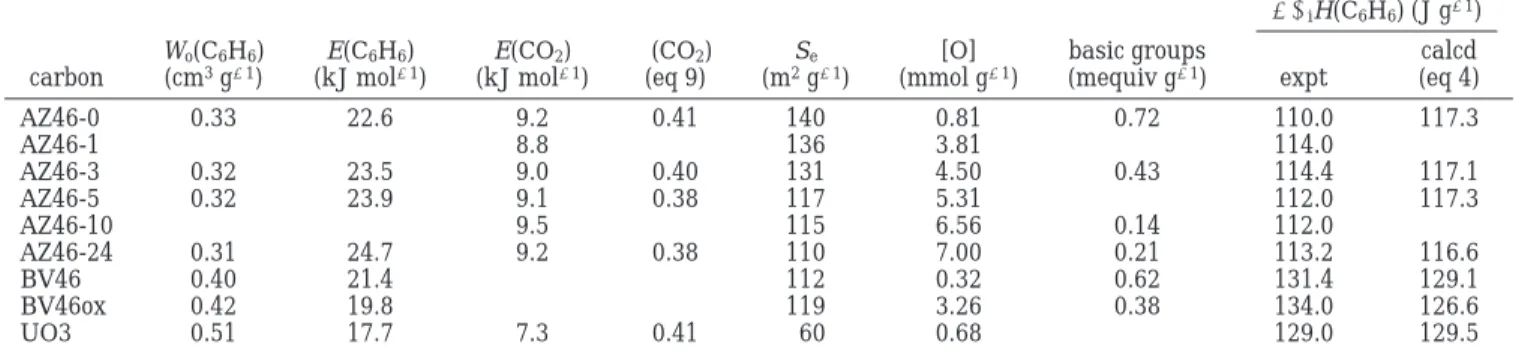
Figures 1 and 2 show the isotherms of benzene, methanol, ethanol, and water on AZ46-0 and AZ46-24. As shown in Table 2, for series AZ46 the adsorption and the immersion data for benzene indicate that the structure of the original material is practically not modified by the oxidation process. On average, the limiting micropore volume Wo) 0.32 cm3g-1and the external surface area
Se shows a slight decrease, from 140 to 110 m2 g-1. Following eq 2, the average micropore width L is close to 0.9 nm.
As shown in Table 2, there exists good agreement between the enthalpies of immersion of the carbons into benzene calculated by eq 4 and the experimental values determined at 293 K, using the experimental data for Se. This provides a test for self-consistency of the adsorption data.
As discussed earlier,5,8in the case of water the increase in the surface oxygen content [O] leads to substantial modifications for the adsorption of water. This is reflected by the change in the shape of the isotherm and the enthalpy of immersion, which depend on the amount of oxygen and on the basic groups present on the surface. The present
study reveals a similar pattern, but to a lesser extent, for methanol and ethanol.
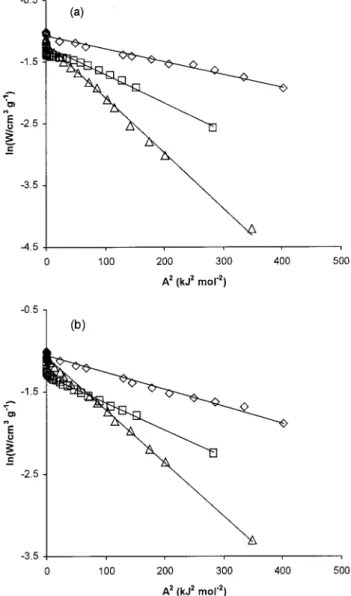
In the case of the adsorption isotherms, the DR plots for benzene, methanol, and ethanol on carbons AZ46-0 and AZ46-24 (see Figure 3) lead to the values of the characteristic energies Eo and E given respectively in Tables 2 and 3. Following eq 9, their ratios correspond to the affinity coefficients β of the two alcohols. In the case of series AZ, the characteristic energy for benzene, Eo, is relatively constant, which suggests that the structure of the carbon has not been altered by the oxidation process. Consequently, the affinity coefficients of the alcohols, with respect to benzene, should remain the same. The increases in β reflect therefore a modification in the behavior of the alcohols, which can be ascribed to a change in specific interactions, not perceived by benzene.
This observation implies, as in the case of water, that the adsorption isotherm of alcohols depends on both the structure of the microporous solid (expressed by Eo) and specific interactions. The latter will be examined in more detail below. At this stage, it is also interesting to note that for series AZ46, the CO2 isotherms do not change significantly, despite the increase in the surface oxygen from 0.8 to 7 mmol g-1. As shown in Table 2, the ratio E(CO2)/E(C6H6) leads to an affinity coefficient β(CO2) of approximately 0.40, which suggests that CO2adsorption Figure 1. Adsorption isotherms on AZ46-0 at 293 K. O, water;
4, methanol; 0, ethanol; ], benzene.
Figure 2. Adsorption isotherms on AZ46-24 at 293 K. O, water;
4, methanol; 0, ethanol; ], benzene.
Figure 3. DR plot for the adsorption isotherms of (]) benzene,
(4) methanol, and (0) ethanol on carbons 0 (a) and AZ46-24 (b) at 293 K.
is not affected by the type of sites introduced in the present treatment. This observation clarifies a recurrent debate on possible specific interactions between CO2and oxygen-containing complexes. However, this does not exclude interactions of CO2with other groups on the surface of carbons in general.
As expected, the enthalpies of immersion of carbon series AZ46 into methanol and ethanol, shown in Table 3, also reflect the changes suggested by the isotherms. It appears that they increase with the degree of oxidation, whereas the enthalpy of immersion into benzene (Table 2) remains constant. The same applies to series BV46. The excess enthalpies of immersion into methanol and ethanol, calculated by eq 8, are given in Table 3.
As suggested by the case of water5,7,8and illustrated by Figure 4, the excess enthalpies are linear functions of the total oxygen content of the surface [O] and are therefore independent of the types of oxygen complexes. For methanol and ethanol, taking into account only the total oxygen content, the linear regressions lead to
and
(regression coefficients of 0.9915 and 0.9912, respectively) Taking into account the basic groups, i.e., correlations of the type a[O + mequiv of HCl] or b[O] + c[mequiv of HCl], does not improve the fits, as the correlation coefficients decrease, in particular for ethanol. In the first case one obtains specific energies of 4.98 J mmol-1 (methanol) and 2.50 J mmol-1(ethanol). For methanol, the second hypothesis leads to specific interactions of respectively 5.24 and 0.03 J mmol-1 with the surface oxygen and the basic groups, against 2.73 and 0.01 J mmol-1for ethanol.
This analysis suggests that in the case of ethanol and methanol the specific interactions can be limited, to a
first and good approximation, to the total surface oxygen and therefore to eqs 14 and 15. It also appears that the specific interactions between the surface oxygen and the alcohols depend on the nature of the alcohol. In the present case, they correspond respectively to 5.32 and 2.64 J mmol-1for methanol and ethanol, against 9.9 J mmol-1 g-1(oxygen and basic groups) for water8. As seen from the data of Table 3, for carbon AZ46-24, with the highest oxygen content (7 mmol g-1), the excess enthalpies into methanol and ethanol represent 27% and 15% of the total enthalpy of immersion. This confirms that the nonspecific interactions dominate in all cases and therefore the isotherm remains basically of type I or II, depending on the relative importance of the external surface area. As shown recently,7 in the case of water the nonspecific interactions are low (approximately 0.8 kJ mol-1of water filling the micropores) and the isotherm depends strongly on the specific interactions. In limiting cases it may even change from the classical type V to type I.
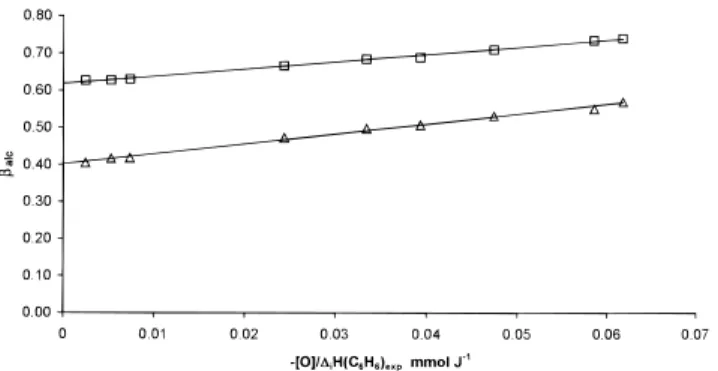
As discussed in the theoretical section, the affinity coefficient can also be calculated from the enthalpies of immersion, by taking ∆iH(C6H6) as the reference. With eq 10, one obtains the values of βalc given in Table 3. In agreement with eq 13, and considering only the surface oxygen, these values are represented in Figure 5 as functions of [O]/∆iH(C6H6)exp. The corresponding linear regressions (correlation coefficients of 0.9943 and 0.9967) lead to
and
These values confirm the lower bounds of the affinity coefficients β° of 0.40 and 0.61, quoted by Wood15 and corresponding to carbons with low oxygen contents. The higher values of βalc given by Bradley and Rand,9,10 respectively 0.45 and 0.65, result from calculations suggested by Dubinin2and do not reflect the real limiting values.
Table 2. Main Characteristics of the Carbons Used in This Study
-∆iH(C6H6) (J g-1)
carbon
Wo(C6H6)
(cm3g-1) (kJ molE(C6H6-1)) (kJ molE(CO2-1)) β(CO2(eq 9)) (m2Seg-1) (mmol g[O] -1) basic groups(mequiv g-1) expt (eq 4)calcd
AZ46-0 0.33 22.6 9.2 0.41 140 0.81 0.72 110.0 117.3 AZ46-1 8.8 136 3.81 114.0 AZ46-3 0.32 23.5 9.0 0.40 131 4.50 0.43 114.4 117.1 AZ46-5 0.32 23.9 9.1 0.38 117 5.31 112.0 117.3 AZ46-10 9.5 115 6.56 0.14 112.0 AZ46-24 0.31 24.7 9.2 0.38 110 7.00 0.21 113.2 116.6 BV46 0.40 21.4 112 0.32 0.62 131.4 129.1 BV46ox 0.42 19.8 119 3.26 0.38 134.0 126.6 UO3 0.51 17.7 7.3 0.41 60 0.68 129.0 129.5
Table 3. Experimental and Excess Enthalpies of Immersion of the Carbons into Methanol and Ethanol; Affinity Coefficients βalcObtained from Eqs 9 and 10 (Isotherms and Enthalpies of Immersion)
methanol ethanol βalc βalc carbon -∆iHexp (J g-1) -∆iHexcess (J g-1) E (kJ mol-1) eq 9 eq 10 -∆iHexp (J g-1) -∆iHexcess (J g-1) E (kJ mol-1) eq 9 eq 10 AZ46-0 99.9 4.2 10.2 0.45 0.42 107.0 0.3 14.7 0.65 0.63 AZ46-1 120.5 21.3 0.50 120.1 9.5 0.68 AZ46-3 123.1 23.6 11.2 0.48 0.51 121.5 10.5 16.6 0.71 0.69 AZ46-5 126.1 28.7 11.5 0.48 0.53 122.5 13.9 16.8 0.70 0.71 AZ46-10 130.2 32.8 0.55 126.5 17.9 0.73 AZ46-24 136.0 37.5 12.5 0.51 0.57 128.9 19.1 17.8 0.72 0.74 BV46 116.0 1.7 0.40 129.0 1.5 0.63 BV46ox 136.0 19.4 0.47 139.0 9.0 0.67 UO3 117.0 4.8 7.1 0.40 0.42 127.6 2.5 0.63 - ∆iH(CH3OH)excess(J g -1 ) ) 5.32[O] (14)
- ∆iH(C2H5OH)excess(J g-1) ) 2.64[O] (15)
β(CH3OH) ) 0.40 + 2.68[O]/∆iH(C6H6)exp (16)
The prefactors of 2.68 and 1.94 J mmol-1 are in agreement with the values of 5.32/c1(methanol) ) 2.45 and 2.64/c1(ethanol) )1.67 J mmol -1suggested by eqs 13-15.
In agreement with eq 9, the affinity coefficient of the alcohol βalc can also be derived from the characteristic energies E of the isotherm, benzene being the reference. This approach, based on an independent technique, should nevertheless be consistent with the results obtained from the enthalpies of immersion, the two being related. As seen in Table 3, for high oxygen contents the values of βalc are somewhat smaller than those obtained from the experimental enthalpies of immersion. This discrepancy may be explained by the difficulty in finding the best fit of the adsorption data to the Dubinin-Astakhov equation. It is interesting to compare this approach with the data provided by Tamon and Okazaki.12 These authors pro-duced three samples by oxidizing an active carbon with HNO3, and determined the adsorption isotherms of a
(25) Rychliki, G.; Terzyk, A. P. Ads. Sci. Technol. 1998, 16, 641.
Figure 4. Excess enthalpies of immersion into (4) methanol
and (0) ethanol. -∆iH(Met)excess(J g-1) ) 5.32[O], correlation
coefficient ) 0.9915; -∆iH(Et)excess(J g-1) ) 2.64[O], correlation
coefficient ) 0.9912.
Figure 5. Variation of βalcas a function of oxygen content. 4, methanol; 0, ethanol. βMet ) 0.40 + 2.68[O]/∆iH(C6H6)exp,
correlation coefficient ) 0.9943; βEt ) 0.61 + 1.94[O]/
∆iH(C6H6)exp, correlation coefficient ) 0.9967.
variety of vapors on all solids. The data, which includes benzene, methanol, and ethanol, was analyzed in terms of a modified DR equation, W ) Woexp[-k(A)2]. This means that k corresponds to -(1/E)2in Dubinin’s formalism and the data can be compared with the present approach. It is found that, for oxygen contents [O] varying between 0.40 and 4.05 mmol g-1, the affinity coefficients of methanol and ethanol increase respectively from 0.44 to 0.95 and from 0.58 to 0.96. The general pattern is similar to that observed in Figure 5, but with steeper slopes. It also appears that the structure of the original carbon is strongly modified by the oxidation progress, the characteristic energy of benzene, Eo, dropping from 18.2 to 14.7 kJ mol-1, as opposed to series AZ46, where the micropore system and the external surface area remain practically constant. In the absence of independent data such as the enthalpies of immersion, it is not possible to cross-check Tamon and Okazaki’s data, but the correlation between the affinity coefficient of alcohols (and other polar adsorptives) and the amount of oxygen is again clearly established.
The present study shows that in the case of activated carbons with oxygen-containing surface groups, alcohols are also subjected to specific interactions with these groups. To a first and good approximation, these interac-tions depend essentially on the total amount of oxygen present on the surface, rather than on type of functional groups. In the case of methanol and ethanol, as opposed to water, the nonspecific interactions prevail, as indicated by the changes in the enthalpy of immersion with respect to benzene. It also appears that the adsorption isotherms follow Dubinin’s theory, but require modified affinity coefficient β. Since the traditional reference for adsorption by microporous carbons is benzene, a molecule which is not sensitive to specific interactions, the classical set of affinity coefficients cannot take into account these inter-actions. An extra variable has therefore to be introduced in the form of specific functions such as eqs 16 and 17, or their logical complements for the enthalpies of immersion given by eqs 14 and 15. This means that Dubinin’s theory can be modified, formally at least, to take into account specific interactions, but predictions become more difficult, as each system has its own set of parameters.
A further property, which has to be investigated in more detail, is the principle of temperature invariance of parameter E in the case of specific interactions. Rychlicki and Terzyk25have shown cases where this principle is not fulfilled by different vapors, including ethanol. However, in the present study the agreement observed between the parameters obtained from the adsorption isotherms and the enthalpies of immersion suggest that the principle of temperature invariance applies. Further systematic stud-ies of adsorption at different temperatures will be carried out, and results will be published in due course.