DYNAMIC ABSORBER LAYER
by Jiulong Meng
BSEE. University of Science and Technology of China, 1988 SUBMIT'ED TO THE DEPARTMENT OF OCEAN ENGINEERING IN PARTIAL FULFILLMENT OF THE
REQUIREMENTS FOR THE DEGREE OF MASTER OF SCIENCE
at the
MASSACHUSETTS INSTITUTE OF TECHNOLOGY February 1991
Copyright @ Massachusetts Institute of Technology, 1991. All rights reserved.
Signature of Author
.1*- " leartment of Ocean E(gjeering
Felo y, 1991
Certified by
Professor Ira Dyer Thesis Supervisor
Accepted by
ProfesWor A. Douglas Carmichael Chairman, Department Committee
DYNAMIC ABSORBER LAYER
byJiulong Meng
Submitted to the Department of Ocean Engineering on February , 1991 in partial
fulfillment of the requirements for the degree of Master of Science.
Abstract
This thesis experimentally tests the effect of a continuous longitudinal dynamic absorber
layer on longitudinal wave propagation in a circular rod. Wavenumber-frequency solutions
are derived analytically. The associated attenuation and phase velocity results are presented to show how their behavior depends on the loading treatment. Experimental results for the phase velocity are compared to a model developed by Dr. Dyer and Olivieri. A relaxation mechanism is developed to fully model the viscoelastic material. It is also shown that the interaction between longitudinal/flexural waves may lead to significant rates of
transformation of the compressional wave energy into bending.
Thesis Supervisor: Title:
Professor Ira Dyer
I would like to express my gratitude to many people whose invaluable contribution made this thesis possible.
Dr. Ira Dyer, for his wealth of insight, guidance and support for this work.
Dr. Richard Lyon and Dr. John Lienhard for their meaningful discussion and advice.
Ms. Marilyn Staruch and Mary Toscano.
My colleagues at MIT: Joe Bondaryk, Djamil Boulahbal, John Briggs, Chifang Chen, Matthew Conti, Chick Corrado Jr, Joe Deck, Kay Herbert, Tarun Kapoor, Kelvin LePage,
Lan Liu, Charles Oppenheimer, Dave Ricks, Ken Rolt, Hee Chun Song, Da Jun Tang; and Alan, Brain, Larry of EECS.
A final note of thanks must go to my family. From them I derived the strength, determination and confidence to make it through and to continue moving forward.
Abstract Dedication Table of Contents List of Figures List of Tables 1. Introduction 2. Analytical Model
2.1 Coupled Wave Equations
2.2 Resonance Characteristic and Relaxation Mechanism 2.3 Wavenumber Analysis
3. The Experiment
3.1 Experiment Design 3.2 Signal Conditioning
3.3 Data Aquisition and Spectrum Analysis
4. Results
4.1 Resonance Frequency and Loss Factor 4.2 Phase Speed From Cross Spectrum Function 4.3 Flexural-Longitudinal Wave Energy Ratio
5. Conclusions
References
Appendix A: Computer Program for Wavenumber Analysis Appendix B: Drive Point Impedance Diagram
Appendix C: Cross Spectrum Data
Appendix D: Longitudinal-Flexural Coupling Data(Symmetric Loading) Appendix E: Longitudinal-Flexural Coupling Data(Asymmetric Loading)
54 56 60 62 69 89 108
Figure 1-1: Elements of a vibratory system
Figure 1-2: Schematic diagrams of dynamic equivalent vibratory systems, Ref[3]
Figure 1-3: Mass-spring-damper model of the dynamic absorber
Figure 2-1: Semi-infinite rod with dynamic absorber Figure 2-2: Three-element spring and dashpot combination
Figure 2-3: Attenuation vs. normalized frequency ratio for 3=3, r=--0.1,0.3,1.0
Figure 2-4: Attenuation vs. normalized frequency ratio for q=0.2, 3= 1,2,3
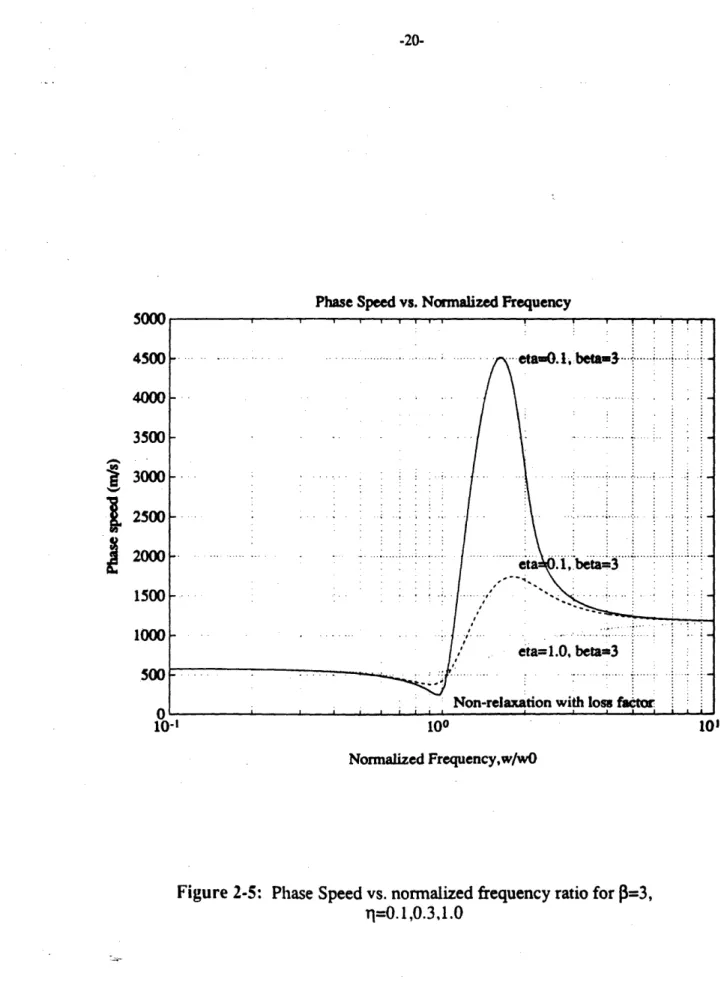
Figure 2-5: Phase Speed vs. normalized frequency ratio for (=3, r--0.l,0.3,1.0
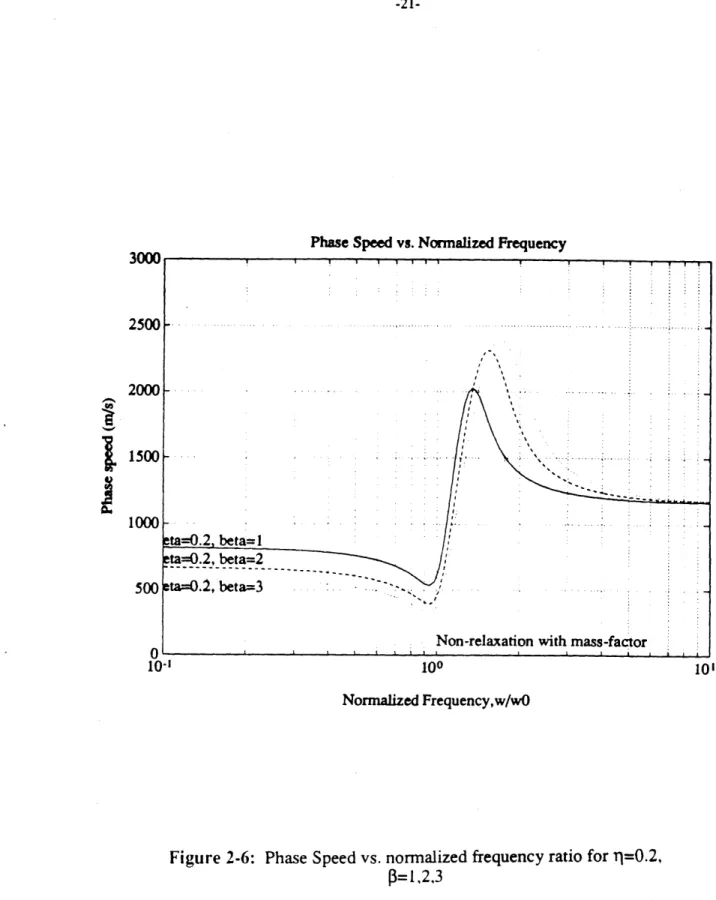
Figure 2-6: Phase Speed vs. normalized frequency ratio for =--0.2, P3=1,2,3
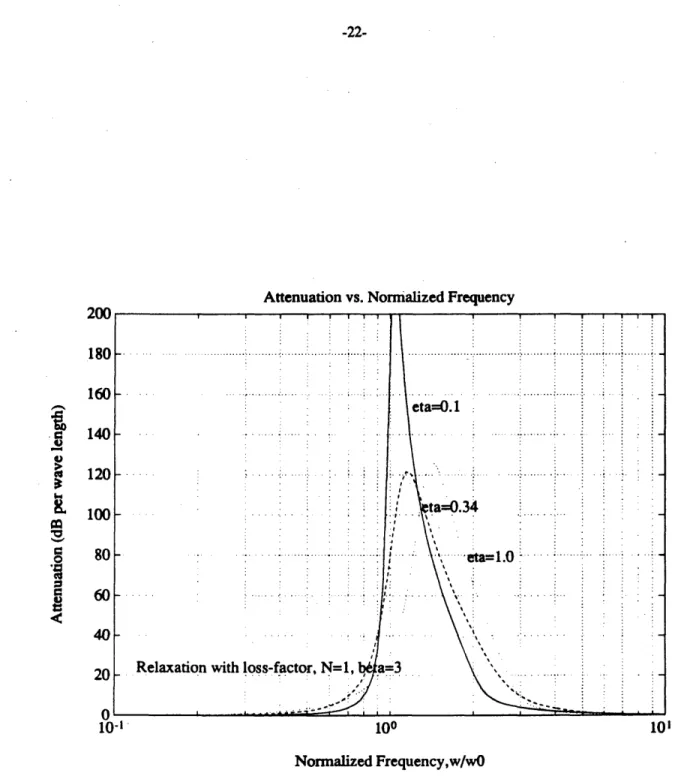
Figure 2-7: Attenuation vs. (o, for 3=3, N=1, -1=0.1,0.34,1.0
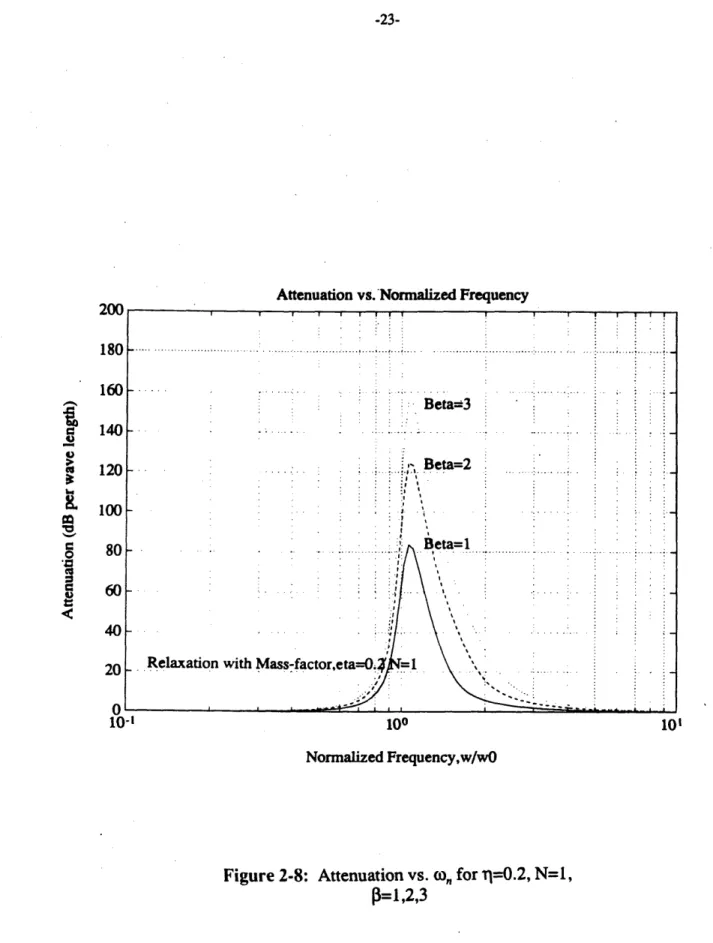
Figure 2-8: Attenuation vs. 3, for =--0.2, N=1, P=1,2,3
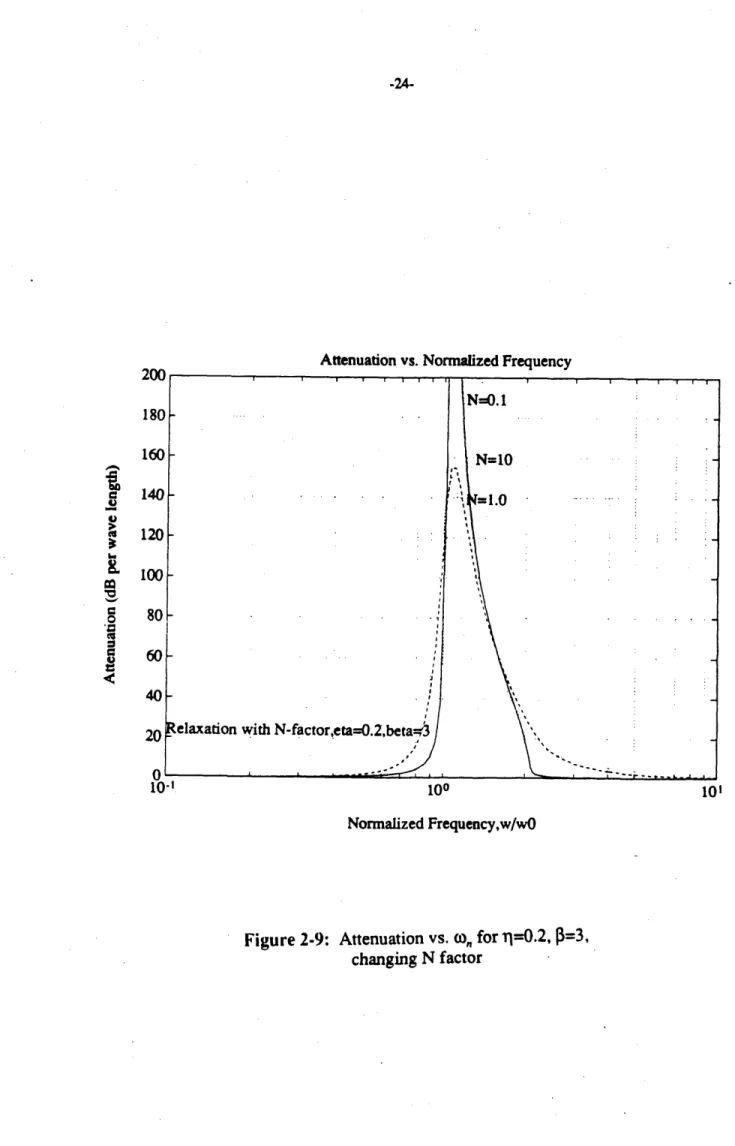
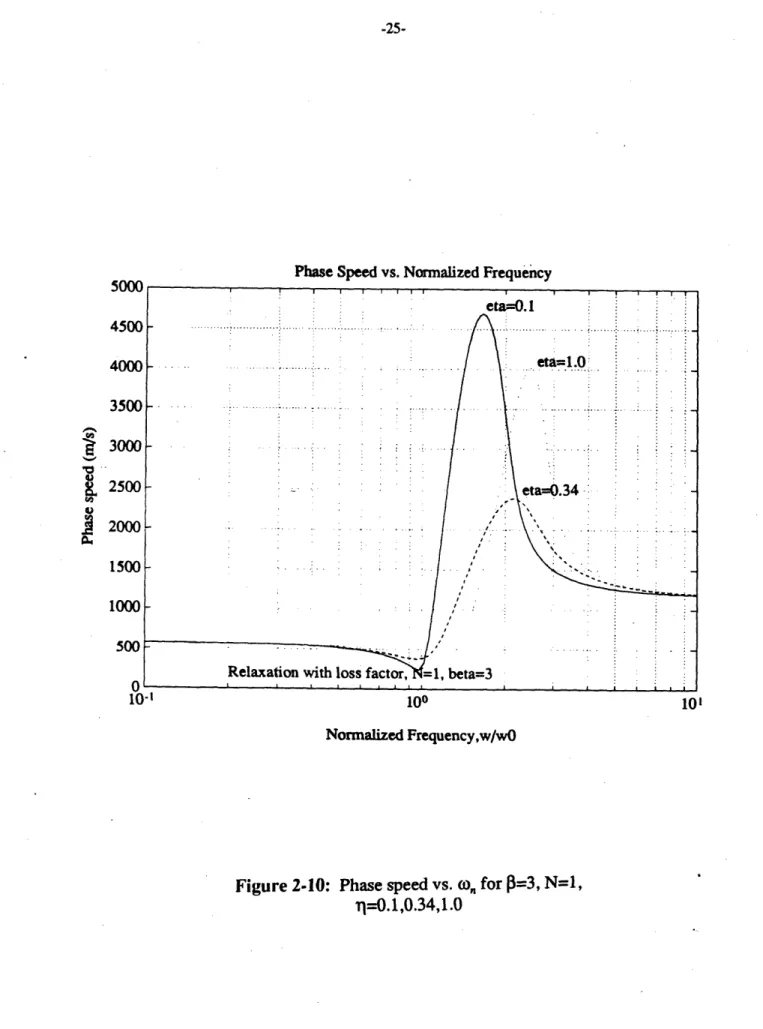
Figure 2-9: Attenuation vs. o, for rl--0.2, 3=3, changing N factor Figure 2-10: Phase speed vs. 0o, for 3=3, N=1, Tr=0.1,0.34,1.0
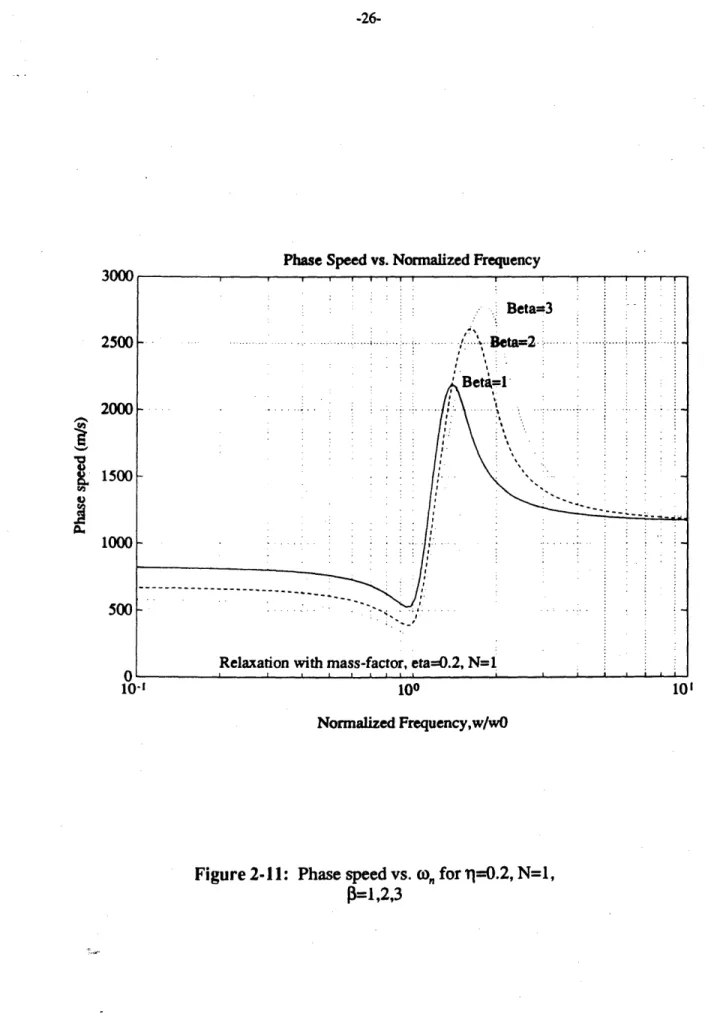
Figure 2-11: Phase speed vs. o, for 1r=0.2, N=1, P=1,2,3
Figure 2-12: Phase speed vs. o,, for 3=3, =--0.2, changing N factor Figure 3-1: Experiment apparatus
Figure 3-2: Resistance bridge with cancellation of flexural vibrations
Figure 3-3: Resistance bridge with cancellation of longitudinal vibrations
Figure 3-4: Decide the range of Rt under the most unfavorable combinations of resistors
Figure 3-5: Six-channel circuit lay-out Figure 3-6: AD624 functional block diagram Figure 3-7: AD624 pin configuration
Figure 3-8: Noise interference problem, initial testing of the conditioning circuit Figure 3-9: 60 Hz and its harmonic interfering noises,conditioning circuit with
proper balance and ground
Figure 3-10: Response of pure tone excitation with battery suplied bridge
circuits
Figure 3-11: Response of pure tone excitation with SNR larger than 30 dB
Figure 3-12: Noise interference problem in data aquisition using the Concurrent
Computer
Figure 3-13: Data aquisition diagram
Figure 3-14: Clock connections on the CK10 and SH16FA modules
Figure 3-15: Sampling of a periodic timing signal
Figure 3-16" LWB modules in the data flow diagram
Figure 3-17: Synchronization virtual instrument
Figure 4-1: Phase speed vs. normalized frequency,ao = 2nfo = 2cn*134.75 Figure 4-2: Longitudinal to flexural coupling wave energy ratio
Figure 5-1: With wave propagation in the dynamic absorber layer
7 8 9 10 15 18 19 20 21 22 23 24 25 26 27 29 30 32 33 34 36 36 37 38 39 40 41 42 43 44 45 46 50 53
55
List of Tables
Table 3-1: AD624A specifications (@ V,= ±15v, Gain= 100, RI= 2kfl and TA 35 = 25 OC
Table 4-1: Resonance frequency and loss factor 49
Introduction
This study investigates the effect of a continuous longitudinal dynamic absorber layer on longitudinal wave propagation in a circular rod. Previous studies [21,22,36,42] relating vibration control to a continuous dynamic absorber layer focused on the attenuation of flexural or longitudinal wave propagation. In this study, an apparatus for measuring phase velocity and flexural/longitudinal wave coupling energy ratio is designed. In addition, a relaxation mechanism is employed to simulate the behavior of the isolator/dynamic absorber.
One of the basic principles in engineering is to start analysis with simple cases. For that reason, modeling of the dynamic absorber in several simple combinations of vibratory elements is studied here.
Hooke Newton Maxwell Kelvin Zener
Figure 1-1: Elements of a vibratory system
9
The mechanical response of viscoelastic bodies are poorly represented by either a spring or a dashpot, which obey Hooke's law and Newton's law, respectively. J.C. Maxwell suggested a series combination of the spring and dashpot elements, which is merely a linear combination of perfectly elastic behavior and perfectly viscous behavior. Another simple element which has been used frequently in connection with viscoelastic behavior is the so-called Kelvin or Voigt model, with a spring and a dashpot in parallel. Creep and stress relaxation studies[2,3,13,14,33,38,39,40,43] reveal that the response of either Maxwell model or Kelvin model to several kinds of deformation does not fully represent some real damping systems. Different combinations of vibratory elements continue to appear in their applications, as cited by S.H.Crandall in the foreword of [33]: vibration theory was essentially complete -except for a realistic treatment of damping.
(a) iLT
I-.
(C)
(b)
Figure 1-2: Schematic diagrams of dynamic equivalent vibratory systems, Ref[3] (a)
When a spring is used as a vibration isolator and damped with a dashpot in parallel (right, the Kelvin or Voigt model) the conventional analysis accurately predicts force transmitted, deflection and damping loss. But when the elastic element is adhesive vinyl foam tape (also known as weatherstrip) with internal damping the conventional analysis may be in substantial error. For such a visco-elastic material, representation with a
relaxation spring added in series with the dashpot (left, known as Zener model) more precisely simulates the behavior of the isolator. It is also regarded as possessing "one and
one-half " degrees of freedom[23].
F.F 0 e F-F
Relaxat unit
Y1 xi
Figure 1-3: Mass-spring-damper model of the dynamic absorber I I
Chapter 2
Analytical Model
2.1 Coupled Wave Equations
We first consider a infinite slender elastic rod with a continuously distributed layer of similar masses, springs and dashpots, transporting longitudinal waves (see Figure 2-1).
kI
r ~ ' I1
Figure 2-1: Semi-infinite rod with dynamic absorber
The equations of motion of this freely suspended rod with Kelvin coupling between u(x,t) and v(x,t) are:
m
2-+ K,(u-v)
+
C-a(u-v)=O
at2
m,-+K,(v-u) + C-(v-u)=E s,
at2
at
TX2
where EI, mi, p,, sl are modulus of elasticity, unit length mass, density and cross
sectional area, of the rod, m,, C, p2, K, are the unit length mass, resistance, density and
stiffness, of the dynamic absorber layer. Finally, u and v are longitudinal displacements of the rod and absorber, and wo which follows is the natural resonance frequency of the
absorber:
-
K,
02
-m2
The damped resonance frequency is usually approximated as mo[7,43]:
(2= 002(1- 2)= 020
with the viscoelastic damping factor typically small, where
- C
2 4Kmn
Since u and v are both space and time dependent, we assume the solution is harmonic and substitute -io for the time derivatives
v = V.ei-(k'x - w-t) u = U-ei'(k'x- w't) in the equation: El a2v a'- K, C S(v-u) - - (v-u) = 0 pI at 2 t2 2 Inl nlat
K2V - KI2V + ---(V-U) -iC•-O(V-U)=O
mE, m,E,
where
1 E=
We can normalize the above equation, with the following non-dimensional parameters: K y - ratio of wavenumber K, =2 mass ratio K, = -o 2m, stiffnless C - loss factor oom2 Wo normalized frequency
Therefore the normalization yields the following equation:
V - v
+
-P(V-U)
-
iP;l(V-U)=o
The coupled equations can now be rewritten as:
V
-v
+
(V-U)-- U + (V-U)--(V-U)-- U-V) On2
ifp(V-U)=o
tO.- il(U-v)=o
onThis is a set of two coupled homogeneous linear equations in U and V. For a
nontrivial solution to exist, the determinant of the coefficients must vanish. This leads to the dispersion relation:
y-1+j3Y -j3Y -Y -1+Y =0 with Y = 1 i (o)2 (on
(y
-
1
+
1Y).(-1 +
Y)
-
P-
=
72(-1 + Y) + 1 - Y - Y = 0 1 1-ilco (onThe roots of this equation in the wavenumber y represent a right going wave and a left going wave. Therefore, there are two different natural modes that can propagate in this semi-infinite rod with an absorber layer. Each mode, of course, can be left going and right going.
2.2 Resonance Characteristic and Relaxation Mechanism
For realistic treatment of damping influence in the vibration isolation, when we look at the indirectly coupled viscous dampling Zener model[35], the complex ratio of stress or strain or, equally, the complex stiffness Kc of the three-element mounting may be written as
1
Kc=K+
(I/NK) + (l/i71()
It is readily shown that the stiffness approximately equals K at low frequency, K + iro. near resonance, and K + NK at high frequency. Therefore this is consistent with the concept of the mass-control, damping-control and stiffness-control regions of a dynamic absorber[24]. Kc K+imoC K isoC 2 - - - (1 + ) m mm K K isoC
+-(1"+')c
m 2KIn our light damping situation,
OC
K
is small near the resonance frequency. We shall therefore be able to approximate 2Oo =
Following the analysis in the previous section, we can easily write down the wave equation for the three-element combination with Zener coupling as:
m, 1 + K ( xt - x, ) + NK( x - x3 ) = Es,x
m2 + K(x 2-x I ) + C ( X-x 3 )
=0
where xI, x2, x3 are the displacements at points shown in Figure 2-2, N is the stiffness ratio of the relaxation spring over the main spring.
X1
Figure 2-2: Three-element spring and dashpot combination
Again we assume a harmonic solution, substitute -iO for the time derivatives, and normalize with the same non-dimensional parameters.
X1 = XIei-(k-x-w-t)
X2 = X.ei-(k-x-w-t)
X3 = X3.ei-(k
x -w-t)
(Y - 1)XI + I(X 1-X2 )/on2 + N0(XI-X3)/0,n 2 = 0
-X 2 + (X:-Xl)/On2 - i0(X2-X3)/1, n = 0
N(XI-X3)/,n 2
- ir(X2-X3)/m,, = 0
1-1+
irlon-N
2.3 Wavenumber Analysis
We introduce a complex wavenumber K, describing propagation of a lightly exponentially decaying wave, Kc = Kr + iK. The imaginary part of the wavenumber representing the right traveling wave is separated to yield an exponentially decreasing amplitude envelope:
ei'(kc-x-wt) = e-kix.e4i-(krx-w-t)
The attenuation per wavelength in dB(dB/A) is stated in terms of the wavenumber components as
Attn = 20-loge-K,-k
where X is the wavelength at each frequency without coupling. We normalize this term to the corresponding wavenumber ratio
Yi =
Ki.--and obtain:
Attn = 54.6yi(dB/X)
In such a dispersive wave propagation pattern, phase and group velocities are defined as:
C•
and
do) gdK
respectively.
The velocities c and c9 can be determined from the dispersion relation. To avoid some complex algebraic manipulation, we write a computer program (enclosed in Appendix
A) solving for both the imaginary component and the real component of the wavenumber
from the above dispersion relation, for both the relaxation (Zener) and non-relaxation (Kelvin) cases.
The following figures, which depict a lightly damped system with different mass ratios, show that both the peak and bandwidth of attenuation increase dramatically with increasing
1,
for both relaxation and non-relaxation models. These figures also reveal that with increasing loss factor, the attenuation and the phase speed peak drops considerably, for the non-relaxation model, but the attenuation bandwidth widens.Furthermore, by increasing loss factor, the relaxation model predicts the attenuation and phase speed drop in the low damping region, increase in the high damping region, and possesses a transition frequency, which is referred to as optimum (attenuation is a maximum at the optimum damping point).
Analytical results are also obtained when holding mass ratio and loss factor unchanged, increasing the stiffness ratio N factor, which causes the attenuation and phase speed to drop.
Attenuation vs. Normalized Frequency eta=0. l,beta=3 i"'" '" '~'' " " " " " '"' '" " '" ~~" "~"~"~ ',eta=0.3,beta=3 Seta=l.Obeta=3. - ---.... . .'... ... . :. . . . . . .. . . •.••,. " • - -•.. . . . _ 0 on-relaxation 10o Normalized Frequency,w/wO
Figure 2-3: Attenuation vs. normalized frequency ratio for 03=3, =--0.1,0.3,1.0 180 160 140 120 100 8 60 40 20 vI-10-'I
,inn
-E ... ~--· . .... .. .. .. .··:· I· r · 1 I r r . -IAttenuation vs. Normalized Frequency
100
Normalized Frequency,w/wO
Figure 2-4: Attenuation vs. normalized frequency ratio for 11=0.2, 13=1,2,3 I' 180 160 140 120 100 o 80 0 60 40 20 0 10-1
Phase Speed vs. Normalized Frequency 4000 3500 3000
-I
2500
-2000 ... ... 135 0 - I ... ,, 1000 " ... ... eta=1.0, beta=3 5 0 0 ... . ...Non-relaxation with loss factor
10-' 100o 10
Normalized Frequency,w/wO
Figure 2-5: Phase Speed vs. normalized frequency ratio for 3=3,
rI=0.1,0.3,1.0
450n'
-
..
. ...
...
.
.
.
1, beta=3
• ~ ... , . . .·.. , ... ·· · ·.,.. . ,
100
Normalized Frequency,w/wO
Figure 2-6: Phase Speed vs. normalized frequency ratio for 11=0.2, O3=1,2,3 2500 2000 1500
I
10001 500 0n eta=0.2, beta=l1 .ta=0.2, beta=3'Non-relaxation with mass-factor
•ta--=.2, bea= 1
10"
-I 10'Attenuation vs. Normalized Frequency
10o- I 100
Normalized Frequency,w/wO
Figure 2-7: Attenuation vs. o,, for j=3, N=1,
1--0.1,0.34,1.0
O~nn8•
"4U 0 10'Attenuation vs. Normalized Frequency
10-' 100
Normalized Frequency,w/wO
Figure 2-8: Attenuation vs. (.
nfor r~=0.2, N=1,
3=1,2,3
0
U
Attenuation vs. Normalized Frequency
100
Normalized Frequency,w/wO
Figure 2-9: Attenuation vs. o,, for 1=0.2, 5=3, changing N factor
1mV
Phase Speed vs. Normalized Frequency
10o
Normalized Frequency,w/wO
Figure 2-10: Phase speed vs. (o. for 3=3, N=l, 1=--0.1,0.34,1.0
cfl,',
a
Phase Speed vs. Normalized Frequency
10-' 100
Normalized Frequency,w/wO
Figure 2-11: Phase speed vs. co, for 1--0.2, N=l, 0= 1,2,3
"Mnn
Phase Speed vs. Normalized Frequency
100
Normalized Frequency,w/wO
Figure 2-12: Phase speed vs. o, for P3=3, ,=0.2, changing N factor 2500 2000 1500
1000
500 0 10- 10' ,2fwvlChapter 3
The Experiment
3.1 Experiment Design
An experiment should be planned to bring into prominence those factors to be studied and to enable their effects to be assessed in relation to the unavoidable errors of experimentation.
The first object to undertake an experimental investigation of wave propagation is to build an apparatus that closely resembles the analytical model: a thin elastic rod with a continuously distributed layer of masses, springs and dashpots, transporting longitudinal waves. A Delrin rod is a solid material used in Olivieri's experiment, which has a very low modulus of elasticity, an average density for a crystalline plastic and one-third of the compressional wave speed that is in steel or aluminum. The use of the Delrin rods was considered fixed, due to the desirability shown in Olivieri's experiment.
To simulate one dimensional propagation of longitudinal waves in an infinite medium, we dampen the propagating waves at the end of the test rod with sand. Enough sand is placed around the end of the rod to reduce wave reflection.
The other end of the rod (not immersed in sand) is drilled and fitted with a bolt, then connected tightly perpendicular to a Wilcoxon Research Fl shaker with a matching Z-602 impedance head.
Input to the shaker was provided by a signal generator with gain provided by a McIntosh power amplifier. The frequency range of the signals, limited by the linearity of the shaker, power amplifier and signal generator, is considered to be low-bounded by 40 Hz.
U,
0
c0
a,EC Uo 0 E 0 S 0ca
a, E 0 0, c *0 0oFigure 3-1: Experiment apparatus
Accelerometers, which were implemented in previous experiments[21,22,36,42] to
measure attenuation spectra, are considered poor choices in measuring phase velocity and
wave coupling energy ratios, because of their phase lag and sensitivity axis difference, and high mass. Instead, strain gauges are used.
3.2 Signal Conditioning
In order to measure longitudinal and flexural waves separately, we need to investigate the strain gage balancing and amplifying circuits.
All commercial strain indicators employ some form of the following Wheatstone bridge circuit to detect the change of resistance in the gage with strain.
Vs
Figure 3-2: Resistance bridge with cancellation of flexural vibrations
In the above well-known Wheatstone circuit, vs and vo are the source and output
voltage of the balancing circuit, respectively; Rgl and Rg2 are two matched gages connected as nonadjacent arms of the bridge circuit (with the same length leadwires, they maintained identical temperature-compensation); and R1, R2 are reference resistors on the two other arms. We find:
Vo_ Rg2 R2
v, R,+Rg2 RgI+R,
where
Rg2 = Ro + A Rt - A Rf
Rgl =Ro+ AR,+ ARf R1 = R2 = Ro
where A R, and A Rf donate to the resistance changes in the two strain gages mounted on the opposite side of the rod at the same distance from the drive point, which reflects the changes in resistance according to the longitudinal and flexural wave propagation. Then:
vo AR, - ARy+Ro Ro
vS 2Ro+AR - ARf 2Ro+AR, + ARf
1 Ro I
2 +(ARt- IAR.) (ARI + ARf)
1+ 1+ 2Ro 2Ro 1 AR - AR ARI - R ARI+AR [= -0 )(,- G(1 (1 )] 2 Ro 2Ro 2Ro
SAR1 - AR, AR- ARf AR +ARf AR,+AR
2 Ro 2Ro Ro 2Ro
With the obvious assumption Ao << 1, we obtain
vo ARi
vS 2Ro
The change of resistance in the strain gage due to longitudinal strain is proportional to the gage factor Fg and actual strain E as ARt = Fg-Ro-• so the bridge circuit output voltage is vo=Vs -T-.
Recall in this case that the measurement cancels out the flexural modes and only contains the longitudinal modes.
In order to investigate the amount of flexural wave energy coupled from longitudinal excitation, the following circuit configuration is used:
+
Vs
Figure 3-3: Resistance bridge with cancellation of longitudinal vibrations
where "~ with the << 1 assumption.
In practice, a Wheatstone bridge is never precisely balanced as a result of the finite tolerances of the bridge resistors. Consequently, some method must be introduced to slightly change the resistance ratios of one side of the bridge. Thus, the pot and trim resistors are introduced as shown:
+
Vs
Figure 3-4: Decide the range of Rt under the most unfavorable combinations of resistors
Given that the resistors RI, R2, R3, R4 are 350.0( ±+ 0.3% (for Micro-Measurement CEA series gages and carefully chosen reference resistors), the maximum value of Rt, for which the bridge can be balanced under the most unfavorable combination of resistors, is decided to be 8.7 kQ. The 50 kQ Rp resistor draws little current and acts simply to control the voltage on one side of Rt.
We now construct this bridge circuit on a proto-board. With a Tektronix ocilloscope and a regulated power supply, we are able to balance the bridge to vo less than or equal to
25 gv.
Considering that the contact resistance at mechanical connections within the bridge circuit can lead to errors in the measurement of strain, a "wiggle" test is made on wires leading to the mechanical connections. The actual change in balance does occur, so we decided to wire-wrap and solder the bridge circuit on a Vector-board to insure that good connections have been made.
The following circuit layout diagram shows six channel balancing bridge circuits and their differential amplifers:
!..:
i"-ii4r'1I
• _i
.--
~-Figure 3-5: Six-channel circuit lay-out
'... ... :.... : : ::::....** * : : * " '... .
9
:
:._
. .....
..
.- -
....
*...--*
. -.
CD o - ... ... . . .. :: :::: ::: : .. .. .... .. . ... :.. .:.::::: ... .. ... .. ... * *. ......
,~~~~~~ . .. ...® . ,, .. .. . ,- .,.... . -. ,,,-... • ... ... .... . ' .. .. . ,I"... .- .. Tc: . . ... ..,+. . . . . . .... .. . .. .. • .. . , . . 0 , ... . .. ... !...! u, ) : .:: .':.. .... O• : : :: : -.. . : :::: : : :: : : :: : 1 .. . . , ... .... . .. c. 0 .. . . . .... . . . . . . . .. ..9 9 , .. . . . . . , . • ..., ... .. . . . . . . .. .. • • • • • ., • i S L . ,L . .. . .. •.. . ... .'j ... ( . .D• ... .. ,, . . .\ .• . . . . .. . .. . . ..\ . .. •... . . ..'... . ,. \ ,. . . . . o..., .7 .7 -. , .4 .. - . CO, ... ,.."- . *, . . . . ! .. ... .. .... .• ' I . ... .... '. ' / i. . .. t . T . ' . . . . . ., ,, ..•.... . . . . .. .. .. .. , . ., . . CCl .. . -.. .. .. .. . .+.. +.. .. g. ... • .,.. O. CL,. 1.... .... S... •.. 4 ...• •••+. . . . .•. . . . .o. . .,V /• - . . . . . . .. . . I * ,. . . ... a i..it o• 1 :::.... ::: 1: •::: •••,:: .. .,• . ,. . . o, ... ... 0. . .. . . - - . . . " I . . .. . . . . . . •. . ... ,4-,* *. . .. ... . .. .. ... ,. .. . .. ,. . ... ... .. . , . . . , . . o•... ,... +... •... +... ,..., | @Avg #feetl l~tTable 3-I: AD624A specifications (@ V, = 15v, Gain = 100, R, = 2k• and TA = 25 OC
The operational amplifier we chose is a AD624 precision instrumentation amplifier. The AD624 amplifier is designed primarily for use with low level transducers (including strain gages), with low noise, high gain accuracy, and low temperature coefficient. For the adjustable pretrimmed gain of 1000, the linearity range of the dynamic response is DC to 25 KHz. The 5V/gs slew rate and 15 gs settling time permit the use in our multiple channel, high sampling rate data acquisition applications.
Speci- Value
Un-fication it
Gain Max Error ±1.0 %
Gain Nonlinearity ±0.005 %
Input voltage range ±10 v
(Max Differ. Input Linear)
Output rating ±10 v
Dynamic response 25 kHz
(small signal -3dB)
Slew Rate 75 ps
Power supply range Min ±5 v
Max ±18
Figure 3-6: AD624 functional block diagram -INPUT I + INPUT r2 RG, -INPUT NULL E4 INPUT NULL E-REFERENCE -Vs 7 * Vs AD624 1" RG, 15" OUTPUT NI 1" OUTPUT NU 7 G = 100 E G - 200 II G -500 101 SENSE "IJ OUTPUT ILL ILL SHORT TO RG, FOR 1D SIRED GAIN
FOR GAIN OF 1000 SHORT RG, TO PIN 12
AND PINS 11 AND 13 TO RG,
Figure 3-7: AD624 pin configuration
-INPUT G 100 G = 200 G = S00 RG, RG, + INPUT SENSE OUTPUT REFERENCE AD624
Too often in experiment designs, noise is considered to be one step down from the weather: hardly anyone even talks about it. Yet it is the noise level in a measurement circuit that ultimately limits the ability of that circuit to transmit faithfully the information carried by the signals being processed. To avoid a "noise-limited" statement that would likely appear in the "conclusion and discussion" chapter, we shall now incorporate into discussion the possible noise sources and their effects.
W12 AUTO SPEC CH.A MAIN Ys -U. 5dB
Yo -6. 5[d /1. OOV2 PWR 80dB X& 61. 50OHz
Xa 54.00Hz - 100Hz LIN
SETUP S1* #As 10C
10-4'--. ... .---- ... ...-... r...
60 70 60 90 100 110 120 130 140 150
SETUP S1
MEASi.:REMENT: DUAL SPECTRUM AVERAGING
TRIGGER: FREE RUN
DELAY: CH. A-*B: 0. Cms
AVERAGINGs LIN 100 OVERLAPs MAX
FRED SPAN: 100Hz AF: 125mHz Ts 8s ATL 7. 81ms
CENTER FREQs ZOOM 104Hz
WEIGHTINGs RECTANGULAR
CH. A: 8V 3Hz DIR FILT: 25. 6kHz 1V/V
CH. 8: 800mV - 3Hz DIR FILT:25. 6Hz V.,V
GENERATOR, VARIABLE SINE
SINE GENERATOR FREQ.a 203. 218Hz
Figure 3-8: Noise interference problem, initial testing of the conditioning circuit
N
W
*
The interfering signals initially were dominated by the interference at 60 Hz and harmonics of 60 Hz, introduced at the Wheatstone bridge circuit. A test signal of a pure tone sine wave at 203 Hz is buried under the 60 Hz, and its harmonics (see Figure 3-9):
j12 AUTO SPEC CH.A CE
Y: -49.1dB /I.0OV2 PWR 8OdB X: GHz - 800Hz LIN #As 100 0 100 200 INPUT MAIN Ys XI 203Hz 300 400 500 600 700 800 SETUP 'A'i MEASUREMENTs TRIGGER: DELA Y: AVERAG INGs FREC SPAN, CENTER FRECQ ElEGHTING%, CH. As CH. Bs GENERATOR:
DUAL SPECTRUM AVERAGING
FREE RUN
CH. A-,8: O. COms
LIN 100 OVERLAP: MAX
800Hz AF 1Hz BASEBAND RECTANGULAR 5CmV + 3Hz DIR 30mV 3Hz DIR VARIABLE SINE
SINE GENERATOR FREQ. s
T, Is
FILTs 25. 6kHz FILT, 25. 6 Hz 203. 218Hz
Figure 3-9: 60 Hz and its harmonic interfering noises,conditioning circuit with proper bala
-71. 7dB
jo-2
' 10-2 T 10-4 U 10-a ATs 488js I V/V IV/V -- L ' · - 1'OD'-~t~~--~l-~..--~-JL
hiBy carefully studying the coupling between the power lines and the experiment
apparatus, along with the use of power transformers and a regulated DC power supply, the interference is reduced by about 10 dB from Fig3-9 (as shown in Figure 3-9, Figure 3-10). With the battery supplied bridge circuits and DC transformer supplied operational amplifier, the signal to noise ratio is satisfactorily increased to larger than 30 dB.
W12 [AUTO SPEC CH. A C 3 INPUT MAIN Yv -105.4dB
Ya -68. 7d- -/1. C3 51.0 PWR 80dB X8 203Hz Xi OHz + 400Hz L. IN #As 100 100 -A L____ _ N E 10-2
10
I n"-4 0 50 100 150 200 250 300 350 400 SETUP WiMEASU'REMENT: DUAL SPECTRUM AVERAGING
TRIGGER: FREE RUN
DELAY: CH. A-B: 0. OOms
AVERAGINGs LIN :00 CVERLAPs MAX
FREQ SPAN: 800Hz AF: 1Hz Til s AT: 488Js
CENTER FREQa BASEBAND
WEIGHTINGs RECTANGULAR
CH. As 30mV + 3Hz DIR FILTsBOTH 1V/V
CH. Bs 30mV 3Hz DIR FILT: BOTH IV/V
GENERATOR: VARIABLE SINE
SINE GENERATOR FREC.: 203. 0OOHz
Figure 3-10: Response of pure tone excitation with battery suplied bridge circuits
W12 I0,'NCISE RATIO Y, 27. 7dB 80dB Xs OHz + 400Hz LIN SETUP 01 #As 100 INPUT MAIN Y: 34. 9dB Xi 203Hz 20 0 -20 -40 - .... ,. .. .,4 0 50 100 150 200
Figure 3-11: Response of pure tone excitation with SNR larger than 30 dB
250 300 1.0 0. 8 0. 6 0. 4 0. 2 C 350 400 0 50 100 150 200 250 300 350 412 CCHERENCE MAIN Y: 6. 92m Y: 1. C X: 800Hz X2 OHz - 400Hz LIN SETUP 01 #A, 100 400
The drifts in power supplies and amplifier offsets are controlled by the balancing adjustment in the circuit. The stray capacity fluctuations and electronic device noises are problems in data acquisition with the Concurrent Computer, as shown in Figure 3-12. With careful shielding, chase and signal grounding, wax-sealing the trimpot, and using the band-pass and low-band-pass filters, we finally achieve an excellent degree of noise isolation in the measurement apparatus. Power-lin ground ac noise source (motor, computer, fan,relay, etc.) Sour Netwo V ng Load ground iSAgnIy C YIuuIIU
3.3 Data Aquisition and Spectrum Analysis
The strain gage output is collected and digitized at the Acoustics and Vibration Lab using the Concurrent Computer.
Figure 3-13: Data aquisition diagram
The analog input from the resistance bridge is amplified by the AD624 operational amplifier. After passing through the Frequency Devices 9016 programmable low pass filter, it is sampled, digitized and displayed with proper triggering, anti-aliasing, synchronizing and clipping.
The AD12FA analog/digital converter, along with a SHI6FA sample and hold module, are used to digitize the data. Two analog/digital channels (Channel 0 and Channel
5) contain amplified signals for flexural and longitudinal waves, respectively.
syne pulse to external de
sync pulse From external
or
external pulse For exter tr ggered sweep!
pulses to 0/A converter
pulses to A/D converter
Inputs
sweep rate clock 0
or exeternal
sync pulse
sweep length clock I
frame rate clock 2
framne length clock 3
burst rate clock 4
resuleteng
timing sequence
The data acquisition on the Concurrent Computer takes place inside the Lab
Workbench (LWB) environment. The analog signal is demodulated using a demultiplexer
module to separate channel 0 from channel
5 (
and multi-channel demodulating, when
applicable).
The channel 0 signal provides the input for a trigger module that controls the data
flow in both channels. The synchronization enables us to measure phase speed in the time
domain. The trigger threshold and intervals are adjustable. This is of importance for future
experimental investigations of multi-mode wave propogation problems.
The power spectra, defined as the Fourier transform of the input time series, are
calculated and displayed with time series for both channels. We can now measure the ratio
of energy transformation as a result of flexural wave coupling with longitudinal excitation.
Chapter 4
Results
4.1 Resonance Frequency and Loss Factor
The quarter wavelength resonance frequency for a free rod of 3.10 m length, with a longitudinal nondispersive wave speed of 1161 m/s, is determined to be 93 Hz. Three tests are conducted to decide the resonance frequency for the Delrin rod with the attached dynamic absorber layer.
An impedance head is installed between the shaker and the contacting surface of the rod. The acceleration and force gage output from the impedance head are taken to the B & K spectrum analyzer.
The drive-point impedance (defined as force over velocity, which comes from integration of the acceleration) is obtained to decide the actual resonance frequency and loss factor.
The first actual resonance peak occurs at a much lower frequency than predicted and is considered to be caused by the resonance frequency of the shaker and sand termination problem, as addressed in Larry Olivieri's report[21].
In order to experimentally decide the loss factor, we conduct a test of the resonance frequency fo and the half power bandwidth (-3dB down from both sides of fo). The loss factor 11 is defined as
fo
for a system consisting of a short rod with a single isolator located very closely to the drive point(mass ratio is 3.2).
Three measurements are conducted and reveal the following results (Plots are enclosed in Appendix B):
Table 4-I: Resonance frequency and loss factor
4.2 Phase Speed From Cross Spectrum Function
The Fourier transform of the cross-correlation function, which is the expected value of the product of two time series, is defined as the cross-spectral density function (Cross Spectrum).
R, (r) = E [y(t) x(t+t) ]
S, (f) R,('t)-.e-i-2'ftd r,
The phase speed of the wave propagation can be determined from the frequency and the phase lag, through phase function 0,,(f) of the cross spectrum
9,(f)= i,(f)l e
- ix(f)
Using the B&K 2032 dual channel signal analyzer to measure the frequency response
Measurement (Hz)
freq. span fto (Hz) f 3dB low(HZ) 3dB high
800 135 111 157 .341
400 134.5 109.5 156.5 .349
200 134.75 107.75 155.25 .353
of a series of pure tone longitudinal excitations to the rod, the phase speed is obtained and compared to the analytical prediction, where the crosses represent the experimental value.
Phase Speed vs. Normalized Frequency
I
U
10-' 100 10'
Normalized Frequency,w/wO
The experimental phase speed is dispersive, with shape as predicted, provided that N = 1.4. The good agreement in shape confirms the analytical model used and also that the attached mass system acts as a continuous longitudinal dynamic absorber. Although an independent measurement of N was not carried out, the Zener model seems to be a significant improvement over the Kelvin model.
4.3 Flexural-Longitudinal Wave Energy Ratio
Power densities referring to longitudinal and flexural wave energy are obtained from the output of two independent sets of stain gages, measuring simultaneously at the same distance away from the drive point. The ratio is presented in dB vs. normalized frequency, and the results reveal that the coupling from longitudinal excitation to a bending wave is much stronger at low frequency than at high frequency.
The estimated spectrum is calculated by Fourier transforming the auto-correlation function of the time series from a sample function, in conjunction with a "window" which is a weighting function applied to data to reduce the spectral leakage associated with the finite observation intervals.
By applying a Hamming window, the power spectra we calculated achieves -30dB down sidelobe level and good frequency resolution of .01 Hz, as shown in Appendix D and Appendix E.
In the symmetric loading case, the flexural wave is considered to be induced by the slight misalignment at the drive point, supporting fishing line, sand termination, and any other imperfections for longitudinal wave propagation.
The experiment results show that the longitudinal to flexural wave coupling is induced significantly by the asymmetric(disc mass adding through half circle weatherstrip to the rod) loading of the resiliently mounted masses. It is also shown in Figure 4-2 that both power spectra decrease linearly in logarithmic frequency scale.
Above resonance frequency, the flexural wave diminishes(-30dB per decade)in the symmetric loading case, while the longitudinal to flexural wave coupling grows (20dB per decade) throughout the investigated frequency span for the asymmetric loading case.
Asymmetric Loading
Flex./Long.
Symmetric Loading
Energy
frequency Symmetric loading Asymmetric loading
(Hz) (dB) (dB) 19.531 9 18
39.063
2
13
58.594
-13
8
78.125 -8 5117.19
-24
-3
156.25 -40 -8 195.31 -35 -25 410.16 -44 -20 800.78 -53 -15Table 4-II: Flexural/Longitudinal coupling wave energy ratio
Vertical
Fkex./ong. wave negy ra•io vs. Nrmalized Frequency
100 10'
Normalized Frequency,w/wO
Power spectrum measurements for a series of pure tone longitudinal excitations to the Delrin rod with a dynamic absorber layer attached, where the crosses represent asymmetric loading and circles for symmetric.
Figure 4-2: Longitudinal to flexural coupling wave energy ratio
A0U 10 0 -10 -20 -30 -40 -50 60I 10-I ... .. - - -. ,..
Chapter
5
Conclusions
For zero damping, a stop band exists for the range 1 < /coo < (1 + (3)n, in which the wavenumber y is pure imaginary. Realistic treatment of damping is applied and the effects of damping parameters to the longitudinal wave propagation through the dispersion relation is verfied from the experiment. The results confirm the analytical model used and that the attached mass system acts as a dynamic absorber.
The three-element combination(Zener model) does stiffen by a small amount as the frequency increases and, by association, is said to possess a transition frequency. This model gives better prediction than the Kelvin model when the loss factor is not too small(1r> 0.2 in our case).
It is also shown that the interaction between longitudinal and flexural waves may lead to significant rates of transformation of the compressional wave energy into bending, as the coupling is much stronger in the asymmetric loading case than symmetric.
Future work may be suggested to have a continuous isolation layer, with consideration of wave propagation in the isolator layer. Also an investigation of multi-mode wave propagation within one layer would appear worthwhile.
-
Velocity, displacement
>
Velocity, displacement
-Figure 5-1: With wave propagation in the dynamic absorber layer
In complex structure testing, e.g. fluid loaded cylindrical shell, use of rubber as a mounting material is generally expected. For this, it is important to fully model the viscoelatic behaviour. Experimental investingation of the stiffness ratio N-factor may thus be important.
References
[1] Abdulhadi, M.I.
Stiffness and Damping Coefficients of Rubber. Ingenieur-Archiv, 55, pp 421-427, 1985. [2] Aklonis, J. J. and Macknight, W. J.
Introduction to Polymer Viscoelasticity. John Wiley & Sons, New York, 1983. [3] Alfrey, T. and Doty P.
The Methods of Specifying the Properties of Viscoelastic Materials. J. Applied Physics, 16(11):700-713,, 1945.
[4] Allen, P. W., Lindley, P. B. and Payne, A. R. Use of Rubber in Engineering.
Maclaren and Sons LTD, London,, 1967. [5] Baer, E.
Engineering Design for Plastics.
Reinhold Publishing Corp., New York, 1964. [6] Bendat, J. S. and Piersol, A. G.
Engineering Application of Correlation and Spectra Analysis. Wiley, New York, 1980.
[7] Bendat, J. S. and Piersol, A. G.
Random Data: Analysis & Measurement Procedures. John Wiley & Sons, New York, 1986.
[8] Brown, R. P.
Physical Testing of Rubbers.
Applied Science Publishers LTD, London ,, 1979. [9] Cremer, L.. Heckl, M. and Ungar, E. E.
Structure Borne Sound.
Springer-Verlag, New York, New York, 1988.
[10]
Feinberg, M.
Vibration-Isolation Systems. Mach. des. 37(18):142-149, 1965. [11] Freakley, P. K. and Payne, A. R.
Theoryn, and Practice of Engineering with Rubber. Applied Science Publishers LTD, London, 1978. [12] Fung, Y.C.
Foundation of Solid Mechanics.
[13] Gent, A. N. and Rusch, K. C.
Viscoelastic Behavior of Open-Cell Forms.
Polymer Conf. Series, Wayne State Univ. , May, 1966. [14] Gurnee, E. F.
Dynamics of Viscoelastic Bahavior.
Polymer Conf. Series, Wayne State Univ. , May, 1966. [15] Harris, Fredric.
On the use of Windows for Harmonic Analysis with the discrete Fourier Transform.
Proc. IEEE, V. 66, No. 1,, 1978.
[16] Hopkins, I. L.
Resonance as Observed by Fitzgerald in Relation to characteristics of the Specimen-Aparatus System.
Polymer Conf. Series, Wayne State Univ. , May, 1966. [17] Junger, M.C. and Feit, D.
Sound, Structures and Their Interactions. The MIT Press, Cambridge, MA, 1986. [18] Kaul, R.K. and McCoy, J.J.
Propagation of Axisymmetric Waves in a Circular Semi-infinite Elastic Rod.
JASA, 36, pp.653-660, 1964.
[19] Kerwin, E. M. Jr. and Ungar E. E.
Discussion of paper entitled 'Damping Structural Resonances Using Viscoelastic Shear-Damping Mechanisms' by J. E. Ruzicka.
Trans. ASME, J. Eng. Ind. 83(4):424, 1961. [20] Klyukin, I. I.
Influence of the Elastic Dissipation Parameters, Load characteristics, and Degree of Lateral Constraint of Vibration-Isolation Elements on Their Damping Properties.
Soviet Physics Acoustics, 28(1):46-49, 1982. [21] Olivieri, L.A.
The Effect of Dynamic Absorbers on Longitudinal Wave Propagation in A Circular Rod.
S.M. Thesis, MJ.T. , September, 1989. [22] LePage, K.D.
The Attenuation of Flexural Waves in Asymmetrically Masses Loaded Beams.
S.M. Thesis, M.I.T. , September, 1986. [23] Levitan, E. S.
Forced Oscillation of a Spring-Mass System having Combined Coulomb and Viscous Damping.
[24] Lyon, R. H.
Machinary Noise and Diagnostics. Butterworths, Stoneham, MA, 1987. [25] McNiven, H.D.
Extensional Waves in a Semi-infinite Elastic Rod. JASA, 33, pp.23-27, 1961.
[26] Meirovitch, L.
Elements of Vibration Analysis. McGraw-Hill, Inc., 1975. [27] Morse, P.M. and Ingard, K.U.
Theoretical Acoustics.
Princeton University Press, Princeton, 1986. [28] Nishinari, K.
Longitudinal Vibration of High-Elastic Gels as a Method for Determining Viscoelastic Constants.
Jap. J. A. Phy. 15(7):1263-1270, 1976. [29] Nolle, A. W.
Methods for Measuring Dynamic Mechanical Properties of Rubber-Like Materials. J. App. Physics, 19(8):753-774, 1948.
[30] Plunkett, R.
Mechanical Impedance Methods.
The American Society of Mechanical Engineers, 1958. [31] Ruzicka, J. E.
Forced Vibration in Systems with Elastically Supported Dampers. S.M. Thesis, M.I.T. , June, 1957.
[32] Ruzicka, J. E.
Resonance characteristics of Unidirectional Viscous and Coulomb-Damped Vibration Isolation Systems.
Trans. ASME, J. Eng. Ind. 89(4):729-740 ,, 1967. [33] Ruzicka, J. E.
Influence of Damping in Vibration Isolation.
Technical Information Division, Naval Research Lab, Washington, D.C. ,, 1971. [34] Senturia, S.D. and Wedlock, B.D.
Electronic circuits and Applications. John Wiley & Sons,.
[35] Seybert, A. F.
Estimation of Damping from Response Spectra. J. Sound Vib. 75(2):199-206, 1981.
[36] Smith, Timothy, L.
The Attenuation of Flexural Waves in Mass Loaded Beams. S.M. Thesis, M.I.T. , May, 1985.
[37] Snowdon, J. C.
Vibration Isolation: Use and Characterization. Rubber Chem., 53(5):1041-1087, 1980.
[38] Snowdown, J. C.
Vibration and Shock in Damped Mechanical Systems. John Wiley & Sons, Inc., 1968.
[39] Soroka, W. W. Vibration Isolators.
Prod. Eng. 141-145 , July, 1957.
[40]
Sperry, W. C.
Rheological-Model Concept. JASA, 36(2):376-385, 1964. [41] Steven, Kay and Stanley, Marple.
Spectrum Analysis -A Modem Perspective. Proc. IEEE, V.69, No. 11 ,, 1981.
[42] Taylor, P.D.
Wave Propagation in a Beam Having Double Resonant Loading.
S.M. Thesis, M.I.T. , August, 1987.
[43] Tse, F. S., Morse, I. E., and Hinkle, R. T.
Mechanical Vibrations : Theory and Applications. Allyn and Bacon, Boston, 1978.
[44] Tse, F. S. and Morse, I. E.
Measurement and Instrumentation in Engineering. Marcek Dekker, New York, 1989.
[45] Ungar, E. E. and Kerwin, E. M. Jr.
Loss Factors of Viscoelastic Systems in Terms of Energy Concepts. JASA, 34(7):954, 1962.
[46] Welch, P. D.
The Use of FFT for the Estimation of Power Spectra.
IEEE Trans.Audio & Electroacoust, V.AU-15, No.2, June, 1967. [47] William, H. Press, etc.
Numerical Recipes, & Example Book (Fortran). Cambridge Univ. Press, 1989.
Appendix A: Computer Program for Wavenumber Analysis
for k-1:250: tl(k)-(2*k+1)/50.0; rl(k, ) -l+beta/(l-(tl(k)*tl(k))/(1+i*ata*tl(k)*N/(i*ata*tl(k)-N))); r(k,1) -sqrt(rl (k,1)); att (k, 1) 54.6*imaqg (r (k, 1) ) ; c (k, 1) -1161/(real (r (k, 1))); end; for k-1:250; tl(k)-(2*k+1)/50.0; rl(k,2) -1+beta/(1- (tl(k)*tl(k)) / (+i*ata*t(k)*N/(i*ata*tl(k)-N))); r(k,2)-sqrt(rl(k,2)); att(k,2)-54.6*imag(r(k,2)); c(k, 2)-1161/(real(r(k,2))); end; for k-1:250; tl(k)-(2*k+1)/50.0; rl(k, 3)-1+beta/(1-(tl(k)*tl(k)) / (l+i*ata*tl(k)*N/(i*ata*tl(k)-N))); r(k,3)-sqrt(rl(k,3)); att(k,3)-54.6*imag(r(k,3)); c(k,3) -1161/(real (r (k,3))); end; text(2.2,2900,'N-0.1,eta-0.204,beta-3.23') >> axis([-1,1,0,30001) >> semilogx (t1, c) >> grid >> axis([-1,1,2,4]) >> loglog(o,c)>> title('Phase Speed vs. Normalized Frequency')
>> xlabel('Normalized Frequency,w/w0') text(2,1500,'Non-relaxation') >> text(2.2,2500,'Relaxation') >> ylabel('Phase speed (m/s)') text(1,40,'eta-0.204, beta-3.23') text(.3,0,'Kl=.6 K2,eta-0.204,beta-3. 23') text (2.2,2900, 'N-0.1')
text(.2,50, 'Relaxation with N-factor,eta-0.204,beta-3.2 3')
>> print('oe -h')
text(.7,1800,'Non-relaxation')
text(.3,2500,'Relaxation with N-1)
text(1,40,'Loss factor 0.284, Mass ratio 3.23')
text(.7,2800,'Relaxation with N-.3') text(.7,2200,'Relaxation with N-1.5') semilogx (tl, c) semilogx (tl, att) axis ([-1,1,2,41) axis ([-1,1,0,30001]) axis([-1,1,0,2001)
text(.12,20, 'Relaxation with N-factor,eta-0.2 N-1')
>> clg
>> semilogx(ti,att)
>> title('Attenuation vs. Normalized Frequency')
>> xlabel('Normalized Frequency,w/wO')
>> ylabel('Attenuation (dB per wave length)')
>> text(.12,20, 'Relaxation with Mass-factor,etaO0.2 N=1')
>> text(1.2,150,'Beta-3')
>> title('Attenuation vs. Normalized Frequency') >> xlabel('Normalized Frequency,w/wO')
>> ylabel('Attenuation (dB per wave length)')
>> grid >> text(l.2,190,'eta=0.1,beta=3') >> text(1.2,100,'eta-0.3,beta=3') >> text(1.2,40,'eta=1.0,beta=3') >> text(.1,20,'Non-relaxation') >> axis((-I,1,0,200]) axis ([-i,1, 0,3000]) for k=1:250; tl(k)=(2*k+1)/50.0; rl(k,l) =l+beta/(1-tl (k)*tl(k) / (l-i*ata*tl(k))); r (k,l)=sqrt(rl (k,1)); c(k,1)=1161/ (real (r (k, 1))); att(k,i)=54.6*imaq(r(k,1)); end; for k=1:250; tl(k)=(2*k+1)/50.0; rl(k,2)=l+beta/ (1-tl(k)*tl(k) r(k,2)=sqrt(rl(k,2)); c(k,2)=1161/(real(r(k,2))); att(k,2)=54.6*imag (r(k,2)); end; / (1-i*ata*tl(k))) ; for k=1:250; tl (k)=(2*k+l) /50.0; rl(k,3) =l+beta/(l-tl(k)*tl(k) / (1-i*ata*tl(k))); r(k,3) sqrt(rl(k,3)); c(k,3) 1161/(real (r(k,3))); att(k,3)=54.6*imag(r(k,3)); end;
Appendix B: Drive Point Impedance Diagram
Measurement
f
(Hz)
freq. span f a
(Hz)
f 3dB Iow(HZ) 3dB high800
135
111
157
.341
400
134.5
109.5
156.5
.349
200
134.75
107.75
155.25
.353
" N NtI O 0O O NO moa z Iz OqN x1 w w 0 So a o a e
(Y
0 N 00g
Q.
>
L
o l
4,6
Z 0 0C V 0m o 0 1 ' N d d d d 10 xO 0 0 a 0 * .N L-nz
Ix o 2 o o w O Z 0 w o 0 w WO -. N I-• " el -4J O °H ao0C o ) 44 4.0) .C 0 4-> uc 4)Q4 0 O 4,4) m w ma w 4 00 r-4 CO) o 0 4-o0 C E 0 U * X9a w N CO 0 0) o * f N .- d d d a .0 o 0"-0 10 0 N 0
o
z <a m N I-O0 O CO NO lo C) (r/0• N V-6 3 (z SJ--I I 0 0< 4 ]= N=NJg,' oa. 0 0 0 O4 $4 0 44 r.40 O0OI O --0m m ro 4•0 S'm 0 O0 0 w 4 U Z + N • NN 10013 0 O ) a Uo rY C-O •'• •L o ••- < t 0 L o m 00 O M N 01. 0 9,.No 0
>c;
o 0 z S0 IO NO< I 4 in + N ( 0 3k 0 IL OL .. r~ C N C S 0 ?i -. 1 . -. .**. . *...I # n > P o co0
0 C)a
0 d 0 aw00
NO 44i-41' zN * CO S O m 0 it 4-)CO0 0 ry0) E oi ora
a
roE
U)c
g A s. 0 N e 0 0 X a cy - U 'i' 'i 'I ' 0 0 c a CI a a ¶u V a I I o O 0-* eN Z 0 N N O*N ) C 0 • wo z N0 0 *00 '.4 O OO NO .C O O Om 4J 0 C, 4 W N$ •) * IN fU) -o L OO 4 0 0 *N X003 '-9 . o. 1 IO C Ko * *._ I Im
"0cJ m'-4 I N 37 < 'U 0XI N V i N+I -4 L-:o : ) La
a a a o o a a d 0 N * Oz . m I -. 0 IO 1 J I t NJO
1 <S<, 0
x
+N a 0 a a - C 1 O L0 ... em - . . . . . . . .m '3 (I ,,N In ;V1 z xx IL o. Z 3 0 0< N I--- m
wq
a a j
:3:J.-x (
a 0 g 9 a 0 N "I N8
0 a S. . d d d d 3 c a a E ; C | i ;I E H rj a a30 1 I I Im
X -A. Aw1 11 L 8 ,N I m <,a 7X N ly a2
N 0< Z + SN Nt SWOI 0 . . U'QL 3>-XU)0 0 0 0 0 ' N 0 U 6
z
p n CL N m U I t N - d d' d d' 0 Ex m M N -I 0 In IxD
a-z E N)N >-0 NO 0 O N< U X WJ N , IN WOO--O. 0. · N 0 N I 03IN N I-c B :, r d O 13 aL 0 C N 0 0 0 U 0 C 0 a C cN 0 0 N I 0?Appendix C: Cross Spectrum Data
Cross spectrum data
= 3.23, 11= 0.348, f o0 134.75 Hz
f f f phase delay phMe speed
(Hz) (degree/120.0cm) (m) (m/s) 0.20 26.625 31.0 13.94 371.0 0.31 41.687 34.4 12.56 523.5 0.56 74.00 91.2 4.737 350.5 0.63 84.00 79.0 5.468 459.3 0.70 93.00 79.4 5.441 506.0 0.73 97.00 88.4 4.887 474.0 0.77 103.00 100.5 4.299 442.7 0.84 112.00 104.5 4.134 463.0 0.99 132.00 107.8 4.007 529.0 1.27 168.25 77.1 5.603 942.7 1.41 187.25 67.9 6.362 1191 1.73 229.5 53.4 8.090 1857 1.80 239.0 50.9 8.487 2028 1.92 256.0 59.7 7.236 1852 2.68 356.0 101.2 4.269 1520 3.43 456.0 145.0 2.979 1359 4.24 564.0 180.0 2.400 1354 4.80 638.0 255.9 1.688 1077 5.66 753.0 279.3 1.547 1165
0 0 0 a O O I I O O d 0 z Z 0 m a. ) 00 ) .0 0U 0 IO 0 .N a ,7 N >.. 0 SzNI= 4-0N 0 .D1 iU N Z Xx WZ I 0. L)
;
.+
+ ON MN 'l ON. N I-NX rW NO ID 0-o U Z N WI WOON - 0.. NO Oa o •O•1 N sro v·(3 --L N II - -u .0 Z . I ZX U) a. I-L " 1 Z -'1-4 0. -- * I f
°
°-.
.
(fl p-N... .. . p •i . P L*1L
-.j 's. : o 0 0 U 0. (I u 9' - (n -. . - 4I ** I*c | · I 5 rd .e r .. 1 · ,-w *t U z w O:cr (LI :3 C. 0. u .tjL 32 0 N -'J S-c. Li C; L 4) 10 . el.·h-La
1.
. .··+ o w 0 N II0 0 o Z IX a-z Z Lf <J I a-u NO O 0 O N3>X
f m
S 00°
a-6
0 m 00) -aCr M (N
a 4S
a N a a* 0 a 0 a q I " d d d . u o 07 @'o to8
0 0 g a U o sI,
t
0 0 o o N --L N mx
O N L m I-0 0 O 0 z -4 IX 2 J -4-I NO C w +k NU Z N wZ ( ON WCON 0 0 . . m i N mW N a mI
U w 0 0 a;; N N II 0 0 .0 co Z <a x-z w fl <-I I 3: 0~ N < I WnOI i V a f OLX