Contract-Based Safety Verification for Autonomous
Driving
by
Lucas Liebenwein
B.Sc., Swiss Federal Institute of Technology Zurich (2015)
Submitted to the Department of Electrical Engineering and Computer
Science
in partial fulfillment of the requirements for the degree of
Master of Science in Electrical Engineering and Computer Science
at the
MASSACHUSETTS INSTITUTE OF TECHNOLOGY
September 2018
c
○ Massachusetts Institute of Technology 2018. All rights reserved.
Author . . . .
Department of Electrical Engineering and Computer Science
August 28, 2018
Certified by . . . .
Daniela Rus
Professor of Electrical Engineering and Computer Science
Thesis Supervisor
Accepted by . . . .
Leslie A. Kolodziejski
Professor of Electrical Engineering and Computer Science
Chair, Department Committee on Graduate Students
Contract-Based Safety Verification for Autonomous Driving
by
Lucas Liebenwein
Submitted to the Department of Electrical Engineering and Computer Science on August 28, 2018, in partial fulfillment of the
requirements for the degree of
Master of Science in Electrical Engineering and Computer Science
Abstract
The safe, successful deployment of autonomous systems under real-world conditions, in part, hinges upon providing rigorous performance and safety guarantees. This thesis considers the problem of establishing and verifying the safety of autonomous systems. To this end, we present a novel framework for the synthesis of safety con-straints for autonomous systems, so-called safety contracts, that can be applied to and used by a wide set of real-world systems by acting as a design requirement for the controller implementation of the system. The contracts consider a large variety of road models, guarantee that the controlled system will remain safe with respect to probabilistic models of traffic behavior, and ensure that it will follow the rules of the road. We generate contracts using reachability analysis in a reach-avoid problem un-der consiun-deration of dynamic obstacles, i.e., other traffic participants. Contracts are then derived directly from the reachable sets. By decomposing large road networks into local road geometries and defining assume-guarantee contracts between local geometries, we enable computational tractability over large spatial domains. To effi-ciently account for the behavior of other traffic participants, we iteratively alternate between falsification to generate new traffic scenarios that violate the safety contract and reachable set computation to update the safety contract. These counterexamples to collision-free behavior are found by solving a gradient-based trajectory optimiza-tion problem. We demonstrate the practical effectiveness of the proposed methods in a set of experiments involving the Manhattan road network as well as interacting multi-car traffic scenarios.
Thesis Supervisor: Daniela Rus
Acknowledgments
I would like to start by thanking my advisor, Daniela Rus, who has been a constant source of inspiration and motivation throughout the last two years at the Distributed Robotics Lab. Her counseling and guidance have helped me over and over again, and allowed me to step into the world of research. It has been an invaluable experience and I look forward to the coming years.
I would also like to thank Sertac Karaman who has provided me with crucial insights during our many meetings and discussions. Cristian-Ioan Vasile and Jonathan DeCastro also deserve particular thanks for all their hard work and enlightening moments. They introduced me to formal methods and verification, and have taught me a great deal about these techniques. Many of the ideas in this thesis originated from our discussions.
During my undergraduate research, I was lucky enough to be advised by Max Kriegleder and Raffaello D’Andrea. It was my first exposure to robotics, and I have been in the field since then. I will always be grateful to them for guiding me through this time and teaching me so much about science. When I first visited MIT, Emilio Frazzoli took it upon him to help me choose an advisor and introduced me to Daniela. His counseling during these days was a tremendous support to help me settle into graduate school.
My time here would have not been the same without the members of the Dis-tributed Robotics Lab, many of which have become my dear friends. I would like to thank Felix Naser, with whom I shared an office for a year. Our countless crazy moments are a more than welcoming distraction to keep a fresh mind. I will always remember the endless hours and nights Cenk Baykal and I have spent solving prob-lem sets and working on research. Cenk’s passion for theoretical computer science has inspired me to strike a new path in my research. I am fortunate to be able to call him my close collaborator, office neighbor, and friend. I would also like to acknowledge my other friends and members of the lab, including Brandon Araki, Thomas Balch, Igor Gilitschenski, Robert Katzschmann, Teddy Ort, Wilko Schwarting, Alex Wallar,
and many more. It is an honor to be part of such a unique group of people.
I would have never come this far if it were not for my family. Their unconditional love and support gave me strength and courage to pursue my dreams. Among my many family members, I would like to thank my mother, Jutta, for all the moments of counseling and advice in every aspect of my life; my father, Karl, for being there when it matters the most; my sister, Leonie, for being the best sister one could imagine; my two brothers, Constantin and Nicolaus, for being such sweet and joyful boys; my aunt and uncle, Karin and Wolfgang, for always having an open ear for my sorrows; and my grandmother, Berta, for being such an inspiration and role model to look up to.
Finally, I would like to thank my wife and love of my life, Pia. She has been there for me at every imaginable moment to guide me, support me through my struggles, and give me the strength when I needed it the most. I could not be here without her. Her passion, joy, and wonderful heart are unparalleled and made me into the person I am today.
Contents
1 Introduction 17
1.1 Contributions . . . 21
1.2 Outline of Thesis . . . 21
2 Related Work 23 2.1 Local Motion Planning . . . 23
2.2 Reachability Analysis . . . 24
2.3 Verification and Synthesis . . . 25
2.4 Falsification . . . 27
3 Contract Synthesis with Known, Dynamic Obstacles 29 3.1 Problem Definition . . . 29
3.1.1 Ego-car . . . 30
3.1.2 Road Network . . . 30
3.1.3 Traffic . . . 30
3.1.4 Controllers and Driving Behaviors . . . 31
3.1.5 Safety . . . 31
3.2 Methods . . . 32
3.2.1 Library of Parameterized Models . . . 34
3.2.2 Reachability Analysis . . . 35
3.2.3 Verification of Controller Contracts . . . 36
3.2.4 Road Network Verification . . . 39
3.4 Implementation . . . 41 3.4.1 Reachability Tool . . . 41 3.4.2 Set Representation . . . 42 3.4.3 Set Pruning . . . 42 3.4.4 Reduction of Complexity . . . 42 3.5 Results . . . 45
3.5.1 Dynamic Motion Model and Dynamic Constraints . . . 45
3.5.2 Other Vehicles . . . 46
3.5.3 Drivable Space . . . 47
3.5.4 Rules of the Road . . . 48
3.5.5 Admissible Configurations . . . 48
3.5.6 Road Library and Network . . . 49
3.5.7 Traffic Model . . . 49
3.5.8 Experiments . . . 50
4 Contract Synthesis with Counterexample-Guided Obstacles 55 4.1 Problem Definition . . . 55
4.1.1 Stochastic Models of the Traffic System . . . 56
4.1.2 Problem Formulation . . . 57
4.2 Methods . . . 58
4.2.1 Overview . . . 58
4.2.2 Gradient-Based Probabilistic Falsification . . . 60
4.2.3 Collision-Free Safety Conditions . . . 62
4.2.4 Reachability with Contracts . . . 63
4.2.5 Computation of Contract . . . 64
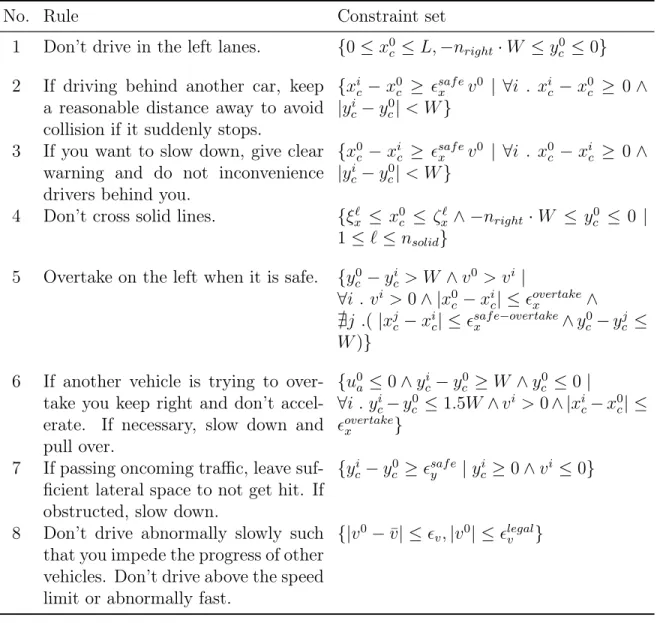
4.2.6 Rules of the Road . . . 65
4.3 Implementation . . . 66
4.4 Results . . . 69
5 Conclusion 73 5.1 Conclusion . . . 73
5.2 Future Work . . . 74 5.3 Lessons Learned . . . 75 5.4 Funding . . . 76
List of Figures
1-1 The network shows the Manhattan street grid. We verified a part of Manhattan consisting of ca. 130 blocks with 180 intersections and 330 straight road segments (marked black) using a library of 22 verified segments. This underlines the gain in efficiency of the compositional-based approach compared to that of a direct naive approach. . . 18
3-1 Consider the library ℳ = {𝑚1, 𝑚2} composed of a straight road 𝑚1
and a four-way intersection 𝑚2. (a) The four-way intersection 𝑚2 is
shown. (b) The entry set is propagated forward, and, (c), concurrently pruned of unsafe states induced by other cars. (d) The safe exit set is the intersection of the safe reachable set at time step 𝐻, the verifica-tion horizon, and the exit set. (e) The safe entry set is computed by backward propagating the safe exit set. (f) Lastly, the composition of the models using the associated assume-guarantee contracts enables us to certify road networks. . . 34 3-2 (a) The exact Minkowski swept volume between the ego-car and
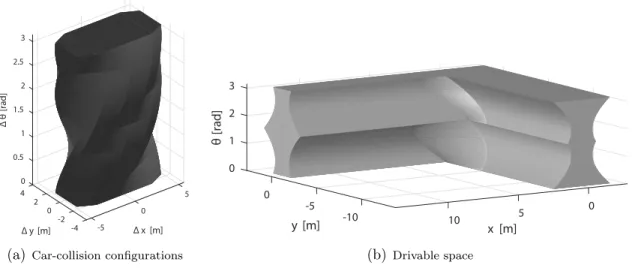
an-other vehicle, which represents configurations in collision, is shown. (b) Drivable space in a four-way intersection left-turn scenario obtained by taking the Minkowski sum between the rectangular ego-car and the road over Δ𝑞, i.e., D(𝒵). This is used to trim the admissible state space. Because of symmetry and for brevity, 𝜃 is only shown for [0, 𝜋]. Approximations to 10 𝜃-slices are used in the implementation to reduce computational complexity. . . 47
3-3 The dynamic obstacles (black) and the drivable space (grey) are shown for time 𝑘 on the left. Set subtraction yields the admissible configura-tion volume A𝑘 (right). . . 49
3-4 The forward propagation of the reachable set is shown for a left turning maneuver. Blue sets indicate the safely reachable configuration set 𝑔𝑞](𝑍𝑘) (top row), and the position set 𝑔𝑝](𝑍𝑘) (bottom row) of the
ego-car for various times 𝑘. Black sets mark the swept volume C𝑖𝑘(𝒵) (top row) and the footprint ℬ𝑖(𝑥𝑖
𝑘; ℛ) (bottom row) of other traffic
participants. The entry and exit sets are shown in green and red, respectively. Note how the ego-car maintains a safe distance to the other cars and the road boundaries at all times. . . 51 3-5 Backward propagation on the four-way intersection 𝑚 for various times
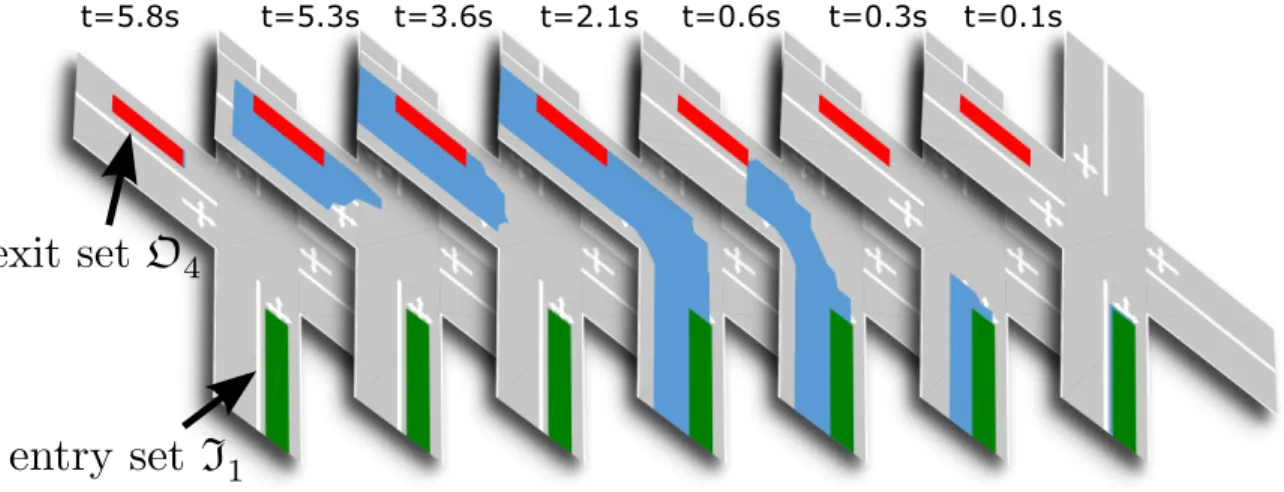
𝑘. At 𝑡 = 6.0𝑠, we start out at[𝑍𝑇 = 𝑒𝑥𝑖𝑡(𝑚, 1, 4) = O4 and compute
the backward reachable set[𝑍𝑘 (marked blue) for each time 𝑘 to obtain
the safe entry set 𝑒𝑛𝑡𝑟𝑦(𝑚, 1, 4). . . 52 3-6 A selection of verified road models, comprised of various intersections
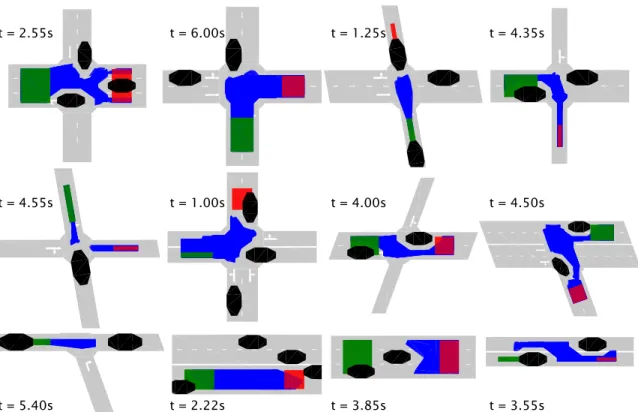
and straight roads, is shown together with the reachable set (blue) and other traffic participants (black) at the indicated timestep. The initial and final set are marked green and red, respectively. . . 53 3-7 The box plot indicates computation times for various parts of one
it-eration with a fixed timestep of ℎ = 0.05𝑠 averaged over all conducted experiments. . . 53
4-1 Two iterations of the overall approach. . . 60 4-2 Different iterations of the approach. Within each iteration, the upper
two plots indicate a counterexample trajectory of the traffic system that falsifies collision-free behavior under the proposed contracts. The lower plot illustrates a new contract that guards against the counterex-ample. . . 70
4-3 The contract for timestep 𝑡 = 4.8𝑠 at iteration 4 for each set of param-eters. . . 71 4-4 The log-likelihood for each test case across all iterations. The red ×
marks iterations where the contract terminated with an empty set, and the green dashed line indicates the chance constraint 𝛼. . . 71
List of Tables
3.1 Symbols table. . . 33
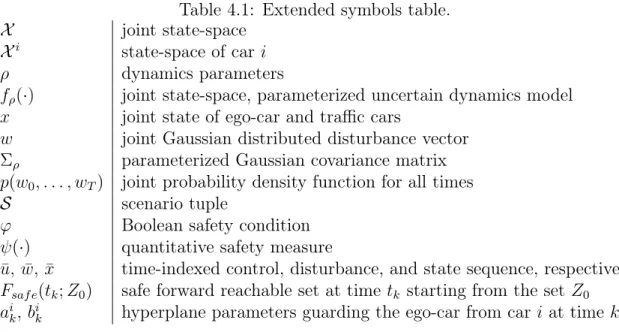
4.1 Extended symbols table. . . 59
4.2 Rules of the road for highway scenarios. . . 67
Chapter 1
Introduction
The way we use and think about mobility and transportation has changed signif-icantly in the last years due to many recent developments in autonomous driving. With the increasing space of potential applications, the required safety certificates for deployment are becoming increasingly difficult to manage both in terms of com-putational complexity for simulations and the hours spent on road testing. Moreover, safety guarantees are not only required for the safe deployment of systems but can also act as a key stepping stone in gaining customers’ trust in autonomous systems.
To this end, we consider the problem of providing rigorous safety guarantees for au-tonomous car controllers through formal verification methods with respect to vehicle, environment, and traffic models. Formal verification can fill the gap of certification by providing a platform to assess safety with clear assumptions and guarantees. While simulation and testing are undoubtedly essential tools for deployment of complex systems, they lack the completeness, and therefore the guarantees, of verification, potentially missing out on rare and hard-to-characterize events.
Recent studies [36] have indicated that the requirement to demonstrate safety for an autonomous car is hundreds of millions of miles of testing taking possibly tens of years to complete. To meet these proof-of-safety demands, testing and simulation, which provide very detailed insights for specific events, can be supplemented with verification frameworks, which provide insights for an entire set of events, though often less detailed. In such a sense, verification provides a way to check over an
Figure 1-1: The network shows the Manhattan street grid. We verified a part of Manhattan consisting of ca. 130 blocks with 180 intersections and 330 straight road segments (marked black) using a library of 22 verified segments. This underlines the gain in efficiency of the compositional-based approach compared to that of a direct naive approach.
infinite number of simulated trajectories as opposed to straightforward case-based simulation at the cost of reduced model complexity.
Despite its appeal, verification can quickly become computationally intractable. For any realistic scenario involving a large number of interacting agents, a large road network, and complex autonomous system implementations, obtaining correct-ness guarantees becomes prohibitively expensive. Since verification usually requires reasoning about the entire set of possible outcomes, which is potentially of infinite cardinality, analytic solutions to verification do not exist, and instead we require ef-ficient approximation algorithms. Moreover, the verification process typically must be repeated whenever any part of the autonomous systems is modified, thus heavily reducing the practicability and reusability of such guarantees.
Current state-of-the-art work, including [3, 25, 45, 47] among others, in verifica-tion has considered the synthesis of safety guarantees for a variety of autonomous systems, such as aerial systems and autonomous vehicles. Previous work has either leaned towards simplifying the system to be verified [25, 47] or towards considering more conservative, coarse approximations of complex systems [3, 45] to cope with
the issue of computational tractability. As a consequence, the question of combining large-scale safety guarantees with complex control systems has not been adequately addressed. In this regard, our work aims at closing the research gap between the vast, mostly independent prior work in verifying large-scale systems and in verify-ing complex systems by proposverify-ing methods to synthesize safety guarantees that are simultaneously applicable to large-scale and complex systems.
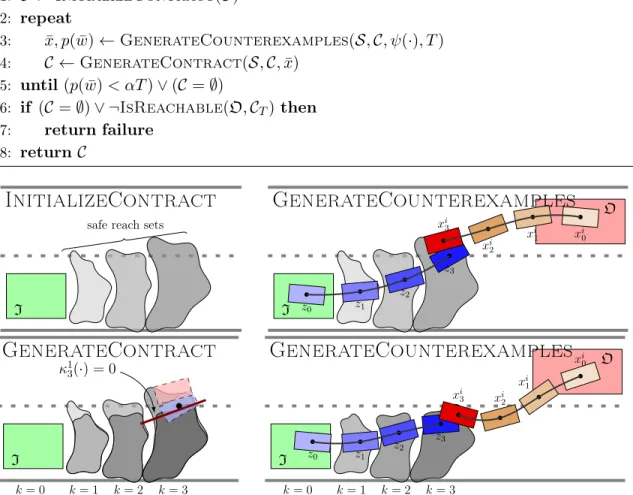
In particular, in this thesis we present a novel framework to concurrently verify and synthesize compositional safety contracts for autonomous systems that are em-bedded in probabilistic traffic scenarios within large road networks and consider rules of the road. By means of generating contracts – instead of verifying the system itself – we may reuse the obtained safety contract, which constitutes a set of constraints in the autonomous system’s state space, enabling scalable verification across any au-tonomous system that implements the safety contract. By means of decomposing the verification tasks into local tasks – instead of verifying the entire system at once – that consider particular traffic scenarios and road geometries, we achieve computational tractability over large domains.
The local verification task and contract synthesis method is based on reachabil-ity analysis, which computes the safe (collision-free) subset of the state space for each timestep. Within these local tasks, we verify local road models, such as in-tersections, and synthesize the contract that allows an autonomous system to safely traverse the local road model. We then compose guarantees for larger road networks through appropriate safe entry and exit sets, i.e., assume-guarantee contracts, which are part of the safety contract. Moreover, we employ falsification to search for rel-evant traffic counterexamples from the rich probabilistic behavior models of other traffic participants. These counterexamples are used to populate the local verifica-tion tasks with traffic. That way, we avoid the need of verifying over the entire set of possible behaviors and overcome the tractability issues arising from verifying such a complex system. The falsification method to find traffic counterexamples is based on a gradient-based trajectory optimization problem with chance constraints. Both methods, reachability analysis and falsification, are combined in an iterative
fash-ion to verify local road models where during each iteratfash-ion we first find a proposal contract using reachability analysis and then try to falsify the proposed contract by searching for a counterexample.
In this sense, we provide safety guarantees for controllers and planners of au-tonomous systems that can operate under consideration of the safety contract, which can be readily implemented via state-space constraints. The focus hereby lies on obtaining safety guarantees for road networks that are known a priori, such that we can obtain the necessary safety guarantees in an offline procedure before deployment. Moreover, as we consider a priori known road networks, the probabilistic traffic model can be validated and augmented using real-world traffic data from the considered road network to ensure its accuracy. While we do not actively consider perception as part of the verification procedure, we note that the modular, decomposable approach of our method can be leveraged to also introduce assume-guarantee contracts between the control system and the perception system, such that (potentially probabilistic) safety guarantees for the perception system can be derived independently.
The proposed framework enables a variety of novel capabilities. Using composi-tionality, we can verify the safety properties over domains, such as the road network shown in Figure 1-1, previously considered to be too large to be tractable using tradi-tional verification techniques. We also argue that the framework results in explainable verification since the found traffic counterexamples from falsification quantify the type of behavior that the contract can and/or cannot guard against. Moreover, through probabilistic modelling of traffic agents, we can evaluate the particular behavior of certain traffic agents in terms of the amount of risk a certain counterexample imposes. The contract synthesis method itself can account for rules of the road while ensuring safety. We can therefore evaluate the performance of the system, not only in terms of safety but also in terms of the desired behavior, and limit the type of behavior that is allowed through an explainable set of rules.
1.1
Contributions
This thesis contributes the following:
1. A safety verification problem formulation that entails providing safety guaran-tees for a large set of autonomous systems and introduces the notion of safety contracts as verification guarantee.
2. A contract synthesis procedure based on reachability analysis that considers rules of the road, local road geometries, road networks, and probabilistic traffic behavior.
3. A gradient-based falsification approach that enables efficient generation of a wide variety of probabilistic traffic scenarios with tunable behavior via chance constraints.
4. Domain-specific methods and implementations to overcome tractability issues, including efficient methods for reachability analysis and set-based operations. 5. Empirical results demonstrating the broad applicability and practical
effective-ness on real-world inspired traffic scenarios, including simulation results on the Manhattan road network and highway overtaking maneuvers.
Preliminary versions of these results have appeared in [21, 42].
1.2
Outline of Thesis
This thesis is organized as follows. In Chapter 2, we present related work in safety verification and discuss the scope and limitation of previous work. In Chapter 3, we formally introduce the safety verification problem and describe the verification framework used to verify and synthesize safety contracts. We show how reachability analysis can be leveraged to synthesize safety contracts in dynamic, known traffic scenarios and present a compositional approach to compute safety guarantees over
large spatial domains. We also present a case study on the Manhattan road net-work. In Chapter 4, we relax the assumption of known, dynamic traffic scenarios via falsification. We show how we use a gradient-based trajectory optimization method to identify probabilistic traffic counterexamples, which can be used to update the contract in an iterative manner. Empirical results on a highway overtaking scenario are also presented. In Chapter 5, we conclude with a discussion on the presented approaches and mention potential directions for future work.
Chapter 2
Related Work
Our work leverages and hinges upon prior work in local motion planning, reachability analysis, formal verification and synthesis, and falsification.
2.1
Local Motion Planning
Methods to compute safe trajectories for autonomous vehicles in dynamic environ-ments have been proposed in various contexts [50]. Using input space discretization, motion planning can be performed on a grid with graph algorithms [26, 64]. Sampling-based methods, such as rapidly exploring random trees [38], sample the state space for points and aim at generating an optimal time-discretized trajectory from the sam-pled points. Receding horizon control [24, 59], or model-predictive control, leverages nonlinear optimization tools to directly optimize a trajectory over a cost map under consideration of constraints, such as dynamics. This can also be applied for shared-control of highly automated vehicles [57] where the authors consider the human input as additional term in the cost function to minimize the deviation from the human input. These methods work well in practice but usually compute valid and safe trajec-tories only up to a pre-defined time horizon with no global and long term guarantees. In this work, we aim to obtain guarantees via safety contracts, which are employed by the local planner.
accounting for disturbances, such as uncertainty in the dynamics and the state of the robot. This yields to approaches such as model predictive control with tubes [46], where the tubes represent a safety margin around the nominal, desired trajectory. Other approaches include planning using motion primitives [29] based on Hamilton-Jacobi reachable sets and a sampling-based planner that can reason about uncer-tainty [41]. Moreover, the concept of funnels [45, 62], where a library of funnel-based motion primitives is built up to account for uncertainty in the state, has been shown to be applied to robust motion planning. In contrast to some of the prior work (such as [24, 46]), our work explicitly accounts for reachable sets based on the underlying dynamics of the robot system. Compared to approaches such as [29, 45, 62], where dynamics are also accounted for through the appropriate reachable sets, our work aims at building a library of safety constraints, i.e., a safety contract, that can ac-count for a wide variety of dynamic obstacles while simultaneously being applicable to a large variety of motion planners. In other words, the safety contract may be imple-mented by any desired motion planner, either sampling-based or optimization-based for example.
2.2
Reachability Analysis
A large body of literature has been devoted to the formal analysis of reachability of systems. For finite systems efficient search mechanisms over the state-transition graph can be used to check the reachable states, e.g., Clarke et al. consider binary decision diagrams to this end [15]. For continuous systems, the authors of [9] and [13] propose to use sampling-based methods to compute reachable sets. In [35], the reachable set of continuous systems is computed using a combination of Runge-Kutta methods and affine arithmetic. The reachable sets of hybrid systems have also been extensively investigated in various contexts [4, 5, 12, 47].
Accurate reachability analysis necessitates the computation of the reachable states from an (uncountable) set of states, which is computationally intractable in prac-tice [60]. Therefore, a vast collection of prior work has focused on developing
approx-imation algorithms, such as finite abstractions, for the computation of approximate reachable sets. To this end, an approach to computing overapproximations of reach-able sets using zonotopes is presented in [2] and implemented as the CORA toolbox. The authors propose to approximate nonlinear systems polynomial systems and to account for approximation errors by appropriately inflating the underlying zonotopes. Taylor flow tubes are used to compute overapproximations of reachable sets in the work of [11]. Tools such as HyTech [32] and [14] consider only linear dynamics. In [25, 47] the task of computing reachable sets is cast as Hamilton-Jacobi Partial Differential Equations (PDEs) and standard tools for solving PDEs are used. Virtu-ally all of these tools, however, compute over-approximations and cast the generVirtu-ally (highly) non-linear system dynamics as polynomials or even linear functions, which results in potentially unbounded error terms. Moreover, they are highly sensitive to the dimensionality of the input space and suffer to a great extent from the curse of dimensionality [47]. More recently, the work in [43] considers a sampling-based approximation method to underapproximation of reachable sets with provable ap-proximation guarantees.
In this thesis, we consider the use of reachability analysis to verify the safety over local road models, which is used to synthesize safety contracts as well as guarantees over larger domains. This way, we avoid the computational tractability issues over large state space domains while allowing to synthesize contracts and guarantees over large domains.
2.3
Verification and Synthesis
Applications of reachability analysis range from ensuring the safety of mobile robots in human environments to flight maneuver verification. In particular, the work in [10, 23, 27, 52, 58, 67] investigates applications of reachability analysis to verifying grasping and manipulation tasks. Other applications include aerial robotics [30] and mobile robotics [44].
such as aerospace [7] and automotive [48, 49, 66]. In the automotive field, prior work has focused on time-bounded behaviors and simple motion primitives rather than the verification of controlled systems over complex, structured environments. In [1] and [3], the authors consider the use of reachability analysis for online safe motion planning in an autonomous vehicle. Accounting for model and sensing uncertainties through reachability analysis, the proposed method can reason about all possible future scenarios under consideration.
The contractual approach to verification has been proposed for complex system designs in many different domains [55] and has found numerous applications in re-cent verification and synthesis techniques, which exploit compositional approaches [6, 18, 39, 53] and assume-guarantee contracts [33, 54]. These approaches enable the separation of the controller design from the verification procedure and enable verifica-tion over larger, otherwise computaverifica-tionally intractable, domains. Our work is similar to [39, 40], where a compositional approach to synthesizing contracts is presented for traffic networks that must adhere to global specifications.
The idea of creating constraints based on a behavioral model may be viewed as an instance of robust explicit model-predictive control. The approaches in [19, 65] aim to synthesize controllers that satisfy a high-level task specification while in [20] the goal is to synthesize simple partitions of the state-space based on reachable sets. In contrast to our work, the aforementioned approaches assume simple, non-probabilistic environment behaviors and are limited in the scope of the system and/or model considered. On the other hand, the contracts considered in this thesis are rep-resented as simple state-space constraints on the car’s behaviors, which are shown to be valid for highway-type scenarios, including lane keeping, lane changing, and merging, as well as city-type scenarios, including various turning maneuvers in inter-sections. To this end, we leverage compositional and contract-based verification to simultaneously achieve scalability and computational tractability in the model (large road networks), the system (control system of car), as well as the considered traffic scenarios (allowed behaviors of dynamic obstacles).
2.4
Falsification
Falsification [9, 13, 51] aims to find counterexamples that violate a given property and enables the analysis of more complex systems than verification at the cost of completeness. The problem – as opposed to verification – becomes one of finding failures, rare events within distributions capturing realistic driving behaviors, which can be difficult to solve.
Bhatia and Frazzoli propose to use sampling-based algorithms, such as rapidly exploring random trees, to capture failure events by sampling points until either a counterexample is found or the search space is exhausted. Counterexample guided abstraction refinement methods, such as the work presented in [16, 37], are based on the idea to initially start with an abstract, simple model that may produce counterex-amples. Through an iterative approach, the model is then refined in subsequent steps to produce more relevant counterexamples. The authors of [56] propose to use the cross-entropy method to efficiently guide the sampling of random scenarios to find relevant counterexamples.
In contrast to sampling-based methods, such as [9, 56], we leverage a gradient-based probabilistic optimization to falsification of systems involving a large number of agents in short scenarios with few discrete decisions. This approach allows us to quickly converge on solutions by optimizing their utility at each iteration step and thus identify highly-relevant traffic scenarios, i.e., a collection of trajectories of dynamic obstacles. Moreover, the falsification-based approach to identify relevant traffic scenarios enables computational tractability since we are not required to verify the system over the entire domain of possible traffic scenarios. We also note that – similar to related work – the highly nonlinear nature of the problem prevents a globally-optimal solution, i.e., conclude that the added certificates are a formal proof of safety. However, our approach seeks to iteratively find locally-optimal counterex-amples at each step of the contract-generation process and hence targets important failure cases that sampling-based approaches may miss.
Chapter 3
Contract Synthesis with Known,
Dynamic Obstacles
In this chapter1, we define the safety verification problem and present a framework to concurrently synthesize and verify safety contracts, i.e., a set of state space constraints for the autonomous system (ego-car). The safety contract is computed using reach-ability analysis and can be implemented by any control strategy that can account for state-space constraints, such as receding horizon and sampling-based controllers. We show how we can synthesize safety contracts for a large variety of local road ge-ometries and how we can subsequently use these local contracts to synthesize safety contracts for large road networks. For the sake of simplicity, traffic, i.e., dynamic obstacles, are assumed to be known. This assumption is further relaxed in Chapter 4.
3.1
Problem Definition
In this section, we introduce the safety verification problem of controllers for au-tonomous cars. We define models for the ego-car, the road network, traffic, con-trollers, and safety that form the context of the verification problem. An overview of
1This chapter is based on Lucas Liebenwein, Wilko Schwarting, Cristian-Ioan Vasile, Jonathan
DeCastro, Javier Alonso-Mora, Sertac Karaman, and Daniela Rus. Compositional and contract-based verification for autonomous driving on road networks. In International Symposium on Robotics Research. International Foundation of Robotics Research, 2017.
the notation used in this chapter is given in Table 3.1.
3.1.1
Ego-car
The ego-car is defined as a dynamical system 𝑉 = (𝒵, ℛ, 𝒰 , 𝑓𝑒𝑔𝑜, 𝑔𝑝, 𝑔𝑞) evolving
according to 𝑧𝑘+1 = 𝑓𝑒𝑔𝑜(𝑧𝑘, 𝑢𝑘), where 𝒵 ⊆ R𝑛𝑒𝑔𝑜 is the state space, ℛ ⊂ 𝒵 the
workspace, 𝒰 ⊆ R𝑛𝑢 the control space, 𝒬 ⊂ 𝑆𝐸(2) the configuration space (pose) of the car, and 𝑧𝑘 the state of the car at time 𝑘. Further, let 𝑓𝑒𝑔𝑜: 𝒵 × 𝒰 → 𝒵, 𝑔𝑝 : 𝒵 →
R2, and 𝑔𝑞 : 𝒵 → 𝒬 be the Lipschitz continuous (invertible) dynamics, observation
function, and configuration space submersion, respectively. Then, 𝑝𝑘 = 𝑔𝑝(𝑧𝑘) and
𝑞𝑘= 𝑔𝑞(𝑧𝑘) denote the location and pose of the car at time 𝑘, respectively. Moreover,
let ℬ(𝑧𝑘) ⊂ 𝒵 be the ego-car’s footprint at time 𝑘, and let
ℬ(𝑍𝑘) =
⋃︁
𝑧𝑘∈𝑍𝑘 ℬ(𝑧𝑘)
denote the ego-car’s footprint for a set of states 𝑍𝑘 ⊆ 𝒵. Finally, let 𝑡𝑘 = ℎ𝑘 denote
the time at 𝑘, where ℎ is the time step.
3.1.2
Road Network
The workspace with its associated rules ℛ contains the roadway of the road network the car operates in, which is a planar compact connected region, and the rules of the road associated with the roadway. We assume that ℛ ⊆ 𝒵, i.e., that we can express the road, which follows naturally, and its rules in terms of state space constraints on the ego-car. In Chapter 4, we will elaborate in details on rules we consider and how they may be implemented.
3.1.3
Traffic
The road network associated with the ego-car is also populated by other traffic partic-ipants, e.g., pedestrians, bikes, and cars. For brevity, we only consider other cars. We denote the state of car 𝑖 present on the road ℛ at time 𝑘 by 𝑥𝑖𝑘, 𝑖 ∈ {1, . . . , 𝑁 (𝑘)},
where 𝑁 (𝑘) is the number of cars in ℛ at time 𝑘. We consider a traffic model 𝒯 = (𝒱(0), I, O, 𝑆), where 𝒱(0) = {𝑉𝑖}𝑁 (0)
𝑖=1 is the set of vehicles present in ℛ at
initial time 𝑘 = 0, I ⊂ 𝒵 and O ⊂ 𝒵 are sets of states for entering and leaving the road network, and 𝑆 is a scheduler that generates cars at I and destroys them at O, see Section 3.5 for an example in the form of a hybrid system. Similar to the ego-car, we denote by ℬ𝑖(𝑥𝑖
𝑘; ℛ) ⊂ 𝒵 the footprint of traffic car 𝑖 at time 𝑘 according to the
rule set ℛ. We note that making the footprint dependent on the rule set allows for including rules, such as varying safety margins, in the footprints of the traffic cars.
3.1.4
Controllers and Driving Behaviors
The behaviors of all the cars are defined by controllers (feedback or open-loop). For-mally, a controller for car 𝑖 is a map from all the car states 𝑥𝑘= [𝑧𝑘, 𝑥1:𝑁𝑘 ] ∈ 𝒳 ⊆ R𝑛to
a control value 𝑢𝑖𝑘, i.e., 𝐶𝑖 : 𝒳 → 𝒰 such that 𝑥𝑖𝑘+1 = 𝑓𝑖(𝑥𝑖𝑘, 𝐶𝑖(𝑥𝑘)), ∀𝑖 ∈ {1, . . . , 𝑁 },
where 𝑓𝑖 defines the dynamics of car 𝑖. Similarly for the ego-car, we let 𝐶 : 𝒳 → 𝒰
denote the controller of the ego-car such that 𝑧𝑘+1 = 𝑓𝑒𝑔𝑜(𝑧𝑘, 𝐶(𝑥𝑘)). 𝒳 hereby
de-notes the joint state-space of all the cars and 𝑥𝑖
𝑘 denotes the state of car 𝑖 at time 𝑘,
as before. Throughout the paper, we will tacitly assume that the other cars’ models are given together with the controllers that define their behavior and are known a priori for verification.
3.1.5
Safety
The controller for the ego-car is said to be safe at time 𝑘 if it does not collide with environment obstacles, the road boundary, or other vehicles, and if it respects the rules of the road ℛ. To this end, let ¬ℛ denote the complement of the road with its associated rules, and let ℬ𝑖(𝑥𝑖𝑘; ℛ) ⊕ ℬ(𝑍𝑘) denote the Minkowski sum ("⊕") between
the footprint ℬ𝑖(𝑥𝑖
𝑘; ℛ) of car 𝑖 and the ego-car’s footprint ℬ(𝑍𝑘) at time 𝑘. Moreover,
we note that a desired safety margin, i.e., minimum distance between the ego-car and other vehicles, can be considered to be part of the rules ℛ and thus appropriately included for in the footprint ℬ𝑖(𝑥𝑖𝑘; ℛ) of the other cars. Then, the ego-car is said to
be safe at time 𝑘 for a set 𝑍𝑘⊆ 𝒵 of potential states if inf 𝑧∈𝑍𝑘,𝑜∈𝒪𝑘 ‖𝑧 − 𝑜‖ > 0, where 𝒪𝑘 = ¬ℛ ∪ 𝑁 ⋃︁ 𝑖=1 ℬ𝑖(𝑥𝑖 𝑘; ℛ) ⊕ ℬ(𝑍𝑘)
denotes the set of unsafe states. Similarly, the ego-car is safe on {0, . . . , 𝑇 }, 𝑇 ∈ N∪{0, ∞}, if it is safe for all times 𝑘 ∈ {0, . . . , 𝑇 }. The set of constraints representing safety are hereby said to be the controller contract 𝒞, which is synthesized during the verification procedure as explained in Section 3.2.3.
The problem that we address in this paper is checking the safety of executing a controller 𝐶 on the ego-car with respect to given car, road network, and traffic models. The controller 𝐶 is hereby represented by the controller contract 𝒞, which it is supposed to enforce and which is synthesized during the verification procedure. This not only allows for an abstract representation of specific controllers but also enables the concurrent verification of a broad class of controllers.
Problem 1 (Controller safety). Given an ego-car model 𝑉 operating in road network ℛ, using controller 𝐶 that abides by the controller contract 𝒞, under the assumption of a traffic model 𝒯 , determine whether the ego-car is safe under control of 𝐶 in the time interval {0, . . . , 𝑇 } starting from some subset of the initial states I ⊆ 𝒵.
3.2
Methods
In this section, we propose a verification framework based on the decomposition of the problem into smaller verification tasks corresponding to topological features of road networks, mainly road segments and intersections. Verification over entire networks is achieved by composition of models using synthesized assume-guarantee contracts.
Table 3.1: Symbols table.
𝑉 vehicle model
𝒵, 𝒰 , 𝒬 state space, control space, configuration space
ℛ road segment and associated rules
𝑓𝑒𝑔𝑜(·) ego-car dynamics
𝑔𝑝(·), 𝑔𝑞(·) observation, configuration map
𝑧𝑘, 𝑍𝑘 state and set of states, respectively, of the ego-car at time 𝑘
𝑥𝑖
𝑘 state of car 𝑖 at time 𝑘
𝑝𝑘, 𝑞𝑘 position and pose, respectively, of the ego-car at time 𝑘
𝑡𝑘, ℎ, 𝑇 time at 𝑘, timestep, final time
ℬ(𝑧𝑘), ℬ(𝑍𝑘) footprint of the ego-car for state 𝑧𝑘 and the set 𝑍𝑘, respectively
ℬ𝑖(𝑥𝑖
𝑘; ℛ) footprint of car 𝑖 at state 𝑥𝑖𝑘
𝒪𝑘 combined footprint of static and dynamic obstacles at time 𝑘
𝒱(𝑘), 𝑁 (𝑘) set and number of cars, respectively, present in ℛ at time 𝑘 𝒯 , 𝑆 traffic model, traffic scheduler
I, O regions where cars may enter and exit a road model
𝐶𝑖 controller of car 𝑖
𝐹 (𝑡𝑘; 𝑧0) reachable set of the ego-car at time 𝑡𝑘 starting from state 𝑧0
𝐹 (𝑡𝑘; 𝑍0) reachable set of the ego-car at time 𝑡𝑘 starting from the set 𝑍0
𝐹†(𝑡𝑘; 𝑧0) backward reachable set at time 𝑇 − 𝑡𝑘 starting from state 𝑧𝑇
𝐹†(𝑡𝑘; 𝑍0) backward reachable set at time 𝑇 − 𝑡𝑘 starting from the set 𝑍𝑇
̃︀
𝑍𝑘, ̂︀𝑍𝑘 safe forward reachable of ego-car at time 𝑘
̂︀
𝑍𝑘 safe backward reachable set of ego-car at time 𝑘
𝐺 = (𝐼, 𝑅) topological graph of the road network
ℳ set of verified road models
𝑚, 𝐴 road model and associated parameters
𝒞, (𝑒𝑛𝑡𝑟𝑦, 𝑒𝑥𝑖𝑡) controller contract, pair of assume-guarantee contracts
1. local verification and synthesis of the controller contract 𝒞 with additional syn-thesis of assume-guarantee contracts, and
2. fitting of local models and composition with the assume-guarantee contracts. In the first part, the parameterized local road models are verified and 𝒞 is syn-thesized. At the same time, a pair of safe entry and exit states is synthesized for each model, which forms the associated assume-guarantee contract.These tasks may be performed off-line in parallel. The collection of local models is called a library.
In the second part, given a road network, locally verified models are fitted to the roads and intersections of the network. The assume-guarantee contracts are used to check the composition of the models based on the topology of the road network.
Entry set ℑ12
Exit set 𝔒42
(a) Four-way intersection
𝑍0 𝑍𝑘−1 𝑍𝑘 𝑍𝐻 𝑍𝑘+1 (b) Forward propagation ෨ 𝑍𝑘−1 ෨ 𝑍𝑘 ෨ 𝑍𝑘+1 ෨ 𝑍𝐻 ෨ 𝑍0 ℬ1(𝒛𝑘+11 )
(c) Unsafe set pruning
𝑒𝑥𝑖𝑡 𝑚2, 1, 4
= ෨𝑍𝐻∩ 𝔒42
(d) Safe exit set
መ 𝑍𝐻 መ 𝑍𝑘+1 መ 𝑍0 መ 𝑍𝑘 መ 𝑍𝑘−1 𝑒𝑛𝑡𝑟𝑦 𝑚2, 1,4 = መ𝑍0∩ ℑ12 𝑒𝑥𝑖𝑡 𝑚2, 1, 4 = ෨𝑍𝐻∩ 𝔒42
(e) Backward propagation
𝑒𝑥𝑖𝑡 𝑚1, 1, 1 ⊆ 𝑒𝑛𝑡𝑟𝑦 𝑚2, 1, 4 Entry set ℑ12 Exit set 𝔒 1 1 (f) Composition
Figure 3-1: Consider the library ℳ = {𝑚1, 𝑚2} composed of a straight road 𝑚1 and
a four-way intersection 𝑚2. (a) The four-way intersection 𝑚2 is shown. (b) The entry
set is propagated forward, and, (c), concurrently pruned of unsafe states induced by other cars. (d) The safe exit set is the intersection of the safe reachable set at time step 𝐻, the verification horizon, and the exit set. (e) The safe entry set is computed by backward propagating the safe exit set. (f) Lastly, the composition of the models using the associated assume-guarantee contracts enables us to certify road networks.
3.2.1
Library of Parameterized Models
The verification process is decomposed into smaller local problems to enable compu-tational tractability as well as facilitate parallel and distributed solutions. Moreover, we want to reuse the local computations both within and across road networks. Thus, we propose constructing a library of parameterized models that can be verified a priori and used in any road network to decide the safety of a controller. Local verification of models is valid for any controller that implements the controller contract 𝒞.
We let 2𝒵 denote the power set of 𝒵. Formally, each road element model is a tuple 𝑚 = (ℛ, I, O, 𝑆, 𝐴), where ℛ is the road with its associated rules as before, I = {I𝑗}𝑛𝑗=1𝐼 ⊂ 2𝒵 is the set of 𝑛𝐼 possible entry regions, O = {O𝑗}𝑛𝑗=1𝑂 ⊂ 2𝒵 is the
set of 𝑛𝑂 possible exit regions, 𝑆 is the traffic scheduler that dictates when cars are
generated into ℛ, and 𝐴 is the set of parameters associated with the model. The parameters of a road model can be related to its geometry, such as the width of the lanes, the angles of an intersection’s branches, and the pose of the model within a global road network. Note that the safety guarantees do not always hold for all possible values of a parameter (e.g. lane width), which implies that the verification procedure has to be conducted for a (finite) set of potential parameter values. The library of all available road element models is denoted by ℳ = {𝑚𝑖}
𝑖, where upper
indices are used to distinguish between multiple road models if necessary. An example of a four-way intersection is shown in Figure 3-1(a). Composition of road models is done such that the exit region of the current model overlaps with the entry region of the next one, see Figure 3-1(f) for an example.
3.2.2
Reachability Analysis
Consider the dynamics model for the ego-car, 𝑧𝑘+1 = 𝑓𝑒𝑔𝑜(𝑧𝑘, 𝑢), where 𝑧 ∈ 𝒵 is the
state, and 𝑢 ∈ 𝒰 is the control input, as previously described. Then, let 𝑧𝑘(𝑧0, 𝑢(·)) ∈
R𝑛𝑒𝑔𝑜 explicitly denote its state at time 𝑘 when starting from the initial state 𝑧0
evolving under control 𝑢 : R≥0 ↦→ R𝑛𝑢. Then, the reachable set 𝐹 (𝑡𝑘; 𝑧0) ⊆ 𝒵 at time
𝑡𝑘 under all possible controls 𝑢 ∈ 𝒰 starting from the state 𝑧0 is defined as
𝐹 (𝑡𝑘; 𝑧0) = {𝑧𝑘(𝑧0, 𝑢(·)) | 𝑢(𝑡𝑘′) ∈ 𝒰 , ∀𝑘′ ∈ {0, . . . , 𝑘}}.
Since we are interested in the reachable set from a set of initial conditions, rather than a fixed initial condition, we define the reachable set 𝐹 (𝑡𝑘; 𝑍0) at time 𝑡𝑘 from a
set of initial conditions 𝑍0 ⊆ 𝒵 as follows:
𝐹 (𝑡𝑘; 𝑍0) =
⋃︁
𝑧0∈𝑍0
𝐹 (𝑡𝑘; 𝑧0).
We note that in practice we usually cannot compute the reachable set 𝐹 (𝑡𝑘; 𝑍0)
reach-able set.
In addition to the forward reachable set 𝐹 (𝑡𝑘; 𝑍0), we also consider the
back-ward reachable set for the purpose of safety verification. To this end, let 𝑓𝑒𝑔𝑜† de-note the inverse dynamics of the ego-car, such that 𝑧𝑘−1 = 𝑓𝑒𝑔𝑜† (𝑧𝑘, 𝑢𝑘−1). Then, let
𝑧−𝑘(𝑧𝑇, 𝑢(·)) ∈ R𝑛𝑒𝑔𝑜 denote the state at time 𝑇 − ℎ𝑘 = 𝑇 − 𝑡𝑘 when starting from
the (final) state 𝑧𝑇 evolving under control 𝑢 : R≥0 ↦→ R𝑛𝑢. Similar to above, let the
backwards reachable set 𝐹†(𝑡𝑘; 𝑧𝑇) ⊆ 𝒵 at time 𝑇 − 𝑡𝑘 under all possible controls
𝑢 ∈ 𝒰 starting from the state 𝑧𝑇 be as follows:
𝐹†(𝑡𝑘; 𝑧𝑇) = {𝑧−𝑘(𝑧𝑇, 𝑢(·)) | 𝑢(𝑡𝑘′) ∈ 𝒰 , ∀𝑘′ ∈ {𝑘, . . . , 𝑇 }}.
Finally, we define the backwards reachable set 𝐹†(𝑡𝑘; 𝑍𝑇) from a set 𝑍𝑇 ⊆ 𝒵 as
𝐹†(𝑡𝑘; 𝑍𝑇) =
⋃︁
𝑧𝑇∈𝑍𝑇
𝐹†(𝑡𝑘; 𝑧𝑇).
We leverage reachability analysis to compute the set of safe reachable states ̂︀𝑍𝑘
at time 𝑘 as explained below.
3.2.3
Verification of Controller Contracts
Verification of the local road models in the library is based on reachability analysis, which enables the concurrent synthesis of the controller contract 𝒞 and the assume-guarantee contracts, which are used to obtain safety assume-guarantees over road networks.
An assume-guarantee contract of a road model 𝑚, traversed from entry region 𝑗 to exit region 𝑗′, is a pair of safe entry and exit sets (𝑒𝑛𝑡𝑟𝑦(𝑚, 𝑗, 𝑗′), 𝑒𝑥𝑖𝑡(𝑚, 𝑗, 𝑗′)), where 𝑒𝑛𝑡𝑟𝑦(𝑚, 𝑗, 𝑗′) ⊆ I𝑗 ⊂ 𝒵 and 𝑒𝑥𝑖𝑡(𝑚, 𝑗, 𝑗′) ⊆ O𝑗′ ⊂ 𝒵. The contract is interpreted as follows: if the system starts in 𝑒𝑛𝑡𝑟𝑦(𝑚, 𝑗, 𝑗′), then it is guaranteed that the controller can drive the ego-car safely to 𝑒𝑥𝑖𝑡(𝑚, 𝑗, 𝑗′) within the exit region O𝑗′. The assume-guarantee contract may be inferred from the controller contract 𝒞, as described in Algorithm 1. The controller contract 𝒞 takes the form of state space constraints, where 𝒞𝑘 denotes the set of constraints at time 𝑘, see below for more details.
Algorithm 1 VerifyRoadModels
Input: 𝑚 = (𝒵, I, O, 𝑆, 𝐴): road model, I𝑗 ∈ I, O𝑗′ ∈ O: pair of entry/exit states, 𝑇 : verification horizon
Output: 𝒞: controller contract, 𝑒𝑛𝑡𝑟𝑦(𝑚, 𝑗, 𝑗′), 𝑒𝑥𝑖𝑡(𝑚, 𝑗, 𝑗′): pair of safe entry/exit regions (assume-guarantee contract)
1: 𝑍̃︀0 ← I𝑗
2: {𝑥𝑖0}𝑁 (0)𝑖=1 ← 𝑆.𝑖𝑛𝑖𝑡()
3: for all 𝑘 ∈ {0, . . . , 𝑇 − 1} do ◁ forward propagation
4: 𝑥𝑖 𝑘+1 ← 𝑓𝑖(𝑥𝑖𝑘, 𝐶𝑖( ̃︀𝑍𝑘, 𝑥 1:𝑁 (𝑘) 𝑘 )), ∀𝑖 ∈ {1, . . . , 𝑁 (𝑘)} 5: 𝑁 (𝑘 + 1) ← 𝑆.𝑢𝑝𝑑𝑎𝑡𝑒() 6: 𝑍𝑘+1 ← 𝐹 (ℎ; ̃︀𝑍𝑘) 7: 𝒪𝑘+1 = ¬ℛ ∪⋃︀𝑁 𝑖=1ℬ 𝑖(𝑥𝑖 𝑘+1; ℛ) ⊕ ℬ(𝑍𝑘+1)
8: 𝑍̃︀𝑘+1 ← 𝑍𝑘+1∖ 𝒪𝑘+1 ◁ enforcing safe behavior
9: 𝑍̃︀𝑘+1 ← ReduceSetComplexity( ̃︀𝑍𝑘+1) ◁ simplify the set representation
10: 𝑒𝑥𝑖𝑡(𝑚, 𝑗, 𝑗′) ← ̃︀𝑍𝑇 ∩ O𝑗′
11:
12: 𝑍̂︀𝑇 ← 𝑒𝑥𝑖𝑡(𝑚, 𝑗, 𝑗′)
13: for all 𝑘 ∈ {𝑇, . . . , 1} do ◁ backward propagation
14: 𝑍̂︀𝑘−1 ← 𝐹†(ℎ; ̂︀𝑍𝑘) ∩ ̃︀𝑍𝑘−1
15: 𝑍̂︀𝑘−1 ← ReduceSetComplexity( ̂︀𝑍𝑘−1) ◁ simplify the set representation
16: 𝒞 ← { ̂︀𝑍𝑘}𝑇𝑘=0 ◁ assign the safe reachable sets to the contract
17: 𝑒𝑛𝑡𝑟𝑦(𝑚, 𝑗, 𝑗′) ← ̂︀𝑍0∩ I𝑗
18:
19: return 𝒞, 𝑒𝑛𝑡𝑟𝑦(𝑚, 𝑗, 𝑗′), 𝑒𝑥𝑖𝑡(𝑚, 𝑗, 𝑗′)
The verification procedure for a road model 𝑚 with given entry and exit regions is shown in Algorithm 1 and can be considered as a type of reach-avoid problem. The objective here is to find the controller contract 𝒞 by computing the safe reachable set
̂︀
𝑍𝑘 for the ego-car at all time steps such that it preserves the rules associated with
ℛ and is collision-free. Concurrently, we are able to synthesize the assume-guarantee contracts for finding the safe entry/exit pairs. Overall, all entry-exit pairs need to be verified. The algorithm has two main components.
First, the entry set is propagated forward over the given time horizon 𝑇 , starting from the initial entry set I𝑗 (line 1). The initial states of the other cars are initialized
are propagated using their controllers 𝐶𝑖 (line 4). Next, the scheduler’s 𝑢𝑝𝑑𝑎𝑡𝑒() method is called (line 5) that spawns and removes vehicles, initializes new vehicles, and returns the number of vehicles according to the traffic model 𝒯 . Then, the ego-car’s reachable set 𝑍𝑘+1 is computed (line 6). The unsafe states 𝒪𝑘+1 are the union
over the road complement ¬ℛ and the union of possible footprints ℬ𝑖(𝑥𝑖
𝑘+1; ℛ) ⊕
ℬ(𝑍𝑘+1) of each of the other cars with the ego-car (line 7). The unsafe states 𝒪𝑘+1
are pruned from 𝑍𝑘+1 (line 8) to obtain the safe, forward reachable set ̃︀𝑍𝑘+1. Note
that the reachable set 𝑍𝑘+1 is computed over all possible control inputs 𝑢 ∈ 𝒰 , and
only afterwards (line 8) do we prune the set of unsafe states to obtain the safe, forward reachable set ̃︀𝑍𝑘 at that time step. In other words, we check for all solutions 𝑍𝑘+1
and then prune them accordingly to obtain the possible solutions ̃︀𝑍𝑘+1 considering
the obstacles and the road with its associated rules ℛ. We also perform an additional step, which is explained in detail in Section 3.4.4, to ensure the set representation remains computationally tractable (line 9). The safe exit set 𝑒𝑥𝑖𝑡(𝑚, 𝑗, 𝑗′) is the set of safe reachable solutions within the exit set O𝑗′ (line 10).
Second, we compute the safe entry set for 𝑒𝑥𝑖𝑡(𝑚, 𝑗, 𝑗′) ⊂ O𝑗′. and the controller contract 𝒞. To this end, we employ backward propagation from the safe exit set (line 12). The safe exit set is backpropagated via the inverse dynamics of the ego-car and intersected with the safe forward reachable set ̃︀𝑍𝑘−1 since these are the only
relevant solutions (line 14). The rules of the road ℛ are enforced at all times since ̃︀
𝑍𝑘−1 abides by them. Then, we can infer the controller contract 𝒞 (line 16) and the
safe entry set (line 17) from the safe reachable sets { ̂︀𝑍𝑘}𝑇𝑘=0.
The necessity for the backpropagation step arises from the fact that, although we can infer the set of initial conditions (I𝑗) of the safe reachable set ̃︀𝑍𝑇, we cannot infer
the set of safe initial conditions 𝑒𝑛𝑡𝑟𝑦(𝑚, 𝑗, 𝑗′) of the safe exit set 𝑒𝑥𝑖𝑡(𝑚, 𝑗, 𝑗′). We also require backpropagation to obtain a sound contract 𝒞 since otherwise we are not guaranteed that the constraint set 𝒞𝑘+1 at time 𝑘 + 1 is reachable from the constraint
set 𝒞𝑘 at the previous time 𝑘.
A graphic representation of the procedure is shown in Figure 3-1. The forward propagation procedure (line 6) is shown in 3-1(b), and the pruning step (line 8) is
shown in 3-1(c). Once the safe-reachable set at step 𝑇 is computed, it is trimmed (line 10) to lie within the exit region, see 3-1(d). The second part of the procedure, the backward propagation (line 12-17) shown in 3-1(e), computes the safe entry set and the controller contract 𝒞.
Algorithm 2 VerifyFromLibrary
Input: 𝑉 = (𝒵, ℛ, 𝒰 , 𝑓𝑒𝑔𝑜, 𝑔𝑝, 𝑔𝑞), ℳ: library of verified parameterized models
Output: Boolean value indicating safety
1: Extract topology graph 𝐺 = (𝐼, 𝑅) of road network ℛ
2: Fit each node 𝜄 ∈ 𝐼 (intersection) to 𝑚𝜄 ∈ ℳ with parameters 𝐴𝜄
3: Fit each edge 𝑟 ∈ 𝑅 (road) to 𝑚𝑟 ∈ ℳ with parameters 𝐴𝑟
4: for all 𝑟1 = (𝜄1, 𝜄2), 𝑟2 = (𝜄2, 𝜄3) ∈ 𝑅 do 5: if ¬(︀𝑒𝑥𝑖𝑡(𝑚𝑟1, 1, 1) ⊆ 𝑒𝑛𝑡𝑟𝑦(𝑚𝜄2, 𝑟 1, 𝑟2) ∧ 𝑒𝑥𝑖𝑡(𝑚𝜄2, 𝑟1, 𝑟2) ⊆ 𝑒𝑛𝑡𝑟𝑦(𝑚𝑟2, 1, 1) )︀ then 6: return ⊥ 7: return ⊤
3.2.4
Road Network Verification
Given a library of verified road models ℳ, we can verify road networks via composi-tion using the models’ assume-guarantee contracts. The procedure is summarized in Algorithm 2. First, we extract the topology graph 𝐺 of the network ℛ (line 1), and then fit models to all intersections 𝜄 ∈ 𝐼 (line 2) and road segments 𝑟 ∈ 𝑅 (line 3) corresponding to the graph’s nodes and edges. Finally, we check for each two inci-dent road segments 𝑟1, 𝑟2 ∈ 𝑅 if: (a) the safe exit set 𝑒𝑥𝑖𝑡(𝑚𝑟1, 1, 1) of the incoming
road 𝑟1 is included in the safe entry set 𝑒𝑛𝑡𝑟𝑦(𝑚𝜄2, 𝑟1, 𝑟2) of the common intersection
𝑚𝜄2, and (b) the safe exit set of the intersection 𝑒𝑥𝑖𝑡(𝑚𝜄2, 𝑟
1, 𝑟2) is included in the
safe entry set 𝑒𝑛𝑡𝑟𝑦(𝑚𝑟2, 1, 1) of the outgoing road 𝑟
2. If all checks pass, then the
network is certified safe. In other words, if the safe set remains non-empty during the propagation throughout the network, the network is certified safe. In the case that a (pairwise) composition is deemed unsafe, Algorithm 1 can be run for the composition. Subsequently, Algorithm 2 can be rerun with the composition as an additional road model.
3.3
Analysis
In this section, we provide results on safety guarantees over paths in the road network provided that Algorithm 2 returns true.
Let 𝑚𝑖 ∈ ℳ be a local road model and 𝑗, 𝑗′ the indices of a pair of entry and
exit regions of 𝑚𝑖, respectively. We denote by 𝑃𝑖
𝑗,𝑗′ : 𝑒𝑛𝑡𝑟𝑦(𝑚𝑖, 𝑗, 𝑗′) → 𝑒𝑥𝑖𝑡(𝑚𝑖, 𝑗, 𝑗′) the surjective map that propagates the states in the safe entry set to the safe exit set in model 𝑚𝑖 from 𝑗 to 𝑗′. Let 𝐺 be the topology graph of a road network. Let
𝜄 = (𝜄1, . . . , 𝜄𝑝) be a path in 𝐺, and let 𝑚 = (𝑚𝑟1, 𝑚𝜄2, 𝑚𝑟2, . . . , 𝑚𝑟𝑝−1) denote the
sequence of road and intersection models traversed by 𝜄, where 𝑟𝑖 = (𝜄𝑖, 𝜄𝑖 + 1) ∈ 𝑅.
The propagation map over the path 𝜄 is 𝑃𝜄 = 𝑃𝑟𝑝−1
1,1 ∘ 𝑃 𝜄𝑝−1 𝑟𝑝−2,𝑟𝑝−1 ∘ . . . ∘ 𝑃 𝜄2 𝑟1,𝑟2 ∘ 𝑃 𝑟1 1,1,
where ∘ denotes a function composition.
Theorem 1. Let 𝑉 = (𝒵, ℛ, 𝒰 , 𝑓𝑒𝑔𝑜, 𝑔𝑝, 𝑔𝑞) be an ego-car implementing a controller
𝐶 satisfying controller contract 𝒞 and 𝐺 = (𝐼, 𝑅) the topology graph of road network ℛ. Let ℳ be a library of road models verified against controller contract 𝒞. If Algorithm 2 returns true, then for all paths 𝜄 = (𝜄1, . . . , 𝜄𝑝) in 𝐺 the ego-car 𝑉
executing 𝐶 from a state 𝑧0 in the safe entry set 𝑒𝑛𝑡𝑟𝑦(𝑚𝑟1, 𝑗, 𝑗′) of road 𝑟1 = (𝜄1, 𝜄2)
is safe over 𝜄.
Proof. Let 𝜄 = (𝜄1, . . . , 𝜄𝑝) be a path in 𝐺 and 𝑚 = (𝑚𝑟1, 𝑚𝜄2, 𝑚𝑟2, . . . , 𝑚𝑟𝑝−1) be the
corresponding sequence of road and intersection models traversed by 𝜄. Note that since 𝑚𝜄𝑖, 𝑚𝑟𝑖 ∈ ℳ, ∀𝑖 ∈ {1, . . . , 𝑝}, it follows that we have 𝑃𝑟𝑖
1,1(𝑒𝑛𝑡𝑟𝑦(𝑚𝑟𝑖, 1, 1)) ̸= ∅
and 𝑃𝜄𝑖
𝑟𝑖−1,𝑟𝑖(𝑒𝑛𝑡𝑟𝑦(𝑚
𝜄𝑖, 𝑟
𝑖−1, 𝑟𝑖)) ̸= ∅, ∀𝑖 ∈ {1, . . . , 𝑝}. Thus, 𝑃𝜄 over 𝜄 also maps the
safe start set of 𝑚𝑟1 to a non-empty set. We are guaranteed that for every start state in 𝑧0 ∈ 𝑒𝑛𝑡𝑟𝑦(𝑚𝑟1, 1, 1) a safe exit state 𝑃𝜄(𝑧0) ∈ 𝑒𝑥𝑖𝑡(𝑟𝑝−1, 1, 1) is reached.
The next result shows that if we assume that local road models in ℳ satisfy a robustness property, we then obtain robustness guarantees over paths in the road network. Informally, the robustness condition on the local models is a lower bound on the volume contraction of propagated sets. Larger volumes indicate higher robustness to perturbation.
Corollary 1 (Robustness). Consider the same assumptions as in Theorem 1. If in addition for all 𝑚𝑖 ∈ ℳ and 𝑗, 𝑗′ there exists 𝑞 > 0 such that for all 𝑆𝑖 ⊆
𝑒𝑛𝑡𝑟𝑦(𝑚𝑖, 𝑗, 𝑗′) it holds that 𝜇(𝐸𝑖) > 𝑞 𝜇(𝑆𝑖) with 𝐸𝑖 = 𝑃𝑖
𝑗,𝑗′(𝑆𝑖) ⊆ 𝑒𝑥𝑖𝑡(𝑚𝑖, 𝑗, 𝑗′), then 𝜇(𝑃𝜄(𝑍
0)) > 𝑞2(𝑝−1)𝜇(𝑍0), where 𝜄 = (𝜄1, . . . , 𝜄𝑝), 𝑍0 = 𝑒𝑛𝑡𝑟𝑦(𝑚𝑟1, 1, 1), and 𝜇 is
the Lebesgue measure.
Proof. Let 𝜄 = (𝜄1, . . . , 𝜄𝑝) be a path in 𝐺 and 𝑃𝜄 its propagation map. The robustness
property of the local models implies that 𝜇(𝑃𝜄(𝑍
0)) = 𝜇(𝑃 𝑟𝑝−1 1,1 (𝑃 𝜄𝑝−1 𝑟𝑝−2,𝑟𝑝−1(𝑃 𝜄′(𝑍 0)))) ≥
𝑞2𝜇(𝑃𝜄′(𝑍0)), where path 𝜄′ = (𝜄1, . . . , 𝜄𝑝−1). By induction, we obtain the desired
bound 𝜇(𝑃𝜄(𝑍
0)) > 𝑞2(𝑝−1)𝜇(𝑍0).
3.4
Implementation
In the following, we introduce the tools for reachability analysis and set operations. Relevant details for the implementation of Algorithm 1 are mentioned as well.
3.4.1
Reachability Tool
We employ CORA [2] to compute an overapproximation 𝐹 (𝑡𝑘; ·) ⊆ 𝒵 of the reachable
set for each time 𝑘 (line 6 of Algorithm 1). CORA is a reachability tool for linear, nonlinear, and hybrid dynamical systems. Starting from some set ̃︀𝑍𝑘, represented as
zonotope, it computes the reachable set 𝑍𝑘+1 at time 𝑘 + 1 by solving the underlying
differential equation for the midpoint and the generators that describe the zonotope, see [2] for more details. Subsequently, 𝑍𝑘+1 is appropriately inflated to account for
the variable control input 𝑢 ∈ 𝒰 . Nonlinear systems, such as the dynamics model used in our experiments in Section 3.5, are abstracted to polynomial systems and the abstraction error is accounted for through an additional inflation of 𝑍𝑘+1 to obtain
3.4.2
Set Representation
The road segments ℛ and the collision constraints 𝒪 are described via polytopes. Since polytopes, as opposed to zonotopes, are closed under intersection, they can be used to prune unsafe solutions from the reachable set. We use the MPT toolbox [34] for polytope operations. To be able to convert sets back between zonotope (for reach-ability) and polytope (for other purposes) representation, we use CORA to compute an overapproximation, i.e., an encompassing convex hull of the polytope. Note that non-convex regions are stored as an array of convex regions. Thus, any error caused by the conversion can be neglected.
3.4.3
Set Pruning
As expressed in Algorithm 1, we check for unsafe states and prune solutions that are in collision with either road boundaries or other cars, which generally yields non-convex sets (line 8). These operations are performed using polytopic representations. Note that any non-convex safe reachable set
̃︀ 𝑍𝑘 = 𝐿𝑘 ⋃︁ ℓ=1 ̃︀ 𝑍𝑘ℓ
is segmented into 𝐿𝑘 convex regions ̃︀𝑍𝑘ℓ and stored accordingly. This is crucial as
CORA requires convex input sets. The next reachable set is then computed as
𝑍𝑘+1 = 𝐿𝑘 ⋃︁
ℓ=1
𝐹 (ℎ; ̃︀𝑍𝑘ℓ)
applying CORA separately to each convex region ̃︀𝑍ℓ
𝑘, see Figure 3-4 for an example.
3.4.4
Reduction of Complexity
Representing sets as an array of convex sets, however, leads to an exponential growth in the number of convex segments 𝐿𝑘, i.e., in the cardinality
⃒ ⃒ ⃒𝑍̃︀𝑘 ⃒ ⃒ ⃒, because:
Algorithm 3 ReduceSetComplexity Input: ̃︀𝑍𝑘 =
⋃︀𝐿𝑘
ℓ=1𝑍̃︀𝑘ℓ: an array of convex sets Output: ̃︀𝑍𝑘′: an array of convex sets such that
⃒ ⃒ ⃒𝑍̃︀ ′ 𝑘 ⃒ ⃒ ⃒≪ ⃒ ⃒ ⃒𝑍̃︀𝑘 ⃒ ⃒ ⃒ 1: 𝐿𝑘← ⃒ ⃒ ⃒𝑍̃︀𝑘 ⃒ ⃒ ⃒ 2: 𝜇𝑚𝑎𝑥 ← maxℓ∈{0,...,𝐿𝑘}𝜇( ̃︀𝑍 ℓ
𝑘) ◁ store maximum volume from the array
3: 𝑍̃︀𝑘′ ← ∅ ◁ initialize the new array
4: for all ℓ ∈ {1, . . . , 𝐿𝑘} do
5: if 𝜇( ̃︀𝑍ℓ
𝑘) ≥ 𝜀𝜇𝑚𝑎𝑥 then ◁ only consider large sets, where 𝜀 ≪ 1
6: 𝑍̃︀𝑘′ ← { ̃︀𝑍𝑘′, ̃︀𝑍ℓ
𝑘} ◁ append the convex set to the new array
7: 𝑍̃︀𝑘′ ← RemoveOverlaps( ̃︀𝑍𝑘′) ◁ remove overlapping sets
8: return ̃︀𝑍𝑘′
1. each pruning operation 𝑍ℓ
𝑘∖ 𝒪𝑘 can lead to a split into more convex regions,
and
2. the reachability tool splits large partial sets ̃︀𝑍ℓ
𝑘 into further subregions to
min-imize the error associated with the underlying approximation procedure. Exponential growth in 𝐿𝑘 will inevitably yield exponential growth in runtime as we
must compute the reachable set individually for each of the 𝐿𝑘 subsets. Thus, this
calls for an efficient and effective method to reduce the cardinality of ̃︀𝑍𝑘 in order for
the verification procedure to be computationally tractable.
The method to reduce the cardinality of ̃︀𝑍𝑘 is shown in Algorithm 3 and is called
from Algorithm 1, Lines 9 and 15 during the verification procedure at each time 𝑘. In particular, Algorithm 3 is based on two key insights:
1. due to the constraint checks during each time 𝑘, many subsets ̃︀𝑍ℓ
𝑘 are reduced
to a negligible size, e.g. subsets that overlap the roadway, i.e., 𝑍𝑘ℓ∩ ¬ℛ ̸= ∅;
2. neighboring subsets ̃︀𝑍ℓ 𝑘, ̃︀𝑍ℓ
′
𝑘 that will be propagated separately are likely to
overlap at time 𝑘 + 1, i.e., ̃︀𝑍𝑘+1,ℓ∩ ̃︀𝑍𝑘+1,ℓ′ ̸= ∅.
We leverage these insights in Algorithm 3 as follows. First, we compute the maximum volume among all convex subsets ̃︀𝑍𝑘ℓ, which we use to prune convex subsets
Algorithm 4 RemoveOverlaps Input: 𝑍 =⋃︀𝐿
ℓ=1𝑍ℓ: an array of convex sets
Output: 𝑍′: an array of convex sets such that |𝑍′| ≪ |𝑍|
1: 𝐿 ← |𝑍|
2: 𝑍′ ← ∅ ◁ initialize the new array
3: if 𝐿 = 1 then ◁ no sets can be removed in this case
4: 𝑍′ ← 𝑍
5: else if 𝐿 = 2 then
6: if 𝑍1 ⊆ 𝑍2 then ◁ check if one set is a subset of the other
7: 𝑍′ ← 𝑍2
8: else if 𝑍2 ⊆ 𝑍1 then
9: 𝑍′ ← 𝑍1 10: else
11: 𝑍′ ← 𝑍
12: else ◁ run the algorithm recursively on smaller sets
13: 𝑍′′ ← RemoveOverlaps({𝑍1, . . . , 𝑍⌈𝐿/2⌉})
14: 𝑍′′′ ← RemoveOverlaps({𝑍⌈𝐿/2⌉+1, . . . , 𝑍𝐿})
15: 𝑍′ ← {𝑍′′, 𝑍′′′} ◁ consolidate the results
16: return ̃︀𝑍𝑘′
that have significantly smaller volume than the largest one (lines 4-6). Since the neglected sets have very small volume, the impact on the overall reachable set is insignificant. In the second step, we remove overlapping subsets using a divide and conquer approach (line 7).
The divide and conquer approach is shown in detail in Algorithm 4. In particular, Algorithm 4 is called recursively on subsets of smaller cardinality (lines 13-15). The base case is a simple pairwise check, whether one of the two convex sets is a subset of the other (lines 3-11). This allows to remove redundant sets form the array with a runtime of 𝒪(𝐿𝑘log 𝐿𝑘), where 𝐿𝑘 denotes the cardinality of ̃︀𝑍𝑘 at time 𝑘. Moreover,
we note that a pairwise check on the entire array, which would run in 𝒪(𝐿2𝑘), is actually quite unfeasible in practical settings, thus elicits the use of the divide and conquer approach.
Our empirical results show that the runtime can be significantly reduced (up to 99%) when Algorithm 3 is applied at the end of each time step during forward and
backward propagation. Finally, we note that the runtime is dependent on the number of vehicles since each additional obstacle increases the complexity of 𝒪𝑘. Empirically,
we found that up to 5-7 vehicles can be added before noticing significant increases in the runtime.
3.5
Results
In this section, we will instantiate the verification framework to verify a specific receding horizon controller, also referred to as model predictive controller (MPC), that implements the controller contract 𝒞. In the following, we specify the dynamic motion model, the vehicle’s dynamic limitations, the collision constraints from other vehicles, and the drivable space constraints. The constraints constitute the rules of the road ℛ. At the end of the section, the Manhattan road library and traffic model, which were verified in the experiments, together with the results are presented. Recall that the Minkowski sum is denoted by ⊕.
3.5.1
Dynamic Motion Model and Dynamic Constraints
We follow the nonlinear MPC formulation in [57] and employ a car model with a fixed rear wheel and a steerable front wheel with state 𝑧 and controls 𝑢. At time 𝑘, we denote the state of the ego-vehicle, typically position 𝑝𝑘 = [𝑥𝑘, 𝑦𝑘] ∈ R2, linear
velocity 𝑣𝑘, orientation 𝜃𝑘, and steering angle 𝛿𝑘, by 𝑧𝑘 = [𝑝𝑘, 𝜃𝑘, 𝛿𝑘, 𝑣𝑘] ∈ 𝒵 ⊆ R5, and
the configuration by 𝑞𝑘 = [𝑝𝑘, 𝜃𝑘] ∈ 𝒬 ⊆ 𝑆𝐸(2). Its control input, typically steering
velocity ˙𝛿𝑘 and acceleration 𝑎𝑘, is labeled 𝑢𝑘 = [𝑢𝛿𝑘, 𝑢𝑎𝑘] ∈ 𝒰 ⊂ R2. The rear-wheel
driven vehicle with inter-axle distance 𝐿 and continuous kinematic model
˙𝑧 = ⎡ ⎢ ⎢ ⎢ ⎢ ⎢ ⎢ ⎢ ⎢ ⎢ ⎣ ˙𝑥 ˙ 𝑦 ˙ 𝜃 ˙𝛿 ˙𝑣 ⎤ ⎥ ⎥ ⎥ ⎥ ⎥ ⎥ ⎥ ⎥ ⎥ ⎦ = ⎡ ⎢ ⎢ ⎢ ⎢ ⎢ ⎢ ⎢ ⎢ ⎢ ⎣ 𝑣 cos(𝜃) 𝑣 sin(𝜃) 𝑣 𝐿tan(𝛿) 0 0 ⎤ ⎥ ⎥ ⎥ ⎥ ⎥ ⎥ ⎥ ⎥ ⎥ ⎦ + ⎡ ⎢ ⎢ ⎢ ⎢ ⎢ ⎢ ⎢ ⎢ ⎢ ⎣ 0 0 0 0 0 0 1 0 0 1 ⎤ ⎥ ⎥ ⎥ ⎥ ⎥ ⎥ ⎥ ⎥ ⎥ ⎦ ⎡ ⎣ 𝑢𝛿 𝑢𝑎 ⎤ ⎦ ⏟ ⏞ 𝑢 , (3.1)