PEOPLE’S DEMOCRATIC REPUBLIC OF ALGERIA
MINISTRY OF HIGHER EDUCATION AND SCIENTIFIC RESEARCH
UNIVERSITY OF ORAN
FACULTY OF LETTERS, LANGUAGES AND ARTS
DEPARTMENT OF ANGLO-SAXON LANGUAGES
SECTION OF ENGLISH
ACCESS TO THE DISCOURSE COMMUNITY OF BIOLOGISTS
IN ALGERIA: IMPROVEMENT IN ENGLISH LANGUAGE
PEDAGOGY USING A CORPUS-BASED APPROACH
This thesis is submitted to the University of Oran
in fulfilment of the requirements of the Degree of ‘DOCTORAT D’ETAT’ in Applied Linguistics and TEFL
Presented by Supervised by
BELKHENCHIR Khadoudja Professor MILIANI Mohamed
Members of the Jury:
President : Dr. Benmoussat Smain Université de Tlemcen
Supervisor : Pr. Miliani Mohamed Université d’Oran
Examiner: Dr. Simpson James Université de Leeds
DECLARATION
I, hereby, declare that this work has not already been accepted in substance for any degree, and is not concurrently being submitted in candidature for any other degree.
Khadoudja BELKHENCHIR
The researching, preparation and presentation of the thesis have been undertaken entirely by the author.
Dedicated to the memory of my father and my uncle Professor Belkhenchir Djilali.
ABSTRACT
This thesis is a pedagogically-motivated study. It deals with the teaching of English (E.S.P) at university level, and more particularly English for Science and Technology (E.S.T).
The present study was conducted at the Department of Biology of the University of Oran. It aims to investigate the context in which the language course takes place, and to explore the scientific discourse used by this community using a corpus-based approach.
An investigation of the discourse community under study is explored through the use of questionnaires. The data were analysed both for explicit information and implicit perspectives. Based on the evidence gathered, this research offers useful implications to English language teaching, focusing mainly on the reading skill, and proposes a task-based teaching to training programmes for effective participation of new members in the discourse community.
A detailed analysis (based mainly on ‘collocation’ and ‘colligation’) of a corpus of biology texts which the learners were reading during their academic courses, is done using two methods: One manual and the other computational. The findings show occurrences of language patterns through concordancing .
Language teachers are provided with useful guidelines as to how they can provide prospective students of a particular academic community with an experience in acquiring fundamental concepts of their discipline before they become members of their target community.
The present research makes a potential contribution to the study of the English language (E.S.P.) by examining closely both the lexis and the grammar of one specific genre i.e. scientific journal articles utilising computerised technology.
The thesis consists of six chapters. ‘Chapter One’ establishes the research area by introducing the research questions with reference to a specific scientific community. ‘Chapter Two’ deals with the review of the literature of the two concepts, namely ‘discourse community’ and ‘discourse analysis’, related to this research. ‘Chapter Three’ describes the English teaching/learning context through questionnaires study. ‘Chapter Four’ specifies the corpus for a manual analysis. In ‘Chapter Five’ a computational analysis of the same corpus is done using concordancing. ‘Chapter Six’ covers the pedagogical implications.
Keywords: Discourse community; scientific discourse; genre; concordancing, collocation, colligation; computational analysis; corpus-based approach; task-based teaching/learning.
ACKNOWLEDGEMENTS
My first thanks go to my supervisor Professor Miliani Mohamed for all his guidance, learned comments, support, and positive encouragement throughout the whole of my research work. Thanks to him I have been able to develop both professionally and intellectually.
I am very honoured and very much indebted to the members of the jury for having accepted so kindly to provide me with a critical reading of this work: Dr Smain Benmoussat, Dr James Simpson, Professor Merièm Kaid-Harche and Dr Sidi Mohamed Lakhdar-Barka .
Many thanks also to Dr Peter Roe and Professor Denis Ager (at the Language Studies Unit (L.S.U) / Department of Languages and European Studies - University of Aston in Birmingham, U.K) for their advice and guidance at the preliminary stages of this research, and to all the L.S.U. staff who provided us with seeds for thought during the PhD summer courses.
Thanks also to Dr Peter Roe and Professor Frank Knowles for granting me permission to use A.T.A (Aston Text Analyser) programme.
Special thanks to all the authors and editors of the scientific journals (in Appendix C).
My thanks also go to Dr Lakhdar Barka Sidi Mohamed for his advice and assistance, and all my gratitude to Mr Nait-Brahim Abdelghani for having sorted out some computer problems.
I am grateful to the teachers and students at the Biology Department of the University of Oran for their cooperation, as well as to the Chief-Librarian Mrs Touhami.
TABLE OF CONTENTS
Abstract ...……...………...……. i
Acknowledgements ...……….. ii
Table of Contents ... ………. iii
List of Tables...………... xi
List of Figures...……….. xii
Glossary of terms used in concordancing literature……….. xiii
General Introduction ...…..…. 1
Chapter One : Statement of the Problem and Choice of Community 1.1 Introduction...………. 12
1.2 Overview of the foreign language teaching policy...……. 13
1.2.1 Historical factors...…… 13
1.2.2 Economic factors...………….. 15
1.3 Role and status of the English language in Algeria...…………. 16
1.3.1 English at school-level ………...………. 16
1.3.1.1 English in the Middle school...………. 16
1.3.1.2 English in the secondary school...…………. 17
1.3.1.3 English at university level...………. 18
1.3.2 The teaching of E.S.P. in Algeria...…. 20
1.4 Reasons for teaching English in Algeria...… 20
1.4.1 English as the language of science and technology...………. 20
1.4.2 English as a substitute for French...…………... 21
1.5 The current model of education and its attendant inefficiencies...………. 22
1.5.1 Objective 1 of the current model of education: E.S.T...…… 22
1.5.2 Objective 2 of the current model of education: English as a substitute for French...……… 26 1.6 Statement of the research problem...………… 26
1.7 Research questions...……… 28
1.8 Choice of Community...…………... 29
1.9 Reasons for the choice of community...….. 33
1.10 Conclusion ...………… 35
Chapter Two: Review of the Literature and Research Methods 2.1 Introduction ...…… 38
2.2 The scientific community’s language impact on social communication ...…… 39
2.2.1 The notion of society...……… 39
2.2.2 Social networks analysis...…….. 42
2.2.2.1 Warner’s work ...…… 43
2.2.2.2 Mitchell’s codification of social network analysis ...…... 43
(i) Communication...……….. 43
(ii) The instrumental or ‘purposive’ type of action ... 44
2.3 The notion of community ...…………. 45
2.3.1 Definitions of community ...……… 45
2.3.2 ‘Speech’ versus ‘linguistic’ community ... ……… 46
2.3.3 Discourse community: Definition and criteria ...……. 47
2.3.3.1 Definition of discourse community ... 47
2.3.3.2 Criteria for describing a discourse community...………. 48
2.3.3.3 Arguments for using Swales’s model and C.A.T.W.O.E…….. 49
2.4 Restatement of the research problem ...……… 54
2.5 Discourse analysis ...…. 57
2.5.1 Role of discourse in society ...……...….. 58
2.5.2 Types of discourse ...…. 60
2.5.2.1 Spoken and non-verbal discourse ...….. 61
2.5.2.2 The written discourse: Text and discourse ... 62
2.8 Genre analysis in E.S.P. ...…….. 66
2.8.1 Genre types and their structures ...……… 68
a) Spoken genres ...……… 68
b) Written genres ...………... 68
2.8.2 The written genre-type in this research ...………. 69
2.9 Survey of research methods in E.S.P ...….. 70
2.9.1 Register analysis ...………. 70
2.9.2 Discourse analysis ... 71
2.9.3 Genre analysis ...… 72
2.9.4 Corpus analysis ...……….. 72
2.10 Research methods ...…….. 73
2.10.1 Questionnaires to assess the teaching/learning context ...………… 74
2.10.2 Discourse analysis ...………… 74
2.10.2.1 Manual analysis...……….. 74
2.10.2.2 Computational analysis...………… 75
2.11 Conclusion ...…… 75
Chapter Three: The teaching and learning context 3.1 Introduction ...………. 78
3.2 The teacher questionnaire (Appendix A) ...………. 79
3.2.1 The format ...………. 79
3.2.2 Analysis of the questionnaire results ...…… 80
3.2.2.1 The teachers’ background and the English course objectives.. 80
3.2.2.2 The teachers’ methodology ……... 80
3.2.3 Conclusions from the questionnaire results...………….. 83
3.3 The student questionnaire (Appendix B) ...……….. 84
3.3.1 The format ...…...…...………... 84
3.3.2 The questionnaire methodology ...………. 84
3.3.2.1 Aims of the questionnaire... …….. 84
3.3.2.2 Organisation of the questionnaire ...……… 85
3.3.3.1 The students’ background ...………. 85
3.3.3.2 General Instructional objectives of the English course ……… 87
3.3.3.3 The English course organisation ...……… 89
3.3.4 Main results of the student questionnaire ...……. 100
3.4 Specification of the reading literature used by biology students ... ……… 103
3.4.1 The subjects using the reading literature (i.e. journal articles)...…. 103
3.4.2 Reasons for using journal articles ...………... 104
3.4.3 Students’ reading strategies ... ………….. 105
3.5 Discourse of biology ...………….. 106
3.6 Aspects of complexity of biology discourse ...….. 109
3.6.1 Lexical density ...……….. 110
3.6.2 Grammatical metaphor ...…………..… 111
3.7 Conclusion ...………. 113
Chapter Four: Framing the biology corpus for manual analysis 4.1 Introduction ...……….. 116
4.2 The current pedagogical situation at the department of biology ...… 116
4.2.1 The traditional way of teaching ...………….. 116
4.2.2 The reading texts ...………...………. 117
4.3 Rationale for the corpus of texts ...…...…. 117
4.3.1 Objective of the research (Reintroducing the second research question)..……….. 118 4.3.2 Resources available ...…….…………. 118
(i) Authenticity of texts ...………... 118
(ii) Text genre and provenance …...………... 118
4.4 Limitations of the corpus ……...…. 119
(i) Lack of students’ cooperation ...…………. 119
4.5 Types and sources of data. ...……. 120
4.6 Corpus text characteristics ……...……… 121
4.6.1 Main features in corpus-building ..……...………. 121
4.6.2 Structure of scientific articles ……...….. 122
4.6.3 Structure of biology journal articles ………… ...………... 123
4.6.4 Tense and voice in scientific writing ...……….. 124
4.7 Manual analysis of the biology corpus ...……… 125
4.7.1 The grammar (voice, tenses and modals) in the corpus ……... 126
4.7.2 The lexis of the biology discourse ...…... 131
4.8 Lexical density (represented in NCs) in the biology corpus ..………... 132
4.8.1 Nominal compound specification ...………... 132
4.8.2 Dealing with lexical density (represented in NCs) ……...………... 133
4.8.3 Rationale behind the use of NCs ...………... 134
(i) Economy ...……… 134
(ii) Scientific meaning ...………. 135
(iii) Collocation ...……….. 135
4.8.4 Frequency and Form of NCs in the biology corpus...………. 136
4.8.4.1 Noun Compound frequency and length: The procedure ... 136
4.8.4.2 Form of nominal compounds (based on Williams’categories ) 140 4.8.5 Functional analysis of nominal compounds (based on Bartolic’s categories) ... ...……. 145 4.9 Conclusion ... ...……… 150
Chapter Five: Computational analysis of the biology corpus 5.1 Introduction ... ...………... 153
5.2 Designing the specialist corpus for computational analysis: The methodology … 155 5.2.1 Copyright permission ... ...………. 155
5.2.2 Steps followed in the computational analysis ... …... 155
5.4 Rationale for the computational analysis...………. 162
5.4.1 Process ... ………... 163
5.4.2 Definitions of Node, Collocate and Span ... ……….. 165
5.4.3 Definition of collocation ... ………. 166
5.4.4 Collocation in biology texts ...…. … 168
5.5 Computational analysis of content words as nodes ... 169
- Nodes ‘RAT’, ‘’, ‘Acid’, ‘Amino’, ‘Sequence’, ‘Protein’, ‘Cells’, ‘DNA’, ‘cDNA’ .. 170
- Nodes ‘Cholera’, ‘toxin’, ‘Diarrhea’, ‘Thymine’, ‘Dopamine’, ‘Cytosine’, ‘Human’ …. 179 - Nodes ‘Nucleotide’, ‘Receptor’, ‘Receptors’, ‘Secretion’, ‘Base’, ‘Cell’, ‘mRNA’ …… 184
- Nodes ‘Gene’, ‘Intestinal’, ‘Kidney’, ‘Template’, ‘Tissue’, ‘Benzamide’, ‘Strand’ …… 188
- Nodes ‘Probe’, ‘Buffer’, ‘Serum’, ‘Lysine’, ‘Penile’, ‘Sites’, Clones’, ‘Patients’ ……. 193
- Nodes ‘PCR’, ‘rna’, ‘Animals’, ‘Peptide’, ‘Secretory’, ‘Cholesterol’, ‘Primer’ ………. 198
- Nodes ‘Enzymes’, ‘Liver’, ‘Proteins’, ‘Rabbit’, ‘Food’, ‘Nucleotides’, ‘Antagonist’…... 202
- Nodes ‘Blood’, ‘ Clone’, ‘Dehydration’, ‘Feeding’, ‘Neurons’, ‘Plasma’, ‘Residue’ ….. 207
- Nodes ‘Pre-steady State’, ‘Diets’, ‘Genes’, ‘Hybridization’, ‘Antagonists’, ………. 212
- Nodes ‘Duplex’, ‘Reflex’, ‘Steady State’, ‘Antiserum’, ‘Cloned’, ‘Drug’, ‘Drugs’ ….… 215 - Nodes ‘Microsomes’, ‘Molecular’, ‘Mouse’, ‘Phosphate’, ‘Polymerase’, ‘Rabbits’ …. 218 - Nodes ‘Casein’, ‘Disease’, ‘N-terminal’, ‘Polymerisation’, ‘Mucosal’, ‘Submucosal’ … 221 - Nodes ‘Substrate’, ‘Agonist’, ‘Agonists’, ‘Cloning’, ‘Encoding’, ‘Hypercholesterolemic’… 225 - Nodes ‘Specificity’, ‘Body’, ‘Electrophoresis’, ‘Fatty’, ‘Responses’………... 229
- Nodes ‘Basal’, ‘Fibers’, ‘Growth’, ‘Nerve’ , ‘Oligonucleotide’,‘Postsynaptic’……… 232
5.6 Discussion and Results...………... 235
5.6.1 The specific features of biology lexis...…….... 239
5.6.1.1 Grammatical functions of nouns in NCs ………...…... 241
i) The noun as ‘head’...……….. 241
ii) The noun as ‘classifier’...…….. 242
5.6.1.2 Position and grammatical functions of nouns used in NCs…... 243
i) Acronyms...………... 245
ii) Abbreviations...……… 246
iii) Symbols and Greek letters...……… 246
iv) Lower case letters in front of acronyms...………….. 247
v) Capital letters ...……… 247
vi) Numbers in the middle of the NCs...……….. 247
vii) Punctuation signs...………... 247
viii) Affixes and prefixes ...………. 248
5.6.2 Analysis of the grammatical structures...……...………. 249
5.6.2.1 Tenses ... …...……… 250 5.6.2.2 Prepositions...………. 253 5.6.2.3 Modals...… …...………… 253 5.6.2.4 Adjectives ...………..………... 254 5.6.2.5 Participials...……… …....………. 255 5.7 Conclusion...……… ………....……….. 256
Chapter Six: Pedagogical Implications 6.1 Introduction...………. 259
6.2 Solutions to the administrative / organisational problems ...…………. 259
6.3 Types of syllabuses in English language teaching / learning ...…… 262
6.4 Methodology in language teaching ... ... 265
6.4.1 Methodology in the literature... 265
6.4.2 Methodology: a proposal ...… 267
6.5 Conditions for language teaching / learning ...………. 267
6.6 Suggested methodology for teaching English to undergraduate biology students. 270 6.6.1 Learning conditions...………... 271
6.6.1.1 Exposure to the target language ...……….. 271
6.6.1.2 Instruction ...………... 271
6.6.1.3 Use of the Target language ...………... 272
6.6.2 Learning outcomes...……… 274
6.7 The general teaching framework (based on Willis’s, 1996)...………… 278
6.7.1 Pre-task phase ...……….. 279
6.7.2 Task-cycle...………. 279
6.7.3 Language Focus ...……… 280
6.8 Willis’s teaching framework to be implemented in class……… 282
6.8.1 Pre-task phase ...……… 282 6.8.2 Task-cycle ...……… 283 6.8.3 Language Focus ...…. 285 6.8.3.1 Nominal Compounds ... 286 6.8.3.2 Grammatical structures ...…. 287 6.8.4 Computer concordancing ...…… 291
6.8.4.1 Steps for the preparation of concordancing materials ...…… 292
6.8.4.2 Procedure ...………... 294
6.9 Final tasks ...………... 301
6.9.1 Suggested areas of problem solving for Algerian biology students …... 302
6.9.2 Biology problem assignments ...………… 302
6.9.3 Evaluation ...………….. 303 6.10 Testing ...…………. 303 6.10.1 Exams ...………. 304 6.10.2 Continuous assessment ...………... 304 6.11 Conclusion ...………….. 305 General Conclusion ………...……….. 307 Bibliography ...……….. 316 List of Appendices ……… 339
List of Tables
Table 1.1 Number of students in Language Departments (University of Oran)… 18
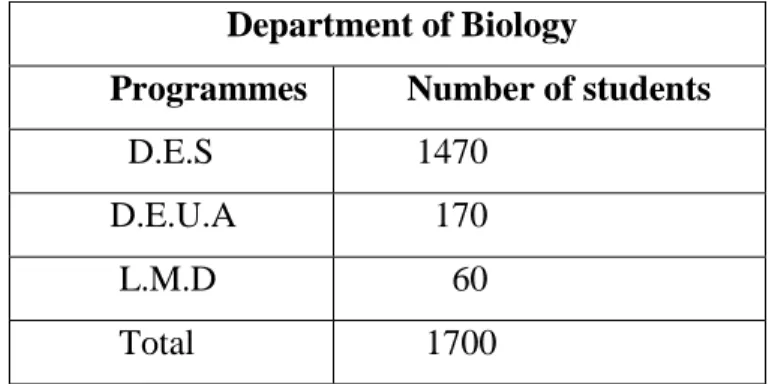
Table 1.2 Number of students on each biology programme 2005-2006……….. 32
Table 2.1 Advance made by English in different disciplines from 1965 to 1981. 67 Table 3.1 The methodology used in teaching the ‘Reading Component’……….. 81
Table 3.2 The methodology used in teaching the ‘Writing Component’………... 82
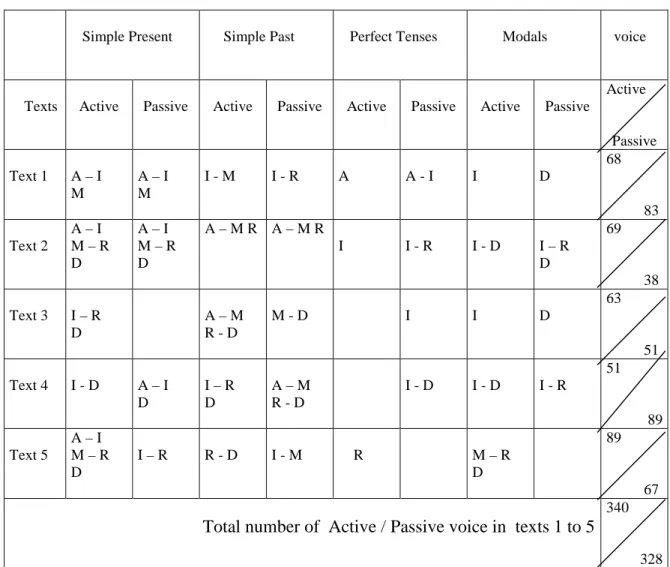
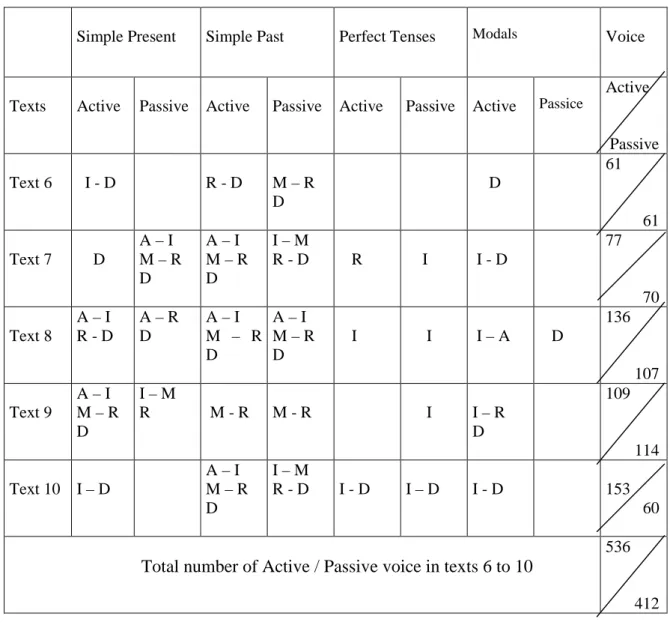
Table 4.1 Tenses and voice used in the biology texts 1 to 5……….. 128
Table 4.2 Tenses and voice used in the biology texts 6 to 10……… 129
Table 4.3 Tenses and voice used in the biology texts 11 to 15………. 130
Table 4.4 Frequency and Length of NCs in Texts 1 to 5……….. 137
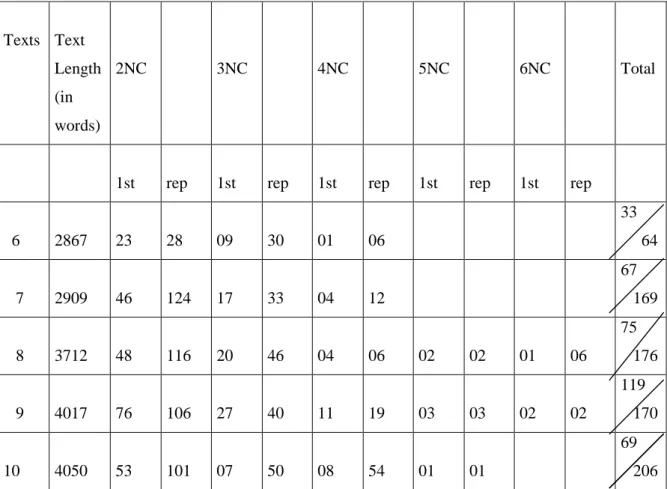
Table 4.5 Frequency and Length of NCs in Texts 6 to 10………. 138
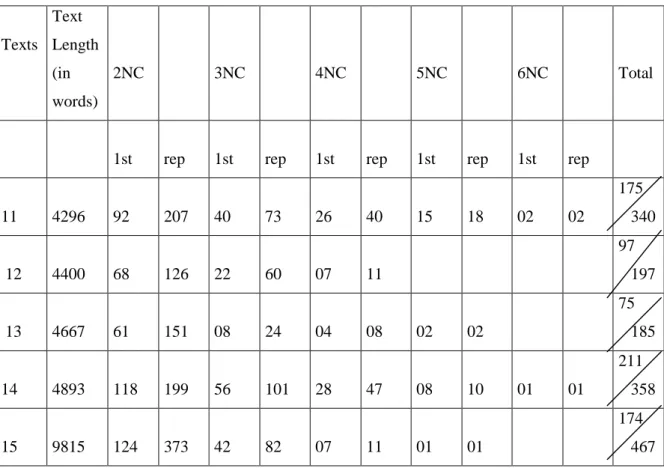
Table 4.6 Frequency and Length of NCs in Texts 11 to 15……….. 139
Table 4.7 Form and Examples of 2 Nominals used in the corpus………. 141
Table 4.8 Form and Examples of 3 Nominals used in the corpus………. 142
Table 4.9 Form and Examples of 4 Nominals used in the corpus………. 143
Table 4.10 Form and Examples of 5, 6 and 7 Nominals used in the corpus……… 144
Table 4.11a Functional Analysis of NCs (following Bartolic’s categorisation)…… 148
Table 4.11b Functional Analysis of NCs (following Bartolic’s categorisation)….. 149
Table 5.1 Classification of the 100 nodes in Word classes……… 238
Table 5.2 Form and Length of the Ncs used in the 100 nodes……….. 239
List of Figures
Figure 1.1 Specialities taught at the Department of Biology……….. 30
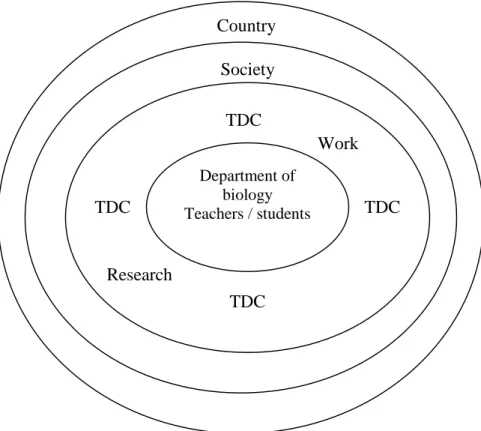
Figure 2.1 Evolution of the university discourse community………..……… 52
Figure 2.2 Role of the Transformation Process………... 53
Figure 5.1 Steps of the computational analysis……….. 159
Figure 5.2 Selected concordance lines of the node ‘Cells’………. 164
Figure 5.3 An Expanded Pedagogic Model of Nominal Compounds (NCs ) in Biology Discourse………. 249 Figure 6.1 Components of the General Teaching Framework (based on Willis’s, 1996: 60)………..…. 278 Figure 6.2 Selected concordance lines of the node ‘Blood’……….. 296
Glossary of terms used in concordancing literature
ASCII (American Standard Code for Information Interchange): A common character set
supported by all computers, representing 128 English letters, numbers, and symbols.
Collocate: place side by side; a collocation of a word shows words appearing frequently
near it.
Collocation: The co-occurrence of lexical items. Colligation: The co-occurrence of grammatical classes.
Concordance: It gives access to many important language patterns in text. Concordancer: A computer programme to do the task of concordances.
Corpus: a collection of texts, from a specific source or field (e.g., medical, literary, etc.) in
the form of a single computer-readable file.
Corpora: plural of corpus.
Corpus-based Approach: Approach using a corpus in a single computer-readable file. KWIC (Key Word In Context): a common option for displaying search results for text
databases. For a concordance, the search term appears in the centre of each line, in coloured or bold text, with the surrounding sentence context to the right and left.
Node: The ‘node’ or the ‘node word’ is the word that appears in the middle of the screen in
a list of concordances. It is the keyword.
Span: The measurement, in words, of the co-text of the node (- 4 to the left / + 4 to the
right)
Synoptic Profile: It calculates collocations for all items to the left and the right of the node
for a span of 4 x 4.
GENERAL INTRODUCTION
“Learning is not finding out what other
people already know, but is solving our own problems for our own purposes, by questioning, thinking and testing until the solution is a new part of our life.”
(Handy, 1990: 50)
The primary concern of this research is the present and future development of the Algerian society. The particular focus it takes is the role of language in that development, more particularly that of English as the language for international communication.
In Algeria, considered as an “emerging” nation, there is much hope invested in science and technology to answer issues facing this country to move into “modernity.” Therefore, scientific communities feel more concerned by the acquisition of a language that will enhance this mutation, and more and more Algerian researchers believe that the “normalisation” of the teaching of English would be a fundamental contribution to these objectives.
Since its independence in 1962, a number of decisions related to language teaching policy have been taken in Algeria. Therefore, Arabic is used as the language for national identity and integrity. But, like many other newly independent and developing countries in Africa, Latin America and Asia, Algeria needs a world language to be in contact with the world’s latest technological and scientific information which is essential for economic
Algeria has reckoned that the goals of economic and commercial development cannot be achieved through the national language alone. Therefore, for Algeria to gain membership in the world community and compete effectively on the international scene because of globalisation (as for example joining the World Trade Organisation in 2007, and other organisations), students should be well-initiated in English to meet their own needs and the needs of the national education which aims at economic and commercial development.
In Algeria, the teaching of the different components is done through English in few institutions only e.g. I.A.P.(Institut Algérien du Pétrole in Arzew and Boumerdès) and I.N.E.L.E.C. (Institut National d’Electronique in Boumerdès). In other institutions, English is taught as a foreign language from primary to university level. At university level, it is taught as a main subject to students majoring in the ‘English language and literature’ at the Department of English. It is also taught as a compulsory subject in the form of E.S.P (English for Specific Purposes) in all science and social science institutes at undergraduate and postgraduate levels.
Throughout the world, on a macro-scale, there has been a growing demand for English courses to provide both undergraduate and postgraduate students with the kind of skills they require in order to pursue their studies ( English for Academic Purposes) to reach a more advanced level of performance.
On a micro-scale, scientists (professionals) and science students (students still getting initiated in their field of study) need to achieve a reasonable level of reading competence in English as much of the material they have to read is published only in this language.
Therefore, it is important for Algeria’s future development (both socially and economically) that scientists (who already master Arabic and/or Berber, and French) be properly educated in English (E.S.P) to become accepted members of the international scientific community. To meet these needs, appropriate courses should be designed for students at university level.
There is, of course, an increased number of courses for teaching E.S.P. commercially designed for different groups of learners. These courses might be suitable to some groups of learners and unsuitable to others, because either the audience aimed at is not the same or the purposes to reach are different. This means that an E.S.P. course designed for French, Spanish or even for other Arab students could not be suitable for Algerian students for different reasons: language and cultural backgrounds, schemata, and so on.
In Algeria, the teaching of English (E.S.P) in science and engineering faculties is often done by either language teachers or sometimes by subject-specialists. The teaching of English to science students by either a language teacher only or a subject-specialist only (instead of the collaboration of the two) may cause learning problems.
A long practice in the field i.e. teaching engineers and technicians in the oil industry, doctors, etc., enriched me professionally (through contact with different colleagues, finding out about teaching methods and techniques and applying them), and prompted me to undertake this research as it urged all of us (as teachers) to be up to date with what is happening in the world as far as teaching E.S.P. is concerned.
However, this same experience made us notice some pedagogical mismatch in terms of teaching / learning practices of the English component: the teaching syllabus, or the teaching methodology, and so forth, leading to an inadequacy between the stated objectives and the actual practice.
In Algeria, designing a syllabus for science students has long been based on teachers’ intuition and common sense, sometimes even without assessing the real needs of the students. While designing E.S.P syllabuses, teachers used mainly ‘E.S.P concocted texts’ (i.e. texts generated for English teaching purposes, instead of ‘authentic texts’). Also, some syllabuses have focused on grammar only and others on lexis only. Therefore, focusing on one area of language teaching at the expense of the other may lead to an inefficient English
Theme of the research
The principal objective of this research is to dig into the nature of the problem of inefficiency of language training programmes in a particular Algerian community in tertiary education, namely that of biologists, with the purpose of undertaking a remedial action.
Our aim is to gain insights that may help in the revision of the pedagogical methods and curricula so that English should not remain for long as just a subject on the timetable, but become a resource which the student can use.
Therefore, the research framework will deal with two concepts :
a) the notion of ‘discourse community’ in reference to the teaching/learning practices of the English language, and how this latter affects the development of the discourse community under study, and the Algerian society as a whole; and
b) ‘Discourse analysis’, the description of how the English language functions in extremely specialised scientific texts, in order to consequently develop an appropriate teaching methodology.
In order to achieve this purpose, we have selected one specific scientific community (undergraduate biology students) studying at both Arabophone and Francophone Departments at the University of Oran, in their third and fourth years of study (reasons for such a choice will be given in ‘Chapter One’). These students studied all their subjects in the primary and secondary schools in Arabic. They studied French as a first foreign language and English as a second foreign language, with a few exceptions, those who studied German or Spanish. They then had three semesters ( two semesters in the third year and one semester in the fourth year) of English study at the department of biology.
The aim and objectives of the English course at the biology department (as stated by the institution ‘the university and departments’, and the Ministry of Higher Education) is to train students to become able to read scientific texts written in English in their own discipline. This specialised reading objective is necessary at the writing-up stage of their
projects, i.e. mémoire. The end-of- course project in biology (i.e. the mémoire) is seen to be performing a social function because it “provides evidence to examiners of a
candidate’s suitability for the award of a degree” as stated by Thompson about the
doctoral theses (2001:4), and to climb up the social ladder afterwards.
This research aims to develop a methodology to help the students read quickly and efficiently. To reach such an objective, the research follows a rational progression.
We first started by the description of the community under study (the biologists) and showed how this latter could form a discourse community by applying the twelve criteria (Swales’ six criteria, and six management science elements summarised in the acronym ‘CATWOE’), as we are primarily interested in managing English language teaching / learning in the classroom. For that, two questionnaires were designed.
One questionnaire addressed the teachers of English at the biology department to find out what teaching methodology is used by both kinds of teachers i.e. language teachers and subject-specialists teaching English.
As one of the characteristics of E.S.P. courses is the importance placed upon meeting the specific needs of the learners to establish the target tasks they need to be able to perform, the other questionnaire addressed students to find out what their real needs (not those assumed by their teachers and/or institution ) for learning English are, what difficulties they have met and what suggestions they could make to improve the English course, to be in a better position for the preparation of appropriate teaching materials.
The results of the preliminary needs analysis showed the students’ real needs and unveiled the problems met by students while learning English. They also provided the motivation for formulating the research questions which will be introduced in ‘Chapter One’ and investigated throughout this study. It seems from this needs assessment that a revision of
Motivation for the study
The primary motivation for the study is pedagogic. The aim is to reach a richer understanding of the nature of the scientific texts read by Algerian biology students, in order to improve the quality of the English course.
As the English course at the biology Department consists mainly of developing the reading skill of the students, the results of the needs assessment specified the type of scientific literature the students need to read to get the necessary information in their subject-discipline. According to the students, they mainly need to read scientific journal articles. These were selected to form a corpus which will be analysed to find out how the English language functions in these extremely specialised texts. Therefore, two kinds of language analyses of this corpus of texts are done in ‘Chapters Four and Five’. The first analysis is quantitative and it is done manually to show what lexical and grammatical structures are used in the whole corpus.
The second approach undertaken in this research is the use of computer technology in order to make the texts tractable for analysis. The texts are indexed on a computer to identify particular features, and then to quantify and analyse the different instances with the use of concordancing software. This computational analysis, using a specific computer programme called ATA (Aston Text Analyser), is both qualitative and quantitative. It is complementary to the first analysis because as Biber, Conrad and Reppen state in this direction “corpus-based analysis should be seen as a complementary approach to more
traditional approaches, rather than as the single correct approach.” (2000: 9)
In this research, the analysis consists of selecting representative content-words (as nodes) in the form of nominal compounds because these were perceived by students as impediments for their text comprehension. The computational analysis is based on a concordance-based approach which shows the content-words in their near environment (collocation) i.e. what items ( lexical or grammatical) precede or follow the node, because
“the goal of corpus-based approach investigations is not simply to report quantitative findings, but to explore the importance of these findings for learning about the patterns of language use.” (Biber, Conrad and Reppen, 2000: 5)
The aim from using a computational analysis is to discover those elements that would remain hidden with other methods, and to complete the manual analysis. The findings of both analyses will be dealt with in ‘Chapter Six.’
As a language teacher, I do not aim to teach biology content-discipline. The selection of a biology corpus is used as a tool to reach the objectives of this research related to the need of students having to read authentic texts, and to show how language is used in these extremely specialised texts.
Therefore, identifying and analysing the third and fourth year biology students’ needs forms the basis for the teaching of the reading skill: for developing a relevant methodology, selecting appropriate classroom tasks and developing suitable evaluation procedures.
Research Questions
The problem stated in the ‘General Introduction / page 3’ (the teaching of English based on teachers’ intuition, use of ‘E.S.P concocted texts’, focus of the syllabi on one area of language ‘grammar’ or ‘lexis’ at the expense of the other), and the relatively little genre-analytic research into scientific discourse dealing with both grammar and lexis, prompted me to undertake this research.
There is quite a good deal of research into scientific texts dealing with either the grammar or the lexis (but not with both), e.g. Tarone et al. (1998), Gunawardena (1989), Hanania and Akhtar (1985), Salager (1984), Wingard (1981), Bartolic (1978), Herbert (1965) and Barber (1962). As yet, there is very little study of complete texts which shows both the lexis and the grammar of scientific discourse.
In this research, the first question involves finding out about how the teaching / learning of the English course is done in this particular community, in order to locate the attendant inefficiencies. It is essential to analyse the teaching / learning situation to be able to suggest solutions to existing inefficiencies.
The second research question is related to the English language itself, not only as being too sophisticated (language of science), but also because of its position in the teaching/ learning Algerian programmes (as third or fourth language, after Arabic/Berber + French).
The third research question will focus on the suggested teaching methodology.
Hypotheses or ‘Anecdotal Evidence’
The methodology most adapted to probe this problem has to answer the specific aspect of this investigation. Indeed, the present study has to be exploratory in orientation, and as such hypotheses are not plainly stated, and subsequently tested.
The role of quantitative analysis using corpus-based approaches goes beyond the quantitative patterns observed empirically and makes suggestions as for the functional interpretations explaining why the patterns exist. Therefore, it is generally admitted that corpus-based approaches work as quantitative measures that may confirm the truth of intuitive extrapolation or ‘anecdotal evidence’ (Biber, Conrad and Reppen, 2000:3). It is a fact that most of the process implemented is an exercise of verification and confirmation or invalidation growing out of other kinds of investigations. One may say that this type of processing is nothing but an attempt to transform an ‘anecdotal evidence’ into a hypothesis to be statistically illustrated, not demonstrated.
Thesis Outline
The present thesis consists of six chapters:
Chapter One establishes the research area. It gives an overview of the foreign language
teaching policy in Algeria. It then focuses mainly on the teaching of English, and the underlying reasons for introducing it in Higher Education together with the problems
The chapter states the research problem and introduces the research questions with reference to a specific scientific community used for a sample study.
Chapter Two deals with the review of the literature of the two concepts related to this
research namely ‘discourse community’ and ‘discourse analysis.’
The first part gives the definition of the notion of ‘Discourse Community’, and it then specifies the discourse community characteristics with reference to the community of biologists.
The second part is devoted to discourse and genre analyses as our students (as learners) are concerned with reading scientific texts in their own discipline.
‘Discourse’ is the element through which these learners interact. Therefore, definitions and examples of discourse and genre analyses in E.S.P are given, and the description of one specific genre of concern to our students, i.e. biology journal articles is done.
Finally, the chapter ends by specifying the research methods that will be used in ‘Chapters Three, Four and Five.’
Chapter Three is concerned with the first concept of our research i.e. discourse
community, and it deals with the assessment of the English course through the analysis of two questionnaires (one for the E.S.P. teachers and the other for the students).
The aim is to find out how the discourse community under study is organised in terms of English language teaching / learning practices.
It also highlights the students’ reading problems and strategies, and specifies the type of discourse and the genre used by Algerian biology students.
The second concept underlying our study i.e. discourse analysis ‘How does the English
language function in extremely specialised texts’ is investigated in two separate but related
chapters (Four and Five).
Chapter Five deals with the computational analysis of the same corpus used in ‘Chapter
Four’. It is complementary to the analysis done in ‘Chapter Four’. A concordance-based study of 100 most frequent lexical items i.e. content-words (nodes) in the form of nominal compounds (NCs) is done, thus showing collocation of recurrent and important items (what language items follow or precede the nodes). The chapter ends with the presentation and analysis of the data obtained from the concordance-based study.
Chapter Six is devoted to the pedagogical implications. The data obtained from both
analyses in ‘Chapters Four and Five’ will be used as an input for the suggested task-based methodology which also uses concordancing.
The ‘General Introduction’ has brought to the fore the suggested points to be discussed, in this research, one after the other in the successive chapters.
CHAPTER ONE
STATEMENT OF THE PROBLEM AND CHOICE OF COMMUNITY
1.1 Introduction...………. 12 1.2 Overview of the foreign language teaching policy...……. 13 1.2.1 Historical factors...…… 13 1.2.2 Economic factors...………….. 15 1.3 Role and status of the English language in Algeria...…………. 16 1.3.1 English at school-level ………...………. 16 1.3.1.1 English in the Middle school...………. 16 1.3.1.2 English in the secondary school...…………. 17 1.3.1.3 English at university level...………. 18 1.3.2 The teaching of E.S.P. in Algeria...…. 20 1.4 Reasons for teaching English in Algeria...… 20 1.4.1 English as the language of science and technology...………. 20 1.4.2 English as a substitute for French...…………... 21 1.5 The current model of education and its attendant inefficiencies...………. 22 1.5.1 Objective 1 of the current model of education: E.S.T...…… 22 1.5.2 Objective 2 of the current model of education: English as a substitute for French...………
26
1.6 Statement of the research problem...………… 26 1.7 Research questions...……… 28 1.8 Choice of Community...…………... 29 1.9 Reasons for the choice of community...….. 33 1.10 Conclusion ...………… 35
CHAPTER ONE
STATEMENT OF THE PROBLEM AND CHOICE OF COMMUNITY
1.1
IntroductionScientists, in Algeria or elsewhere, form a discourse community that needs to update its knowledge by reading the most recently published information in the scientific field. The latest information available is almost all written in English. It is claimed that 80% of the world’s scientific production is written in English.
The present research focuses on ‘discourse community’, as access to societal power for the discourse community under study is through education and technology, based mainly on familiarity with the norms of the written language of scientific discourse.
Therefore, it is important for Algeria’s future development that scientists be ‘properly’ educated in English to become accepted members of the international scientific community.
Scientists need to be ‘properly’ trained in English because English occupies the third position (after Arabic and French) or fourth position (after Arabic, Berber and French) in terms of language instruction in Algeria, and inappropriate or inadequate language training programmes could impair the efficient and effective development of the country.
An overview of the foreign language teaching policy seems to be necessary in order to state the research objectives. I do not aim to give a detailed description of the national language policy, but to deal with those points that would be of relevance to this research. In Algeria, at independence in 1962, the foreign language issue was dealt with in the following way.
1.2
Overview of the foreign language teaching policyLike many former European colonies, independent Algeria has had to deal with problems of choosing which language(s) it had to encourage its citizens to learn. Besides Classical Arabic (Al-fusha) taught as the first language and as the language for national identity and integrity, other languages (second and foreign) were to be taught as part of the new language planning policies and practices of the post-colonial era. The foreign language teaching policy seems to have been influenced by two main factors: historical and economic.
1.2.1 Historical factors
In 1962 When Arabic was declared the national and official language, French remained the provisional official language before the completion of the arabisation process.
1962-71 period witnessed the bilingual instruction (Arabic and French) as a transitory phase before the achievement of total arabisation. At this period, French was considered as a second language. After this period, and as Djité clearly describes it:
By 1971, a ‘système-ponctuel’ (a step-by-step system) was adopted. According to this system, all subjects were arabized at a given level one year at a time. By 1974, the entire public school system was arabized and French was taught only as a foreign language in the third year [of the primary school.] (Djité, 1992:21)
At this period, French became the first foreign language.
French played and is still playing its role as it is still taught from primary to university level. From 1993 to 2004, French was introduced in the fourth year (instead of the third year) of primary school (age 10). In 2004-2005, French was introduced in the third year of primary school. Then, in 2005-2006, it was introduced in the second year of primary
This ‘swing of the pendulum’ i.e. the teaching of French at primary school (once in the third year , then in the second year, then in the third year again), sometimes without even justifying such a policy, seems to be decided without any previous planning and shows a real improvisation.
The Ministry of Education seems to take decisions without any analytical work as regards the linguistic, social and economic factors, and that long-term planning (or even short-term planning) is not part of their plans.
This kind of decision-taking and lack of long-term planning would obviously affect everyone in the society: the teachers, the pupils (with all the increasing number of drop-outs), the textbook designers, the pupils’ parents, etc.
Miliani clearly summarises such a policy when he states that:
changes are always conceived in a limited and localised stage of the system, never as part of a whole where transformation at a level may have impacts on others. Besides, decisions for change seem to come out of the blue. The idea of long-term planning, of thinking in terms of decades, is something that decision-makers do not seem to be capable of.(Miliani, 1996: 8)
At university level, French is taught to students majoring in the ‘French language and literature’ at the Department of French. French is still the medium of instruction in the Medical Science Faculty (Medicine, Pharmacy and Dentistry) as well as in the different engineering faculties (computer science, civil and electrical engineering).
The teaching of Berber ‘Tamazight’ was introduced in ‘Primary School’ in 1993-94, but was discontinued. It will be reintroduced in the fifth year of ‘primary school’ and in the second year of ‘secondary school’, in 2006-2007, as part of the new education reform.
The teaching of other foreign languages (English, German, Italian, etc.) was introduced in the second year of the Middle school. Students could choose to study the foreign language
they wished if different foreign languages were taught in the school where they studied. The teaching of English (as a foreign language) is provided in all schools in Algeria (in cities and villages), whereas the teaching of other foreign languages was provided only in the main cities like Algiers, Oran, Constantine, Mostaganem, etc.
1.2.2 Economic factors
As Algeria’s wealth of oil and gas was growing, Algeria needed to develop the oil and gas industry as well as other industries. To develop the industry, the Algerian people needed to be trained to cope with the new techniques of the new technologies. Therefore the Algerian authorities had to take further decisions as to which foreign languages they had to introduce in the educational system.
Classical Arabic is used for national unity as a prerequisite for political stability and this in turn can enhance economic prosperity. To reach economic prosperity, Algeria needed a language to play that role because Arabic (the language for identity and integrity) could not do that. Ager observes:
The Arabic language itself needed change and development, it had not been used in advanced scientific and technological spheres for it lacked many of the needed terms and expressions in which to describe processes, inventions and procedures applicable to a modern society. (Ager,1984: 6)
Therefore, French was used instead, in many different fields. As Djité (1992) put it “the
knowledge of French was seen as a guarantee to socioeconomic well-being.”
However, nowadays, even French cannot play fully that role, as almost all scientific information is published in English (as stated previously). The French scientists themselves have to write their work, or part of it, in English if they want it to be worldwide used. So,
1.3 Role and Status of the English language in Algeria
At independence, French was given importance (for reasons explained in ‘Section 1.2.1’), and English was only the second foreign language after French. Changing attitudes began to be noticed in the 1980s (with the advent of the ‘Ecole Fondamentale’ as will be explained later). From this period, English began to be given greater importance than French as a medium of learning, especially at university level. The role of English in Algeria has been that of a second foreign language and has been taught from grade 8 (age 14) to both levels of university education (undergraduate and post-graduate), with the aim of enabling learners to benefit from ‘external experiences and contemporary cultures.’ (Fetni, 1987: 10).
In the 1990s, English gained more ground. In 1993-94 English was introduced for the first time in Algeria in some primary schools. Pupils (age 10, at the fourth year of primary school), or rather the pupils’ parents, had to choose for their children between English or French as a first foreign language. But this ‘dual’ foreign language teaching at the primary school was discontinued as it did not have much success, and only French remained on the timetable.
In attempting to define the role that English plays in the educational system, I shall have to briefly present the school levels at which English is taught.
1.3.1 English at school-level
In Algeria, English is taught in the Middle and Secondary Schools at different levels, and in all streams (literary, scientific and technical teaching).
1.3.1.1 English in the Middle School
During the period of ‘Enseignement Général’, pupils in the Middle Schools (Collège d’Enseignement Moyen ‘C.E.M’) had the possibility to choose English as a foreign language or any other foreign language such as Spanish, German, Italian or Russian, in addition to Arabic as first language and French as a second language or first foreign language. The teaching of foreign languages was introduced in the ninth year of education (age 15).
The status of the English language has changed since the 1980s. The foreign languages mentioned above have been gradually replaced by English. Since the creation of the ‘Ecole Fondamentale’, English has been the only foreign language taught and has been moved to second rank next to French. It is introduced in the eighth year of education.
For the other foreign languages (Spanish, German, Italian, etc.) they were not taught anymore in the middle and secondary schools. As the Minister of Education1 stated in an interview in 1992,
As regards the other foreign languages such as Spanish, German or Italian, a new policy would be put in use for their re-implementation i.e. ‘redynamisation2’. For this purpose, contacts are being taken with the foreign embassies. (El Watan, 1992)
1.3.1.2 English in the Secondary School
English is taught in secondary schools during the three years of education in all streams. In the literary stream, English is compulsory and is taught for 4 hours a week (2 sessions), together with another foreign language (Spanish or German) that the students choose. The ‘coefficient’ of English in this stream is three (3). In the scientific stream, English is compulsory and it is the only foreign language taught for three hours a week (two sessions). The ‘coefficient’ in this stream is two (2).
As part of the new education reform (March 2006), a new schedule for teaching English in the secondary schools has been developed where the numbers of teaching hours as well as the coefficients have been changed because of the new ‘Architecture’ of the Baccalauréat. There will be six main branches for the ‘Baccalauréat 2008’: Foreign Languages, Letters and Philosophy, Experimental Sciences, Mathematics, Technical Mathematics, and Management and Economics (Le Quotidien d’Oran, 2006:09). The number of teaching hours and the coefficient of English have increased in some branches thus showing the
importance given to English by the Algerian authorities. The number of teaching hours and coefficients are as follows:
- Foreign languages: 5 hours a week / Coefficient 4; - Letters and Philosophy : 4 hours a week / coefficient 3
- Experimental sciences and Technical Mathematics: 3 hours a week / coefficient 2, but in the third year of secondary education the coefficient is 3 for both branches; - Mathematics and Management / Economics: 3 hours a week / coefficient 2.
( Teaching Department of National Education, March 2006)
1.3.1.3 English at university level
English is taught as a main subject to students majoring in English at the Section of English of the Department of Anglo-Saxon Languages ( Faculty of Letters, Languages and Arts) which aim is to train students mainly for a teaching career (in Middle and Secondary Schools), or for post-graduate studies for a university teaching career or research, as well as for working in other economic sectors either state-owned (SONATRACH, Mobilis) or private (Djezzy, etc.). The Section of English has always counted the biggest number of students in the four years of study, as compared to the other departments of foreign languages.
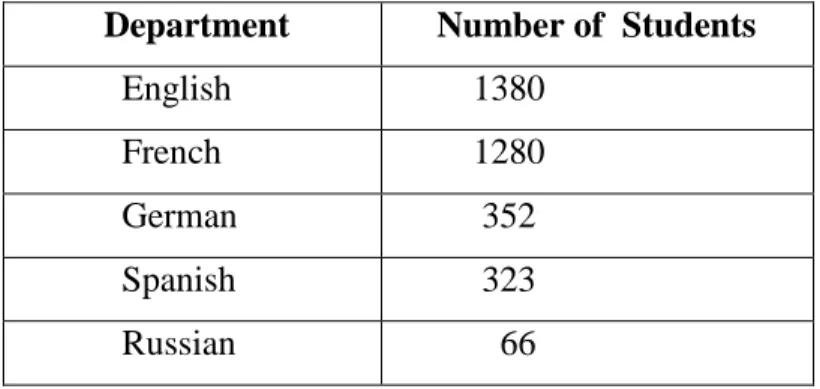
The table below gives the total number of students in the different foreign language departments of the Faculty of Letters, Languages and Arts of the University of Oran - Es-sénia. The figures given in Table 1.1 have been almost the same for the last five years.
Department Number of Students
English 1380
French 1280
German 352
Spanish 323
Russian 66
The curriculum of the English degree includes language modules (Grammar, Phonetics, Conversation, Written Expression, Reading Comprehension and Listening Comprehension) and content modules such as Linguistics, African Literature and Civilisation, American Literature and Civilisation, and British Literature and Civilisation, together with T.E.F.L and Educational Psychology in the fourth year to prepare students for their teaching career.
English is also a compulsory subject (not a medium of instruction) in all science and social science institutes of Higher Education at both undergraduate and post-graduate levels. English is taught in these institutes in the form of E.S.P. ( English for Specific Purposes). By E.S.P., we mean English taught to a group of learners for academic or professional purposes. In Algeria, the purpose is to help students have access to academic scientific and technological information in English publications and contribute to international meetings and conferences in order to avoid isolation from new discoveries and university standards. E.S.P. is also incorporated as an option into the ‘Linguistique Appliquée’ Magister programmes (post-graduate level) at the three main universities of Algiers, Oran and Constantine.
Three E.S.P. Centres (run by the Algerian Ministry of Higher Education and the Overseas Development Administration ‘O.D.A’ in London) were set up between 1988 and 1994 at the universities of Algiers, Oran and Constantine, and the objectives of which were agreed upon by the Algerian authorities, and summarised by the former British Cultural Attaché in Algiers, as follows:
1) To promote the use of English in tertiary level establishments so that it can become a tool, for further academic purposes and an effective means of assisting Algeria’s economic and commercial development;
2) To help raise the status, orientation and objectives of E.S.P. in Algerian tertiary level establishments so that it may become a viable part of the higher education
3) To help Algerian cadres in key priority areas to benefit from postgraduate training and research in Britain.
Therefore, between 1988 and 1994, English language teaching programmes to prepare students for the IELTS (International English Language Testing Services) exam were delivered every year, for one year, to students from science institutes who got scholarships from the Algerian government to go abroad (United States of America, Great Britain and Canada) to further their studies. Unfortunately, this training course was discontinued because of the events that took place in Algeria during the period called ‘la décennie noire’, literally meaning ‘the black decade’ (the 1990s).
1.3.2 The teaching of E.S.P. in Algeria
In Algeria, English is considered as a means for achieving scientific and technological development and its present introduction in different sectors attests to this.
E.S.P. courses are provided in different institutions such as I.A.P. (Institut Algérien de Pétrole), I.N.E.L.E.C. (Institut National d’Electronique)., and the C.P.E (Centre de Perfectionnement de l’Entreprise) funded by SONATRACH ( a state-owned oil company) whose aim is to train its staff to become able to use English in different contexts.
1.4 Reasons for teaching English in Algeria
As English has never been the medium of instruction in Algeria (except in few institutes as the I.A.P and I.N.E.L.E.C ), we can group the reasons for teaching English in Algeria into two:
1.4.1 English as the language of science and technology
English is considered as the language of science and technology because most of the scientific literature is either originally written in English, or is translated into English. Hayane3(1989) stressed this reason when he said,
3
«Si à partir de 1923 une partie des Algériens s’était mise à voir dans les langues étrangères un moyen de progrès et de communication avec le reste du monde, après 1962 les autorités ne leur accordèrent qu’un crédit d’utilité limitée à la science et à la technique moderne. » (Hayane, 1989:45)
From 1923 part of the Algerians had started seeing in the foreign languages a means to progress and communication with the rest of the world; after 1962 the authorities only assigned them a functional status limited to science and modern technology.
(Hayane, 1989: 45)
According to Taleb Ibrahimi (a former Algerian Minister of Foreign Affairs), to develop science and technology in Algeria, we need to master English. He stated that “science and technology need English.”4(1976:32)
However, English is a code which is mastered only by a small fraction of the society, and the achievement of its generalisation is conceivable only if the necessary conditions are satisfied. The provision of these conditions is pertinent to avoid falling in the same ‘vicious circle’ of students’ failure followed by drop-outs.
Therefore, the development of the Algerian society is crucially dependent on an efficient and effective command of the English language.
1.4.2 English as a substitute for French
This is clearly stated in an official document5which reads that:
The generalisation of the teaching of English should be considered as a substitute for French. (Teaching Services, Ministry of Higher
Education, 1986)
This is so mainly because of its freedom from ‘colonial connotations’ in Algeria. As Treffgarne (1994) put it,
rather than English. In addition to its freedom from colonial connotations, the dominance of English as the language of science and technology has accentuated its less emotionally charged function as a language of wider communication. (Treffgarne, 1994: 7)
The Algerian Minister of culture, as quoted by Taleb Ibrahimi (1976:164) also emphasised the importance of using English because it has no colonial connotations when he stated that ‘parce que l’anglais est sans aliénation politique.’ This means that the objectives of teaching English to Algerian university students is a desirable end, especially in the situation whereby pre-university education is largely arabised while science and technology in the world is largely anglicised.
The problem of this research will be discussed after examining the current model of education and its attendant inefficiencies to see how these can affect the learning of English in Algeria, particularly for science students.
1.5 The current model of education and its attendant inefficiencies
The broad objectives of the current model of education have been explained in ‘Section 1.2/ Overview of the foreign language teaching policy’ and may be described as consisting of statements of desirable ends for educational practices.
Practices consist of means that are assumed realised ends. It is in these means where the inefficiencies attendant to the current model are located.
In this study, two main educational ends (i.e. objectives) are isolated and their attendant inefficiencies of the means used to achieve them are discussed one after the other.
1.5.1 Objective 1 of the current model of education: E.S.T
The objective of the gradual replacement of French by English in Algeria (as stated in ‘Section 1.4.1’) is to help learners access information fundamental to their subject-speciality in science and technology, as it is claimed that most scientific literature is published in English.
But in practice, reality is quite different. Arab6observes:
The objectives assigned [to the teaching of English] are rarely reached because of the quantitative and qualitative deficiency, as well as the instability of the staff teaching in this field; to these difficulties are added the non-existence of appropriate pedagogical techniques and methods and the chronic absence of books and other didactic tools. (Arab, 1990)
This was also emphasised in the official document which reads:
Such a substitution is not obviously possible in the short and middle terms. It implies a total reorganisation of the teaching of languages at primary and secondary levels, and would consequently be confronted to a shortage of teaching staff and problems of availability of didactic tools.7 (Teaching Services, Ministry of Higher Education, 1986)
Furthermore, in spite of the fact that “ 40% of the national budget was devoted to
educational and vocational training as by the mid-seventies” (Djité, 1992), considerable
problems have accompanied the arabisation of primary and secondary education, and democratisation of primary education. According to Bennoune:
In 1977-78, of 100 pupils enrolled in primary schools, 20 would drop out before the end, and 40 would fail to pass the examination for the certificate of primary education ( and therefore would not be allowed to stay at school).
6
« Les objectifs assignés [à l’enseignement de l’anglais] sont rarement atteints en raison de
l’insuffisance quantitative et qualitative, ainsi que de l’instabilité du corps enseignant dans ce domaine ; à ces difficultés s’ajoutent l’inexistence de techniques et méthodes pédagogiques appropriées sans parler de l’absence chronique de livres et autres supports didactiques. »
Thus,
....of the remaining 40 pupils about 18 would be admitted to high schools, 16 of which would be candidates for the baccalauréat examination. (Bennoune, 1988: 227)
and as a result, “The pass rate was 25 percent in 1978-79. This meant that only 4 out of
100 would have the chance to go to the university.” (Ibid)
Whereas the arabisation of primary and secondary education was dictated by the demands of a wish to increase access to education and reduce elitism, it is obvious that this policy had also resulted in “the absence of qualified teachers, adequate textbooks, laboratories,
and even classrooms”, in that “ the quality of education was impaired, a fact that
undermined particularly the scientific and technical option.” (Bennoune, 1988: 223).
It is not the fact of using Arabic that affected the quality of teaching / learning, but because the prerequisites, sine qua non conditions for such an educational decision were not available.
In the same line of thought, Miliani finds that,
The democratisation of primary education that is a shift from highly selective and competitive, to a stage where it became considered as an inalienable human right for the benefit of all, .... was not also supported by the pedagogical, didactic and human resources necessary to provide a quality education for all. ( Miliani, 1996: 7)
This mass schooling was also accompanied by school-drop-outs which generated a new phenomenon that affected the whole society. According to Miliani (1996: 7):
These drop-outs and other young unemployed who developed a kind of anti-establishment attitude, became known as ‘hittistes’ (those who lean on walls).
Literally, but essentially jobless, idle and available for delinquency, or the trip abroad.
Funnily enough, this situation induced as a corollary an increasing interest for foreign languages, contrasting the debasement of learners for education in Arabic and a kind of under-evaluation of local cultural values. Indeed, French and English came to mean a chance to go abroad, to have a qualification for a job, and climb in the social ladder of life, thanks to a ‘decent earning.’
English, more than French, has supplied thousands of unemployed young Algerians with dreams of a better life, not only because it represented the might of the Anglo-Saxon world namely the U.S.A (the American Dream), but certainly, because it offered much wider geographical horizons of fulfilling a career, as France became a more and more saturated destination of emigration.
Another reason contributed to the growing passion for English, beyond the absence of the emotional burden the recent ‘common’ or ‘shared’ history of Algerians, the French language drags on. As France has in the past represented a place of emigration for unqualified labour, physical human capacities were needed for low rated jobs left over by the French. The English world required by necessity a minimum level of education, and therefore the English speaking Algerian community postulating for emigration, tends to be more and more qualified. This criterion gave a larger choice of destinations in the world, including areas where English is the official language. This status, we are thinking of the Arab and Asian worlds, gave Algerians almost the same linguistic competence as the local populations of the host countries, and drastically increased needs away from French, back to a non-native English community in which they found themselves competing with others, with equal chance of getting a fair deal of opportunities.
The choice of Arabic as an instructional medium and democratisation of primary education would thus seem (for reasons mentioned above) to have resulted in the deterioration of the quality of primary and secondary education. Inevitably Higher Education was also likely to
1.5.2 Objective 2 of the current model of education: English as a substitute for
French.
As stated in ‘Section 1.4.2’ English has been taught in Algeria as a substitute language to French because of its freedom from colonial connotations.
The consequences of a real replacement of French by English at different levels of the educational system (i.e. English as a substitute for French) may affect not only the educational system, but the Algerian society as a whole. Such a decision will result in a society :
Where French would still be used but in an inappropriate way, and where English would be spoken only by a minority, in a mediocre way, and quickly forgotten. (Kapil8, 1989, in Slougui, 1993:3).
In a word “une anglicisation qui sera inévitablement sauvage” (Arab, 1990), because the linguistic vehicle chosen to facilitate development is the language in which Algerians do not have efficient command.
My concern, if this is true, is that we need a description of the situation, a diagnosis of problems and a prescription.
1.6 Statement of the research problem
Algeria is well aware that the economic and commercial development cannot be achieved through the Arabic language as this latter itself needs change and development. To gain membership in the world community and be part of this ‘global village’ where mainly the English language is used for such interchanges (economic and commercial), students (especially those in science faculties / departments) should be well-initiated in English to meet their own needs and the needs of the national education which aims at such
8
«où le français sera encore parlé mais mal, et où l’anglais sera connu de peu, de façon médiocre et bien vite oublié. » (Kapil, 1989, in Slougui, 1993:3).
development. To meet these needs, appropriate courses should be designed for students at university level.
However, and as stated in the ‘General Introduction’, designing a syllabus for science students (in the different departments where English is not the medium of instruction) has long been based on teachers’ intuition and common sense. And as such, some syllabuses, have focussed on grammar only and others on lexis only, using ‘E.S.P. concocted texts’ (instead of authentic texts). Hunston et al. (1997) note:
It is common to see grammar and vocabulary as separate areas of language teaching and learning. Many course books have separate sections on grammar and vocabulary; syllabuses list grammatical structures and key vocabulary items separately; students are described as being ‘good at grammar’ but having a ‘limited vocabulary’, or vice versa; grammar and vocabulary are often tested separately. (Hunston et al., 1997:208).
In science institutes in Algeria, the great majority of the teachers of English are language teachers (newly qualified with a B.A. degree), and to a much lesser extent, English is taught by few subject-specialists. As a result, we get two separate teaching methods: one focusing on grammar and the other focusing on lexis.
1) Focus on grammar only: Most syllabuses for teaching / learning English in science institutes were/are mainly based on teaching grammar for two main reasons:
a) Most teachers of English in science institutes were / are not members of the scientific community, and as such they themselves did / do not master properly the frame of reference i.e. the scientific lexis and concepts.
b) It is taken for granted that science students already master scientific lexis and concepts.