HAL Id: hal-01131577
https://hal.archives-ouvertes.fr/hal-01131577
Submitted on 23 Jan 2020
HAL is a multi-disciplinary open access
archive for the deposit and dissemination of
sci-entific research documents, whether they are
pub-lished or not. The documents may come from
teaching and research institutions in France or
abroad, or from public or private research centers.
L’archive ouverte pluridisciplinaire HAL, est
destinée au dépôt et à la diffusion de documents
scientifiques de niveau recherche, publiés ou non,
émanant des établissements d’enseignement et de
recherche français ou étrangers, des laboratoires
publics ou privés.
Neutral Na in Cometary Tails as a Remnant of Early
Aqueous Alteration
Y. Ellinger, F. Pauzat, Olivier Mousis, A. Guilbert-Lepoutre, François
Leblanc, M. Ali-Dib, M. Doronin, E. Zicler, A. Doressoundiram
To cite this version:
Y. Ellinger, F. Pauzat, Olivier Mousis, A. Guilbert-Lepoutre, François Leblanc, et al.. Neutral Na in
Cometary Tails as a Remnant of Early Aqueous Alteration. The Astrophysical journal letters, Bristol :
IOP Publishing, 2015, 801 (2), pp.L30. �10.1088/2041-8205/801/2/L30�. �hal-01131577�
NEUTRAL Na IN COMETARY TAILS AS A REMNANT OF EARLY AQUEOUS ALTERATION
Y. Ellinger1, F. Pauzat1, O. Mousis2, A. Guilbert-Lepoutre3, F. Leblanc4, M. Ali-Dib3, M. Doronin1,5, E. Zicler1, and A. Doressoundiram6
1
Laboratoire de Chimie Théorique, Sorbonne Universités, UPMC Univ. Paris 06, CNRS UMR 7616, F-75252 Paris CEDEX 05, France
2
Laboratoire d’Astrophysique de Marseille (LAM), Aix Marseille Université, CNRS, UMR 7326, F-13388 Marseille, France
3Observatoire des Sciences de l’Univers de Besançon, Université de Franche-Comté, Institut UTINAM, CNRS/INSU,
UMR 6213, F-35030 Besançon CEDEX, France
4
LATMOS/IPSL, Sorbonne Universités, UPMC Univ. Paris 06, CNRS UMR 8190, F-75252 Paris CEDEX 05, France
5
Laboratoire de Physique Moléculaire pour l’Atmosphère et l’Astrophysique (LERMA/LPMAA), Sorbonne Universités, UPMC Univ. Paris 06, CNRS UMR 7092, F-75252 Paris CEDEX 05, France
6
LESIA—Observatoire de Paris, Sorbonne Universités, UPMC Univ. Paris 06, Univ. Paris-Diderot, CNRS UMR 8109, F-92190 Meudon, France Received 2014 November 6; accepted 2015 February 6; published 2015 March 12
ABSTRACT
Observations of comet C/1995O1 Hale-Bopp during the spring of 1997 led to the discovery of a neutral sodium tail whose origin is still not clearly understood. Here, we propose an interpretation for the origin ofthis sodium tail, which is based upon chemical grounds. Starting from Na+trapped chemically during the condensation of refractory material in the protosolar nebula to its incorporation in the building blocks of comets and its transfer from refractory to volatile phases in the nucleus due to aqueous alteration, we follow the chemical path of sodium until its transformation into a neutral atom when released from the sublimating cometary ice. We propose that two Na reservoirs should coexist in a comet: one coming from the refractory dust, the other one from the icy matrix. Their relative importance would depend on the extent of the zone where liquid water formed within the nucleus and the time during which water remained liquid, thus favoring the Na+exchange between rocks and ice. These two key parameters would in turn strongly depend on the thermal history of the comet(amounts of radiogenic nuclides, orbital history, etc.). If our model is correct, the detection of Na originating from water ice would be a testimonial of the past aqueous alteration of the comet or its parent body.
Key words: astrochemistry – comets: general – Kuiper Belt: general – Oort Cloud – protoplanetary disks 1. INTRODUCTION
The presence of sodium D-line emission has been confirmed in a large number of comets close to perihelion for over more than a century(Bredichin1882; Lemon & Bobrovnikoff1926; Levin1964; Oppenheimer1980; Leblanc et al.2008; Cochran et al. 2013). Observations of comet C/1995O1 Hale-Bopp
during the spring of 1997 led to the discovery of a new tail connected with the sodium D-line emission. This neutral sodium gas tail is entirely different from the previously known ion and dust tails, and its associated source is unclear. It has been proposed that the third type of tail is shaped by radiation pressure due to resonant scattering of sodium atoms (Cremo-nese et al. 1997). How the observed Na atoms are released
from the nucleus and/or from the dust is debated. The evolution of the Na release rate with respect to heliocentric distance suggests a release dominated by thermal desorption(Watanabe et al. 2003; Furusho et al. 2005) rather than by energetic
processes like photo-desorption, solar wind sputtering, or cometary ion sputtering(Leblanc et al. 2008).
Here, a completely different scenario built upon chemical grounds is proposed for discussion. Starting from Na+trapped chemically during the condensation of refractory material in the protosolar nebula to its incorporation in the building blocks of comets and its post-formation evolution in the cometary matrix, we follow the chemical path of sodium until its transformation into a neutral atom when released from the sublimating cometary ice. In this Letter, we address these critical points in chronological order in the subsequent sections. Wefirst report the results of thermochemical equilibrium calculations that show that Na is mainly trapped in rocks in the protosolar nebula. Due to radiogenic heating, the parent bodies of comets,
initially made from a mixture of rocks and ices, have undergone some melting in their interiors, implying that liquid water interacted with rocks. This washing led to a transfer of Na from the rocks to the aqueous phase in the form of Na+ions. Once liquid water froze, Na was trapped in stable cages made from water molecules, as demonstrated by quantum calcula-tions. In the end, Na was released as a neutral atom when the ice vaporized due to heating. In other words, having Na in cometary tails could be a testimonial of the past presence of liquid water during the thermal history of comets or the thermal history of their parent bodies.
2. FORMATION OF Na-RICH REFRACTORY MATERIAL IN THE NEBULA
The solid/gaseous composition of the disk is obtained using the HSC Chemistry software developed by Outotec Research,7 which is based on the Gibbs energy minimization technique (White et al.1958). This method takes as an input the initial
composition of the system and then calculates the resulting most stable species (having the minimal Gibbs energy) on a pressure–temperature grid. This method necessitates a database of a large number of species for accuracy, hence our commercial package choice since the present version contains more than 28,000 chemical compounds. As an input in our calculations, we have used a gaseous mixture of a protosolar composition(Asplund et al.2009) with Na/H2= 3.81 × 10⁻⁶in
the initial gas phase. The software was run to get the abundances of the most abundant Na-bearing species in the protosolar nebula at P = 10−4bar, a typical disk’s pressure, and
© 2015. The American Astronomical Society. All rights reserved.
7
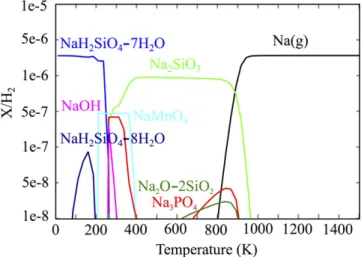
temperatures in the 10–1500 K range, which are valid for a wide range of heliocentric distances (from ∼1 to 30 AU). Figure 1 shows that Na is in gaseous form at temperatures higher than ∼900 K. Interestingly, it is unclear whether or not Na was ionized or neutral at high temperatures in the protosolar nebula. Indeed, if the ionization of the disk’s H2from EUV and
X-rays was efficient (Glassgold et al. 2000), then the
probability of Na+ meeting an electron would be high. At lower temperatures, Na becomes essentially incorporated in the solid refractory phase. Our calculations then support the idea that the sodium observed in comets was originally acquired by their refractory material at its condensation epoch in the protosolar nebula.
3. ICE MELTING IN COMETS
Comets and their parent bodies accreted from a mixture of volatile ices and rocky material. The refractory material includes radioactive isotopes, whose decay provides an important source of heat in comet nuclei, possibly significantly altering their initial structure and composition. As of today, the effects of early processing of comet material remain mostly unknown. Comet nuclei appear very primitive in nature: for instance, they contain volatiles like CO, which require that they suffered from an extremely limited thermal processing after their formation. Given their very short lifetime, the effective-ness of nuclides such as26Al or60Fe in heating a comet interior strongly depends on the nucleus formation timescale. Recent formation theories (Johansen et al. 2007; Johansen & Klahr 2011) arguing for very short formation timescales are
therefore compatible with a possible significant heating of comet material. This is supported by the detection of minerals formed by aqueous alteration in meteorites and, most strikingly, by the identification of brine inclusions in crystals like those found in the Monahans chondrite, providing a sample of the liquid presumably responsible for this aqueous alteration in planetesimals (Zolensky et al. 1999). Hints of
aqueous alteration were also found in the dust samples from comet 81P/Wild 2 brought by the Stardust mission (Brownlee 2014).
Despite the large uncertainty in our knowledge of comet early thermal processing, we can investigate the possible outcome of radiogenic heating for a realistic range of initial parameters. Heating due to the radioactive decay of short-lived nuclides such as26Al or60Fe can be described by
r t t = æ è çç çç - ö ø ÷÷÷ ÷
rad d XradHrad 1 exp t , (1)
rad rad
withρd, the dust bulk density; Xrad, the initial mass fraction of
the nuclide in the dust; Hrad, the heat released by this nuclide
per unit mass upon decay;τrad, its decay time; and t, the time.
The decay product of short-lived radionuclide26Al,26Mg, can be found in Ca–Al rich inclusions (CAIs), which are believed to be the first solids to condensate in the solar system. A compilation of 26Mg abundance measurements for various meteorites shows that the majority of chondrites have a canonical ratio26Al/27Al= 5 × 10⁻⁵(MacPherson et al.1995).
The distribution of 26Al has been inferred to be uniform, at least for the inner solar system (Jacobsen et al. 2008).
However, CAIs with low (5´10-6) ratios have been reported(Kunihiro et al.2004; Liu et al.2009). The existence
of such inclusions with no excess of 26Mg is perceived as a reason to invoke a non-uniform distribution of26Al within the solar system(Makide et al.2011,2013), but given the current
debate, we consider that26Al was uniformly distributed across the solar system as afirst approximation, with a canonical value at the time of CAI formation.
In order to assess the effect of radiogenic heating on the early history of comet parent bodies, we need to solve the heat conduction equation: r ¶ k ¶ + æ è ççç- ¾ ¾ öø÷÷÷ = c T
t div gradT rad, (2)
where T is the temperature distribution to be determined, ρ is the nucleus bulk density, c is the material heat capacity, κ is its effective thermal conductivity, andrad is the radiogenic heat source described in Equation (1). Figure 2 presents the evolution of the internal temperature for a comet parent body with a radius of 30 km, computed with the thermal evolution model of Guilbert-Lepoutre et al.(2011) and assuming that the
icy matrix is initially made of amorphous ice and crystalline ice, for formation times ranging from 0 to 3 Myr after CAI formation. A typical mass fraction of 50% is assumed for the ice (∼70% in volume fraction) in the nucleus (Huebner et al.2006). For other thermophysical parameters, we assumed
typical values as found in the literature(Huebner et al.2006),
for example, a density of 700 kg m−3, a porosity of∼80%, and an initial thermal inertia lower than 10 J K−1m−2s−1/2. Both amorphous and crystalline cases lead to similar conclusions: the results show that liquid water is produced in many situations, in particular, during the early evolution of comets. Whatever the initial state of the water-ice matrix, our calculations show that liquid water may be produced in the core of comet parent bodies in many situations, especially if comets formed quickly after CAI formation (in typically less than 0.3 Myr). Although still debatable, the potential effect of
26
Al decay on the thermal history of comets has been known for decades. Interestingly, any intermediate case in which the icy matrix would be composed of a mixture of crystalline and amorphous water ice would have a temperature evolution
Figure 1. Equilibrium abundances relatives to H2of Na-bearing compounds forming over a wide range of temperatures at a constant total gas pressure of 10−4bar in the protosolar nebula. Sodium is in gaseous form at temperatures higher than∼900 K. At lower temperatures, Na is incorporated in the solid refractory phase.
ranging between the two extreme cases and induce ice melting at similar conditions.
The effects of 26Al decay on the thermal history of comets has been known for decades. Irvine et al. (1980) and Wallis
(1980) showed that the heat produced by26Al decay could melt water ice. Prialnik et al.(1987) studied the implications of this
intense heating with regard to the time formation of comets. They found that the heat released upon radioactive decay could potentially result in the melting of cores for objects larger than 6 km. Characteristics such as porosity, thermal conductivity, composition, or size can strongly influence the outcome of early radiogenic heating. For example, a smaller amount of dust in the ice/dust mixture would result in lower internal temperatures since fewer amounts of radionuclides would be available to heat the objects. This would decrease the chances for liquid water to be produced in the core of comet parent bodies. The influence of each of these unknown parameters has already been addressed in the literature. For instance, Haruyama et al. (1993) showed that thermal histories are also
very sensitive to the material thermal conductivity. Indeed, Prialnik & Podolak(1995) demonstrated that depending on an
object’s size, thermal conductivity, porosity, and initial composition, the early thermal evolution under the influence of 26Al decay could lead to distinct outcomes, ranging from pristine structure being thoroughly preserved to extensive melting of ice in comet cores, sometimes extending all the way up to the surface. We mention that, although debatable, the occurrence of liquid water in comets or comet parent bodies would be strengthened by accounting for some accretional
heating, processing comet material concurrently with radio-genic heating during the lifetime of short-lived nuclides.
These two processes have been combined into a single model (Merk & Prialnik 2006), showing that the early
occurrence of liquid water in 2–32 km radius bodies may be a very common phenomenon. For example, the authors find
Figure 2. Evolution of the central temperature of a 30 km radius comet parent body, as a function of time after CAI formation, under the influence of heating by the decay of radioactive nuclides26Al and60Fe. The icy matrix is initially considered amorphous(left panel) or crystalline (right panel). The phase transition between amorphous and crystalline water ice considered here is exothermic(see Huebner et al.2006for a review). Each solid line shows the temperature evolution after a
specific formation time after CAI formation, ranging from 0 (top curve) to 3 Myr (bottom curve). The dashed line highlights the melting temperature of water ice. Table 1
Electronic Distribution within the Na–H2O Complex
Basins Population(e−) Core(O) 2.12 Core(Na) 10.02 Val(OH) 1.68 Val(OH) 1.68 Val(lpO) 2.30 Val(lpO) 2.37 Val(Na) 0.77
Figure 3. Typical structures of Na–H2Oicearrangements. Column 3 gives the stability in eV and column 4 reports the net charge of Na according to position. Na, O, and H atoms are colored in yellow, red, and gray, respectively.
that for a given set of realistic initial parameters, all accreting objects with a final radius above 4 km could produce liquid water cores, extending from 10% to ∼90% of the overall interior and lasting for up to 5 Myr.
4. CHEMICAL MODEL
Neutral sodium cannot survive in liquid water and becomes ionized Na+with the formation of hydroxyl OH−and release of molecular hydrogen. This statement, which could be located in any college chemistry textbook for several decades now, has only really been explained in depth in the last 15 years. Using Car–Parinello molecular dynamics (Mundy et al. 2000; Mer-curi et al.2001), as well as static density functional theory in a
cluster approach(Ferro & Allouche2003), it was shown that it
is the Na2dimer that is at the origin of this exothermic reaction,
not atomic Na.
Taking the relative abundance ratio Na/H2O of∼5.10−6from
comet Hale-Bopp(Cremonese et al. 2002), the probability of
forming Na2in the cometary environment is extremely weak.
Hence, sodium can only be present in the form of isolated atoms surrounded by layers of H2O molecules. A sampling of
the representative structures of sodium in apolar solid water ice has been obtained using a strategy based on periodic density functional theory that has proved appropriate for modeling bulk and surface ice structures (Casassa & Pisani 2002; Calatayud et al.2003; Casassa et al.2005).
Practically, we used the Vienna ab initio simulation package (Kresse & Hafner 1994a, 1994b). It is a code specifically
designed for the study of solid state electronic structures in a periodic formalism. It makes use of a plane-wave expansion of the basis set coupled to projector augmented wave ultrasoft pseudo-potentials for the atomic cores. The integration grid was adapted to provide an equivalent treatment for all the unit cells considered with an optimized 500 eV energy cutoff. As in previous work on the adsorption of organic molecules (Lattelais et al. 2011), the generalized gradient approximation
was employed in the form of the Perdew and Wang exchange-correlation functional (PW 91; Perdew et al. 1992). The
contribution of long-range interactions due to the spatial extension of the sodium 3 s orbital was considered by employing the Grimme correction scheme(Grimme2004,2006; Grimme et al. 2010). The technical details concerning the
optimization schemes, the construction of the molecular slabs, and the definition of the unit cell can be found in the aforementioned specialized papers.
How the electronic charge of the sodium atom varies according to its position in the ice has been addressed by means of a topological analysis (Silvi & Savin1994) of the electron
localization function. The physical space is partitioned into well-defined volumes, each of which correspond to a clear chemical situation, as represented by the Lewis structural formula in terms of core and valence (bonds and lone pair) electrons. The chemically significant electronic populations are obtained by numerical integration of the electronic density over the corresponding volumes. In practice, the topological analysis was performed by means of the TOPMOD package (Llusar et al. 1999) and its recent extension to periodic systems
(Kozlowski & Pilmé2011).
Using the same level of functionality as for crystalline ice, wefirst studied the elemental brick of the Na in ice puzzle, i.e., Na-H2O. We found a stable pyramidal structure of Cs
symmetry in which both the unpaired electron and the Na–O
linkage are situated in the bisector plane of the water molecule, meaning a 2A′ spectroscopic ground state with a binding energy of∼0.3 eV. It should be pointed out that such energy is of the same order for the H2O–H2O dimer, which lets anticipate
a possible replacement of H2O by Na in the crystal structure.
The importantfinding shown by the topological analysis in Table1 is that Na retains 79% of its unpaired electron, which amount to a net charge of qNaof +0.21 electron, far from a fully
ionic structure. The path of Na from its inclusion in the bulk of the crystal to the surface where it desorbs is displayed top to bottom in Figure3, together with the stability and ionicity of each typical situation.
In the top structure, Na is encapsulated in a hole inside the crystal(slightly distorted to accommodate the presence of Na). In this position, it is stabilized by∼0.5 eV, i.e., by a little less than the cohesion energy of the ice, with qNa= +0.86 electron.
In the substitution structures, Na is taking the place of an H2O molecule. It interacts strongly with its three closest
neighbors. In this structure, Na is stabilized by ∼1 eV when deep in the crystal, a little less when reaching the top bilayer. At the same time, Na loses part of its ionic character(+0.82 to +0.56 electron).
In the three bottom structures, Na is adsorbed on the surface of the ice. When on top of the center of a surface hexagon, it is attached by ∼0.63 eV, i.e., by a bonding energy practically identical to that of∼0.61 eV with which a single H2O molecule
is retained on the ice. When on top of a surface oxygen, the adsorption energy decreases to∼0.5 eV. The position on top of an OH dandling bond, which is the last that can possibly be occupied in the Na escape process, is stabilized by only ∼0.1 eV. This evolution corresponds to an increase of the distance of Na to the mean surface plane from 1.90 to 4.31 Å. The ionicity of Na falls to +0.11 electron, which means that the sodium atom has recovered∼91% of its 11 electrons in the last step before desorption as a neutral species.
5. DISCUSSION
The aforementioned developments allowed us to propose the following scenario: Na has been essentially trapped in rocks during their condensation in the protosolar nebula. Comets(or their parent bodies), which are made from a mixture of ices and rocks, underwent some thermal heating due to radiogenic decay at early epochs after their formation. This enabled the formation of liquid water in the nuclei, washing the Na+ ions out of the refractory material. The fraction of sodium transferred from rocks to liquid water has been investigated in a few geophysical studies. Equilibrium calculations performed by Zhanshi (2001) at 120 °C, namely, the lowest
temperature we found in the literature so far, show that the mole fraction of Na+ in liquid water increases from∼10−3 to 10−2 with the water-to-rock ratio decreasing from 106 to 10. Though studies performed in the 0°C–100 °C range would be more compatible with our nucleus model, extrapolating to an ice-to-rock ratio of 1 as in our model(see Section2), we find
that Na+/H2O mole fractions higher than 10−2 are plausible in
the liquid phase of the nucleus. Once transferred to liquid water, the ionized sodium atoms acquired electrons from the forming ice. In this process, sodium atoms cannot remain in a vacuum within the crystal cells that are not in a stable position and migrate either to take the place of an H2O molecule or
diffuse to the surface. As the layers of ice vaporize, Na lies closer to the surface finally becoming an adsorbed atom and
acquiring a quasi-neutral structure in that position. In conclusion, it is a neutral Na that is ejected from the surface layers with H2O.
Our scenario is consistent with the fact that Na can also be derived from refractory dust. In fact, two Na reservoirs should coexist in a comet. The Rosetta spacecraft should have the ability to verify our scenario. Two mass spectrometers, namely, Cometary Secondary Ion Mass Analyser (COSIMA; Le Roy et al. 2012) and Rosetta Orbiter Spectrometer for Ion and
Neutral Analysis(ROSINA; Balsiger et al.2007), are on board
the Rosetta spacecraft and should investigate the composition of the material expelled from the nucleus of 67 P/Churyumov– Gerasimenko from 2014 August to the end of 2015. COSIMA and ROSINA are dedicated to the analysis of dust ejected from the nucleus and the determination of the comet’s atmosphere/ ionosphere compositions, respectively. The COSIMA detection of Na in dust would in principle support the likely existence of its refractory reservoir, unless this atom has been adsorbed on grains when volatiles were expelled throughout the crust. On the other hand, the ROSINA detection of Na in the coma and the highlighting of a correlation between its production rate and the one of H2O during the Rosetta flyby would validate (1) the
existence of a volatile reservoir and (2) the fact that 67 P/ Churyumov–Gerasimenko or its parent body underwent some aqueous alteration in the past.
O.M. acknowledges support from CNES. This work has been carried out thanks to the support of the A*MIDEX project (No. ANR-11-IDEX-0001-02) funded by “Investissements d’Avenir” French Government programs, managed by the French National Research Agency (ANR). A.G.-L. acknowl-edges support from the European Space Agency Fellowship program. This research was also supported by CNRS program PCMI(Physique et Chimie du Milieu Interstellaire) and a PhD grant from MICHEM Labex to M.D.
REFERENCES
Asplund, M., Grevesse, N., Sauval, A. J., & Scott, P. 2009,ARA&A,47, 481
Balsiger, H., Altwegg, K., Bochsler, P., et al. 2007,SSRv,128, 745
Bredichin, T. 1882,AN,102, 207
Brownlee, D. 2014,AREPS,42, 179
Calatayud, M., Courmier, D., & Minot, C. 2003,CPL,369, 287
Casassa, S., Calatayud, M., Doll, K., Minot, C., & Pisani, C. 2005, CPL,
409, 110
Casassa, S., & Pisani, C. 2002,JChPh,116, 9856
Cochran, A. L., Wooden, D. H., McKay, A. J., et al. 2013, AAS/Division for Planetary Sciences Meeting Abstracts,45, #502.05
Cremonese, G., Boehnhardt, H., Crovisier, J., et al. 1997,ApJL,490, L199
Cremonese, G., Huebner, W. F., Rauer, H. J., & Boice, D. C. 2002,AdSpR,
29, 1187
Ferro, Y., & Allouche, A. 2003,JChPh,118, 10461
Furusho, R., Kawakita, H., Fujii, M., & Watanabe, J.-I. 2005,ApJ,618, 543
Glassgold, A. E., Feigelson, E. D., & Montmerle, T. 2000, in Protostars and Planets IV, ed. V. Mannings, A. P. Boss, & S. S. Russell(Tuscon, AZ: Univ. of Arizona Press),429
Grimme, S. 2004,JCoCh, 25, 1463 Grimme, S. 2006,JCoCh, 27, 1787
Grimme, S., Antony, J., Ehrlich, S., & Krieg, H. 2010, JChPh,132, 154104
Guilbert-Lepoutre, A., Lasue, J., Federico, C., et al. 2011,A&A,529, A71
Haruyama, J., Yamamoto, T., Mizutani, H., & Greenberg, J. M. 1993,JGR,98, 15079
Huebner, W. F., Benkhoff, J., Capria, M.-T., et al. 2006, in Heat and Gas Diffusion in Comet Nuclei, ed. W. F. Huebner et al.(Noordwijk: ESA Publications Division),31
Irvine, W. M., Leschine, S. B., & Schloerb, F. P. 1980,Natur,283, 748
Jacobsen, B., Yin, Q.-Z., Moynier, F., et al. 2008,E&PSL,272, 353
Johansen, A., & Klahr, H. 2011,EM&P,108, 39
Johansen, A., Oishi, J. S., Mac Low, M.-M., et al. 2007,Natur,448, 1022
Kozlowski, D., & Pilmé, J. 2011,JCoCh, 32, 3207 Kresse, G., & Hafner, J. 1994a,PhRvB,49, 14251
Kresse, G., & Hafner, J. 1994b,JPCM,6, 8245
Kunihiro, T., Rubin, A. E., McKeegan, K. D., & Wasson, J. T. 2004,GeCoA,
68, 2947
Le Roy, L., Briani, G., Briois, C., et al. 2012,P&SS,65, 83
Lattelais, M., Bertin, M., Mokrane, H., et al. 2011,A&A,532, A12
Leblanc, F., Fulle, M., López Ariste, A., et al. 2008,A&A,482, 293
Lemon, H. B., & Bobrovnikoff, N. T. 1926,Natur,117, 623
Levin, B. J. 1964,Icar,3, 497
Liu, M.-C., McKeegan, K. D., Goswami, J. N., et al. 2009,GeCoA,73, 5051
Llusar, R., Beltran, A., Andrès, J., & Silvi, B. 1999, JCoCh,20, 1517
MacPherson, G. J., Davis, A. M., & Zinner, E. K. 1995,Metic,30, 365
Makide, K., Nagashima, K., Krot, A. N., et al. 2011,ApJ,733, L31
Makide, K., Nagashima, K., Krot, A. N., et al. 2013,GeCoA,110, 190
Mercuri, F., Mundy, C. J., & Parrinello, M. 2001,JPCA,105, 8423
Merk, R., & Prialnik, D. 2006,Icar,183, 283
Mundy, C. J., Hutter, J., & Parrinello, M. 2000,JAChS, 122, 4837 Oppenheimer, M. 1980,ApJ,240, 923
Perdew, J. P., Chevary, J. A., Vosko, S. H., et al. 1992,PhRvB,46, 6671
Prialnik, D., Bar-Nun, A., & Podolak, M. 1987,ApJ,319, 993
Prialnik, D., & Podolak, M. 1995,Icar,117, 420
Silvi, B., & Savin, A. 1994,Natur,371, 683
Wallis, M. K. 1980,Natur,284, 431
Watanabe, J.-I., Kawakita, H., Furusho, R., & Fujii, M. 2003,ApJL,585, L159
White, W. B., Johnson, S. M., & Dantzig, G. B. 1958,JChPh,28, 751
Zhanshi, Z. 2001, Geothermal Training in Iceland, Vol. 17 (Reykjavík: Reykjavík University), 405