u'c.u,,-m.nt ?oRm , 3
3
,,iv chas att s Lzstitute o! Tcl.nology
DETERIORATION OF OXIDE-COATED CATHODES UNDER
LOW DUTY-FACTOR OPERATION
J. F. WAYMOUTH, JR.
to
4
Co7
TECHNICAL REPORT NO. 159
JULY 2U, IY5U
RESEARCH LABORATORY OF ELECTRONICS
MASSACHUSETTS INSTITUTE OF TECHNOLOGYThe research reported in this document was made possible through support extended the Massachusetts Institute of Tech-nology, Research Laboratory of Electronics, jointly by the Army Signal Corps, the Navy Department (Office of Naval Research) and the Air Force (Air Materiel Command), under Signal Corps Contract No. W36-039-sc-32037, Project No. 102B; Department of the Army Project No. 3-99-10-022.
MASSACHUSETTS INSTITUTE OF TECHNOLOGY RESEARCH LABORATORY OF ELECTRONICS
Technical Report No. 159 July 20, 1950
DETERIORATION OF OXIDE-COATED CATHODES UNDER LOW DUTY-FACTOR OPEI*ATION*
J. F. Waymouth, Jr.
Abstract
The behavior of oxide cathodes coated on a nickel alloy containing about 0. 1 percent silicon has been investigated under 100 percent and zero duty-factor operation. The operation of these cathodes at zero duty-factor was found to be highly favorable to the development of a high resistance in a layer of Ba2SiO4 located at the interface between
the oxide and the core. The layer itself was present not only in cathodes that had aged without electron emission and had developed interface resistance, but also in cathodes that had aged with electron emission and had not developed interface resistance. A model is presented to account for the experimental observations. Evidence is also presented which shows that there may exist an "active" nickel alloy that does not lead to undue interface resistance formation.
* This report is based on a thesis which was submitted in partial fulfillment of the requirements for the degree of Doctor of Philosophy at the Massachusetts Institute of Technology.
DETERIORATION OF OXIDE-COATED CATHODES UNDER LOW DUTY-FACTOR OPERATION
I. Introduction
Oxide cathodes coated on an active-nickel-alloy core* often fail before a thousand-hour life when they are operated at a low duty factor, due to the development of a high internal resistance. This failure has been recognized to be a major difficulty by the several groups now engaged in the construction of computers (1). Tubes similar to those that failed in computer service have been found to last thousands of hours when they are operated with continuous emission current.
The internal cathode resistance of the failures could be accounted for by the hypoth-esis of an "interface rhypoth-esistance". The phenomenon of interface resistance has been investigated in connection with cathode sparking by Eisenstein (2, 3), Danforth and
Goldwater (4), Mutter (5), Wright (6), and others. These workers found that in cathodes coated on cores containing impurity concentrations of several percent, a layer of an insulating compound was formed at the interface between the oxide and the core by chemical reaction between the oxide and an impurity.
The dependence on duty factor, doubted by some, was a fundamental feature of the deterioration that could not be accounted for on the basis of existing knowledge of inter-face resistance. There was no adequate data to determine whether the deterioration was also associated with a loss of emission, as would be expected from the work of Wright (6).
II. Experimental Procedures
The research performed may be divided into two experiments. The first was a study of the behavior of cathodes coated on a commercial active-nickel alloy under high and low duty-factor operation; the second was an investigation into the dependence on the history of electron flow through the interface of the resistance and "activation energy" of an interface resistance on a high-silicon nickel core.
A. Experiment I
Diodes similar in electrode structure to the ASTM Standard Diode** were chosen for the study of cathode behavior under high and low duty-factor operation, since these diodes could be obtained in the necessary quantities from the Raytheon Manufacturing Company***, who produced them under carefully controlled conditions. With the
* "Active" nickel alloys contain reducing agents in concentrations of the order of tenths of a percent. Such agents help activate cathodes coated on these alloys.
** Developed by American Society of Testing Materials Committee B-4, on Oxide C athode s.
*** Under their contract N7-onr-389.
exception of the alumina-coated tungsten heaters and the 699 nickel alloy cathode cores, all metallic parts of the diodes used were of 499 nickel alloy. Typical analyses* of the two alloys are as follows:
699 Si, 0. 095%; Fe, 0. 072; Mn, 0. 085 Mg, 0. 14; Cu, 0.006; Ti, 0.008 499 Si, 0. 008%; Fe, 0.033; Mn,
0.008-Mg, 0.009-; Cu, 0.009; Ti, 0.003
Forty diodes were aged in four panels of ten tubes each at a cathode temperature of 1100°K. Diodes in Panels I and II were aged with an electron emission of 60 ma/cm Tubes in Panels III and IV were aged without electron emission. The tubes of Panel III had their anodes connected to their cathodes, while those of Panel IV had their anodes at -110 volts d-c with respect to their cathodes, to simulate the effect of cut-off operation in a pentode or triode.
The tubes were tested periodically for d-c emission, pulsed emission, and interface resistance. The d-c emission measurement was made at a cathode temperature of about 600'K, with an applied anode potential of 4. 5 volts. The average emission obtained at zero hours life was between 30 and 40 L a.
The pulsed emission measurement was made at a cathode temperature of 940'K by applying to the diode a single 1-msec 300-volt pulse from a thyratron pulser, and
observing the emission by means of a synchroscope with a long-persistence screen. The average pulsed emission obtained at zero hours life was about 0. 5 amp/cm2 .
The interface resistance measurement was made by pulsing the diode at constant current space-charge-limited in 2 1/2-±L sec pulses and observing the voltage across the diode during the pulses with a synchroscope. Under these conditions, if the cathode has no interface resistance, the voltage pulse appearing across the diode is "square", and equal in height to the potential necessary to draw the constant pulse-current space-charge-limited, as shown in Fig. la. If the cathode has an interface resistance, a
volt-age builds up across this resistance during the pulse, as in Eq. 1
V = iR [- exp(-t/RC)] . (1)
R and C are the effective interface resistance and capacitance, respectively, and i is the constant pulse-current. Since the pulse length is 2 1/2 p. sec and RC is of the order of a
Fig. 1
Interface resistance measurement. a. No interface resistance b. Interface resistance
A B
* Furnished by Mr. James Cardell of Raytheon; private communication.
-2-_1 I I _
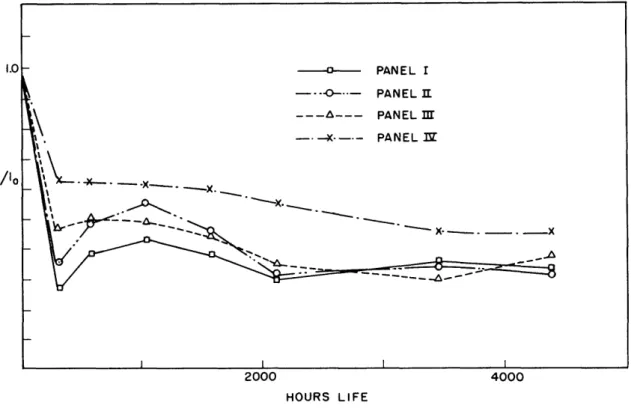
1.0 I/Ia HOURS LIFE Fig. 2 D-C emission. 2000 4000 HOURS LIFE
Fig. 3 Pulsed emission.
-3-1.0
I/Io
microsecond or less, V varies from zero to within a few percent of iR during the pulse. When the diode is pulsed at constant current space-charge-limited, the potential difference between the surface of the cathode and the anode must remain constant during the pulse. Any change in the potential difference across the cathode must be
compen-sated for by a change in the potential difference across the tube. Consequently, if the cathode has an interface resistance, the voltage pulse across the diode is no longer
"square" but has the time-varying interface potential superimposed upon it, as shown in Fig. lb.
To simplify the identification of an interface resistance, the measurement was made at a reduced cathode temperature (940°K). Because of the high negative temperature coefficient of interface resistance, the resistance at 940°K is a factor of five or more greater than at the normal operating temperature of 1050°K.
Note that a voltage pulse similar to that shown in Fig. lb would be observed under the conditions of the interface resistance measurement if the cathode of the tube under test had no interface resistance but its emission were decreasing with time during the pulse. To eliminate this uncertainty, the pulsed emission was measured at the same temperature as the interface resistance, and the variation of the emission with time was directly observed with the synchroscope. Since no tubes ever showed any detectable decrease in emission with time up to 10 ,u sec, voltage pulses having the shape shown in Fig. lb could be used as evidence for the presence of interface resistance.
Results of Experiment I
The results of the d-c and pulsed emission measurements are shown in Figs. 2 and 3, respectively. Each point represents the average emission from the tubes of the panel of ten, normalized to the average emission of the same tubes at zero hours life. Notice that, up to 4316 hours life, there is no significant difference in behavior among the four panels as far as emission is concerned.
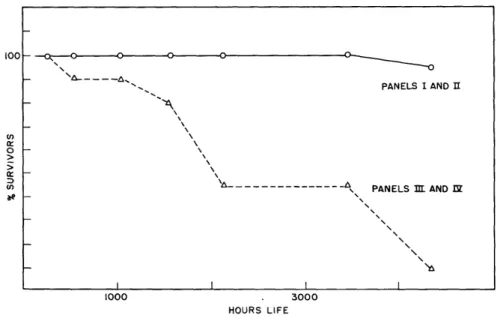
The results of the interface resistance measurements, shown in Fig. 4 in the form of a survival curve, show a striking difference in behavior between tubes aged at zero duty-factor and tubes aged at 100 percent duty-factor. Only one tube from Panels I and II failed, while all but three from Panels III and IV had failed at 4316 hours. The cri-terion for failure used in plotting Fig. 4 was the presence of any detectable interface resistance. The resistances of failures from Panels III and IV ranged from forty to
about a thousand ohms. There was no difference between Panels III and IV.
At the conclusion of the ageing program, x-ray diffraction and spectrochemical analyses were performed. For the identification of the interface compound by x-ray diffraction, samples were prepared by molding together (with Duco cement) scrapings from the interfaces of three cathodes whose coatings had been removed*. One sample
* The identification of the interface compound was attempted from patterns taken using the entire core (with coating removed) as a sample but the layer of interface compound was too thin to give detectable lines on the patterns.
-4-Ion00 Y, 0: U, be 1000 . 3000 HOURS LIFE
Fig. 4 Survival against interface resistance.
was prepared from cathodes with interface resistance from tubes of Panels III and IV, and another from cathodes without interface resistance from tubes of Panels I and II. The layer of interface compound was visible in all of these cathodes as a grayish discol-oration of the core; no difference between the two categories could be detected in the layer by visual examination.
Prints made from the patterns obtained from the two samples are shown in Fig. 5. They are quite similar; in each pattern, the heavy lines are due'to nickel, while the fine lines at low angle are due to Ba2SiO4. In each case, Ba2SiO4 is a major constituent of
the scrapings from the interfaces. From this evidence, it may be concluded that a layer
of Ba 2SiO4 is present at the interface, not only in cathodes that have aged without
a.
b.
Fig. 5 X-ray diffraction patterns of interface compound. a. Cathodes with interface resistance
b. Cathodes without interface resistance
-5-A... PANELS I AND a
'A
\
\\
-I-~
PANELS ' AND &I I I I
---I -- · ll-·---·l·-rrrrrr-urrr---·---^·-·- .__..II
electron emission and have developed interface resistance, but also in cathodes that have aged with electron emission and have not developed interface resistance.
Three categories were chosen for spectrochemical analysis: A. Tubes without interface resistance (Panels I and II)
B. Tubes with interface resistance (Panels III and IV) C. Tubes without interface resistance (Panels III and IV) Four samples were obtained from each of these categories:
a. Surface of anode b. Bulk of anode
c. Cathode coating plus surface of nickel core d. Bulk of nickel core
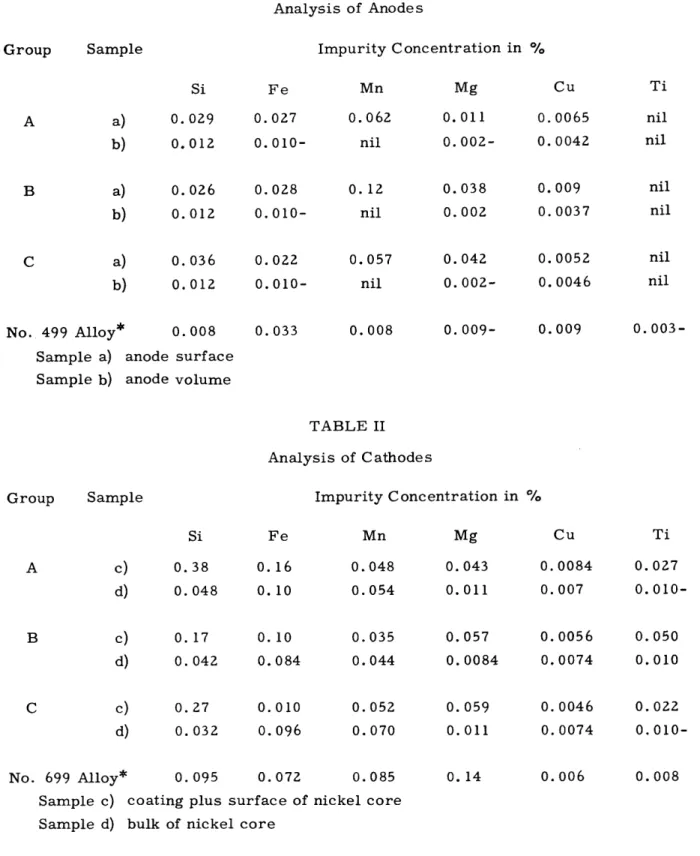
The results of the spectrochemical analyses are shown in Tables I and II. Note that in every case, the concentration of impurities is greater in the anode surface than in the bulk of the anode. This may be ascribed to a contamination of the anode surface by impurities evaporated from the cathode. A comparison of analyses for group A and group B indicates that it is unlikely that the results obtained under the
interface-resistance measurement are due to a systematic difference in impurity content between tubes of Panels I and II and tubes of Panels III and IV.
A significant difference in impurity content is shown in the sample labelled "cathode coating plus surface of nickel core" of group C, which consisted of tubes that aged with-out electron emission withwith-out developing interface resistance. The iron concentration in this sample is only one-tenth as great as in the same sample of group B (interface-resistance failures). Meager though this evidence is, it seems to indicate that an alloy containing as much silicon and manganese as 699, but far less iron, might be signifi-cantly better as a base-metal for cathodes which are to be operated under low duty-factor conditions.
B. Experiment II
The purpose of the second experiment was to investigate the dependence on the history of electron flow of the resistance and "activation energy" of an interface resist-ance on a high-silicon nickel core. A "sandwich" diode was constructed, in which a wafer of (BaSr)O was compressed between two flat electrodes, as shown in Fig. 6. The electrode labelled K1 was of silicon-nickel alloy (about 5 percent Si); K2 was of Grade A
nickel (less than 0. 3 percent Si). Two 0. 7-mil platinum wire probes imbedded in the wafer, as shown in Fig. 6, permitted the determination of the potential difference
across the interface by the double-probe method which has been used by Eisenstein (2) and others.
The wafer was constructed by spraying a coating on K1 in three layers with probes
between the layers; a single-layer coating was sprayed on K2, and the two were
mounted in contact to form the wafer. Since there was apparently a certain amount of
-6-OXID
SPIRAL W HEATER ,
Fig. 6
Schematic of sandwich diode.
- . R, /'/"..;
W TC WIRE'
-L---PROBES COILED W SPRING
W
potential difference across the junction of the coatings, the probes were used only to measure the potential across the K1 interface. The temperature of this interface was measured with a tungsten-nickel thermocouple. One leg of this thermocouple was the K1
electrode itself, while the other was a 3-mil tungsten wire welded to the back of the electrode, as shown in Fig. 6.
In the process of conversion of the carbonates, great care was taken to raise the temperature of the wafer slowly, with the pressure monitored by an ion gauge, to pre-vent excessively rapid liberation of COB. This was felt to be necessary because of the
relatively large volume of the wafer, and the small surface area it presented to the vacuum. After the conversion of the carbonates, the wafer was activated by the passage of electron current at a temperature in excess of 1000°K until no further reduction in resistance took place. At this time, the resistance at 900°K of the wafer (0. 2 cm2 area of cross-section, 0. 5 mm thick) was about a megohm. The pressure at seal-off was less than 5 X 108mm.
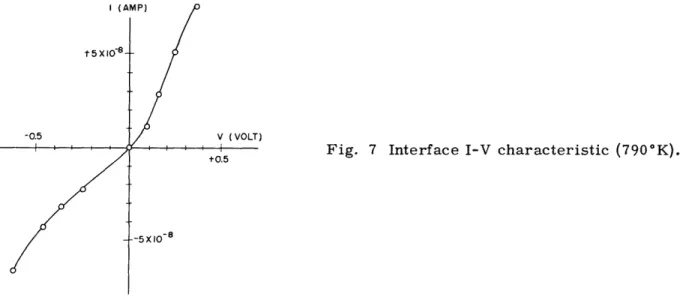
A typical current-voltage characteristic obtained for the K1 interface is shown in
Fig. 7. Note the rectifying nature of the interface resistance, similar to that observed by Mutter (5). The high-resistance direction is the direction of electron flow from the core to the oxide. To obtain from these characteristics a value of the "activation energy", use was made of the fact that in the theory of rectifying contacts, the current can be expressed as a function of the voltage by an expression of the form*
i = A(T) f (V/T) exp (- E /kT) (2)
where is the activation energy in electron-volts, and A(T) varies as Tn, where n is of the order of one or two; k is the Boltzmann constant.
Measurements were taken of the current-voltage characteristic in the high-resistance direction at three different temperatures; as few points as possible were read on each curve to avoid difficulties with lack of reproducibility. The logarithm of the current observed at a fixed value of V/T for each of the temperatures was plotted as a function of
* See, e. g. Torrey and Whitmer, Crystal Rectifiers, p. 77 (McGraw Hill, N. Y. 1948).
I (AMP)
t-5X10⁻⁸
-0.5
Fig. 7 Interface I-V characteristic (790°K).
1/T. From the slope of the best straight line that could be drawn through the three points, the activation energy was obtained.
The result of a typical measurement of this kind is shown in Fig. 8. The numbered points are the reproducibility check points, which were taken with the same potential
applied across the wafer after the measurements at 7600K, 820'K, and 870°K, respec-tively. Note that although the oxide has tended to activate during the measurements, the
state of the interface has not changed.
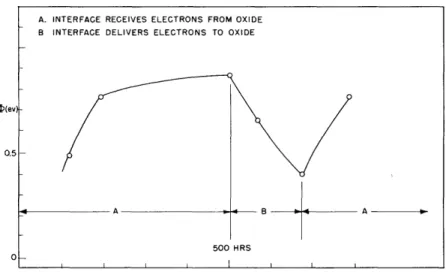
The tube was aged at a wafer temperature of 1000°K as follows: 0-503 hours: electrons flow from oxide to K1 interface
503-668 hours: electrons flow from K1 interface to oxide
668-790 hours: electrons flow from oxide to K1 interface
The currents that flowed during the ageing were about 10 or 20 a, and the potential dif-ference across the interface was about one or two volts. If a value of 10 3 cm is
assumed for the thickness of the interface region, the electric field in this region can be calculated to have been of the order of one or two thousand volts per cm.
The variation of the activation energy of the interface resistance with time during the ageing is shown in Fig. 9. As long as electrons flowed from the oxide to the interface, the activation energy increased, but when electrons flowed from the interface to the oxide, the activation energy decreased sharply. A similar behavior was shown by the resistance, as may be seen in Fig. 10.
III. Interpretation
The results that have been obtained have posed a particularly serious question: how can a layer of Ba2SiO4 (an insulator) at the interface between the oxide and the core have
a high resistance after ageing with no current flow, and have a low resistance after ageing with, electron flow from core to oxide? To answer this question, which I believe to be fundamental to the understanding of the behavior of oxide cathodes under low
76 ev
I I I
1.30
1000 T
Fig. 8 Measurement of activation energy.
Fig. 9 Activation energy vs. time.
Fig. 10 Resistance vs. time (790°K).
-9-V T = CONSTANT I (AMPI IXIO- 7 I X167 LOG I 0.5 V (VOLT) 1.10 107 n I
A. INTERFACE RECEIVES ELECTRONS FROM OXIDE B. INTERFACE DELIVERS ELECTRONS TO OXIDE
- A -500 HRS
_0
r I I i I i i i
-
-·--·I
-· -·ICX----C
-- ---C---- ---p---^lrs··l-*---^-·--·pll···*l
--·
l*IX 1III
----I
I\
_
duty-factor operation, I will propose a model of the interface region and show that it is capable of accounting qualitatively for the observations of both Experiments I and II.
During the process of activation of a cathode coated on a silicon-bearing nickel core, a layer of Ba2SiO4 forms at the interface by a reaction between silicon in the core and
BaO of the coating. This reaction is probably at least partly responsible for the forma-tion of the stoichiometric excess of barium necessary for an active cathode. Some of this excess of barium undoubtedly remains in the layer of interface compound, providing it with donor centers which transform it from an insulator to an "excess" or N-type
semiconductor. The conductivity of the Ba2SiO4 in this state is high enough so that the
cathode has a negligible interface resistance.
LL
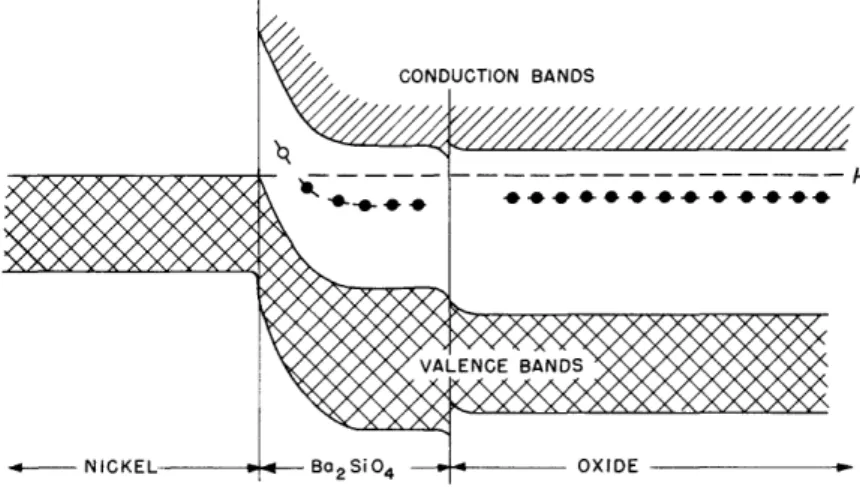
Fig. 11. Energy level system early in life.
The energy level configuration of the interface region in this state would be as shown in Fig. 11. The diagram has been drawn in accordance with the views of Slater (7) con-cerning the junction between conductors and semiconductors, with the a priori assump-tion that the work-funcassump-tion of the activated Ba2SiO4 does not differ greatly from the
work-function of the activated oxide, but that the work-work-function of the nickel is greater than either. In all probability, the Schottky "depletion-layer" barrier at the interface between the nickel and the Ba2SiO4 has a negligible resistance, because the boundary is
undoubt-edly not abrupt, as shown, but much more "diffuse".
As the cathode is aged, the layer of Ba2SiO4 thickens to the point where reaction
between silicon of the core and BaO of the coating becomes negligible. The behavior of the concentration of donor centers in the layer during the ageing will depend on whether
an electric field is present, because the donor centers behave on the average as positive charges.
If no electron emission is drawn from the cathode, there is no electric field in the interface region, and the donor centers can migrate out of the layer of interface com-pound by thermal diffusion. The concentration of donor centers in the layer is reduced to the extent that it is insufficient to maintain a negligible resistance; the cathode has
then developed an interface resistance.
If the cathode is aged delivering electron emission, an electric field directed from oxide to core exists in the interface region. Field-induced migration of donor centers
into the layer of interface compound and thermal diffusion of donor centers out of the
layer of interface compound are then in competition. The equilibrium concentration of donor centers in the Ba2SiO4 layer is greater than it would be if thermal diffusion were
the only migration process. If the field is strong enough, the equilibrium concentration of donor centers is sufficient to maintain the conductivity of the interface compound. The cathode does not develop an interface resistance.
The energy-level configuration of the interface region of a cathode that aged deliv-ering electron emission and did not develop interface resistance would probably be quite
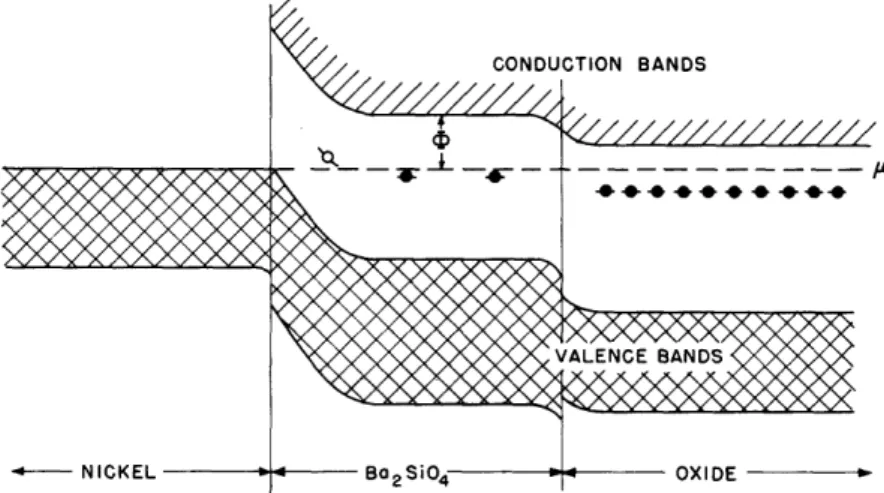
similar to that shown in Fig. 11, with the exception that the layer of interface compound would be thicker. For a cathode that did develop interface resistance, the energy level configuration would be as shown in Fig. 12.
Fig. 12 Energy level system of cathode with interface resistance.
In Fig. 12, the levels of the Ba2SiO4 have been shifted upward relative to the levels of the nickel and the oxide, because of the dependence of the Fermi level () in the
Ba 2SiO4 on the concentration of donor centers. Since the resistance of the Schottky
"depletion-layer" barrier can still be neglected, the activation energy of the interface resistance would be equal to i, the energy difference in electron volts between the Fermi level () and the bottom of the conduction band in the Ba2SiO4, as shown in the figure.
If the cathode were aged with electrons flowing from the oxide to the core, an elec-tric field directed from the core to the oxide would exist in the interface region. The field-induced migration of donor centers would then be in such a direction as to reduce the concentration in the interface compound, and would aid rather than retard the
devel-opment of an interface resistance. Furthermore, a comparison of Figs. 11 and 12 shows
that as the concentration of donor centers decreases and the resistance increases, the activation energy also increases.
-11--
I IC- --
IICII
·II__-·-·-··I1-·I-·Illllllly
This is exactly what was observed in Experiment II; as long as the interface was aged with electrons flowing from the oxide to the core, the resistance and activation energy increased. The fact that resistance and activation energy could be reduced by the pas-sage of electron current from the core to the oxide is also in agreement with the features of this model, since there is no reason why a low concentration of donor centers could not be increased by the establishment of field-induced migration in the proper direction.
To account for one of the results of Experiment II, it is necessary to modify the model slightly, without altering the fundamental features already outlined. An examina-tion of Figs. 9 and 10 shows that the resistance is not related to the activaexamina-tion energy by the simple expression
Ra exp (E4/kT) (3)
as would be expected on the basis of Eq. 2. The variation observed in R is not nearly as great as would be expected from the variation observed in .
This can be accounted for by the fact that the interface layer is probably not at all homogeneous, but varies in thickness and in donor-center concentration. Conduction through it depends on parallel conduction through many "patches" of different thickness, conductivity, and activation energy. The experimental measurements of resistance and activation energy represent two different methods of averaging over the patches. Since the degree of inhomogeneity, on which the resistance strongly depends, can be quite dif-ferent for two states of the interface barrier having the same observed activation energy, it is not surprising that the resistance and activation energy fail to be related in the simple manner expressed by Eq. 3.
IV. Summary and Conclusions
The results obtained in this work have shown that the anomalous deterioration that occurs in oxide cathodes coated on silicon-bearing nickel cores when they are operated at a low duty-factor is due entirely to the development of a high resistance in a layer of BaSiO4 located at the interface between the oxide and the core. The layer itself was
found to be present not only in cathodes that had developed interface resistance, but also in cathodes that had not. The development of a resistance in this layer was heavily favored by the absence of electron emission from the cathode during life.
Further investigation of the properties of an interface resistance on a high-silicon nickel core has shown the resistance and activation energy to be strikingly dependent on the history of electron flow through the interface. A model has been presented that appears capable of accounting for all the experimental observations, and of providing a framework for the understanding of the fundamental features of the deterioration that has been under study.
The application of this understanding to the engineering problem of developing cath-odes that do not deteriorate when they are operated at a low duty-factor leads to two main avenues of approach. (1) Use nickel containing less silicon and other impurities; the layer of interface compound will be thinner, and will have less resistance.
(2) Search for other substances that can be added to the interface compound to provide it with permanent donor centers that will persist in the layer irrespective of duty-factor.
The first of these avenues is currently being exploited by most of the major tube manufacturers, although it suffers from two faults. First, there is enough variation in impurity content among different melts of what is nominally the same alloy to make it possible for different production lots of the same tube to have widely different life expect-ancies. Second, the use of alloys containing appreciable amounts of impurities (i. e.
"active" alloys) is often highly desirable as an aid to easy activation of the cathodes. That the second avenue is not beyond the realm of possibility appears to be indicated by the results of the spectrochemical analyses of diodes that had aged 4316 hours with no electron emission without developing interface resistance. The cathodes of these diodes were found to contain far less iron in the "cathode-coating-plus-surface-of-nickel-core" sample, which contains the interface, than cathodes that had developed interface resist-ance. It is conceivable that in cathodes containing very little iron, the presence of BaMnO4 in the Ba2SiO4 lattice might provide just such permanent donor centers. The
dependence on the iron content stems from the fact that the coexistence of BaMnO4 and
Fe side by side at a temperature of 1100°K for 4000 hours would be extremely improb-able, because the MnO4 ion is a strong oxidizing agent.
However meager the data, and whatever the mechanism may be, these results appear to indicate at first sight that a nickel alloy containing all impurities except iron to the extent that they are found in 699 nickel alloy might be a satisfactory active nickel alloy for cores of cathodes to be operated at a low duty-factor.
Acknowledgements
The author is deeply indebted to Mr. James Cardell, of the Raytheon Manufacturing Company, who performed the spectrochemical analyses, and provided the diodes used in Experiment I; to Mr. H. B. Frost of the M. I. T. Servomechanisms Laboratory, who assisted greatly with the pulsed-emission and interface resistance measurements of Experiment I; to Mr. C. B. Walker of the M. I. T. X-Ray Laboratory, who assisted with the X-Ray diffraction analyses; to the technicians and glass-blowers of the Research Laboratory of Electronics; to his associates in the M. I. T. Physical Electronics Group for many helpful discussions; to Prof. W. B. Nottingham of M. I. T., who supervised this research, for many helpful criticisms and much helpful advice.
TABLE I Analysis of Anodes Group Sample Si Fe 0.029 0.027 0.012 0.010-Impurity Concentration in % Mn 0.062 nil Mg 0.011 0. 002-0.0065 0.0042 a) 0. 026 0.028 b) 0.012 0.010-a) 0. 036 0. 022 b) 0.012 0.010-No. 499 Alloyi Sample a) Sample b) 0.008 anode surface anode volume TABLE II Analysis of Cathodes Group Sample Si A c) d) Impurity Concentration in % Fe 0.38 0.16 0.048 0.10 c) 0.17 d) 0. 042 c) d) 0.27 0. 032 No. 699 Alloy4 Sample c) Sample d) 0. 095 coating plus 0. 072 0.085
surface of nickel core bulk of nickel core
* Typical analysis, furnished by Mr. James Cardell of the Raytheon Manufacturing Company; private communication.
-14-A a) b) Cu B C Ti nil nil 0.12 nil 0.057 nil 0.038 0.002 0.042 0.002-0.009 0. 0037 0. 0052 0. 0046 nil nil nil nil 0.033 0.008 0.009- 0.009 0.003-Mn 0.048 0.054 Mg 0. 043 0.011 B C Cu 0.0084 0. 007 Ti 0. 027 0.010-0. 10 0. 084 0.010 0.096 0.035 0.044 0.052 0. 070 0.057 0.0084 0.059 0.011 0.0056 0.0074 0.0046 0.0074 0.050 0. 010 0.022 0.010-0.14 0. 006 0.008
References
(1) Report R-139, Project Whirlwind Div. of M. I. T. Servomechanisms Laboratory. (2) A. Eisenstein: J. App. Phys. 17, 663 (1947).
(3) A. Eisenstein: J. App. Phys. 20, 776 (1949).
(4) W. E. Danforth, D. L. Goldwater: J. App. Phys. 20, 163 (1949). (5) W. E. Mutter: Phys. Rev. 72, A531(1947).
(6) D. A. Wright: Proc. Roy. Soc. (Lond.) A190. 394 (1947). (7) J. C. Slater: Phys. Rev. 76, 1592 (1949).