HAL Id: insu-03118075
https://hal-insu.archives-ouvertes.fr/insu-03118075
Submitted on 21 Jan 2021
HAL is a multi-disciplinary open access
archive for the deposit and dissemination of
sci-entific research documents, whether they are
pub-lished or not. The documents may come from
teaching and research institutions in France or
abroad, or from public or private research centers.
L’archive ouverte pluridisciplinaire HAL, est
destinée au dépôt et à la diffusion de documents
scientifiques de niveau recherche, publiés ou non,
émanant des établissements d’enseignement et de
recherche français ou étrangers, des laboratoires
publics ou privés.
WISDOM/ExoMars: Towards the high resolution
imaging of the Martian subsurface
Nicolas Oudart, Valérie Ciarletti, Alice Le Gall, Yann Herve
To cite this version:
Nicolas Oudart, Valérie Ciarletti, Alice Le Gall, Yann Herve. WISDOM/ExoMars: Towards the high
resolution imaging of the Martian subsurface. EPSC-DPS Joint Meeting 2019, Sep 2019, Geneva,
Switzerland. pp.EPSC-DPS2019-553-2. �insu-03118075�
WISDOM/ExoMars: Towards the high resolution imaging
of the Martian subsurface
Nicolas Oudart, Valérie Ciarletti, Alice Le Gall, Yann Hervé
LATMOS/IPSL, UVSQ (Université Paris-Saclay), UPMC (Sorbonne Université), Guyancourt, France ([email protected])
Abstract
The WISDOM ground penetrating radar is one of the instruments onboard the rover of ESA and ROSCOSMOS ExoMars 2020 mission. Its objective is to seek out traces of past or present life in the shallow Martian subsurface. To achieve this goal, the rover is equipped with a 2 m long drill, able to retrieve underground samples. WISDOM will give useful insights on the structure and dielectrical properties of the subsurface to guide drilling operations. In this context, the vertical resolution of the radar is key. In order to improve this resolution, bandwidth extrapolation techniques are applied to both synthetic and experimental WISDOM data.
1. Introduction
ExoMars 2020 is a mission including a rover and a surface platform. The main objective of the rover mission is to seek out traces of past or present life on Mars. The Martian surface being subject to strong radiation levels and oxidation, if such traces still exist, they would likely be in the subsurface. To reach those potential traces of life, the mission drill will be able to collect samples down to 2m in the subsurface, that will be analysed by a suite of analytical instruments in the rover body.
The WISDOM ground penetrating radar (Water and Ice Subsurface Deposits On Mars) has been developed by the LATMOS and the TUD to unveil the structure and dielectrical properties of the Martian subsurface down to a depth ranging from about 3 and 10 m depending on the nature of the subsurface [5]. Being a “stepped-frequency” radar, WISDOM works in the frequency domain between 0.5 and 3 GHz. This 2.5 GHz interval is referred to as the “bandwidth” B of the instrument, and drives the theoretical resolution in distance of the instrument
𝛿 = 𝑐
2𝐵√𝜀𝑟 (1)
where 𝑐
√𝜀𝑟 is the speed of light in the material. In
theory, the vertical resolution of WISDOM is thus limited by this 2.5 GHz bandwidth (3.5 cm if 𝜀𝑟≈ 3).
Confronted with the same limitation with the Cassini radar and the SHARAD/MRO radar, Mastrogiuseppe [9] and Raguso [10] applied with success a bandwidth extrapolation (BWE) technique to improve the vertical resolution by a factor of 3. With such a promising result, it seemed legitimate to apply this technique to WISDOM data.
2. The Bandwidth Extrapolation
technique
2.1 BWE method
The bandwidth extrapolation method was invented by the Radar Imaging Technique group of the Lincoln laboratory. The concept was introduced by S. B. Bowling [2] in 1977 and then further developed by K. M. Cuomo [6] in 1992 who applied it to radar imaging.
As previously explained, a frequency limited spectrum is measured by WISDOM. If correctly modelled, it can in theory be extrapolated. The chosen model is an autoregressive linear one (forward or backward), with coefficients to be determined: 𝑠𝑛= − ∑ 𝑎𝑖 𝑠𝑛−𝑖 𝑝 𝑖=1 or 𝑠𝑛= − ∑ 𝑎𝑖 𝑠𝑛+𝑖 𝑝 𝑖=1 (2)
with sn the data from the spectrum, ai the coefficients
of the model and p its order.
The main difficulty lies in the determination of the best coefficients and order of the model. To obtain a better approximation of the order, a statistical criterion can be used [1].
EPSC Abstracts
Vol. 13, EPSC-DPS2019-553-2, 2019 EPSC-DPS Joint Meeting 2019
c
2.2 The Burg algorithm
The Burg algorithm is a recursive method to determine the coefficients of a linear autoregressive model [3]. For a given order, it returns the coefficients values that minimise the forward and backward prediction error using the maximum entropy method. It is the most commonly used algorithm for this task, because it ensures a stable model. The Modified Covariance Method has also been tested by Raguso et al. [10], and proved to be more efficient in low-noise cases. However, the stability of the model is not guaranteed.
2.3 Particle Swarm Optimisation
The Burg algorithm is a fast method that guaranties the stability and singularity of its result. However, it does not necessarily return the best stable solution, and it requires an a priori on the order of the model. For those reasons, we propose a new algorithm for the determination of the coefficients and the order of the autoregressive model: the Particle Swarm Optimisation (PSO) [11] [7].
A population of solutions moves across the space of possible solutions. Every individual in the population has a speed, being a sum of three weighted components: the distance from its own best known position in the space of solutions, the distance from the best known position in the entire swarm, and a random component. We applied this algorithm to the research of an autoregressive model, every position in the space of solutions being a list of coefficients of a model. We also ensured that the returned solutions were always stables, and added the “catfish” [4] and “crown jewel defense” [8] techniques to avoid local minima.
3. Validation
To test the different extrapolation techniques, we use both simulated and experimental data. For the simulated data, a simple layered subsurface model is used. The 1st layer is 38 cm of air, consistent with WISDOM antennas accommodation. The 2nd layer is
a layer of sand (𝜀𝑟= 3) with thickness values ranging
between 1 and 4 cm. The 3rd layer is a semi-infinite
layer of bedrock (𝜀𝑟= 6). A numerical code has been
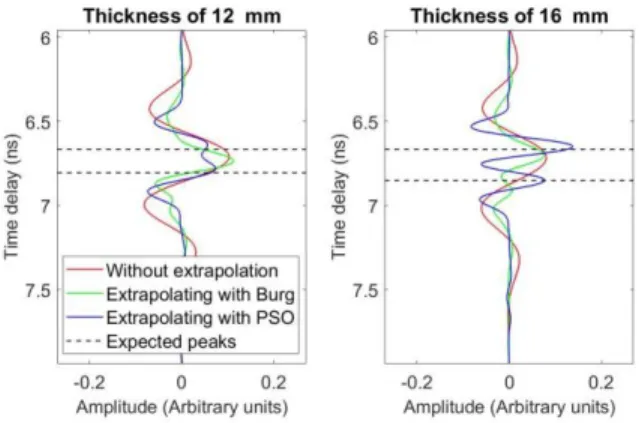
used to model WISDOM operation and to generate relevant simulated data. Figure 1 shows results obtained with the different methods. We observe that the PSO algorithm gives better results in terms of separation and localisation of the peaks than the Burg algorithm. The two peaks corresponding to the two
interfaces are clearly detected with the PSO algorithm for thickness values larger than 1.2 cm.
Figure 1: Simulated soundings for different thickness values of the 2nd layer.
4. Conclusions and perspectives
Bandwidth extrapolation applied to simulated WISDOM soundings allowed us to detect interfaces in theory too close to be separated according to the theoretical resolution. For a same amount of extrapolated frequencies, PSO algorithm separates closer interfaces than Burg algorithm. The application to experimental data is in process and currently shows promising results for the PSO algorithm extrapolation, but disappointing results for Burg algorithm. Further tests on experimental data are required to understand this last result. Data obtained by simulations will also be further processed to check the effect of the extrapolation on the shape of the peaks.
Acknowledgments
The WISDOM instrument has been supported by CNES and DLR. This research has been supported by CNES and UVSQ.
References
[1] Akaike: IEEE Trans. On Automatic Control vol. 19, 1974. [2] Bowling: Project Report RMP-122, MIT Lincoln Laboratory, 1977. [3] Burg: 37th Meeting of the Society of Exploratory Geophysicists, 1967. [4] Chuang et al.: IEEE, 2008. [5] Ciarletti et al.: Astrobiology vol. 17, 2017. [6] Cuomo: Project Report, MIT Lincoln Laboratory, 1992. [7] Eberhart, Shi: IEEE, 2001. [8] Lin et al.: IEEE, 2012. [9] Mastrogiuseppe et al.: AGU publications, 2014. [10] Raguso et al.: IEEE, 2018. [11] Shi, Eberhart: IEEE, 1998.