HAL Id: hal-02377545
https://hal.archives-ouvertes.fr/hal-02377545
Submitted on 23 Nov 2019
HAL is a multi-disciplinary open access
archive for the deposit and dissemination of
sci-entific research documents, whether they are
pub-lished or not. The documents may come from
teaching and research institutions in France or
abroad, or from public or private research centers.
L’archive ouverte pluridisciplinaire HAL, est
destinée au dépôt et à la diffusion de documents
scientifiques de niveau recherche, publiés ou non,
émanant des établissements d’enseignement et de
recherche français ou étrangers, des laboratoires
publics ou privés.
Coexistence of Two Singularities in Dewetting Flows:
Regularizing the Corner Tip
Ivo Peters, Jacco H. Snoeijer, Adrian Daerr, Laurent Limat
To cite this version:
Ivo Peters, Jacco H. Snoeijer, Adrian Daerr, Laurent Limat. Coexistence of Two Singularities in
Dewetting Flows: Regularizing the Corner Tip. Physical Review Letters, American Physical Society,
2009, 103 (11), pp.114501. �10.1103/PhysRevLett.103.114501�. �hal-02377545�
Ivo Peters1,2, Jacco H. Snoeijer2, Adrian Daerr1, Laurent Limat1
1Laboratoire Mati`ere et Syst`emes Complexes, UMR CNRS 7057, Universit´e Paris Diderot,
10 rue Alice Domon et L´eonie Duquet, 75205 Paris cedex 13, France
2Physics of Fluids Group and J. M. Burgers Centre for Fluid Dynamics,
University of Twente, P.O. Box 217, 7500 AE Enschede, The Netherlands
(Dated: August 13, 2009)
Entrainment in wetting and dewetting flows often occurs through the formation of a corner with a very sharp tip. This corner singularity comes on top of the divergence of viscous stress near the contact line, which is only regularized at molecular scales. We investigate the fine structure of corners appearing at the rear of sliding drops. Experiments reveal a sudden decrease of tip radius, down to 20 microns, before entrainment occurs. We propose a lubrication model for this phenomenon, which compares well to experiments. Despite the disparity of length scales, it turns out that the tip size is set by the classical viscous singularity, for which we deduce a nanometric length from our macroscopic measurements.
Fluid interfaces can be deformed into singular struc-tures exhibiting length scales much smaller than that of the global flow. The most common example is a water drop detaching from a faucet, developing a singularity at pinch-off [1, 2]. Similar topological changes occur when the flow near the interface is driven so strongly that one of the fluid phases can invade the other. This so-called entrainment often occurs through a sharp cusp or tip [3–7], as is e.g. observed for air bubbles entrained by a jet or solid plunging into a liquid pool [8–12]. However, below the critical driving strength the interface remains at steady state and a stationary, singular structure is formed. Besides fundamental interest, this control over small length scales is crucial in applications such as spray formation and inkjet printing [13, 14], while entrainment is rate limiting in coating [15].
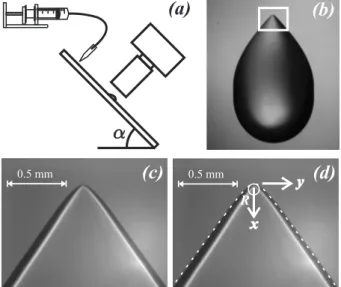
A peculiar situation arises in wetting flows, when the liquid is bounded by a corner-shaped contact line [8– 10, 16–18], cf Fig. 1b. Above a critical speed the sharp corner tip breaks up to entrain bubbles or droplets de-pending on whether the contact line is advancing or re-ceding. This corner singularity emerges on top of the fa-mous moving contact line singularity: even a perfectly straight contact line develops diverging viscous stress when maintaining a no-slip boundary condition down to molecular scale [19, 20]. Despite progress on the flow away from the tip [21, 22], it has remained unclear how these two singularities can coexist, whether they are re-lated and what determines the sharpness of the corner tip [17].
In this Letter we investigate the fine structure of cor-ner tips appearing at the rear of drops sliding down an inclined plane (Fig. 1). The steady-state corners are char-acterized by the tip radius R, which close to the entrain-ment threshold is found to decrease dramatically with drop speed U . Using a lubrication model we derive the approximate relation
R = ` eθ3
e/9Ca, (1)
FIG. 1: (a) Sketch of the experimental set-up. Partially wet-ting silicone oil drops slide down an inclined plane with con-stant velocity. (b) The interface shape of the drop is mon-itored from above for different sliding velocities. At large speeds a sharp corner forms at the rear of the drop. (c) The tip radius R can be determined from a zoom of the corner tip. (d) Same as in (c) showing that the contact line is well approx-imated by a hyperbolic shape (dashed, using R = 50 µm).
that accurately describes the experimental observations. Here θe is the equilibrium (receding) contact angle and
the speed dependence appears through the capillary number Ca = U η/γ, where η and γ denote viscosity and surface tension. We identify the length ` as the molecu-lar scale associated with the microscopic physics of wet-ting [23–31]. We obtain a length of the order of 10 nm by fitting the experimental data. From a hydrodynamic point of view, this is the scale at which the classical vis-cous singularity is regularized.
Dewetting corners thus have the remarkable feature that the tip size is governed by an inner length scale `, much smaller than the tip radius itself. This scenario
2
FIG. 2: Experimental measurements of the tip curvature 1/R as a function of Ca. Data are normalized by the contact line radius at zero speed, R0= 1.63 mm. At low Ca the curvature
stays nearly constant R/R0 ≈ 1, while close to the pearling
transition (vertical dashed line) the curvature increases nearly two orders of magnitude. Solid line indicates the prediction (1) with ` = 7 nm. Inset: The logarithmic plot confirms the predicted scaling. Dashed line is the best linear fit.
is very different from free surface singularities without a contact line, even though these can exhibit a similar exponentially decreasing tip size. For example, the cusp solution by Jeong & Moffat [3] scales as Rcusp∼ Le−Ca,
but in this case L is an outer length scale characterizing the macroscopic flow.
Experiments. — A schematic view of the
experimen-tal setup is given in Fig. 1a. Silicon oil drops are de-posited on an inclined glass plate (η = 18.6 cP, γ = 0.0205 N/m, ρ = 940 kg/m3). The drops detach from
a pipette connected to a syringe pump, resulting in a constant drop volume (typically 8 − 10 mm3). The drops
slide down at a constant speed U that is controlled by the angle at which the plate is inclined. The glass plate is coated with fluoro-polymers (FC725), providing partial wetting conditions for silicon oil [16] with static advanc-ing and recedadvanc-ing angles of 55◦and 45◦respectively. As we
consider the receding contact line at the rear of the drop we take θe = 45◦. The corners are visualized with large
magnification that is achieved by using a 25 mm Pentax lens in reversed direction combined with several macro extension tubes. The optical resolution of the images like Fig. 1c on which the actual tip curvature measurements are done is 2 µm/pixel on a 1 Mega pixel image.
Figure 2 shows experimental results on the contact line curvature 1/R as a function of drop speed Ca. Tip radii are normalized by the radius of curvature of a static drop of the same volume, R0 = 1.63 mm. At low speeds the
curvature remains constant, while a rapid increase of the curvature can be seen at capillary numbers Ca >∼ 5·10−3.
This behavior coincides with the onset of the cornered
FIG. 3: The receding contact angle θ measured at a fixed distance x = 50 µm. A linear fit is made to the Cox-Voinov regime (solid line). A clear departure from the linear regime sets in at Ca ≈ 6·10−3, where R approaches the measurement
scale of 50 µm. Inset: A side view of the rear of a drop sliding from right to left. h0 is the height of the drop along the
centerline.
shape. The measurements continue up to the ‘pearling transition’ at which small droplets are entrained, occur-ring around Ca = 7 · 10−3. The smallest tip size we find
before this entrainment is approximately 20 µm, which is nearly two orders of magnitude smaller than the global drop size. The scaling (1) is revealed in the inset of Fig. 2, showing the curvature 1/R on a semi-logarithmic scale versus 1/Ca. In the corner regime the data agree very well with this exponential behavior. The solid line was fitted using the length scale ` as the sole adjustable pa-rameter, yielding ` = 7 nm. We wish to emphasize, how-ever, that the determination of ` is very sensitive to the details of the fit. For example, when fitting (1) using θe
as second adjustable parameter one finds θe = 41◦ and ` = 65 nm (dashed line). We nevertheless conclude that
the length scale is of nanometric size, consistent with the typical size of silicone oil molecules [17].
We now wish to demonstrate that ` is related to the regularization of the viscous singularity that appears in the Cox-Voinov law for the dynamic contact angle θ [23]
θ3= θ3e− 9Ca ln x/`θ, (2)
which is accurate within 2% for angles up to 45◦ [24].
This dynamic angle varies logarithmically with the dis-tance to the contact line x, cut-off at a scale `θ. The
pre-cise interpretation of this length depends on the physics at molecular scale, which goes beyond hydrodynamics and beyond the purpose of the present paper [23–31]. Here we estimate `θby measuring the contact angle along
the central axis of the drop, very near the tip, from side view images at different speeds (cf. inset of Fig. 3).
Strictly speaking, (2) is derived for straight contact lines. We therefore perform our measurements at a distance
¿ R, where the effect of contact line curvature should be
negligible. Given the resolution of the side view images, we take x = 50 µm in order to have sufficient accuracy on the contact angle.
Figure 3 shows θ3 versus Ca. We clearly distinguish
the linear regime of (2), as well as a departure from this behavior at higher drop speeds. From a linear fit we recover the (receding) equilibrium angle θe= 45 ± 1◦ as
well as `θ= 8±5 nm. This length scale is consistent with
the order of magnitude found from the R measurements. The deviation from the Cox-Voinov behavior occurs when the radius of curvature approaches the measurement scale of 50 µm, around Ca ≈ 6 · 10−3. This once more suggests
an interaction between R and `θ in the corner regime. Lubrication model. — We interpret these findings
within a lubrication model that incorporates the strongly curved tip. For small contact angles the shape of the liquid-gas interface, h(x, y), obeys a partial differential equation that expresses a balance between capillary and viscous forces [32]. The multi-scale nature of the problem makes it difficult to solve the equation by direct simula-tion. Instead, we propose an approximate analysis that has the additional advantage of yielding expressions in closed form. First, we assume that the flow is oriented purely in the x direction (Fig. 4, inset), so that the lu-brication equation simplifies
∂xκ = 3Ca
h2 . (3)
κ is the interface curvature providing the Laplace
pres-sure p = −γκ. For sharp corners with vanishing tip size, this ’planar flow approximation’ was found very accu-rate [21]. In the present case this corresponds to x À R. For x ¿ R the flow becomes truly one-dimensional since
∂/∂y ¿ ∂/∂x and (3) is even exact. In this region κ = ∂xxh, and (3) can be integrated to the Cox-Voinov
law [23, 24, 33]. For corners such as in Fig. 1 we thus expect to recover (2) at small distance from the tip.
Away from the tip, x ∼ R, the interface exhibits a truly two-dimensional structure, κ = ∂xxh + ∂yyh, making the
analysis much more involved. This effect has been con-sidered in the limit of weak contact line curvature [34], but this is not sufficient for the present purpose. To make progress we estimate κ by (i) approximating the contact line shape by a hyperbola, y2
cl= 2Rx + φ2x2, and (ii)
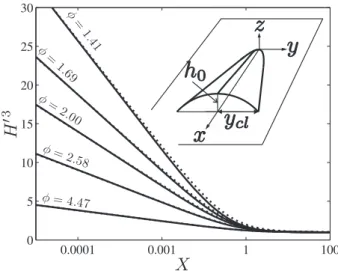
ap-proximating the cross-section of the corner by a parabola. The quality of the former approximation can be inferred from the dashed line of Fig. 1d, while the latter has been justified in detail in [21]. With this, the interface is pa-rameterized as (cf. inset Fig. 4)
h(x, y) = h0(x) µ 1 − y 2 y2 cl ¶ , (4)
FIG. 4: Rescaled slope H03obtained from numerical solution
of (6) with boundary conditions H0(∞) = 1, H(0) = 0 (solid
lines). The Cox-Voinov logarithmic variation saturates at a distance X ∼ 1, corresponding to the tip radius. Dotted lines represent (7) using β as fit parameter. Inset: the drop shape is modeled by a hyperbolic contact line shape ycl(x)
and parabolic cross section. The centerline profile h0(x) can
then be computed from (6).
containing R and φ, the opening angle of the hyperbola, as parameters. In addition, we still need to solve the centerline profile h0(x). To close the problem we evaluate
the curvature at the centerline y = 0,
κ = h00
0−
2h0
2Rx + φ2x2, (5)
which together with (3) provides an ordinary differential equation for h0(x). This equation was previously studied
with vanishing tip radius R = 0 [21, 22], here represent-ing the limit x À R. This regime admits solutions with a well-defined corner angle h0
0(∞) = Ω = (3Caφ2/2)1/3,
obtained by combining (3) and (5).
It is convenient to introduce dimensionless variables
X = xφ2/R and H = h
0φ2/RΩ, so that from (3,5) we
obtain the equation on the centerline
φ2 2 H 000− µ H X(X + 2) ¶0 = 1 H2. (6)
The only remaining parameter is the opening angle φ [35]. We have the asymptotic boundary conditions H0(∞) → 1
(corner solution) and H(0) → 0 towards the contact line. Figure 4 displays the solutions obtained from numerical integration, for various φ. At small X one recovers the Cox-Voinov logarithmic variation of the slope H0,
show-ing up as a straight line on this plot. However, this trend saturates at large X, when the two-dimensional nature of the curvature becomes apparent. All solutions are very accurately represented by the form
4 H03= 1 + 6 φ2ln µ 1 + β X ¶ , (7)
as can be seen from Fig. 4 (dotted lines). We used β as a fit parameter that turns out to depend weakly on φ. A perturbation expansion shows that (7) is in fact the exact solution for φ À 1, with β = 2.
To solve for the tip radius, the final step is to match (2) to the small scale asymptote of (7), which in original variables reads h03' Ω3+ 9Ca ln βR
xφ2. Equating the two
expressions one finds
Ω3= θ3e− 9Ca ln βR φ2`
θ, (8)
which is the sought for relation between R, Ca and the contact angles. Since in practice Ω ¿ θe, it can be recast
as (1) with ` = `θφ2/β. Strictly speaking this length
con-tains a dependence on drop speed through the opening angle φ that also induces a variation of β. This variation, however, is subdominant with respect to the exponential dependence in (1).
Let us emphasize that the structure (7) is robust with respect to the choice of parameterization of the interface shape and the ‘planar flow approximation’, since these only affect the cross-over to the corner regime. On the other hand, the numerical value of β is determined from the second term in (5) and will certainly be model de-pendent. One should bear in mind that these details fall within the experimental uncertainty on ` and `θ.
Outlook. — We have identified a new kind of
singu-larity in free surface flows for which the regularization involves a microscopic (inner) scale instead of a macro-scopic (outer) scale. In fact, the corner is obtained by sharply bending the line singularity associated to the vis-cous divergence near the contact line. This is very spe-cific for wetting flows and differs qualitatively from other free surface singularities. Our findings also emphasize that the dynamic contact angle is strongly affected by the corner. This gives a departure of the Cox-Voinov be-havior when the tip size becomes comparable to the scale of measurement. It would be interesting to compare these results to advancing contact lines, where bubble entrain-ment occurs through sharp corners as well [8–10].
In the experiment, the minimum tip size that can be achieved is limited by the onset of the pearling insta-bility. This instability can possibly be incorporated in the model by matching the cross sections to the inclined contact lines, along the lines of Ref. [22]. In that study, however, the tip radius was neglected and incorrectly pre-dicted a vanishing size of emitted drops at threshold. In practice these drops are or the order of 100 µm, which we speculate to be related to the finite radius of the tip.
IP acknowledges financial support by NWO.
[1] J. Eggers, Rev. Mod. Phys. 69, 865 (1997).
[2] R. F. Day, E. J. Hinch, and J. R. Lister, Phys. Rev. Lett. 80, 704 (1998).
[3] J.-T. Jeong and H. K. Moffatt, J. Fluid Mech. 241, 1 (1992).
[4] J. Eggers, Phys. Rev. Lett. 86, 4290 (2001).
[5] I. Cohen and S. R. Nagel, Phys. Rev. Lett. 88, 074501 (2002).
[6] W. W. Zhang, Phys. Rev. Lett. 93, 184502 (2004). [7] S. Courrech du Pont and J. Eggers, Phys. Rev. Lett. 96,
034501 (2006).
[8] R. Burley and B. S. Kennedy, Chem. Eng. Sci. 31, 901 (1976).
[9] T. D. Blake and K. J. Ruschak, Nature 282, 489 (1979). [10] H. Benkreira and M. I. Khan, Chem. Eng. Sci. 63, 448
(2008).
[11] E. Lorenceau, D. Qu´er´e, and J. Eggers, Phys. Rev. Lett 93, 254501 (2004).
[12] E. Lorenceau, F. Restagno, and D. Qu´er´e, Phys. Rev. Lett. 90, 184501 (2003).
[13] A. M. Ga˜n´an-Calvo, Phys. Rev. Lett. 79, 217 (1997). [14] J. Eggers and E. Villermaux, Rep. Prog. Phys. 71,
036601 (2008).
[15] S. F. Kistler and P. Schweizer, Liquid film coating -
Sci-entific principles and their technological implications, vol.
169 (Kluwer Academic, Dordrecht, 1997).
[16] T. Podgorski, J. M. Flesselles, and L. Limat, Phys. Rev. Lett. 87, 036102(1) (2001).
[17] N. Le Grand, A. Daerr, and L. Limat, J. Fluid Mech. 541, 293 (2005).
[18] C. Duez, C. Ybert, C. Clanet, and L. Bocquet, Nat. Phys. 3, 180 (2007).
[19] C. Huh and L. E. Scriven, J. Coll. Int. Sci. 35, 85 (1971). [20] E. B. Dussan V. and S. H. Davis, J. Fluid Mech. 65, 71
(1974).
[21] L. Limat and H. A. Stone, Europhys. Lett. 65, 365 (2003).
[22] J. H. Snoeijer, N. Le Grand-Piteira, L. Limat, H. A. Stone, and J. Eggers, Phys. Fluids 19, 042104 (2007). [23] O. V. Voinov, Fluid Dynamics 11, 714 (1976). [24] R. G. Cox, J. Fluid Mech. 168, 169 (1986). [25] P. G. de Gennes, Coll. Pol. Sci. 264, 463 (1986). [26] Y. Pomeau, C.R. Acad. Sci. Paris 328, 411 (2000). [27] J. Eggers, Phys. Rev. Lett. 93, 094502 (2004).
[28] U. Thiele, K. John, and M. B¨ar, Phys. Rev. Lett. 93, 027802 (2004).
[29] L. W. Schwartz, D. Roux, and J. J. Cooper-White, Phys-ica D 209, 236 (2005).
[30] E. Rolley and C. Guthman, Phys. Rev. Lett. 98, 166105 (2007).
[31] J. De Coninck and T. D. Blake, Annu. Rev. Mater. Res. 38, 1 (2008).
[32] A. Oron, S. H. Davis, and S. G. Bankoff, Rev. Mod. Phys. 69, 931 (1997).
[33] B. R. Duffy and S. K. Wilson, Appl. Math. Lett. 63, 63 (1997).
[34] J. H. Snoeijer, E. Rio, N. Le Grand, and L. Limat, Phys. Fluids 17, 072101 (2005).
[35] Experimentally, the angle φ decreases with drop speed, in order to reduce the normal velocity of the inclined contact lines [16, 17]; its value remains of order unity.