HAL Id: hal-00879129
https://hal.inria.fr/hal-00879129
Submitted on 31 Oct 2013HAL is a multi-disciplinary open access
archive for the deposit and dissemination of sci-entific research documents, whether they are pub-lished or not. The documents may come from teaching and research institutions in France or abroad, or from public or private research centers.
L’archive ouverte pluridisciplinaire HAL, est destinée au dépôt et à la diffusion de documents scientifiques de niveau recherche, publiés ou non, émanant des établissements d’enseignement et de recherche français ou étrangers, des laboratoires publics ou privés.
Exploring beam-based shift-reduce dependency parsing
with DyALog: Results from the SPMRL 2013 shared
task
Éric Villemonte de la Clergerie
To cite this version:
Éric Villemonte de la Clergerie. Exploring beam-based shift-reduce dependency parsing with DyALog: Results from the SPMRL 2013 shared task. 4th Workshop on Statistical Parsing of Morphologically Rich Languages (SPMRL’2013), Oct 2013, Seattle, United States. �hal-00879129�
Exploring beam-based shift-reduce dependency parsing with DyALog:
Results from the SPMRL 2013 shared task
Éric Villemonte de la Clergerie INRIA - Rocquencourt - B.P. 105 78153 Le Chesnay Cedex, FRANCE
Abstract
The SPMRL 2013 shared task was the op-portunity to develop and test, with promising results, a simple beam-based shift-reduce de-pendency parser on top of the tabular logic programming system DYALOG. The parser
was also extended to handle ambiguous word lattices, with almost no loss w.r.t. disam-biguated input, thanks to specific training, use of oracle segmentation, and large beams. We believe that this result is an interesting new one for shift-reduce parsing.
1 Introduction
DYALOGis a tabular-based logic programming en-vironment, including a language (variant of Prolog), a bootstrapped compiler, and C-based abstract ma-chine. It is mostly used for chart-like parsing (de La Clergerie, 2005b), in particular for a wide coverage French Tree Adjoining Grammar (de La Clergerie, 2005a). However, DYALOG offers all the power of a programming language a la Prolog, with some specific advantages, and it was tempting to try it on statistical parsing paradigms. The SPMRL 2013 shared task (Seddah et al., 2013) was an interesting opportunity to develop a simple (non-deterministic) beam-based shift-reduce dependency parser, called
DYALOG-SR, inspired by (Huang and Sagae, 2010).
The main advantage of logic programming is the (almost) transparent handling of non-determinism, useful for instance to handle ambiguous word lat-tices. DYALOGallows an easy tabulation of items, and their fast retrieval (thanks to full term indexing), needed for the dynamic programming part of the al-gorithm. Thanks to structure sharing and term hash-ing, it also reduces the costs related to the tabulation
of multiple items (sharing subparts) and to term uni-fication. Logic programs tend to be very concise, with, in our case, around 1500 lines of DYALOG code. However, one of the disadvantages of (pure) logic programming, and of DYALOG in particular, is the handling of mutable structures, which moti-vated the development of a companion C module (around 850 lines) to handle statistical models (load-ing, query(load-ing, updat(load-ing, and saving).
We briefly present the implemented algorithm (Section 2) and list the preliminary adaptations done for the 9 languages of the shared task (Section 3). We analyze in Section 4 the official results for
DYALOG-SR. Recent developments corrected some
weaknesses of DYALOG-SR. In particular, we ex-plain in Section 5 how we seriously improved the parsing of ambiguous lattices, an important new re-sult for shift-reduce parsing. Finally, Section 6 pro-vides some empirical data about the efficiency and complexity of the algorithm.
2 A Dynamic Programming Shift-Reduce parser
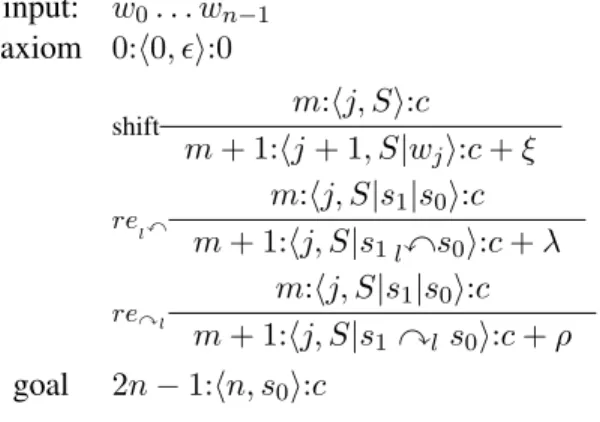
We used (Huang and Sagae, 2010) as the starting point for this work, in particular using the same simple arc-standard strategy for building projective dependency trees, defined by the deductive system of Figure 1. In a configuration m:hj, Si:c, m de-notes the number of transitions applied since the ax-iom configuration, j the current position in the in-put string, S the stack of partial dependency trees built so far, and c the cost. A shift transition pushes the next input symbol on top of the stack while the two reduce transitions combine the 2 topmost stack trees, add a new (labeled) leftmost or rightmost
de-pendency edge between their roots, and remove the newly governed subtree from the stack. The delta cost ξ, λ, and ρ denote the cost of each operation w.r.t. the input configuration.
input: w0. . . wn−1 axiom 0:h0, ǫi:0 shift m:hj, Si:c m+ 1:hj + 1, S|wji:c + ξ relx m:hj, S|s1|s0i:c m+ 1:hj, S|s1 lxs0i:c + λ reyl m:hj, S|s1|s0i:c m+ 1:hj, S|s1 yl s0i:c + ρ goal 2n − 1:hn, s0i:c
Figure 1: Arc-standard deductive system
From the configurations, the deductive system, and the configuration elements used to determine the transition costs, it is relatively straightforward to design items denoting partial configurations stand-ing for equivalence classes of configurations and al-lowing computation sharing, folal-lowing the principle of Dynamic Programming. The deduction rules are adapted to work on items and beam search (with size b) is then achieved by keeping only the b best items for each step m1. By following backpointers from
items to parents, it is possible to retrieve the best transition sequence and the best dependency tree.
i t e m { s t e p => M, r i g h t => J , s t a c k => S0 , % t o p m o s t t r e e s s t a c k 1 => S1 , % p r e f i x => Cost , % max c o s t i n s i d e => I C o s t % i n s i d e c o s t } .
back ( Item , Action , P a r e n t 1 , P a r e n t 2 , C) . t a i l ( Item , A n c e s t o r ) .
Listing 1: Item structure
Instead of the items proposed in (Huang and Sagae, 2010), we switched to items closer to those proposed in (Goldberg et al., 2013), corresponding
1Because we use Dynamic Programming techniques,
keep-ing the b-best items at step m actually corresponds to keep more than the b-best configurations at step m.
to Tree Structured Stacks (TSS), where stack tails are shared among items, as defined by Listing 1. The prefix cost corresponds to the maximal cost attached to the item, starting from the initial item. The inside cost is the maximal cost for a derivation from some ancestor item where s0was shifted on the stack, and
is used to adjust the total cost for different ancestor items. The items are completed by backpointers (us-ing asserted facts back/5) and links to the potential stack tails (using asserted facts tail/2) needed to retrieve the lower part of a stack when applying a re-duce action. Figure 2 shows the adaptation for items of some of the deductive rules.
shift I= m:hj, s0, s1i:(c, ι)
J = m + 1:hj + 1, wj, s0i:(c + ξ, ξ)
tail(J) += I
back(J) +=(shift, I, nil, c + ξ)
relx I= m:hj, s0, s1i:(c, ι) J = _:h_, s1, s2i:(c′, ι′) ∈ tail(I) K= m + 1:hj, s1 lxs0, s2i:(c′+ δ, ι′+ δ) δ= ι + λ tail(K) ∪= tail(J) back(K) +=(lx, I, J, c′+ δ)
Figure 2: Deductive system on items (fragment)
The stack elements for configuration are depen-dency trees, but approximations can be used for the item fields stack and stack1, under the con-dition that sufficient information remains to apply the transitions and to compute the costs. In prac-tice, we keep information about the root node, and, when present, the leftmost and rightmost dency edges, the numbers of left and right depen-dencies (valency), and the label sets (domain) for the left and right dependencies.
The training phase relies on sequences of ac-tions provided by an oracle and uses a simple
av-eraged structured perceptron algorithm (Daume,
2006). The underlying statistical model is updated positively for the actions of the oracle and negatively for the actions of the parser, whenever a point of di-vergence is found. Several updating strategies may be considered (Huang et al., 2012), and, in our case, we update as early (early update) and as often as possible: after completion of Step m + 1, we update the model locally (i.e. for the last action) whenever
• the best item BO
m+1 derived from the oracle
item Om at Step m differs from the expected
oracle item Om+1;
• the oracle item Om+1 is not in the beam, for
intermediary steps m < 2n − 2;
• the oracle item Om+1 is not the best item, for
the last step m = 2n − 2.
We use a relatively standard set of word features related to the CONLL fields such as lex (FORM), lemma, cat (CPOSTAG), fullcat (POSTAG), mstag (morphosyntactic features FEATS). They apply to the next unread word (*I, say lemmaI), the two next lookahead words (*I2 and *I3), and (when present) to the 2 stack root nodes (*0 and *1), their leftmost and rightmost child (before b*[01] and after a*[01]). We have dependency
featuressuch as the labels of the leftmost and
right-most edges ([ab]label[01]), the left and right valency and domains ([ab][vd][01]). Finally, we have 3 (discretized) distance features between the next word and the stack roots (delta[01]) and between the two stack roots (delta01). Most feature values are atomic (either numerical or sym-bolic), but they can also be (recursively) a list of values, for instance for the mstag and domain fea-tures.
A tagset (for a given language and/or treebank) contains a set of feature templates, each tem-plate being a sequence of features (for instance fullcat0:fullcat1:blabel0).
Model management is a key factor for the effi-ciency of the algorithm, both for querying or updat-ing the costs attached to a configuration. Therefore, we developed a specialized C companion module. A model is represented by a hash trie to factor the pre-fixes of the templates. Costs are stored in the leaves (for selecting the labels) and their immediate par-ent (for selecting between the shift and reduce base actions), ensuring join learning with smoothing of an action and a label. Querying is done by pro-viding a tree-structured argument representing the feature values for all templates2, with the
possibil-2The tree structure of the argument mirrors the tree structure
of the templates and getting the argument tree for a configura-tion is actually a fast and very low memory operaconfigura-tion, thanks to unification and structure sharing.
ity to leave underspecified the action and the label. By traversing in a synchronous way the model trie and the argument tree, and accumulating costs for all possible actions and labels, a single query returns in order the cost for the b best actions. Furthermore, when a feature value is a list, the traversal is run for all its components (with summation of all found costs).
3 Preparing the shared task
We trained the parser on the training and dev de-pendency treebanks kindly provided by the organiz-ers for the 9 languages of the task, namely Ara-bic3, Basque (Aduriz et al., 2003), French (Abeillé
et al., 2003), German (Brants et al., 2002; Seeker and Kuhn, 2012), Hebrew (Sima’an et al., 2001; Tsarfaty, 2013; Goldberg, 2011), Hungarian (Vincze et al., 2010; Csendes et al., 2005), Korean (Choi et al., 1994; Choi, 2013) , Polish ( ´Swidzi´nski and Woli´nski, 2010), Swedish (Nivre et al., 2006).
Being very short in time, we essentially used the same set of around 110 templates for all languages. Nevertheless, minimal tuning was performed for some languages and for the pred data mode (when using predicted data), as summarized below.
For French, the main problem was to retrieve MWEs (Multi Word Expression) in pred data mode. Predicted features mwehead and pred were added, thanks to a list of MWEs collected in the gold treebank and in the French lexicon LEFFF (Sagot et al., 2006). We also added the predicted feature is_number to help detecting numerical MWEs such as 120 000, and also a is_capitalized feature. For all data modes, we added a sub-categorization feature for verbs (with a list value), again extracted from LEFFF.
For Arabic, Hebrew, and Swedish, the lemma feature is removed because of the absence of lemma in the treebanks. Similarly, for Polish and German, with identical CPOS and POS tagsets, we remove the cat feature.
For Hungarian, the SubPOS morphosyntactic feature is appended to the fullcat feature, to get a
3We used the shared task Arabic data set, originally provided
by the LDC (Maamouri et al., 2004), specifically its SPMRL 2013 dependency instance, derived from the Columbia Catib Treebank (Habash and Roth, 2009; Habash et al., 2009)
richer set of POS. The set of dependency labels be-ing large (450 labels), we split the labels into lists of more elementary ones for the label features.
Similarly, the Korean POS tags are also split into lists, because of their large number (2743 tags) and of their compound structure.
For French, Hebrew, and Korean, in order to com-pensate initially large differences in performance between the gold and pred modes, we added, for the pred mode, dict features filled by predicted information about the possible tags for a given form, thanks to the dict lexicons provided by the IMS_SZEGED team.
Finally, we discovered very late that the depen-dency trees were not necessarily projective for a few languages. A last-second solution was to use the MALT projectivization / deprojectivization wrap-pers (Nivre and Nilsson, 2005) to be able to train on projectivized versions of the treebanks for Ger-man, Hungarian, and Swedish, while returning non projective trees.
4 First results
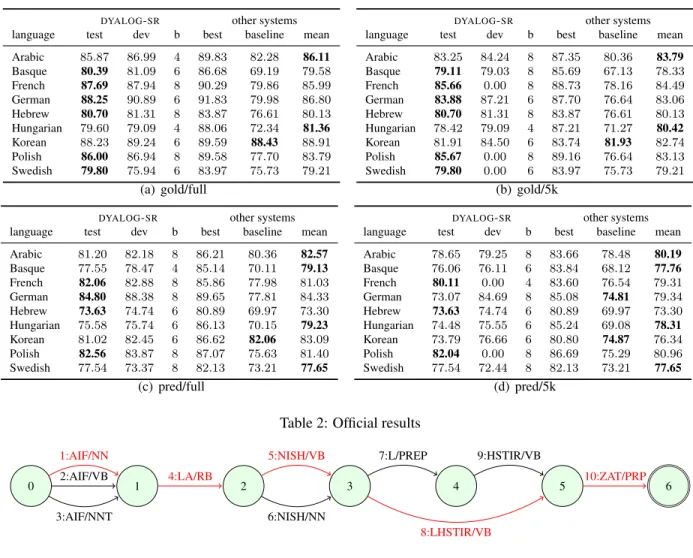
Under the team label ALPAGE-DYALOG, we have returned parsed data for the 9 languages of the shared task, for the full and 5k training size modes, and for the gold and pred data modes. For each configuration, we provided 3 runs, for beam sizes 8, 6, and 4. The results are synthesized in Tables 2, with LAS4 on the test and dev files, contrasted
with the LAS for the best system, the baseline, and the mean LAS of all systems. The tables show that
DYALOG-SR cannot compete with the best system
(like most other participants !), but performs reason-ably well w.r.t. the baseline and the mean LAS of the participants, at least in the gold/full case.
The system is proportionally less accurate on smaller training treebanks (5k case), lacking good smoothing mechanisms to deal with data sparseness. The pred case is also more difficult, possibly again because of data sparseness (less reliable information not compensated by bigger treebanks) but also be-cause we exploited no extra information for some languages (such as Basque or Swedish).
The big drop for German in pred/5k case
4Labeled Attachment Score, with punctuation being taking
into account.
comes from the fact we were unable to de-projectivize the parsed test file with Malt5 and
re-turned data built using an old model not relying on Malt proj/deproj wrappers.
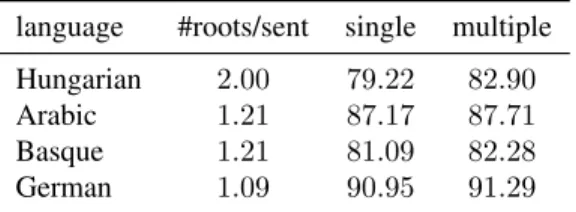
For Hungarian, a possible reason is the high level of multiple roots in sentences, not compatible with our initial assumption of a single root per sentence. New experiments, after modifying slightly the al-gorithm to accept multiple roots6, confirm this
hy-pothesis for Hungarian, and for other languages with multiple roots, as shown in Table 1.
language #roots/sent single multiple Hungarian 2.00 79.22 82.90 Arabic 1.21 87.17 87.71 Basque 1.21 81.09 82.28 German 1.09 90.95 91.29 Table 1: Taking into account multiple roots (on gold/full)
Finally, the Korean case, where we are below the baseline, remains to be explained. For the pred case, it could come from the use of the KAIST tagset in-stead of the alternative Seijong tagset. For the gold case, the results for all participants are actually rela-tively close.
5 Handling ambiguous lattices
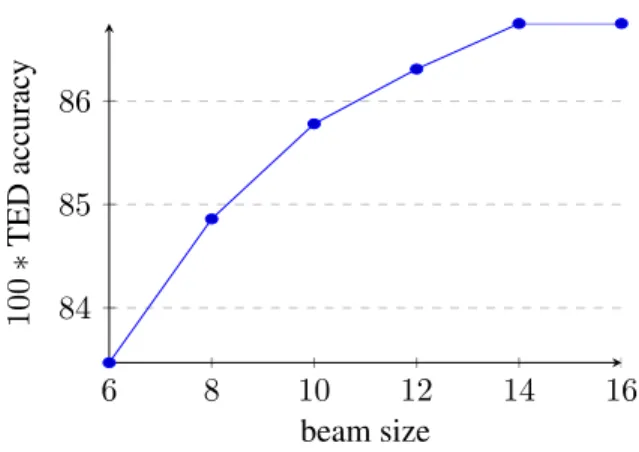
One of the important and innovative sub-tasks of the SPMRL campaign was to parse ambiguous lattices using statistical methods. A word lattice is just a Di-rected Acyclic Graph (DAG) whose edges are deco-rated by words with their features and whose nodes denote positions in the sentence, as represented in Figure 3 for an Hebrew sentence. A valid analysis for a sentence should follow a path in the DAG from its root node at position 0 till its final node at posi-tion n. Each edge may be associated with an unique identifier to be able to refer it.
Lattice parsing is rather standard in chart-parsing7
and since the beginning, thanks to DYALOG’s sup-port, DYALOG-SR was designed to parse ambigu-ous word lattices as input, but originally using
5because of non-termination on at least one sentence.
6Essentially, the initial configuration becomes 0:h0, 0i:0
and the final one 2n:hn, 0 y ⋆i:c using 0 as a virtual root node.
7being formalized as computing the intersection of a
DYALOG-SR other systems language test dev b best baseline mean Arabic 85.87 86.99 4 89.83 82.28 86.11 Basque 80.39 81.09 6 86.68 69.19 79.58 French 87.69 87.94 8 90.29 79.86 85.99 German 88.25 90.89 6 91.83 79.98 86.80 Hebrew 80.70 81.31 8 83.87 76.61 80.13 Hungarian 79.60 79.09 4 88.06 72.34 81.36 Korean 88.23 89.24 6 89.59 88.43 88.91 Polish 86.00 86.94 8 89.58 77.70 83.79 Swedish 79.80 75.94 6 83.97 75.73 79.21 (a) gold/full
DYALOG-SR other systems language test dev b best baseline mean Arabic 83.25 84.24 8 87.35 80.36 83.79 Basque 79.11 79.03 8 85.69 67.13 78.33 French 85.66 0.00 8 88.73 78.16 84.49 German 83.88 87.21 6 87.70 76.64 83.06 Hebrew 80.70 81.31 8 83.87 76.61 80.13 Hungarian 78.42 79.09 4 87.21 71.27 80.42 Korean 81.91 84.50 6 83.74 81.93 82.74 Polish 85.67 0.00 8 89.16 76.64 83.13 Swedish 79.80 0.00 6 83.97 75.73 79.21 (b) gold/5k
DYALOG-SR other systems language test dev b best baseline mean Arabic 81.20 82.18 8 86.21 80.36 82.57 Basque 77.55 78.47 4 85.14 70.11 79.13 French 82.06 82.88 8 85.86 77.98 81.03 German 84.80 88.38 8 89.65 77.81 84.33 Hebrew 73.63 74.74 6 80.89 69.97 73.30 Hungarian 75.58 75.74 6 86.13 70.15 79.23 Korean 81.02 82.45 6 86.62 82.06 83.09 Polish 82.56 83.87 8 87.07 75.63 81.40 Swedish 77.54 73.37 8 82.13 73.21 77.65 (c) pred/full
DYALOG-SR other systems language test dev b best baseline mean Arabic 78.65 79.25 8 83.66 78.48 80.19 Basque 76.06 76.11 6 83.84 68.12 77.76 French 80.11 0.00 4 83.60 76.54 79.31 German 73.07 84.69 8 85.08 74.81 79.34 Hebrew 73.63 74.74 6 80.89 69.97 73.30 Hungarian 74.48 75.55 6 85.24 69.08 78.31 Korean 73.79 76.66 6 80.80 74.87 76.34 Polish 82.04 0.00 8 86.69 75.29 80.96 Swedish 77.54 72.44 8 82.13 73.21 77.65 (d) pred/5k
Table 2: Official results
0 1 2 3 4 5 6 1:AIF/NN 2:AIF/VB 3:AIF/NNT 4:LA/RB 5:NISH/VB 6:NISH/NN 7:L/PREP 8:LHSTIR/VB 9:HSTIR/VB 10:ZAT/PRP
Figure 3: An ambiguous Hebrew word lattice (with gold segmentation path AIF LA NISH LHSTIR ZAT)
models trained on standard CONLL non ambigu-ous sentences. However, the initial experiments with Hebrew lattices (Table 3, using TED metric) have shown an important drop of 11 points between non ambiguous lattices (similar to standard CONLL files) and ambiguous ones.
Hebrew Arabic disamb nodisamb disamb no training 87.34 76.35 87.32 spec. training 86.75
Table 3: Results on dev lattices (TED accuracy ∗ 100)
The main reason for that situation is that multi-ple paths of various lengths are now possible when traversing a lattice. Final items are no longer associ-ated with the same number of steps (2n−1) and final items with a large number of steps (corresponding to
longest paths in the lattice) tend to be favored over those with a small number of steps (corresponding to shortest paths), because the transition costs tend to be positive in our models.
A first attempt to compensate this bias was to “normalize” path lengths by adding (incrementally) some extra cost to the shortest paths, proportional to the number of missing steps. Again using models trained on non-ambiguous segmentations, we gained around 3 points (TED accuracy around 79) using this approach, still largely below the non-ambiguous case.
Finally, we opted for specific training on lattice, with the idea of introducing the new length word feature, whose value is defined, for a word, as the difference between its right and left position in the lattice. To exploit this feature, we added the following 9 templates: length[I,I2,0],
fullcat[I,I2,0]:length[I,I2,0],
lengthI:lengthI2, length0:lengthI,
and length0:lengthI:lengthI2.
Then, to ensure that we follow valid lattice paths, the configurations and items were completed with three extra lookahead fields la[123] to remem-ber the edge identifiers of the lookahead words that were consulted. Obviously, adding this extra infor-mation increases the number of items, only differing on their lookahead sequences, but it is an important element for the coherence of the algorithm.
The reduce actions are kept unchanged, modulo the propagation without change of the lookahead identifiers, as shown below:
relx m:< j, S|s1|s0,la1,la2,la3>: c m+ 1 :< j, S|s1 lxs0,la1,la2,la3>: c + λ reyl m:< j, S|s1|s0,la1,la2,la3>: c m+ 1 :< j, S|s1yls0,la1,la2,la3>: c + ρ
On the other hand, the shift action consumes its first lookahead identifier la1(for a word between
po-sition j and k) and selects a new lookahead identifier la4(which must be a valid choice for continuing the
path la1,la2,la3):
shift m:< j, S, la1,la2,la3>: c
m+ 1 :< k, S|la1,la2,la3,la4>: c + ξ
It should be noted that for a given position j in the lattice, we may have several items only differ-ing by their lookahead sequences la1,la2,la3, and
each of them will produce at least one new item by shifting la1, and possibly more than one because of
multiple la4. However, several of these new shifted
items are discarded because of the beam. Learning good estimations for the shift actions becomes a key point, more important than for usual shift-reduce al-gorithms.
In order to do that, we modified the oracle to pro-vide information about the oracle segmentation path in the lattice, essentially by mentioning which edge identifier should be used for each oracle shift action. It should be noted that this information is also suffi-cient to determine the lookahead sequence for each oracle item, and in particular, the new edge identifier la4to be retrieved for the shift actions.
An issue was however to align the predicted lat-tices with the gold sentences (implementing a stan-dard dynamic programming algorithm) in order to find the oracle segmentation paths. Unfortunately, we found that the segmentation path was missing for 1,055 sentences in the provided Hebrew lattices (around 20% of all sentences). Rather than discard-ing these sentences from an already small traindiscard-ing set, we decided to keep them with incomplete prefix segmentation paths and oracles.
Figure 4 shows the strong impact of a specific training and of using large beams, with a TED accu-racy climbing up to 86.75 (for beam size 16), close to the 87.34 reached on non-ambiguous lattices (for beam 6). Increasing beam size (around 3 times) seems necessary, probably for compensating the lat-tice ambiguities (2.76 transitions per token on aver-age). However, even at beam=6, we get much better results (TED=83.47) than without specific training for the same beam size (TED=76.35).
6 8 10 12 14 16 84 85 86 beam size 100 ∗ TED accurac y
Figure 4: Score on Hebrew lattices w.r.t. beam size
To test the pertinence of the length features, we did some training experiments without these fea-tures. Against our expectations, we observed only a very low drop in performance (TED 86.50, loss = 0.25). It is possible that the lex features are suffi-cient, because only a relatively restricted set of (fre-quent) words have segmentations with length > 1. In practice, for the Hebrew 5k training lattices, we have 4,141 words with length > 1 for 44,722 oc-currences (22.21% of all forms, and 12.65% of all occurrences), with around 80% of these occurrences covered by only 1,000 words. It is also possible that we under-employ the length features in too few templates, and that larger gains could be obtained.
6 Empirical analysis
The diversity and amount of data provided for the shared task was the opportunity to investigate more closely the properties ofDYALOG-SR, to identify its weaknesses, and to try to improve it.
The usefulness of beams has been already proved in the case of Hebrew ambiguous lattices, and Fig-ure 5 confirms that, in general, we get serious im-provements using a beam, but in practice, beam sizes above 8 are not worth it. However, we observe al-most no gain for Korean, a situation to be investi-gated. 2 4 6 8 84 85 86 87 88 89 beam size LAS Arabic French Korean
Figure 5: Accuracy evolution w.r.t. beam size
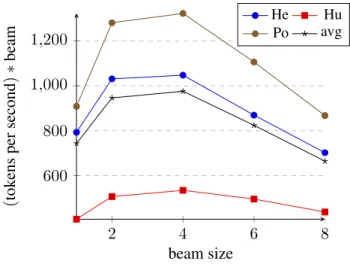
Efficiency was not the main motivation for this work and for the shared task. However, it is worth-while to examine the empirical complexity of the al-gorithm w.r.t. beam size and w.r.t. sentence length. As shown in Figure 6, the average speed at beam=1 is around 740 tokens by second. At best, we ex-pect a linear decreasing of the speed w.r.t. to beam size, motivating the use of a normalized speed by multiplying by the size. Surprisingly, we observe a faster normalized speed than expected for small beam sizes, maybe arising from computation shar-ing. However, for larger beam sizes, we observe a strong decrease, maybe related to beam manage-ment through (longer) sorted DYALOGlists, but also to some limits of term indexing8. The same
experi-ence carried for large beam sizes on the Hebrew lat-tices does not exhibit the same degradation, a point to be investigated but which suggests some kind of
8Even with efficient term indexing, checking the presence of
an item in DYALOGtable is not a constant time operation.
equivalence between beam=4 on non ambiguous in-put string and beam=12 on ambiguous lattices (also reflected in accuracy evolution).
2 4 6 8 600 800 1,000 1,200 beam size (tok ens per second ) ∗ beam He Hu Po avg
Figure 6: Normalized speed w.r.t. beam size (dev)
6 8 10 12 14 16 260 280 300 320 340 beam size (tok ens per second ) ∗ beam
Figure 7: Normalized speed w.r.t. beam size (lattices)
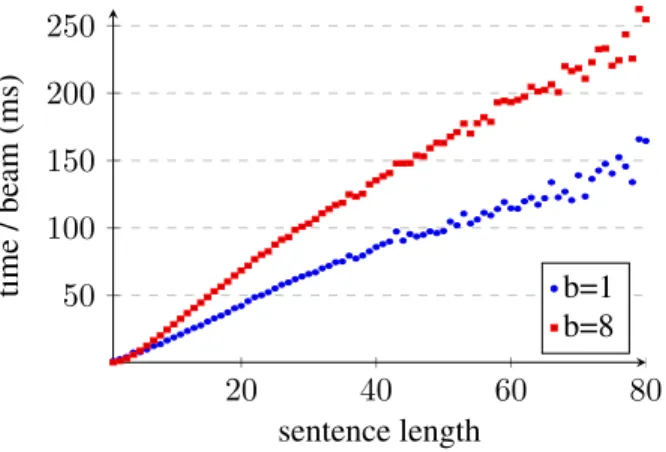
Collecting parsing times for the sentences under length 80 from all training files and for all training iterations, Figure 8 confirms that parsing time (di-vided by beam size) is linear w.r.t. sentence length both for beam=1 and beam=8. On the other hand, we observe, Figure 9, that the number of updates increases with beam size (confirming that larger beams offer more possibilities of updates), but also non linearly with sentence length.
7 Conclusion
We have presented DYALOG-SR, a new implemen-tation on top of DYALOGsystem of a beam-based
20 40 60 80 50 100 150 200 250 sentence length time /beam (ms) b=1 b=8
Figure 8: Parsing time w.r.t. sentence length (train)
20 40 60 80 0 20 40 60 80 100 sentence length #updates b=1 b=8
Figure 9: Number of updates w.r.t. sentence length (train)
shift-reduce parser with some preliminary support for training on ambiguous lattices. Although devel-oped and tuned in less than a month, the participa-tion of this very young system to the SPMRL 2013 shared task has shown its potential, even if far from the results of the best participants. As far as we know, DYALOG-SR is also the first system to show that shift-parsing techniques can be applied on am-biguous lattices, with almost no accuracy loss and with only minimal modifications (but large beams).
Several options are currently under considera-tion for improving the performances ofDYALOG-SR. The first one is the (relatively straightforward) evo-lution of the parsing strategy for handling directly non-projective dependency trees, through the addi-tion of some kind of SWAP transiaddi-tion (Nivre, 2009). Our preliminary experiments have shown the impor-tance of larger beam sizes to cover the increased level of ambiguity due to lattices. However, it seems
possible to adjust locally the beam size in function of the topology of the lattice, for improved accu-racy and faster parsing. It also seems necessary to explore feature filtering, possibly using a tool like
MALTOPTIMIZER(Ballesteros and Nivre, 2012), to
determine the most discriminating ones.
The current implementation scales correctly w.r.t. sentence length and, to a lesser extent, beam size. Nevertheless, for efficiency reasons, we plan to im-plement a simple C module for beam management to avoid the manipulation in DYALOGof sorted lists. Interestingly, such a module, plus the already im-plemented model manager, should also be usable to speed up the disambiguation process of DYALOG -based TAG parser FRMG (de La Clergerie, 2005a). Actually, these components could be integrated in a slow but on-going effort to add first-class probabili-ties (or weights) in DYALOG, following the ideas of (Eisner and Filardo, 2011) or (Sato, 2008).
Clearly, DYALOG-SRis still at beta stage. How-ever, for interested people, the sources are freely available9, to be packaged in a near future.
Acknowledgements
We would like to thank the organizers of the SPMRL 2013 shared task and the providers of the datasets for the 9 languages of the task.
References
Anne Abeillé, Lionel Clément, and François Toussenel. 2003. Building a treebank for French. In Anne Abeillé, editor, Treebanks. Kluwer, Dordrecht. Itziar Aduriz, M. J. Aranzabe, J. M. Arriola, A. Atutxa,
A. Díaz de Ilarraza, A. Garmendia, and M. Oronoz. 2003. Construction of a Basque dependency treebank. In TLT-03, pages 201–204.
Miguel Ballesteros and Joakim Nivre. 2012. MaltOp-timizer: an optimization tool for MaltParser. In
Pro-ceedings of the Demonstrations at the 13th Conference of the European Chapter of the Association for Com-putational Linguistics, pages 58–62.
Sabine Brants, Stefanie Dipper, Silvia Hansen, Wolf-gang Lezius, and George Smith. 2002. The TIGER treebank. In Erhard Hinrichs and Kiril Simov, edi-tors, Proceedings of the First Workshop on Treebanks
9via Subversion on INRIA GForge at https://gforge.
inria.fr/scm/viewvc.php/dyalog-sr/trunk/ ?root=dyalog
and Linguistic Theories (TLT 2002), pages 24–41,
So-zopol, Bulgaria.
Key-Sun Choi, Young S Han, Young G Han, and Oh W Kwon. 1994. KAIST tree bank project for Korean: Present and future development. In Proceedings of
the International Workshop on Sharable Natural Lan-guage Resources, pages 7–14. Citeseer.
Jinho D. Choi. 2013. Preparing Korean Data for the Shared Task on Parsing Morphologically Rich Lan-guages. ArXiv e-prints, September.
Dóra Csendes, Janós Csirik, Tibor Gyimóthy, and An-drás Kocsor. 2005. The Szeged treebank. In Václav Matoušek, Pavel Mautner, and Tomáš Pavelka, editors,
Text, Speech and Dialogue: Proceedings of TSD 2005.
Springer.
Harold Charles Daume. 2006. Practical structured learning techniques for natural language processing.
Ph.D. thesis, University of Southern California. Éric de La Clergerie. 2005a. From metagrammars to
fac-torized TAG/TIG parsers. In Proceedings of IWPT’05
(poster), pages 190–191, Vancouver, Canada.
Éric de La Clergerie. 2005b. DyALog: a tabular logic programming based environment for NLP. In
Proceedings of 2nd International Workshop on Con-straint Solving and Language Processing (CSLP’05),
Barcelone, Espagne, October.
Jason Eisner and Nathaniel W. Filardo. 2011. Dyna: Ex-tending Datalog for modern AI. In Tim Furche, Georg Gottlob, Giovanni Grasso, Oege de Moor, and Andrew Sellers, editors, Datalog 2.0, Lecture Notes in Com-puter Science. Springer. 40 pages.
Yoav Goldberg, Kai Zhao, and Liang Huang. 2013. Efficient implementation of beam-search incremen-tal parsers. In Proc. of the 51st Annual Meeting of
the Association for Computational Linguistics (ACL),
Sophia, Bulgaria, August.
Yoav Goldberg. 2011. Automatic syntactic processing of
Modern Hebrew. Ph.D. thesis, Ben Gurion University
of the Negev.
Nizar Habash and Ryan Roth. 2009. Catib: The Columbia Arabic Treebank. In Proceedings of the
ACL-IJCNLP 2009 Conference Short Papers, pages
221–224, Suntec, Singapore, August. Association for Computational Linguistics.
Nizar Habash, Reem Faraj, and Ryan Roth. 2009. Syn-tactic Annotation in the Columbia Arabic Treebank. In
Proceedings of MEDAR International Conference on Arabic Language Resources and Tools, Cairo, Egypt.
Liang Huang and Kenji Sagae. 2010. Dynamic program-ming for linear-time incremental parsing. In
Proceed-ings of the 48th Annual Meeting of the Association for Computational Linguistics, pages 1077–1086.
Associ-ation for ComputAssoci-ational Linguistics.
Liang Huang, Suphan Fayong, and Yang Guo. 2012. Structured perceptron with inexact search. In
Proceed-ings of HLT-NAACL 2012, pages 142–151.
Mohamed Maamouri, Ann Bies, Tim Buckwalter, and Wigdan Mekki. 2004. The Penn Arabic Treebank: Building a Large-Scale Annotated Arabic Corpus. In
NEMLAR Conference on Arabic Language Resources and Tools.
Joakim Nivre and Jens Nilsson. 2005. Pseudo-projective dependency parsing. In Proceedings of the 43rd
An-nual Meeting on Association for Computational Lin-guistics, pages 99–106.
Joakim Nivre, Jens Nilsson, and Johan Hall. 2006. Tal-banken05: A Swedish treebank with phrase structure and dependency annotation. In Proceedings of LREC, pages 1392–1395, Genoa, Italy.
Joakim Nivre. 2009. Non-projective dependency parsing in expected linear time. In Proceedings of the Joint
Conference of the 47th Annual Meeting of the ACL and the 4th International Joint Conference on Natural Lan-guage Processing of the AFNLP: Volume 1-Volume 1,
pages 351–359.
Benoît Sagot, Lionel Clément, Éric de La Clergerie, and Pierre Boullier. 2006. The Lefff 2 syntactic lexicon for French: architecture, acquisition, use. In
Proceed-ings of the 5th Language Resources and Evaluation Conference (LREC’06), Genova, Italie.
Taisuke Sato. 2008. A glimpse of symbolic-statistical modeling by PRISM. J. Intell. Inf. Syst., 31(2):161– 176.
Djamé Seddah, Reut Tsarfaty, Sandra Kübler, Marie Can-dito, Jinho Choi, Richárd Farkas, Jennifer Foster, Iakes Goenaga, Koldo Gojenola, Yoav Goldberg, Spence Green, Nizar Habash, Marco Kuhlmann, Wolfgang Maier, Joakim Nivre, Adam Przepiorkowski, Ryan Roth, Wolfgang Seeker, Yannick Versley, Veronika Vincze, Marcin Woli´nski, Alina Wróblewska, and Éric Villemonte de la Clergerie. 2013. Overview of the SPMRL 2013 shared task: A cross-framework evalu-ation of parsing morphologically rich languages. In
Proceedings of the 4th Workshop on Statistical Pars-ing of Morphologically Rich Languages: Shared Task,
Seattle, WA.
Wolfgang Seeker and Jonas Kuhn. 2012. Making El-lipses Explicit in Dependency Conversion for a Ger-man Treebank. In Proceedings of the 8th
Interna-tional Conference on Language Resources and Eval-uation, pages 3132–3139, Istanbul, Turkey. European
Language Resources Association (ELRA).
Khalil Sima’an, Alon Itai, Yoad Winter, Alon Altman, and Noa Nativ. 2001. Building a Tree-Bank for Modern Hebrew Text. In Traitement Automatique des
Marek ´Swidzi´nski and Marcin Woli´nski. 2010. Towards a bank of constituent parse trees for Polish. In Text,
Speech and Dialogue: 13th International Conference (TSD), Lecture Notes in Artificial Intelligence, pages
197—204, Brno, Czech Republic. Springer.
Reut Tsarfaty. 2013. A Unified Morpho-Syntactic Scheme of Stanford Dependencies. Proceedings of
ACL.
Veronika Vincze, Dóra Szauter, Attila Almási, György Móra, Zoltán Alexin, and János Csirik. 2010. Hun-garian dependency treebank. In LREC.