HAL Id: hal-02416340
https://hal.archives-ouvertes.fr/hal-02416340
Submitted on 17 Dec 2019HAL is a multi-disciplinary open access archive for the deposit and dissemination of sci-entific research documents, whether they are pub-lished or not. The documents may come from teaching and research institutions in France or abroad, or from public or private research centers.
L’archive ouverte pluridisciplinaire HAL, est destinée au dépôt et à la diffusion de documents scientifiques de niveau recherche, publiés ou non, émanant des établissements d’enseignement et de recherche français ou étrangers, des laboratoires publics ou privés.
cellular automata based model
Cf. Perez Brokate, D. Dicaprio, D. Feron, J. Delamare, A. Chaussé
To cite this version:
Cf. Perez Brokate, D. Dicaprio, D. Feron, J. Delamare, A. Chaussé. Corrosion modeling of surfaces using 3D probabilistic cellular automata based model. CORROSION 2016 - Research in Progress Symposium – ICME and Corrosion, Mar 2016, Vancouver, Canada. �hal-02416340�
Corrosion modeling of surfaces using 3D probabilistic cellular automata based model Cristian Perez Brokate2, Dung di Caprio1, Damien Féron2, Jacques de Lamare2, Annie
Chaussé3
1Chimie ParisTech, PSL Research University, CNRS, Institut de Recherche de Chimie Paris
(IRCP), F-75005 Paris, France
2CEA, DEN, DANS, DPC, Service de Corrosion et du Comportement des Matériaux dans
leur Environnement, 91 191 Gif sur Yvette Cedex, France
3Laboratoire Analyse et Modélisation pour la Biologie et l’Environnement, UMR 8587,
CNRS-CEA-Université d’Evry Val d’Essonne, Bd F. Mitterrand 91 025 Evry, France
ABSTRACT
We have used a probabilistic cellular automata based model to study the influence of localized and uniform corrosion on the morphological evolution of a surface. We show that for certain diffusion conditions acid and basic regions are generated. The simulation reveals two regimes where localized and uniform corrosion are predominant respectively.
INTRODUCTION
Corrosion in water environments involves two electrochemical semi-reactions (anodic and cathodic) that may occur at different places of the metal. A homogeneous surface distribution of these semi-reactions results in a uniform corrosion. In the opposite, when the surface distribution of anodic and cathodic reactions is well separated, localized corrosion occurs. These two phenomena are intrinsically stochastic. That is the reason why probabilistic methods are well suited for their description. In this paper, a probabilistic cellular automata based method has been used to model the morphological evolution of the metal-electrolyte interface. The overall volume is discretized with a fixed 3D mesh. Elementary cells may have a finite number of chosen states. Complex physico-chemical phenomena are described by a simple set of rules and possible events that govern the space and time evolution of the cells states. Each event is given a relative probability, which is a parameter of the model. The aim of this work is to study the morphological evolution of a reactive surface undergoing corrosion, and the corresponding kinetics. Special emphasis is given to the electrical connection between the anodic and cathodic semi-reactions. Even if the reactions occur at different places, they are not independent and occur simultaneously, maintaining an electric balance.
THE PHYSICAL DESCRIPTION OF CORROSION
In this model, the anodic dissolution of metals is characterized by low pH. For acidic and neutral environments, the metal oxidation followed by the cation hydrolysis can be simplified into
M + H2O → MOHaq + H+ + e- .
In basic medium, the metal oxide products have lower solubility, thus the semi-reaction corresponds to the precipitation of the hydroxide
M + OH- → MOHsolid + e- .
The associated cathodic semi-reaction corresponds to the reduction of hydrogen or water depending on the local acidity. In acidic or neutral environments, the cathodic process is mainly the reduction of hydrogen ions
H+ + e- → 1/2 H2 .
Meanwhile, for basic electrolyte, the reduction of water can be expressed as follows H2O + e- → 1/2 H2 + OH- .
Diffusion of the generated H+ and OH- ions is represented as a random walk phenomenon. A
neutralization occurs whenever there is an interaction between them, represented by H+ + OH- → H2O.
THE CELLULAR AUTOMATA MODEL
The cellular automata representation of the system, is inspired form previous works [1]. The system is represented by a discrete lattice. The state of each lattice cell corresponds to the local dominating species. The solid sites may have three different states : M standing for bulk metal, R for metal in contact with the electrolyte that is reactive metal and P for passive oxide. The electrolyte sites may have three states depending on the pH: acid (A), basic (B) or neutral (E). The models uses CA transition rules inspired from the above electrochemical reactions. They are combined with probabilities to simulate corrosion stochastic behavior. The spatially separated electrochemical (SSE) reactions occur simultaneously at separated sites. To preserve the global electro-neutrality of the system, these semi-reactions have to be integrated in a closed electric circuit. Then the corresponding sites must be electrically connected both through the solid and the electrolyte.
The Moore connectivity (26 neighborhoods) is used to check the nearest neighbors of a cell. The local pH is represented qualitatively using the parameter Nexc which is the algebraic difference of the number of acid and basic sites around a selected metal site. Thus Nexc is positive for acidic pH and negative for basic pH.
R1 → A1 if Nexc ≥ 0, R1 + B2 → P1 + E2 if Nexc > 0.
The subscripts 1 and 2 stand for the selected metal site and the randomly chosen neighbor respectively. Here we adopt the rule that any surface site S, where S=R or S=P mediates the cathodic processes with an equal probability. We represent the cathodic semi-reaction by
S1 + A2 → S1 + E2 if Nexc ≥ 0,
S1 + B2 → S1 + B2 if Nexc > 0.
The transition rules that model the Brownian motion of the ion species are represented as a swap of the species A or B with the neutral solution E. This has been presented in many other studies [2], and gives :
A1 + E2 → E1 + A2,
B1 + E2 → E1 + B2.
If there is a collision of an acid and basic site, the result is an annihilation of both sites, turning them into neutral solutions sites:
A1 + B2 → E1 + E2.
ALGORITHM
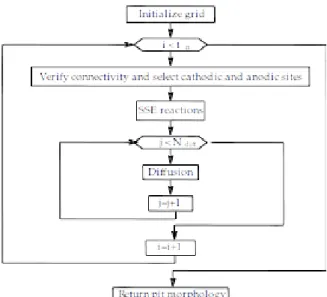
Simulations are made using parallel programming on Graphics Processing Units (GPU) with CUDA environment [3]. They are performed on a Intel Core i7-3930K PC with an NVIDIA GTX 980 GPU. The used algorithm is shown in the following figure. Note that in each main loop, the inner diffusion loop is performed Ndiff times. This is made to regulate the diffusion rate
with respect to corrosion.
Simulations are done using the following initial conditions. The three dimensional system has a dimension of 256 x 256 x256 sites. The half upper part of the system is composed by a neutral electrolyte, the half lower part is composed by bulk metal and the interface between the two has reactive metal sites. The a priori probability Psse for anodic and cathodic reactions is set as 0.5.
The rate of diffusion Ndiff is 200. The SSE reactions do not occur at detached metal clusters, they
RESULTS
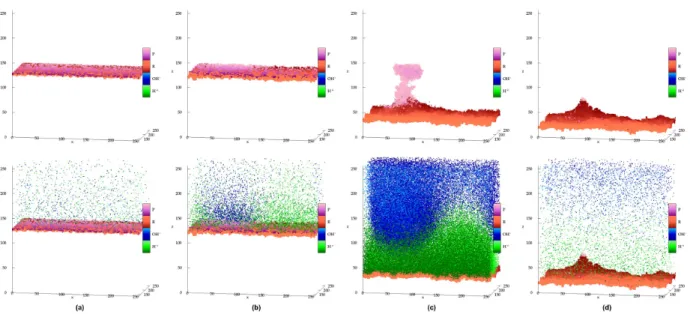
Figure 2a) shows the first corrosion regime, where anodic and cathodic reactions are distributed homogeneously over the surface. This distribution leads to a predominance of uniform corrosion.
Anodic reaction has an auto-catalytic effect that corrodes the metal and acidifies the environment. On the other side, cathodic reaction increases the local pH. Both reaction are randomly distributed over the metal surface. The accumulation of acid ions and the fact that diffusion is not sufficient to maintain a spatially homogeneous pH leads to the acidic and basic zones separation. Figure 2b) shows this separation of acid and basic zones. At this stage, localized corrosion is predominant, the corrosion rate increases locally where there is an accumulation of acid sites. Metal in contact with basic environment passivates and cathodic reaction occurs. Figure 2c) shows an peninsulas of passivated metal, where cathodic semi-reaction is preferentially done. Metal peninsulas can then detach due to the anodic reaction. When big metal peninsula is detached, cathodic protection is lost, as shown in Figure 2d). The surface returns to the initial state where uniform corrosion is predominant.
CONCLUSIONS
At the mesoscopic scale of our model, results of generalized corrosion indicate a surface morphology that oscillates between a rather flat surface and a front showing passivated-metal peninsulas. These peninsulas play a cathodic role and are progressively disconnected from the main corrosion front due to the anodic reactions. This is reflected in the discrepancy between the metal loss that can be deduced from the electrical current measurements and the real metal weight loss. The appearance of these metal peninsulas has been found in archaeological analogues for different kinds of metal alloys. To our knowledge this cellular automata description is the only probabilistic approach capable of predicting such behavior. [4]
REFERENCES
[1] C. Vautrin-Ul, H. Mendy, A. Taleb, A. Chaussé, J. Stafiej, and J. P. Badiali, “Numerical simulations of spatial heterogeneity formation in metal Corrosion,” Corrosion Science, vol. 50, no. 8, pp. 2149–2158, Aug. 2008.in
[2] B. Chopard and M. Droz, Cellular automata modeling of physical systems. Cambridge; New York: Cambridge University Press, 2005.
[3] CUDA, http://www.nvidia.com/object/cuda home new.html
[4] P. Dillmann, D. Neff, and D. Féron, “Archaeological analogues and corrosion prediction: from past to future. A review,” Corrosion Engineering, Science and Technology, vol. 49, no. 6, pp. 567–576, Jul. 2014.