HAL Id: halshs-01850263
https://halshs.archives-ouvertes.fr/halshs-01850263
Submitted on 27 Jul 2018
HAL is a multi-disciplinary open access
archive for the deposit and dissemination of
sci-entific research documents, whether they are
pub-lished or not. The documents may come from
teaching and research institutions in France or
abroad, or from public or private research centers.
L’archive ouverte pluridisciplinaire HAL, est
destinée au dépôt et à la diffusion de documents
scientifiques de niveau recherche, publiés ou non,
émanant des établissements d’enseignement et de
recherche français ou étrangers, des laboratoires
publics ou privés.
Multi-modeling the morphogenesis of transportation
networks
Juste Raimbault
To cite this version:
Juste Raimbault. Multi-modeling the morphogenesis of transportation networks. European
Confer-ence on Artificial Life (ALIFE 2018), Jul 2018, Tokyo, Japan. pp.382-383. �halshs-01850263�
Multi-modeling the morphogenesis of transportation networks
Juste Raimbault
1,21UPS CNRS 3611 ISC-PIF, Paris, France 2UMR CNRS 8504 G´eographie-cit´es, Paris, France
Abstract
This research introduces a multi-modeling approach to the growth of transportation networks. More precisely, we imple-ment and compare several models, based on biological net-work growth, cost-benefit rules, and gravity potential break-down. The resulting multi-modeling framework is calibrated on observed topological data for the European road network. We show that different heuristics are complementary to cover the feasible topological space and that all are necessary to approach existing configurations, what suggests the superpo-sition of corresponding processes in territorial systems. The growth of transportation networks in territorial sys-tems bears stunning similarities with biological networks, and the understanding of processes driving their spatial ex-tension can both have practical planning applications but also bring theoretical insights into complex morphogenetic systems. Network growth models have been proposed in several disciplines, of which Xie and Levinson (2009) give a large overview, taking into account diverse processes such as economical, geometrical, geographical processes for ex-ample. There exists to our knowledge no systematic compar-ison of different network generation heuristics. We develop here such a comparison in a multi-modeling paradigm.
Modeling network growth
We introduce a general model of road network growth, con-ditioned to a fixed population density on a grid, in a se-quential way with the following steps. A common core en-sures the positioning of new centers preferentially to pop-ulation density and a direct connection to the existing net-work. Nodes and links are then added following different potential processes corresponding to the selected heuristic: (i) no supplementary growth (baseline); (ii) random links; (iii) biological network growth following the model of Tero et al. (2010), where new links are taken as the links with the highest capacity in the stationary flow network obtained by evolving capacities of the full network of potential new links; (iv) cost-benefit network growth as proposed by Louf et al. (2013); (v) stochastic gravity potential breakdown as used by Schmitt (2014); and (vi) a novel model based on
thresholded deterministic potential breakdown. The network is grown until reaching a fixed number of new nodes to en-sure comparability between the different heuristics.
A network is then quantified by topological indicators, namely average closeness and betweenness centralities, di-ameter, efficiency, and average path length. To compare the generated network to real data, we collected the Euro-pean street network from the open data provided by Open-StreetMap, and extracted the value of topological indicators on 50km side moving windows. Typical configurations were then selected according to morphological classes for popu-lation density. The corresponding real network measures are compared to network generated on the same population den-sity configurations, for 50 different configurations.
Results
The heterogeneity of models suggested the choice of an im-plementation in NetLogo which handles easily heterogenous multi-agent systems. Source code and results are available on the open repository of the project1. The parameter space
of the model is explored using the workflow engine Open-MOLE (Reuillon et al., 2013) which allows an easy distri-bution of tasks on a computation grid.
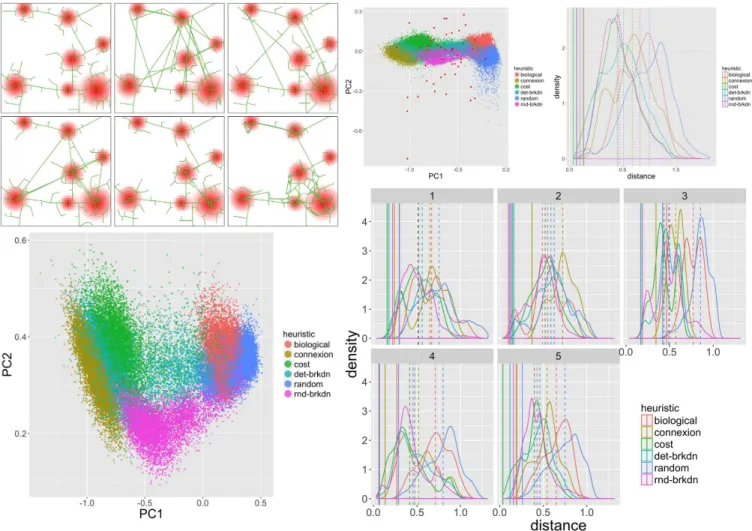
We sample for each density configuration 1000 param-eter points (including the generation heuristic and specific parameters for each heuristic in the random LHS sampling) and repeat the stochastic model 5 times for each point. Re-sults are shown in Fig. 1 below. We illustrate for a syn-thetic population density configuration the different types of networks obtained. The feasible space covered by the sam-pling in the reduced indicator space (two first components of a principal component analysis) is such that heuristics are complementary to cover the full area, and overlap between point clouds quantified with a concentration index are low (Herfindhal index with a first quartile at 0.54 on a grid of size 20 separating the reduced indicator space). This com-plementarity is confirmed when comparing to the indicator values for real networks: some points fall relatively far from
1
at https://github.com/JusteRaimbault/
Figure 1: (Top left) Examples of network configuration generated by the different heuristics; (Bottom Left) Feasible space of topological indicators for networks generated by the model, shown in a reduced dimension after principal component analysis, with a different color for each heuristic; (Right) Feasible space with red points corresponding to real networks, and histograms of indicator distance to data, for all densities configuration and conditioned by the type of urban form.
the point cloud, but each heuristic captures some real con-figurations. The distribution of distances of simulated points to real points confirm this low minimum for each heuristic. When conditioned by morphological class for population density, we obtain varying behavior regarding the most per-formant heuristic, conforming that different urban regimes are associated to specific network morphogenesis processes. Therefore, our work demonstrates that, among the heuris-tic we compared, there is no best model to reproduce real configurations and that all processes included are comple-mentary. Possible developments include a more refined cali-bration to find for typical configurations of real networks the heuristic and parameters producing the closest networks, or a comparison between heuristics controlling for the number of parameters to take overfitting into account (which could be here at the origin of the low performance of the biologi-cal heuristic e.g.). We also suggest that similar benchmarks should be more systematically performed for the modeling of complex territorial systems.
References
Louf, R., Jensen, P., and Barthelemy, M. (2013). Emergence of hi-erarchy in cost-driven growth of spatial networks. Proceed-ings of the National Academy of Sciences, 110(22):8824– 8829.
Reuillon, R., Leclaire, M., and Rey-Coyrehourcq, S. (2013). Open-mole, a workflow engine specifically tailored for the dis-tributed exploration of simulation models. Future Generation Computer Systems, 29(8):1981–1990.
Schmitt, C. (2014). Mod´elisation de la dynamique des syst`emes de peuplement: de SimpopLocal `a SimpopNet.PhD thesis, Paris 1.
Tero, A., Takagi, S., Saigusa, T., Ito, K., Bebber, D. P., Fricker, M. D., Yumiki, K., Kobayashi, R., and Nakagaki, T. (2010). Rules for biologically inspired adaptive network design. Sci-ence, 327(5964):439–442.
Xie, F. and Levinson, D. (2009). Modeling the growth of trans-portation networks: A comprehensive review. Networks and Spatial Economics, 9(3):291–307.