HAL Id: hal-00570607
https://hal-iogs.archives-ouvertes.fr/hal-00570607
Submitted on 5 Apr 2012
HAL is a multi-disciplinary open access
archive for the deposit and dissemination of
sci-entific research documents, whether they are
pub-lished or not. The documents may come from
teaching and research institutions in France or
abroad, or from public or private research centers.
L’archive ouverte pluridisciplinaire HAL, est
destinée au dépôt et à la diffusion de documents
scientifiques de niveau recherche, publiés ou non,
émanant des établissements d’enseignement et de
recherche français ou étrangers, des laboratoires
publics ou privés.
Difference between penetration and damping lengths in
photonic crystal mirrors
Christophe Sauvan, Jean-Paul Hugonin, Philippe Lalanne
To cite this version:
Christophe Sauvan, Jean-Paul Hugonin, Philippe Lalanne. Difference between penetration and
damp-ing lengths in photonic crystal mirrors. Applied Physics Letters, American Institute of Physics, 2009,
95 (21), pp.211101. �10.1063/1.3266840�. �hal-00570607�
Difference between penetration and damping lengths in photonic crystal
mirrors
C. Sauvan, J. P. Hugonin, and P. Lalanne
Citation: Appl. Phys. Lett. 95, 211101 (2009); doi: 10.1063/1.3266840 View online: http://dx.doi.org/10.1063/1.3266840
View Table of Contents: http://apl.aip.org/resource/1/APPLAB/v95/i21 Published by the American Institute of Physics.
Related Articles
Time dependent changes in extreme ultraviolet reflectivity of Ru mirrors from electron-induced surface chemistry J. Appl. Phys. 111, 063518 (2012)
Fabrication of bioinspired omnidirectional and gapless microlens array for wide field-of-view detections Appl. Phys. Lett. 100, 133701 (2012)
A combined Kirkpatrick-Baez mirror and multilayer lens for sub-10 nm x-ray focusing AIP Advances 2, 012175 (2012)
Liquid crystal micro-lenticular array assembled by a fringing field J. Appl. Phys. 111, 063104 (2012)
X-ray–optical cross-correlator for gas-phase experiments at the Linac Coherent Light Source free-electron laser Appl. Phys. Lett. 100, 121107 (2012)
Additional information on Appl. Phys. Lett.
Journal Homepage: http://apl.aip.org/Journal Information: http://apl.aip.org/about/about_the_journal Top downloads: http://apl.aip.org/features/most_downloaded Information for Authors: http://apl.aip.org/authors
Difference between penetration and damping lengths in photonic
crystal mirrors
C. Sauvan,a兲J. P. Hugonin, and P. Lalanne
Laboratoire Charles Fabry de l’Institut d’Optique, CNRS, Univ. Paris-Sud, Campus Polytechnique, RD128, 91127 Palaiseau, France
共Received 27 May 2009; accepted 31 October 2009; published online 23 November 2009兲 Different mirror geometries in two-dimensional photonic crystal slabs are studied with fully vectorial calculations. We compare their optical properties and, in particular, we show that, for heterostructure mirrors, the penetration length associated with the delay induced by distributed reflection is not correlated with the characteristic damping length of the electromagnetic energy distribution in the mirror. This unexpected result evidences that the usual trade-off between short damping lengths and large penetration lengths that is classically encountered in distributed Bragg reflectors can be overcome with carefully designed photonic crystal structures. © 2009 American Institute of Physics.关doi:10.1063/1.3266840兴
Optical microcavities are able to trap light in small vol-umes close to the diffraction limit during a long time.1They are essential components for various applications, including photonic integrated circuits2 and semiconductor quantum light sources.3Several recent experimental results have dem-onstrated that, among different light confinement schemes, photonic crystal 共PhC兲 microcavities are highly valuable candidates for achieving extremely long lifetimes with wavelength-sized volumes.4–6The light confinement in these resonators can be understood with a simple Fabry–Perot model,7which highlights the key role played by PhC mirrors. Studying in details PhC-mirror properties is therefore essen-tial for future applications and developments.
PhC mirrors are periodic structures in which the reflec-tion of light is distributed over several periods. As such, they are usually thought to behave like classical distributed Bragg reflectors 共DBRs兲, whose optical properties are well known and described in many textbooks.8,9This analogy is valid for most two-dimensional 共2D兲 and one-dimensional 共1D兲 PhC structures, but we evidence hereafter that some PhC mirrors may exhibit unusual properties that cannot be found in clas-sical DBRs.
Let us consider the main mirror properties that are nec-essary to build a microcavity with a high quality factor and a small modal volume. The latter issue requires that the reflec-tion be distributed over a short distance. More precisely, the evanescent tail of the electromagnetic energy distribution in the mirror has to be as small as possible. On the other hand, high quality factors are achieved provided that the reflection process be extremely efficient, i.e. with very low radiation losses.7However, reducing the losses is not the only mecha-nism for increasing the quality factor. Indeed, distributed re-flection is not an instantaneous process. It induces a delay that can be used to increase the photon lifetime in the cavity. A mirror with a reflection coefficient r =
冑
R exp共ir兲 reflects a light pulse with a delay =r/, which can also be expressed in terms of a characteristic length Lp. Usually called penetration length, Lp is defined as the half-distance over which light would have propagated in the incident me-dium for accumulating the same delay,8Lp= 1 2vg= c 2ng r , 共1兲
wherevg and ngare the group velocity and the group index of the incident mode. In classical DBRs, the penetration length defined by Eq. 共1兲is directly related to the character-istic damping length ␦ of the energy distribution inside the mirror. For arbitrary filling factors and index modulations ⌬n, the relation Lpⱕ␦ holds, the equality being fulfilled in the limit case of quarter-wave DBRs with low refractive in-dex contrasts for which Lp=␦= n⌳/共2⌬n兲, where ⌳ is the grating period and n is the average index.8,9 Consequently, these two characteristic lengths are often considered to be equal and mixed up in the literature. The delay induced by distributed reflection is therefore usually not seen as a degree of freedom to design high-Q and small-V microcavities, since large delays are thought to be synonymous of large volumes. However, we demonstrate hereafter that the pen-etration and damping lengths are not necessarily correlated and that carefully designed PhC mirrors allow to overcome the usual trade-off between short damping lengths and large penetration lengths.
In this letter, we study the optical properties of reflectors in 2D PhC slabs with three-dimensional共3D兲 rigorous calcu-lations. We compare different mirrors and demonstrate that, in the structure shown in Fig. 1共b兲and known in the litera-ture as the heterostruclitera-ture mirror,4the penetration length as-sociated with the delay is unexpectedly much larger than the characteristic damping length of the energy distribution. Thus, such mirrors can induce large delays while maintain-ing small volumes.
Figure 1 shows the two structures under study, which both aim at reflecting the fundamental mode of a single-line-defect PhC waveguide共W1 waveguide兲. In the first structure, the mirror consists of a finite-length section of the surround-ing PhC, see Fig. 1共a兲. It will be referred as the classical mirror hereafter. The second structure is the heterostructure mirror.4 It consists of a finite-length section of a deformed W1 waveguide with the same transverse lattice constant a, but a smaller longitudinal lattice constant am⬍a, see Fig.
1共b兲. In both structures, the 2D PhC is a triangular lattice of air holes etched in a silicon membrane with a = 420 nm. The
a兲Electronic mail: [email protected].
APPLIED PHYSICS LETTERS 95, 211101共2009兲
longitudinal lattice constant in the heterostructure mirror is
am=400 nm. The mirrors have a finite length L=Na in Fig.
1共a兲and L=Namin Fig.1共b兲, with N the number of periods. Note that, in Fig. 1共b兲, the waveguide is a nominal W1 and the mirror is a deformed W1. The incident guided modes are thus identical in Figs. 1共a兲 and 1共b兲, and we can directly compare the properties of both mirrors. Different behaviors can thus be unambiguously attributed to the mirrors them-selves.
The main characteristics of the incident mode have been calculated below the light line and are summarized in Figs.
1共c兲and1共d兲. The computations have been performed with a 3D fully vectorial Fourier Bloch-mode method 共FBMM兲, which has been recently elaborated for analyzing light scat-tering in periodic waveguides.10The dispersion curve of the incident mode is represented by the solid curve in Fig.1共c兲
and its group index is shown in Fig. 1共d兲. The spectral range of interest is the spectral range of operation of the W1 below the light line. It extends from =1.48 m to c =1.561 m, which corresponds to the incident mode cutoff at the edge of the first Brillouin zone, where the group index diverges. In the following, we are mainly interested in the optical properties of PhC mirrors in the region of moderate group index, ng⬍20. The classical mirror reflects light effi-ciently all over the spectral range of interest since this range naturally lies inside the band gap of the surrounding PhC. In the heterostructure, the mirror is a deformed W1 with a cut-off at g=1.52 m. Its dispersion curve is represented by the dashed curve in Fig. 1共c兲. The incident mode will be reflected only for wavelengths larger than the cutoff g, where no propagative mode is available in the deformed W1. The cutoff g thus corresponds to the band gap edge of the heterostructure mirror. The band gap width ⌬=c−g de-creases for decreasing lattice constant difference ⌬a=a−am. The reflection and transmission coefficients of the PhC mirrors have been calculated with the FBMM.10 Figure 2
shows their intensity R=兩r兩2 and T=兩t兩2 for two different lengths, N=3 共solid curve兲 and N=4 共dashed curve兲. The reflection and transmission of the classical mirror are
repre-sented in Figs.2共a兲and2共b兲, and those of the heterostructure mirror are represented in Figs.2共c兲and2共d兲. Heterostructure mirrors transmit all the incident light when operating outside their band gap but their reflection increases rapidly as soon as ⬎g. The results evidence some oscillations in the spec-tra of finite-length mirrors. For some wavelengths, the spec- trans-mission vanishes 共T⬃0兲 and the reflection reaches the value of the semi-infinite mirror 关thin curves in Figs. 2共a兲 and
2共c兲兴. The spectral position of the oscillations, which are much larger for the heterostructure, depends on the mirror length. Such a behavior inside the band gap does not exist in classical DBRs where the distributed reflection is due to a single evanescent Bloch mode.9 But in the PhC mirrors un-der study, more than one evanescent Bloch mode are in-volved in the reflection process. These higher-order modes, which were previously reported for slow-light injection in W1 waveguides,11,12 cause some oscillations, whose
ampli-tude decreases with the mirror length. Nevertheless, the ra-diation losses given by 1−R−T do not exhibit such oscilla-tions; they are roughly equal for every length to 1−R⬁, with
R⬁the reflection of the semi-infinite mirror 共thin curve兲. It is
noteworthy that heterostructure mirrors exhibit extremely low radiation losses,4,7 1−R
⬁⬃10−4.
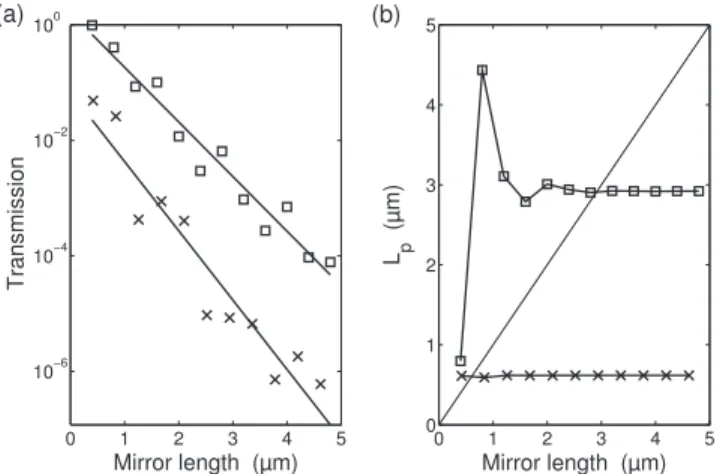
Although several evanescent modes are involved in the reflection process, it is possible to estimate the characteristic damping length ␦ of the intensity in the mirror from the transmission calculation as a function of the mirror length. Figure 3共a兲 shows the variation of T in a logarithmic scale for =1.54 m. The calculated data for the classical and the heterostructure mirrors are given by crosses and squares, respectively. As expected, the transmissions exponentially decay with the length, T=exp共−L/␦兲,8 and the linear fits
shown by the solid lines in Fig. 3共a兲 allow to retrieve the damping length ␦ for both mirrors. They are of the same order of magnitude ␦=360 nm for the classical mirror and ␦=460 nm for the heterostructure. The discrepancies be-tween the ideal linear decrease and the actual data can be attributed to higher-order evanescent Bloch modes involved in the reflection process.
The penetration length Lpis directly calculated from the phase of the reflected mode, see Eq. 共1兲, and its variation with the mirror length for =1.54 m is represented in Fig. (a) Classical mirror with N = 3
1 r t a a a (b) Heterostructure mirror with N = 3 1 r t am a a 1 r t a a 1 r t a a 1 r t am a 1 r t am a 0.2 0.3 0.4 0.5 0.26 0.27 0.28 0.29 k [2π/a] a/ λ (c) a/λc a/λg 1.48 1.5 1.52 1.54 1.56 10 20 30 40 50 λ (µm) Group index ng (d)
FIG. 1. Schematic top view of the PhC mirrors and characteristics of the incident mode. The classical 共a兲 and the heterostructure mirrors 共b兲 are built in a triangular lattice of air holes 共lattice constant a=420 nm and hole radius r=126 nm兲 etched in a silicon slab 共refractive index n=3.42 and thickness h=240 nm兲. The longitudinal lattice constant in the heterostruc-ture mirror is am=400 nm. The number of periods in the mirrors is denoted
by N. 共c兲 Dispersion curves of the nominal W1 共solid curve兲 and the de-formed W1 共dashed curve兲. Their cutoff wavelengths are c=1.561 m and
g=1.52 m, respectively. The gray surface represents the range above the
light line. 共d兲 Group index of the incident mode 共nominal W1兲.
0.94 0.96 0.98 1 Reflection 0.27 0.274 0.278 0.282 a/λ (a) 1.480 1.5 1.52 1.54 1.56 0.004 0.008 0.012 λ (µm) Transmission (b) 0 0.2 0.4 0.6 0.8 1 Reflection 0.27 0.274 0.278 0.282 a/λ (c) 1.480 1.5 1.52 1.54 1.56 0.2 0.4 0.6 0.8 1 λ (µm) Transmission λg (d)
FIG. 2. Reflection and transmission spectra. 共a兲 Reflection and 共b兲 transmis-sion of the classical mirror. 共c兲 Reflection and 共d兲 transmistransmis-sion of the het-erostructure mirror. The solid and dashed curves correspond to finite-length mirrors with N=3 and N=4, respectively. The thin curves in 共a兲 and 共c兲 correspond to semi-infinite mirrors.
3共b兲. For the classical mirror 共crosses兲, Lp=620 nm remains constant even for short mirrors 共N=1 or 2兲 and is comparable to the damping length. For the heterostructure mirror, the penetration length varies with the mirror length for very short mirrors, but it reaches rapidly a plateau corresponding to the value of the semi-infinite mirror. From N=3, Lp =3 m is roughly constant and sevenfold larger than the damping length. Unlike the classical mirror that mostly behaves like an usual DBR, the heterostructure mirror exhib-its an unexpected behavior with a penetration-length-to-damping-length ratio much larger than unity. Besides, it is interesting to note that short heterostructure mirrors may be remarkably efficient 共R⬎99%兲 with penetration lengths that are even larger than the mirror length.
By repeating the fitting procedure shown in Fig.3共a兲for other frequencies, the spectral dependence of the damping length can be calculated. The results are represented in Fig.4
together with the penetration length. Lp has been calculated for semi-infinite mirrors, since it weakly depends on the mir-ror length. For the classical mirmir-ror 共dashed curve and crosses兲, both lengths are comparable, like in DBRs. On the contrary, for the heterostructure, the penetration length 共solid curve兲 is much larger than the damping length 共squares兲, except for large wavelengths where the incident group velocity is small. In fact, close to the band gap edge g =1.52 m, the properties of heterostructure mirrors are similar to those of classical DBRs, with a divergence of ␦ and Lp.9But the fact that Lpremains one order of magnitude
larger than␦inside the band gap is really unusual. This result evidences that, in a heterostructure mirror, light is reflected with a delay corresponding to a propagation distance that is considerably larger than the exponential decay of the inten-sity in the mirror.
In conclusion, we have studied the optical properties of reflectors in 2D PhC slabs. We have shown that, in hetero-structure mirrors, the penetration length associated with the delay can be much larger than the characteristic damping length of the energy distribution inside the mirror. This amazing property evidences that these two characteristic lengths are not necessarily correlated. Consequently, the usual trade-off between short damping lengths and large pen-etration lengths that is encountered in classical DBRs can be overcome with carefully designed PhC structures. Intuitively, large penetration lengths may be understood as a result of the small lattice constant difference in the heterostructure. In-deed, such a behavior is classically encountered in DBRs with a small index contrast. But, contrary to DBRs, hetero-structure mirrors exhibit also small damping lengths because of their peculiar dispersion properties.13This unexpected re-sult allows to understand why, until now, the quality factors achieved in heterostructure cavities remain one order of mag-nitude larger than those achieved in 1D PhC resonators, while the mirror radiation losses and the cavity-mode vol-umes are essentially the same.7
The authors acknowledge funding through the EU-FP6 “SPLASH” project and the French ANR under Contract No. Miraman ANR-06-NANO-000-30.
1K. J. Vahala,Nature 共London兲 424, 839 共2003兲.
2V. R. Almeida, C. A. Barrios, R. R. Panepucci, and M. Lipson,Nature
共London兲 431, 1081 共2004兲.
3A. J. Shields,Nat. Photonics 1, 215 共2007兲.
4B. S. Song, S. Noda, T. Asano, and Y. Akahane,Nature Mater. 4, 207
共2005兲.
5E. Kuramochi, M. Notomi, S. Mitsugi, A. Shinya, T. Tanabe, and T.
Wa-tanabe,Appl. Phys. Lett. 88, 041112 共2006兲.
6P. Velha, E. Picard, T. Charvolin, E. Hadji, J. C. Rodier, P. Lalanne, and D.
Peyrade,Opt. Express 15, 16090 共2007兲.
7P. Lalanne, C. Sauvan, and J. P. Hugonin,Laser Photonics Rev. 2, 514
共2008兲.
8L. A. Coldren and S. W. Corzine, Diode Lasers and Photonic Integrated Circuits共Wiley, New York, 1995兲.
9A. Yariv and P. Yeh, Optical Waves in Crystals 共Wiley, New York, 1984兲. 10G. Lecamp, J. P. Hugonin, and P. Lalanne,Opt. Express15, 11042 共2007兲. 11J. P. Hugonin, P. Lalanne, T. P. White, and T. F. Krauss, Opt. Lett. 32,
2638 共2007兲.
12T. P. White, L. C. Botten, C. M. de Sterke, K. B. Dossou, and R. C.
McPhedran,Opt. Lett. 33, 2644 共2008兲.
13B. S. Song, T. Asano, and S. Noda,New J. Phys. 8, 209 共2006兲.
0 1 2 3 4 5 10−6 10−4 10−2 100 Mirror length (µm) Transmission (a) 0 1 2 3 4 5 0 1 2 3 4 5 Mirror length (µm) L p (µm) (b)
FIG. 3. Mirror properties as a function of the mirror length for =1.54 m. 共a兲 Transmission in a logarithmic scale. Crosses: classical mir-ror. Squares: heterostructure mirmir-ror. The solid lines show a linear fit of log共T兲 that allows to estimate the damping length␦. 共b兲 Penetration length. The thin line corresponds to Lp=L. The calculations have been performed
from N=1 to N=11 periods. 1.52 1.53 1.54 1.55 1.56 0.01 0.1 1 10 100 λ (µm) L p and δ (µm) classical mirror heterostr. mirror Lp δ λg 0.27 0.272 0.274 0.276 a/λ
FIG. 4. Spectral variation of the penetration length Lpand of the damping
length␦. The calculations of the penetration length have been performed for semi-infinite mirrors. For the classical mirror, Lp is represented by the
dashed curve and ␦by the crosses. For the heterostructure mirror, Lp is
represented by the solid curve and␦by the squares.