HAL Id: hal-00379189
https://hal.archives-ouvertes.fr/hal-00379189v2
Submitted on 7 Dec 2009
HAL is a multi-disciplinary open access
archive for the deposit and dissemination of
sci-entific research documents, whether they are
pub-lished or not. The documents may come from
teaching and research institutions in France or
abroad, or from public or private research centers.
L’archive ouverte pluridisciplinaire HAL, est
destinée au dépôt et à la diffusion de documents
scientifiques de niveau recherche, publiés ou non,
émanant des établissements d’enseignement et de
recherche français ou étrangers, des laboratoires
publics ou privés.
Accurate evaluation of magnetic coupling between atoms
with numerous open-shells : an ab-initio method
Alain Gellé, Julien Varignon, Marie-Bernadette Lepetit
To cite this version:
Alain Gellé, Julien Varignon, Marie-Bernadette Lepetit. Accurate evaluation of magnetic coupling
between atoms with numerous open-shells : an ab-initio method. EPL - Europhysics Letters, European
Physical Society/EDP Sciences/Società Italiana di Fisica/IOP Publishing, 2009, 88 (3), pp.37003.
�hal-00379189v2�
Accurate evaluation of magnetic coupling between atoms with
numerous open-shells : an ab-initio method
Alain Gell´e, Julien Varignonand Marie-Bernadette Lepetit
CRISMAT, ENSICAEN-CNRS UMR6508, 6 bd. Mar´echal Juin, 14050 Caen, FRANCE
PACS 71.15.-m–
PACS 71.15.Qe–
Abstract.- We propose a new ab initio method designed for the accurate calculation of effective exchange integrals between atoms with numerous open-shells. This method applies to ferromag-netic as well as antiferromagferromag-netic exchange, direct or ligand-mediated exchange. Test calculations on high spin transition metal oxides such as KNiF3, Ba2CoS3 or YMnO3 exhibit a very good
accuracy compared either to the best ab initio calculations — when those are feasible — and with experimental evaluations.
In the last two decades transition metal oxides attracted a lot of attention due to the discovery of novel and intrigu-ing properties. The interest of the physicists community was first triggered by the discovery of high-temperature superconductivity in copper oxide compounds. Since then, many transition metal oxides exhibiting properties of prac-tical or theoreprac-tical interest were discovered. Presently the attention of the community is mainly focused on cobalt, manganese and iron oxides. Most of these systems present intriguing magnetic properties or ordering. It is thus of crucial importance for the understanding of these prop-erties to be able to accurately evaluate the local effec-tive interactions such as magnetic interactions between the Fermi-level, unpaired, electrons.
In these materials, the Fermi-level electrons are local-ized, essentially on the d orbitals of the metal ions. This localization is a consequence of the fact that the electron-electron repulsion is of larger magnitude than the kinetic energy. Such strongly correlated materials cannot be de-scribed by a simple band structure since such a descrip-tion supposes the dominance of the delocalizadescrip-tion effects over electron-electron repulsion ones. The importance of the electronic correlation results in charge, spin or orbitals occupation fluctuations arising from the competition be-tween different configurations in the electronic structure. The nature of the ground and the low-lying excited-states is thus fundamentally multi-configurational. Therefore it is not surprising that ab-initio single-determinant based methods (such as density functional theory) encounter difficulties in properly describing strongly correlated
sys-tems. For this purpose physicists use model Hamiltonians. The knowledge of the pertinent degrees of freedom to be treated in such models and the amplitude of the interac-tions between them is thus of crucial importance.
In the case of copper, nickel or vanadium oxides, such microscopic models were accurately determined using ex-act diagonalization of selected configurations spaces (Con-figuration Interaction or CI methods) on embedded frag-ments [1,2]. The CAS+DDCI [3] (Complete Active Space + Difference Dedicated Configurations Interaction also found under the acronym of DDCI3) and LCAS+S [4] (Large CAS + single excitations) type of configurations selections proved their high reliability and efficiency. In-deed, they allowed the determination of magnetic cou-plings within experimental accuracy for the superconduct-ing copper oxides [5, 6]. In molecular systems, where the magnetic coupling can be experimentally evaluated with a great accuracy, the cited methods were able to reproduce them with an error smaller than 5 cm−1 [7]. Moreover
the availability of the wave function offers the possibility to evaluate the pertinence of the chosen effective model. Let us recall the example of the famous α′NaV
2O5 where
such ab initio study showed the incompleteness of the com-monly used models that were neglecting the magnetic role of the oxygen ligands. The novel model, derived using CAS+DDCI ab initio calculations, allowed to explain the apparently contradictory experimental results of this com-pound [8].
Unfortunately the CAS+DDCI, LCAS+S and related methods cannot be used for systems involving more than
Alain Gell´e, Julien Varignon Marie-Bernadette Lepetit
one or two unpaired electrons per magnetic center, and therefore not for high spin manganese, cobalt, iron ox-ides, etc. Indeed, for such systems the computational cost of the methods becomes prohibitive since the size of the space to diagonalize scales exponentially with the number of magnetic electrons. In this paper we propose an ab ini-tio approach that overcomes this problem. We establish a simple physical criterion in order to select the impor-tant reference configurations, and derive from it a novel method with a strongly reduced computational cost. We will see that this method allows, for the first time, the determination within experimental accuracy, of effective magnetic interactions in high spin manganese or cobalt oxides, thus opening entire new classes of materials to ab initio studies.
Let us first recall the principle of the usual CAS+DDCI and LCAS+S methods. These variational methods are based on the expansion of the low lying states wave func-tions into a reference part and a screening part.
|Ψmi = reference z }| { X I CI,m|ΦIi + screening z }| { X J∗ CJ∗,m|ΦJ∗i = |Ψrmi + |Ψ∗mi (1) In the CAS+DDCI and LCAS+S approaches the refer-ence configurations, |ΦIi, span a Complete Active Space
(CAS) and the screening configurations, |Ψ∗
mi, are all
sin-gle (or sinsin-gle and selected double) excitations on all the references |ΦIi. The definition of the CAS is based on a
mathematical formalization of the distinction between the core or ligands electrons — that are essentially paired — and the essentially unpaired magnetic electrons. Indeed, the orbital space is partitioned into three subsets : i) the occupied orbitalsthat are doubly occupied in all the CAS configurations, ii) the active orbitals that can take any oc-cupation or spin values in the CAS configurations and iii) the virtual orbitals that are unoccupied in all CAS con-figurations. In the CAS+DDCI method the three orbitals sets strictly correspond to the orbitals supporting the es-sentially paired electrons, the magnetic electrons, and the rest. The screening configurations are then taken as all the single and double excitations on any of the CAS con-figurations, that contribute to the excitation energies at the second order of perturbation.
In the LCAS+S method one uses the fact that the screening effects are essentially supported by single exci-tations. The double excitations are thus eliminated from the calculations under the condition that the configura-tions associated with all important processes mediating the interactions between the magnetic atoms are incorpo-rated within the references [4]. The LCAS+S method thus uses an active orbital set enlarged to the ligand orbitals mediating the interactions between the magnetic orbitals. The screening part is thus reduced to the single excitations on this large CAS. It was shown that the CAS+DDCI and LCAS+S methods yield results of equivalent accuracy [4], thus rooting the idea that the important effects to treat, in
order to achieve accurate evaluation of local interactions, are the interactions between i) the magnetic configurations (referred to as zeroth-order) ii) the charge transfer config-urations mediating the interactions (metal-to-metal and ligand-to-metal) and iii) the screening effects on the first two subsets as given by the single excitations on them.
|Ψmi = reference z }| { X I CI,m0 |Φ0Ii | {z } zeroth-order +X J CJ,m|ΦJi | {z } charge transfer + screening z }| { X J∗ CJ∗,m|ΦJ∗i = |Ψ0 mi + |Ψ ct mi + |Ψ∗mi (2)
The size of the configurations space to diagonalize in both the CAS+DDCI and LCAS+S methods is directly proportional to the size of the CAS that itself scales expo-nentially with the number of active orbitals. Thus, when the number of open shells per atom, or the number of magnetic atoms increases, it rapidly results in intractable calculations. For instance, the evaluation of the magnetic coupling between two Mn3+atoms (3d4) involves CI space
to diagonalize of about 60 billions configurations using the CAS+DDCI method and of over 10 billions ones using the LCAS+S method. Among all those configurations, however, many of them are not really important for the physics. Indeed, the major difference between the case of metal atoms with a unique open shell and of metal atoms with multiple open shells lies in the number of multiple-charge-transfer configurations. In the former case, there are very few, while in the latter case there are the most numerous configurations in the reference space, while their pertinence for the low energy physics is far from obvious. For instance, the Mn7+Mn−configurations exhibit a
negli-gible contribution in the wave functions of states involving two high-spin Mn3+ ions, and contributes in a negligible
way to the magnetic coupling between the two ions. From this simple illustration one sees that the configu-rations involved in the usual methods are far too numer-ous compared to the really necessary ones for a proper description of the low-lying states physics. We shall thus find another criterion allowing to further select among the LCAS+S configurations the really pertinent ones. Let us make a perturbative analysis of equation 2. The so-called zeroth-order configurations are the configurations with large weight in the wave functions and the basis of any minimal model. As the Hamiltonian only contains one and two particle interactions, and using |Ψ0
mi as
zeroth-order wave functions, the quasi-degenerate perturbation theory tells us that only the singly-excited and doubly-excited configurations on |Ψ0
mi are of real importance for
the physics.
The method we propose in this work for the evalua-tion of local interacevalua-tions takes advantage of the above analyses. The reference part in equation 2 shall be re-duced to i) the zeroth-order part and ii) the single charge transfer configurations only. The screening part thus in-cludes the single excitations on the zeroth-order part,
plus the double excitations built from a single excitation on top of a single charge transfer excitation. Compared to the LCAS+S we removed the multiple metal-to-metal and ligand-to-metal charge transfer configurations from the reference part, and the associated screening effects. Compared to the CAS+DDCI method (i) we removed the multiple metal-to-metal charge transfer configurations and associated screening configurations and (ii) we restricted the double excitations to the screening excitations on the ligand-to-metal charge transfers (as proved sufficient by the LCAS+S method [4]). Consequently the number of configurations is dramatically reduced. Going back to the two manganese example, the present method (referred to as Selected Active Space + Single-excitations or SAS+S) will involve only about 20 × 106 configurations to
diago-nalize instead of 10 × 109 for the LCAS+S and 60 × 109
for the CAS+DDCI method.
We tested the accuracy of the proposed method on the magnetic coupling of three compounds with respectively 2, 3 and 4 open shells per magnetic atoms and 3, 1 and 2 dimensionality of the magnetic interactions : KNiF3,
Ba2CoS3 and YMnO3. Since for Ba2CoS3 and YMnO3
the CAS+DDCI and LCAS+S methods are out of reach, we will present, for the sake of comparison between the different methods, calculations where the treatment of the screening effects are strongly pruned (only about 35% of the screening excitations are taken into account, see ap-pendix for details). The evaluation of the exchange inte-grals will thus not be physically correct, however we will be able to compare the different methods. In a second time, we will use the method proposed in this work (SAS+S) using fully screened calculations in order to compare the computed values with experimental evaluations. Finally, for the sake of analysis of the relative importance of the multiple metal-to-metal and ligand-to-metal charge trans-fer configurations, we made an intermediate calculation where only the multiple ligand-to-metal charge transfer configurations were removed from the references. Since in each of the present examples the magnetic exchange are supposed to follow and Heisenberg Hamiltonian,
H = X
<i,j>
Jij S~i· ~Sj
we can extract the exchange integrals from different spin excitations and, as a by product, verify the validity of the Heisenberg model.
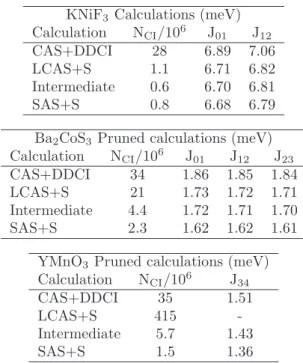
Table 1 displays the evaluation of the magnetic exchange of the three compounds for the two reference methods, the SAS+S method and the intermediate calculation. One sees that for KNiF3 the four methods yield very similar
results with a relative difference of at most 3.5%. For Ba2CoS3 and YMnO3where the number of open shells is
larger, the error of the present method compared to the reference ones is somewhat larger, of the order of 5 to 10% according to the reference method. Comparing now the LCAS+S and the intermediate calculations, one sees that
KNiF3 Calculations (meV)
Calculation NCI/106 J01 J12
CAS+DDCI 28 6.89 7.06 LCAS+S 1.1 6.71 6.82 Intermediate 0.6 6.70 6.81 SAS+S 0.8 6.68 6.79 Ba2CoS3 Pruned calculations (meV)
Calculation NCI/106 J01 J12 J23
CAS+DDCI 34 1.86 1.85 1.84 LCAS+S 21 1.73 1.72 1.71 Intermediate 4.4 1.72 1.71 1.70 SAS+S 2.3 1.62 1.62 1.61
YMnO3 Pruned calculations (meV)
Calculation NCI/106 J34
CAS+DDCI 35 1.51
LCAS+S 415
-Intermediate 5.7 1.43
SAS+S 1.5 1.36
Table 1: Comparison of different methods using a pruned eval-uation of the screening effects. SAS+S refers to the method proposed in the present work and intermediate refers to the calculation where only multiple ligand-to-metal charge trans-fer configurations were removed from the retrans-ference space. NCI
is the size of the CI space. Jijcorrespond to the exchange
inte-grals computed from the energy difference between the S = i and S = j spin states.
the difference is negligible (less than 1%). The multiple ligand-to-metal charge-transfer configurations, present in the LCAS+S calculation and not in the intermediate one are thus of no influence on the exchange couplings, and more specifically on the super-exchange part of them. The role of the multiple metal-to-metal charge transfers can now be evaluated by the comparison between the interme-diate and SAS+S calculations. This time their influence is somewhat larger for the Ba2CoS3 and YMnO3
com-pounds, accounting for a relative decrease of the super-exchange term of about 5%.
Table 2 displays the evaluation of the magnetic exchange for the three examples using the present SAS+S method with full calculation of the screening effects. Comparing ab initio results with the experimental data, on KNiF3,
Ba2CoS3 and YMnO3, the magnetic exchange integrals
are obtained within good accuracy to the experimental val-ues. Indeed, the error to the nominal value is respectively of 9%, 4% and 7%, and within the error bar for Ba2CoS3,
that is of the same order of magnitude of the best methods (CAS+DDCI and LCAS+S) for the single open-shell sys-tems such as vanadium or copper oxides [9]. We also like to point out that the experimental incertitudes should be taken with caution since there is not a real proper way to extract the magnetic coupling from susceptibility measure-ments, specifically in 2D and 3D systems. In this respect
Alain Gell´e, Julien Varignon Marie-Bernadette Lepetit
Material B3LYP CAS+DDCI LCAS+S SAS+S Exp. KNiF3 14.86 [10] 6.98 6.77 6.74 7.7±0.4 [11]
Ba2CoS3 4.08 - - 3.07 3.19±0.2 [12]
YMnO3 0.59 - - 2.8 3 [13]
Table 2: Exchange integrals evaluation. Comparison with experiments (in meV).
the experimental incertitudes are most likely larger than proposed on the 2D YMNO3 and 3D KNIF3 systems.
Let us sum up the main ideas supporting the present method. The CI space to diagonalize is built from three types of configurations. (i) The zeroth-order reference, that is the dominant configurations. These configura-tions are usually obvious from a simple analysis of the local physics. When the magnetic fragments are high-spin atoms they do correspond to the determinants for which the two magnetic atoms remain in a high-spin state. (ii) The configurations dominant in the mediation of the mag-netic coupling. In most cases it does correspond to simple ligand-to-metal and metal-to-metal charge transfer config-urations. However, in some complex cases, as for instance in cases where ligands present low-lying excited states in-volving bridging orbitals (occupied and virtual), the dom-inant configurations in the magnetic coupling mediation also involve metal-to-ligand charge transfers and the asso-ciated the low-lying ligand-to-ligand excitations. (iii) The screening effects on all the above cited reference configu-rations, that is all single excitations on all above reference configurations. Following these specifications our method is expected to be very general, applying to hetero-nuclear dimers of high-spin atoms, to complex ligands (extended, non-symmetric, conjugated, etc.), even to extended mag-netic centers.
Let us also point out that the present method, that addresses the problem of numerous open-shells magnetic centers, can be profitably combined with complementary techniques developed for the reduction of the CI space as for instance : the treatment of large ligands using localized orbitals [14] or a more efficient treatment of the screening effects by the optimization of the virtual orbitals [15].
In conclusion, the SAS+S method presented in this work aim at the evaluation of magnetic couplings between atoms with multiple open shells. Indeed, on one hand, den-sity functional theory encounters a lot of difficulties in the description of such strongly correlated systems. These difficulties are particularly dramatic for the evaluation of magnetic couplings since it often fails even to get the cor-rect value by a factor two or more. On the other hand, embedded fragment quantum chemical ab initio methods succeeded in evaluating magnetic couplings when the mag-netic atoms display only one or two open-shells. For larger numbers of open-shells, the size of the calculations were out of reach. We proposed in this paper a new CI method that condenses the pertinent information on magnetic ex-citations. This method allowed us to reach accurate ab
ini-tio evaluaini-tion of effective magnetic couplings in high spin cobalt or manganese compounds. It is the first time that such couplings become reachable. The SAS+S method thus opens new fields of research. For instance one can think to look at the local fluctuations of magnetic cou-plings in manganites, fluctuations known to be important for the colossal magneto-resistance effects but not experi-mentally directly accessible.
∗ ∗ ∗
The authors thank Daniel Maynau for providing them with the CASDI suite of programs. These calculations where done using the CNRS IDRIS computational facili-ties under project n◦1842 and the CRIHAN computational
facilities under project n◦2007013. The present project
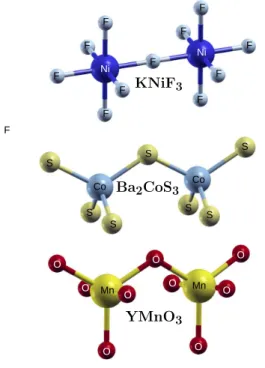
was financed by the french ANR project SEMOME. Computational details The embedded fragments used for the magnetic couplings were built as follow. i) A quantum part containing the two magnetic atoms, the ligands mediating the interactions between them (S,F or O atoms) and their first shell of coordination (see figure 1). ii) The embedding part reproducing the main effects of the rest of the crystal on the quantum part : the exclu-sion effects and the Madelung potential. The excluexclu-sion effects are treated using two shells of total ions pseudo-potential [16] that forbid to the quantum part electrons to delocalize out of the fragment. The Madelung poten-tial is computed using an appropriate renormalized set of charges [17] with an accuracy better than 10−2meV.
The basis sets and pseudo-potentials used in this work are of valence 3ζ quality on the metal atoms and 3ζ + P on the ligands. They can be found in reference [18].
The fragment orbitals were optimized using a Com-plete Active Space Self Consistent Field calculation on the highest spin state. The active orbitals were chosen as the magnetic opened 3d orbitals. This method is well known to yield a good separation between the occupied, active and virtual orbitals used in our reference spaces. The ligand orbitals mediating the interactions (used in the LCAS+S and SAS+S methods) were extracted from the occupied orbitals in a two-steps process. First, the lig-and orbitals which occupation number fluctuates between different states (computed at a the minimal CAS+S level) were extracted from the Fermi sea using a multi-state nat-ural orbitals method [19]. Second, among these orbitals the bridging ones were obtained by maximizing the hop-ping (kinetic integral) between them and the magnetic
or-KNiF3 Ba2CoS3 YMnO3 Ni Ni F F F F F F F F F F F F Co Co S S S S S S S Mn Mn O O O O O O O O O
Fig. 1: Quantum part of the embedded fragments.
bitals. The bridging orbitals used in the present work are thus uniquely defined and qualitatively correspond to the bridging orbitals expected from simple physical consider-ations [12].
REFERENCES
[1] M.B. Lepetit, Recent Research Developments in Quan-tum Chemistry 3, p. 143, Transword Research Network (2002).
[2] M.B. Lepetit, N. Suaud, A. Gell´e and V. Robert, J. Chem. Phys. 118, 3966 (2003) ; A. Gell´e and M.B. Lepetit, J. Chem. Phys. 128, 244716 (2008).
[3] J. Miralles, J. P. Daudey and R. Caballol, Chem. Phys. Lett. 198, 555 (1992) ; V. M. Garc´ıa et al., Chem. Phys. Lett. 238, 222 (1995) ; V. M. Garc´ıa, M. Reguero and R. Caballol, Theor. Chem. Acc. 98, 50 (1997). [4] A. Gell´e, M. L. Munzarov´a, M.B. Lepetit and F. Illas,
Phys. Rev. B 68, 125103 (2003) ; C J. Calzado, J. F. Sanz and J. P. Malrieu, J. of Chem. Phys. 112, 5158 (2002).
[5] See for instance : C. Jimenez Calzado, J. Fernandez Sanz, J. P. Malrieu and F. Illas, Chem. Phys. Lett. 307, 102 (1999); D. Munoz, F. Illas, I. de P.R. Mor-eira, Phys. Rev. Letters 84, 1579 (2000); A. Gell´e and M.B. Lepetit, Phys. Rev. B 74, 235115 (2006). [6] D. Munoz ,C. De Graaf ,F. Illas, J. of Comp. Chem.
25, 1234 (2004).
[7] J. Cabrero et al., J. Phys. Chem. A 104, 9983 (2000). [8] N. Suaud, M.B. Lepetit, Phys. Rev. Lett. 88, 056405
(2002).
[9] I. de P. R. Moreira and F. Illas, Phys. Rev. B 55, 4129 (1997).
[10] X. Feng and N. M. Harrison, Phys. Rev. B 70, 092402 (2004).
[11] M. E. Lines, Phys. Rev. 164, 736 (1967).
[12] A. D. J. Barnes, T. Baikie, V. Hardy, M.B. Lepetit, A. Maignan, N. A. Young and M. Grazia Francesconi, J. Mater. Chem. 16, 3489 (2006).
[13] J. Park, J.-G. Park, G. S. Jeon, H.-Y. Choi, C. Lee, W. Jo, R. Bewley, K. A. McEwen, and T. G. Perring, Phys. Rev. B 68, 104426 (2003).
[14] C. Angeli, C. J. Calzado, R. Cimiraglia, S. Evangelisti, N. Guihery, Th. Leininger, J. P. Malrieu, D. Maynau, J. V. Pitarch Ruiz and M. Sparta, Mol. Phys. 101, 1389 (2003) ; V. Barone, I. Cacelli and A. Ferretti, J. Chem. Phys.130, 094306 (2009).
[15] V. Barone, I. Cacelli, A. Ferretti, and G. Prampolini, Phys. Chem. Chem. Phys. 11, 3854 (2009).
[16] N. W. Winter, R. M. Pitzer and D. K. Temple, J. Chem. Phys. 86, 3549 (1987).
[17] A. Gell´e and M.B. Lepetit, J. Chem. Phys. 128, 244716 (2008).
[18] Z. Barandiaran and L. Seijo, Can. J. Chem. 70, 409 (1992).
[19] A. Gell´e and M.B. Lepetit, unpublished.
The multi-state natural orbital method is an adapta-tion of the joint diagonalizaadapta-tion method to the determi-nation of natural orbitals diagonalizing simultaneously the density matrix of several states.