Enhancing Exterior Durability of Jack Pine by Photo-Stabilization of Acrylic Polyurethane Coating using Bark Extract: Part 1- Effect of UV on Color Change and ATR-FTIR
Analysis
Sudeshna Saha
1, Duygu Kocaefe
1*, Yaman Boluk
2, Andre Pichette
11Université du Québec a Chicoutimi, Canada
555, boul de l’Université, Chicoutimi Québec Canada G7H 2B1
* [email protected] Ph No: 1-418-5455011 (5215)
Fax No: 1-418-5455012
2 University of Alberta, Department of Civil and Environmental Engineering, 3-142 Markin/CNRL Natural Resources, Edmonton Alberta Canada T6G 2W2
Abstract
Heat-treated wood is a value-added product but its exposure to various environmental factors leads to discoloration of wood surface due to the photochemical reactions. Discoloration has become an important economic problem for wood industries since product specifications are now more demanding. In addition, stricter environmental legislations necessitate the development of environmentally friendly transparent coatings with minimal use of chemicals which balances aesthetic and protection. In this study, the acrylic polyurethane coating was improved with the addition of natural antioxidant (bark extract) and lignin stabilizer alone or in combination to enhance the resistance of this coating to different weathering factors. An accelerated aging test was conducted with the aim of comparing the acrylic polyurethane coatings containing different additives with the commercially available pigmented solvent borne coating used by industry and organic UV absorbers. The modifications in chemical structure of coatings were characterized by ATR-FTIR analysis. The color change data showed that the coating containing bark extract was the most effective and performed better than the industrial coating. However, the visual assessment showed that the coating containing bark extract and lignin stabilizer had the best performance. FT-IR analyses suggested that the chain scission reaction took place throughout the weathering but its effect was not significant for any of the coatings.
Key Words: Heat-treated jack pine, Acrylic polyurethane, Weathering, Bark extract, Color
change, ATR-FT-IR analysis
1. Introduction
Heat-treated wood is a value-added product [1-3] and has a unique place among other competitive materials such as concrete, metals and plastics due to its aesthetical appeal (attractive dark brown color), improved dimensional stability and biological resistance.
Saguenay-Lac-St-Jean region of Quebec in Canada is the leader in heat treatment of wood in North America. Exposure of heat-treated wood to various environmental factors such as solar radiation, water, heat, pollutants etc. for long periods leads to photochemical reactions which result in discoloration of wood surface [4-12]. This is mainly due to the degradation of lignin (main UV absorber among the wood components) at the superficial surface of the wood by UV light leading to formation of colored hydrophilic byproducts, and its ensuing removal by rain.
With the move towards the value-added products and requirement of higher product quality discolorations have become an important economic problem. In order to increase the service life of this new non toxic product, development of environmentally friendly transparent coatings with minimal use of chemicals became very important for wood industries. The main challenge of coating development is to assure the balance between aesthetic and protection.
Water based acrylic polyurethane coatings have wide applications and was chosen for this study because of their high durability characteristics in accelerated weathering environment and environmentally friendliness [13-18]. In order to block the harmful portions of solar radiation and slowdown the photodegradation of the organic substrates long lasting UV absorbers are needed to incorporate into the resin [13,19,20]. Similarly, HALS also stabilizes the polymeric coatings by scavenging the free radicals produced during weathering. Most of the UV stabilizers available in the market are toxic in nature. For this reason development of a non toxic UV stabilizer which can delay the discoloration of the polymeric coatings on the wood surface is of utmost importance. Bark extract can be a potential UV stabilizer due to it’s highly antioxidant properties. The purpose of this study is to evaluate the effectiveness of the natural antioxidant (bark extract) with or without lignin stabilizer in delaying the photodegradation of acrylic polyurethane coating applied to heat-treated jack pine. The results are compared with the commercially available organic UV stabilizers when exposed to accelerated weathering. The color measurement results along with the visual assessments before and after weathering of these acrylic polyurethane coatings with different UV stabilizers are also compared with those of the solvent borne commercially available coating (almost green and opaque in nature) containing some toxic components used by the industry.
The coating degradation is a combination of both physical and chemical processes. The significance of FTIR in the analysis of chemical modification of polymeric materials has been recognized in recent years [13,21-26]. In this study the chemical modifications of these coatings after weathering for different time periods were evaluated by the ATR-FTIR analysis.
2. Materials and Methods
2.1.
Wood Surface PreparationIn this study, commercially available jack pine wood heat-treated at 210°C was used for all the tests. The wooden boards with tangential surfaces were randomly chosen from the lot obtained from ISA industries. The wooden panels were then planed and sawed. The test panels were selected carefully avoiding knots and cracks and any other visible defects. The dimension of the wood samples used in the accelerated weathering test was 20cm×7cm×1.9cm.
2.2.
Transmission TestsThe transmission spectra of different concentration of natural antioxidant (bark extract) were carried out using UV/VIS spectrophotometer (Agilent 8453 UV-VIS spectroscopy system).
Different amount of the bark extract was dissolved in methanol.
2.3.
Preparation of CoatingsSunlight-cured two component acrylic-polyurethane (Bayer Corporation) coating was used for this study as the base. Organic UV stabilizers (Tinuvin123 and Tinuvin1130 obtained from CIBA specialty chemicals), organic antioxidant (bark extract, synthesized in the laboratory), and lignin stabilizer (obtained from CIBA specialty chemicals) were used as additives. Alone or different combinations of these additives were tested. The formulations of different coatings are presented in Table1.
Coating Description
Acrylic polyurethane coating The base coating without any light stabilizer Acrylic polyurethane with organic UV
absorber
The base coating + Tinuvin123 + Tinuvin1130 as UV stabilizer
Acrylic polyurethane with bark extract The base coating + bark extract as UV stabilizer
Acrylic polyurethane with lignin stabilizer The base coating + lignin stabilizer Acrylic polyurethane with bark extract and
lignin stabilizer
The base coating + bark extract + lignin stabilizer
Industrial coating Laurentide coating
2.4.
Accelerated Weathering Test42 samples (6.6cm×7cm×1.9cm) were coated with three layers except for industrial coating. For
this coating only two layers are used as recommended. Seven samples were prepared for each
coating. Six of these samples were exposed to accelerated weathering test and one sample for
each coating was kept as a reference. The reference samples were protected from the light exposure.
Accelerated aging test was conducted in Atlas Xenon Weather-Ometer (with a daylight filter, irradiation 0.35W/m
2at 340nm, BPT 63±3
◦C and continuous light cycle with 102min light and 18 min specimen spray with light). All the samples were exposed to UV light for different times.
The maximum exposure time was 1500h. A sample for each coating was taken out after 72h, 168h, 336h, 672h, 1008h and 1500 h exposure.
2.5.
Color MeasurementThe color of all the samples was measured before and after the weathering test using Datacolor CHECK® spectrocolorimeter with diffuse illumination 8° viewing in conformance with CIE publication No.15.2 (Colorimeter based on D65 light source by simulating day light). The CIE L*, a*, b* coordinates are characterized by three parameters. L* axis represents the lightness and it varies from 100 (white) to 0 (black). a* and b* are the chromaticity indices where +a* is the red, -a* is the green, +b* is the yellow, -b* is the blue directions. The color differences were calculated using the equations [1] to [3] and the total color difference was calculated from equation [4] for each sample.
[1]
[2]
[3]
[4]
2.6.
FT-IR AnalysisThe chemical modifications of the coated wood samples due to weathering were examined by FT-IR spectroscopy. IR spectra were collected in the wave number range of 550-4000 cm
-1and all the spectra were recorded at 4 cm
-1resolution. Each time 20 scans were carried out prior to the Fourier transformation. All spectra were collected using a diamond micro-ATR crystal (Jasco FT/IR 4200). The incident angle of the crystal was 47˚ corresponding to an analysis depth of 0.2- 5 µm, depending on the wave number. This ensured that the recorded FT-IR spectra were solely for the coating and there was no interaction with wood. The diameter of the actual analysis area was ~30µm. All spectra were analyzed using Jasco spectra manager software.
3. Results and Discussions
3.1. Transmission Tests
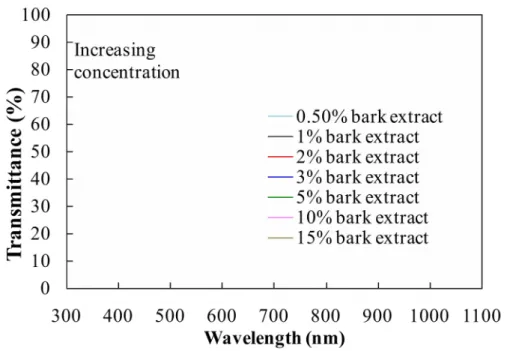
In order to assess the performance of the bark extract as potential UV absorber, UV-VIS spectroscopy tests were carried out using different concentration of the bark extract.
The transmission tests results are presented in Figure1. 1% bark extract transmittance spectrum shows that it can be used as a potential UV absorber as no transmission was observed up to 403nm (in the UV range) whereas in the visible region almost complete transparency was realized. With increase in concentration of the bark extract, there was a clear shift of the lower limit towards the red region (403nm for 1% bark extract to 482nm for 15% bark extract). Since not only UV light but small wavelength of visible portion of sunlight also cause wood weathering, this bark extract at higher concentrations can be very effective in diminution of weathering effect on wood surface. But before drawing any conclusions, their performance should be tested.
Figure 1 The transmittance spectra of different concentration of bark extract in methanol
3.2. Color Measurement
The accelerated weathering test was carried out in order to study the effect of UV exposure on color change of coated and heat-treated wood within a shorter time span compared to natural weathering.
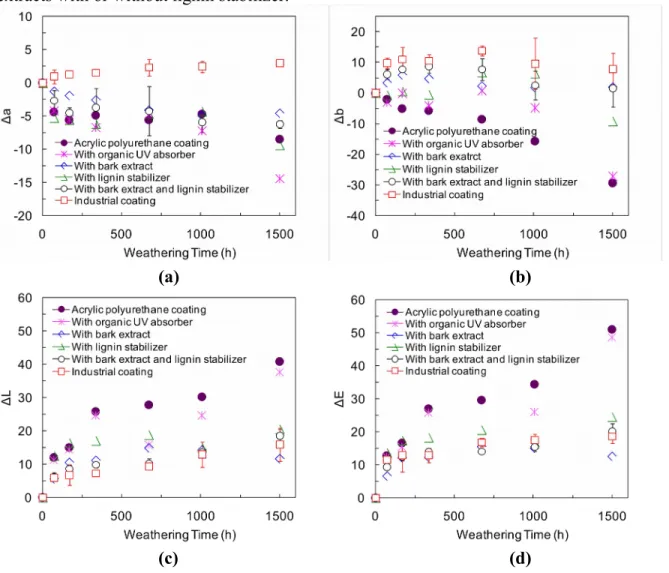
The color measurement data suggested that other than industrial coating all the other coatings
became greener (Figure 2(a)) with increasing weathering time whereas industrial coating became
redder. The industrial coating exhibited lowest variation in red-green index while acrylic
polyurethane coating containing organic UV absorber showed highest variation of the same index. The industrial coating, acrylic polyurethane coating containing bark extracts with or without lignin stabilizer demonstrated yellowish nature whereas other coatings showed bluish nature after 1500h of weathering. For the former three coatings the yellow-blue index increased during the initial stages of weathering. This was followed by a decrease in the same index though extent of this change was higher for industrial coating (Figure 2(b)). The highest change in yellow-blue index was observed for base acrylic polyurethane coating, conversely, the lowest variation of the same index was observed for the acrylic polyurethane coating containing bark extracts with or without lignin stabilizer.
(a) (b)
(c) (d)
Figure 2 Comparison of base, acrylic polyurethane coatings stabilized with different additives and industrial coating (a) red-green index, (b) yellow-blue index, (c) lightness index and (d) total color change for different weathering time
The lightness of all the coatings increased with weathering time; however, lightness variation of
industrial coating was lower for initial 1100h of weathering (Figure 2(c)) compared to coatings
developed during this study. After 1100h of weathering, the acrylic polyurethane coating
containing bark extract pertained lowest lightness variation. The highest change in lightness
index was observed for the base acrylic polyurethane coating. The acrylic polyurethane coating
stabilized with organic UV absorbers also exhibited high lightness index change. The acrylic
polyurethane coating containing lignin stabilizer showed almost similar lightness variation as the acrylic polyurethane coating containing bark extract and lignin stabilizer; however for initial period of weathering the former coating showed comparatively higher lightness variation.
Highest color change was detected for the base acrylic polyurethane coating (Figure 2(d)) nevertheless the acrylic polyurethane coating stabilized by organic UV absorbers also showed a high total color change after 1500h of weathering. The acrylic polyurethane coating containing bark extract pertained highest protection (Figure 2(d)) among all coatings during the accelerated weathering test, except for 500h to 1000h of weathering. In this exposure periods, the acrylic polyurethane coating containing bark extract and lignin stabilizer showed highest protection.
Similar protective characteristics were observed for the acrylic polyurethane coating containing bark extract alone or with lignin stabilizer and the industrial coating during initial 400h of aging but the color of acrylic polyurethane coating containing bark extract and lignin stabilizer varied less compared to the color of the industrial coating from 400h to 1400h of weathering. On the other hand, the acrylic polyurethane coating with bark extract exhibited better protection throughout compared to the industrial coating. The acrylic polyurethane coating containing lignin stabilizer also showed high protective characteristic.
High UV resistance of industrial coating was expected as it is a highly pigmented (almost green and opaque) solvent based coating which tends to cover the natural grain texture of heat-treated jack pine surface completely. Also, this coating contains some toxic substances. On the other hand, the acrylic polyurethane is transparent, non toxic and waterborne coating which contains natural antioxidant with or without a very small amount of lignin stabilizer. This study showed that the bark extract and lignin stabilizer alone or together can replace effectively the pigments and UV absorbers which are used for slowing down the degradation of wood in outer environment.
3.3.Visual Assessment
The visual assessment is very important from end user’s perspective as this is the main factor which accounts for coating’s durability and time for repainting the substrate surface.
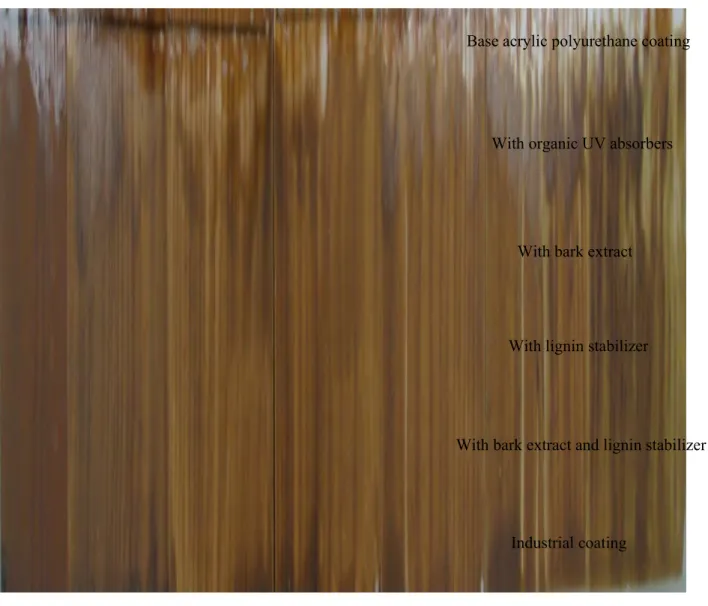
The visual assessment of different coatings on heat-treated jack pine revealed that the base acrylic polyurethane coating showed poor protective characteristics starting from the initial period of weathering and became completely white at the end of 1500h of weathering (Figure 3).
On the other hand, the acrylic polyurethane coating with organic UV absorbers displayed better protection than the base coating but also underwent heavy color loss (Figure 3). Small cracks were formed on the surface after 1500h of weathering for both of the above mentioned coatings.
When the acrylic polyurethane coating was stabilized with bark extract, it became highly
efficient in protecting the heat-treated jack pine surface from weathering. According to naked
eye evaluation, almost no color change was observed for this coating with the exception of two
or three local degradation points (small white patches) at the end of 1500h of weathering. On the
other hand acrylic polyurethane coating containing lignin stabilizer demonstrated high
degradation at the edges after1008h of weathering and the coating degradation started only after
672h of weathering. The acrylic polyurethane coating containing bark extract and lignin
stabilizer was the most efficient coating developed during this study and no degradation was
observed with naked eye for this coating even after 1500h of weathering (Figure 3). Very little
color change (became slightly lighter) was detected for this coating but the color change was
homogeneous. The industrial coating though covered fully the heat-treated jack pine surface, did
Base acrylic polyurethane coating
With organic UV absorbers
With bark extract
With lignin stabilizer
With bark extract and lignin stabilizer
Industrial coating
not protect the surface completely. Local degradation started only after 672h and complete degradation took place after 1500h of weathering (Figure 3). The cracks and fissures were also observed on the surface after 1008h of weathering for this coating.
Increasing weathering time
Figure 3 Visual assessment of coated heat-treated jack pine for different weathering times
3.4.FT-IR AnalysisBefore the weathering test, all the coated samples were cured at 23
°C and 15% humidity(laboratory condition) for one week. The effects of different additives on chemical changes of
acrylic polyurethane coatings were analyzed using ATR-FT-IR. The FT-IR spectra of the acrylic
0h 72h 672h
1500h
0h 72h 672h
1500h
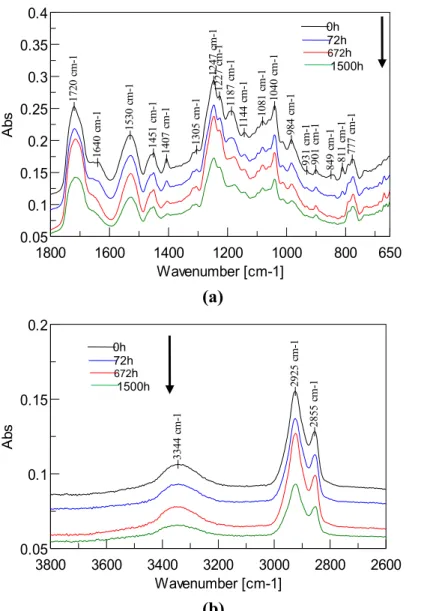
polyurethane coating containing bark extract and lignin stabilizer coated wood panels before and after weathering for different exposure times are shown in Figures 4(a) and 4(b). The assignments of the bands were performed based on the literature FT-IR data for acrylic- polyurethane system that is well documented [13, 21-27].
(a)
(b)
Figure 4 ATR-FTIR analysis of acrylic polyurethane coating containing bark extract and lignin stabilizer for different exposure times (a) 1800-650 cm
-1and (b) 3800-2600 cm
-1Before the detailed analysis, each spectrum was normalized at the CH bending frequency (1451cm
-1) in order to emphasize the oxidation of the polymer matrix [22]. As reported by Perrin et al. [21], CH bending frequency must decrease slightly due to the partial oxidation of the CH
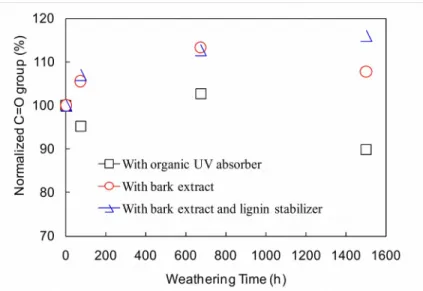
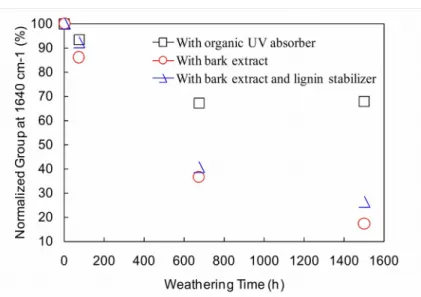
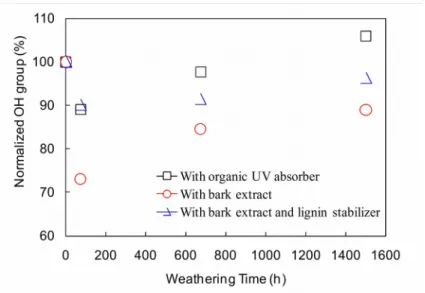
2in the α-NH position. Semi-quantitative measurements were carried out to comprehend the effect of different additives (Figures 5- 10) on the weathering of acrylic polyurethane coating. Increase in absorption in the carbonyl region (1670-1770 cm
-1) for acrylic polyurethane coating containing bark extract with or without lignin stabilizer suggested the formation of several oxidation photoproducts mainly the carboxylic acid (peak at 1715 cm
-1) while a decrease in
0.05 0.4
0.1 0.15 0.2 0.25 0.3 0.35
1800 1600 1400 1200 1000 800 650
Abs
Wavenumber [cm-1]
1720 cm-1 1640 cm-1 1530 cm-1 1451 cm-1 1407 cm-1 1305 cm-1 1247 cm-1 1227 cm-1 1187 cm-1 1144 cm-1 1081 cm-1 1040 cm-1 984 cm-1 931 cm-1 901 cm-1 849 cm-1 811 cm-1 777 cm-1
0.05 0.2
0.1 0.15
3800 3600 3400 3200 3000 2800 2600
Abs
Wavenumber [cm-1]
3344 cm-1 2925 cm-1 2855 cm-1