by TSUTOMU YATA
B. Eng., Tokyo Institute of Technology (1973)
M. Eng., Tokyo Institute of Technology (1976)
SUBMITTED TO THE DEPARTMENT OF URBAN STUDIES AND PLANNING IN PARTIAL FULFILLMENT OF THE
REQUIREMENTS FOR THE DEGREE OF
DOCTOR OF PHILOSOPHY IN URBAN AND REGIONAL PLANNING
at the
MASSACHUSETTS INSTITUTE OF TECHNOLOGY June 1981
Tsutomu Yata 1981
The author hereby grants to M.I.T. permission to reproduce and to distribute copies of this thesis document in whole n part.
Signature of Author
Department
$
Urban Stu s and Planning , f(/May 26, 1981 Certified by 'Gary A. Hack Thesis Supervisor Accepted by Robert Fogelson MASSACHUSETTS P-ji-man, Departmental Graduate CommitteeOF TECHNLOGY
AUG 11 1981
by TSUTOMU YATA
Submitted to the Department.of Urban Studies and Planning in May 1981, in partial fulfillment of the requirements for the
degree of Doctor of Philosophy in Urban and Regional Planning ABSTRACT
This study proposes citywide policy planning as a way of improving the practice of urban design in American cities. Citywide policy
planning involves the formulation of citywide urban design goals,
objectives, and policies to guide decisions affecting the physical form and character of the city. This activity also prepares for the official adoption of citywide urban design policies and helps begin their imple-mentation. A series of background studies covering the entire city usually supports this activity.
Despite the fundamental importance of what a city looks like and how it feels to many people, urban design has been seldom extended beyond the conceptualization of individual projects and into the arena of policy planning to be carried out citywide. At the same time, urban design has been largely divorced from the rationality that has been
common in city planning: articulating goals, making decision-making criteria explicit, informing decisions with the empirical data, etc. A planning report survey conducted as part of this study confirms these observations: only several cities have ever studied their form and
character systematically; among major cities, only a few have ever formu-lated citywide urban design policies. The promise of citywide policy planning is great; its practicability and merit are not yet clear.
Chapter I through IIIreport case studies of citywide policy planning efforts in three cities. In Minneapolis and San Francisco, citywide urban design policies have been actually formulated and officially adopted. In Dallas, staff efforts fell short of policy formulation, but a series of citywide studies were carried out.
Chapter IV discusses a set of common themes emerging from the case studies. Urban designers in the three cities expressed four kinds of intent which as a set distinguish their approaches from more tradi-tional ways of practicing urban design: improving the perceptual and behavioral quality of the physical environment; studying citywide issues and overall city strategies; responding to the needs of the people who live in the city and its neighborhoods; and increasing overall
rationality in approach to urban design. Of strategic importance to
those urban designers were the development of an empirical data base and the formulation of citywide urban design policies.
tive, but overall successes with citywide policy planning, development projects and design controls that worked within a framework of citywide urban design policies, problems that emerged in specific situations with-out initial policy discussions, and the potential for improving present practice by having citywide urban design policies formulated and agreed upon, together, provide initial confirmation as to the actual benefits of conducting citywide policy planning.
The three case studies generally support the practicability of citywide policy planning in certain situations. Chapter VI reviews the factors that affect the practicability, use, and effect of citywide policy planning: the theories and techniques of city design policy formulation; the governmental context; and the context of citizen
participation and the role government urban designers play in the plan-ning process. Various difficulties as experienced in the three cities should not entirely prohibit citywide policy planning.
The last part of the thesis speculates where citywide policy planning could be useful and where it mightbe applied. Not all cities in which this activity could be beneficial would support it. The poli-tical and business leaders of the community might even see the very purpose of citywide policy planning (e.g. to guide the development of the perceptual form of the city) inconsistent with what they consider the important business of their community (e.g. to remove constraints on real estate development).
At present, there is much uncertainty as to whether citywide
policy planning can be successfully practiced in each city. Each urban designer entering this new area of practice must necessarily search his own way as part of efforts to devise the process of urban design that is adapted to his community.
Thesis Supervisor: Dr. Gary Arthur Hack
Title: Associate Professor of Urban Design
Abstract . . . . Table of Contents . . . . . List of Illustrations . . . Acknowledgements . . . . . Introduction Chapter I. Chapter II. Chapter III. Chapter IV. Chapter V. Chapter VI. Prospect of . . . . . . . Case Study 1: Minneapolis Case Study 2: Case Study 3: An Impossible Common Themes . . . . . . . . . . . . . . . .
Citywide Policy Planning in
. . . . . . . . . . . .
The San Francisco Urban Design Plan The Citywide Urban Design Framework,
Dream? . . . . . . . . . . . . . .
in Cases . . . . . . . . . . . . .
Use and Effect of Citywide Policy Planning Making Citywide Policy Planning Work .
Citywide Policy Planning . . . . . .
Appendix: A Survey of the General State of the Art of Citywide Urban Design Studies and Plans in American Cities since 1960 Footnotes . . . . . Bibliography . . . Biographical Note . . . . . . . . . . . . . . . . . . . . . -1 14
55
92 127 141 163 192 199 210 245 262 (iii) . i .,iii . iv . v . . . . . . . . . . . . .Figure
2-1. Fundamental Principles for Major New Development 1,
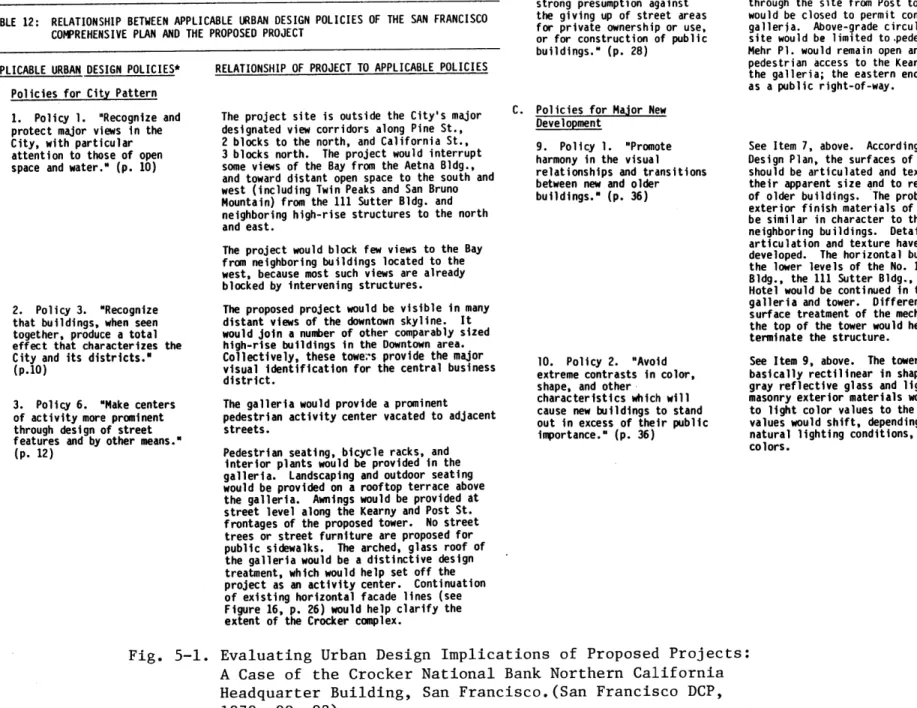
the Urban Design Plan .. .. .. .. . .. .. ... 72 5-1. Evaluating Urban Design Implications of Proposed
Projects: A Case of the Crocker National Bank Northern California Headquarter Building,
San Francisco ..... . . .. ..... . . *.. .... . 157 A-1. Relative Emphases on the Quality of the Environment
and the Urban Design Management System . . . . . . . . 201
I wish to express my deep appreciation to Professor Gary Hack for his supervision and guidance throughout this study. I also wish to thank Professors Kevin Lynch and Lawrence Susskind, other members of my thesis committee, for their useful suggestions and advice.
Oliver Byrum, director of the Minneapolis Planning Department, Rai Okamoto, then director of the San Francisco Department of City Planning, and E. Jack Schoop, director of the Dallas Deparment of Urban Planning, kindly granted me permission to study the urban
design programs of their departments. Weiming Lu and Professor Allan Jacobs offered their valuable observations and useful advice to help my field work in Minneapolis, Dallas, and San Francisco. Lawrence M.
Irvin, John Burg, Stephen Murray, Richard Hedman, Tom Niederauer, and James M. Prince, among other people, guided me in their planning departments and suggested sources of information to help me see their urban design programs in perspective. I am unable to list other people who offered their valuable time for interviews with me and helped this study. I am grateful to all these people who made this study possible.
Much of the literature review for this study was conducted at the Main Library of the U.S. Department of Housing and Urban Development, Washington, D.C., the Municipal Information Library of the City of Minneapolis, the Management Services Library of the City of Dallas, the
Loeb Library of Harvard University, and the Rotch Library of MIT. I would like to thank the people who helped me in these libraries.
I would like to extend my thanks to Professors Kiyoshi Seike and Hirokuni Taniguchi who generously allowed me to study at MIT in the
course of my work in the doctoral program at the Department of Archi-tecture, Tokyo Institute of Technology. Finally, I thank my parents Yasuko and Tadahiko for their patience and support throughout my life.
Problems of Traditional Urban Design Practice
Urban design defined generally is a discipline concerned with and the process of giving form to ensembles of structure, to whole neighborhoods, or to the city at large so as to make an urban area
comprehensible, functional, and aesthetically pleasing (Abrams, 1971:
329). The primary concern of urban design could be just form giving,
while I believe its true concern has to do with human experience in urban environment -- something more than aesthetics or visual quality alone. The origin of urban design can be traced back in the history of cities. However, the concept of urban design as a public planning function to be assumed by city governments, with which this study is concerned, is relatively new in this country; it began to emerge only around the late 60s to the early 70s (Urbonas, 1969; Barnett, 1974; and Kaiser et al., 1974).1
Traditionally, urban design has been practiced dominantly as
project planning or project design. Project planning or "project
design" (Lynch, 1968: 249) means planning or design of a defined geographical area in which there is a definite group of clients, a concrete program, and a foreseeable time of completion. This type of activity assumes the existence of effective controls over the significant aspects of environment. Examples are a housing project, an urban renewal project and, perhaps, a small new town. (Note that
"project planning" or "project design" here is not the development
of a project management plan or work program.) While most urban designers are strong in project design, project design-oriented practice has drawn various criticisms. At first, criticisms to
"disjointed-incrementalism" in city planning generally apply. Without
an overall framework to see to it that individual projects are carried out in view of citywide intentions for the form and character of the
city, economic efficiency and overall rationality in approach are
questionable. The effect of one project often detracts from that of
another. Long and repeated public controversies over individual pro-jects, studies and restudies, and delays in project execution often result. Resources could be wasted in this way.
Second, urban design carried out in individual projects is usually no more than a stock of techniques to get development projects done or an art of giving form to projects, schematic or detailed. Without explicit definition of the quality of the environment to be pursued,
there is no assurance that projects really make the environment better even if certain general values such as aesthetics and functional
efficiency are implicit in the mind of designers. More generally, urban designers designing projects more often than not neglect or
fail to articulate goals or value premises of urban design. Goals or value premises, if articulated, are often dissociated from actual decisions. The effect of this is arbitrariness of criteria for decision-making. Without explicit criteria, it is difficult to have reasonable public debate. Urban design in this sense remains to be a personal art of professional urban designers. Superficiality of analysis and lack of accumulation of real knowledge are often the result.
Allied with the special importance urban designers give to their artistic skills is a lack of real concern with the people who live or use the place, the neighborhood, and the city. Without faithful
efforts to secure inputs from groups of people which have a stake in
the project, there is no assurance that urban design will be responsive to the needs and wishes of the people of the city. Good design
(aesthetics functional efficiency) from a professional point of view is often unperceived by people whom the project is supposed to serve. Urban designers in this way invite public criticism that their pursuit
is "elitist" and irrelevant.
In projects, planning goals/objectives and basic concepts are often imposed by others because projects are conceived as means of
implementing more comprehensive plans. Thus, project design creates little demand for articulating broad goals or objectives for the urban environment or specific criteria for decision-making. More-over, good urban design demands artistic skills of designers and their professional devotion. Demands to serve the wishes of people and to make design criteria explicit so as to allow broad participa-tion in decision-making are not inconsistent with this demand but they are often lost, subjected to all-or-nothing choices. In this way, problems with traditional practice derive partly from the nature of projects and partly from the nature of urban design. However, what is really in question is the context in which project design has been
carried out (e.g. without any citywide policy framework).
There are few new constructs in urban design that depart from
the project design-oriented bias. The notion of urban design as
public policy (Barnett, 1974) is one. Observing its practice in
New York City, it has operated in two ways: district-level design
controls (e.g. special district zoning) and, to a lesser extent, citywide design controls to deal with specific systems or areas of concern (e.g. housing quality: Urban Design Council of the City of New York, 1973). In either case, it is implementation (development
of specific design controls and its enactment) rather than policy
planning that has been emphasized. Thus, "urban design as public
policy" in fact has been urban design as public "programs" or
"regulation" (cf. policy as program, Pressman and Wildavsky, 1973: vix). With weak emphasis on policy planning, responsiveness to the overall neeeds of people may be questioned as in project design-oriented
practice. Being incrementalism in its own way, overall rationality
and effect on the overall form and character of the city are doubtful.
The construct of architectural and environmental programming (including
user needs assessment) that has been emerging from around the mid 70s is another. This represents efforts to make the design of physical settings responsive to the needs and wishes of people who live or use them.2 However, we see little application of this concept at a scale of major district or city as a whole. Most of the research has taken place for project or system design (cf. some efforts by Alexander
At present, we lack a general-state-of-the-art survey of urban design practice in this country to confirm these impressions of the
"domination of project-centered urban design practice". (What we
have at present are a few studies of cases that are exemplary rather than common or dominant (e.g. Hack, 1980; Ray, 1979). However,
criticisms outlined above seem to correctly identify the basic nature of traditional and dominant ways of practicing urban design.
Citywide Policy Planning as a Response
There would be many ways to respond to these problems commonly associated with urban design practice on an individual project or
control basis. But, as a set, they seem to be best dealt with by introducing into the government urban design program "citywide policy planning" which reflects important concerns about urban design. Those
concerns should include at least the- following:
- Urban design has not dealt with the perceptual and behavioral quality of the physical environment broadly;
- Urban design has not dealt with citywide issues and overall city strategies for urban design directly;
- Urban design has not been responsive to the needs of the people who live in the city and its neighborhoods (suggesting a need to incorporate surveys, citizen participation, and other means of eliciting inputs from citizens and commnicating with them); and
- Urban design has been largely divorced from the rationality that has been common in city planning for some time, such as articulating goals, making decision-making criteria explicit, and informing decisions with the empirical data. I use "citywide policy planning" loosely here. I only suggest that its core should be the formulation of city design policy without sug-gesting its boundaries. City design policy is a set of goals,
objectives, and policies to gudie decisions affecting the physical from and character of the city. Ideally, it should be adopted as official city policy but it could be internal policy of the planning
agency made explicit andused publicly. Closely allied with the
formulation of city design policy are activities 1) to prepare for its official adoption by the decision-making body (the planning commission or the city council or both) and 2) to begin its imple-mentation. Implementation can be made part of citywide policy planning,
but it does not need to be. This is because of the nature of policy implementation; implementation has a logic of its own (the politics of implementation). Moreover, implementation does not need to be carried out citywide while most of essential activities in citywide policy planning take place on a citywide basis.5 A series of studies would be carried out citywide or perhaps in an additive way
encompas-sing the entire city. Their purposes are to support city design policy formulation and to allow informed decisions on city development by urban designers, decision-makers and, perhaps, citizens at large.
The promise of citywide policy planning seems great. At first, it
is a response to major criticisms to the kind of urban design people have seen in many places to date. In fact, its important benefits seem to derive from the very way it responds to those criticisms. For example, formulating policies and subjecting them to public dis-cussion following the formal process of decision-making in the community means better incorporation of the various interests of the community
in planning and development (response to the needs of people). Once adopted and used as a decision framework (overall city strategies for urban design), city design policy would guide public and private actions to further efforts to achieve community goals. As public statement of what a good city is in the community (explicit decision-making criteria), it would put public and private interests on notice of the intent of the city (Kent's (1964) "communication"), increase public awareness of urban design-related issues, and stimulate public and private improvement activities ("education"). A bonus of such an effort would be increased staff experience and a better basis for project-level urban design (e.g. data bases and informed citizens).
An idea of extending urban design to the arena of policy planning to be carried out on a citywide basis is ambitious; its practicability and actual merit are not yet clear. There seem to be many obstacles, including the everpresent danger of duplicating efforts of more
traditional city planning in policy setting and the political reality which generally favors short-range, opportunistic programming.
Moreover, urban design has problems of its own:
- Relatively undeveloped theories and techniques of urban design; technical issues of policy formulation (e.g. How
can urban designers define the "elusive" qualities of the envi-ronment? How can a policy be a decision guide specific enough to choose among alternatives at hand, yet general enough
to deal with numerous project proposals over years?
- Issues of the city government as it defines the status, role
and client of urban design or urban designers (e.g. How can urban designers deal with city officials if the latter view urban design only as a tool of getting development projects done, and argue for citywide policy planning? How can they justify a new set of government controls -- various design controls which would stem from city design policy as well as city design policy itself as a form of control
through communication?); and
- Issues of citizen participation and the role of government urban designers in relating to interests of various groups of people in the city (e.g. How can urban designers discuss design-related issues with lay citizens if they are not
supportive of good urban design or appreciative of urban designers' principles of good design?).
Questions thus arise: Is citywide policy planning as suggested here actually happening in cities? Does the promise of citywide policy planning match the actual merit of conducting it in practice? Is citywide policy planning practicable in cities given various
obstacles? How have urban designers attempting citywide policy
planning dealt with those obstacles? How can they make citywide
policy planning work? This study is an attempt to answer these
questions in a general way on the basis of in-depth case studies of citywide policy planning efforts in three cities and to develop a framework for studying citywide policy planning. A section to follow at first examines citywide policy planning in its historical context and in theory.
Citywide Policy Planning: An Emerging Area of Practice
Historical context
In the early development of American cities, urban design, especially aesthetics, was given little consideration. Sanitation, drainage, transportation, street extension, and police and fire protection were among more important concerns of growing cities.
In the mid 19th century, an interest began to emerge in romantic landscapes. Frederic Law Olmsted designed Central Park in New York
City in the 1860s and landscaped the grounds of the Capitol in
Washington, D.C. in the early 1870s, but without an immediate impact
in stimulating formal beautification programs in cities (Wrenn, 1980).
But an idea of designing a city as a whole, or at least a major part
of it, is not totally alien to American cities. The initial pattern of development in cities like Philadelphia and Savannah was set by
the design of great minds (William Penn and John Oglethorpe).
The Columbian Exposition of 1893 in Chicago gave birth to the City Beautiful Movement. The depression of the 1890s delayed the movement for a while but, with recovering economy, the early 20th century brought grand schemes of street and park systems to many cities throughout this century. Cities then lost their ambition in the face of financial difficulties and shifting national priorities during the two great wars, economic depression, progress of
suburban-ization and deterioration of downtown and inner-city neighborhoods in the post-war era.
Major public efforts to design cities came back with the federal urban renewal program in the 50s and the 60s. Exercise of strong
public power -- condemnation and redevelopment -- enabled good urban
design in some large areas of cities but results were not always enviable. Big-scale architecture often created sterile environments. The process of urban renewal projects was often problematic, and design programs seldom made value premises and reasoning about the basis for specific forms explicit. The art of urban design remained largely a domain of personal skill of urban designers. More importantly, the influence of urban renewal projects on the overall design of cities was limited except in a few cities where a "critical mass" had been created by massive public investment. As a positive impact, urban renewal created new opportunities for architectural design and
stimulated the development of imaginary schemes to renew cities or create entirely new ones. Urban design became viewed among architects as the art of relating a single building to surrounding ones and streets in the 60s. English townscape designers, especially Gordon Cullen
(1960) helped architects to expand their views and to think about buildings as they related to streets, plazas, and other buildings. However, the art of designing townscapes remained unrelated to broader
social concerns which city planners had to deal with in guiding the
development of the visual form of the city.
Recent interest in city-scale urban design owes much to Kevin Lynch's research. In his book, The Image of the City, Lynch (1960).
demonstrated that a seemingly elusive subject of urban design could be informed by data and discussed as a matter of public interest.
As a result, the role of urban design in city planning became more legitimate. The book provided urban designers with a host of ammuni-tion to deal with urban design as a matter of public policy -- a set of clear premises (legibility, or imageability; identity, structure,
and meaning), models of city form and image of the environment (made up
of elements such as landmarks, paths, and nodes), design concepts (e.g. strategically locating highrises as man-made landmarks), survey methods (especially, image map drawing) and, most importantly, a new way of viewing the city environment and a new philosophy of urban design.
The federal Community Renewal Program gave government urban
designers the first opportunities to try out city-scale urban design.
A few cities thus embarked on citywide urban design studies in the mid 60s (Brookline, Mass. -- Lynch, 1965; Minneapolis, 1965-70). This
program, however, was not entirely supportive of systematic citywide studies because of its emphasis in identifying short-range improvement needs to deal with physical deterioration in selected areas (urban renewal, rehabilitation, code enforcement, etc.).
The major impetus for citywide urban design studies came with an extension of the federal Comprehensive Planning Assistance Program
(the so-called 701 Program) to large cities during the late 60s and the early 70s. With few strings concerning the substance of
compre-hensive planning, the program allowed several cities to conduct
innovative citywide urban design studies (Oakland, Ca., 1968, 1969; Jacksonville, Fla., 1971, 1972; Los Angeles, Ca., 1971; San Francisco, Ca., 1968-70, 1971; Seattle, Wash., 1971; and Dallas, Tex., 1974;
cf. Appendix).
The federal Highway Beautification Program, beginning in 1965, encouraged many cities, large and small, to prepare citywide
their plans as an element of their comprehensive plans, but their scope was quite limited, largely determined by the federal guidelines for funding. Moreover, the emphasis in beautification and appearance studies was on the preparation of a short-range improvement program and they seldom involved systematic analysis and articulation of a set of goals, objectives, and policies. This program is nevertheless
significant because it raised the level of public support for city beautification nationwide and created a ground for urban designers'
initiative to plan on a citywide basis.
Nation-wide interest in city beautification, increased public awareness of the quality of urban life, and grass-root efforts for historic preservation, among other things, convinced some cities that assuring the quality of their city environment should be a high
priority concern of city government (.e.g. San Francisco DCP, 1971b: 132). A notion of urban design as an arena for public policy (Bar-nett, 1974) began to emerge in this context. In the face of immediate demands, the primary attention of government urban designers was
directed primarily to short-range programs, opportunistic intervention, and downtown where important public and private investments were
taking place. Citywide policy planning seldom happened. While impor-tant innovation in techniques of urban design control (e.g. incentive zoning, special district zoning, and transfer of development rights) took place to support the work of urban designers, the theoretical and methodological underpinning of citywide policy planning had to come at first from outside the group of new government urban designers
(cf. Lynch, 1960).
Theories
Until recently, very little has been known about city-scale urban design. It is thus not clear if citywide policy planning is happening in cities. The literature that has existed is small, offering
nothing more than a brief account of the best-known urban design reports and plans (Lynch, 1976; Kaiser et al., 1974; Gulak, 1978; Southworth and
Southworth, 1973; Jacobs, 1971). Only few people have examined imple-mentation and use of citywide urban design plans (O'Hern, 1973; Staten,
published to offer us in-depth accounts of cases that are considered to be exemplary in this country (Jacobs, 1978a, b; Lu, 1979; cf.
Skaff, 1978). While some attempt has been made to develop a general, theoretical framework (Lu, 1979; Lynch, 1968, 1976, including a
brief discussion on "area policy"; Kent, 1964, including a discussion
on the civic design element of the urban general plan), theory of city-scale urban design is yet to be developed with more cross-case
knowledge. Theories in related fields (including city planning,
especially comprehensive planning and planning theory) are of limited use given little substantive knowledge we have on urban design
practice at a scale of city.6
In the past several years, we have been observing two contrasting trends in urban design without knowing what is actually happening in cities. On the one hand, the 70s saw increasing emphasis on neighbor-hoods, imcrementalism, and opportunistic improvements in city planning. Some observers of the planning scene thus conclude that it is not the time for citywide things today. On the other hand, the 70s was a decade of rediscovery of comprehensive planning. Some states mandated municipal comprehensive plans and created a good ground for increasing faith in comprehensive planning (California, Minnesota, and Florida). Not only a renewed interest in citywide urban design plans came from
those who led the most successful urban design programs in this country (Jacobs, 1978a, b; and Lu, 1979), but also there are some observers who saw citywide urban design studies as part of process-oriented
approach a cutting edge of environmental quality management practice (Kaiser et al., 1974). In the face of these contradictory descriptions, there is a need to survey the general state of the art of citywide
urban design studies and plans at first.
The general state of the art of citywide urban design studies In the summer of 1979, I conducted a survey of citywide urban design study reports and plans prepared in American cities since 1960.
(The results of this survey are discussed in more detail in Appendix.) This survey generally confirmed observations Lynch (1976) and others
formulated a citywide urban design plan or a set of goals, objectives, and policies that are more than a beautification plan and incorporated it into their decision-making process by officially adopting it. Only
several cities have conducted in-depth studies of their physical form
and character on a citywide basis.
Traditionally, urban designers have been preoccupied with studies of the quality of the existing physical environment. They have seldom attempted to define the desirable urban design management system
(decision-making processes) and explored ways of achieving or approach-7
ing it. Worse, many citywide urban design studies stopped short of formulating policies to define the desirable quality of the
environ-ment and chart action strategies after completing surveys of the existing
form and character of the city. Changing priorities of the city and resource problems of the planning agency, among other problems, have often prevented urban designers from going one step further. The relatively undeveloped theories and techniques of city-scale urban design (e.g. without any standard procedure) must have made it dif-ficult for urban designers to know what to do next. As a result, resources tended to be allocated to surveys and analyses at a cost of neglecting policy and action strategy formulation. In some cases, too much emphasis was placed on simply publishing the data. In others, urban designers considered it inappropriate to define the desirable quality of the environment for their city whether in general policy
terms or as specific blueprints. (Defining the quality of the environ-ment was often equated to drawing up a blueprint of a future city.) Numerous beautification and appearance plans may be included in this
category. They surveyed the city's appearance, diagnosed problems, resources, and potentials, and directly went on to prescribe specific actions to be taken within the next three to five years. General, long-range urban design policies for the city were seldom formulated.
Among several exemplary cities, Minneapolis, San Francisco, and Dallas have emerged as cities which deserve in-depth case studies. These cities have tried major citywide urban design studies, putting real faith in policy planning. The planning staff in San Francisco viewed the city-wide urban design plan defining the quality of the
result of two years of concentrated efforts, they completed such a plan and sought and received early adoption of it by the planning
commission as an element of the comprehensive plan (the Urban Design Plan of 1971). In Minneapolis, citywide policy planning began almost at the beginning of its urban design program (the CIP Urban Design Study, 1965-ca. 1970, following the Southeast Minneapolis Planning Study, 1961-64). A citywide urban design plan was drafted in an adoptable form in 1971, although its adoption had to wait until 1976
(the Visual Design Framework). The Visual Quality Plan recently adopted incorporates policies for design management as well as those for the physical environment. The urban design staff in Dallas have not gone beyond the survey and analysis phase in their citywide studies. Without studies specifically aimed at formulation of city design policy, Dallas has been without overall citywide policy plan-ning (my definition). However, the staff made much effort to introduce
citywide policy planning into their urban design program throughout the 70s: they continued their work to prepare the citywide urban design framework which would set forth policies for the quality of
the environment. Also, the staff did policy planning in a few
spe-cific areas of concern (e.g. escarpment area design guidelines and flood plain management policies). Articles in professional and popular journals suggest that these cities have built their own urban design capability and have been achieving good results in urban design for some ten years or so.
The in-depth case studies which follow do not cover cities with-out any citywide policy planning effort. This is because situations with and without citywide urban design policies ought to be compared in cases in which it is practicable in one way or another. In a context in which citywide policy planning is very difficult to
prac-tice, problems with the urban design program might not be attributable to the lack of citywide policy planning. The same context could make the practice of urban design difficult and create those problems; citywide policy planning might not make differences. Without a theory defining situations that demand and support citywide policy planning at the outset, I have chosen cities in which it has been tried.
The Organization of This Thesis
Chapters I through III report cases of citywide policy planning efforts in the three cities (Chapters I - III). Attention is given
to the theories and techniques and their evolution over time, results,
issues of practice, and factors that might have affected the urban
designer's approach and the effectiveness of citywide policy planning. Chapter IV discusses common themes that have emerged from the three case studies. Citywide policy planning for the physical environment has been actually tried fully in Minneapolis and San Francisco and partially in Dallas. Chapter V examines the actual benefits of having citywide urban design policies formulated and debated, contrasting experience in the three case cities with the promise of citywide policy planning. Cases in the three cities provide initial confirma-tion as to the merit of conducting citywide policy planning. To describe the promise, this chapter develops a general framework for defining the effectiveness (use and effect) of citywide policy planning.
The three case studies generally support the practicability of citywide policy planning in certain situations. The last chapter considers important factors that affect the practicability and
effectiveness of citywide policy planning in terms of 1) the theories and techniques of city design policy formulation, 2) the governmental context, and 3) the context of citizen participation and the role of government urban designers in the planning process. While three case studies are not sufficient to make broad generalizations, it is
possible to speculate where citywide policy planning might be useful and where it could be applied. The final section of this thesis thus discusses the prospect for citywide policy planning.
CASE STUDY 1: CITYWIDE POLICY PLANNING IN MINNEAPOLIS
Introduction
Minneapolis has been known for its urban design achievements for more than a decade. The Nicollet Mall project designed by Lawrence Halprin is the first and best-known example: it has become one of the most successful examples of downtown malls in this country, contributed greatly to downtown revitalization, and created a sense of place,
beauty, and identity in the downtown retail area. A skyway system, a series of second-level pedestrian passageways to link retail and office spaces in the downtown core has grown into the most extensive system in this country and become a model of similar development in other cities. While it is a superb response to a severe Minnesota climate during the winter, it is not just an expression of pragmatism of Minneapolitans. It created a marvelous center piece of Minneapolis urban design as well: the Crystal Court at the foot of the IDS Tower designed by Phillip Johnson in the early 70s. Finally, Metro Center
'85, one of the most successful downtown development plans in this country, received much attention from the professional community.
On the other hand, little is known about citywide studies which underlie Minneapolis' approach to urban design (cf. a brief account
in Lynch, 1976: 82; Lu, 1979). We learn how the city's recent compre-hensive planning effort began in the late 50s through Alan Altshuler's
(1965) case study but little is known about urban design within the context of city planning in the 60s and the 70s. This case study is an attempt to illustrate how systematic studies carried out citywide
to formulate city design policy and to make the process of urban design work better during the formative era of the Minneapolis urban design program helped the development of the theories and techniques
of urban design in this city and prepared a ground for integrating urban design into the process of planning and development.
The Minneapolis urban design program is quite complex. It has evolved over some twenty years through several citywide and district-level studies and programs. To place its evolution in a perspective, I suggest two phases of development in the theories and techniques of urban design in this city. The first phase began with a few urban designers in the planning department (to be called the urban design staff hereafter) applying their new idea of urban design at first at a planning district level (the Southeast Minneapolis Planning Study, 1961-64) and, then, at a citywide scale (the CIP Urban Design Study, 1965-ca. 1970). In this phase, the theories and techniques of urban design were developed primarily in respect to the technical aspect of city design policy formulation -- methods of studying the quality
of environment, design concepts, and form of city design plan. The publication of the second downtown plan Metro Center '85 in 1970 marked the culmination of this phase of development.
During the first half of the 70s, the urban design staff did studies and projects identified in the CIP Urban Design Study
(reiterated in Metro Center '85). Systematic studies were no more carried out at a scale of district or beyond. Efforts to formulate city design policy were made without further studies of the quality of environment and research about citizen concerns. Meantime, the con-text of urban design changed gradually. In 1976, three events took place and made the need for further development of the theories and techniques of urban design clear: At first, the Visual Design
Frame-work proposal developed over five years had to be completely revised
as a result of intensive neighborhood review in a several-month period. Second, the master design district ordinance proposal did not take off the ground after several rounds of revisions to incorporate neighborhood groups' wishes. Finally, the Minneapolis voters approved administrative reorganization to move the planning department away from the city
coordinator's development function. The second phase of development should allow the urban design staff to increase their sophistication in ways of communicating with people and influencing decisions of a plural set of actors inside and outside city government. This phase
has just begun through the Metro Center '90 program, 1977-78, and
comprehensive planning for the 80s.
City planning behind the progress
Minneapolis is a mature Midwestern city of 434,400 (as of 1970) with its relatively small territory (59 square miles) confined by surrounding communities. Together with Saint Paul, the city forms the heart of the Twin Cities metropolitan area, a region with 2.0 million people. The city was initially established in 1849 at St. Anthony on
the east bank of the Mississippi River and grew into a regional center for lumbering and milling with the coming of railroads during 1860-75. The city today is the economic center for the entire region, and the
home for major national industries and businesses. Minneapolis as the
"City of Lakes" owes much to landscape architect H. W. S. Cleveland's visionary master park plan of the late 1880s which guided the subsequent
acquisition and development of the land around lakes. The city's park system linking lake, creek, and river areas has a profound effect on the form and image of the city today.(Minneapolis P&D, 1970a: 10)
The City Planning Commission was created in 1919. The commission occupied a rather prominent place in city government in the 1920s but
a series of events including the Depression and the withdrawal of
busi-nessmen from civic activity after the 1933-34 strike brought an end to the period of prominence.(Altshuler, 1965: 200) Plans were prepared to accomodate the already established city form to new needs -- espe-cially automobile traffic -- but their impact was very little before World War II.(Minneapolis P&D, 1970a)
In the early 50s, Minneapolis was behind the progress of city planning in this country. The role of the planning department was in many ways vague and city officials were not supportive of long-range
planning. This owed much to the very design of the Minneapolis government. The
city's somewhat antiquated government structure was determined by the 1920 charter which provided for a weak mayor-strong council form of
government. Highly decentralized nature of city government was
paralleled by extremely weak political party organization.(Altshuler, 1965: 191-2)
Planning department rejuvenation
Minneapolis' downtown saw its speculative peaks in the 1920s. The Depression and World War II halted investment and business activity in downtown began to lag behind other places in the region from around the mid 50s. Inner-city decay and other factors contributed to migra-tion of city residents to the suburbs. Spacious outlying areas
attracted the city's industries and businesses away as well.
In August 1955, concerned business leaders formed the Downtown Council and began an impending campaign for downtown revitalization. Studies to assess the effect of freeways on the Minneapolis CBD followed its initial attention to the Lower Loop urban renewal project. City planning began to draw sudden attention in this context (Altshuler,
1965: 200). George Barton and Associates working with a city planning
consultant Frederic T. Aschman evaluated the State Highway Department's proposals from a local point of view and found deficiency in the city's planning programs that would be necessary in harmonizing freeways with the city's street system. Barton and Aschman thus convinced the Down-town Council and the city engineer the role city planners ought to play. Subsequently, Aschman did a study of the general state of city planning in the city, recommending the city to strengthen the planning depart-ment. Among his recommendations were hiring of a planning director and fivefold budget increase. This brought the city a successful administra-tor-planner Lawrence Irvin from Columbus, Ohio.(Altshuler, 1965: 203, 205)
Irvin came to Minneapolis on March 1958. He was with a ready-made constituency: the business community had induced several prominent
businessmen to accept membership of the planning commission. There were no vocal opponents.(Altshuler, 1965: 205) The planning director saw his small planning staff and budget (increased three times) further increased over the next few years.
Urban design in early comprehensive planning efforts
The planning director at first concentrated on a downtown plan for the business community and saw the completion of the first downtown plan, First Report on the Central Minneapolis Plan, in 1959 (Minneapolis CPC,
1959b). Studies were also initiated within six months of his arrival to develop a new citywide zoning ordinance, a new citywide industrial land use plan, and three neighborhood plans. Neither the business community nor the city council was particularly interested in compre-hensive planning but the planning director made an early commitment to
comprehensive planning and a program to revise the city's official plan (comprehensive plan or master plan) was initiated in 1961. According to Lu (1979: 7), the history of planning in Minneapolis after the planning department rejuvenation closely followed the national trend: the first focus on public housing; then on urban renewal; then on
free-way systems, joint land use-transportation planning, and community
renewal programs in the mid 60s; and, finally, on model cities programs, social services and health care planning, and human resources develop-ment in the late 60s and the early 70s.
It was only in the early 70s that a separate urban design office
was established within the planning department and "urban designer"
became official position in Minneapolis. However, a few urban designers
(including Weiming Lu, principal planner) began to work as part of the
planning staff back in the late 50s. Planning for the downtown area already incorporated urban design considerations. For example, Goals for Central Minneapolis: Its Functions and Design (Minneapolis CPC,
1959a) included "appearance" along with land use and transportation
in "design goals which [would] most fully enable Central Minneapolis
to perform its proper functions." The report recommended that the
under-lying goal for appearance should be:
In all matters of the design and location of physical features in or relating to Central Minneapolis, the effects of such features on the appearance of the area should be taken into account so as to create the most rewarding, stimulating and memorable environment. {Emphasis mine.]
Three specific goals relating to distinctiveness, unity, and variety
were recommended. These goals not only found their way into the down-town plan but also remained important in the second downdown-town plan
Metro Center '85 (Minneapolis P&D, 1970a) and its revision Metro Center
'90 (Minneapolis P&D, 1978a-d). It is also important to note that
design-related goals were defined in terms of image and behavior at this point (e.g. "memorable" environment, "understandable" layout, and focal
poinAts as "points of reference"). Urban design was not just a matter of fine views or formal order. However, it took a few more years for
the urban design staff to fully articulate these new value premises in urban design and operationalize their definitions. Moreover, no work was done to formulate policies and programs for urban design in response
to once articulated goals. On the contrary, the 1959 downtown plan did not deal with design issues directly (Lu, 1974: 80).
Comprehensive planning on a citywide basis, begun in 1959, produced the official city plan in the fall of 1962 (Minneapolis CPC, 1962). Urban design considerations were integrated into some parts of the plan
but urban design goals were not articulated except in a few sections. As in the first downtown plan, formulation of policies and programs for
urban design was not possible. Clear articulation of urban design goals came at first in the Southeast Minneapolis Planning Study. To formulate urban design policies, the urban design staff had to continue their exploration till the end of the 60s.
From the Beginning to Early Maturity
An emerging approach in the Southeast Minneapolis Planning Study A significant change in the status of urban design took place in the Southeast Minneapolis Planning Study. In 1961, the planning commission began a program of comprehensive planning for Southeast Minneapolis upon the request of citizens and businessmen of the
com-munity (official planning district in Minneapolis). The program was
concluded in the spring of 1964 with the publication of A Workable Plan
for the Active Conservation and Orderly Development of Southeast
Minneapolis (Minneapolis CPC, 1964). This program had five important characteristics which distinguished it from previous studies in
Minneapolis and most of the studies that were carried out in this country around that time:
- Substantial involvement of citizens and businessmen took place in the community;
- Urban design was recognized as a distinct element of the
comprehensive plan for a planning district; 1
- Urban design was defined in terms of image and behavior;2 and - The comprehensive plan was conceived as a framework or
process-oriented tool.
The progress in the development of the theories and techniques of urban design the staff made in this study is significant. Basic approach, important goals, and key concepts were developed for reuse and refinement in later studies. On the other hand, finding prescrip-tions for a good environment and stating them in policy terms remained
to be a problem. Policy recommendations in the plan were ambiguous as
in the following examples:
- Some of the existing landmarks including churches, schools and other significant structures, are hidden. They need to be brought out and be properly presented.
- A number of new landmarks including high-rise apartments,
campus office buildings and other tall structures of distinc-tion may be created and strategically located.
- -Particular attention should be given to the general grouping of buildings, the relationship between building and parking space and streets and buildings.
The urban design staff needed to know how to determine what would
consti-tute "proper presentation" or "strategic location" or "particular
attention". At the same time, the staff needed to learn to balance
generality with specificity in policy statement, knowing what would make the environment better. Also, they needed to study the urban design management system that would be essential in incorporating urban design
considerations into the process of planning and development. All these point to a need for more studies. It was good however that the urban design staff demonstrated the level of their sophistication. With suc-cessful completion of a plan and community acceptance of urban design in the Southeast Minneapolis Planning Study, the staff perhaps force-fully argued for a legitimacy of urban design within city planning
(comprehensive planning). Introduction of an urban design component in the Minneapolis Community Improvement Program (CIP) in 1965 when the program was half way through should be viewed in this context. As we shall see, issues the Southeast Minneapolis Planning Study raised were taken up in the CIP Urban Design Study.3
The first citywide urban design study
* The Minneapolis Community Improvement Program (CIP)
The 1962 official city plan was conceived as an interim plan. The planning department needed time and resources to develop a data base on which systematic research of goals and policies for the city
and its communities should be based. In March 1961, the city applied to the Housing and Home Finance Agency for a Community Renewal Grant. With the federal grant, the Minneapolis Community Renewal Program
(CIP) commenced in 1962.
The purpose of the CIP Study was to determine the best means of
eliminating and preventing blight in the city. The city planning
commission administered the program under the direction and approval
of the city council to the point where plans became action. The
Citizens Advisory Committee was established for the program with various subcommittees, both citywide and community-level. This committee was charged to recommend a comprehensive program of action for the commu-nity's immediate and long-range improvement, evaluating.the existing conditions of each community'and identifying its assets, liabilities, problems, and potentials.(Minneapolis CPC, 1965)
* The CIP Urban Design Study
In 1965, an urban design study component was formally introduced into the CIP Study as a new addition. The primary goal of the urban design study was "to provide readily acceptable image of the city's environment, emphasizing its function, and fostering the observer's sense of civic pride in that environment" (Minneapolis CPC, 1965). The study was to develop an urban design plan called citywide "design framework" setting forth an overall design policy for the city and out-lining an action program for its implementation. The study, in the second phase, was also to examine the process of decision-making and
identify "missing links in the legislative framework" (Lu, 1979: 14).
The urban design staff had a clear idea of what they wanted from the outset, if not a clear image of the product they should produce. An initial work program for the first-phase study (pilot study) was
issued in January 1965 and approved in February with some revisions. The pilot study started in March and ended in about twenty weeks.
Since the last phase of the CIP Study to put together final recommen-dations was soon to begin, the pilot study had to be completed before the end of June 1965. The second-phase study work program proposing a twelve-month study was issued in January and October of 1966.
* The first-phase study (pilot study)
The pilot study focussed on surveys of the city's visual form and image and prototype case studies. Selected for study were a freeway corridor, a residential renewal area, two business/commercial centers, and a changing industrial area. The Urban Design Committee was formed to direct the urban design study as one of the CIP subcommittees. The study was administered by the Design Coordinater (Weiming Lu, principal planner) under the overall supervision of the planning director and the Minneapolis Chapter of the American Institute of Architects. Almost
all the individual studies were contracted out to local consultants. This was due to funding and staffing constraints and a decision to
involve the local architect- and art communities (Lu, 1979: 8).
Seminars and exhibits were planned during the study period. A
major exhibition called "Toward a New City" was organized during
September 21 - October 24, 1965 to present the results of the pilot study to the public. A series of program events -- lectures, panel
discussions, film presentations, and "city planning workshops"
--accompanied the exhibit at the Walker Art Center. The exhibition and its program events were well attended. Press coverage of the progress and the results of the pilot study suggests increasing public awareness of urban design and expectation for a "New City".5 A report to conclude
the pilot study, Toward a New City: A Preliminary Report on Minneapolis' Urban Design Study, was issued in December 1965. This report summarized all the individual studies of the pilot study (except one). The Pre-liminary City Design Policy Plan and the Powderhorn Community Design Plan are important in understanding the evolution of the theories and
techniques of city design policy formulation in Minneapolis.
The Preliminary City Design Plan as presented in the December 1965 report contained the following sections:
- Twelve basic design issues (relating to the city's identity, lake-side highrises, views from freeways, and aesthetics as standardsin neighborhood design among others);6
- Four basic planning goals for the city (such as a "balanced" population and the ideal community);
- Fourteen specific design goals (such as "integration of free-ways to the city form", "new identity for old neighborhoods", "careful location of highrise structures", and "preservation of historic buildings"); and
- Preliminary city design plan (sixteen recommendations and mapped visual image and form structures without any comment). The plan was sketchy, suggesting only general approaches to deal
with general design issues. For example, one recommendation aimed at
guiding proposed development was:
We should permit highrise apartment development in carefully selected locations which are accessible, near employment centers, and near parks, providing they are compatible with existing and future land use.
This, like many others, not only failed to respond to the initial question (Should social, aesthetic considerations be given equal emphasis in determining the placement of highrises?) but also left much ambiguity as to procedures and criteria (e.g. How do you determine
'carefully selected locations" and "compatible with ... future land
use"?). Generally, the plan did not discuss the study team's reasoning as to how their recommendations would respond to issues and implement goals. The plan also failed to clearly state its basic value premises. The purpose of the CIP Urban Design Study was to enhance the city's visual image. Yet, the plan did not define what a good city image would
be as the Southeast Minneapolis Plan did. The urban design staff was aware of the preliminary nature of the plan and the refinement of goals, policies, etc. became an important part of the second-phase study.
Other case studies of the pilot study, except one for a freeway corridor and another for the Powderhorn Community, had little immediate impact on city design policy formulation and changes that actually took place in the physical environment. The former study was initiated from concerns about the visual impact of freeways upon the city's landscape
(from a point of view of travellers through freeways) and carried out drawing upon a set of methods and concepts that had been developed by a group of urban design researchers working with Kevin Lynch at MIT
study, was carried out "for building a more attractive, stable
Powder-horn Community" (Minneapolis CIP, 1965j). This study made significant
headway toward development of the concept of "the design framework".
It analyzed major forces and trends in the community, surveyed visual
forms and residents' images drawing upon Lynch's methods, and proposed a design plan setting forth the visual image and form structures for the
community. Its proposals include a zoning control system for visual character, setting categories defining the city's visual scene in terms of mass, light, spacing, etc. Design control (design guidance) was to be exercised according to several levels ranging from design control more potent than the existing zoning in visually strategic areas to
freedom in design greater than the existing zoning in other areas. The concept of the "design framework" had been well developed by
the end of the pilot study. While the Preliminary City Design Policy
Plan did not clearly articulate this concept, its theoretical basis was established in an introduction to the December 1965 report (Minneapolis CIP, 1965k) and reiterated in Lu's (1966) paper. At a community level, this concept saw its application in a primitive form in the Southeast Min-neapolis Plan (the basic"urban design structure", MinMin-neapolis CPC, 1964)
and, then, fully in the Powderhorn Community Design Plan (Minneapolis CIP, 1965j). The term "design framework" derives from the concept of
the plan as a "framework" or "guide" for design and change, allowing "freedom of expression" and "work toward a common goal" at the same time
(Minneapolis CPC, 1964). The design framework in Minneapolis would
especially attempt to "set up a systematic design approach" which will
guide public action -- urban renewal and caiptal improvements so as to
"enable public improvement to serve as an effective incentive for
private investment" (Lu, 1966) -- as well as private constructions
(Minneapolis CIP, 1965j). The design framework could have informational and educational uses as well:
- The power of "the framework" is expected to be in its uncom-plicated new insights of existing systems of predictions and urban socio-economic reality.(Minneapolis CIP, 1965j)
- This design framework is necessarily to create both a keen awareness of the central-area form and a strong visual identity
... .(Minneapolis P&D, 1970a)
- A fifteen-year time frame (with flexible and expandable design proposals) (Lu, 1966);
- A balance between specificity (to solve problems of today)
and generality (to meet the needs of tomorrow);
- Both imaginative (to inspire the creativity of designers) and realistic (to attract the confidence of farsighted builders); and
- Attention to certain key elements of city form: tighter controls of strategic elements and more freedom in the design of the rest of the city (Lu, 1966; Minneapolis CIP, 1965j).
Urban designers in Minneapolis learned much from Lynch's theory. According to Lynch (1960), legibility and its three components --identity, structure, and meaning -- were among the fundamental values in the city environment and those qualities could be managed by way of influencing key visual image elements (landmarks, paths, nodes, edges, and districts). This led to an idea of controlling those key elements while leaving the rest of the city relatively free in design. This is what the design framework as device for control was for. It is quite natural, then, that urban designers in Minneapolis associated the design framework closely with achievement of certain qualities (e.g. a vivid and coherent image of the city) rather than others.
The ideal was high but it was difficult to achieve. As we shall see, the urban design staff had to learn more over the next ten to
fif-teen years in order to have their city design policy proposals officially
adopted. Over years, the concept of design framework received transfor-mation as members of the urban design staff changed.
* The second-phase study
The second-phase CIP Urban Design Study began in 1966. The primary focus of this study was on the decision-making process. A study on
urban design legislation was conducted by Richard Babcock with a
presti-geous law firm Ross, Hardies, O'Keefe, Babcock, McDugale and Parsons (e.g. enabling legislation for historic preservation, design district, and development district). Barton-Aschman Associates (1970) worked on a study of organization, administration, programming, and financing.
Work on the urban design framework continued, adding a few more case studies "to put our design framework into the form of more specific standards and principles for guiding future urban renewal and freeway