Publisher’s version / Version de l'éditeur:
Polymer Degradation and Stability, 22, 4, pp. 313-323, 1988
READ THESE TERMS AND CONDITIONS CAREFULLY BEFORE USING THIS WEBSITE. https://nrc-publications.canada.ca/eng/copyright
Vous avez des questions? Nous pouvons vous aider. Pour communiquer directement avec un auteur, consultez la
première page de la revue dans laquelle son article a été publié afin de trouver ses coordonnées. Si vous n’arrivez pas à les repérer, communiquez avec nous à [email protected].
Questions? Contact the NRC Publications Archive team at
[email protected]. If you wish to email the authors directly, please see the first page of the publication for their contact information.
NRC Publications Archive
Archives des publications du CNRC
This publication could be one of several versions: author’s original, accepted manuscript or the publisher’s version. / La version de cette publication peut être l’une des suivantes : la version prépublication de l’auteur, la version acceptée du manuscrit ou la version de l’éditeur.
For the publisher’s version, please access the DOI link below./ Pour consulter la version de l’éditeur, utilisez le lien DOI ci-dessous.
https://doi.org/10.1016/0141-3910(88)90003-1
Access and use of this website and the material on it are subject to the Terms and Conditions set forth at
Stabilization of polypropylene to γ-initiated oxidation
Becker, R. F.; Carlsson, D. J.; Cooke, J. M.; Chmela, S.
https://publications-cnrc.canada.ca/fra/droits
L’accès à ce site Web et l’utilisation de son contenu sont assujettis aux conditions présentées dans le site LISEZ CES CONDITIONS ATTENTIVEMENT AVANT D’UTILISER CE SITE WEB.
NRC Publications Record / Notice d'Archives des publications de CNRC:
https://nrc-publications.canada.ca/eng/view/object/?id=17060e5f-3915-4cfa-bc3e-e8f093e01134 https://publications-cnrc.canada.ca/fra/voir/objet/?id=17060e5f-3915-4cfa-bc3e-e8f093e01134Polymer Degradation and Stability 22 (1988) 313-323
Stabilization of Polypropylene to ?-Initiated Oxidation*
R. F. Becker, a D. J. Carlsson, b J. M. C o o k e a & S. C h m e l a b
Himont Research and Development Center, Wilmington, Deleware 19808, USA b National Research Council of Canada, Ottawa, Canada K 1A 0R9
(Received 10 February 1987; accepted 9 March 1987)
A BS TRA CT
The chemical and physical property changes produced in polypropylene samples by 7-irradiation in air have been measured for a range of potential stabilizers. Impact properties of post-irradiation aged samples were compared with the yields of tertiary and secondary hydroperoxides, peroxyl radicals and ketones. Some additives markedly increased the initial rate of peroxyl radical decay, but this effect did not correlate with subsequent stability. Retention of impact strength was .found for additives which minimized the initial formation of hydroperoxides and ketonic, backbone scission products. A piperidyl additive gave good protection but was especially effective when used in combination with some benzophenone derivatives. The latter were largely ineffective radiation stabilizers when used alone. None of the stabilizers appeared to reduce the initial yield of peroxyl radicals produced in the 7-irradiated polymer and the piperidyl compound was only converted to its nitroxide during the post-irradiation period.
I N T R O D U C T I O N
The 7-irradiation of medical equipment is finding wide acceptance as an effective way to sterilize packaged items prior to storage under aseptic conditions.1 N ormally, a dose of 2.5 Mrad is adequate to kill bacteria, fungi
and spores. However, it is well appreciated that this dose can cause major
* Issued as N R C C No. 28925.
313
Polymer Degradation and Stability 0141-3910/88/$03"50 ~ 1988 Elsevier Science Publishers Ltd, England. Printed in Great Britain.
314 R. F. Becker, D. J. Carlsson, J. M. Cooke, S. Chmela
changes in the appearance and mechanical properties of many polymers. Polypropylene (PP) is extensively used in disposable medical equipment, but is severely degraded by the sterilization dose. Embrittlement occurs not only during irradiation but also as the result of slow reactions (on a months to years time scale) during the subsequent storage of the irradiated articlesfl '3 The mechanism of the 7-initiated deterioration of PP has been extensively studied, and is established to be a chain oxidation process involving peroxyl (PPO 2") and alkyl (PP.) radicals (reactions (1)-(4)). 4-6
1- Caged ] PPH ~ • |macro-radical| ~ PP" (1) L pair .I PP" + O 2 ~, PPO 2" (2) PPO 2" + PPH ~ PPOOH + PP" (3) //O
2PPO 2" • non-radical products, e.g. ,-~C, (4)
" C H 3
PP- and hence PPO 2. may result from bond scissions and peroxyl attack to give primary, secondary and/or tertiary products. The chain-end ketone from reaction (4) is the major backbone scission product from PP. The storage deterioration has been attributed both to trapped (i.e. long lived) free radicals produced by the ~-dose and to the instability of the primary product from oxidation, hydroperoxide groups (reaction (3)). 2'3 The latter decompose slowly but steadily at room temperature to generate new oxidative chains. The chain oxidation of polyolefins can be effectively terminated by phenolic antioxidants. In y-irradiated polymers, phenolics produce objectionable, intensely coloured products and may be consumed rapidly. 2'7 This has led to a search for more acceptable, effective stabili- zation systems with reports in the literature of some unexpected improvements by novel additives. 2,s- so
Several approaches to radiation stabilization have been recommended. One y-stabilization mechanism that has been proposed is based upon the suggestion that the long-lived peroxyl (PPO2") radicals, produced by y- irradiation in air, are responsible for the deterioration during storage. 2 Additives which accelerate the decay of the PPO 2. by a plasticizer action were examined, and reported to enhance the post-7 stability of PP articles. Other radiation stabilization effects suggested recently include the trapping of ionic intermediates, ejected electrons or free radicals and deactivation of energetically excited species. ~ ~'12 Some of these species are very short lived, and may require high concentrations of efficient stabilizers. Many of the additives proposed for radiation stabilization can potentially take part in
Stabilization qf polypropylene to 7-initiated oxidation 315
several of the degradative reactions yet little systematic work has been done to identify the important protective steps. As well as measuring the change in physical properties resulting from a given dose and post-? storage, a systematic study should identify:
(1}
(2)
(3)
{4}
(5}
(6)In this paper we have begun to apply this approach to several interesting new 7-stabilization systems.
yield of peroxyl (and any other) radicals immediately after irradiation;
rate of decay of the peroxyl radicals;
concentration of long lived peroxyl radicals;
the nature and rate of accumulation of oxidation products especially the unstable hydroperoxides and the backbone scission products (such as ketones);
stabilizer concentration (and any of its products) immediately after 7- irradiation;
stabilizer loss and its conversion products in the post-? period.
E X P E R I M E N T A L
Additives were melt compounded into PP resin (Himont Profax 6501) and then pressed into ,-,25~tm films in a heated press. These films were 7- irradiated (6°Co, A.E.C.L. Gammacel1220, dose rate ~ 1.0 Mrad/h) either at ambient (~40°C in the Gammacell) or at - 7 8 ° C , in air in both cases.
Film samples were analyzed immediately after irradiation and at times of up to 120h of post-? storage at room temperature. Free radical products were identified by electron spin resonance (esr, X-band Varian E4, variable temperature cavity, 0-5mW power, 0"5 x 101 modulation amplitude). Radical concentrations were estimated by double integration of the esr signal (Adalab A-D converter, Vidichart software (Interactive Microware Inc.) and Apple II + computer) and comparison with the double integral from standard 2,2-diphenyl-l-picrylhydrazile solutions in benzene. In order to measure accurate radical concentrations in the post-irradiation period at 22°C, samples were periodically cooled in liquid nitrogen and then esr spectra recorded with the sample and the spectrometer cavity at - 145°C. PP oxidation products were measured by Fourier Transform Infrared spectroscopy (FTIR, Perkin-Elmer 1500, TGS detector, 200 scans per sample, polarized IR beam and films at the Brewster angle to eliminate interference ripples). Derivatives of oxidation products produced by reaction with NO (for hydroperoxides and alcohols) and SF 4 (for carboxylic acids) were used to identify products and to increase the sensitivity for
316 R. F. Becker, D. J. Carlsson, J. M. Cooke, S. Chmela
quantification, as reported previously. 13'14 Heats of fusion were measured on a D u P o n t 1090 differential scanning calorimeter (DSC).
Samples for impact testing were prepared from medium molecular weight polypropylene (Himont Profax 6801) (Mw = 800000 and
M,
= I00 000) by Henschell milling in the appropriate additives, extruding the formulation at ,,~ 230°C into pellets under a nitrogen atmosphere. The pellets were then extruded into 40 mil (1000 #m) sheet at an extrusion temperature of 240°C, a chill roll temperature of 50°C and a die gap of 50 mil. Impact properties of plaques die cut from the 40mil extruded sheet, were measured using a Gardener drop-weight impact test (Method ASTM No. D-3029-G). 15 All extruded sheet was irradiated to 3.0 Mrad at room temperature and aged, after irradiation, at 60°C. Impact strength was measured at ambient temperature on the aged plaques.Additives studied included bis 4-(2,2,6,6-tetramethylpiperidyl) decandio- ate (I, Ciba Geigy Tinuvin 770), bis(4-methylphenyl) carbinol (II, Milliken XA-100), 2-hydroxy-4-octoxybenzophenone (III, American Cyanamid, Cyasorb UV-531), an alkane oil (IV, Witco 300) and benzophenone (V, Aldrich). All PP samples contained 0"1 w% calcium stearate as an antiacid. Calcium stearate reacted partially with SF4 to give the stearoyl fluoride which obscured acid fluorides generated from carboxylic acid groups in oxidized PP. However, the IR spectra were greatly simplified by SF 4 exposure and allowed precise measurement of ketonic products because of the removal of acids and hydrogen bonding effects. 13
R E S U L T S
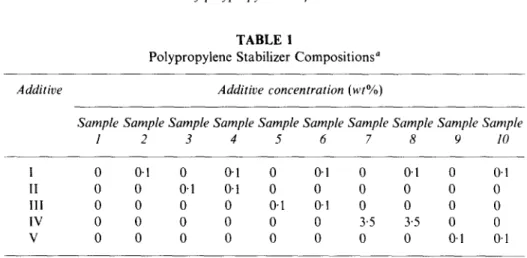
The compositions of the films and plaques studied are listed in Table 1. All samples were exposed to a 2"5 Mrad irradiation. Films were exposed under two sets of conditions: one representative of each family was exposed at - 7 8 ° C (dry ice) whereas the second set was exposed at the ambient temperature in the Gammacell (--~40°C). Exposure at - 7 8 ° C allowed the total radical yield immediately after irradiation to be measured because PPO 2" are indefinitely stable at this temperature. 6 After irradiation and storage at - 78°C, only PPO2" signals were observed by low temperature esr; macro-alkyl was undetectable provided 02 was present. The nitroxyl ( ~ N O . ) signal expected in the esr spectrum at - 145°C from the oxidation of I was negligible in samples 2, 4, 6, 8 and 10 immediately after irradiation at
- 7 8 ° C .
The initial P P O 2 ' concentrations ([PPO 2 "]o) for all ten samples are listed in Table 2. The concentration of I can be conveniently measured by treatment of films with a dilute hexane solution of m-chloroperbenzoic acid
Stabilization of polypropylene to y-initiated oxidation 317
T A B L E 1
Polypropylene Stabilizer Compositions a
Additive Additive concentration (wt%)
Sample Sample Sample Sample Sample Sample Sample Sample Sample Sample
1 2 3 4 5 6 7 8 9 I0 I 0 0-1 0 0"1 0 0"1 0 0"1 0 0.1 II 0 0 0"1 0"1 0 0 0 0 0 0 1II 0 0 0 0 0"1 0-1 0 0 0 0 IV 0 0 0 0 0 0 3'5 3"5 0 0 V 0 0 0 0 0 0 0 0 0"1 0"1
All samples contained 0.1 w t % of calcium stearate.
(2 × 10 - 3 mole/liter). ~6 Very rapid (30-60s) quantitative conversion of \ NH groups to ~/NO" occurs and the latter can be measured by esr. This method showed negligible change in the concentration of I during ~2- irradiation at -78°C.
Upon warming ( _ 10 s) to 22°C, rapid peroxyl decay began and /~NO. began to accumulate as shown by the esr changes in Fig. 1. After a long decay time (> 100h at 22°C), the peroxyl signal became very small and /~NO.
~. q/ ~sxlo )
A
Ii,~!/
120112
B
":i'
, , o x , o , h:I \ " " ~ ~ l J ' O
2mln
i:'i
2
15110 ~ ) U , ~ . _ ~ _ ~ n (5x101) ~J,~. Omin ( 5 x 1 0 )Fig. 1. ESR changes in 7-irradiated polypropylene film. Films irradiated 2"5 Mrad in air at - 78~C. Times indicate period at 22'-'C. A, Sample 1 (additive free); B, sample 2 (with hindered amine I). Values in parentheses indicate spectrometer gain (35 mg samples in both cases).
Sample [PP02 "]0 -- d[PP02 "]o/dt number × 103 x 106 (mole/kg) b (mole/kg) b T A B L E 2 Effects of 7-Irradiation on p p a After 120h at 23°C
[tert. OOH] c'a [sec. OOH] c'a [ ~ C = O ] c,e [ ~ N O . ] ¢ [ppo2.]b X 1 0 3 (mole/kg) 1 6-0 48 29 2 6.5 54 16 3 7.1 77 27 4 7.2 80 9 5 6-8 45 23 6 6.0 50 13 7 6.7 85 25 8 6-3 80 15 9 6.3 30 27 10 7.3 49 20
2'5 M r a d exposure of film samples unless specified. h Irradiation at - 7 8 ° C , decay at 22°C. c Irradiation at a m b i e n t t e m p e r a t u r e in the G a m m a c e l l . Retention o f impact strength (days) s 15 16 - - 0.10 12 10 9 1.2 0-12 200 16 11 - - 0.10 42 8 5 0.74 0" 10 450 13 16 - - 0"10 10 8 7 1-5 0-20 > 450 12 16 - - 0-27 15 10 8 1"2 0"25 320 14 20 - - 0"10 10 13 10 1"2 0"15 > 4 5 0
d After N O treatment, m e a s u r e d by F T I R as nitrate ( - - O O H ) a n d nitrite ( - - O H ) , respectively. " After SF 4 t r e a t m e n t to destroy h y d r o g e n b o n d i n g p r o d u c t s a n d carboxylic acids.
Stabilization of polypropylene to y-initiated oxidation 319
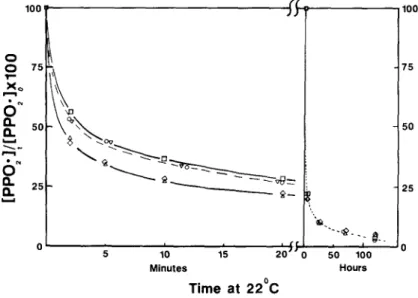
dominated in samples initially containing I. The anisotropic signal shown in Fig. 1 for the I-containing sample after 120h is identical to that found for ~/NO- samples in PP films. 16 The decay o f P P O 2 • concentration and growth o f / ~ N O , with time are plotted in Figs 2 and 3. Initial peroxyl decay rates ( - d [ P P O z "]o/dt) and both residual PPO 2. and ~/NO" levels after 120h at 22°C are listed in Table 2 for all samples.
Immediately after irradiation at - 7 8 ° C , oxidation products were undetectable by FTIR, but rapidly accumulated after warming to room temperature, as reported previously. 6 The NO derivitization method clearly showed differences in concentrations and distributions of hydroperoxide products which were estimated by F T I R as their nitrates. Secondary nitrates (from NO reactions with secondary - OOH) absorb at 1635 and 1275 cm 1 whereas tert.-nitrates (from NO reactions with tert.-OOH) absorb at 1630 and 1300-1293 c m - 2. ~4 Concentrations of tert. and sec.-hydroperoxide and total ketone after 120h at 23°C were measured for samples irradiated at - 7 8 ° C and irradiated at ambient temperature. Somewhat different yields and distributions of products were found for each sample irradiated under these differing conditions. In general, hydroperoxide yields were 50-100% greater for ambient temperature 7-irradiation and these concentrations are collected in Table 2. The time of 120 h was chosen as a convenient point for analyses because, at this time, most of the PPO2" had reacted and the slow storage oxidation just started. The difference in product yields from the
1 0 0 0 7 5 6 o 0 0 ~ 10 15 2 0 Minutes Time at
22°C
i I 5 0 1 0 0 Hours 1 0 0 7 5 5 0 2 5Fig. 2. Peroxyl radical decay in 7-irradiated polypropylene film. Initial peroxyl concentrations given in Table 2. Irradiation and decay conditions as in Fig. 1. ©, Samples 1
320 R. F. Becker, D. J. Carlsson, J. M. Cooke, S. Chmela A G) 0 E v x
6
Z & 1.5 1.0 0,5 o _ -~ ~ . . . ~ = 1'0 1; 2 0 s ' i M i n u t e s Time at 2 2 ° C ///Jo
° /
/
b 5'0 180 Hours 1,5 1,0 0,5Fig. 3. Nitroxyl radical formation in y-irradiated polypropylene film. Irradiation and time conditions as in Fig. 1. O, Sample 2; A, sample 4; [2], samples 6 and 10; ~ , sample 8. ambient temperature and - 7 8 ° C irradiation probably result from the high initial PPO 2" concentration at - 78°C as compared to the much lower level at any one time during irradiation at ambient temperature.
For comparison purposes, drop weight impact measurements were performed on a series of plaques, but these were 7-irradiated at ambient temperature and then stored at 60°C to accelerate post-irradiation oxidation. The times at 60°C to cause a 50% reduction in the initial impact strength are collected in Table 2. Some of the best formulations show only slight deterioration after over 1 year at 60°C, with no discoloration.
D I S C U S S I O N
Radiation stabilization by the trapping of charged species such as ions and electrons, quenching of excited states and scavenging of the initial radicals produced (prior to 02 interception) will reduce the initial yield of peroxyl radicals formed.11,12 However, from Table 1, none of the additive systems causes a reduction in the [PPO2"]o yields from y-irradiation of PP film at - 78°C. For irradiation at ambient temperatures when formation and decay of peroxyls occur together, ions, electrons, excited states and initial radicals can be expected to have even shorter lifetimes than at - 78°C. Consequently, the trapping and quenching of these species by the additives studied is
Stabilization of polypropylene to 7-initiated oxidation 321
apparently not a component of the stabilization mechanism. This is consistent with the fact that loss of the functional group in additive I ( ~ N H ) was not detected after irradiation.
The additives do affect the decay of the peroxyl radicals and the concentrations of oxidation products from the polymer as well as the formation of products from I. Peroxyl decay at 23°C was accelerated by 3.5wt% of IV as has been reported previously. 2 However, 0"1 wt% of II caused a similar acceleration (Fig. 1). It is difficult to understand how such a small concentration of additive could act as a 'plasticizer' to promote radical mobility and hence termination. By differential scanning calorimetry, all films had quite similar heats of fusion (91 +_ 3 J/g), so that gross differences in crystalline content caused by nucleating additives are apparently not present. However, subtle changes in morphology induced by the additive (number ofcrystallites, size of amorphous domains, etc.) may be responsible, as peroxyl radical decay in PP appears to be extremely sensitive to changes in segmental mobility. For example, large changes in peroxyl decay rate are caused by small temperature changes in the 0-25°C range. Additives I, III and V failed to accelerate PPO 2" decay.
The initial speed of PPO 2" decay is not related to the concentration of residual (long lived) PPO 2" measured arbitrarily at 120 h (Table 2). However, we have previously confirmed the report of Reuben and Mahlman that these long lived radicals do not propagate but simply terminate. 17.1s In addition, the initial speed of decay has only a marginal effect on the longer term yields of oxidation products. Thus, additive IV alone roughly doubles the initial rate of PPO 2" decay, but causes only a 10% drop in hydroperoxide yield at 120h. In contrast, additives I, II and III cause significant reductions in hydroperoxide and ketone formation. Combinations of the hindered amine I with additives III, IV and especially II produced an even greater suppression of PP oxidation products, with reduction in tert.-hydroperoxide and ketone (backbone scission product) dominating (Table 2).
All film samples containing the hindered amine ! showed a rapid development of nitroxide radicals during the early stages of PPO 2" decay, followed by a slow but steady accumulation after about 10h (Fig. 3). Products from hindered amines are known to operate as moderately efficient alkyl and peroxyl radicals scavengers with a high stoichiometry. 1~2° The radical scavenging cycle is usually written as shown in reactions (5) and (6)
t I
- - C + ) N O " , - - C - - O - - N ( (5)
I I I I
- - C - - O 2" + - - C - - O - - N ~ / ~ - - C - - O - - O - - C - - + \ / N O ' (6)
322 R. F. Becker, D. J. Carlsson, J. M. Cooke, S. Chmela
where ~/NO- is the nitroxide derived from the present amine. The route by which ~ N H is converted to ~ N O . has not yet been unambiguously established. However, from Fig. 2, it is apparent that the PPO z- decay is not affected by the presence of I. This implies that the direct attack of PPO/" on ) N H is unimportant as a direct stabilization process, and is consistent with the low rate constant (,-- 3.0 liters/mol s at 25°C) for this reaction in liquid- phase model systems. 21 Possibly some intermediate species from peroxyl self-reactions is responsible for /~NH oxidation. It is interesting that additive II caused a marked reduction in ~ N O " yield during storage (Fig. 3, Table 2) although unclear as to whether this is beneficial to post-)' stabilization.
From the data shown in Table 2, enhanced post-)' impact stability is found in samples where the yield of oxidation products is suppressed. This is consistent with the suggestion that it is the decomposition o f - - O O H groups at ambient temperatures which generates fresh radicals during storage to continue the oxidation process. 3 The hindered amine I appears to be operating as a radical scavenger, but only scavenging radicals which are involved in prolonged chain processes as I does not interfere with the rapid self-reactions of peroxyl radicals involving pairs or clusters of peroxyls produced by each 7-initiation event. 19 Combination of I with any of the additives II, III, or IV leads to even better suppression of the post-irradiation oxidation. The 2-hydroxybenzophenone III is reported to act as a weak radical scavenger itself under some oxidation conditions. 12 The mobilizer oil IV presumably enhances the radical scavenging ability of I by increasing its diffusion rate. The origin of the synergistic effects from II and V is unclear, and requires further investigation. However, it is possible that V can convert to II in the oxidizing polymer and that II undergoes abstraction of the aliphatic hydrogen of the carbinol group leading to a rapid peroxyl termination reaction. The combination of additives I and V was much more effective in preventing - - O O H formation in samples irradiated at - 78°C as compared to those irradiated at ambient temperature. This could imply that V must undergo radical attack to give a conversion product which is the real stabilizer.
R E F E R E N C E S 1. Plester, D. W., BioMed. Eng., 5 (1970) 443.
2. Dunn, T. S. & Williams, J. L., J. Indust. Irrad. Tech., 1 (1983) 33.
3. Carlsson, D. J., Dobbin, C. J. B., Jensen, J. P. T. & Wiles, D. M., Amer. Chem. Soc. Syrup. Ser., 280 (1985) 359.
Stabilization of polypropylene to 7-initiated oxidation 323 5. Decker, C., Mayo, F. R. & Richardson, H., J. Polym. Sci. Polym. Chem. Ed., I1
(1973) 2878.
6. Carlsson, D. J., Dobbin, C. J. B. & Wiles, D. M., Macromolecules, 18 (1985) 2092. 7. Williams, J. L., Dunn, T. S., Sugg, H. & Stannett, V. T., Adv. Chem. Ser., 169
(1978) 142.
8. Raynor, M. G., US Patent 4563259 (Jan. 7, 1986). 9. Rekers, J. W., US Patent 4431 497 (Feb. 14, 1984).
10. Becton, Dickinson and Co., Jpn. Kokai, Tokkyo Koho, J.P. 6094,438 (27 May 1985).
11. Makhlis, F. A., Radiation Physics and Chemistry qfPolymers. John Wiley and Sons, New York, 1975.
12. Schnabel, W. In Aspects of the Degradation and Stabilization of'Polymers, cd. H. H. G. Jellinek. Elsevier, Amsterdam, 1978.
13. Carlsson, D. J., Brousseau, R., Zhang, Can & Wiles, D. M., Amer. Chem. Soc. Symp. Ser., 364 (1988) 376.
14. Carlsson, D. J., Brousseau, R., Zhang, Can & Wiles, D. M., Poly. Deg. and Stab.,
17 (1987) 303.
15. Annual Book of ASTM Standards, Vol. 08.02, American Society for Testing and Materials, Philadelphia, 1987.
16. Carlsson, D. J. & Wiles, D. M., Poh'. Deg. and Stab., 6 (1984) 1. 17. Reuben, J. & Mahlman, B. H., J. Phys. Chem., 88 (1984) 4904.
18. Carlsson, D. J., Dobbin, C. J. B. & Wiles, D. M., Macromolecules, 18 (1985) 1791.
19. Carlsson, D. J., Chan, K. H., Garton, A. & Wiles, D. M., Pure Appl. Chenl., 52 (1980) 389.
20. Carlsson, D. J., Tovborg Jensen, J. P. & Wiles, D. M., Makromol. Chem. Suppl., 8
(1984) 79.
21. Carlsson, D. J., Grattan, D. W. & Wiles, D. M., Poly. Deg. andStab., 1 (1979) 69. 22. Vink, P. & Van Veen, T. J., Euro. Polvm. J., 14 (1978) 533.