CHEMICAL SENSITIVITY: AN EMERGING
PUBLIC HEALTH AND ENVIRONMENTAL
PROBLEM
Nicholas A. Ashford
Massachusetts Institute o f Technology
Claudia S. Miller
University o f Texas Health Sciences Center, San Antonio
Chemical exposures are endemic to our modem industrial society. People who believe they are chemically sensitive are caught up in an acrimonious crossfire among competing groups of physicians including traditional allergists and clinical ecologists. This acrimony is fueled by different medical/scientific paradigms of the definition and nature of disease or symptoms associated with exposure to low levels of chemicals in food and water, the outdoor environment, the work environment, indoor air, and consumer products. Much, but by no means all, of the early anecdotal evidence for chemical sensitivities has been reported by clinical ecologists-- physician practitioners whose clinical practices have come under intense criticism. However, chemical sensitivity is by no means the exclusive property of clinical ecology. The fields of occupational and environmental medicine increasingly contain sufficient examples to suggest that a serious public health problem is emerging. Although a precise number for the magnitude of the problem is not available, evidence for significant and increasing chemical sensitivity is provided by (1) recent dramatic increases in synthetic organic chemical production and pesticide use, (2) decreased ventilation in buildings, especially those that are "energy-tight," (3) increased outbreaks of sick-building illness, (4) increased reporting of symptoms in chemically contaminated communities, (5) increases in the numbers of physicians treating chemically sensitive patients, and (6) increases in the numbers of people reporting sensitivity. In this article we focus on the nature of chemical sensitivity. Address requests for reprints to: Nicholas A. Ashford, CTPID, E40-239, Ma.ssachusetts Institute of Technology, Cambridge, MA 02139.
Excerpted from Ashford, N.A., and Miller C.S. 1991. Chemical Exposures: Low Levels and High Stakes, New York: Van Nostrand Reinhold.
© 1994 Elsevier Science Inc.
452 NICHOLAS A. ASHFORD AND CLAUDIA S. MILLER
The treatment of chemically sensitive patients is a separate topic, beyond the scope of this article.
Groups Sensitive to Low-Level Chemical Exposures
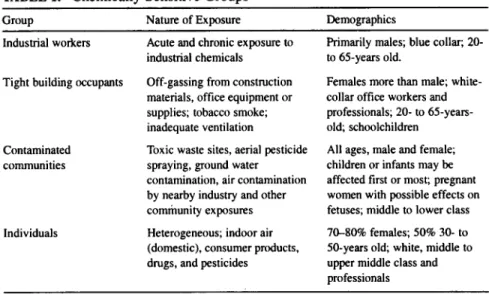
A review of the literature on exposure to low levels of chemicals reveals four groups or clusters of people with heightened reactivity: (1) industrial workers, (:2) occupants of "tight buildings," including office workers and schoolchildren, (3) residents of communities whose air or water is contaminated by chemicals, and (4) individuals who have had personal and unique exposures to various chemicals in domestic indoor air, pesticides, drugs, and consumer products. These four groups are compared in Table 1. Note that they differ in professional and educational attainment, age and sex, and the mix and levels of chemicals to which they are exposed, but that all have multiple symptoms involving multiple organ systems with marked variability in the type and degree of those systems. Symptoms are often "subjective." For example, central nervous system (CNS) symptoms such as difficulty concentrating or irritability are common, and physical examinations are frequently unremarkable for individuals in each category. Careful analysis of these groups may reveal similarities and differences that can illuminate the origins and mechanisms of chemical sensitivity. Recently, an additional cluster of possibly affected individuals has emerged--the returning Gulf War veterans.
Problems experienced by people in tight buildings, by industrial workers in a particular workplace, or by the residents of a contaminated community often develop within a relatively short time period--perhaps weeks or a few months. These problems may occur after a recognized event such as the installation of new carpeting, relocation to a new workplace, or changes in workplace or community exposures. The temporal cohesiveness between exposures and illness contributes to the recognition of the problem as real. The fact that individuals in such demographically divergent groups as those in Table l, including industrial workers, office workers, housewives, children, and most recently the Gulf War veterans report similar polysymptomatic complaints triggered by chemical exposures also suggests a real problem. In some chemically sensitive patients, no single, identifiable, "high-level" exposure seems to have been associated with the onset of their difficulties. Exposures may have occurred but were not recognized or remembered. Some observers suggest that repetitive or cumulative lower-level exposure events may lead to the development of sensitivities. Still others implicate genetic predisposition, pregnancy, major surgery with anesthe- sia, pharmaceuticals, physical trauma, or major psychological stress as contributors to the illness.
"l~pes of Sensitivity
The different meanings of the term
sensitivity
are at least partially responsible for the confusion surrounding chemical sensitivity. Individuals differ in theirTABLE 1. Chemically Sensitive Groups
Group Nature of Exposure Demographics Industrial workers
Tight building occupants
Contaminated communities
Individuals
Acute and chronic exposure to industrial chemicals Off-gassing from construction materials, office equipment or supplies; tobacco smoke; inadequate ventilation
Toxic waste sites, aerial pesticide spraying, ground water contamination, air contamination by nearby industry and other community exposures Heterogeneous; indoor air (domestic), consumer products, drugs, and pesticides
Primarily males; blue collar; 20- to 65-years old.
Females more than male; white- collar office workers and professionals; 20- to 65-years- old; schoolchildren
All ages, male and female; children or infants may be affected first or most; pregnant women with possible effects on fetuses; middle to lower class 70-80% females; 50% 30- to 50-years old; white, middle to upper middle class and professionals
responses to increasing doses of a toxic substance. The underlying causes o f inter-individual variability include age, sex, and genetic makeup; lifestyle and behavioral factors, including nutritional and dietary factors, alcohol, tobacco, and drug use; environmental factors; and preexisting disease (Ashford et al. 1984). In the classical, toxicological use o f the word
sensitivity,
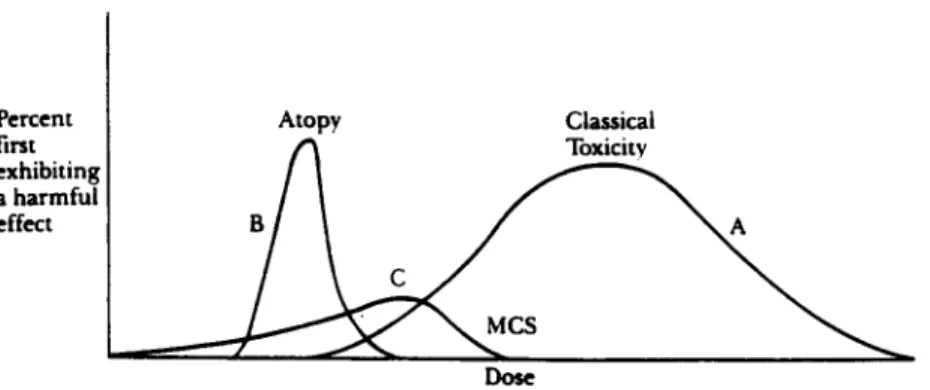
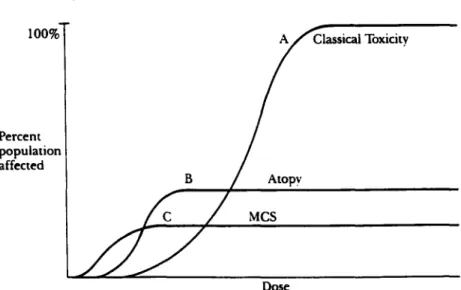
those individuals who require relatively lower doses to induce a particular response are said to be more sensitive than those who would require relatively higher doses before experiencing the same response (Hattis et al. 1987). A hypothetical distribution o f sensitivities, that is, the minimum doses necessary to cause individuals in a population to exhibit a harmful effect, is shown in curve A in Figure 1. (Plotting the cumulative number o f individuals who exhibit a particular response as a function o f dose generates a more familiar population dose-response curve, depicted as curve A in Figure 2.) This distribution describes the traditional toxicological concept o f sensitivity. Curve A in Figure 1 illustrates that health effects o f classical diseases are seen in a significant portion o f the normal population at a certain dose; the sensitive and resilient populations are found in the tails o f the distribution. (Of course, not all toxic substances have large variances or significant tails.) Painstaking scientific research and removing the effects o f confounding variables have resulted in the discovery of sensitive individuals at levels heretofore considered safe. Recent work on lead (Bellinger et al. 1987) and benzene (Rinsky et al. 1987) are just two examples. For the sensitive person, avoidance o f low-level exposures generally leads to improvement, or at least to the arrest o f the development o f the disease.454 NICHOLAS A. ASHFORD AND CLAUDIA S. MILLER Percent first exhibiting a harmful effect Atopy Classical ] ~ Toxicity
FIGURE 1. Hypothetical distribution of different types of sensitivities as a function of dose. Curve A is a sensitivity distribution for classical toxicity, e.g., to lead or a solvent. Sensitive individuals are found in the left-hand tail of the distribution. Curve B is a sensitivity distribution of atopic or allergic individuals in the population who are sensitive to an allergen, e.g., ragweed or bee venom. Curve C is a sensitivity distribution for individuals with multiple chemical sensitivities who, because they are already sensitized, subsequently respond to particular incitants, e.g., formaldehyde or phenol.
A second meaning o f the word sensitivity appears in the context o f classical IgE-mediated allergy (atopy). IgE is one of five classes o f antibodies made by the body, and from the perspective o f classically allergic individuals is the most important antibody. Atopic individuals have IgE directed against specific environmental incitants, such as ragweed pollen or bee venom. Positive skin tests in these individuals correlate generally with a rapid onset of symptoms when they are actually exposed to those allergens. The atopic individual exhibits a reaction, whereas non-allergic persons do not, even at the highest doses normally found in the environment. A hypothetical sensitivity distribution for an atopic effect is shown in curve B o f Figure 1, and the dose-response curve derived from that distribution is found in curve B o f Figure 2. Allergists include in the term allergy well-characterized immune responses that result from industrial exposure to certain chemicals, such as nickel or toluene diisocyanate (TDI). Most allergists refer to such responses as chemical sensitivity, but reserve this term for responses that have or appear to have a distinct immunological basis, preferring to use a term such as chemical intolerance for non-immunological responses to chemicals.
Patients suffering from multiple chemical sensitivities (MCS) m a y be exhibiting a third and entirely different type of sensitivity. Their health problems often (but not always) appear to involve a two-step process. The first step originates with some acute or traumatic exposure, after which the triggering o f symptoms and observed sensitivities occur at very low levels o f chemical exposure (the second step). The inducing chemical or substance may or m a y not be the same as the substances that thereafter provoke or " t r i g g e r " responses.
loo~
P e r c e n t population affected B sical Toxicity / Atopy MCS DoseFIGURE 2. Hypothetical population dose-response curves for different effects. Curve A is a cumulative dose-response curve for classical toxicity, e.g., to lead or a solvent, curve B is a cumulative dose-response curve for atopic or allergic individuals in the population who are sensitive to an allergen, e.g., ragweed or bee venom, curve C is a cumulative dose-response curve for individuals with multiple chemical sensitivities who, because they are already sensitized, subsequently respond to particular incitants, e.g., formaldehyde or phenol.
(Sometimes the inducing substance is described as "sensitizing" the individual and the affected person is termed a "sensitized" person). The fact that normal persons do not experience even at higher levels of exposure those symptoms that chemically sensitive patients describe at much lower levels of exposure probably helps to explain the reluctance of some physicians to believe that the problems are physical in nature. To compound the problem of physician acceptance of this illness, multiple organ systems may be affected, and multiple substances may trigger the effects. Over time, sensitivities seem to spread, in terms of both the types of triggering substances and the systems affected (Randolph 1962).
Avoidance of the offending substances is reported to be effective but much more difficult to achieve for these patients than for classically sensitive patients because symptoms may occur at extremely low doses and the exposures are ubiquitous.
Adaptation
to chronic low-level exposure with consequent "masking" of symptoms (discussed more fully later) may make it exceedingly difficult to discover these sensitivities and unravel the multifactoriai triggering of symptoms. A hypothetical sensitivity distribution for a single symptom for thealready
chemically sensitive person in response to a single substance trigger is shown in curve C of Figure 1, and the corresponding dose-response curve is shown in curve C of Figure 2. It should be emphasized, however, that individuals who become chemically sensitive may have been exposed to an initialpriming
event that wastoxic
(e.g.456 NICHOLAS A. ASHFORD AND CLAUDIA S. MILLER
neurotoxic) as classically defined. Conceivably, exposure to certain substances, such as formaldehyde, might elicit all three types of sensitivities.
A Working Definition for Multiple Chemical Sensitivity
Given the multitude of environmental exposures (both chemical and food) that allegedly can result in a seemingly endless array of physical and mental syndromes and the frequent absence of findings on routine physical examination, the practitioner who sees these patients with their divergent and unfamiliar litany of complaints is at great disadvantage in trying to diagnose the condition.
Although there has been great pressure from the medical community to develop a case definition for MCS, no agreement on a definition has yet emerged. MCS is most likely a classification of diseases--such as infectious diseases-- which bear some similarities to one another but are not identical. Attempts to construct a single definition at this time might lead to the same kind of errors as lumping together, say, tuberculosis and viral pneumonia. To circumvent this problem, we propose the following
operational
definition of multiple chemical sensitivity, a definition that is based upon environmental testing:The patient with multiple chemical sensitivities can be discovered by removal from the suspected offending agents and by rechallenge, after an appropriate interval, under strictly controlled environmental conditions. Causality is inferred by the clearing of symptoms with removal from the offending environment and recurrence of symptoms with specific challenge.
Isolation of the patient results in de-adaptation or unmasking (discussed later). Challenges conducted for research purposes should be performed in a double-blind, placebo-controlled manner. In this way, the patient serves as his/her own control. This definition embodies the approach to discovering environmental causation that was developed by Randolph utilizing an environmental unit (a hospital unit as free as possible from chemical exposures). This operational definition is essential to resolving, once and for all, the debate about whether an allegedly chemically sensitive individual's symptoms can or cannot be environmentally induced. For research purposes, a specially constructed environmental unit is necessary for scientific validation of the concept of chemical sensitivity. Ultimately, biological markers may be identified or a
phenomenological
definition may emerge that allows physicians to diagnose, at least tentatively, chemical sensitivity based on a history of a specific sensitizing event (such as a pesticide exposure) followed by evidence of chemical and food sensitivities, multisystem effects, improvement after avoidance of exposure, and similar experiences of persons with like histories.Adaptation
One of the difficulties the observer encounters in trying to understand multiple chemical sensitivity is the ostensible lack of a central concept or unifying theory.
Such a unifying theory does exist and revolves around the concept of adaptation, known in other contexts as acclimation or acclimatization, habituation, developing tolerance, and even addiction. Understanding adaptation is important for two reasons: (1) adaptation makes difficult the subsequent discovery of the effects of a particular exposure on the body of an already sensitized person, and (2) chemical exposures may adversely impact adaptation mechanisms and thus lead to illness. Chemically sensitive persons seem to adapt and de-adapt differently than normal people.
Adaptation has been recognized as occurring for a variety of substances, for example, ozone, nitroglycerin, and solvents. Solvents are among the chemicals most frequently implicated by chemically sensitive patients who attribute the onset of their illness to a particular exposure. Molhave and associates (Molhave et al. 1986) exposed individuals who had previously complained of sick building syndrome symptoms to a mixture of 22 volatile organic compounds common in indoor air, predominantly solvents, for 2.75 hours. Levels were much lower than occupational health standards required and in the range of levels found in tight buildings. These healthy but sensitive subjects complained of nasal and throat irritation and inability to concentrate at levels of solvents far below permissible occupational exposure levels. A similar study, using healthy subjects who had not previously complained of symptoms, showed no effect on the ability to concentrate (Otto et al. 1990).
Chemically sensitive patients commonly report central nervous system symptoms at solvent levels as low as those used by Molhave and lower. Their complaints are consistent with the recognized health effects of these substances, albeit the levels of exposure that trigger symptoms in these patients may be lower by orders of magnitude.
Adaptation is characterized by acclimatization (habituation, tolerance) with repeated exposures that result in a masking of symptoms. Withdrawal symptoms occur when exposure is discontinued. Once a person has adapted, further exposures have very little additional effect and therefore may not be observed, i.e., the effects of any additional exposure may not be observable because a kind of "saturation" effect has set in. Comprehensive environmental control, that is, an environmental unit, can overcome the masking effect of adaptation and the problems of overlapping exposures that result in overlapping responses to multiple agents. One of the main sources of confusion in diagnosing chemical sensitivity comes from failure of the examining physician to properly de-adapt the patient.
Mechanisms of Multiple Chemical Sensitivities
Any mechanism or model proposed for multiple chemical sensitivities should consider the following clinical observations associated with this illness:
1. Symptoms involving virtually any system in the body or several systems simultaneously;
4 5 8 NICHOLAS A. ASHFORD AND CLAUDIA S. MILLER
2. Differing symptoms and severity in different individuals, even those with the same exposure;
3. Induction (that is, sensitization) by a wide range of environmental agents; 4. Subsequent triggering by lower levels of exposure than those involved in
initial induction of the illness;
5. Concomitant food intolerances, estimated to occur in a sizable percentage of those with chemical sensitivities;
6. "Spreading" of sensitivity to other, often chemically dissimilar substances; different substances may trigger different constellations of symptoms; 7. Adaptation or masking, that is, acclimatization to environmental incitants,
both chemical and food, with continued exposure; loss of this tolerance with removal from the incitants; and augmented response with re-exposure after an appropriate interval (for example, 4 to 7 days);
8. An apparent threshold effect referred to by some practitioners as the patient's
total load,
a theoretical construct which suggests that illness occurs when the total load of biological, chemical, physical, and psychological stressors exceeds some threshold for the patient.The most frequently cited theories to explain chemical sensitivity involve the nervous system, the immune system, or the interaction between them. These two systems most clearly link the external environment and the internal milieu (Bell 1982). The rapid responsiveness of these systems also makes them attractive candidates because symptoms of food or chemical sensitivity have been reported to develop within seconds of exposure.
Mechanisms Involving the Limbic System
The olfactory nerves, with their receptors in the nose, link the external chemical environment to the amygdala, hippocampus, and hypothalamus and other parts of the limbic system. The limbic system, or so-called "primitive smell brain," is a phylogenetically ancient part of the brain, present in all mammals. It governs the organism's interaction with its environment in many subtle ways essential for preservation of the individual and the species. The amygdala, popularly described as "emotion central," is involved in feelings and activities related to self-preservation, such as searching for food, feeding, fighting, and self- protection (MacLean 1986). Lesions in the septal area may cause hyperrespon- siveness to physical stimuli (such as touching, sounds, or temperature changes), hyperemotionality, loss of motivation, excessive sugar and water intake, and fear of unfamiliar situations (Isaacson 1982). The hippocampus is important for laying down new memories and thus is essential for learning (Gilman and Winans 1982). Memory and concentration difficulties are among the most disabling symptoms of patients with chemical sensitivities report.
In the hypothalamus, the immune, nervous, and endocrine systems converge. The hypothalamus governs (1) body temperature via vasoconstriction, shivering, vasodilation, sweating, and fever; (2) reproductive physiology and behavior; (3) feeding, drinking, digestive, and metabolic activities, and (4) physical manifesta- tions of emotion such as increased heart rate, elevated blood pressure, dry mouth, and gastrointestinal responses (Gilman and Winans 1982). The hypothalamus is also the locus at which the sympathetic and parasympathetic nervous system converge. Some symptoms of chemical sensitivity are suggestive of autonomic (sympathetic and parasympathetic) nervous system dysfunction, for example, altered smooth muscle tone producing Raynaud's phenomenon, diarrhea, constipation, and other symptoms. The hypothalamus appears to influence anaphylaxis and other aspects of immunity (Stein et al. 1981). Conversely, antigens may affect electrical activity in the hypothalamus (Besedovsky et al. 1977).
Lesions in the limbic region may be associated with irrational fears, feelings of strangeness or unreality, wishing to be alone and sadness (MacLean 1967). A feeling of being out of touch with or out of control of one's feelings and thoughts, not unlike that described by many patients with chemical sensitivity, may be perceived.
The dynamic involvement of the hypothalamus and iimbic system in virtually every aspect of human physiology and behavior makes injury to these structures an intriguing hypothesis to explain chemical sensitivity's myriad manifestations. Sensitization or kindling of olfactory-limbic pathways by acute or chronic exposure to chemicals for chemical sensitivity such as solvents or pesticides (Bell et al. 1992) has been proposed as a putative mechanism. Subsequently, lesser exposures to chemicals might trigger inappropriate firing of nerve cells in the limbic area. Genetic endowment, prior environmental exposures, psychological stress, hormonal variations, and other factors may enhance neurological sensitization (Bell et al. 1992).
Immunological Mechanisms
Some view environmental illness as a disorder of immune regulation (Levin and Byers 1987). Relatively low-molecular-weight chemicals can alter native protein, by acting as haptens, and elicit an autoimmune-type response to the altered protein. Broughton and Thrasher (1988) report the development of antibodies to formaldehyde-albumin conjugates, evidence of immune system activation (activation marker Tal or T-lymphocytes), low titers of a variety of autoantibod- ies, and altered IL-I (interleukin) production in these individuals, suggestive of "subtle but chronic activation of the immune system" (Broughton 1990). They report that exposed groups were three to four times more likely than controls to have one or more autoantibodies. Autoantibody titers were higher when exposure was ongoing and diminished after cessation of exposure. The clinical significance
4 6 0 NICHOLAS A. ASHFORD AND CLAUDIA S. MILLER
of such antibodies in low titers is not known, but reported differences between exposed and unexposed groups are striking and warrant further investigation. Prospective studies of homogeneous exposed groups, for example, individuals exposed to the same sick building or chemical spill, and employing carefully matched control subjects, are needed to clarify the meaning and clinical utility, if any, of these markers.
Biochemical Mechanisms
Some physicians have noted vitamin and mineral abnormalities in their chemically sensitive patients (Johnson and Rea 1989; Rogers 1990). Conceiva- bly, individuals who have genetically or nutritionally defective enzyme detoxification systems might be more susceptible to low level chemical exposures.
Levine and Reinhardt (1983) propose that environmental sensitivities may be the result of toxic chemicals reacting with cell constituents to create free radicals (which are formed when a molecule loses an electron). If an antioxidant molecule (such as Vitamin A, C, or E or selenium) is not present nearby to supply the missing electron, then an electron may be removed from an unsaturated lipid (lipid peroxidation) in a cell membrane damage, release of prostaglandins and other inflammatory mediators, and formation of antibodies to chemically altered tissue macromolecules.
Rea et al. (1975) hypothesize that blood vessel constriction, inflammation, or leakage in multiple organ systems may explain the bizarre combinations of symptoms in these patients. Symptoms might simply mirror the site and size of affected blood vessels. Smooth muscle constriction affecting blood vessels and the respiratory, gastrointestinal, and genitourinary tracts is another plausible hypothesis.
Possible Psychogenic Mechanisms
Psychological symptoms are often reported by patients, but are not necessarily psychological in origin. Advances in biological psychiatry demonstrate that genetic and biochemical factors contribute to central nervous system dysfunction and behavioral disturbance. Environmental exposures~ for example to solvents or pesticides, can have psychological sequelae. Symptoms of environmental chemical exposure may include depression, difficulty concentrating, anxiety, peculiar bodily sensations, headaches, and other subjective symptoms. Such symptoms may be interpreted by physicians and responses to psychosocial stresses, and patients may be willing to accept such insights lacking another explanation. Patients who have been worked up in an environmental unit often say they are amazed to find direct, cause-and-effect relationships between their symptoms and various foods and chemicals and find it difficult to accept psychological interpretations thereafter.
Many of the chemicals these patients say cause their symptoms are solvents, pesticides, and other substances whose primary target organ, in terms of classical toxicity, is the brain. Interestingly, these individuals who "react" to levels well below those heretofore considered toxic most often complain of central nervous system symptoms. Thus, their complaints are in many respects consistent with known toxic actions of such substances, albeit the levels of exposure triggering their responses are much lower.
That odor conditioning could occur in some cases is certainly possible. However, patients report reproducible symptoms to specific chemical exposures: (1) at levels below the odor threshold (Reaet al. 1975), (2) when their noses are clamped during provocative testing, and (3) when anosmia (inability to detect odors) is present (Ziem 1989). These observations weigh heavily against classical conditioning as more than a partial explanation in certain patients.
Some are of the opinion that multiple chemical sensitivity is an erroneous "belief system" that chemicals are the cause of their health problems (Staudenmayer and Selner 1987) and either advocate systematic deprogramming of the patients to purge them of their beliefs (Selner 1988), or believe that no psychotherapeutic intervention will help (Terr 1989). Others attribute multiple chemical sensitivities to atypical depression, hypochondriasis, post-traumatic stress disorder, hysteria, panic disorder, conversion disorder, or combinations of these (Brodsky 1987; Schottenfeld 1987).
Because psychological symptoms are not necessarily psychogenic in origin, future research should employ blinded, placebo-controlled chemical challenges in order to distinguish between psychogenic and chemical etiologies. Such studies should be conducted in an environmental unit and must take adaptation into account.
Biomarkers for Chemical Sensitivity
Acceptance of chemical sensitivity as a bona fide medical illness has been hampered by the lack of an identified biornarker for the condition. Other illnesses, such as fibromyalgia and chronic fatigue syndrome, share the same difficulty, but they do not have chemical sensitivity's double burden of organized, economically vested opposition and lack of a biomarker. Unfortunately, there is little incentive for pharmaceutical companies to support research that might identify a biomar-ker (which could be used as a gauge for drug treatment), given the fact that these patients generally avoid taking drugs.
Up to now, most clinical studies of MCS patients have focused on markers of immunological, neurological, inflammatory, and psychological responses. Clini- cal ecologists, a few other physicians in the private sector and some commercial laboratories have reported alterations in a number of parameters in these patients, including T- and B-lymphocyte counts; helper/suppressor T-cell ratios; immu- noglobulin levels; autoimmune antibodies (including anti-nuclear, anti-smooth muscle, anti-thyroid, anti-parietal cell and other auto antibodies); activated
462 NICHOLAS A. ASHFORD AND CLAUDIA S. MILLER
T-lymphocytes (Tal or CD-26); quantitative EEGs; evoked potentials; SPECT and other brain scans; levels of various vitamins, minerals, amino acids, and detoxification enzymes; and blood or tissue levels of pesticides, solvents, and other "pollutants." Flaws in these studies are many and varied including: failure to define the study population (no case definition used; failure to compare cases with age- and sex-definition used); failure to blind specimens; and failure to assess the accuracy and reproducibility of the test method. Studies performed by ecologists or commercial laboratories have been viewed with considerable skepticism by regulatory agencies and academic researchers. Some MCS proponents claim that different immunological abnormalities occur in different patients. However, if enough tests are done, statistically a certain number will be abnormal (one in 20). This is not always taken into account.
With regard to claims of immunological dysfunction, no consistently abnormal immunological parameter has been demonstrated in these patients to date. There are a number of reasons why a biomarker for chemical sensitivity may be elusive: 1. If chemical sensitivity in fact involves alterations in brain or limbic function, then salient markers might not be accessible with current technology. For example, biochemical alterations in the central nervous system may not be reflected in blood chemistry determinations. Conceiva- bly, advances in functional brain imaging (including SPECT and PET) in the future may provide insight into blood flow or metabolic changes that correlate with symptoms;
2. Biomarkers of interest may be in normal ranges during normal non- exposure conditions. Provocative chemical challenges with pre- and post-exposure measurement of markers may be necessary to distinguish between patients and normal controls. Just as methacholine challenges are needed to diagnose certain patients with reactive airway disease, it may be necessary to perform low-level chemical challenges with these patients in order to elicit their symptoms and observe a change in a biomarker; and 3. Patients may need to be de-adapted prior to challenge in order to see the
most robust symptoms and changes in biomarkers.
The fact that no consistently abnormal immunological marker has been found in these individuals to date does not necessarily mean that the immune system is unaffected. It is conceivable that chemically induced limbic/hypothalamic disturbances could alter immune function secondarily but in unpredictable directions. By analogy, if one were to throw a magnet into a computer, dysfunction no doubt would occur, but the direction and degree of dysfunction might vary depending upon where the magnet happened to land. Alternatively, specific immune cell subsets or immunocytokines not yet explored in these patients may prove significant in the future. To date, only one provocative challenge test has been performed on chemically sensitive patients (Doty et al. 1988). In this study, patients manifested decreased nasal patency relative to
controls, both before and after challenge. Similar low-level exposure provocative challenge studies that examine other parameters of interest are needed.
Advancing the Understanding of Chemical Sensitivity
While much posturing by medical societies has produced one-sided published opinion on chemical sensitivity, two recent conferences are noteworthy for their efforts to bring together scientists and physicians of divergent views to discuss needed research and future initiatives. The National Academy of Sciences Board on Environmental Studies & Toxicology held a multidisciplinary workshop in 1991 sponsored by the EPA Office of Indoor Air (NRC 1992). The Association of Occupational & Environment Clinics also held a workshop in 1991 sponsored by the Agency for Toxic Substances and Disease Registry (ATSDR) involving primarily occupational and environmental physicians (AOEC 1992). Both conferences lead to published proceedings which contain a wide range of views and discussions that provide a balanced perspective on chemical sensitivity.
Consensus was reached in both meetings concerning the need for and direction of further research. Specific research recommendations included: (1) the identification of sensitizing agents responsible for the initiating event, (2) the performance of blinded chemical challenges of those [sensitive] persons already sensitized in a controlled environment, and (3) the undertaking of prospective studies of groups of recently exposed individuals such as those working in a recently renovated building. Challenge studies and prospective exposure-driven (event-driven) studies focusing on the most sensitive individuals in the population are imperative for comprehensive human risk assessment and responsive environmental policy. Both conferences attempted to arrive at initial case definitions for research purposes, but the definitions were not identical. Remembering that MCS is unlikely to be a single disease, efforts to construct a case definition, especially one that defines away symptoms that have other disease labels such as reactive airways disease (RADS), allergic rhinitis, or chronic fatigue syndrome, are likely to obfuscate and delay rather than hasten clarification of the nature of MCS.
Public Policy Implications
The previous discussion has focused on the description of, and scientific issues attending, the problems of chemical sensitivity. Although the precise nature of this condition (or conditions) and the underlying mechanisms remain somewhat uncertain and are evolving in nature, chemical sensitivity seems sufficiently well-recognized to require attention by government, industry, and the medical profession. Actions are needed for establishment of regulations minimizing exposures to certain chemicals, notification of sensitive or potentially sensitive populations to past or possible future exposures, accommodations in housing and employment, and compensation for damage to health. The strength of the evidence sufficient to trigger a particular regulatory, legal, or political response
464 NICHOLAS A. ASHFORD AND CLAUDIA S. MILLER
may differ according to the area of action--i.e., notification, control of exposures, accommodation or compensation--what is called the "burden of persuasion" in legal terms.
Public policy needs to be focused toward two distinct groups: (1) those individuals who could become sensitized as a result of an initiating exposure, and (2) those individuals who have already become sensitized and are now sensitive to chemicals at extremely low levels. Regulations and policies need to be developed to prevent sensitization of individuals in the first place. Sensitizing events occur in domestic indoor or white-collar work environments (possibly by exposure to certain pesticides). Other sensitizing events occur in industrial workplaces (possibly by classical sensitizers such as toluene diisocyanate or by solvents), in contaminated communities, and as a result of exposure to consumer products, pharmaceuticals, or possibly anesthesia. To prevent sensitization we would need to identify possible sensitizers and establish regulatory standards within the appropriate regulatory regime. If, in fact, chemical sensitivity proceeds through a neurotoxic mechanism, attention should be focused on the neurotoxic- ity of chemicals and the development of appropriate standards. To the extent that immunotoxic mechanisms are at play, attention should be directed toward immunotoxicity. The indoor air environment presents a particularly difficult regulatory challenge because no single regulatory regime applies, even though the Environmental Protection Agency has established an Office of Indoor Air in its Office of Air and Radiation. Regulation of consumer products, building materials, and construction practices, as well as pesticide applications, are but a few of the areas that would need to receive attention.
In addition to establishing regulations minimizing exposures to sensitizing and triggering chemicals, advance notification of possible sensitizing or triggering exposures should also be considered. In Massachusetts, for example, advance notice of pesticide applications in both public buildings and apartment buildings is now required. For individuals who are already sensitized, public policy must focus on ways to accommodate them by providing chemically less contaminated work environments, schools, and housing. Indeed the recently passed Americans with Disabilities Act requires "reasonable accommodation" for those individuals who are in fact or are c o n s i d e r e d disabled. This means that although "proof" that a particular person has chemical sensitivity is absent, discrimination by employers, landlords etc. may be illegal if the person is regarded as disabled by the discriminator. This feature of the law gets around the need for the person who is the target of discrimination from proving that he/she has chemical sensitivity or that it, in fact, exists as a medical condition.
For a particular individual, this accommodation will probably need to he temporary in nature, except for those who are severely afflicted. Accommodation can take the form of providing a workplace with adequate ventilation, removal of offending substances, location in a temporary office, allowing the person to work at home, the cessation of pesticide application at certain times, changes in
cleaning materials, etc. Regulatory and corporate policies are needed to accommodate these individuals in an immediate, humane, and understanding manner.
At first, addressing the needs of people who are exquisitely sensitive to chemicals at possibly several orders of magnitude lower than the conventional toxic limits might seem to present an impractical and insurmountable challenge. However, if an aggressive set of initiatives to prevent future sensitization were instituted, then we might eliminate the next generation of sensitive individuals, and the need to accommodate or compensate them would become much less burdensome in practice.
For persons whose health is already damaged, compensation can come from the workers' compensation, tort (court-awarded damages), social security, or private insurance disability systems. Under workers' compensation, the worker must prove that the injury was job-related by a preponderance of the evidence, i.e., that his/her condition was more likely than not caused by (or exacerbated by) a workplace exposure. The same burden is required in a tort suit for damages in the courts against a product manufacturer, pesticide applicator, owner of a building, etc. The recent Daubert (Daubert 1993) decision in the U.S. Supreme Court, expanding the admissibility of scientific evidence in the courts, is likely to make it easier for plaintiffs to present evidence of the developing science behind chemical sensitivity in order to seek damages. The burden in social security disability awards is less than it is in workers' compensation or the tort system, and the burden for private insurance varies with the insurance policy.
In sum, chemical sensitivity is a debilitating condition and a serious public health concern, but one that can be addressed by aggressive, coordinated public and private sector efforts. Understanding the nature of this difficult, if not bewildering, condition is the first step.
References
AOEC (Association of Occupational and Environmental Clinics). 1992. Advancing the understanding of multiple chemical sensitivity. Journal of Toxicology and Industrial Health 8(4): 1-257.
Ashford, N. et al. 1984. Human monitoring: Scientific, legal and ethical considerations. Harvard Environmental Law Review 8(2):263-364.
Bell, I. 1982. Clinical Ecology, Bolinas, CA: Common Knowledge Press.
Bell, I.R., Miller, C.S., and Schwartz, G.E. 1992. An olfactory-limbic model of multiple chemical sensitivity syndrome. Possible relationships to kindling and affective spectrum disorders. Biological Psychiatry 32:218-242.
Bellinger, D. et al. 1987. Longitudinal analyses of prenatal and postnatal lead exposure and early cognitive development. New England Journal of Medicine 316:1037-1043. Besedovsky, H. et al. 1977. Hypothalamic changes during the immune response. European
466 NICHOLAS A. ASHFORD AND CLAUDIA S. MILLER
Brodsky, C. 1987. Multiple chemical sensitivities and other 'environmental illness': A psychiatrist's view. In Workers with Multiple Chemical Sensitivities, Occupational
Medicine: State of the Art Reviews, M. Cullen (ed). Philadelphia: Hanley & Belfus,
2(4):695-704.
Broughton, A., and Thrasher, J. 1988. Antibodies and altered cell mediated immunity in formaldehyde exposed humans. Comments in Toxicology, Great Britain: Gordon and Breach Science Publishers, 2(3): 155-174.
Broughton, A. 1990. Biological monitoring of indoor air pollution: A novel approach.
Indoor Air '90, Toronto, Ontario: Fifth International Conference on Indoor Air Quality
and Climate, 2:145-150.
Daubert v. Merrell Dow Pharmaceuticals Inc. 1993. U.S. Sup. Ct., No. 92-102; 17 CRR 5, June 28.
Doty, R.L., Deems, D.A., Frye, R.E., Pelberg, R., and Shapiro, A. 1988. Olfactory sensitivity, nasal resistance, and autonomic function in patients with multiple chemical sensitivities. Archives o f Otolaryngology Head and Neck Surgery 1 ! 4:1422-1427. Gilman S., and Winans, S. 1982. Manter and Gatz' s Essentials o f Clinical Neuroanatomy
and Neurophysiology, Philadelphia: F. A. Davis Company.
Hattis, D. et al. 1987. Human variability in susceptibility to toxic chemicals: A preliminary analysis of pharmacokinetic data from normal volunteers. Risk Analysis 7:415-426. lsaacson, R. 1982. The Limbic System, New York: Plenum Press.
Johnson, A., and Rea, W. 1989. Review of 200 Cases in the Environmental Control Unit, Dallas, TX: presented at the Seventh International Symposium on Man and His Environment in Health and Disease, February 25-26, 1989.
Levin, A., and Byers, V. 1987. Environmental illness: A disorder of immune regulation. In
Workers with Multiple Chemical Sensitivities, M. Cullen (ed). Philadelphia: Hanley &
Belfus, 2(4):669-682.
Levine, S., and Reinhardt, J. 1983. Biochemical pathology initiated by free radicals, oxidant chemicals and therapeutic drugs in the etiology of chemical hypersensitivity disease. Orthomolecular Psychiatry 12:166-183.
MacLean, P. 1967. The brain in relation to empathy and medical education. Journal o f
Nervous and Mental Disease 144(5):374-382.
MacLean, P. 1986. Culminating developments in the evolution of the limbic system: The thalamocingulate division. In Organization and Clinical Disorders, B. Doan and K. Livingston (eds). New York: Raven Press, pp. 1-28.
Molhave L., et al. 1986. Human reactions to low concentrations of volatile organic compounds. Environmental International 12:167-175.
NRC (National Research Council). 1992. Multiple Chemical Sensitivities. Addendum to
Biologic Markers in Immunotoxicology, Washington, DC: National Academy Press.
Otto, D. et al. 1990. Neurobehavioral and sensory irritant effects of controlled exposure to a complex mixture of volatile organic compounds. Neurotoxicology and Teratology. Randolph, T. 1962. Human Ecology and Susceptibility to the Chemical Environment,
Rea. W. et al. 1975. Environmentally triggered large-vessel vasculitis. In Allergy and Medical Treatment, J. Johnson and J. Spencer (eds). Chicago: Symposia Specialists, pp. 185-198.
Rinsky, R.A., et al. 1987. Benzene and leukemia: An epidemiologic risk assessment. New England Journal of Medicine 316:1044-1050.
Rogers, S. 1990. A practical approach to the person with suspected indoor air quality problems. Indoor Air '90, Toronto, Ontario: Fifth International Conference on Indoor Air Quality and Climate, 5:345-349.
Schottenfeld, R. 1987. Workers with multiple chemical sensitivities: A psychiatric approach to diagnosis and treatment. In Workers with Multiple Chemical Sensitivities, Occupational Medicine: State of the Art Reviews, M. Cullen (ed). Philadelphia: Hanley & Belfus, 2(4):739-754.
Selner, J. 1988. Chemical sensitivity. In Current Therapy in Allergy, Immunology and Rheumatology, Philadelphia: B.C. Decker, pp. 48-52.
Staudenmayer, H., and Selner, J. 1987. Post-traumatic stress syndrome (PTSS): Escape in the environment. Journal of Clinical Psychology 43(1): 156-157.
Stein, M. et al. 198 I. The hypothalamus and the immune response. In Brain, Behavior and Bodily Disease, H. Weiner et al. (eds). New York: Raven Press, pp. 45-65.
Terr, A. 1989. Personal communication, December 19. Ziem, G. 1989. Personal communication, November 8.