Publisher’s version / Version de l'éditeur:
Vous avez des questions? Nous pouvons vous aider. Pour communiquer directement avec un auteur, consultez la première page de la revue dans laquelle son article a été publié afin de trouver ses coordonnées. Si vous n’arrivez pas à les repérer, communiquez avec nous à [email protected]. Questions? Contact the NRC Publications Archive team at
[email protected]. If you wish to email the authors directly, please see the first page of the publication for their contact information.
https://publications-cnrc.canada.ca/fra/droits
L’accès à ce site Web et l’utilisation de son contenu sont assujettis aux conditions présentées dans le site LISEZ CES CONDITIONS ATTENTIVEMENT AVANT D’UTILISER CE SITE WEB.
Roadmap to Resilient Ultra-Low Energy Buildings Symposium, 2020-10-16
READ THESE TERMS AND CONDITIONS CAREFULLY BEFORE USING THIS WEBSITE.
https://nrc-publications.canada.ca/eng/copyright
NRC Publications Archive Record / Notice des Archives des publications du CNRC :
https://nrc-publications.canada.ca/eng/view/object/?id=7db24fb7-04d3-4a6e-a509-7e7c1225fde5 https://publications-cnrc.canada.ca/fra/voir/objet/?id=7db24fb7-04d3-4a6e-a509-7e7c1225fde5
NRC Publications Archive
Archives des publications du CNRC
This publication could be one of several versions: author’s original, accepted manuscript or the publisher’s version. / La version de cette publication peut être l’une des suivantes : la version prépublication de l’auteur, la version acceptée du manuscrit ou la version de l’éditeur.
Access and use of this website and the material on it are subject to the Terms and Conditions set forth at
Supporting the development of net-zero energy ready building codes
Barssoum, Mariana; Knudsen, Heather; Macdonald, Iain; Marjaba,
CAE Roadmap to Resilient Ultra-Low Energy Built Environment with Deep Integration of Renewables in 2050
Montreal Symposium, QC October 16, 2020
SUPPORTING THE DEVELOPMENT OF NET-ZERO ENERGY READY
BUILDING CODES
Mariana Barssoum
1, Heather Knudsen
1, Iain Macdonald
1, Ghassan Marjaba
2,
Edward Vuong
1and Adam Wills
11
National Research Council Canada, Ottawa, ON
2Engineers in Motion Inc, Ottawa, ON
ABSTRACT
The Construction Research Centre of the National Research Council of Canada (NRC) is conducting research in support of the development of updated National Model Construction Codes. The research is directed at informing decision making for the National Energy Code for Buildings of Canada (NECB), and Section 9.36 of the National Building Code (NBC). A review of international codes is presented, and the technical goal of ‘net-zero energy ready’ framed. Results of a simulation/cost study are presented to demonstrate that the goal is achievable. Remaining challenges are presented.
INTRODUCTION
Globally there is a push towards improving energy performance of new buildings and existing building stocks. Examples include EPBD (Energy Performance of Buildings Directive) in Europe (BUILD UP, 2020) and in the US various versions of the IECC and ASHRAE 90.1 (US Department of Energy, 2020).
In the Canadian context the Federal, Provincial and Territorial governments’ collective plan to address climate change is outlined in the Pan-Canadian Framework on Clean Growth and Climate Change (Canada 2016). The specific goals for the built environment are:
1. Making new buildings more energy efficient; 2. Retrofitting existing buildings, as well as fuel
switching;
3. Improving energy efficiency for appliances and equipment;
4. Supporting building codes and energy efficiency in Indigenous communities.
Items one and two are being addressed via the national building codes and item one is the focus of this paper. National codes in Canada are developed by the Canadian Commission for Building and Fire Codes (CCBFC). Since 1937 the NRC has been developing and maintaining Canada’s building codes and the CCBFC approves all changes proposed by any stakeholder. In 2016, the CCBFC published a position paper on the long term development for energy codes (CCBFC 2016). This document outlines the policy positions on energy code development and introduces the concept of a Tiered-code approach to permit a flexible framework for adopting jurisdictions while also defining an ‘ultimate performance target’. This is a significant change from current codes, where only minimum acceptable performance is defined. For new buildings the ‘ultimate performance target’ is defined as ‘net-zero energy ready’. In addition to new buildings, CCBFC also recognises that the energy performance of existing buildings is a critical component to achieving national energy demand reductions; therefore, there is a need to develop technical guidance for improvements during alterations and renovations.
Energy provisions in Canadian codes are divided between the NECB and the NBC. The Standing Committee on Energy Efficiency (SC-EE) under the CCBFC is responsible for developing code change proposals for the NECB and NBC (specifically Division B, Section 9:36). The provisions in NBC 9:36 are only for housing and small buildings – essentially buildings types that are considered simple enough to not require professionals in their design (the technical definition is in Division A 1.3.3.3 (NRC 2015)). Every code change proposal is subject to a comprehensive review process including public review and final approval by CCBFC.
This paper highlights some of the technical challenges and achievements in converting policy directions into code language/technical requirements.
REGULATORY CONTEXT
While the NECB and NBC are developed at the national level, they are modified and adopted by the Provinces and Territories, and then enforced (and sometimes further modified) by local authorities having jurisdictions, usually municipalities. This provides a challenge in developing harmonised codes, as individual jurisdictions can have vastly different drivers (environmental, economic, land availability etc.). This is particularly true in Canada, where energy resources vary across the country, and thus demands on energy efficient building codes differ. This is compounded by carbon accounting and general societal perspectives.
International overview
A review had been completed of approaches taken in other jurisdictions (Bourgeois, 2018). This review identified that energy code solutions were driven by the energy supply context of the adopting jurisdictions. In particular, the EPBD has many different implementations by EU member states.
The approach taken in France is notably different from other countries. Absolute targets for maximum energy consumption are defined as opposed to the more conventional reference vs proposed methodology, e.g., ASHRAE Standard 90.1 (ANSI/ASHRAE/IES 2019). Proponents of absolute targets argue that the method delivers real energy savings since the required performance is defined, as opposed to the conventional reference vs. proposed method where the target performance is defined relative to a notional reference building modelled using prescriptive rules. However, enforcement of a code with absolute targets requires a fully defined calculation procedure; in the reference vs. proposed method, identical assumptions made in both models can cancel out. For instance, infiltration rates in energy codes are often assumed; this is neutralised in the reference vs proposed method, as both buildings will be equally impacted. In the absolute method, the assumed rate will contribute directly to a pass/fail (note this is a separate issue from requiring airtightness testing and using a measured value). Likewise, assumptions related to occupancy, space use, etc. all directly affect the predicted performance. The solution in France was to develop a set of ‘factors’ that relax the headline energy performance target depending on space use, climate and altitude, essentially defining a reference building. The compliance target then ranges from 50 kWh/m2to over 600 kWh/m2. This is particularly relevant for Canada due to the variations in climate across the country and the variations in building use/type covered by the NECB. Therefore, the current approach of reference vs.
proposed is likely to be the most suitable method for performance assessment.
The review also highlighted the variation in scope and metrics used to assess energy performance. In some cases site energy is used (i.e., at the meter), in other cases source energy (i.e., at the power station) and in some cases energy is converted into equivalent carbon dioxide emissions. In the NECB and NBC, energy is regulated at the building, i.e., site energy. This is different from the goals of the Pan Canadian Framework, where carbon dioxide (and equivalent) reductions are the goal.
Net-zero energy ready
In their position paper, the CCBFC identified that Tiers of energy performance should be developed and that the top Tier should be ‘net-zero energy ready’. The definition in the position paper is:
A net-zero energy building is defined as a high performance building that combines superior standards in energy efficiency with renewable energy production to offset all of the building’s annual energy consumption. A net-zero energy ready building is defined as a high performance building that is built to the same level of energy efficiency as a net-zero energy building but does not include renewable energy production.
It should be noted that the annual energy equation fails to identify peak load issues and potential temporal mis-matches between renewable generation and demand (for example, see Clarke, Hensen, Johnstone and Macdonald (1999). Wide-scale deployment of renewables without concern of temporal effects has resulted in grid issues characterised by the ‘duck’ curve (Lazar 2016); essentially the rate at which utilities have to adjust their generation increases as PV goes offline in the evening while residential loads are increasing. This has results in a need for increased peak load capacity and grid stability management.
Recalling the definition of a net-zero energy building there is considerable latitude in defining the performance associated with a ‘high performance building’ and ‘superior standards in energy efficiency’. Two studies were conducted to frame the ultimate performance goal:
1. How close are current code minimum buildings to net-zero energy ready performance levels? 2. What performance level are current net-zero
energy buildings achieving?
To address the first question, existing building archetypes with renewable systems were simulated in several Canadian locations (Beausoleil-Morrison, Meister and Brown 2018). The work showed that single family housing in some locations could be considered net-zero energy ready when built to current codes. However, this required installing the maximum possible number of PV panels and thus would be cost prohibitive
(cost is one of several considerations in determining code changes). For buildings the results were clear: additional energy efficiency measures are required. Therefore, for all building types, further improvements in energy efficiency are required before a building can be determined to be net-zero energy ready.
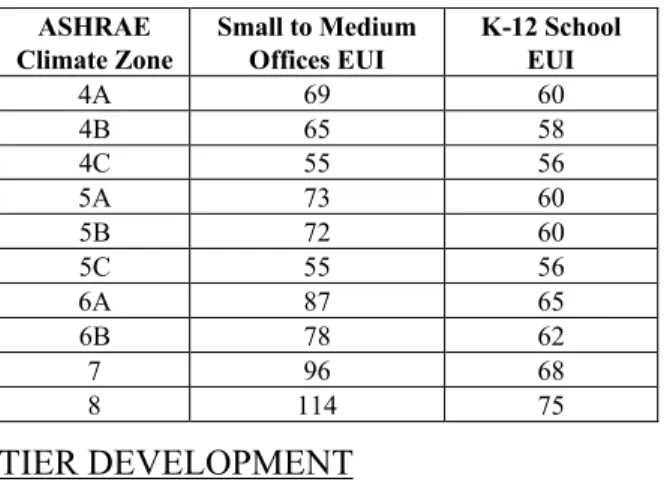
The second question was addressed by reviewing existing performance data. This data is sensitive to building type and limited information is available (ASHRAE, AIA, IES, USGBC, & US-DOE, 2018, 2019). For small to medium offices and K-12 schools, the absolute energy performance varies by building type and location (see Table 1). It should be noted that these figures are for all energy consumed in a building – the NECB and NBC only regulate some energy uses, e.g., heating and cooling are regulated, but residential lighting is not. Thus, direct comparison is not possible, rather the figures should be used as a guideline.
Table 1: ASHRAE Design Guide Site Energy Targets (kWh/m2).
TIER DEVELOPMENT
Based on the constraints of current energy code as a minimum acceptable performance level and net-zero energy ready as highest performance level, the SC-EE proposed an additional two Tiers between these performance levels (i.e. four Tiers in total):
Tier-1 is the enforced edition of the NECB; Tier-2 at least a 25% energy reduction from Tier-1; Tier-3 at least a 50% energy reduction from Tier-1; Tier-4 at least a 60% energy reduction from Tier-1. To validate if the Tiers were technically possible and to determine cost impacts, a simulation study was undertaken on the following six archetypes:
Secondary School (2 storeys, 19,600 m2);
Medium (3 storeys, 5,000 m2) and Large (12 storeys, 46,300 m2) Offices;
Warehouse (1 storey, 4,800 m2);
Retail Strip Mall (1 storey, 2,100 m2); and Highrise Apartment (10 storeys, 7,800 m2).
Annual simulations of these archetypes were conducted for five locations: Victoria BC, Windsor ON, Montreal
QC, Edmonton AB, and Yellowknife, NT, representing climate zones (CZ) 4 to 8. Both the base (NECB 2017) and Tier-compliant set of archetypes were simulated and the differences costed, totalling 120 simulations.
Simulation Method
An engineering approach was applied to the simulations: the models were analysed and the least performing aspect improved iteratively until Tier 4 performance was achieved. The solution arrived at via this ‘hill climbing’ approach demonstrates that the technical goal can be achieved (the primary objective of the analysis), but does not necessarily represent the cost-optimal solution. Key energy performance areas examined include: additional insulation in opaque assemblies; reduced glazing area; increased window performance; alternative HVAC systems and heat recovery. Internal gains were also examined. Lighting technology can already deliver substantial savings over current code maximums and are expected to further improve (the expected high end value was used for Tier 4). Although plug loads are not currently regulated expectations are that office equipment will become more energy efficient, therefore reduced load assumptions were examined.
Some options available to practitioners were not examined: window distribution (all facades had equal glazing areas), orientation and form remained static for each archetype.
To manage the simulations the BTAP environment (authored by NRCan) for OpenStudio was used. This enables a consistent application of energy efficiency measures to the archetype models using EnergyPlus as the calculation engine.
Tier-4 Sample Design Solution Set
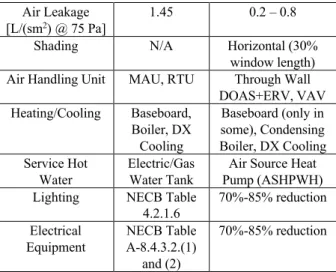
All six archetypes in all five locations can achieve the Tier-4 target (and by extension the lower Tiers). Each solution was unique, and Table 2 presents an overview of the initial NECB 2017 and Tier 4 archetype descriptions for the Secondary School, Warehouse, Highrise Apt, and Retail Strip Mall. Complete results and data for Offices are available (Vuong, Barssoum, Macdonald and Wills 2019).
Table 2: Tier-4 Description of Secondary School, Warehouse, Highrise Apt, and Retail Strip Mall in CZ-4
to CZ-8.
Component NECB 2017 Tier-4
Wall R-value [(°F·ft2·h)/BTU] R18 – R31 R36 – R57 Roof R-value [(°F·ft2·h)/BTU] R30 – R47 R40 – R57 Window U-value [W/(m2K)] 2.1 – 1.4 1.2 – 0.7 Window-Wall Ratio 0.4 – 0.2 0.26 – 0.08 ASHRAE Climate Zone Small to Medium Offices EUI K-12 School EUI 4A 69 60 4B 65 58 4C 55 56 5A 73 60 5B 72 60 5C 55 56 6A 87 65 6B 78 62 7 96 68 8 114 75
Air Leakage [L/(sm2) @ 75 Pa]
1.45 0.2 – 0.8
Shading N/A Horizontal (30%
window length) Air Handling Unit MAU, RTU Through Wall DOAS+ERV, VAV Heating/Cooling Baseboard, Boiler, DX Cooling Baseboard (only in some), Condensing Boiler, DX Cooling Service Hot Water Electric/Gas Water Tank
Air Source Heat Pump (ASHPWH) Lighting NECB Table
4.2.1.6 70%-85% reduction Electrical Equipment NECB Table A-8.4.3.2.(1) and (2) 70%-85% reduction
Incremental costs for the Tiers were estimated by a cost consultant. Note that these costs represent only the elements of the building that effect energy performance – for example it was assumed that structural costs would be identical in all cases for a specific archetype. Table 3 summarises the incremental costs for Tier 4. In some cases the cost to build to the higher performance level is less than current code. This is primarily due to smaller window areas and smaller HVAC equipment resulting in cost savings offsetting increased insulation costs. This analysis was cross-referenced with other studies. Simulated data showed little correlation between overall performance and cost. Therefore, these costs are subject to considerable variation depending on myriad design decisions.
Table 3: Tier-4 Archetype Incremental per Area Cost ($/m2) for 5 Locations in Canada (CZ-4 to CZ-8).
DISCUSSION
For all Tiers increasing the insulation level for opaque assemblies proved less effective than reducing fenestration transmittance and area (higher performing windows can help offset the lower fenestration and door
to wall ratios used). Increasing the insulation level for opaque assemblies results in diminishing rates of return on energy use reduction; although heat losses are reduced, additional cooling energy (fan, water pump) is required in many cases (typically those with large internal gains). It should be noted that thermal bridging in the envelope remains a concern and that improving air-tightness was identified as the most cost effective route to achieving energy performance gains.
Although reduced lighting results in increased heating, for the majority of the locations this additional energy consumption is negligible when compared to the direct energy saved. As a result, for Tier-4, more efficient lighting technology must be used to deliver reductions in the range of 70% to 85% compared to current code. This will be a challenge for the lighting industry; indications from SC-EE members are that 50-60% are achievable with current technology.
It was found that HVAC changes, e.g., replacing constant volume (CAV) with variable volume (VAV) systems, adding dedicated outdoor air system (DOAS) and other HVAC changes greatly reduces the energy consumption of the archetypes. This is attributed to the inefficient CAV rooftop units and make-up air units currently prescribed in the baseline (‘reference’) NECB 2017 archetypes.
CONCLUSIONS
Developing technically sound code requirements to deliver net-zero energy ready building performance requires a nuanced understanding of the drivers and goals. Reviews have shown that other jurisdictions have tailored their codes to their contexts. This presents challenges for a national code in a diverse country. Work to frame the target has shown that a single EUI is not the most appropriate and that further improvements in energy efficiency are required to deliver ‘net-zero energy ready’ buildings. It has been demonstrated via simulation that these goals are achievable with minimal cost implications.
Future work is required to ensure the availability of solutions that deliver the assumed performance levels in the simulation study. In addition, the solution sets identified in the initial study should be expand and there is growing need to validate that the predicted savings at design are being achieved once the building is operating.
ACKNOWLEDGEMENT
The authors would like to acknowledge the support of Natural Resources Canada Office of Energy Efficiency. In addition this work would not be possible without our collaboration with NRCan CanmetENERGY lab on BTAP/HTAP. In addition the authors acknowledge the detailed discussions with Codes Canada staff and members of SC-EE. Archetype V ic to ri a B C (C Z 4 ) W in ds or O N (C Z 5 ) M on tr ea l Q C (C Z 6 ) E dm on to n A B ( C Z 7 a) Y el lo w kn if e N T (C Z 8 ) Secondary School $44 $59 $58 $58 $32 Medium Office -$102 -$150 -$162 -$174 -$55 Large Office -$97 -$91 -$29 -$52 -$65 Warehouse $50 $111 $36 $53 $48 Retail Strip Mall $78 $4 $60 $70 -$7 Highrise Apt $57 $37 $11 $36 -$37
REFERENCES
ANSI/ASHRAE/IES (2019) Standard 90.1-2019
--Energy Standard for Buildings Except Low-Rise Residential Buildings.
ASHRAE, AIA, IES, USGBC, US-DOE (2018).
Achieving Zero Energy: Advanced Energy Design Guide for K-12 School Buildings.
ASHRAE, AIA, ISE, USGBC & US-DO (2019).
Achieving Zero Energy: Advanced Energy Design Guide for Small to Medium Office Buildings.
Beausoleil-Morrison I, Meister C, and Brown S. (2018)
Renewable energy generation potential of building-mounted solar collectors. Report to NRC.
Bourgeois, D. (2018). Building energy performance
codes – An assessment of international performance.
Report to NRC.
BUILD UP (2020)
http://www.buildup.eu/en/explore/country-facts Clarke, J.A., Hensen, J.L.M., Johnstone, C.M.,
Macdonald, I.A., "On the use of simulation in the design of embedded energy systems," Proceedings of the Building Simulation '99 (Kyoto, 99).
CCBFC (2016). Long-Term Strategy for Developing and
Implementing More Ambitious Energy Codes.
Available from: https://nrc.canada.ca/sites/default/
files/2019-03/policy_paper_longterm_energy_strategy.pdf Canada (2016). Pan-Canadian Framework on Clean
Growth and Climate Change.
Lazar, J. (2016). Teaching the “Duck” to Fly, Second Edition. Montpelier, VT: The Regulatory Assistance Project. Available at: http://www.raponline.org/ document/download/id/7956
NRC (2015). National Building Code of Canada 2015 Volume 1. Second printing. NRCC 56190.
US Department of Energy (2020) https://www.energycodes.gov/status-state-energy-code-adoption
Vuong E, Barssoum M, Macdonald I and Wills A (2019). Simulation Study for Working Group – Costing: PCF 1527 – Impact Analysis. NRC report number A1-013150.16.