Publisher’s version / Version de l'éditeur:
Solid State Phenomena, 170, pp. 282-285, 2011
READ THESE TERMS AND CONDITIONS CAREFULLY BEFORE USING THIS WEBSITE. https://nrc-publications.canada.ca/eng/copyright
Vous avez des questions? Nous pouvons vous aider. Pour communiquer directement avec un auteur, consultez la
première page de la revue dans laquelle son article a été publié afin de trouver ses coordonnées. Si vous n’arrivez pas à les repérer, communiquez avec nous à [email protected].
Questions? Contact the NRC Publications Archive team at
[email protected]. If you wish to email the authors directly, please see the first page of the publication for their contact information.
NRC Publications Archive
Archives des publications du CNRC
This publication could be one of several versions: author’s original, accepted manuscript or the publisher’s version. / La version de cette publication peut être l’une des suivantes : la version prépublication de l’auteur, la version acceptée du manuscrit ou la version de l’éditeur.
Access and use of this website and the material on it are subject to the Terms and Conditions set forth at
Interpretation of the magnetic order, neutron diffraction and 111Cd PAC
Cadogan, J. M.; Ryan, D. H.
https://publications-cnrc.canada.ca/fra/droits
L’accès à ce site Web et l’utilisation de son contenu sont assujettis aux conditions présentées dans le site LISEZ CES CONDITIONS ATTENTIVEMENT AVANT D’UTILISER CE SITE WEB.
NRC Publications Record / Notice d'Archives des publications de CNRC: https://nrc-publications.canada.ca/eng/view/object/?id=3554d9dc-cc02-485e-b729-e60f574cfa64 https://publications-cnrc.canada.ca/fra/voir/objet/?id=3554d9dc-cc02-485e-b729-e60f574cfa64
! " #$ %
& '' ' ( # $)
* + * ''
+ + , '' +
NdScGe is a ferromagnet with TC = 194(2) K. The magnetic moments of the Nd
substructure order along the tetragonal c-axis just below TC and undergo a gradual canting away
from the c-axis upon cooling, commencing at around 165 K. We used neutron powder diffraction to show that the Nd magnetic moments lie 70(3)o off the c-axis at 4 K [1]. The apparent discrepancy between our neutron diffraction results and those obtained using PAC [2] (a canting angle of around 32o just below TC , increasing to 45o at 25 K) can be reconciled by placing the principal axis of the
electric field gradient tensor in the tetragonal basal plane, rather than along the c-axis, as assumed in the PAC analysis. The unusual temperature dependence of the 111Cd PAC quadrupole frequency at the Sc site, which was interpreted in terms of a lattice softening occurring near the Curie temperature, is shown to be a consequence of the fact that one cannot determine the sign of the quadrupole frequency from a PAC experiment. Finally, we show that the Nd magnetic moments in the canted regime have a [110] basal component rather than [100].
The RScSi and RScGe (R = light rare-earth) intermetallic compounds crystallize in the CeScSi-type tetragonal structure which is derived from the La2Sb-type (tI12) structure ( #139). The
R atom occupies the site (point group ), Sc is in the site ( ) and Ge/Si is in a second
site ( ). The magnetism of these phases exhibits a wide variety, ranging from strong ferromagnetism (TC ~ 350 K) in GdScGe [3, 4] to antiferromagnetism below 26 K in CeScSi [5].
PrScGe exhibits multiple magnetic transitions [6].
The magnetic order of the Nd substructure in NdScGe was studied by 111Cd Perturbed Angular Correlation (PAC) in which the NdScGe is doped with 111In which subsequently decays to the probe
111
Cd by electron capture [2, 7]. All available evidence suggests that the 111In occupies the Sc site (for example, our point-charge crystal-field calculations of the three available sites (Nd, Sc & Ge) indicate that only the Sc site has a non-zero quadrupole asymmetry parameter: η = 0.15 was measured by PAC [2]).
On the basis of the PAC magnetic hyperfine field and the quadrupole frequency NdScGe was reported to be ferromagnetic below 200 K and canted away from the tetragonal c-axis by 30(5)o at 188 K, 35(5)o at 181 K and increasing to 45(3)o at 25 K. Magnetometry measurements yielded a Nd magnetic moment at 10 K of only 2.0 µB, 61% of the ‘free-ion’ value of 3.27 µB. Furthermore, the
unusual temperature dependence of the PAC quadrupole frequency at the Sc site was interpreted in terms of a lattice softening occurring near the Curie temperature.
In a previous paper [1] we showed that NdScGe is ferromagnetic below TC = 194(2) K with the
Nd magnetic moments lying along the tetragonal c-axis just below TC. A canting away from the
c-axis upon cooling commences at around 165 K. At 4 K, the Nd magnetic moments lie 70(3)o off the c-axis. Our determination of the magnetic structure of NdScGe was subsequently confirmed in [8]. In this paper we show that the seemingly different ‘canting angles’ (neutron PAC) of (0o 32o, the average of the 188 K and 181 K results) and (68o 45o as T → 0) are, in fact, mutually
All rights reserved. No part of contents of this paper may be reproduced or transmitted in any form or by any means without the written permission of TTP, www.ttp.net. (ID: 132.206.9.182-19/04/11,16:42:11)
consistent when one takes into account the orientation of the principal axes of the electric field gradient (EFG) tensor at the Sc (111Cd) site.
We also show that the unusual temperature dependence of the 111Cd PAC quadrupole frequency, upon which the claim of a lattice softening was based, is due to the fact that one cannot determine the sign of the quadrupole frequency from a PAC experiment. We also demonstrate that the principal Z-axis of the EFG at the Sc site is in the tetragonal basal-plane and the Nd magnetic moments in the canted regime have a [110] basal component rather than [100], information that cannot be extracted from neutron diffraction on a powder sample due to the tetragonal symmetry [9].
Details of the preparation of the NdScGe sample can be found in our previous paper [1]. Neutron powder diffraction measurements were carried out on the DUALSPEC C2 high-resolution diffractometer at the NRU reactor, Chalk River, Ontario. The neutron wavelength was 1.3285(1) Å and all patterns were refined using the FullProf/WinPlotr suite [10, 11]. At room temperature the lattice parameters of NdScGe are a = 4.313(1) and c = 15.821(2) Å, with the c parameter showing an increase upon cooling due to magnetoelastic effects.
Our neutron diffraction refinements, reported in [1], indicated that at 4 K the Nd magnetic moment in NdScGe attains the ‘free-ion’ value of 3.19(8) µB and is canted away from the tetragonal
c-axis by 70(3)o. The subsequent paper by Manfrinetti et al. [8] gives a canting angle of 54(2)o but this is an underestimate because their refined Nd moment is 3.53(4) µB which is actually 8% larger
than the ‘free-ion’ value. In the 111Cd PAC investigation of NdScGe, Mishra and Dhar [2] found an angle between the hyperfine field at the probe nucleus (reflecting the Nd magnetic order) and the c-axis of around 32(8)o just below TC, which increased to 45(3)o upon cooling to 25 K.
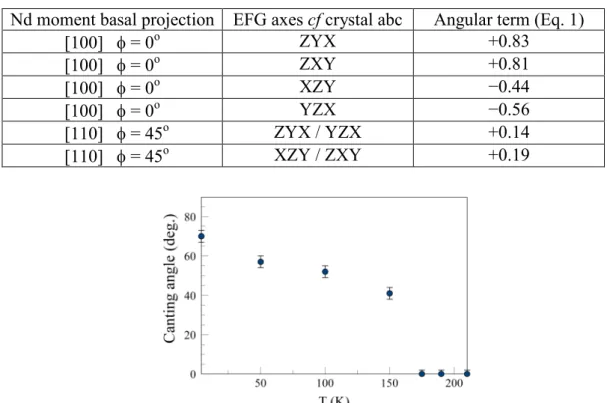
In Fig. 1 we show the canting angle of the Nd moments relative to the c-axis as a function of temperature, as determined from our neutron diffraction refinements. Just below TC, the Nd
moments are aligned along the c-axis and a canting away from the c-axis sets in at TSR ~ 165 K. The
apparent discrepancy between the PAC angle of 32(8)o and our neutron diffraction angle of 0o above TSR can be resolved by considering the fact that PAC cannot determine the sign of the
electric quadrupole interaction. In deriving the PAC angle of β = 32o, which is the angle between the hyperfine magnetic field at the Sc (111Cd) site (assumed collinear with the Nd moment) and the Z-axis of the EFG, Mishra and Dhar [2] assumed that Z(EFG) is along the tetragonal c-axis. The
111
In dopant in NdScGe used for the PAC measurements resides in the Sc site which has the point
symmetry so the XYZ axes of the EFG are coincident with the crystal ABC axes but there is
no correspondence regarding the exact relationships.
To illustrate this point, we consider the second-order angular term which arises when projecting the hyperfine magnetic field (moment), whose direction in the EFG frame is given by the polar angles (β, α), onto the principal Z-axis frame of the EFG,
(
3cos β 1 ηsin βcos(2α))
2
1 2 2
+
− . (1)
This second-order term equals +(0.56 ± 0.21) for the PAC angle β = 32(8)o [2] with Z(EFG) along the c-axis, taking into account the error in β and the fact that the azimuthal angle α was not specified above TSR. However, if Z(EFG) lies in the basal plane, our neutron diffraction
determination that the Nd moment (hence field) is along the c-axis above TSR yields β = 90o and a
value of –(0.50 ± 0.02) for this angular term. Once again, we note that PAC is insensitive to the sign of the electric quadrupole interaction in these experiments.
At low temperatures i.e. well below TSR, the PAC angles (at 25 K) are α ~ 45o and β = 45(3)o [2]
whereas our neutron diffraction measurements show that the Nd moments are canted away from the crystal c-axis by 70(3)o at 4 K. Taking the Z(EFG) along the c-axis, as in the PAC analysis [2], these angles yield a value of +(0.25 ± 0.08) for the second-order term in Eq. 1. However, if Z(EFG) lies in the basal plane as we suggest, our neutron diffraction determination that the Nd moment is canted by 70(3)o from the c-axis at 4 K yields a number of possible values for the angular term, depending on the exact orientation of the three EFG axes and also on the orientation of the basal component of the Nd magnetic moment (either along [100] or [110]), as shown in Table 1. The best fit to the experimental value of +(0.25 ± 0.08) is +(0.19 ± 0.03) which corresponds to Z(EFG) in the basal plane, Y(EFG) lying along the tetragonal c-axis and the Nd magnetic moment canted towards the [110] direction. This latter piece of information cannot be determined by neutron powder diffraction on a tetragonal phase [9].
Table 1. Values of the angular term (Eq. 1) as a function of the orientations of the Nd moment and the XYZ axes of the EFG.
Nd moment basal projection EFG axes crystal abc Angular term (Eq. 1)
[100] φ = 0o ZYX +0.83 [100] φ = 0o ZXY +0.81 [100] φ = 0o XZY −0.44 [100] φ = 0o YZX −0.56 [110] φ = 45o ZYX / YZX +0.14 [110] φ = 45o XZY / ZXY +0.19
Figure 1. Temperature dependence of the canting angle of the Nd magnetic moments in NdScGe Finally, we wish to address the question of a lattice softening which was claimed to occur around TC, on the basis of the PAC work. The measured temperature dependence of the quadrupole
frequency showed a pronounced dip around TC which was ascribed to lattice softening. First of all,
the magnetic hyperfine field just below TC is quite small, making the determination of the hyperfine
parameters somewhat unreliable. Secondly, PAC cannot ‘see’ the sign of the quadrupole interaction and we suggest that the different sign of the angular term discussed above serves to ‘flip’ the half of the temperature dependence of the quadrupole interaction term measured in the magnetic regime. PAC measures the magnitude of the quadrupole interaction, resulting in the pronounced dip reported in [2]. In Fig. 2 we show a schematic illustration of this effect.
Figure 2. Schematic temperature dependence of the electric quadrupole term in the nuclear Hamiltonian at the Sc (111Cd) site in NdScGe.
The Nd magnetic moments in the ferromagnet NdScGe order along the tetragonal c-axis at 194(2) K. At around 165 K, these moments cant away from the c-axis towards the [110] basal plane and at 4 K they lie 70(3)o off the c-axis. The apparent discrepancies between our neutron diffraction results and previously reported PAC results regarding the orientation of the Nd moments can be reconciled by placing the principal axis of the electric field gradient tensor in the tetragonal basal plane, rather than along the c-axis, as assumed in the PAC analysis.
Acknowledgements
JMC is grateful to A. Byrne (Canberra) and W.-D. Zeitz (Berlin) for enlightening discussions regarding the interpretation of PAC data. This work was supported by the Canada Research Chairs programme (JMC) and the Natural Sciences and Engineering Research Council.
[1] J.M. Cadogan, D.H. Ryan, R. Gagnon and C.J. Voyer, J. Appl. Phys. Vol 97 (2005), 10A916. [2] S.N. Mishra and S.K. Dhar, J. Phys.: Cond. Matter Vol 16 (2004), pp. 635-640.
[3] S.A. Nikitin, I.A. Ovtchenkova, Yu.V. Skourski and A.V. Morozkin, J. Alloys Comp. Vol 345 (2002), pp. 50-3.
[4] P. Manfrinetti, M. Pani, A. Palenzona, S.K. Dhar and S. Singh, J. Alloys Comp. Vol 334 (2002), pp. 9-13.
[5] S. Singh, S.K. Dhar, C. Mitra, P. Paulose, P. Manfrinetti and A. Palenzona, J. Phys.: Cond. Matter Vol 13 (2001), pp. 3753-66.
[6] S. Singh, S.K. Dhar, P. Manfrinetti, A. Palenzona and D. Mazzone, J. Magn. Magn. Mater. Vol 269 (2003), pp. 113-121.
[7] S.N. Mishra, J. Phys.: Cond. Matter Vol 21 (2009), p. 115601 (11pp).
[8] P. Manfrinetti, A.V. Morozkin, O. Isnard, P. Henry and A. Palenzona, J. Alloys Comp. Vol 450 (2008), pp. 86-91.
[9] G. Shirane, Acta Cryst. Vol 12 (1959), pp. 282-5.
[10] J. Rodríguez-Carvajal, Physica B Vol 192 (1993), 55-69.
[11] T. Roisnel and J. Rodríguez-Carvajal, Mater. Sci. Forum Vol 378-81 (2001), 118-23.
Quad.
term
T
Interpretation of the Magnetic Order, Neutron Diffraction and <sup>111</sup>Cd PAC Studies of NdScGe