lID1994: 170(September) Correspondence 745
References
I. Schneemann M, Schoedon G, Hofer S, Blau N, Guerrero L, Schaffner A. Nitric oxide synthase is not a constituent of the antimicrobial armature of human mononuclear phagocytes. J Infect Dis 1993;167: 1358-63.
2. Fuchs D, MurrC.Reibnegger G, et aI. Nitric oxide synthase and anti-microbial armature of human macrophages [letter]. J Infect Dis 1994; 169:224.
3. Schneemann M, Schoedon G, SchaffnerA. Reply [letter]. J Infect Dis 1994;224-5.
4. Eizirik DL, Cagliero E, Bjorklund A, Welsh N.Interleukin-Iri induces the expression of an isoform of nitric oxide synthase in insulin-pro-ducing cells which is similar to that observed in activated macro-phages. FEBS Lett 1992;249-52.
5. Eizirik DL, Bjorklund A. Welsh N.Interleukin-l-induced expression of nitric oxide synthase in insulin producing cells is preceded byc-fos induction and depends on gene transcription and protein synthesis. FEBS Lett 1993;317:62-6.
Reply
To the Editor-We appreciate the comments of Eizirik
[1]
in response to our article and the subsequent correspondence[2-4].
He restates the hypothesis that occult cytokine profiles are required to induce a high output of nitric oxide (NO) synthase activity (iNOS) in human mononuclear phagocytes. He ob-serves that the basal production of7.1pmol of NO/islet in un-stimulated human islet cells is increased to 16.5 pmol bytreat-Correspondence: Dr.A.Schaffner, Department of Medicine, AA23, Uni-versity Hospital. CH-8091 Zurich, Switzerland.
The Journal of Infectious Diseases 1994;170:745-6 © 1994byThe Universityof Chicago. All rights reserved. 0022-1899/94/7003-0046$01.00
6. SouthernC.Schulster D, Green Ie. Inhibition of insulin secretion by interleukin-I{jand tumour necrosis factor-a via an t-arginine-de-pending nitric oxide generating mechanism. FEBS Lett 1990; 276:42-4.
7. Corbett JA, Wang JL, Sweetland MA. Lancaster JR, McDaniel M. Interleukin-I{jinduces the formation of nitric oxide by {j-cells puri-fied from rodent islets of Langerhans. Evidence for the tt-cell as a source and site ofaction of nitric oxide. J Clin Invest 1992;90:2384-91.
8. Eizirik DL, Welsh N, Hellerstrom e. Predominance of stimulatory ef-fects of interleukin-I{jon isolated human pancreatic islets. J C1in Endocrinol Metab 1993;76:399-403.
9. Corbett JA. Sweetland MA, Wang JL, Lancaster JR, McDaniel ML. Nitric oxide mediates cytokine-induced inhibition of insulin secre-tion by human islets of Langerhans. ProcNatl Acad Sci USA 1993;90: 1731-5.
10. Eizirik DL, SandlerS, Welsh N, et aI. Cytokines suppress human islet function irrespective of their effects on nitric oxide generation. J Clin Invest 1994;93: 1968-74.
ment with tumor necrosis factor-a (TNFa), to 23.7 pmol by
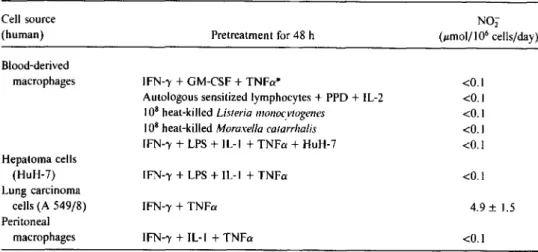
TNFa combined with interferon-v (IFN-')'), and to 37.4 pmol byTNFa combined with IFN-')' and interleukin-l d (IL-l{j) [5]. Thus, he proposes that IL-l{j,by the way a secretory product of macro phages (but not of islet cells) activated with lipopolysac-charide, IFN-')',TNFa, bacteria, ora complete afferent loop of cell-mediated immunity, could be essential for inducing iNOS activity in human mononuclear phagocytes. Our experiments [2](table 1)tell otherwise.
Recently it was proposed that human mononuclear phago-cytes can be induced to secrete NO by coculture with certain tumor cells
[6].
In these studies, however, no attempts were made to control for an activation of iNOS in the tumor cells used (that had a basal NOS activity if cultured without phagocytes) by secretory products of macrophages such as IL-l{j orTNFaTable1. Comparison of nitrite(N02")secretionbymacrophages from different human sources. Cell source (human) Blood-derived macrophages Hepatoma cells (HuH-7) Lung carcinoma ceIls (A 549/8) Peritoneal macrophages Pretreatment for 48 h IFN-')'
+
GM-CSF+
TNFa*Autologous sensitized lymphocytes
+
PPD+
IL-2 108heat-killedListeria monocytogenes108heat-killedMoraxella catarrhalis
IFN-')'
+
LPS+
IL-I+
TNFa+
HuH-7 IFN-')'+
LPS+
IL-I+
TNFa IFN-')'+
TNFaIFN-')'
+
IL-I+
TNFaN02" (I-Lmol/I06cells/day) <0.1 <0.1 <0.1 <0.1 <0.1 <0.1 4.9±1.5 <0.1
NOTE. Culture conditions are in [2J. Data are mean±SE from triplicate experiments. IL-I, human recombi-nant interleukin I-tt, 100 units/ml.; IFN, interferon; GM-CSF, granulocyte-macrophage colony-stimulating fac-tor; TNF. tumor necrosis facfac-tor; PPD, purified protein derivative; LPS, lipopolysaccharide.
746 Correspondence JID1994; 170 (September)
during coculture. This control is essential in view of the respon-siveness of NOS in human tumor cell lines to such stimuli
[7]
(table I).We therefore conclude that in human mononuclear phago-cytes, iNOS is not induced by IL-I{j.In addition, in clear distinc-tion to other human cell types, no convincing evidence has been provided for iNOS in human macrophages thus far.
M.Schneemann, G. Schoedon, and A. Schaffner Clinical Mycology Laboratory. Division of Infectious Diseases.
Department ofMedicine. University ofZurich Medical School. Zurich. Switzerland
References
l. Eizirik DL. Nitric oxide synthase and antimicrobial armature of human macro phages [letter]. J Infect Dis1994;170:744-5.
High Rate of Reactivation of Human Herpesvirus
6
in Children with Dengue Hemorrhagic FeverColleagues-In 1986, a new herpesvirus, now designated as human herpesvirus 6 (HHV-6), was isolated from patients with Iymphoproliferative disorders [I] and was recognized to be the causative agent of exanthem subitum in 1988 [2]. It is now be-lieved that HHV -6 persists in the host after primary infection and can be reactivated later in life. By characterization of iso-lates obtained worldwide from various diseases, HHV-6 is now classified into two variants: HHV-6A and HHV-6B [3].
Dengue fever is a common childhood disease in tropical countries. Although dengue virus infection usually results in mild disease, sometimes infection by this virus can result in a severe disease such as dengue hemorrhagic fever (DHF) and dengue shock syndrome [4]. Alterations in the immune system ofDHF patients are likely since there is extensive damage to the lymphoid tissue of various organs and some depression of the bone marrow elements [5]. In the present study, we investigated HHV -6 reactivation in DHF patients.
The study included 30 patients with suspected DHF who were admitted to the children's ward of Charoenkrung Pra-charak Hospital. Patients were 3-13 years old (3-5,26%; 6-10, 48%; and 11-13, 26%). These patients were classified into DHF grade I or II according to their typical clinical manifestations of the following: fever, hemorrhagic manifestations including a pos-itive tourniquet test and some bleeding phenomena, thrombo-cytopenia, and hemoconcentration. During the course of illness,
Informed consent was obtained from parents of all patients.
Grant support: Japan Society for the Promotion of Science (K.B.); Min-istry of Education. Science. and Culture of Japan (K.Y.).
Reprints or correspondence: Dr. Koichi Yamanishi, Department ofVirol-ogy. Research Institute for Microbial Diseases. Osaka University. Yamada-oka, Suita, Osaka565. Japan.
The Journal of Infectious Diseases 1994;170:746-8 ©1994 by The University of Chicago. All rights reserved. 0022-1899/94/7003-0047$01.00
2. Schneemann M. Schoedon G. Hofer S. Blau N. Guerrero L. Schaffner A. Nitric oxide synthase is not a constituent ofthe antimicrobial armature of human mononuclear phagocytes. J Infect Dis1993;167:1358-63. 3. Fuchs D. MurrC.Reibnegger G. et at. Nitric oxide synthase and antimi-crobial armature of human macrophages [letter]. J Infect Dis 1994; 169:224.
4. Schneemann M. Schoedon G. SchaffnerA.Reply [letter]. J Infect Dis 1994; 169:224-5.
5. Eizirik DL. Sandler S. Welsh N. et at. Cytokines suppress human islet function irrespective of their effects on nitric oxide generation. J Clin Invest1994;93 (in press).
6. Zembala M. Siedlar M. Marcinkiewicz J. Pryjma J. Human monocytes are stimulated for nitric oxide release in vitro by some tumor cells but not by cytokines and lipopolysaccharide. Eur J Immunol 1994;24: 435-9.
7. Radomski MW. Jenkins DC. Holmes L. Moncada S. Human colorectal adenocarcinoma cells: differential nitric oxide synthesis determines their ability to aggregate platelets. Cancer Res1991;51 :6073-8.
they did not receive blood transfusion or steroid therapy. For virologic and serologic studies, peripheral blood ( -- 5 mL) was drawn into heparinized medium during the acute phase on the first day ofhospital admission and again during the convalescent phase 2-3 weeks after the onset of disease. Heparinized blood samples from both phases were separated into plasma and pe-ripheral blood mononuclear cells (PBMC) using Ficoll-Paque (Pharmacia, Piscataway, NJ) gradient centrifugation. PBMC were divided into two parts (--2 X 10⁶ cells each) for virus isolation and detection of HHV-6 DNA. Antibody to HHV-6 was determined by immunofluorescence antibody (IFA) testing as described [2]. The titer ofantibody was expressed as the high-est dilution yielding detectable immunofluorescence. Antibody to dengue virus was determined by the hemagglutination inhibi-tion (HAl) test with dengue virus type 2 used as antigen. At least a fourfold increase in antibody titer in plasma between the acute and convalescent phases or an antibody titer of> I: 1280 in the acute phase was considered positive for a second dengue virus infection. The method for detection ofHHV-6 DNA in PBMC by polymerase chain reaction (PCR) was described previously [6]. For virus isolation, PBMC were cultured in RPM I 1640 supplemented with 10%fetal bovine serum, 0.1 unit ofrecomb i-nant human interleukin-2 (provided by Takeda Chemical In-dustries, Osaka, Japan) and phytohemagglutinin (5 mg/mL; Honen, Tokyo) at 37°C as described [2]. The medium was changed weekly, and cells were observed for cytopathic effect (CPE) for 2 weeks. Isolates were classified by IFA test as HHV-6A or -6B by use of monoclonal antibodies OHV -I and OHV -3; OHV -I reacted with both variants, whereas OHV -3 reacted only with HHV-6B [7]. The Wilcoxon signed rank test was used to compare antibody titers to HHV-6 in DHF patients.
All patients had DHF with typical symptoms: fever, hemor-rhagic manifestations, thrombocytopenia, and hemoconcentra-tion. Spontaneous bleeding in some patients developed only in the tourniquet test (grade I) but others had hemorrhages, such as petechiae, maculopapular rash, gum bleeding, epistaxis, and black vomiting (grade II). Symptoms such as restlessness, hepa-tomegaly, abnormal reflex, vomiting, injected pharynx, and cough also appeared in some cases. All 30 suspected patients