Conference Reports
LCM2007
7
© Springer-Verlag 2008Int J LCA 1313131313 (1) 7 – 9 (2008)
Conference Reports
LCM2007 – From Analysis to Implementation
Zurich, 27–29 August 2007
Stefanie Hellweg
1*, Annette Koehler
1and Gerald Rebitzer
21 ETH Zurich, Institute of Environmental Engineering, Wolfgang-Pauli-Strasse 15, 8093 Zurich, Switzerland 2Alcan Packaging Food Europe, Badische Bahnhofstr. 16, 8212 Neuhausen am Rheinfall, Switzerland
* Corresponding author ([email protected])
DOI: http://dx.doi.org/10.1065/lca2007.12.369
ganized the conference, addressed in his keynote lecture in par-ticular the implementation of LCM from an industry perspec-tive. He presented a simplified approach for applied sus-tainability assessments in globally operating companies. His final plea was to view product stewardship or LCM as a manage-ment process similar to quality managemanage-ment and to consider the economic and social dimension of sustainability in addition to the environmental pillar. Stefanie Hellweg (ETH Zurich) provided facts and figures on the LCM conference, including an LCA study of the complete conference with all its associated services. The climate change impacts of the conference were highly relevant with the major contribution stemming from air-plane trips of the international participants. As a consequence, the CO2 emissions were offset for the complete conference
in-cluding all traveling activities. Werner Bosmans (European Commission) presented the EU strategy on sustainable use of natural resources with a focus on decoupling economic growth from environmental impact and the improvement of the EU resource strategy. He emphasized the demand for simplified indicators, such as the ecological footprint, initiating a lively discussion within the audience on appropriate indicator schemes for environmental assessments. Jürg Gerber (World Business Council for Sustainable Development, WBCSD) presented the activities of the WBCSD, highlighting specifically the Sustain-able Value Chain Initiative. The initiative's overall objective is to promote, assist and support the use of life cycle thinking and life cycle approaches by WBCSD member companies and by their suppliers, customers and value chain partners. For this initiative WBCSD is partnering with UNEP and SETAC (Soci-ety of Environmental Toxicology and Chemistry) in the con-text of the 'Life Cycle Initiative'. In the final keynote lecture,
Ana Quiros (ECOGLOBAL and Association for LCA in Latin
America) discussed a dissemination strategy towards a more sustainable development for the world. Next to the more tradi-tional dissemination pathways, such as the UNEP/SETAC Life Cycle Initiative, she especially mentioned education and spe-cific employment projects as viable options to promote life cycle thinking (e.g. a project on handbag manufacturing from food packaging waste).
2 Platform Sessions
The session Management Challenges concluded that tools and concepts from other disciplines are available, which could be very useful for LCM. Also, it was emphasized that the benefits of LCM should be clearly communicated within industry and to relevant stakeholders. For instance, the systems perspective Nearly 500 experts from science, industry and governmental
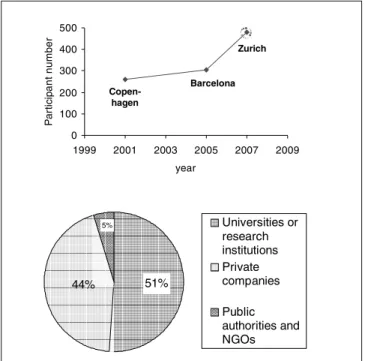
organizations met in Zurich from August 27–29 to discuss new methods for Life Cycle Management and its implementation in practice.. In particular, many participants from emerging coun-tries attended the conference. With the very high number of attendants, the LCM2007 meeting has become one of the big-gest conferences on applied sustainability approaches world-wide (Fig. 1).
1 Plenary and Keynote Lectures
At the conference opening, Hans Peter Fahrni from the Swiss Federal Office of the Environment reviewed the past three de-cades of work performed on Life Cycle Assessment (LCA) in Switzerland and the implementation of LCA in Swiss policy making. Among the recent examples presented were, for in-stance, tax reductions for biofuels and efficient cars, which were based on results of LCA studies. Mr. Fahrni concluded that LCA has a great potential to support environmental policy making, given the condition that the LCA results are reproduc-ible and transparent. Gerald Rebitzer from Alcan, who
co-or-0 100 200 300 400 500 1999 2001 2003 2005 2007 2009 year P a rt ic ip ant numb er Copen-hagen Barcelona Zurich
Fig. 1: Development of participation of the LCM conferences (top) and
participant structure of LCM2007 (bottom) 5% 44% 51% Universities or research institutions Private companies Public authorities and NGOs
LCM2007
Conference Reports
8
Int J LCA 1313131313 (1) 2008may contribute to a better decision making process. The Eco
Efficiency session was characterized by five rather diverse
pre-sentations, in terms of geographical origin as well as study commissioners (business, academia and government), covering different products, services, economic sectors, and industries. Generally, the link between micro-level performance and im-provements on the macro level, which ultimately are required for sustainable economies and societies were perceived to be too weak, requiring more clear and sound methods. In the ses-sion Promoting Life Cycle Thinking broader strategies on a regional and national level were presented. The European Plat-form on LCA attracted attention on database registry issues and the work on impact assessment factors recommended for a broad application of LCA. Further projects were presented by the Brazilian Center of Excellence, the e-learning tool from the international Iron and Steel Institute and the UNEP platform. In the session Process Development the presentations, from both academia and industry, focused very much on the practical implementation of LCM. A new decision-support framework for process development including the concept of exergy and de-cision-support methods for early process-development stages were introduced. The discussion highlighted the need to more closely interact with other disciplines such as product life cycle manage-ment, which, in contrary to LCM, uses the life cycle concept to describe a commodity's economic life span (including introduc-tion, growth, maturity, decline of a product on the market). In the session Chemicals and Pharmaceuticals, all presentations fo-cused on chemical processes, rather than individual products. One presentation showed a newly developed approach to esti-mate various environmental indicators like Cumulative Energy Demand (CED) and Chemical Oxygen demand (COD emissions by using neuronal networks. The session Electronics elaborated case studies on telecommunication and e-print. E-print generally showed to have environmental advantages over newsprint. The session Services−−−−− Transport, Banking/Financing and other
Services pointed to the strong relationship between direct and
indirect emissions of services and emissions of related transpor-tation activities. Various options to reduce mobility-related en-vironmental impacts were presented. For instance, in the long-term, a fuel change, e.g. to hydrogen, might mitigate the impact of traveling. Eco-driving and more efficient vehicles can also contribute to this goal. New telecommunication services may lead to significant reduction in energy consumption if transpor-tation is avoided. It was further stated that a dialogue between investors and companies based on life cycle performance is needed. Investors need guidance to better understand the car-bon-intensity and other environmental aspects of companies. The key message of the session Social Responsibility was that social impacts of product manufacturing are becoming increas-ingly relevant in LCA-based studies. The central question dis-cussed was on how LCA- similar approaches can be used to address economic and social aspects. Whereas for Life Cycle Costing (LCC) a Code of Practice is currently in development, Social LCA approaches have not been harmonized yet and no clear consensus on type and way of measuring social impact is currently available.
In the Biomaterials session, comparative assessments of bio-based versus conventional materials were presented. In all the discussed cases, non-renewable energy and greenhouse gas
emissions were lower for bio-based materials. However, there were trade-offs with higher impacts in eutrophication and acidi-fication for same bio-materials investigated. The session cov-ered the interpretation of the LCA inventory results by applying various methods, among them Eco-indicator 99, distance to tar-get methodologies, eco-efficiency analyses and the social cost method (defined as the total of microeconomic cost and external cost). It seems essential to look at the stocks and flows of the biomass and to conduct meta-analyses for multiple pathways of biomass utilization (including fuel, power and materials). In the session on Energy Efficiency / Generation – Energy from
Biom-ass it was concluded that prospective decisions need new data for
future energy technologies but also for future production of ma-terials and transport systems that are closely linked with future energy technologies. Also, it was apparent that environmental risks that are not included, e.g. from hydro and nuclear power, should be considered in comprehensive sustainability assessments. With regards to bio-fuels, land use and deforestation are key issues that need thorough consideration for a sound life cycle management of these energy products.
Several case studies were presented in the session on Design for
Environment. For instance, a study of high performance
con-crete showed potential benefits in greenhouse gas emissions as well as in costs. Environmental gains in cement manufacture were achieved by substituting raw materials with waste materi-als having cement-like properties. In a case study focusing on the design of seating solution platforms, the design of the new plat-form was complicated by a decision to outsource work to an external firm. Poor communication between the external design-ers and company-internal designdesign-ers resulted in a design that achieved only a 17% weight reduction and no improvement in GHG emissions. In another study on wood furniture, stream-lined LCAs and a simplified Environmental Management System were used to identify key environmental hot-spots and imple-ment continuous improveimple-ment programs. The simplified approach was supported by detailed studies specific to the sector. How-ever, some members of the audience were still concerned about the credibility of eco-labels based on the simplified methods and the danger of missing 'real' environmental hot-spots. In the session Agriculture and Food it was concluded that the complete agricultural production chain should be considered, from the farm up to the use and disposal of the retail products. Key factors in LCA studies of agriculture and food systems were found to be the whole feed formula. Also, sensitivity analyses related to different functional units (mass, protein content, etc.) and to food processing (fresh, frozen, etc.) should be taken into account. The need to consider consumption patterns and life styles, in addition to production efficiency, was specifi-cally acknowledged in the session on Sustainable
Consump-tion and Consumer Products. Several presentaConsump-tions showed
the importance of the product’s use phase reflecting the con-sumption side. Further, the conclusion was drawn that envi-ronmental impacts often do not occur in the countries were consumption takes place, but rather in the countries where the goods are produced. The application of various tools such as (Hybrid-) LCA, LCC, Input-Output (I-O) or Waste I-O modeling were presented. Furthermore, a time-trend analysis showed different patterns regarding the overall environmental impacts resulting from an increase in living standards and im-proved product and process efficiency.
Conference Reports
LCM2007
Int J LCA 1313131313 (1) 2008
9
The session Scenario Analysis for Prospective Assessment pre-sented a new approach expanding the assessment of resources in LCA to human-, social- and manufactured resources, by as-sessing the future costs covered by current activities. The po-tential impact can be expressed in terms of productivity reduc-tion due to human-health impacts, missing educareduc-tion, and similar factors. Other approaches were introduced taking into account trade offs between different objectives such as net CO2 impacts
and employment resulting from different scenarios modeled. In the session Environmental Communication the presenters high-lighted the communication challenges pointing specifically to the business and market constraints. An integrated approach is needed that considers the policy and business context. To generate in-formation for environmental improvement actions, a general perspective should be adopted beyond the company borders, hot-spots for impact reduction should be identified, quantita-tive data necessary for communication should be gathered and suitable assessment criteria should be defined.
An exposé of material flow analysis on different levels (national, regional, firm level) with various degrees of modeling sophisti-cation was provided in the session Industrial Ecology. It also gave a procedure for finding opportunities for 'process integra-tion' on a regional level and suggested carbon-intensity indica-tors on a company level. The session clearly underlined that engineers and social scientists need to more closely interact to learn from each other. Similar issues were approached very dif-ferently by researchers from the two sides.
In the session Life Cycle of Metal Products two presentations showed examples of how to take into account closed metal loops by combination of MFA and LCA for a more efficient global metal management. Another presentation analyzed meth-odological challenges with the modeling of light-weighting with metal applications for the automotive sector.
In the session Sustainable Settlements real case studies (e.g. from the city of Zurich) illustrated that sustainable settlements are not only a vision but that they can become reality. This session was complemented by a presentation series on the topic
Con-struction. A model of the European residential housing
situa-tion underlined the discrepancy of building practice and best practice with respect to energy consumption. The potentials for energy and cost savings were shown. From a deficit analy-sis applying LCC of housings in Portugal it became clear, that ignorance of different agents in the building sector (such build-ing owners, architects) and inadequate contracts can be respon-sible for poor building performance. Another case study illus-trated the successful use of LCA for the product management of a gypsum board manufacturer in New Zealand. Suitable agent
interaction was found to be an important source for energy and cost savings as well as increased user comfort. Life cycle based rating schemes for buildings are important drivers for the planer to consider life cycle aspects and apply LCA for the building assessment. The insufficient communication and in-formation management during the planning process is one rea-son for high efficiency losses of buildings.
Several interesting case studies illustrating important method-ological aspects were discussed in the session on Waste
Manage-ment. There was, for example, a clear illustration of the
metho-dological differences in how metals were handled in various analyses. In all case studies presented, there were clear environ-mental benefits from increased recycling. Three presentations looked at options to simplify LCA. Two of the studies imple-mented simplification by focusing on a reduced set of environ-mental impacts (mostly energy and greenhouse gas emissions). The third presenter suggested a modular streamlining approach. The session Simplified Methods illustrated that user interfaces and databases improve continuously. However, important im-pact categories are still missing (e.g. land use) in the respective tools and methods. Industry has developed advanced tools and databases, but primarily for internal use. Still, there is a lack in data and often timing to influence decisions in early product development phases. Weighting was also discussed as an im-portant issue. Although weighting should not be applied for comparative assertions disclosed to the public, many studies do so as some experts anticipate weighting to be needed. Panel weighting methods might be democratic but easy to manipu-late. In the session Tools and Databases it was discussed that open software will certainly help to promote Life Cycle Think-ing. Also, a new way to determine normalization values based on consumption was presented. A further presentation dealt with a new data format converter allowing the exchange of data between different databases.
Many case studies from Non-OECD countries were presented on various LCM-related topics in the session LCM in emerging
countries. A range of proposals to address applications of
eco-efficiency, LCM and LCA for countries with limited databases and/or capability resources were elaborated by several present-ers. A focus was also on the development of national LCI data-bases which are currently under construction in several Non-OECD countries to provide more representative environmental data for emerging economies.
Further, the need for regionalized impact assessment methods was highlighted to appropriately account for ecological im-pacts specific to different climatic regions of the globe.
Further information: Presentation slides and manuscripts are available at: www.lcm2007.org
Awards. Danielle Maia de Souza (UFSC -Federal University of Santa Catarina, Brazil) was awarded for the best platform presentation and
Shubha Pandey (TERI, The Energy and Resources Institute, Delhi, India) for the best poster presentation from Non-OECD countries.
Associated events. Several UNEP/SETAC meetings and various workshops were organised in connection with the conference. Outlook. The next LCM conference will take place in Capetown, South Africa (www.lcm2009.org)
Acknowledgements. The authors wish to thank all session chairs
who provided summaries of their sessions, which were the basis of this article. The session chairs were: Althaus H. J., Bauer C., Binder C., Brent A.C., Buxmann, K., Christiansen K., Da Silva G.A., de Beau-fort A., Dewulf J., Fava J., Feijoo Costa G., Finnveden G., Frisch-knecht R., Fritz G., Gaillard G., Goedkoop M., Grant T., Hirao M.,
Hischier R., Hofstetter P. , Hungerbühler K., Hunkeler D., Huppes G., Jensen A.A., Jeske U., Jolliet O., Köhler A., Köllner T., Kreissig J., Kuhndt M., Lalive A. L., Lang D., Margni M., Nakamura S., Pant R., Patel M., Pesonen H., Quiros A., Rubik F., Schalcher H.R., Scharnhorst W., Schenk R., Schmidt W.P., Swarr T., Tillman A. M., Valdivia S.