1. Chapter 4: Mobility Car Sharing: An
Evolving Co-Operative Structure
Peter Suter and Markus Gmür
Introduction
Co-operatives have a statistically low macroeconomic relevance; nevertheless, occasionally they are big players in specific sectors and countries. In Switzerland the two largest retail co-operatives, Migros and Coop, are responsible for 8% of the Gross Domestic Product. In comparison to its neighbouring countries, the co-operative is a very popular legal form in Switzerland with almost 10,000 organisations (see Table 1). The number of co-operatives in the more heavily populated Germany seems to be very low, only 8,106, although it should not be ignored that 20 million Germans are members of these co-operatives, which provide jobs for 440,000 people (ICA, 2011).
Table 1 Number of co-operatives and population
Switzer-land Germany Italy France
Co-operatives* 9,980 8,106 70,400 21,000
Population** 7,954,662 81,843,743 60,820,764 65,397,912 Density
(co-operatives per
1,000 inhabitants) 1.25 0.10 1.16 0.32
* Source: Eidgenössisches Amt für das Handelsregister (2011) and ICA (2011) ** Source: Eurostat (2011)
In Switzerland co-operatives can mainly been found in the financial, retail, social housing and agriculture sectors (Gmür and Lichtsteiner, 2009, p. 193). But several other successful co-operatives also exist in niche markets. One of these is the Mobility car sharing co-operative. The principle of car sharing is
very simple: instead of owning a car the individual has access to a fleet of vehicles on an as-needed basis. Therefore he/she gains the benefits of a ‘private’ car without the responsibilities and full cost of ownership (Shaheen, Sperling and Wagner, 1999, pp. 18-19). Nowadays the concept of car sharing is widespread, but it is mostly still limited to certain local areas, with a focus on bigger cities. The case of Switzerland is an exception and can actually be called the motherland of car sharing for two reasons. As shown in Figure 1, the first modern type of car-sharing service was implemented there and, after 25 years of constant growth, a unique offer and client density was established. Compared to the size of its population, the number of car-sharing users in Switzerland is seven times higher than in Germany (Loose, 2010, p. 18).
Throughout the history of car sharing in Switzerland one aspect is particularly remarkable: the transition of Mobility from a pure self-help organisation in 1987 to a modern service-driven co-operative that stays true to its principles, values and business model. During the past 25 years Mobility was able to attract over 100,000 customers, 46.1% of whom are members of the co-operative (Mobility, 2012b). At first sight the history of Mobility seems to be a spectacular take-off without any setbacks. But behind the curtain there have been several challenges to overcome; in particular, the management of such a sudden growth was not easy at all. Mobility has been growing for over 20 years and is a unique example of sustainability in the Swiss co-operative sector. Mobility successfully transitioned from its start-up to a growth phase over the course of 20 years and has now moved to a mature phase. The growth of the last decades slowed down as most potential clients with an affinity to car sharing have already been acquired. The turbulent history of car sharing in Switzerland and the innovative business idea make Mobility the ideal example for a case study on sustainable co-operative concepts.
Nowadays, Mobility car sharing is the most modern and important pillar of custom- and environmental-friendly mobility with stable economic revenues (Muheim and Partner, 1998, Haefeli et al., 2006).
Figure 1 Car-sharing participants in Switzerland’s neighbouring countries in relation to total population (Loose, 2010, p. 19)
The Mobility case study follows three research questions that are based on the general research questions of the book:
1. How was and is Mobility handling the balancing act between the co-operative principles and a service-orientation based on market logic? 2. What are the risks of a professional business model considering the
decentralised co-operative structure?
3. How can the member value of Mobility be measured?
The chapter is divided into two main sections. As many parts of the answers to the research questions lie in the history of Mobility, the first section traces the history of car sharing in Switzerland, considering the strategic challenges of the co-operative(s). One focus in the more recent history is placed on the reorganisation of the regional sections in 2007 because of the change in the delegates system and thus the changed possibilities of members to participate in the co-operative. Especially the first two questions are strongly interdependent; this makes it difficult to separate the answers, and therefore the first section mainly follows a chronological structure.
In order to analyse the member value according to the third research question, a new member value approach will be presented in the second section. It considers the following questions: what motivates a member to enter or leave a operative, and what are the reasons that they stay in a co-operative? The majority of studies on this topic mainly focus on economic factors and the rational behaviour of the member. However, co-operatives also have other purposes not associated with economic and/or functional
Year of foundation Percentage of CS-c ustomers in Com p aris on w ith populati on Switzerland Germany
goals. The interdisciplinary member value approach focuses on the individual member, but does not ignore the co-operative character. Members have different expectations of the co-operative, whereas latent preferences – based on the nine basic needs as described by Max-Neef (1991) – and economic goals must be distinguished. For example, Mobility members are looking for a cheap price for their individual transportation, but at the same time they want to do something for the environment. Member value arises as a result of the match between these latent preferences and the economic goals of the members, and the latent and manifest benefits provided by the co-operative. In this sense, member value is not a static but a dynamic concept.
From the very beginning, Mobility was financially self-sufficient and did not participate in financial markets. Therefore there was never a risk to compromise its principles or a need to access risk capital.
Method
The research design follows a qualitative case study methodology and focuses on Mobility’s history and its sustainability. Since Mobility can be considered the pioneer of modern car sharing, several studies have already been made on the organisation, mostly focusing on the idea of car sharing itself and its environmental benefits. In addition to this, Mobility pursues a transparent and open communications policy; hence a rich database of the business model, the development and client feedback exists. In order to complete the data and get specific insight, four personal interviews have been conducted with: Viviana Buchmann, chief executive officer; Beat Schmid, head of the ‘co-operative business and sections’ department; Andreas Blumenstein, head of the ‘Bern’ section; and Oskar von Arb, former head of the ‘Kirchlindach’ section (a small village close to Bern), vehicle attendant and active member. The four participants were chosen due to their position in Mobility as they all represent different functions and have specific expertise on a different level in the organisation. All interviews were semi-structured and lasted around 90 minutes. The transcribed interviews were coded and analysed with the software MAXQDA 10. The general coding is based on the theoretical model and the Max-Neef’s (1991) nine basic needs. Some additional codes have been developed inductively.
The Rise of Modern Car-Sharing Co-operatives
One hundred years after the invention of the car, which revolutionised private transportation, the time has come for the ‘public’ car (Muheim and Partner,
1998, p. 6). Car sharing can be seen as the most important innovation in the transport sector in the nineties. The era of modern car-sharing organisations started in 1987 with the funding of the ‘AutoTeilet Genossenschaft’ (ATG) by eight people in a small rural area in Switzerland – Stans. ‘AutoTeilet Genossenschaft’ can simply be translated as ‘car-sharing co-operative’ and is an adaption of an old Swiss tradition called ‘Chästeilet’ (cheese sharing). Cheese makers in the rural area shared their produced cheese equitably according to the amount of milk delivered by each farmer. The peculiar name was chosen on purpose in order to stress the ideological and traditional roots of the founders. Only 17 days later, the ‘ShareCom’ co-operative was established in Zurich. Although Switzerland is a rather small country and the two co-operatives were founded less than 100 kilometres apart, they did not know each other and were going their own way. Nevertheless, the similarities of both co-operatives cannot be neglected.
In the early phase the founding members were mainly looking for a suitable mobility solution of their own and followed their personal (mobility) interests. For the first couple of years, both organisations mostly grew in their local area and both were managed by volunteers. Then, in 1991, the strategy of the two co-operatives started to drift apart. While ATG started spreading all over the German-speaking part of Switzerland, ShareCom decided to focus on the Zurich region. The alienation away from the self-help character of ATG did not only lead to changes but also to the creation of new risks. There was a discrepancy between the will of the members, to strengthen the accessibility and the flexibility of car sharing, and the goals of the board – expansion, acquisition, service improvement (Hadorn, 2009, pp. 79-135). The transformation of a small grass roots car-sharing organisation into an economically viable business firm presented many difficulties. Based on an European study about car sharing, Lightfoot (1997) concluded that, given their strong local ideological roots, new start-up car-sharing organisations were more likely to succeed if they remained at a self-organising local level as long as possible. But the car-sharing idea in Switzerland just struck a nerve with many people. In the first six years, both co-operatives doubled their size nearly every year. Both organisations were complementary in the area they covered. This caused the first thoughts about co-operation and an eventual merger in the early nineties. But the discussions failed, the corporate philosophies were too different and personal conflicts between the partners made it impossible to find a solution. After the failed merger project in 1992, the leading heads of both co-operatives left the boards.
The new leading board members of ATG adopted a more aggressive expansion strategy. Far away from their origins as a self-help organisation and the dependence entirely on volunteers, the new leaders acted like professional managers of a small- and medium-sized enterprise. Although
ATG did not expand in the French part of Switzerland due to additional costs and risk because of the language barrier, they merged with the independent car-sharing co-operative CopAuto after its project largely failed after a short time. Furthermore, ATG broke the unwritten ‘non-aggression pact’ with ShareCom and applied in competition with ShareCom for the project ‘ZüriMobil’, a programme launched by ‘Zurich Public Transport’ (VBZ) with the intention of promoting a combined mobility. Finally, VBZ made the deal with ATG despite their low or even non-existing presence in Zurich, because of the more professional appearance and greater resources. After this blow the gulf between ShareCom’s traditionalists (advocating voluntary self-help) and the modernist faction (pushing for more commercialisation) started growing. Disappointed with the new, commercial course Charles Nufer, enthusiastic leader from the outset and exponent of the co-operative green philosophy, resigned and therefore opened the door for a new strategy. Without Nufer, ShareCom management entered a stage of imbalance, but once the leadership struggle was resolved, it did not take long for ATG and ShareCom to relaunch a new round of merger talks (Hockerts, 2003b). From now on everything moved very quickly: only six months after Nufer’s resignation both co-operatives voted in favour of a merger.1 So 10 years after
the founding of ATG and ShareCom, the new co-operative called ‘Mobility’ started business on the 1st June 1997.
Mobility – The Car-Sharing Monopolist
The merger with CopAuto (which was, rather, a takeover) and the merger between ATG and ShareCom led to a national car-sharing service and a continuous monopoly of Mobility.2 The following years were marked by the
differences in the management and the board as well as by the hard work of everyone due to the huge growth. The management was running the organisation mostly independently which caused serious problems with the board. The massive investment in new cars and the administration did not reflect the view of the board. It ended with a dismissal of the management and an austerity course (see the years after 2002 in Figure 2). In 2004, the financial losses of the turbulent period of changes had been made up and
1 Although the merger between ShareCom and ATG was proclaimed as a union of equals, it was in reality a takeover of ShareCom (Hockerts, 2003c).
2 There also exist some smaller car-sharing organisations that focus especially on electric cars, but they cannot compete with the size and the level of service of Mobility.
60,000 clients were using the 1,750 Mobility-cars. Mobility continued growing, step by step, but not as fast as in the early years.
Figure 2 Development of Mobility between 1987–2011
During its 15 years of existence, Mobility has developed and kept on developing technical innovations and software for car sharing, strengthened its co-operations, established a business customer service, and simplified the reservation process and access to its fleet. In the early days, the clients got access to the key of a car by opening a safe deposit box next to the parking lot. At the end of a trip all users manually noted the distance travelled in the board book. Once per month car-sharing employees collected the board book data and communicated the details to the billing department. But the system was inefficient and accident-prone: bills took a very long to be delivered; clients tended to take the wrong car or made mistakes in the board book (by mistake or on purpose); and, finally, the car-sharing organisations had no way to control abuse. This last point became more of a problem as the number of fare dodgers, freeloaders and car theft increased and the stolen cars were shipped out of the country3 (Hockerts, 2003c, p. 3). These risks
increased according to the growing number of clients and were associated with the decrease of social contacts and rising anonymity. Therefore an electronic reservation system and a board computer in every car became crucial in order to reduce the risk of abuse and free-riding (Hadorn, 2009, pp.
3 Many of the stolen vehicles could be found in Montenegro and one of them was even used to deliver the mail (Hadorn, 2009).
156-157). Mobility developed a digital car lock system that allows cars to be used with a personalised member card which therefore minimises the risk of free-riding. In a report for the attention of the European Commission, Harms and Truffer (1998, p. 4) wrote: ‘A reservation and accounting system as well as means for access control had to be invented (e.g., by installing on-board computers in the cars). The huge success of car sharing was thus dependent on the existence, diffusion and maturity of new information and telecommunication technologies’. Nowadays the problem of free-riding has been solved.
Mobility offers over 100,000 clients access to 2,600 vehicles at more than 1,300 stations throughout Switzerland. Meanwhile, Mobility is established successfully on the market, with a market share of 19% in the car sharing and car rental segment and a total revenue of CHF 70 million (Mobility, 2012e, Mobility, 2012b). Sixty-two per cent of all Swiss inhabitants have a Mobility station in their local municipality and in Zurich the average distance between domicile and the next Mobility station is only 250 metres (Buchmann, 2011, Mobility, 2012e).
Thus, except for the vision of a green mobility concept and its grass roots history, at first sight Mobility would be mainly characterised as a commercial service company. However, Mobility is a co-operative and in this respect is concerned about its members. The members are not just the customers of a service but also owners of the co-operative. Furthermore, the members and the board are rather risk-averse and follow a stable financing strategy instead of participating in financial markets in order to enable bigger investments. Hence it is no surprise, but rather a symbol for its modest course, that the Mobility headquarters is just a couple of offices on two floors in an old building nobody would recognise from the outside. True to its co-operative values, Mobility reinvests almost all profits in its car fleet, the service and new technology. In this way the profits are channelled back to the clients.
A Balancing Act Between Co-operative Principles and Service
Orientation
As the history of Mobility shows, the balancing act between the co-operative principles and a service orientation was not always easy. Mobility always had and still has to deal with several permanent states of tension (see Table 2).
Table 2 Mobility’s strategic states of tension
Co-operative principles versus Service-orientation Traditional co-operative versus Commercial service company
Board of directors versus Executive committee
Self-help versus Business model
Participation versus Consumption
Local orientation versus Expansion
Everybody knows everybody versus Anonymisation
Ponderousness versus (Fast) progress
Idealism versus Pragmatism
Amateurish (volunteers) versus Professional (managers)
Ecology versus Economy
At the very beginning ATG as well as ShareCom were traditional self-help co-operatives with a local range and a focus on their green ideologies. But as the car-sharing idea was attractive to a growing number of people, both organisations had to make up their mind and find a strategy. Both organisations were founded around a charismatic leader sharing a green ideology. Conrad Wagner, co-founder of ATG, can be characterised as a pioneer and social entrepreneur. Charles Nufer, initiator of the ShareCom co-operative, on the other hand, was a devout Christian with strong ethical and moral principles, but did not have a flair for business. Both of them shaped their organisation’s strategy significantly. Conrad Wagner had the perception of car sharing as a service which could eventually be turned into a profitable business. These different visions also existed within the co-operatives and affected them from the beginning. All in all, the highly ideological co-operative principles were shown to be more important to Nufer than to Wagner respectively more important to ShareCom than to ATG. So, whereas ShareCom remained true to its original ideology and the co-operative idea, ATG were clearly committed to commercialisation and positioned itself more and more as a service provider.
Although ATG had initially relied on voluntary contributions by its members too, the co-operative decided at an early stage to appoint professionals to take care of the cars and, over time, moved towards a professional system – paid and employed by ATG. However, the management of ShareCom realised too late that car sharing is not just something for ‘green do-gooders’, but is also a good opportunity for average customers, who are not interested in cleaning the cars regularly or participating in the co-operative. The internal battle between pure self-help promoters and followers of a professional business model slowed down
ShareCom’s development significantly (Hadorn, 2009, pp. 173-181). From this point of view the lower success of ShareCom resulted from the failure to have sufficient regard for the changed clientele and the lack of a consistent strategy. The majority of members and customers were and are mainly interested in an inexpensive and easily accessible mobility. A lot of them surely have an ecological awareness and co-operatives generally have a good reputation in Switzerland, but it is not the main motivation any more to join a car-sharing organisation. On the other hand it would be wrong to say that ATG respectively Mobility abandoned its co-operative principles and values. It is, rather, a balancing act between co-operative principles and the changing needs and preferences of members and customers. Until today, no moves have been made in the direction of a transformation into an investor-owned enterprise, despite the undeniable market orientation of Mobility. On the contrary, Mobility has recently endeavoured to strengthen the co-operative character. Overall, Mobility still upholds its ties to its ideological values and its member at the grass roots level. Or, in other words, Mobility manages to offer its members and customers a balanced member value that contains economic as well as latent benefits.
Co-operative Structure of Mobility
Before looking at the member value, Mobility’s co-operative structure shall be explored. The structure and the reorganisation of the sections reflect the states of tension and how Mobility tries to handle it. At the beginning ShareCom and ATG were pure self-help organisations, but ATG already stated in its first articles of association: ‘Under specific conditions, the vehicles can be rented by non-members too’ (quoted from Hadorn, 2009, p. 78). For some years now the relationship between members and customers has been almost equal. In 2012 53.9% of the clients were ordinary customers (Mobility, 2012b). Members pay a unique entrance fee of CHF 250 and a co-operative share of CHF 1,000 (which they can retrieve with no interest when leaving Mobility), whereas customers pay an annual fee between CHF 190 and CHF 290, depending on their membership in a partner organisation. The co-operative shares were crucial during the early stages as the equity was low. Nowadays, as the financial conditions are stable, the members’ shares are still important as they are a decisive competitive advantage. Hence Buchmann (2012) and Schmid (2012) underline the benefit of this balance between customers and members. Customers are important because of their annual fee, but in return members are more loyal, more committed and use the organisation for longer.
However, in general the differences between members and customers are small. In the eyes of Schmid, the decision to become a customer or a member depends primarily on how much somebody want to use Mobility and if he has CHF 1,000 at his disposal. This perspective is probably true, but it lacks the differentiation between the different kinds of members. Blumenstein (2012) describes Bern section as a big cloud of 10,000 clients. Half of them are members and among them a small part is really interested in the organisation [Mobility]. Among the interested members there is once more a part that is motivated to attend a section meeting. Maybe they come just once or repeatedly, depending on the sense of belonging and commitment. Some members of this coterie are additionally willing to help when needed, the active members (‘activists’). In terms of figures, there are within the Bern section about 10,000 Mobility clients, 50,000 members, 70 activists and, finally, 19 make themselves available to be voted as delegates or join the active member forum. Among all Mobility members, only 697 are activists, who actively support the organisation and exercise their rights as a co-operative member. In other words, less than 1.5% of the members show a high involvement in Mobility (Schmid, 2012). This is the opposite of the dynamic in the early days, when the majority of the work was done on a voluntary basis in order to keep the car sharing alive, although it must be said that at this time the main work was done by a couple of highly involved members.
As Mobility thrived after the merger, frustration and disaffection among the traditional grass roots activists grew. Christian Vonarburg, managing director of Mobility during those days, says that grass roots activists had been crucial at the beginning, but would not play a role in the future. ‘We have neutralised the co-operative system to a maximum. Today the management team can run Mobility as it sees fit. The annual delegate assembly has been marginalised as far as legally possible’ (quoted from Hockerts, 2003c, p. 4). But not all of the board shared Vonarburg’s view, and at the co-operative’s annual assembly activists challenged the expansion plans, concerned that Mobility was becoming just another rental company.
The history of Mobility is not just a history of growth but also a history of professionalisation. In the beginning, car sharing was merely a local business and followed a bottom–up strategy of small sections that organised themselves mainly independently. In 2007 around 350 small sections existed all over the country and all were managed by a head of section. But in an organisation with more than 77,000 clients, at this time, it was impossible to manage the business professionally. At the annual assembly in 2007, 10 years after the merger, the management and the board proposed a reorganisation of the sections, which meant a reduction to 27 professionally managed sections (Schmid, 2012).
Figure 3 Organisational chart of the Mobility co-operative (own presentation)
Not all of the delegates were amused about the application: some feared the loss of basic democracy. Notwithstanding, the application was closely adopted (Hadorn, 2009, p. 262). Especially the former heads of the sections were dismayed and felt something had been taken away from them. Many members could not understand how Mobility would work without the small sections. So the most important task of the new heads of sections was to earn the trust of some angered members (Blumenstein, 2012). Although the basic democratic instrument stayed the same (one member, one vote) the social cohesion between the members decreased. Finally, it was a trade-off between professionalisation and a co-operative sense of community.
Despite the reorganisation of the sections and local deprivation of power, Mobility tried to integrate the former head of sections and vehicle attendants in the new structure. Blumenstein and Schmid stated independently of one another that car sharing is a local business and it is necessary to know the best locations for the Mobility parking lots, any developments in the public transport system as well as traffic-related political decisions. Mobility created regional active member forums in which the organisation was reflected, as well as the services and generation of new ideas. On the other hand, the active member forums served as a platform for top–down information from the management to the members and thus kept them up to date.
The active member forums do not have a direct influence in the decision-making process but are, rather, a think-tank and a platform to discuss actual
Clients of the co-operative
(approx. 102,000) members and customers)
Members of the co-operative
(approx. 47,000 members in 27 sections)
Mobility co-operative conference of delegates (N = 150)
Board of directors (N = 5) Chief executive officer
(Viviana Buchmann)
Human resources & academy Finance & services
Mobility car sharing Switzerland Mobility International
Inc.
Co-operative system & sections
(Beat Schmid)
6 regional active member forums
(approx. 700 active members)
Professional system Voluntary system
problems as well as opportunities. In the past, many of the discussions now conducted in the active member forums took place at the conference of delegates with the result that the conference of delegates lasted for hours and many of the topics were not issues to discuss at a conference of delegates but at the operative level. Next to the head of ‘Co-operative System and Sections’ there is always at least one member of the executive committee attending the active member forums and mostly also a member of the board of directors. Due to this close connection between the active member forums and the management, the new ideas of the activists can be discussed directly and introduced more quickly into the co-operative in a less formal way.
Beyond the active member forum, the ‘Co-operative System and Sections’ division functions as a direct link between the basis – the sections – and the executive committee. The mere existence alone of such a division stresses the importance of the co-operative members to Mobility. Structurally speaking, the sections are little more than an organisational unit in the whole system; they are the valuable source of information and the inner core of the co-operative.
In the way it is strategically set up, the co-operative board of directors at Mobility resembles a board of directors of an investor-owned firm. Each member of the board brings a specific expertise and/or network that is directly linked to Mobility and its services: an expert in the IT-business; a politician of the French-speaking part of Switzerland; a juristic consultant; an expert in transportation systems and a member of the executive board of the Swiss Business Federation. The composition of such a highly qualified board of directors is also a sign of the advanced professionalisation of Mobility and its strategy towards a service-oriented business.
In addition to the formal structure of the co-operative, some rather informal aspects of Mobility’s character have to be mentioned which are crucial for its sustainability. Although Mobility virtually has a monopoly on car sharing, there are several car rental companies, but they cannot compete with the low-cost offer from Mobility in the short-term rental service. One important factor for the low price of Mobility is its high capacity for utilisation. Another main factor in this segment is the direct involvement of the car users. Mobility follows self-service principles that reduces costs for employees and enables unattended stations with just one or a few cars. Furthermore, the car has to be returned in a clean and operational condition, otherwise the user has to pay extra (Buchmann and Fischer, 2010). By contrast, commercial car rental companies normally clean their cars after every use and the price for cleaning is included in the offer.4 The benefit of
the member involvement and the appeal to fair play lies in the higher awareness of the car-users with regards to cleanliness and, as a result, reduced service costs. The monetary difference of the voluntary contribution can be shown in the example of ShareCom which had maintained prices 10– 30% below ATG’s due to non-existing costs for cleaning and maintenance.
Mobility has chosen a way between a pure volunteer maintenance-system and a professional service. The cars are checked and cleaned on a regular schedule by a semi-professional vehicle attendant or Mobility’s professional team. ShareCom had to face the question of how much should the clients become involved in the cleaning too. So in order to keep ShareCom pure they established the commercially oriented stock corporation Car Sharing Company (CSC) which offered the same service but without the duty of cleaning the car (Mobility, 2012d, Hockerts, 2003a). Malicious tongues even rephrased ShareCom’s slogan from ‘Use it – but don’t own it!’ (Nutzen statt besitzen) to ‘Clean it – but don’t use it!’ (Putzen statt nutzen) (Hockerts, 2003b). High involvement is a double-edged sword: on the one hand it keeps up the principals of the co-operative and helps to reduce the costs; but on the other hand it can scare off potential clients who prefer paying a higher price instead of increased duties. So it is a challenge to balance the compulsory involvement, especially at a time and society of increasing individualisation. The way Mobility succeeds in making its members more accountable can definitely provide a lesson for other business models; the difficulty will be to find a market in which costs can be reduced by involving the users and to what extent the users are ready to actively participate.
The strong emphasis on high client involvement at ShareCom was linked with Nufer’s self-perception as the ‘guardian of the co-operative spirit’. In his role as ideological and charismatic leader he was pulling all the strings and prevented any efforts towards a more service-oriented business model. He was able to push his opinions through the democratic decision-making process even against the general will of the majority (Hadorn, 2009, p. 149). The history of ATG and ShareCom as well as Mobility is characterised by ongoing tensions between the co-operative and the executive committee as well as with the conference of delegates. During the last two years Mobility was able to boost trust and confidence in the board of directors, the executive committee and the whole management that was leading to a better atmosphere at the conferences of delegates.
The basic democratic structure of Mobility worked and still works as a self-disciplining tool with all its positive and negative effects, and guarantees a stable development. Nowadays, Mobility is highly professionalised, the co-operative structure is efficient and the business model fits the actual preferences and needs of its clientele.
From Case Example to Theory
The history of Mobility and its co-operative structure make it obvious that Mobility changed from a grass roots co-operative into a professional service provider. Nevertheless, it can be classified as a traditional co-operative (Chaddad and Cook, 2004). Most of the clients are primarily looking for a cheap mobility solution and choose Mobility because of its good offer. In other words, nowadays the majority of the clients are mainly focused on economic goals when they join Mobility. Even the majority of the members do not really care about the true value behind their membership. This is not surprising since the most non-economic values are latent and therefore only unconsciously recognised by the member. It means that they do not recognise it as a value, but they would miss it when it was gone, like the dissolution of the small sections. All in all Mobility is not just selling a modern mobility concept at a good price but, rather, a whole set of benefits. The way the set of benefits is arranged is a result of the states of tension. It is not possible to satisfy all client needs to the same amount. The strengthening of a certain characteristic or benefit may induce a weakening of another aspect. Therefore the set of benefits Mobility offers is also a reflection of the co-operative’s identity. In order to analyse the member value of Mobility a new theoretical approach is presented that focuses mainly on the non-economic benefits of a membership.
According to Mazzarol, Mamouni Limnios and Soutar (2011a):
Although marketing science has a strong track record of measuring value perception, customer commitment and loyalty, little attention has been given to co-ops in past research. (p. 1)
It is now time to make an effort towards closing this research gap. To achieve this goal, this chapter suggests a new approach to the measurement of member value within co-operatives that primarily focuses on non-economic parameters. This suggested new approach should help co-operatives become more aware of differing member expectations. Member value refers to the success of a co-operative, not primarily in terms of growth, but in the sense of a better promotion of the members.
The term ‘member value’ is an adaption of the popular marketing concept ‘customer value’ and was developed first in the German-speaking co-operative literature via discussion over the relationship that exists between the shareholder value concept and the member promotion obligation (‘Förderungsaruftrag’; see Monnsen, 1998). The concept of member value can be looked at from two different perspectives. The first emphasises the value of membership to the individual member. However, member value can also be understood as the value that the membership represents to the
organisation itself (Smith et al. n.d.). In the co-operative literature the second perspective is well known under the term ‘lifetime member value’, or the ‘customer lifetime value’ (CLV), which both represent the exact opposite of member value used in the current approach (Pritchard and Trout, 1991, Venkatesan and Kumar, 2004). A co-operative should never be viewed as an end in itself and the co-operative’s mission should always be linked to the promotion of its members.
In the German-speaking literature on co-operatives, the Anglo-American term ‘member value’ was mentioned the first time in 2001. Since then an intensive discussion has emerged. In this context, Ringle (2007) asked the critical question: ‘Member value – more than a buzz word?’. Gmür (2011) took up this question and looked at the member value concept as an opportunity to close the gap between the theoretical discussion, regarding the measurement of co-operative success, and its practical application.
Until now the mainstream of co-operative research has focused on the economic aspect of member value. One reason for this economic focus is the particular position of co-operatives between the private and the third sector, which caused Levi and Davis (2008) to describe co-ops as the ‘enfants terrible of economics’. Furthermore, this economically focused view is supported by Swiss law which defines the primary purpose of co-operatives as ‘promoting or safeguarding the specific economic interests of the society’s members by way of collective self-help’(Swiss Confederation, 2012, The Code of Obligations Art. 828).5
Finally, this economic fixation is also caused by the origins of the value concepts, all of which are based on traditional marketing research. Nevertheless, there are some authors who recognise the importance of non-economic elements besides the financial value as significant components of member value. However, this addendum rarely occurs in more than a marginal note: only a few researchers explicitly include the non-economic elements in their work (Sheth, Newman and Gross, 1991, Sweeney and Soutar, 2001, Tschöppel, 2011). The necessity to broaden the concept of member value by these non-economic aspects becomes evident when paying specific attention to the multiple roles played by the members within a co-op. Each member has at least four distinct roles that they (can) take: (1) investor; (2) patron; (3) owner; and (4) community member (Mazzarol, Mamouni
5Similar co-operative laws can be found in Germany as well as in Austria. However, the narrow focus of the legal regulation becomes especially obvious in comparison to the recommendations of the ILO (2002), which defines a co-operative as an ‘autonomous association of persons united voluntarily to meet their common economic, social and cultural needs and aspirations through a jointly owned and democratically controlled enterprise’.
Limnios and Soutar, 2011). The objective of this work is therefore to develop a multidisciplinary approach of member value that meets the requirements represented by the complex characteristics of co-operatives and the different roles its members can take.
Up to now, the term member benefit has been much more frequently used. However, it has to be said that this notion is used inconsistently and the concept is only distantly related to member value. The first time the member value concept was mentioned in the context of co-operatives was in a discussion paper by Mazzarol (2009) and it had no connection to the German-speaking discussion about the member promotion obligation (cf. Richter, 1977, Boettcher, 1979, Blümle, 2001, Bakonyi, 1980, Bänsch, 1990). The member value concept pursued by Mazzarol, Mamouni Limnios and Soutar (2011) can be understood as an extension of the consumption value theory by Sheth, Newman and Gross (1991) as well as the consumer perceived value concept by Sweeney und Soutar (2001).
Member Value Approach
Thus the goal of this following member value approach is to build a bridge between the member promotion obligation research according to the German-speaking research line and the multi-dimensional marketing concepts according to the Anglo-American research line. Furthermore, psychological and sociological theories shall be taken into consideration in order to develop a deeper understanding of the value perception of co-operative members. Under the conviction that the perception of member value is highly individualistic and members are the heart of any co-operative, the suggested approach follows an individual-centred perspective.
Theories of perceived value repeatedly mention that individuals are searching for a desired end state (see Zeithaml, 1988, Lemmink, de Ruyter and Wetzels, 1998). Although Holbrook (1996, 1999) does not directly mention end states, he notes it implicitly in his dichotomy of extrinsic versus intrinsic. In his reasoning, extrinsic can be viewed as kind of means-end dimension, whereas intrinsic refers to the desired end state on its own. Although the reference (implicit or explicit) to end states is used very often, almost no one is asking what underlies it: what makes people happy? A very common answer to this question is the satisfaction of personal needs (see Diener and Lucas, 2000, Chiu and Lin, 2004). In this respect the starting point to define value should be the exploration of basic human needs: unwanted offers will never provide any benefit. Schneider and Bowen (1995, p. 56) argue that ‘customers are people first and consumers second’. This could be translated to the context of co-operatives as ‘members are people first and members second’.
It is therefore important to understand what individuals really want and not to focus too much on what the co-operative has to offer. This point of view also pays attention to potential new members and also broadens the co-operative’s attention. There is a wide range of different theories and ideas addressing human needs which are also covered by a multiplicity of discipline-specific concepts. The probably best-known need theory stems from Maslow (1943) and was established in his article ‘Theory of Human Motivation’. Although Maslow’s hierarchy of needs proved to be a valid framework in marketing research, the current member value approach builds on Max-Neef’s (1991) interdisciplinary theory, which denies any hierarchies except the need of subsistence, to remain alive (Chiu and Lin, 2004). Max-Neef’s human need theory understands needs as a system, in which all needs are interrelated and interactive. A second very important aspect in his theory is the differentiation between needs and satisfiers. For example, food and shelter should not be seen as needs but as satisfiers of the need for subsistence. The differentiation is that there is no one-to-one correspondence between certain needs and satisfiers, but needs can be satisfied by many different satisfiers and vice versa (Max-Neef, 1991). As satisfiers may vary, the needs remain constant over time. Max-Neef postulates nine universal human needs, which are the same in all cultures and through all historical periods:
1. Subsistence (e.g., physical and mental health, etc.) 2. Protection (e.g., care, solidarity, trust, etc.)
3. Affection (e.g., respect, friendships, family, share, etc.)
4. Understanding (e.g., curiosity, rationality, investigate, study, etc.) 5. Participation (e.g., interact, propose, willingness, rights, etc.) 6. Idleness6 (e.g., imagination, have fun, free time, spectacles, etc.)
7. Creation (e.g., skills, invent, compose, change, build, etc.)
8. Identity (e.g., sense of belonging, reference groups, norms, values, etc.) 9. Freedom (e.g., autonomy, choose, be different, etc.)
Each economic, social and political system adopts different satisfiers. From this point of view the choice of satisfiers is a culture-defining aspect. Based on these considerations, it is necessary to distinguish (basic) needs and (cultural) wants. The goal of any co-operative should therefore be to offer the best set of satisfiers according to their members’ needs and to build their own specific co-op culture, which is desirable to its members. Nevertheless, it is not possible to define a set of satisfiers that will be valid eternally for the
6 Idleness has a negative connotation, but not in the understanding of Max-Neef (1991). Idleness is not laziness, but rather recreation, comfort, convenience and pleasure.
op and all its members. The wants of the members and the environment by which they are influenced are changing as well as the co-operative itself. Therefore the unique characteristics of a co-operative and the lifecycles of the co-operative itself and its members have to be taken into consideration (see Gmür and Lichtsteiner, 2009).
With respect to the changes of expectations over time, the member value approach adds a third level of needs: organisational preferences. A new member probably has different preferences than a long-standing member, and there are also differences between recently founded co-operatives and those that have passed the peak of their ability to provide the demanded satisfiers.
Furthermore, organisational preferences account for the different roles a member plays, which deduces also different expectations that are subsequently explained (Mazzarol, Simmons and Mamouni Limnios, 2011): 1. As an investor, the member is mainly interested in financial gain by
his/her share;
2. As a patron, the member is looking for fair prices, efficient transactions and quality service:
3. The role of the owner tends to focus on member control and is
underpinned by expectations of organisational democracy and ‘procedural justice’; and, last but not least:
4. Every co-operative member is also a member of the community too. One distinctive characteristic of co-operatives is their embeddedness in the local community, which can lead to a virtuous circle and reciprocal loyalty. Tschöppel (2011) emphasises the same point and mentions the interaction between the op and the community. A regional commitment of a co-operative – for example, in the form of local economic promotion – also provides value to its members outside the co-operate structures.
The distinction of these three levels of needs – basic needs, cultural wants and organisational preferences – is an important element in the herein presented approach to member value, since it helps to develop a better understanding of the motivation to join a co-operative and provides a classification grid. The combination of these levels of needs helps to explain that the members are not all aware about their full set of needs and wants (Schneider and Bowen, 1995). Especially the basic needs are mostly unconscious, but influence most decisions nonetheless.
Henceforth, all three levels can be summarised under the term ‘latent preferences’. The notion latent is a reference to the unconscious and intangible element of expectations and preferences considered to be the highest level of needs. As a result of the intangibility of these latent preferences, Richter (1977) described the comprehensive definition of the
member promotion obligation as ‘lacking in content’. However, it is far too limited in scope to treat latent preferences as irrelevant and meaningless. Rather, it seems to be important to operationalise these preferences with the objective of filling the lack of content.
In contrast to the latent preferences, the economic goals of the members are generally conscious. Therefore in many cases they are the most important reasons to join a operative. For example, a lot of members of housing co-operatives are interested above all in obtaining an apartment for a reasonable price. The aspect of being a member of a specific co-op often only plays a much lesser significant role when deciding about membership. This is also reflected in Swiss law, which considers the economic goal as the primary purpose of any co-operative. But as shown in the corporate support order discussion and the multidimensional value approach, co-ops provide a much broader value than just those economic advantages. All in all, four different but interacting elements have to be distinguished when discussing the value of membership in a co-operative from a member’s point of view:
basic needs: nine universal needs according to the axiological categories by Max-Neef (1991), which remain constant over time cultural wants: cultural adaption of the basic needs, the choice of
satisfiers in a certain culture (group element)
organisational preferences: organisational adaption of the cultural wants, the expected set of satisfiers provided by the co-op (individual element)
economic goals: expectations about the (functional) utility derived from the membership (quality and performance), due to the reduction of its short and long term costs (individual element) From this discussion about the latent preferences and economic goals of co-op members, the question remains co-open where the actual member value originates from. The current value approach assumes that member value is not a static construct and cannot be created by the co-operative only. Member value is dependent on the match of the member’s latent preferences and economic goals and the co-operative’s ability to satisfy latent and manifest benefits. By way of analogy with the member side, co-ops do not only provide manifest benefits in the form of products and services but also in the form of their specific characteristics and structure. The better the provided benefits of a co-op match the member’s latent preferences and economic goals, the bigger the resulting member value.
The background of this basic concept is based on the conviction that it does not matter how much benefit a co-op may offer, if the member is not interested in the benefits provided, there will be no member value and vice
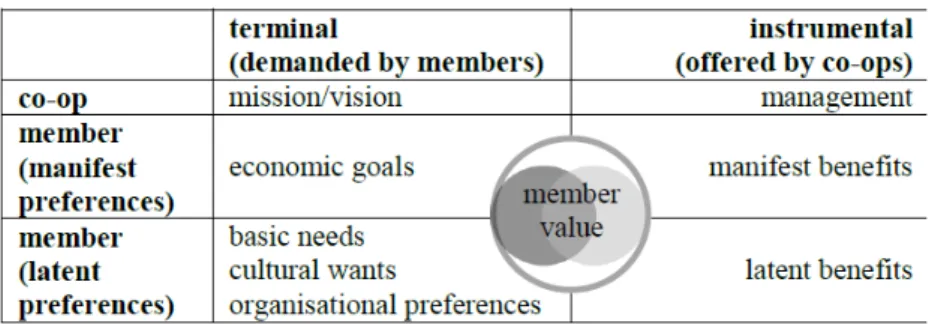
versa. So, even a small co-operative can create big member value as long as its benefits match the member’s latent preferences and economic goals. All the mentioned elements merge in a model of member value. According to Rokeach (1973), two dimensions can be differentiated: terminal, the preferences demanded by the members; and instrumental, the benefits offered by the co-op. The satisfaction of the latent preferences and economic goals of the members can be seen as the terminal objective, whereas the benefits offered by the co-op are instrumental in nature. Furthermore, a co-op is not only a provider of manifest and latent benefits, but also a value of the co-operative on its own. The offered satisfiers and specific characteristics of the co-op, which are mainly important for their latent benefits, cannot be understood solely with a member-focused perspective. Therefore it is necessary to add the co-op as a discrete element in the model. In combination of the two dimensions by Rokeach and the differentiation between the latent preferences, economic goals and the co-op, a two by three table can be drawn in the centre of which the member value arises (see Table 3).
Table 3 3x2 table of member value
By analogy with the members, co-operatives have a terminal goal too. And in most of the co-ops this terminal goal (social goals) – the co-operative’s vision – is the key determinant of the (strategic) actions taken by the entire organisation and the distinguishing element between a co-op and an investor-owned firm (IOF) which primarily focuses its actions on generating profits. In order to be able to pursue its mission, the co-operative relies on an elaborated ‘instrumental’ system that keeps the co-operative alive. Co-operatives are complex systems which have to be managed carefully (Schwarz et al., 2009, pp. 45-49).
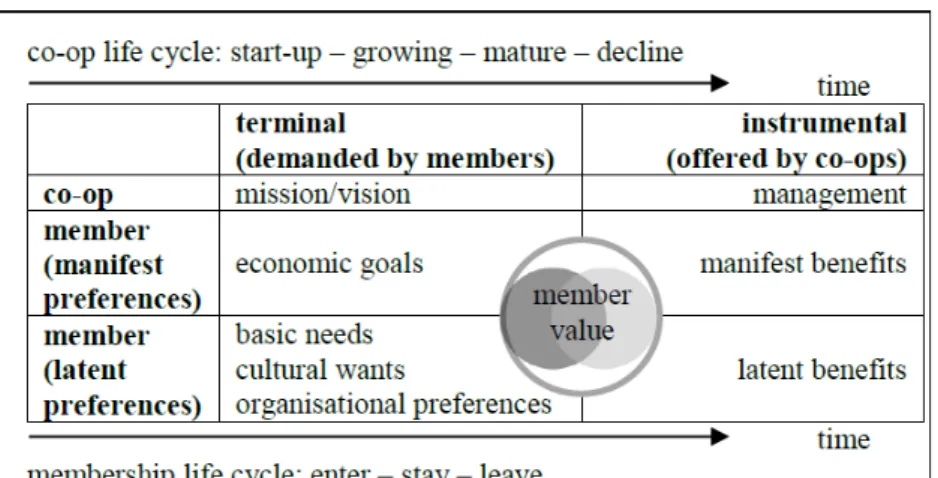
Members do not only take multiple roles within a co-operative: they are also a fundamental part of it. It has already been mentioned that many latent preferences are unconscious but have a crucial influence on the decision to enter, stay or leave the co-operative and that these preferences may change over time. Like the lifecycle of non-profit organisations (NPOs), the
membership can be divided into different phases too (Gmür and Lichtsteiner, 2009). The reasons behind these changes are the changed expectations of satisfiers. Therefore it is important to add a time-dimension to the member value model (see Table 4).
Table 4 Member value model
Although the basic needs do not change at all and the cultural wants just change slightly, the time dimension is very important to the organisational preferences and the ability of co-operatives to provide the demanded satisfiers. Thus the success of a co-operative can be defined as its ability to adapt its provided benefits according to changing organisational preferences and economic goals. It is not possible to adapt to every individual change in the organisational preferences and economic goals because they sometimes change in a different direction at the same time. But it is necessary to get a picture of the general feeling in the co-operative and the member opinions.
The close connection between the member and the co-operative side makes obvious that the two lifecycles can mutually influence each other. In the start-up phase of a newly founded co-operative, a new set of satisfiers is provided which could motivate members to enter. As long as the co-operative can offer an attractive set of manifest and latent benefits, new members will enter the co-operative constantly. The co-operative grows and may reach its maturity as long as it is able to adapt to the latent preferences and the economic goals of its members. But as soon as it starts losing this ability to satisfy those latent preferences and economic goals, the member value will decrease, and members are most likely to gradually leave the co-operative and the co-operative will move towards a decline phase.
Theoretical Conclusion
The presented member value includes the different important aspects of this chapter. The history of modern car sharing is mapped in the co-operative lifecycle, and the balancing act between the co-operative principles and service-orientation can be located in the combination of the terminal and instrumental dimension on the co-operative level. But the core of the model is the latent preferences and economic goals that are finally the starting-point of every co-operative.
The goal of any co-operative is to offer the best set of satisfiers according to their members’ needs at a certain time and to build their own specific co-operative culture, which is desirable to its members. Nevertheless, it is not possible to define a set of satisfiers that will be valid eternally for the co-operative and all its members. The wants of the members and the environment by which they are influenced are changing as well as the co-operative itself. Therefore the unique characteristics of a co-co-operative and the lifecycles of the co-operative itself and its members have to be taken into consideration (see Gmür and Lichtsteiner, 2009).
It should be kept in mind that one specific benefit or co-operative characteristic can satisfy several latent preferences of different members. In a nutshell, members have different expectations towards the co-operative whereas latent preferences, based on the nine basic needs by Max-Neef (1991), and economic goals must be distinguished. On the other hand, the co-operative is made responsible for a set of satisfiers, which meets the latent preferences and economic goals of their members. Member value arises as a result of the match between the latent preferences and economic goals of the members and the latent and manifest benefits (set of satisfiers) provided by the co-operative; therefore member value is not a statistic, but a dynamic concept.
From Theory Back to the Case
Looking back at the first part about the history of Mobility it becomes obvious that Mobility is already in the third phase of the co-operative cycle and members are not looking for the same values as at the beginning. Also the modern and highly professionalised co-operative itself cannot be compared anymore to the early day business when it was solely based on volunteer work. A lot more could be said about the changes along the co-operative and member lifecycle, but the focus of the last question lies on the latent member wants and preferences.
The Mobility reservation system is a good example to show the differences between the two levels of needs. In the beginning of car sharing every car had its board-book where every reservation had to be made by hand in advance. After that ATG established a call centre and ShareCom an electronic reservation system that facilitated the reservation. Later on Mobility launched a website with an online reservation tool and recently they even developed a smartphone application to reserve a car immediately. This technological progress is not just a specific characteristic of Mobility but of the whole culture. Nowadays almost every service can be reserved online and nobody would even think about writing a reservation manually in a boardbook. That is to say, the easy accessibility is a cultural want rather than a specific organisational preference to Mobility. Most of the time there is a flowing transition between cultural wants and organisational preferences, so the difference is mainly useful for in-depth analysis: an organisational preference became a common cultural want. In the analysis of Mobility’s member value the focus is not on the different levels of needs but rather on the provided satisfiers according to the nine basic needs.
Subsistence
In modern societies cars – or more general mobility – are essential for everybody. Therefore mobility itself should be interpreted as a substantial preference. To buy a car on its own and to maintain it is very expensive: some people just cannot afford it. In case of a low budget, Mobility is probably the only possibility to stay mobile beyond the fixed scheduled timetable and network of the public transport system that does not always fit with individual preferences. The same problem can arise in young families with babies. Mothers who stay at home sometimes rely on a car and if the husband goes to work by car, Mobility car sharing is a very good opportunity instead of buying a second car. The decision to join Mobility or to leave is closely related to the concrete life situation and the dependence on a private car respectively the flexibility to use other forms of transportation.
Protection
Protection is more than just the safeguard of one’s physical integrity; rather, it is a sense of security and confidence. Of course the safety of the cars is crucial, so the safety standards are an important factor in selecting new vehicles for the fleet. Confidence is probably the most important key word in relation to the basic need of protection. The reliability of the car-sharing service is absolutely necessary. Clients rely on a well-functioning car which is available to them at the exact time they reserved it for.
Since the members are not just patrons of Mobility but also investors, they want to be sure their co-operative share is safe. Hence Mobility has to demonstrate that the business is doing well. To build up confidence in the service of Mobility and its management communication is the key. Transparency and open communication are two principles of Mobility. Most of the information like annual and sustainability reportsand Mobility journals are available online without any restrictions of access. Another confidence-building factor are co-operations with reputable organisations like universities and semi-state institutions (Blumenstein, 2012).
Affection
The times when the regular clients knew each other in their small regional Mobility section are gone. Massive growth, professionalisation, reorganisation of the section model and the growing number of clients who are just looking for an inexpensive car have disrupted the original social cohesion. A proper community and sense of belonging does not exist anymore; for ‘normal’ members, the section meetings are the only possibility to get personal contact with each other. But most members are not interested in joining any kind of social interaction. By contrast, the members who are participating actively appreciate being together with other Mobility members and there is also a strong sense of community. Although the meetings officially have a formal character and provide a platform for information and discussion, the informal part is at least as important to those who are strongly involved. In general all members have the feeling of being recognised and listened to – they are not just a number but equal discussion partners. The same applies to the average member. The small sectional structure may be broken up, but the former heads of sections still play a role as representatives of their village or town and remain a point of contact for the members and customers.
Understanding
Understanding is closely connected to communication. In order to meet the members’ wishes for insights and news, Mobility offers the quarterly journal ‘my journal’ which is brief and simple to read. Additionally, for current issues the call centre is available 24 hours a day. Another aspect of the need understanding is curiosity. Mobility is famous in Switzerland and almost everybody knows the red cars. Nevertheless, even if somebody is interested he/she might not be willing to join Mobility. Therefore Mobility also offers trial memberships which last for four months and offer the opportunity to test Mobility and its cars.
Participation
Mobility is still a traditional co-operative and remains true to the ‘one man, one vote’ principle, at least at the section level. On the national level a delegate system is established where each section can vote a certain number of delegates according to the number of members. Beyond the formal structures, some members are also willing to help voluntarily at events like a Mobility promotion stand at a local campaign day against pollution. Mobility supports the participation of active members by small financial compensation for specific events and additionally all activists can profit from a bonus programme. Furthermore, the former heads of sections are still helpful in order to find new locations (parking) and to arrange contacts to local politicians or potential business customers, especially in rural areas.
Although all members have the same opportunity to participate, the big majority prefers to remain inactive, knowing that they could participate if they want to. If they should have a problem or a request they still have the possibility to call or write Mobility directly or to get in contact with the head of the section.
Idleness
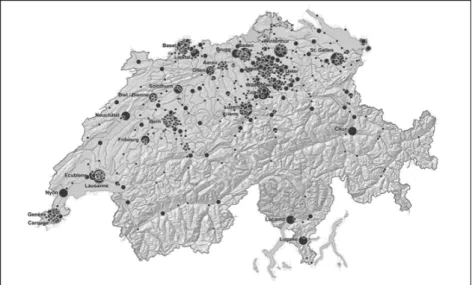
Max-Neef’s basic need idleness, according to Mobility, should be interpreted as convenience. On the one hand Mobility captivates with its service. There is no need to pay insurance, to search for a parking space, to change tires nor to care about other car repairs. Just reserve a car, use it and bring it back. On the other hand, the Mobility network is very dense, so usually there is not a long journey involved for anybody to get to the next car. For example, in Zurich the average distance to the next station is only 250 metres. Mobility has cars all over Switzerland, albeit mainly in the urban areas. The easy access is one of the crucial success factors of Mobility.
Today, more than 90% of the reservations are made digitally, though the call centre works very well. As a pioneer Mobility launched an online reservation tool in 1998 and in 2010 they created a smartphone app for an even more user-friendly service. Recently Mobility improved its smartphone app and introduced a shaking possibility. After shaking the smartphone the app instantly shows the next free Mobility vehicle and offers the possibility to book it directly. With this system spontaneous trips are possible.
Most of the Mobility-cars are mainly chosen because of their low fuel consumption and the safety standards. In May 2012 Mobility created the new
category ‘Emotion’ and offer black7 BMWs (116d urban-line) and a sporty
Mini Cooper D, which is advertised with the keywords driving pleasure and comfort (Mobility, 2012f). Moreover, the category ‘Convertibles’ stands also for pleasure and fun.
Figure 4 Map of the Mobility-stations (Source: Mobility, 2012c) Creation
In the case of Mobility creation is closely linked to participation. Members cannot only participate but also actively change something in the organisation. Especially when they become delegates, their opportunities increase strongly. As Mobility is a traditional co-operative and true to its basic democratic values the members respectively the delegates have decision-making power. A different form of creation is the work in a village or a town itself. Sometimes members help to find better parking or motivate other people to join Mobility in order to get a second car at the station. Von Arb (2012) says that the possibility to find a Mobility station and to see it grow was one of his main reasons to participate actively.
Identity
At the beginning of car sharing, ideological reasons, norms and values were crucial. The founders were mainly ecologically motivated to launch a car-sharing service and the early members were also willing to forgo certain benefits in order to support their ecological idea. The green ideology is present to this day. On average every client helps reduce CO2 emissions by
290 kg a year and the average consumption of the Mobility fleet is 14.8% lower than the average consumption of new cars sold in Switzerland (Mobility, 2012a). Therefore Mobility stands for an environmental-friendly organisation and thus attracts clients by its concept. Environmental awareness in Switzerland is rather high, so the car-sharing idea and Mobility benefit from social values.
Mobility is very famous and well established. Most people regard Mobility as cool and smart, despite knowing how car sharing works in detail. However, many clients are proud to be a part of Mobility and identify themselves with the shared values.
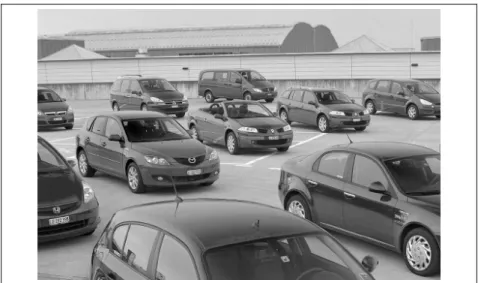
Except for the emotion category and the electric mobile, all Mobility cars are red. The red colour is one of Mobility’s trademarks, so every driver can easily be recognised as a Mobility client in an instant (see Figure 5).
Figure 5 The red Mobility fleet (Mobility, 2010, p. 32) Freedom
The most important point about freedom is having the right, but not the duty, to do anything. Mobility members are not forced to participate in the