© Oxford University Press 1989
Legitimacy and comparative economic success
at the core of the world system:
an exploratory study
VOLKER BORNSCHIER
ABSTRACT This paper suggests that comparative economic success is influenced by political choices which themselves are linked to the competitive world system. Governments produce social order (or protection) as a territorially bounded public utility, which is seen as a productive force. Citizens invest a social order with differing degrees of legitimacy which is thus, via motivation, an important competitive resource. A multiple regression design covering 18 Western core societies over the postwar era is used to test whether legitimacy, operationalized as relative absence of mass political protest, has an effect on comparative overall economic performance once initial wealth, absolute and relative size of government and membership in trading blocs are controlled for. We find robust empirical evidence for a positive impact of legitimacy on growth in the postwar era. The study thus suggests additional support for the theory of the 'world market for protection', developed elsewhere to explain long-term economic success and societal convergence at the core of the world system.
INTRODUCTION they benefited more from one of the sources of In the postwar era core Western countries comparative advantage in the competitive world adopted a new politico-economic regime system to which we draw special attention, embedded in a changed societal model namely legitimacy.
(Bornschier, 1988). This new societal model What we suggest is that comparative represented more than mere interventionist economic success is not altogether endogenous economic policy; it recruited unprecedented to the economy, but is influenced by political legitimacy among national populations. This— choices which themselves are linked to the as we argue—was one of the fundamental pre- competitive world system. Our proposition adds requisites of the enormous economic growth in weight to the recently reactivated debate on the that era, quite unprecedented in history. As economic growth implications of the welfare compared to previous high growth phases in state, which has become a postwar solution by capitalist development, growth rates doubled or core countries to achieve social peace and even tripled in that Golden Age (Maddison, effective social order (see Korpi, 1985, for an 1982). When the coherence of the societal model overview of the debate).
dissolved, growth declined from the 1970s When we point to politically created competi-through the early 1980s. In this paper we are not tive advantages we do not argue that govern-concerned with cycles but with the whole epoch ment per se is favorable for capitalist growth, as a unit of social change. Within the context of Quite the contrary. State action oriented the changed societal model of that epoch we towards what we call a 'tribute logic' hinders would expect those countries that were more long-term economic success in the world system, successful in tempering social conflict to have The state, however, which emerged at the core been even more successful economically, since of the modern world system is the result of a
long process during which the 'tribute logic' had to be given up in favor of the 'profit logic', and eventually—in order to take advantage of broader based legitimacy as a resource in the competitive world system—the profit logic had increasingly to be compromised with the 'logic of legitimization'.
The 'world market for protection' argument—to which we briefly turn in the next section—suggests an explanation for the evol-ution at the core of the world system. The evolution of a certain logic of state action which takes care of broader based legitimacy was the outcome since it represented a comparative advantage in the long run. Before we test whether this proposition holds also in the postwar era, we turn to the context of Western core countries, the development of hypotheses and the discussion of indicators.
Subsequently, we test, for core countries, whether comparative economic success in the postwar era was proportional to events of mass political protest per million inhabitants, the inverse of which we suggest as an exploratory indicator of legitimacy. For these tests we employ various controls; that is, initial wealth and the quantitative role of government, the latter in absolute as well as in relative terms. We discuss the findings and add further exploratory analyses of causal links between world system forces, political structures and policies and characteristics of the social structure.
THE 'WORLD MARKET FOR PROTECTION' ARGUMENT
The theory underlying the 'world market for protection' argument (Bornschier, 1988: ch. 14) emphasizes that 'social order', what we also term protection, is a public utility, although a territorially bounded one. Thus, protection is a neglected element of the national economic production function. Governments—which can be understood as political undertakings— produce 'order' and sell this public utility to capitalist enterprises, as well as to citizens under their rule.
Three actors are relevant in the social system which is interpreted as the 'world market for protection'. Political undertakings—which we
normally call governments or states—are ulti-mately defined by their claim to territorial monopoly of physical force, which is also the basis for their capacity to raise resources (tax-ation being the modern form). This is called the tribute logic. Capitalist enterprises combine factors of production and sell products and services on markets in order to make profits. They are thus subject to the profit logic. The large majority of citizens sell their labor power to either political or economic undertakings to gain an income and to make a living. Yet— although subject to political and economic power—citizens have a unique option to invest a social order with various degrees of legitimacy. They are subject to the logic of legitimization. The degrees of legitimacy invested in a social order we see as dependent on the extent to which claims to security, equality and efficiency are fulfilled. The compromise between these contradictory orientations of the three actors is regulated in the long run by the 'world market for protection'.
Since there exist various political under-takings offering 'social order', an important element to characterize the constellation as a market is fulfilled. Nevertheless, consumers of 'social order' are to varying degrees restricted where they can buy that public utility. The consumer choices are restricted because migrants between territories incur costs: transfer costs, loss of economic and social capital and devaluation of cultural capital, to mention only material ones.
Despite such (sometimes heavy) market imperfections, the actual or threatened shift of consumers to alternative supplies of effective 'social order' force different producers of that territorially bounded public utility into a competitive relationship. This may also be simply the result of long-term economic conse-quences of different types of 'social order'.
Since social order is a product with attached utilities, it must be produced. In principle, government can produce 'social order' either by means of coercion, which rests on force as the ultimate means of state power, or it can adopt measures which change the social structure in such a way that capitalists and/or the population subject to the state's rule attach greater
legitimacy to the social order.1 Although force and legitimacy are partly substitutive measures to produce 'social order', the world market for protection argument maintains that only effective social order represents a competitive advantage in the longer run; that is, the one which rests on legitimacy attached by citizens to it. This proposition needs further comment. The outcome of the 'market' at the core in
evolutionary perspective
Social order as a factor is not a homogeneous product: it is of different qualities depending on whether this protection is produced by force or by attached legitimacy. In the latter case we speak of high quality or of effective social order. We must now introduce points on the social basis of preferences for 'social order' of different quality, applying the triple articulation: political undertakings as suppliers of social order, capi-talist enterprises and citizens as consumers of that territorially bounded public utility.
Suppliers of protection are—in general— clearly not indifferent to the quality they pro-duce. Legitimacy as a source of protection limits their power and thereby that portion of 'tax-ation' they can consume as the ruling class. The political ruling class comes under different pressures. Private enterprises demand cheap effective protection, and their threat to invest abroad may force government to supply protec-tion almost at cost. Thus the political 61ite has to renounce part of its potential income, a part of the income-generating capacity of the state being eventually shifted from the luxury con-sumption of political 61ites to protection rents of capitalists. Of course, this historical shift has accompanied democratization, but in compara-tive perspeccompara-tive such an outcome was not the rule, being largely restricted to core countries.
With regard to preferences of consumers of protection, we consider first those citizens who are clearly not indifferent. The majority prefers a social order of high quality. Citizens have three broad measures of resistance at their disposal in order to combat an illegitimate regime: (i) politico-military opposition to government, (ii) political protest or votes against office holders, and (iii) subtle measures of refusal by reduction of commitment. The
opposition of citizens to a regime raises the costs of control and suppression for those in political power. They need to raise taxes to break or hold down resistance, which increases the costs of the state without improving the level and quality of protection.
Refusal as a more subtle form of resistance seems to be unspectacular, but should not be underestimated. It is probably among the most powerful weapons at the disposal of citizens, at least in the long run and in the competitive world environment. A reduction in commitment seriously impairs productivity, since a lack of consensus about the social order reduces motiv-ation in general, and work motivmotiv-ation in par-ticular. In purely economic terms such losses may outweigh working days lost through strikes. As employers, capitalist enterprises are thus also not indifferent to the kind of protection they can buy. Of course, in the first place they prefer protection at low cost. But, subsequently, induced by world competition, they are interested in a motivated and loyal work force. It would be naive to assume that the behavior of employers in general is characterized by a search for low costs per se. Primarily they optimize profit, and this may be easier to achieve if the factors of production they buy are of good quality and thus worth their price.
If a state tries to break resistance in a popu-lation by means of force, capitalist enterprises suffer from two disadvantages. First, they cannot rely any longer on a motivated work force, and, second, they must pay more for protection. Under such conditions capitalist pro-duction is clearly not impossible, as we know from numerous historical and contemporary examples, but such social formations are neither able to maintain nor attain core status in world production.
The hypothesis is, then, that on the 'world market for protection' sufficiently high quality protection is preferred. However, protection of high quality—effective social order which is based on legitimacy—has not always been the actual outcome of the world market at various places and times. The reason is that we only elaborate the argument for core societies. Different solutions exist for other societies which are not the topic of this paper. Another
reason is that the reaction of the world market—even at the core of the world system— is sticky and does not penalize alternative solutions immediately, but only in the longer run.
To avoid falsifying history, we must acknowl-edge certain regularities. The long run in more successful social formations at the core has always been characterized by protection options that favor legitimacy. This should be understood in comparative-historical terms, that is, as compared to contemporary competitors. Only because of this were they successful and, for a while, leaders in capitalist development. Freer arrangements of wage labor, more opportunities for larger parts of the population and more liberal institutions were typical for all the indus-trial leaders of the modern world system. This holds also when one goes far back to Venice or North Holland. Over time this option, typical for ascending social formations, became even more urgent owing to increasing levels of indus-trial complexity. Those who tried to 'row against the tide' never reached the peaks of the world industrial pyramid.
This pattern is, however, one of ascending social formations, as well as of those that man-age to keep on top. Declining ones, and declin-ing hegemonies in particular, lose their position also because they gamble away their earlier competitive advantage in the protection market. External protection rents of hegemons may mask the decline for a while, but intensify it later since they cause the Elites to neglect the claims of domestic legitimacy.
The postwar societal model is conceived of as a specific step in the evolution of the outcome on the 'world market for protection' at the core. Governments were either forced to behave according to the requirement of a capitalist state; that is, to renounce the tribute logic and to take care of internal legitimacy, in order to compete in the world system or they were economically penalized in the long run. Under this situation of effective social order, capitalist enterprises and populations eventually share in the advantages of that territorially bounded public utility. What enterprises seem to give away, as compared to cheaper solutions than welfare states, they recuperate through a loyal
and motivated work force and through the enlargement of their markets.
Acknowledging prior theoretical work
The ideas underlying the notion of a regulatory mechanism of the 'world market for protection' build on prior theoretical work, and it is only fair to mention the most influential.
The idea of subordination of the tribute logic of the state to the profit logic of capital in the modern world system goes at least back to Max Weber. While he seems to imply that this is a characteristic of the world system as a whole, we would rather suggest that this is the condition for attaining or maintaining core status in the world system.
After the turn of the century Weber added an interesting new idea to the long history of think-ing about the relationship between the state and capitalism. Weber's (1923) reasoning is that the continuous, formally peaceful or belligerent struggle between competing states provided the most excellent opportunities for modern capi-talism. A given state had to compete for the free-flowing capital that dictated the conditions under which it was willing to help state power develop. According to him, this constellation of competing states is the prerequisite for the development, as well as the perpetuation, of capitalism. Capitalism will only last as long as no world empire arises. This paragraph is now inserted at the beginning of his sociology of the state.2
The idea that both important processes of the modern world system, that is, state formation and capitalist development, are inextricably interrelated—representing but two sides of the same underlying social process (Hintze, 1929: 28)—was not fully elaborated by Weber, on account of his early death. Yet it has influenced various other theorists and recently received a new and very interesting interpretation by Chase-Dunn (1981, 1989) who regards capi-talism as a system in which political and economic processes can be understood to have a single, integrated logic.3
Equally seminal was Weber's notion of economic behavior. He introduces the analytical distinction between economic and economically motivated action (Weber, 1972: 31). Later Lane
elaborated further the notion of economically motivated behavior which uses force as a means, and suggested that violence, under certain con-ditions, may be productive (Lane, 1979: 5If).
Weber's seminal ideas thus laid the ground for two things. First, the distinction between two types of enterprise that developed in modern times and which do not differ in their ends, but only in the means of achieving them: tribute versus profit logic. Second, the notion that not only economic activity in the narrow sense, but also force may be productive, and that 'violence-controlling' elements must be included in economic analysis.
But Hintze first formulated the idea of two enterprises. According to him, the process of modern state formation can be regarded as an undertaking—a political undertaking alongside the economic one. In the long run the political undertaking can only be successful in striving for power if it is able at the same time to satisfy the vital needs of citizens. Service to the public lies in the creation and supply of power to provide security and legality (Hintze, 1929, reprinted 1964: 331f).
In the late work of Lane (1979) these theoreti-cal ideas in the tradition of Weber and Hintze reappear. Lane takes both the notion of two types of enterprise and state power as a basis of utility and profit. This is clearly evident in the very title of his collection of essays Profits from Power: Readings in Protection Rent and Violence-Controlling Enterprises. In addition Lane initiated a systematic treatment of the problem in comparative perspective. What are the consequences of protection if it is at certain times and in certain places produced with more ease or at lower cost?
In order fully to understand Lane's theorem of protection rent, it must be acknowledged that not only are capital, land, labor and technology factors of production, but so also is protection. Protection, although politically created, shares certain characteristics with land, insofar as it is also territorially bounded. Thus, there exist not only land rents but also protection rents (Lane, 1979: 25).
The two theorems can be stated from the point of view of states or capitalist enterprises: (i) that state will be the strongest which can
'combine a moderate tribute with effective pro-tection conducive to innovation and investment' (Steensgaard, 1981: 271); and (ii) that capitalist enterprise will prosper most which can choose, or is fortunately placed in, a network of economic transactions effectively protected at low cost. Advantages thus accrue to both sides: higher returns due to lower protection costs provide protection rents for capitalists and enhance their accumulation, and higher returns due to more income to tax also provide a larger resource basis for the state.
What we add to this history of thought4 is that not the capitalist state per se is most favorable for economic success, but the one that reconciles the capitalist profit logic with the claims for legitimacy among citizens, based on demands for security, equality and efficiency. Although legitimacy is attached, we suggest that its endur-ing impact does not rest on ideology but on features of the social structure which reflect the fulfilment of such demands.
THE CONTEXT OF THE WESTERN CORE IN THE POSTWAR ERA AND THE
HYPOTHESES
If the basic argument of the 'world market for protection' is correct, we should also find empirical evidence for the working of the theor-etical mechanism over a much shorter time-span. This is what we test in the next, empirical section for 18 core countries between 1948 and 1980-83. Our main question is whether legitimacy has been a comparative economic advantage among core countries also in the postwar era.
Our empirical study which tests the impact of effective social order, as evidenced by the absence of mass political protest, applies to a selection in space and time. The test includes only core countries5 since we expect specific outcomes on the 'world market for protection' in different subformations of the world system. By our restriction to core countries we introduce certain conditions which are noteworthy. The institutional framework characterized by the state under the rule of law, political democracy and civil rights to quite freely express dissension and opposition (and also beyond 'normal'
politics) drastically narrows the range of options between the use of force and measures that enhance legitimacy. In the perspective of the history of state formation governments in postwar core countries employed comparatively little overt force.6
The social techniques to elicit legitimacy attached to a social order by citizens are time-bound. In the postwar era of Western countries those social techniques which are typical of the welfare state emerge. A cluster of such policies, which became very popular in several Western countries, consists of quasi-corporatist arrange-ments of conflict resolution, strategies to help dampen class conflict, measures to redistribute income (including substantial social security mechanisms), measures to reduce inequality of opportunities in status allocation through the opening of the school system and other inter-ventions.
Hypotheses, indicators and control variables Already from the characterization of the whole period under study as the welfare state era, it becomes obvious that government played in general a large role. Yet, more specifically, we expect that rather the extent to which govern-ment policies were successful in keeping social conflict low provided a valuable asset, that is, legitimacy, which resulted in comparative national economic success.
We do not then imply that sheer measures of size of government matter. Quite the contrary: economic resources which the state controls but which are not channelled into political action that enhances legitimacy should rather have an unfavorable impact on comparative economic success (being relics or new forms of the tribute logic).
In order to test the hypotheses of the com-parative advantages of legitimacy, we rely in this exploratory study on the frequency of mass political protest events (weighted by the number of citizens in millions). The inverse of this conflict measure we take as an indicator of 'legitimacy'. This procedure is obviously not without problems. Of course, frequent mass political protest is an indicator of limited legitimacy. But the absence of such protest need not indicate legitimacy, but may only stand for
mere toleration of the social order or may only be the consequence of government repression of mass political conflict. The latter objection we do not consider relevant in the context of core Western societies, but it seems obviously of importance in other societies. Yet the objection that the absence of protest may indicate either mere toleration or legitimacy we cannot rule out in this exploratory study. The reader who is sceptical about our interpretation of the legitimacy indicator may simply interpret the empirical results more straightforwardly: absence of mass political protest.
When we test for the effect of legitimacy on comparative economic success we have to con-trol for size measures of government, in order to show that the advantage is not simply a correlate of government, but is politically created by a specific set of measures which are at the core of the welfare state model. Although we do not analyze such measures in detail in our explora-tory study, we point to some empirical correlates of legitimacy as it is measured in this study.
There exists no single measure of the quan-titative role of government since it depends on the perspective. In national terms, the resources which, for example, the Dutch state controls may be quite impressive (government expen-ditures of the Dutch state as compared to Dutch GDP), but in absolute terms states in larger countries have much more impressive resources at hand. Thus, even if the relative share of government were the same among Western so-cieties (which is, of course, not the case), the absolute size of government still differs enor-mously. This is due to one important structural feature in the world system; that is, the large differences in the power base among states. Since absolute government size may be a means of influencing the world political economy, we have to consider such a measure as a control variable.
Furthermore, if a certain level of absolute government size is necessary in the world political economy in order to protect national economic interests, the relative size of govern-ment in smaller countries will be necessarily larger than in bigger countries. Thus, we would not expect the relative size per se to be unfavor-able for economic success. Smaller countries are
221 more forced by the world political economy to
bring both the perspective of the world economy and the national economy together. In order to be competitive at the core, they have to increase state strength, but have to use it in a way that increases internal legitimacy. This is the more the case if a small country is highly integrated into the world political economy.7
We pointed to the possible impact of power in the world political economy on economic success and have at least to mention that membership in trading blocs may also be an important factor. Although we cannot go into details here, we consider a first and rudimentary control for such membership. Trade among the core countries was for only part of the period under study (1948-83) effectively regulated by the international regime laid down in the GATT rules (non-discrimination and liberalization). The exercise of power in international trade relations became more important after 1971-73. Finally, over the period under study new trading blocs emerged, like the EEC, while the (British) Commonwealth of Nations disinte-grated.
Moreover, we would like to point to another variable which we consider to be very important for explaining comparative economic success; that is, the catch-up or late-comer effect. The United States emerged out of World War II as the consolidated economic and political hegemonic power. As compared to Japan and large parts of Europe, which faced heavy economic disruption and destruction, the US entered the postwar era strengthened. The US initially took a clear lead in the new economic sectors that gave most dynamism to the postwar boom. Thus, in terms of industrial development, but also in standard of living and spread of mass consumption, the US was far ahead, at the core of the core, while the other core countries lagged behind, although to quite different degrees. This, for example, is evidenced by the considerable spread and range of GNP per capita in 1950, when the US GNP per capita— the highest at that time—was 10 times the lowest figure, that for Japan. In the postwar period, however, the other core countries caught up markedly, those with the lowest initial GNP per capita growing on the average faster. This
catch-up effect, limited as it was to core countries, we will control in the empirical study.
Finally, our concept of comparative economic success needs some comment. In order to test the impact of our explanatory variable, legitimacy, we need to cover a long period since we expect the effects to work gradually but cumulatively. The frequently used measure of real growth rates of economic aggregate figures,
TABLE 1 Indicators used in the empirical study
Alternatives for the dependent variable: economic success - The ratio of a country's share in total GNP of the core,
1980 and 1955: (GNP 1980/GNP 1955, times 100). The source is the World Bank (1971, 1983).
- The ratio of a country's GNP per capita, 1985 and 1960: (GNP per capita 1985/GNP per capita 1960, times 100). The source is the World Bank.
- The ratio of a country's share in total world exports, 1983 and 1953. The source is UNCTAD (1976) and Monthly Bulletin of Statistics (various issues).
Test variables
- Mass political protest, 1948-77, per million inhabitants in 1965. This indicator includes all events of anti-government demonstrations, riots and political strikes and relates them to the total population. The source is Taylor and Jodice (1983: II; 16ff). The source reports for the years 1948 to 1977 total 7,742 events for all 18 countries. (Hibbs (1973) has demonstrated that the above-mentioned conflict items load on one factor, which was confirmed by our own factor analysis.)
Note: we interpret the inverse of political mass protest as an indicator of legitimacy.
- Initial wealth as indicated by GNP per capita in 1950 (World Bank, 1971).
Control variables
- Relative size of government over the 1948-77 period, indicated by government expenditures as a share of GDP, averages for the figures for 1950, 1960 and 1977. The sources are Schmidt (1982) and OECD (1985).
- Absolute size of government over the 1948-77 period, indicated by government expenditures in US-dollars. This variable is constructed by multiplying the government share by total GDP.
- Loss of external protection due to disintegration of the (British) Commonwealth of Nations, represented by a dummy variable with the value one for the members of the Commonwealth in our sample (United Kingdom, Canada, Australia, New Zealand) and with the value zero for all other core countries.
like the GNP, has clearly limitations since revaluations of national currencies under the regime of floating exchange rates since the 1970s have an impact on national economic wealth. This is of even greater importance if countries trade considerably across borders.
Therefore, we do not consider real growth rates but compare the relative position at the beginning and the end of the period under study. As the dimension of comparison we use the total national product converted to US-dollars, and mention also our findings for gross national product per capita and for shares in world exports. To illustrate the nature of such com-parative economic success measures: the Netherlands in 1953 had a share in total world exports of 2-6 per cent and one of 3-6 per cent in 1983. Since the same increase in percentage points means quite different things for small initial shares in world exports than for large ones, we relate the later share to the initial share and obtain growth rates of shares.
Design and model
We underline that we analyze the postwar era as an epoch, the one in which the welfare state was institutionalized and expanded. Ultimately, dur-ing the 1970s, this societal model seems to have approached limits and lost some of its initial cohesive power, albeit to varying degrees in different countries. We characterize the whole period from 1948 to 1977 by an indicator of mass political protest which we interpret as relative lack of legitimacy and do not consider changes in legitimacy over this time.8 Instead we compare differences in solutions to moderate the ever-present social conflict over the whole epoch and relate them to comparative economic success among the core countries.
Our causal hypothesis is difficult to test since we take a whole epoch as our unit of analysis. In order to include a causal ordering in our design, we estimate the lagged effect of legitimacy in the 1948-77 period on economic performance from the mid-1950s to the early 1980s. The results we obtain with this method are checked by estimat-ing lagged cross-panel regressions. The advan-tage of such a design is that we can rule out false causal inferences, but this is achieved at the expense of basing our observations of mass
political conflict on shorter periods.
The test model we apply proposes that our measure of comparative economic success is proportional to the inverse of mass political protest and the inverse of initial wealth. To this model we add in a second step control variables. The model is given with Equation 1.
Equation 1
'"77
where:y' denotes the estimated growth ratio,
a is a constant (which represents unmeasured growth effects),
x denotes mass political protest, and z represents initial wealth.
The model in Equation 1 specifies non-linear relationships. In order to be able to apply linear regression estimates, we have to transform the model into linear relationships. This can be done by taking natural logarithms.
Equation 2
hi y' = In a — brln x — b2-ln z
The model specified in Equation 2 can be estimated by ordinary least square (OLS) tech-niques. In order to show that such a log-linear model yields better results, and thus corroborates our non-linear specification of effects, we report also the results for linear effects between the variables.
EMPIRICAL TESTS AND RESULTS
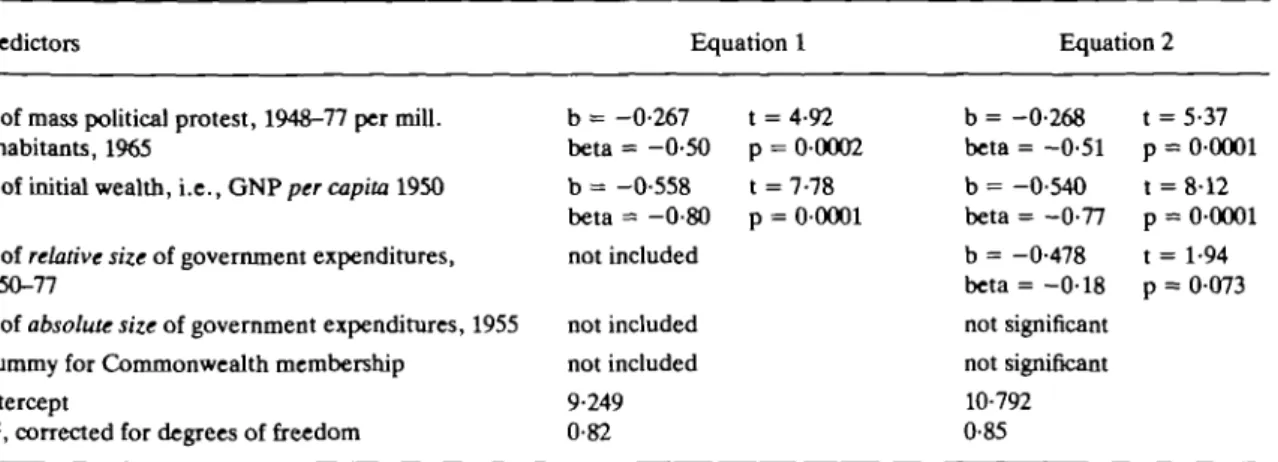
Table 2 presents the results of regressing the ratio of GNP 1980/GNP 1955 on mass political protest, on initial GNP per capita, and on three controls in log-linear form. Equation 1 includes only the two main predictors without further controls.
Initial GNP per capita has a significant and very substantial negative effect on comparative GNP growth. The same applies to mass political protest, which has a significant and substantial negative effect of the GNP growth ratio. Both predictors are virtually independent: the
corre-EUROPEAN SOCIOLOGICAL REVIEW
TABLE 2 Dependent variable: comparative economic success, as measured by GNP growth. Linear OLS-estimates for
ln(100*GNP 1980/GNP1955)W
Predictors
hi of mass political protest, 1948-77 per mill, inhabitants, 1965
In of initial wealth, i.e., GNP per capita 1950 hi of relative size of government expenditures, 1950-77
hi of absolute size of government expenditures, 1955 Dummy for Commonwealth membership
Intercept
R2, corrected for degrees of freedom
Equation b = -0-267 beta = -0-50 b = -0-558 beta = -0-80 not included not included not included 9-249 0-82 t = P = t = P = 1 4-92 00002 7-78 00001 Equation 2 b = -0-268 beta = -0-51 b = -0-540 beta = -0-77 b = -0-478 beta = - 0 1 8 not significant not significant 10-792 0-85 t = P = t = P = t = P = 5-37 = 00001 812 = 0-0001 1-94 0073
Note: (a) The insignificant predictors in Equation 2 were removed from the final regression.
lation between initial wealth and mass political protest is r = - 0 0 6 .
In Equation 2 it is tested whether our control variables (relative and absolute size of govern-ment expenditure and Commonwealth member-ship) have an impact. Only for the measure of relative size of government do we obtain a negative effect. But this effect leaves those for initial wealth and for mass political protest almost unchanged. Again, the intercorrelations between the independent variables are prac-tically zero (relative size of government with mass political protest: r = —001, and with initial wealth: r = 0-14). The effects of the other control variables are insignificant.
Robustness of regression in log-linear form The regression of the GNP growth ratio on initial wealth alone, on mass political protest alone and on relative size of government alone are presented in Figure 1. Removing outliers from the regressions yields still very significant results for initial wealth and for mass political protest, whereas removing the outlier on rela-tive size of government from the sample (Japan, with the lowest value on this variable and the highest value on GNP growth ratio) makes the effect of relative size of government expenditure drop to insignificance (t = 0-88).
Does only the log-linear specification produce the results?
When we regress the GNP growth ratio on the predictors, and both dependent and indepen-dent variables are now in un-logged form, we obtain the same structure of results as listed in Table 2, albeit with a less significant total regres-sion because non-linearities are now involved. But in this case also both initial GNP per capita and mass political protest have significant nega-tive effects on GNP growth, whereas that of the relative size of government expenditures is again negative, but again not robust.
Intermediate conclusion
We find for 18 core countries that mass political protest, 1948-77 per million inhabitants and initial GNP per capita, 1950 have substantial negative effects on the growth of GNP between 1955 and 1980. The quantitative role of govern-ment has either no effect at all, or the negative effect of (relative size of) government is not robust because it rests only on the impact of a single outlier. Since we interpret mass political protest as an indicator of relative lack of legitimacy, we can conclude that legitimacy has been an economic advantage, whereas the quan-titative role of government as such had no economic growth impact.
y = -.63«x • r s i , R2 = .591 6 5.8
I
56
£ 5.4 | 5.2? 5
I 4.8
8 4.6 - 4.4 4.2 ( • * • • •> 1
t 5.25 5.5 5.75 6.25 6.5 6.75 7 ln(GNPper capita 1050) 7.25 7.5 7.75I
I
4 B 4 - 4 4 .5 y = - . 2 4 3 x + 5.30, R2=.21 •f
•
• • ••
^^
—-^—^^^
1 1.5 2 2.5 3 3.5 ln(ma*s political protest 1948-77 per million inhabitants 1965)y = - . 7 4 1 x • 7.411, R2 = .081 o. 5.8 5.6 5.4 5.2 5 4.8 4.6 t 4.4 4.2 • = - - = ; • ' • 1 1 < U* — - — 3.1 3.2 3.3 3.4 3.5 3.6 3.7 3.8
ln(govemment expenditures as % of GDP, average 1950,1960,1977)
TABLE 3 Dependent variable: comparative economic success, as measured by share in world exports. Linear OLS-estimates
for ln(100* export share 1983/export share 1953)^
Predictors
hi of mass political protest, 1948-77 per mill, inhabitants, 1965
hi of initial wealth, i.e., GNP per capita 1950 hi of relative size of government expenditures, 1950-77
hi of absolute size of government expenditures, 1955 Dummy for Commonwealth membership
Intercept
R2, corrected for degrees of freedom
Equation b = - 0 1 9 1 beta = -0-22 b = - 0 - 9 % beta = -0-86 not included not included not included 11-886 0-73 t = P = t = P = 1 1-73 0105 6-82 00001 Equation 2 b = - 0 1 9 6 beta = -0-22 b = -0-896 beta = -0-77 not significant b = 0-089 beta = 0-19 b = -0-474 beta = -0-33 10-767 0-86 t = 2-49 p = 0-027 t = 7-72 p = 0-0001 t = 209 p = 0-056 t = 3-36 p = 0-005
Note: (a) The insignificant predictors in Equation 2 were removed from the final regression.
The remaining analyses test in a first step (i) whether this finding holds for other indicators of comparative economic success and (ii) whether the results are similar in a lagged cross-panel regression design. In a second step we present initial evidence for the causal chain between external constraints and internal legitimacy. GNP per capita growth ratio (1985/1960) as the
dependent variable
Again we test the model in the log-linear form. GNP per capita 1985/GNP per capita 1960 is now the dependent variable. In order to avoid rep-etition, we simply mention the results. Mass political protest and initial GNP per capita are also significant predictors of GNP per capita growth. Relative size of government expen-ditures has a significant negative effect which is, again, not robust once we remove only one outlier. In addition to these findings, which are very much the same as those of Table 2, we estimate a negative effect of Commonwealth membership on GNP per capita growth between 1960 and 1985.
Growth of share in world exports (1983/1953) as dependent variable
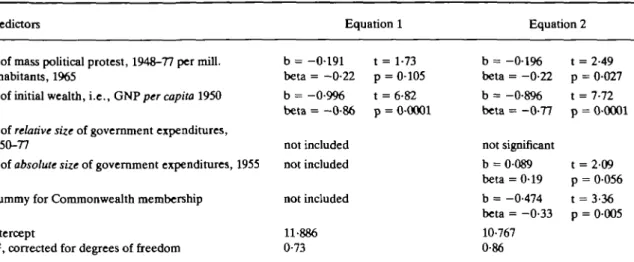
The effects estimated for a model in log-linear form are listed in Table 3. Again, both initial
GNP per capita and mass political protest have significant negative effects on export share growth. The regression estimate for mass political protest is—although significant— weaker than for GNP growth (cf. Table 2), while the effect for initial wealth is stronger. Absolute size of government expenditures has a significant positive effect, while the effect of relative size is now insignificant. Commonwealth membership has a substantial negative effect.
We conclude that in the case of export per-formance additional variables which indicate power (or loss of power) in the world political economy seem to play an important role besides domestic legitimacy and initial wealth.
Test to exclude false causal inferences
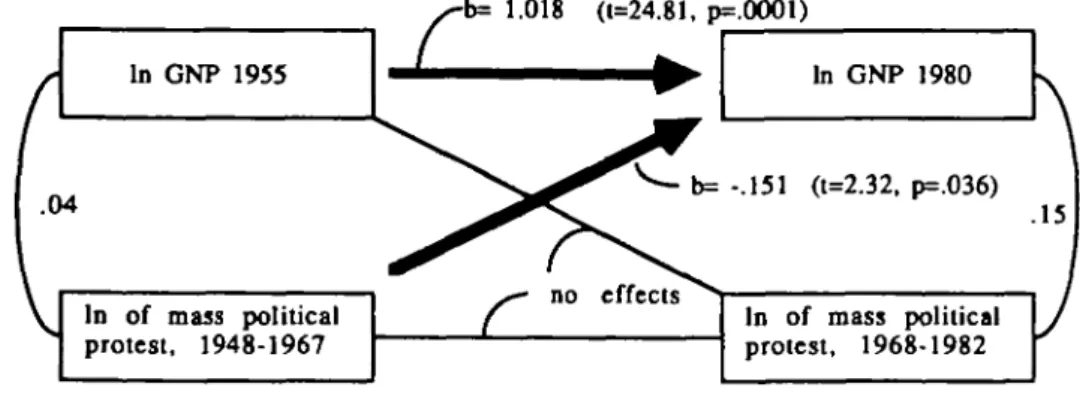
Was a sound economic performance helpful in keeping social conflict low, or does causality also run the other way round, as our hypothesis suggests? Our design comparing whole social epochs makes causal testing difficult and our time-lag design so far is no proof of causality. Figure 2 presents the results for a lagged cross-panel regression model that includes measures of mass political protest between 1948-67 and 1968-82. We estimate a significant negative effect of mass political protest in the period 1948-67 on later GNP, whereas GNP in 1955 has
/i
b= 1.018 (t=24.81, p=.0001) In GNP 1955 .04 In of mass political protest. 1948-1967 In GNP 1980 b= -.151 (t=2.32, p=.O36) .15 In of mass political protest, 1968-1982J
FIGURE 2 Lagged cross-panel regressions^')
Note: (a) Both In GNP 1980 and In of mass political protest 1968-82 have been regressed also on initial wealth. This variable (not represented in the graph) has a significant effect on In GNP 1980 but no effect on In mass political protest 1968-52.
no effect on later mass political protest. It is, furthermore, interesting to note that the mass political protest in the two consecutive periods is virtually unrelated.
The additional test employing lagged cross-panel regressions cannot rule out our causal interpretation that mass political protest reduces comparative economic success. Such a main causal effect does, of course, not exclude feed-backs between legitimacy (absence of mass pro-test) and economic success.
DISCUSSION AND ADDITIONAL FINDINGS First we would like to point to what we consider to be our main findings.
(i) Countries with lower initial wealth had an economic advantage over others. This catch-up effect among core societies proved to be very strong.
(ii) Furthermore, countries with a lower per million level of mass political protest, 1948-77, had greater comparative economic success in the period between the mid-1950s and early 1980s. This holds for three measures of economic success (see above). This finding appears to be robust, and additional tests suggest that our causal interpretation cannot be ruled out.
(iii) We did not find the quantitative role of
government over the 1948-77 period to be sub-stantially related to comparative economic success. Either the effect was not robust or small.
We interpret our findings in the following way: the inverse of mass political protest we consider as an indication of legitimacy among the population attached to the social order. Thus, legitimacy or 'effective social order' has been a competitive advantage in the postwar era among Western core countries. It was therefore not government invervention as such which mat-tered but intervention that could elicit legitimacy among the citizens. This appears to us as an often neglected aspect in the debate on the welfare state.
Thus far we only have a limited number of other empirical results with which to compare the main finding of this paper. Earlier findings (Bornschier, 1988) are corroborated by the more rigorous test we employed here.
Negative associations between political pro-test and economic growth indicators are also reported in previous research (Hibbs, 1973: 38; Jagodzinski, 1983: 36). In contrast to these earlier findings for world samples of countries, the effect revealed in our study appears remarkably robust and is more substantial. One reason for this difference may be that we fined the analysis to core countries and con-sidered a whole epoch, the postwar era.
World system forces (external constraints) (position in the world system and relative importance of world economic links) Internal characteristics of policy formulation and conflict resolution
(internal procedures aimed at dampening conflict)
Outcomes of policies and socioeconomic characteristics
(characteristics of the social structure which are appreciated or disliked by citizens)
- • Legitimacy with which citizens invest the social order . (motivation and satisfaction which affects
labor productivity as well as entrepreneurial I efforts)
Comparative economic success in the competitive world system, net of other factors
FIGURE 3 A flow chart of causal links
Korpi (1985) found measures of welfare spending to be significantly positively associated with growth of GDP per capita as well as growth of productivity in the period 1950 to 1973, and also from 1973 to 1979, for 17 OECD countries.9 Korpi's findings are highly compatible with ours. The difference from our design is that he employed measures to achieve legitimacy while we measured legitimacy itself, which may be based on quite different social techniques. Thus Korpi had to exclude the case of Japan in order to obtain significant results, a country which partly uses different means to achieve legitimacy (Bornschier, 1988, ch. 13).
In this paper we have broached the question of social techniques with which protection is 'produced' by the state, but no more than inci-dentally. Only briefly have we mentioned back-ground variables that tend to affect the need to tackle domestic legitimacy. Such background variables arise from the position a country occupies in the world system. Smaller countries are, in general, more exposed to the world
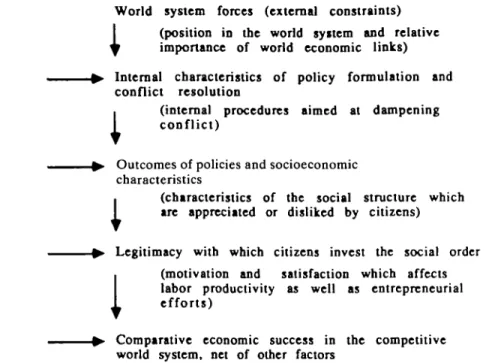
market. In Figure 3 we suggest a causal chain between world system forces (external con-straints) and efforts to achieve legitimacy among citizens.
Such a causal chain is compatible with prior work on world market links and internal charac-teristics (Cameron, 1978; Schmidt, 1982; Bornschier, 1988: 285f) as well as with Coser's (1956) 'proposition 9', derived from the work of Simmel (1908).
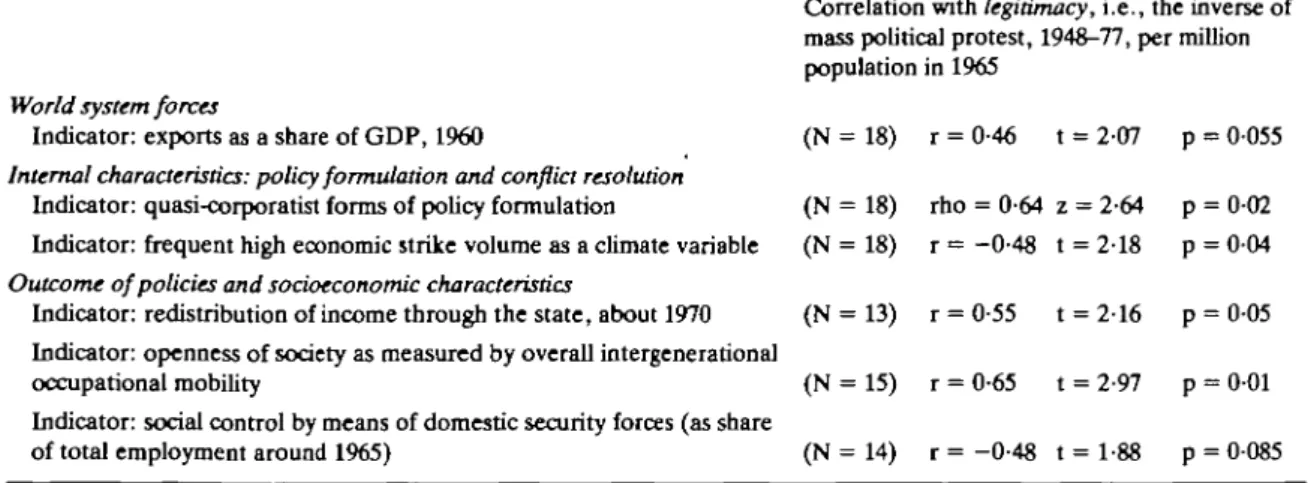
We do not discuss and test this causal chain in more detail here but simply point to some illustrative correlations that suggest initial support for the underlying hypotheses. As indicators we consider preliminary variables. Table 4 lists the correlations between indicators on each level of the causal chain with legitimacy, that is, the inverse of mass political protest.
The findings in Table 4 suggest that legitimacy is related to background variables as well as to internal characteristics. Furthermore, there exist significant correlations between the indicators of the different levels of the causal chain (not given
TABLE 4 Zero order correlations with legitimacy
(N = 18) r = 0-46 t = 2-07 p = 0055 Correlation with legitimacy, i.e., the inverse of mass political protest, 1948-77, per million population in 1965
World system forces
Indicator: exports as a share of GDP, 1960
Internal characteristics: policy formulation and conflict resolution
Indicator: quasi-corporatist forms of policy formulation (N = 18) rho = 0-64 z = 2-64 p = 0-02 Indicator: frequent high economic strike volume as a climate variable (N = 18) r = —0-48 t = 2-18 p = 0-04
Outcome of policies and socioeconomic characteristics
Indicator: redistribution of income through the state, about 1970 (N = 13) r = 0-55 t = 2-16 p = 0-05 Indicator: openness of society as measured by overall intergenerational
occupational mobility (N = 15) r = 0-65 t = 2-97 p = 001 Indicator: social control by means of domestic security forces (as share
of total employment around 1965) (N = 14) r = -0-48 t = 1-88 p = 0085 Sources: The data can be found in Bornschier (1988, notes to ch. 15), except for occupational mobility where we rely on unpublished findings by Michael Nollert, and for exports as share of GDP (see Bornschier and Heintz, 1979). Note: quasi-corporatist forms of policy formulation is a rank scale; therefore, we compute the rank correlation.
in the table) which give prima facie support to the whole argument.
One fruitful line of future research would be to establish more systematic empirical evidence on the structurally determined, as well as time-bound range of state policy options—on how they are combined to produce protection as well as how successful such policies are over the long-run to achieve the attribution of legitimacy among citizens. Since legitimacy is attributed, further research should also investigate our claim that mere ideology, that is, without changes in the social structure that provide a basis for high quality social order, does not result in an enduring favorable effect on economic success.
Concluding remark
We could not reject the hypothesis that politically created effective social order matters for long-term economic success. Effective social order in which citizens invest legitimacy we found to be associated with various indicators of economic performance over a 30 year period.
In historical perspective, we furthermore observed from previous research that countries which enjoyed high quality protection had an edge over their competitors in the world system
(Bornschier, 1988, ch. 11). This limited the choice of governments in producing protection. The 'world market for protection' thus seems to regulate political undertakings in the long run through the differential economic success associ-ated with differences in 'social order' that they provide. The 'world market for protection' argu-ment may thus tell us something about why social structures, including the state, converged at the core of the world system.
The sanctioning of that specific social system to which Max Weber first drew our attention seems to have been powerful. Social formations which did not conform could not attain or maintain core status. This is a historical lesson, which we should not forget when we think about the future of the welfare state. There is no reason to accuse the welfare state of having generally been a 'leaky bucket'.10 Rather it was an indispensable 'irrigation system', one of the bases for success. But this applies to the qualitat-ive, not to the mere quantitative role of government.
NOTES
1. Under force we subsume all actual or threatened acts that aim at compelling actors to behave in a specific way or to avoid certain behavior, whatever the various
measures of force may be (threat of physical harm to persons and property, curtailment of freedom to act, to move, to express opinions or to trade). Insofar as force is exercised on the basis of laws, we speak of a state under the rule of law or of an international order based on international law. Legality and democracy within a state territory substantially narrows the application of force. Legitimacy is extended by actors according to the degree to which they acknowledge and accept the rules of social action and their results. A collection of recent works that reflect the ambiguities and problems associ-ated with the term legitimacy in sociological thought can be found in Current Sociology (1987). Perfect legitimacy would occur if perfect consensus about values, norms and procedures exists. There are links between legality and legitimacy. But even under conditions of democracy these links are neither perfect nor sometimes even substantial. The missing congruence of both terms is reflected in the semantic meanings of legal CgesetzmSssig') and legitimate ('anerkannt'). Even if the subjection to laws is based on majority vote, legality and legitimacy may not be congruent.
2. First published in Weber (1923). Later added to Weber's Wirtschaft und Gesellschaft by Johannes Winckelmann, 5th edition, 1972, p. 815.
3. Kennedy (1987) also sees the political and military rivalry of states and the world economy as a mutually interdependent unity subordinated to an embracing overall logic.
4. Elements of the 'world market for protection' argument are also compatible—while others differ—with ideas expressed in the work of Parsons (1964), Spencer (1880, 1969), and of Buchanan (1980).
Parsons (1964) suggests that evolutionary universals provide an edge to those societies which develop them first. Among such evolutionary universals he points to legitimization as an explicit societal task. This idea is compatible with our proposition. Furthermore, the difference between the tribute and profit logic are also mentioned by Parsons, although in a different termin-ology. The same is true for the distinction between military and industrial society in the work of Spencer (1880, 1969). Recently a dualism of orientations appeared in the new political economy under the labels of 'rent seeking' and 'profit seeking' (Buchanan, 1980; Tollison, 1982). Originally rent-seeking action was seen on the part of individuals who wish to manipulate the state; lately, this perspective has been extended to the behavior of the state itself.
In contrast to Parsons, Spencer and Buchanan, we analyze the two distinct logics within the framework of a specific overarching historic social system that emerged at the core of the modern world system and triggered thrusts of social change within individual societies, dictated by the need to increase legitimacy as a resource in the competitive world system. Davis (1961) also points to the selective effect of the international system for social change. In addition to earlier theoretical work mentioned in the text, our argument also explicitly covers the welfare state era. In terms of the economic growth implications of the welfare state—see also
below—we differ form Olson (1982), who seems to imply that any attempt at coordination of economic action other than through 'pure' market forces retards economic growth. For the debate, see also Korpi (1985). 5. We select the countries according to the following two criteria in the postwar era: (i) high and homogeneous capital development throughout society and (ii) a power distribution that conforms to what Dahl (1971) has called polyarchy. At the operational level we select countries with high per capita income (as a measure of aggregate economic efficiency) which are not charac-terized by substantial intersectoral income differences, and which have been formal democracies throughout the entire period under study. From this sample we exclude those with very small populations (Iceland and Luxemburg) as well as one involved in quasi-continuous warfare (Israel). The resulting sample consists of 18 countries: Austria, Australia, Belgium, Canada, Denmark, Finland, France, the German Federal Republic, Great Britain, Ireland, Italy, Japan, the Netherlands, New Zealand, Norway, Sweden, Switzerland, the United States.
6. Force as represented by negative government sanctions over the period (Taylor and Jodice, 1983: II, 61 ff) has been present in our sample of the 18 countries (a total number of 5,658 events are reported in the source). But in the sample the number of political protest events (from which we derive our indicator of domestic legitimacy, see below) appears to be very highly correlated with government sanctions over the whole period (r = 0-86). Thus, there is little independent variation of government force, most of it being identical with variations in political protest.
7. There exist studies on the relationships between the exposure to world trade, relative size of government and specific political arrangements and policies geared at enhancing consensus (see, Cameron, 1978; Boli-Bennett, 1980; Schmidt, 1982; Bornschier, 1988: 285f). 8. For changes in legitimacy over time, see Bornschier
(1988, ch. 7, and ch. 15, pp. 399ff).
9. Korpi's measure of welfare spending was social security expenditures related to GDP. He also reports that the coefficient for the relative size of the public sector becomes negative when Japan is included. Korpi (1985: 105) further summarizes earlier findings reporting nega-tive effects of public sector size.
10. The metaphors 'leaky bucket' and 'irrigation system' we take from Korpi (1985).
ACKNOWLEDGEMENTS
This paper was presented at the 30th annual convention of the International Studies Association, London, March 1989, panel on 'International anarchy, state rationality, and the problem of the national interest'. I would like to thank Chris Chase-Dunn, Pat McGowan, Manuel Eisner, Michael Nollert and Peter Lengyel for helpful comments on an earlier version. The suggestions of three anonymous reviewers of the European Sociological Review are also appreciated.
REFERENCES
Boli-Bennett J. (1980): 'Global Integration and the Uni-versal Increase of State Dominance, 1910-1970', in
Bergesen A, (ed), Studies of the Modern World-System,
New York: Academic Press: 77-107.
Bornschier V. (1988): Westliche Gesellschaft im Wandel,
Frankfurt and New York: Campus.
Bornschier V, Heintz P. (eds) (1979): Data Compendium for
World System Analysis, Zurich: Bulletin of the
Sociological Institute of the University of Zurich, Special Issue, March.
Buchanan J M. (1980): 'Rent Seeking and Profit Seeking', in Buchanan J M, Tollison R D, Tullock G, (eds), Towards a Theory of Rent-Seeking Society, College Station: Texas A & M University Press: 3-15.
Cameron D. (1978): "The Expansion of the Public Economy:
A Comparative Analysis', American Political Science
Review, 72 (4): 1243-1261.
Chase-Dunn Ch. (1981): 'Interstate System and Capitalist World Economy. One Logic or Two?', International Studies Quarterly, 25 (1): 19-42.
(1989): Global Formation. Structures of the
World-Economy, New York: Basil Blackwell.
Coser L A. (1956): The Functions of Social Conflict, New
York: The Free Press.
Current Sociology (1987): 'The Sociology of Legitimation'
(issue coordinator: Roberto Cipriani), 35 (2): 1-179.
Dahl R A. (1971): Polyarchy. Participation and Opposition,
New Haven: Yale University Press.
Davis K. (1961): 'Social Change Affecting International Relations', in Rosenau J N, (ed), International Relations and Foreign Policy. A Reader in Research and Theory, New York: The Free Press. (Not in the revised edition of 1969.)
Hibbs D A. (1973): Mass Political Violence, New York: Wiley.
Hintze O. (1929): 'Wirtschaft und Politik im Zeitalter des
modernen Kapitalismus', Zeitschrift ftlr die gesamte
Staatswissenschaft, 87: 1-28. Reprinted in Hintze O,
Stoat und Verfassung, vol. II: Gesammelte Abhandlungen zur Soziologie, Politik und Theorie der Geschichte, edited by Ostereich G, Gdttingen: Vandenhoeck & Ruprecht, second edition 1964.
Jagodzinski W. (1983): 'Okonomische Entwicklung und politisches Protestverhalten 1920-1973. Eine kom-binierte Quer- und Lflngsschnittanalyse', in Eberwein
W-D, (ed), Politische StabilitSt und Konflikt, in Politische
Vierteljahresschrift, special issue no. 14: 18-43.
Kennedy P. (1987): The Rise and Fall of the Great Powers,
New York: Random House.
Korpi W. (1985): 'Economic Growth and the Welfare State: Leaky Bucket or Irrigation System?', European Sociological Review, 1 (2): 97-118.
Lane F C. (1979): Profits from Power. Readings in
Protec-tion Rent and Violence Controlling Enterprises, Albany: State University of New York Press.
Maddison A. (1982): Phases of Capitalist Development,
Oxford: Oxford University Press.
Monthly Bulletin of Statistics (periodical of the United Nations), various volumes and issues until 1986. OECD. (1985): 'The Role of the Public Sector'. Special
Issue of OECD Economic Studies, No. 4, Spring 1985.
Olson M. (1982): The Rise and Decline of Nations.
Economic Growth, Stagflation, and Social Rigidities, New Haven and London: Yale University Press.
Parsons T. (1964): 'Evolutionary Universals in Society', American Sociological Review, 29: 339-357.
Schmidt M G. (1982): Wohlfahrtsstaatliche Politik unter
bilrgerlichen und sozialdemokratischen Regierungen. Ein internationaler Vergleich, Frankfurt and New York: Campus.
Simmel G. (1908, 1958): 'Der Streif, in Simmel G, Soziologie. Untersuchungen Uber die Formen der
Vergesellschaftung, Berlin: Duncker & Humblot, fifth
edition.
Spencer H. (1880, 1969): Principles of Sociology, London: Macmillan.
Steensgaard N. (1981): 'Violence and the Rise of Capi-talism: Frederic Lane's Theory of Protection and Tribute', Review, V, (2), Fall: 247-273.
Taylor Ch L, Jodice D A. (1983): World Handbook of Political and Social Indicators, third edition, volume n, New Haven and London: Yale University Press.
ToUison R D. (1982): 'Rent Seeking: A Survey', KYKLOS, 35 (4): 575-602.
UNCTAD (1976): Handbook of International Trade and
Development Statistics, New York: United Nations.
Weber M. (1923): Wirtschaftsgeschichte. Abriss der
uni-versalen Sozial- und Wirtschaftsgeschichte (posthumous, edited by Hellmann S and Palyi M, according to lectures of Max Weber in Munich), Leipzig: Duncker & Humblot, 1923, 3rd edition 1958.
(1972): Wirtschaft und Gesellschaft, posthumous 1922,
5th edition 1972. Tubingen: Mohr (Siebeck).
World Bank (1971): World Tables, mimeographed, Washington (DC): IBRD.
(1983): World Bank Atlas, mimeogTaphed, computer outprint of data 5/2/83, Washington (DC): IBRD.
AUTHOR'S ADDRESS
Volker Bomschier, University of Zurich, Sociological Insti-tute, Rflmistrasse 69, CH-8001 Zurich.