Influence of organic diet on the amount of conjugated linoleic acids in breast
milk of lactating women in the Netherlands
Lukas Rist
1*, Andre´ Mueller
2, Christiane Barthel
2, Bianca Snijders
3, Margje Jansen
4,
A. Paula Simo˜es-Wu¨st
1, Machteld Huber
5, Ischa Kummeling
3, Ursula von Mandach
6, Hans Steinhart
2and Carel Thijs
31Research Department, Paracelsus Hospital Richterswil, Bergstrasse 16, CH-8805 Richterswil, Switzerland
2Institute of Biochemistry and Food Chemistry, Department of Food Chemistry, University of Hamburg, Grindelallee 117, D-20146 Hamburg, Germany
3Department of Epidemiology, Nutrition and Toxicology Research Institute Maastricht (Nutrim) and Care and Public Health Research Institute (Caphri), Maastricht University, P.O. Box 616, NL-6200 MD Maastricht, The Netherlands
4TNO Nutrition and Food Research, P.O. Box 360, NL-3700 AJ Zeist, The Netherlands 5Louis Bolk Institute, Hoofdstraat 24, NL-3972 LA Driebergen, The Netherlands
6Department of Obstetrics, Zurich University Hospital, Frauenklinikstrasse 10, CH-8091 Zurich, Switzerland
(Received 29 June 2006 – Revised 30 October 2006 – Accepted 6 November 2006)
The aim of the present study was to find out whether the incorporation of organic dairy and meat products in the maternal diet affects the contents of the conjugated linoleic acid isomers (CLA) and trans-vaccenic acid (TVA) in human breast milk. To this purpose, milk samples from 312 breastfeeding mothers participating in the KOALA Birth Cohort Study have been analysed. The participants had documented varying lifestyles in relation to the use of conventional or organic products. Breast milk samples were collected 1 month postpartum and analysed for fatty acid composition. The content of rumenic acid (the main CLA) increased in a statistically significant way while going from a conventional diet (no organic dairy/meat products, 0·25 weight % (wt%), n 186) to a moderately organic diet (50 – 90 % organic dairy/meat, 0·29 wt%, n 33, P¼ 0·02) and to a strict organic diet (. 90 % organic dairy/meat, 0·34 wt%, n 37, P# 0·001). The levels of TVA were augmented among the par-ticipants with a moderately organic diet (0·54 wt%) and those with a strict organic diet (0·59 wt%, P# 0·001), in comparison with the conventional group (0·48 wt%). After adjusting for covariables (recruitment group, maternal age, maternal education, use of supplements and season), statistical significance was retained in the group of the strict organic dairy users (P, 0·001 for rumenic acid). Hence, the levels of CLA and TVA in human milk can be modulated if breastfeeding mothers replace conventional dairy and/or meat products by organic ones. A potential contribution of CLA and TVA to health improvement is briefly discussed.
Conjugated linoleic acid: trans-Vaccenic acid: Human milk: Organic nutrition
The term conjugated linoleic acid (CLA) describes a mixture of positional and geometric isomers of linoleic acid (C18 : 2n-6) which contain a conjugated double-bond system instead of the more common isolated double bonds (for a very recent review see Bhattacharya et al. 2006). Rumenic or cis-9,trans-11-octadecadienoic acid (cis9,trans11-C18 : 2) is the most common CLA isomer and is often regarded as the biologically most relevant one (Fritsche & Steinhart, 1998). The various CLA are produced in the rumen of rumi-nant animals mainly by the bacteria Butyrivibrio fibrisolvens (Kepler et al. 1966; Kim et al. 2000) through reactions of iso-merization and biohydrogenation. These reactions lead as well to the formation of a wide variety of trans- and cis-monoenic fatty acids (especially C18 : 1 trans isomers). In addition, trans-vaccenic acid (trans11-C18 : 1, TVA) which originates
from linoleic and linolenic acid plays an important role as pre-cursor of rumenic acid. Very recent work has shown that the conversion of TVA in rumenic acid does occur as well in man (Mosley et al. 2006). CLA are currently receiving much attention in nutritional research, since there is exper-imental evidence suggesting that these fatty acids might have anti-carcinogenic, anti-atherosclerotic, anti-diabetic and immune-modulating effects, as well as a favourable influence on body fat composition, i.e. on the proportion of fat tissue to muscle mass (Belury, 2002). Most of this experimental evi-dence derives from in vitro experiments or animal tests (Bhat-tacharya et al. 2006), which justifies the recent interest in clinical trials concerning the relevance of CLA for human health. The newly published reports concerning the effect of CLA supplementation on health-related outcomes have
*Corresponding author: Dr Lukas Rist, fax þ 41 (0)44 787 29 40, email [email protected]
Abbreviations:CLA, conjugated linoleic acid; FID, free induction decay; TVA, trans-vaccenic acid; wt%, weight percentage.
contradicting messages and in some cases an isomer-specific effect on the lipid profile could be shown (for a review see Tricon et al. 2005). A double-blind study revealed that the consumption of dairy products naturally enriched in cis9,trans11-C18 : 2 increases the level of this fatty acid in plasma and cellular lipids (Burdge et al. 2005). However, this change did not appear to have a significant effect on the whole blood lipid profile, including several CVD risk par-ameters (Tricon et al. 2006).
It is known that the lipid composition of cow’s milk is strongly influenced by the stable conditions and feeding man-agement, with milk from cows held in organic farms (Germany, Italy) containing significantly more CLA than that from their conventionally held counterparts (Jahreis et al. 1997; Bergamo et al. 2003). Note that farms certified as ‘organic’ are those in which the use of synthetic inputs, such as synthetic fertilizers and pesticides, preventive veterin-ary drugs, genetically modified seeds and breeds, most preser-vatives, additives and irradiation are excluded (htpp:// www.ifoam.org/sub/faq.html). Since the major source of CLA in man is the diet, we have hypothesized that the amount of CLA in the milk of breastfeeding women could be augmented by increasing the amount of organic dairy nutri-ents within their diet. The sources of CLA for man comprise not only dairy products but also ruminant meat (Ritzenthaler et al. 2001); therefore, emphasis was put on these two groups of nutrients. In a small pilot study in Switzerland, we have previously found that the milk from breastfeeding women who obtained more than 50 % of the energy content of their diet from organic products had about 30 % higher CLA content at 4 and 40 days post-partum, compared to con-trols consuming the same mixture (dairy products and meat) of conventional products (Rist et al. 2003). The aim of the KOALA Birth Cohort Study, which is being performed in the Netherlands, is to identify factors that influence the clinical expression of atopic disease with a main focus on lifestyle including, among other parameters, dietary habits, breastfeed-ing and breast milk composition (Kummelbreastfeed-ing et al. 2005). Accordingly, this cohort study comprised persons with alterna-tive lifestyles, including organic food choice, which offered an opportunity to study the effect of organic food intake on the lipid composition of breast milk and, in particular, on the cor-responding CLA content.
In summary, we addressed the question whether an organic diet of the mothers can result in increased levels of CLA and TVA in human milk. Accordingly, the relative amounts of these fatty acids were measured in the milk from 312 breast-feeding women following diets with different content of organic dairy and/or meat products. While about 50 % of the study participants consumed conventional food, the remaining women included organic dairy and meat products in their diet. The present results, showing that an organic diet can lead to increased levels of CLA and TVA, are discussed in view of the possible health-favourable properties of these fatty acids.
Subjects and methods
Subjects and collection of breast milk
Breast milk samples were donated by breastfeeding partici-pants to the KOALA study, a prospective birth cohort study
described in detail elsewhere (Kummeling et al. 2005). Briefly, we recruited participants with varying lifestyles (con-ventional and alternative). Pregnant women with a conven-tional lifestyle (n 2343) were recruited from an ongoing prospective cohort study on Pregnancy-related Pelvic Girdle pain in the Netherlands (Bastiaanssen et al. 2005). During the same recruitment period (December 2002 to August 2003), pregnant women with an alternative lifestyle, which included the use of organic food (n 491), were recruited through several channels, such as organic food shops, anthro-posophic clinicians and midwives, Rudolf Steiner schools and relevant magazines. Finally, 312 (146 from the conventional and 166 from the alternative recruitment group) were enrolled, each donating one sample of breast milk, 1 month post-partum. The study was approved by the Medical Ethical Committee of Maastricht University/Academic Hospital Maastricht, Maastricht, The Netherlands.
Breast milk sampling and extraction of total milk lipids Mothers received a sterile 50 ml tube (Cellstar PP-test tubes;
Greiner Bio-One, Kremsmuenster, Austria) and were
instructed to collect the milk sample in the morning, before breastfeeding their child, from the contra-lateral breast (since the last feeding) and to keep the tube in the refrigerator (at approximately 48C) until it was collected by one of the researchers. If the mother was not able to collect the milk sample by herself (with or without a pumping regimen), an electric breast pump (Medela, Baar, Switzerland) was used with the help of one of the researchers, within the same day. Collection and processing of the breast milk samples occurred on the same day. During transport the milk samples were stored in a cooler (Coleman Company, Inc., Breda, The Netherlands) on packed ice (at approximately 48C). Fractions for fatty acids analysis were preserved by mixing approximately 2 ml milk with 2 ml butylated hydroxytoluene – methanol (1 : 1, v/v). The samples were stored at 2 80 8C in plastic sto-rage vials (Sarstedt, Nu¨mbrecht, Germany) at the European Biobank in Maastricht (the Netherlands), until analysis. Lipids were extracted from the 0·2 ml milk samples with 3 ml chloroform – methanol (2 : 1, v/v containing 0·001 % buty-lated hydroxytoluene) after adding water to improve phase separation and 200 ml of the internal standard (containing approximately 200 mg heptadecenoic acid methyl ester in n-hexane, cis10-C17 : 1). The lower organic phase was trans-ferred into a Pyrex glass tube and extraction was repeated twice. The combined organic phases were evaporated to dry-ness under a nitrogen stream at 408C.
Fatty acid analysis
The lipid extracts were transmethylated with 5 % potassium meth-ylate solution in methanol for 30 min at 608C. After cooling to room temperature, 3 ml 0·5M-methanolic sulphuric acid in metha-nol were added. Thereafter, the extracts were vortexed and heated at 608C for 15 min. After cooling, 3 ml saturated sodium chloride solution in water and 2 ml n-hexane phase were added. The newly formed fatty acid methyl esters were then extracted into the n-hexane phase by vortexing. The upper n-hexane phase was transferred after centrifugation into a 4 ml glass vial; the extrac-tion was repeated once. The combined n-hexane phases were
evaporated to dryness under a stream of nitrogen and solved in 500 ml n-hexane. Fatty acid methyl esters were analysed by GC–free induction decay (GC –FID) and Agþ– HPLC essen-tially as previously described (Mu¨ller et al. 2005). For the GC– FID analysis, an Agilent 6890 GC (Agilent Technologies, Wald-broon, Germany) equipped with a split/splitless injector at 2308C, a flame ionization detector at 2608C, an autosampler and a CP SIL 88 column (100 m, 0·25 mm, 0·2 mm film thickness; Varian, Darmstadt, Germany) was used. Hydrogen was used as carrier, at a constant flow rate of 1 ml/min. The temperature of the GC oven was set to 708C for 3 min, increased at 88C/min up to 1808C, held for 2 min, increased at 48C/min up to 2108C, held for 4 min, increased at 28C/min to a final temperature of 2408C and held for 25 min. The data were analysed using the HP Chem-station software (Rev. A08.03); the percentage method which excludes the internal standard was used, to allow a better compari-son of the fatty acids among the various samples. Conjugated fatty acid isomers were separated using Ag þ –HPLC– diode-array detection. The system consisted of an isocratic Merck-Hitachi L-6000 A HPLC pump equipped with a Waters 717 autosampler (Waters, Eschborn, Germany) and a Waters 996 diode-array detector operated at wavelength between 210·4 and 395·4 nm. Three Chromspher 5 lipid columns (250 mm £ 4·6 mm, 5 mm) were used in series with a 50 mm £ 4·6 mm pre-column of the same column material (Varian). Propionitrile at 0·02 % in n-hexane was used as eluent at a flow rate of 1 ml/min (approxi-mately 80 bar). Millennium32software (Version 3.20; Waters) was used for data analysis. The following CLA isomers were con-sidered in the analysis: trans12,trans14-, trans11,trans13-, trans10,trans12-, trans9,trans11-, trans8,trans10-, trans7,-trans9-, cis11,trans13-, trans10,cis12-, cis11,trans13-, trans11,-cis13-, cis9,trans11-, trans8,cis10-, cis11,trans11,-cis13-, cis10,cis12-, cis9,cis11- and cis8,cis10-C18 : 2.
FFQ
The FFQ (Kummeling et al. 2005) was included in a self-administered questionnaire in week 34 of the pregnancy. The questionnaire was based on an existing validated one (Grootenhuis et al. 1995), which was extended and modified to meet the specific aims of the present study. To make the questionnaire suitable for subjects with a vegetarian, anthropo-sophic, macrobiotic or other alternative dietary lifestyle, specific foods often used by these groups were included as well. The FFQ consisted of approximately 160 food items, for which the frequency of consumption and portion size were to be estimated. Furthermore, we have asked for infor-mation concerning the origin of the various food groups, for each of the three following food categories: dairy products, meat and certain other food items. The study participants had to specify whether the aliments had originated from con-ventional, organic or biodynamic – a special form of organic agriculture in which emphasis is put on activating the life of the soil by using natural preparations from plant and animal origin – production. The patients who consumed organic (including biodynamic) food were asked whether these consti-tuted , 50 %, 50 – 90 % or . 90 % of the food, within the corresponding food group. Since biodynamic foods are expensive, difficult to find and often used as an adjunct to organic foods, we only asked whether subjects used ‘any’
foods of biodynamic origin, again distinguishing between dairy products, meat and other food groups.
Subjects were classified into four groups distinguished in terms of the origin of the meat and dairy products: (1) conventional (if , 50 % of both the meat and dairy they used was of organic origin, or they ate no meat and , 50 % of the dairy they used was of organic origin, or they ate no dairy and , 50 % of the meat they used was of organic origin); (2) 50 – 90 % organic (if . 50 % of both the meat and dairy they used was of organic origin but , 90 % of one of the two was of organic origin, or they ate no meat and 50 – 90 % of the dairy they used was of organic origin, or they ate no dairy and 50 – 90 % of the meat they used was of organic origin); (3) . 90 % organic (if . 90 % of both the meat and dairy they used was of organic origin, or they ate no meat and . 90 % of the dairy they used was of organic origin, or they ate no dairy and . 90 % of the meat they used was of organic origin); (4) other (including any combi-nation of , 50 % meat of organic origin and . 50 % dairy of organic origin or vice versa, and missing and inconsistent data). For the purpose of the present study, only those food items which are relevant dietary sources of CLA were docu-mented: milk and milk products, including cheese and butter (nineteen food items), meat and meat products (nineteen food items). Fat intake from these food groups was calculated using the most recent Dutch Food Composition Table (Anon-ymous, 2001). Calculation of fat intake from meat was limited to that of ruminant cattle such as beef and veal (omitting minced and processed meat because it is often a mixture of beef and pork), lamb and mutton; throughout this paper, we refer to these nutrients as ‘meat’ only, for simplicity reasons. Since we expected that the fatty acid composition of the breast milk could be influenced by the use of dietary supplements during pregnancy and lactation, the questionnaire adminis-tered during the pregnancy and a questionnaire adminisadminis-tered at the moment of breast milk sampling included detailed ques-tions on the use of supplements with borage oil or primrose oil (both containing g-linolenic acid, C18 : 3n-6) and fish oil (con-taining eicosapentaenoic acid, C20 : 5n-3; docosapentaenoic acid, C22 : 5n-3; docosahexaenoic acid, C22 : 6n-3).
Statistical methods
Duplicate values of fatty acids – expressed as weight percen-tage (wt%) of total fatty acids in breast milk fat – were aver-aged for each subject, and the resulting mean values were used for further calculations. Mean wt% of rumenic acid and other CLA (total CLA minus rumenic acid) were computed for groups of subjects classified by organic origin of dairy and meat, using Student’s t test to assess differences between the groups (not assuming equality of variances); a difference between two groups was considered to be statistically signifi-cant if P# 0·05. A linear regression analysis used rumenic acid level and TVA (wt%) as the dependent variables, while the independent variables were the categories of organic or biody-namic origin of dairy and meat and the fat intake from rumi-nant meat and dairy (g/d). Possible interactions between origin and fat intake were tested by adding interaction terms to the linear regression models. Since we expected CLA levels in fresh dairy products to be higher in summer months,
we also included the season in which the breast milk was sampled in the multivariate analysis, to correct for a possible confounding effect (dichotomized into two periods: December 2002 to May 2003; June 2003 to September 2003). Other cov-ariables in the regression analyses were: recruitment group (conventional/alternative), maternal age, education, and the use of oil supplements during pregnancy or lactation (yes/ no). All statistical analyses were done in SPSS version 12.0 for Windows (SPSS Inc., Chicago, IL, USA).
Results
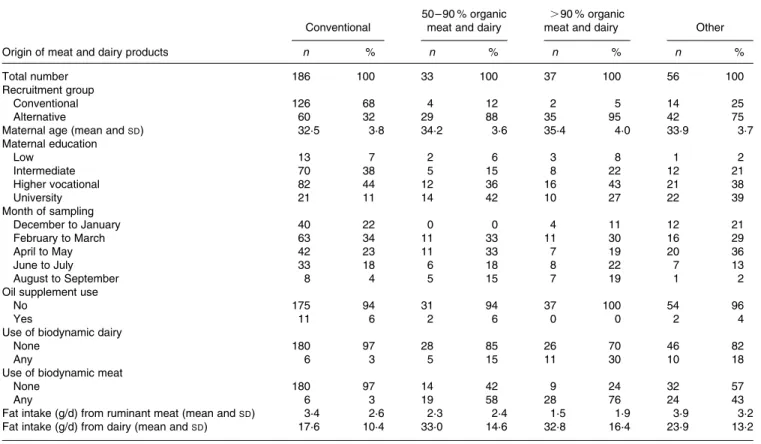
Of the 312 participants, thirty-three (10·5 %) used 50 – 90 % meat and dairy of organic origin, while thirty-seven (11·8 %) used more than 90 % of these aliments (Table 1). The subjects differed substantially in terms of recruitment group, and slightly in terms of the month during which breast milk sampling took place, education level and age of the mother, as well as in the use of oil supplements (Table 1). Therefore, we have included these characteristics as covariables in the multivariate linear regression analysis. Only six (3 %) subjects in the conventional group used any meat and dairy of biody-namic origin, whereas, as expected, this percentage was higher in the groups of organic users, increasing up to 30 % use of biodynamic meat and 76 % use of biodynamic dairy in the . 90 % organic group (Table 1); the ‘other’ group had an intermediary position. As shown in Table 1, the total fat intake from the main dietary fat sources included in the
FFQ was comparable between the groups, but the percentage contributed by dairy fat was almost twice as high in the groups with 50 – 90 % (70 %) and . 90 % (75 %) meat and dairy of organic origin compared to the conventional group (39 %).
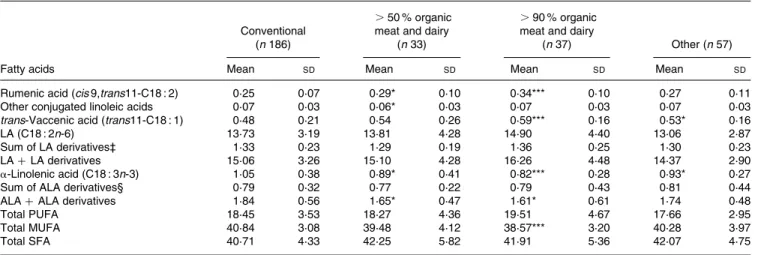
The levels of rumenic acid were higher in the groups of organic meat and dairy users, with an increasing trend going from the ‘other’ group to the 50 – 90 % organic meat and dairy group to the . 90 % organic meat and dairy group (Table 2). The difference between the levels of rumenic acid in these groups and that in the conventional group was always statistically significant. No such trend was found for other CLA, and the relative amount of all the other CLA (wt%) was slightly lower in the 50 – 90 % group (Table 2). The mean level of TVA was about twice the level of rumenic acid in breast milk and correlated with rumenic acid (r 0·51, P, 0·001). Like rumenic acid, TVA content showed an increasing trend over the organic groups relative to the con-ventional group (Table 2), reaching statistical significance in the . 90 % organic meat and dairy group. However, this was not the case for the differences among the other groups, which was probably due to the relatively high standard devi-ation values. The most abundant fatty acids present in milk are depicted in Table 3, to better understand the context of the mentioned changes in CLA and TVA levels. The increases in the levels of these fatty acids seem to be associated with relative decreases in the levels of trans-C18 : 1 and of C20 : 4 fatty acids.
Table 1. Relevant characteristics of the study participants†
Conventional
50 – 90 % organic meat and dairy
.90 % organic
meat and dairy Other
Origin of meat and dairy products n % n % n % n %
Total number 186 100 33 100 37 100 56 100
Recruitment group
Conventional 126 68 4 12 2 5 14 25
Alternative 60 32 29 88 35 95 42 75
Maternal age (mean andSD) 32·5 3·8 34·2 3·6 35·4 4·0 33·9 3·7
Maternal education Low 13 7 2 6 3 8 1 2 Intermediate 70 38 5 15 8 22 12 21 Higher vocational 82 44 12 36 16 43 21 38 University 21 11 14 42 10 27 22 39 Month of sampling December to January 40 22 0 0 4 11 12 21 February to March 63 34 11 33 11 30 16 29 April to May 42 23 11 33 7 19 20 36 June to July 33 18 6 18 8 22 7 13 August to September 8 4 5 15 7 19 1 2
Oil supplement use
No 175 94 31 94 37 100 54 96
Yes 11 6 2 6 0 0 2 4
Use of biodynamic dairy
None 180 97 28 85 26 70 46 82
Any 6 3 5 15 11 30 10 18
Use of biodynamic meat
None 180 97 14 42 9 24 32 57
Any 6 3 19 58 28 76 24 43
Fat intake (g/d) from ruminant meat (mean andSD) 3·4 2·6 2·3 2·4 1·5 1·9 3·9 3·2
Fat intake (g/d) from dairy (mean andSD) 17·6 10·4 33·0 14·6 32·8 16·4 23·9 13·2
† The participants (n 312) were distributed by the various groups (conventional, 50 – 90 % organic, . 90 % organic and other) according to the origin of the dairy and meat products included in the corresponding diet. The characteristics of the participants attributed to each of the four groups, in terms of number, age, maternal education, month of breast milk sampling, use of oil supplement and use of biodynamic dairy and meat products are depicted.
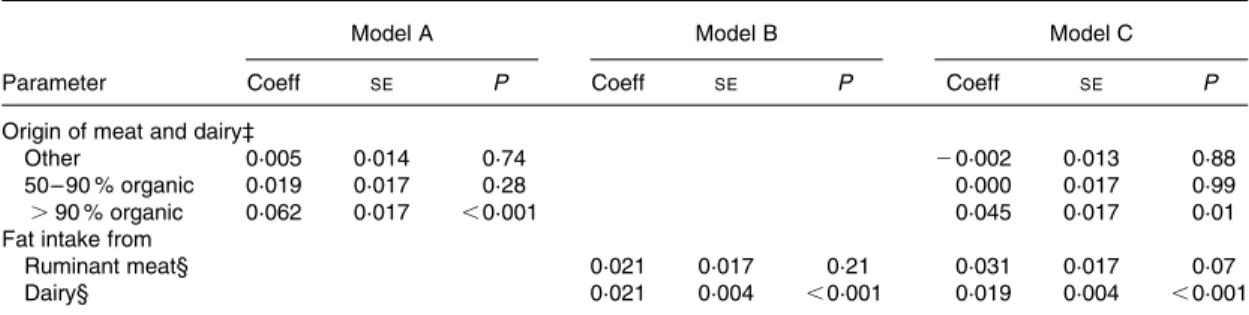
After adjusting for covariables (alternative v. conventional recruitment group; maternal age; maternal education; use of supplements; winter v. summer months), rumenic acid remained statistically significantly higher in the . 90 % organic group (v. conventional) (Table 4, model A). Fat intake from ruminant meat and from dairy contributed equally to the rumenic acid level in breast milk, but only the result for dairy fat was statistically significant: 0·021 increment of rume-nic acid level (as wt% of total milk fat) per 10 g/d increment of daily dairy fat intake, P, 0·001 (Table 4, model B). When we additionally adjusted for fat intake from dairy and rumi-nant meat, rumenic acid remained significantly higher in the . 90 % organic group compared to the conventional group
(Table 4, model C). In addition to the organic origin, dairy fat intake still contributed to the rumenic acid level in breast milk (Table 4, model C). In linear regression analysis of breast milk TVA, results were very similar to those of rumenic acid: TVA (wt% of total milk fat) was statistically significantly higher in the . 90 % organic group (v. conven-tional, regression coefficient 0·097, SE 0·040, P¼ 0·015). Moreover, TVA was dependent on dairy fat intake in a statisti-cally significant way: 0·023 increment of TVA (as wt% of total milk fat) per 10 g/d increment of daily dairy fat intake (SE 0·009, P¼ 0·009), linear regression adjusting for the covariables mentioned earlier. It is worth mentioning that rumenic acid in breast milk peaked in the early summer Table 2. Rumenic acid, other conjugated linoleic acids, trans-vaccenic acid and other relevant fatty acid classes in breast milk (as weight percentage (wt%) of total milk fat) by origin of meat and dairy (n 312)†
(Mean values and standard deviations)
Conventional (n 186)
.50 % organic meat and dairy
(n 33)
.90 % organic meat and dairy
(n 37) Other (n 57)
Fatty acids Mean SD Mean SD Mean SD Mean SD
Rumenic acid (cis 9,trans11-C18 : 2) 0·25 0·07 0·29* 0·10 0·34*** 0·10 0·27 0·11
Other conjugated linoleic acids 0·07 0·03 0·06* 0·03 0·07 0·03 0·07 0·03
trans-Vaccenic acid (trans11-C18 : 1) 0·48 0·21 0·54 0·26 0·59*** 0·16 0·53* 0·16
LA (C18 : 2n-6) 13·73 3·19 13·81 4·28 14·90 4·40 13·06 2·87
Sum of LA derivatives‡ 1·33 0·23 1·29 0·19 1·36 0·25 1·30 0·23
LA þ LA derivatives 15·06 3·26 15·10 4·28 16·26 4·48 14·37 2·90
a-Linolenic acid (C18 : 3n-3) 1·05 0·38 0·89* 0·41 0·82*** 0·28 0·93* 0·27
Sum of ALA derivatives§ 0·79 0·32 0·77 0·22 0·79 0·43 0·81 0·44
ALA þ ALA derivatives 1·84 0·56 1·65* 0·47 1·61* 0·61 1·74 0·48
Total PUFA 18·45 3·53 18·27 4·36 19·51 4·67 17·66 2·95
Total MUFA 40·84 3·08 39·48 4·12 38·57*** 3·20 40·28 3·97
Total SFA 40·71 4·33 42·25 5·82 41·91 5·36 42·07 4·75
ALA, a-linolenic acid; LA, linoleic acid
Mean values were significantly different from those of the conventional group (Student’s t test): *P, 0·05; **P, 0·01; ***P, 0·001. † For details of procedures, see pp. 736 – 737.
‡ Sum of LA derivatives includes: C18 : 3n-6, C20 : 3n-6, C20 : 4n-6, C22 : 4n-6 and C22 : 5n-6. § Sum of ALA derivatives includes : C18 : 4n-3, C20 : 4n-3, C22 : 4n-3, C22 : 5n-3 and C22 : 6n-3.
Table 3. Most abundant fatty acids in breast milk (as weight percentage (wt%) of total milk fat) by origin of meat and dairy (n 312)† (Mean values and standard deviations)
Conventional (n 186)
.50 % organic meat and dairy (n 33)
.90 % organic
meat and dairy (n 37) Other (n 57)
Fatty acids Mean SD Mean SD Mean SD Mean SD
C16 : 0 22·62 2·30 22·79 2·54 22·63 2·86 23·21 2·57 C18 : 2 13·73 3·19 13·81 4·28 14·90 4·40 13·06 2·87 C18 : 0 7·02 1·48 6·60 1·49 6·87 1·15 6·95 1·66 C14 : 0 5·63 1·50 6·65** 1·74 6·42* 1·78 6·20* 1·80 C12 : 0 4·56 1·70 4·95 1·90 4·69 1·52 4·61 1·57 C18 : 3n-3 1·05 0·38 0·89* 0·41 0·82*** 0·28 0·93* 0·27 trans9-C18 : 1 0·61 0·27 0·47*** 0·20 0·51* 0·24 0·52** 0·18 C20 : 4 0·53 0·10 0·48** 0·08 0·48** 0·08 0·50* 0·09 trans11-C18 : 1 0·48 0·21 0·54 0·26 0·59*** 0·16 0·53* 0·16 C18 : 3n-6 (di-homo) 0·46 0·11 0·48 0·10 0·53** 0·13 0·47 0·12 C22 : 6 0·42 0·20 0·41 0·16 0·42 0·27 0·44 0·28 C17 : 0 0·31 0·10 0·36*** 0·07 0·34 0·12 0·33 0·11 C15 : 0 0·30 0·09 0·38*** 0·12 0·40*** 0·13 0·37*** 0·12 cis9,trans11-C18 : 2 0·25 0·07 0·29* 0·10 0·34*** 0·10 0·27 0·11 C14 : 1 0·23 0·08 0·29** 0·12 0·29* 0·12 0·29*** 0·11
Mean values were significantly different from those of the conventional group (Student’s t test): *P, 0·05; **P, 0·01; ***P, 0·001. † Only fatty acids present in amounts higher than 0·2 % of total milk fat are shown. For details of procedures, see pp. 736 – 737.
months in the conventional and 50 – 90 % organic meat and dairy users, and somewhat later in the . 90 % organic group (data not shown).
Discussion
CLA and TVA are often formed by isomerization and biohy-drogenation of dietary linoleic and linolenic acid by microor-ganisms (mainly Butyrovibrio fibrisolvens) living in the rumen of ruminant animals. These reactions lead to the formation of various positional and geometric isomers, which differ sub-stantially in nutritional value (Banni et al. 1999). TVA is the major trans-fatty acid in ruminant milk fat and an inter-mediate in the bioconversion of linoleic acid (C18 : 2n-6) to rumenic acid (cis9,trans11-C18 : 2). In man, it can be con-verted by D9 desaturation to rumenic acid (Turpeinen et al. 2002), being probably responsible for one-quarter of the human CLA pool (Kuhnt et al. 2006). This conversion has been shown to occur in lactating women (Mosley et al. 2006); in this precursor study, consumed TVA was converted in rumenic acid which was detectable in the human milk. Other trans-fatty acids, such as trans-10-octadecenoic acid (trans10-C18 : 1) cannot be desaturated. Bertschi et al. (2005) have recently described an about 50 % concomitant increase of both TVA and rumenic acid levels in human breast milk after consumption of alpine butter, in comparison with margarine. Since alpine butter had a high content of these fatty acids whereas the tested margarine had hardly any (Bertschi et al. 2005), this observation suggests that the CLA and TVA present in human milk have a dietary origin. At least in the Netherlands the main sources of CLA and TVA are of dairy origin (Voorrips et al. 2002). In the present work, however, no determination of the content in these fatty acids in the dairy and meat products normally consumed by the mothers of the different groups was performed.
It should be mentioned that industrially produced trans-fatty acids, as often incorporated in commercial products, are likely to contribute to pathological situations, such as IHD (Stender & Dyerberg, 2004) and type 2 diabetes (Odegaard & Pereira, 2006). This possible contribution is leading several govern-ments to limit the total amount of these fatty acids – mainly elaidic acid (trans9-C18 : 1), but to some extent also TVA (trans11-C18 : 1) – which can be included in oils and fats.
For instance, in the case of the Danish government, this limit has been set to 2 % of the total fat content (Stender et al. 2004). The oscillations of the levels of TVA reported in the present study occur therefore within a range which is clearly different from the one of industrially produced trans-fatty acids, meaning that no unfavourable effects on human health are to be expected. Furthermore, and as often occurs in natural mixtures, the observed oscillations occur concomi-tantly to other alterations, namely to an increase in the CLA levels, which are likely to exert beneficial effects on health performance.
We found that the levels of rumenic acid as well as of TVA in breast milk were higher in mothers which included organic dairy and meat products in their diet, in comparison with mothers who had pursued a conventional diet. Furthermore, the extent of the increase in rumenic acid depended on the amount of organic products consumed during the study, with those mothers using almost exclusively (more than 90 %) organic dairy and meat products in their diet having a higher content of this fatty acid in their milk than mothers with a moderately (50 – 90 %) organic dairy and meat diet. These data corroborate the results of our previous pilot study, which showed that mothers who consumed more than 50 % organic dairy and meat products had higher levels of CLA (Rist et al. 2003). Interestingly, it has been shown in a variety of studies (Jahreis et al. 1997; Bergamo et al. 2003; Gedek, 1980; Dewhurst et al. 2003) that the levels of CLA in cow’s milk from organic producers in Europe, including the Netherlands (Adriaansen-Tennekes et al. 2005), are sig-nificantly higher than CLA levels in the milk from convention-al producers. Therefore, and since the fat from human breast milk is likely to be of dietary origin (see earlier), we believe that the larger amounts of rumenic acid and TVA in breast milk from the organic groups were due to the corresponding intake of organic dairy and meat products with higher levels of rumenic acid and TVA. This interpretation of the present results is strengthened by the fact that the total fat intake was comparable among the various groups and that the CLA content of the food is very stable and not influenced by storage or processing (Luna et al. 2005). The fat intake from meat was five to twenty times lower than that from dairy products; therefore, it is likely that dairy products were more strongly influencing the final fat composition of the milk than the Table 4. Rumenic acid in breast milk as a function of the use of either meat and dairy of organic origin (model A), or dietary
fat intake from ruminant meat and dairy products (model B) or both (model C)†
Model A Model B Model C
Parameter Coeff SE P Coeff SE P Coeff SE P
Origin of meat and dairy‡
Other 0·005 0·014 0·74 20·002 0·013 0·88
50 – 90 % organic 0·019 0·017 0·28 0·000 0·017 0·99
.90 % organic 0·062 0·017 ,0·001 0·045 0·017 0·01
Fat intake from
Ruminant meat§ 0·021 0·017 0·21 0·031 0·017 0·07
Dairy§ 0·021 0·004 ,0·001 0·019 0·004 ,0·001
Coeff, linear regression coefficient;SE, standard error of the regression coefficient.
† The difference in rumenic acid (as weight percentage (wt%) of total milk fat) was assumed to vary linearly with one of the two or with both parameters; data from the 312 participants were incorporated in the linear regression. Linear regression models controlled for the following covariables: alternative v. conventional group; maternal age; maternal education level; use of supplements; winter v. summer months. ‡ Coefficients denote the difference in rumenic acid level (wt%) in each group compared to the conventional group.
meat products. Much to our surprise, the multivariate analysis found an additional effect of the organic origin on the diet, stronger than that to be expected from the total dairy fat intake.
The CLA levels found in the breast milk from the . 90 % organic dairy and meat products consumers were as high as those reached after supplementation with 30 g/d alpine butter for 10 d (Bertschi et al. 2005): 0·33 g/100 g milk fat (margar-ine control: 0·22 g/100 g milk fat). Breast milk levels of rume-nic acid in the conventional group (0·25 g/100 g fat) were in the same range as the values previously reported: 0·21 g/100 g fat (Park et al. 1999); 0·28 g/100 g total fatty acids (Ritzenthaler et al. 2005), and 0·19 and 0·18 g/100 g fat (Jensen et al. 1998; Jensen & Lammi-Keefe, 2001). The higher levels, namely 0·4 g/100 g fat, recorded in American (McGuire et al. 1997; Innis & King, 1999) and in German mothers (Jahreis et al. 1999) can be attributed to a diet which normally includes higher amounts of dairy products and/or meat. The fact that the relative amounts of CLA and TVA correspond to less than 1 % of the total fat should not be taken as indicative of a reduced physiological relevance of these fatty acids. Their mechanism of action is likely to include the production of bio-logically active compounds and processes of intracellular sig-nalling (Khan & Vanden Heuvel, 2003), and it is typical for molecules participating in such processes that they are present in very small amounts. In this context it is worth mentioning that, although the levels of n-3 fatty acids in maternal milk are as well rather low, they have been shown to influence the risk of non-atopic eczema and asthma in the infant (Oddy et al. 2006; Wijga et al. 2006). Concerning the magni-tude of the differences in breast milk CLA levels that we found among the various groups, it might be argued that they are minor. Nevertheless, it should be noted that the level in breast milk reflects CLA intake by maternal diet and could therefore be a marker of placental supply in uterus and possibly of ongoing supply to the child from dietary sources of dairy products and meat shared by the family. Taken together, these factors are likely to represent a lifelong cumulative effect.
The health effects of CLA and TVA on human newborns are still unknown; nevertheless there is promising evidence stemming from animal models and from clinical studies invol-ving human adults. Often, the positive effects of CLA on health parameters revealed themselves stronger in animal models than in clinical studies with man (Bhattacharya et al. 2006). One possible explanation for this discrepancy is that, while animal studies have concentrated on very young grow-ing rats or mice, clinical studies have exclusively focused on adult man. This strengthens the need for long-term clinical studies starting with very young participants, as is possible within the frame of the KOALA study. An area in which the expectations concerning the CLA effects are relatively high concerns their immunomodulating properties (see review by O’Shea et al. 2004). Indeed, in animal models, these fatty acids lead to a reduction of the harmful effects of intranasally administered influenza viruses, and to a reduction of the leukotriene and prostaglandin production which suggests a favourable effect in preventing inflammatory phenomena that are typical of an immediate immune response (O’Shea et al. 2004). Moreover, CLA feeding was able to pre-vent wasting after endotoxin injections (Cook et al. 1999).
The examination of healthy human volunteers who had been vaccinated against hepatitis B revealed that supplemen-tation with certain CLA isomers resulted in a statistically sig-nificant higher level of protective antibodies, indicative of a better immune-responsiveness to the vaccination (Albers et al. 2003). CLA supplementation in young healthy men affected the immune function in terms of increased plasma IgA and IgM, and the anti-inflammatory cytokine IL-10, and decreased levels of IgE and the proinflammatory cytokines TNF-a and IL-1g (Song et al. 2005). Dietary studies have indicated a protective effect of butter relative to margarine against allergy and asthma (Bolte et al. 2001; Dunder et al. 2001; Woods et al. 2003). Similarly, a 3-year prospective cohort study found a decreased risk of asthma in children who consumed full cream milk and butter daily, compared to those who did not (Wijga et al. 2003). Since butter is nor-mally rich in CLA, this might suggest a positive effect of CLA on the prevention of those diseases. Furthermore, it is known that children who grow up in families with an anthroposophic lifestyle have a reduced risk of atopic diseases compared to those in families with conventional lifestyles (Alm et al. 1999; Alfven et al. 2006). An anthroposophic lifestyle com-prises, besides a restrictive use of antibiotics and few vacci-nations, a diet that usually contains raw milk and organic, or more specifically biodynamic, products. Given that an organic diet and organic dairy and/or meat products have a higher CLA content than their conventional counterparts (see earlier), this observation might suggest that CLA consumption could add to a protective effect against atopic diseases.
In conclusion, we show here that the levels of both rumenic acid and TVA in human breast milk were higher in the case of mothers following a diet that contained organic dairy and meat products, in comparison with mothers consuming a con-ventional diet. In view of the accumulating evidence pointing towards various positive effects of CLA on human health, in particular at a very young age, the present results are highly interesting. Further results of the KOALA Birth Cohort Study, in particular those concerning allergic sensitization and asthma in the children corresponding to the mothers that have participated in the present study, are awaited anxiously.
Acknowledgements
This study was financially supported by the Netherlands
Organization for Health Research and Development
(ZonMw, the Netherlands), Royal Friesland Foods (the Netherlands), Triodos Foundation (the Netherlands), UDEA organic retail (the Netherlands), Biologica organization for organic farming and food (the Netherlands), the Consumer Association for Bio-Dynamic Agriculture Zurich (Switzer-land) and Weleda AG Arlesheim (Switzer(Switzer-land).
References
Adriaansen-Tennekes R, Bloksma J, Huber MAS, Baars T, De Wit J & Baars EW (2005) Biologische producten en gezondheid. Resul-taten melkonderzoek (Organic Products and Health. Results of Milk Research). Publication GVV06. Driebergen, the Netherlands: Louis Bolk Instituut.
Albers R, van der Wielen RP, Brink EJ, Hendriks HF, Dorovska-Taran VN & Mohede IC (2003) Effects of cis-9, trans-11 and trans-10, cis-12 conjugated linoleic acid (CLA) isomers on immune function in healthy men. Eur J Clin Nutr 57, 595 – 603. Alfven T, Braun-Fahrlander C, Brunekreef B, et al. (2006) Allergic
diseases and atopic sensitization in children related to farming and anthroposophic lifestyle – the PARSIFAL study. Allergy 61, 414 – 421.
Alm JS, Swartz J, Lilja G, Scheynius A & Pershagen G (1999) Atopy in children of families with an anthroposophic lifestyle. Lancet 353, 1485 – 1488.
Anonymous (2001) Foundation Zeist. NEVO-table 2001, Dutch Food Composition Table 2001. The Hague: The Netherlands Nutrition Centre.
Banni S, Angioni E, Casu V, Melis MP, Carta G, Corongiu FP, Thompson H & Ip C (1999) Decrease in linoleic acid metabolites as a potential mechanism in cancer risk reduction by conjugated linoleic acid. Carcinogenesis 20, 1019 – 1024.
Bastiaanssen JM, de Bie RA, Bastiaenen CH, Heuts A, Kroese ME, Essed GG & van den Brandt PA (2005) Etiology and prognosis of pregnancy-related pelvic girdle pain; design of a longitudinal study. BMC Public Health 5, 1.
Belury MA (2002) Dietary conjugated linoleic acid in health: physio-logical effects and mechanisms of action. Annu Rev Nutr 22, 505 – 531.
Bergamo P, Fedele E, Iannibelli L & Marzillo G (2003) Fat-soluble vitamin contents and fatty acid composition in organic and conven-tional Italian dairy products. Food Chem 82, 625 – 631.
Bertschi I, Collomb M, Rist L, Eberhard P, Sieber R, Butikofer U, Wechsler D, Folkers G & von Mandach U (2005) Maternal dietary Alpine butter intake affects human milk: fatty acids and conjugated linoleic acid isomers. Lipids 40, 581 – 587.
Bhattacharya A, Banu J, Rahman M, Causey J & Fernandes G (2006) Biological effects of conjugated linoleic acids in health and disease. J Nutr Biochem. Published online: 2 May 2006. PMID: 16650752. Bolte G, Frye C, Hoelscher B, Meyer I, Wjst M & Heinrich J (2001)
Margarine consumption and allergy in children. Am J Respir Crit Care Med 163, 277 – 279.
Burdge GC, Tricon S, Morgan R, et al. (2005) Incorporation of cis-9, trans-11 conjugated linoleic acid and vaccenic acid (trans-11 18 : 1) into plasma and leucocyte lipids in healthy men consuming dairy products naturally enriched in these fatty acids. Br J Nutr 94, 237 – 243.
Cook ME, DeVoney D, Drake B, Pariza MW, Whigham L & Yang M (1999) Dietary control of immune-induced cachexia: conjugated linoleic acid and immunity. Adv Conjug Linoleic Acid Res 1, 226 – 237.
Dewhurst RJ, Evans RT, Scollan ND, Moorby JM, Merry RJ & Wilkins RJ (2003) Comparison of grass and legume silages for milk production. 2. In vivo and in sacco evaluations of rumen func-tion. J Dairy Sci 86, 2612 – 2621.
Dunder T, Kuikka L, Turtinen J, Rasanen L & Uhari M (2001) Diet, serum fatty acids, and atopic diseases in childhood. Allergy 56, 425 – 428.
Fritsche J & Steinhart H (1998) Analysis, occurrence, and physiologi-cal properties of trans fatty acids (TFA) with particular emphasis on conjugated linoleic acid isomers (CLA). A review. Fett/Lipid 100, 190 – 210.
Gedek B (1980) Fungal diseases of domestic animals – a review. Berl Munch Tierarztl Wochenschr 93, 321 – 327.
Grootenhuis PA, Westenbrink S, Sie CM, de Neeling JN, Kok FJ & Bouter LM (1995) A semiquantitative food frequency question-naire for use in epidemiologic research among the elderly: validation by comparison with dietary history. J Clin Epidemiol 48, 859 – 868.
Innis SM & King DJ (1999) trans Fatty acids in human milk are inversely associated with concentrations of essential all-cis n-6
and n-3 fatty acids and determine trans, but not n-6 and n-3, fatty acids in plasma lipids of breast-fed infants. Am J Clin Nutr 70, 383 – 390.
Jahreis G, Fritsche J, Mo¨ckel P, Schone F, Mo¨ller U & Steinhart H (1999) The potential anticarcinogenic conjugated linoleic acid, cis-9, trans-11 C18 : 2, in milk of different species: cow, goat, ewe, sow, mare, woman. Nutr Res 19, 1541 – 1549.
Jahreis G, Fritsche J & Steinhart H (1997) Conjugated linoleic acid in milk fat: high variation depending on production system. Nutr Res 17, 1479 – 1484.
Jensen RG, Lammi-Keefe CJ, Hill DW, Kind AJ & Henderson R (1998) The anticarcinogenic conjugated fatty acid, 9c, 11t-18 : 2, in human milk: confirmation of its presence. J Hum Lact 14, 23 – 27.
Jensen RG & Lammi-Keefe C (2001) The anticarcinogenic conju-gated fatty acid c9, t11-c18 : 2, or rumenic acid, in human milk: amounts and effects. Adv Exp Med Biol 501, 153 – 156.
Kepler CR, Hirons KP, McNeill JJ & Tove SB (1966) Intermediates and products of the biohydrogenation of linoleic acid by Butyrinvi-brio fibrisolvens. J Biol Chem 241, 1350 – 1354.
Khan SA & Vanden Heuvel JP (2003) Role of nuclear receptors in the regulation of gene expression by dietary fatty acids (review). J Nutr Biochem 14, 554 – 567.
Kim YJ, Liu RH, Bond DR & Russell JB (2000) Effect of linoleic acid concentration on conjugated linoleic acid production by Butyrivibrio fibrisolvens A38. Appl Environ Microbiol 66, 5226 – 5230.
Kuhnt K, Kraft J, Moeckel P & Jahreis G (2006) Trans-11 – 18 : 1 is effectively Delta9-desaturated compared with trans-12 – 18 : 1 in humans. Br J Nutr 95, 752 – 761.
Kummeling I, Thijs C, Penders J, et al. (2005) Etiology of atopy in infancy: the KOALA Birth Cohort Study. Pediatr Allergy Immunol 16, 679 – 684.
Luna P, de la Fuente MA & Juarez M (2005) Conjugated linoleic acid in processed cheeses during the manufacturing stages. J Agric Food Chem 53, 2690 – 2695.
McGuire MK, Park Y, Behre RA, Harrison LY, Shultz TD & McGuire MA (1997) Conjugated linoleic acid concentrations of human milk and infant formula. Nutr Res 17, 1277 – 1283. Mosley EE, McGuire MK, Williams JE & McGuire MA (2006) Cis-9,
trans-11 conjugated linoleic acid is synthesized from vaccenic acid in lactating women. J Nutr 136, 2297 – 2301.
Mu¨ller A, Ringseis R, Dusterloh K, Gahler S, Eder K & Steinhart H (2005) Detection of conjugated dienoic fatty acids in human vascular smooth muscle cells treated with conjugated linoleic acid. Biochim Biophys Acta 1737, 145 – 151.
Oddy WH, Pal S, Kusel MM, et al. (2006) Atopy, eczema and breast milk fatty acids in a high-risk cohort of children followed from birth to 5 yr. Pediatr Allergy Immunol 17, 4 – 10.
Odegaard AO & Pereira MA (2006) Trans fatty acids, insulin resist-ance, and type 2 diabetes. Nutr Rev 64, 364 – 372.
O’Shea M, Bassaganya-Riera J & Mohede IC (2004) Immunomodu-latory properties of conjugated linoleic acid. Am J Clin Nutr 79, 1199S – 1206S.
Park Y, McGuire MK, Behr R, McGuire MA, Evans MA & Shultz TD (1999) High-fat dairy product consumption increases delta 9c,11t-18 : 2 (rumenic acid) and total lipid concentrations of human milk. Lipids 34, 543 – 549.
Rist L, Zweidler R & von Mandach U (2003) Biologische Erna¨hrung und Gesundheit. (Organic nutrition and health). In Beitra¨ge zur 7. Wissenschaftstagung zum O¨ kologischen Landbau: O¨kologischer Landbau der Zukunft (Contributions to the 7th Research Confer-ence on Organic Agriculture: Organic Agriculture of the Future), pp. 237 – 240 [B Freyer, editor]. Vienna: University of Natural Resources and Applied Life Sciences.
Ritzenthaler KL, McGuire MK, Falen R, Shultz TD, Dasgupta N & McGuire MA (2001) Estimation of conjugated linoleic acid
intake by written dietary assessment methodologies underestimates actual intake evaluated by food duplicate methodology. J Nutr 131, 1548 – 1554.
Ritzenthaler KL, McGuire MK, McGuire MA, Shultz TD, Koepp AE, Luedecke LO, Hanson TW, Dasgupta N & Chew BP (2005) Con-sumption of conjugated linoleic acid (CLA) from CLA-enriched cheese does not alter milk fat or immunity in lactating women. J Nutr 135, 422 – 430.
Song HJ, Grant I, Rotondo D, Mohede I, Sattar N, Heys SD & Wahle KW (2005) Effect of CLA supplementation on immune function in young healthy volunteers. Eur J Clin Nutr 59, 508 – 517. Stender S & Dyerberg J (2004) Influence of trans fatty acids on
health. Ann Nutr Metab 48, 61 – 66.
Tricon S, Burdge GC, Jones EL, et al. (2006) Effects of dairy pro-ducts naturally enriched with cis-9,trans-11 conjugated linoleic acid on the blood lipid profile in healthy middle-aged men. Am J Clin Nutr 83, 744 – 753.
Tricon S, Burdge GC, Williams CM, Calder PC & Yaqoob P (2005) The effects of conjugated linoleic acid on human health-related outcomes. Proc Nutr Soc 64, 171 – 182.
Turpeinen AM, Mutanen M, Aro A, Salminen I, Basu S, Palmquist DL & Griinari JM (2002) Bioconversion of vaccenic acid to con-jugated linoleic acid in humans. Am J Clin Nutr 76, 504 – 510. Voorrips LE, Brants HA, Kardinaal AF, Hiddink GJ, van den Brandt
PA & Goldbohm RA (2002) Intake of conjugated linoleic acid, fat, and other fatty acids in relation to postmenopausal breast cancer: the Netherlands Cohort Study on Diet and Cancer. Am J Clin Nutr 76, 873 – 882.
Wijga AH, Smit HA, Kerkhof M, de Jongste JC, Gerritsen J, Neijens HJ, Boshuizen HC & Brunekreef B (2003) Association of consumption of products containing milk fat with reduced asthma risk in pre-school children: the PIAMA birth cohort study. Thorax 58, 567 – 572. Wijga AH, van Houwelingen AC, Kerkhof M, Tabak C, de Jongste
JC, Gerritsen J, Boshuizen H, Brunekreef B & Smit HA (2006) Breast milk fatty acids and allergic disease in preschool children: the Prevention and Incidence of Asthma and Mite Allergy birth cohort study. Allergy Clin Immunol 117, 440 – 447.
Woods RK, Walters EH, Raven JM, Wolfe R, Ireland PD, Thien FC & Abramson MJ (2003) Food and nutrient intakes and asthma risk in young adults. Am J Clin Nutr 78, 414 – 421.