The Journal of Heredity 75:417-418. 1984.
Inheritance of leaf variegation
in Vitis species
B. I. Relsch and J. P. Watson
Results and Discussion
Most of the variegated seedlings showed a green and white pattern of variegation. A few variegated seedlings had patches of pinkish-purple and patches of green tissue in true leaves and occasionally in the cotyledons. The pink-ish-purple color eventually bleached out, leaving white tissue in its place. Leaves on variegated
seedlings ranged from almost entirely green to entirely white. Classification at the cotyledon to first true leaf stage was inaccurate; 10 days later many seedlings classified earlier as normal showed leaf variegation. Data collected from seedlings showing 2-4 true leaves were subse-quently analyzed and the results are presented here. The symbol uar is proposed for the mutant causing green and white leaf variegation.
> ABSTRACT. Chlorophyll vartegatton in V7rts species was examined In F, and St populations. A single recessive gene Is proposed to account for trie occurrence of 25 percent variegated seedlings In both Fi and S, populations. Variegation was not . lethal and might be useful In wine grape breeding (if associated with Inactive polyphenol oxklase) , and for Its ornamental value. This trait Is one of very few seedling traits under monogenic control that might be useful In genetic studies of grapes.
LEAF VARIEGATION in Vitis has been described among the progeny of Aramon, an ancient Eu-. ropean grape (VEu-. vinifera) cultivar5Eu-. A single recessive gene was reported to cause green and white variegation among selfed progeny of Aramon. However, such variegation was ex-pressed only among plants grown at 20°C, not at 35°C5. Variegation also was described in a sport of cv. Sultana, but inheritance was not studied1. We have observed that, following severe cold i damage to dormant buds, small variegated shoots
are a common vineyard occurrence.
Well-defined mutants identifiable at an early stage of growth are of importance in genetic studies of plants. De Lattin3 listed 53 genes identified in Vitis prior to 1957. Of these, four concerned traits identifiable among seedlings. No further seedling traits have since been re-ported4.
Variegated leaves appeared in seedling grapevine populations planted in 1982 and were studied to identify the genetic basis for their oc-currence.
Materials and Methods
Crosses and selfs among hybrid stocks (see Figure 1) and V. oinifera grape cultivars (Riesling and Chardonnay) were made in 1981 and 1982 using standard techniques4. Seed were stratified for 3 months at 1-2°C and planted in Cornell-Mix2 medium in a greenhouse in mid-March of 1982 and 1983. Approximately 4 weeks after planting, seedlings showing true leaves were classified as cither variegated (green and white) or normal (entirely green). The available data were subjected to chi-square analysis to deter-mine goodness-of-fit to the Mendelian monohy-brid ratio. In June 1982 and 1983, seedlings were transplanted to a field nursery and observed for survival and expression of variegation.
The authors are affiliated with the Department of Horticultural Sciences, New York State Agricultural Experiment Station, Cornell University, Geneva, New York 14456. They wish to thank Dr. R. Pool for valu-able discussions.
© 1984, American Genetic Association.
RavatSi — Baco2-16 — S 6905
-r s
- s. *— PlnotNolr(vin) — Seedling[—
— Baco 1l_
NY 34217 — I Alicante_ i— S. 452 —i 4595 — — S.405 — — 4 1 9 9 -- S.85-r~
UC . 132-11^ IBaroque Blanc (vin) Noah (lab, rip) Folle Blanche (vin)
Vitis rlparia — Pinot Blanc (vln) — Ontario (lab) Qanzin — S. 14 AxR1 — L_ AxR1 — (rup) (vin) AxR4 — Alicante Bouschet Jaeger 70 (vin) Jaeger 70 (vin) Aramon ( rupestris Ganzin Jaeger 70 (vin) i— Aramon (vln) | rupestris Ganzin (V, Aramon) [— (Unc) I— (rup) |—(Unc) I—(rup) vin) i-(linc) ' - ( r u p ) Aramon (vln) rupestris Ganzin
FIGURE 1 Pedigreeof hybrid stocks used in the study of variegation in Vilii. Abbreviations for species:
vin-cinifera; lab—labrusca; rip—riparia; line—lincecumii; rup—nipeslris.
Variegated plants from crosses made in 1981 continued to express the trait in tissues produced in 1982, 1983, and 1984 (Figure 2). Expression within each plant was irregular; some shoots were entirely green, others were intensely variegated. Only a few seedlings classed as normal exhibited variegation in the field. These individuals had apparently been misclassified at the seedling stage. Following two seasons in the field, 78 of 149 green plants in two Fi populations survived, as did 15 of 48 variegated plants. Apparently, variegation was not a lethal trait, although it appears to decrease plant survival. Surviving variegated plants appeared to be as vigorous as their normal sibling counterparts.
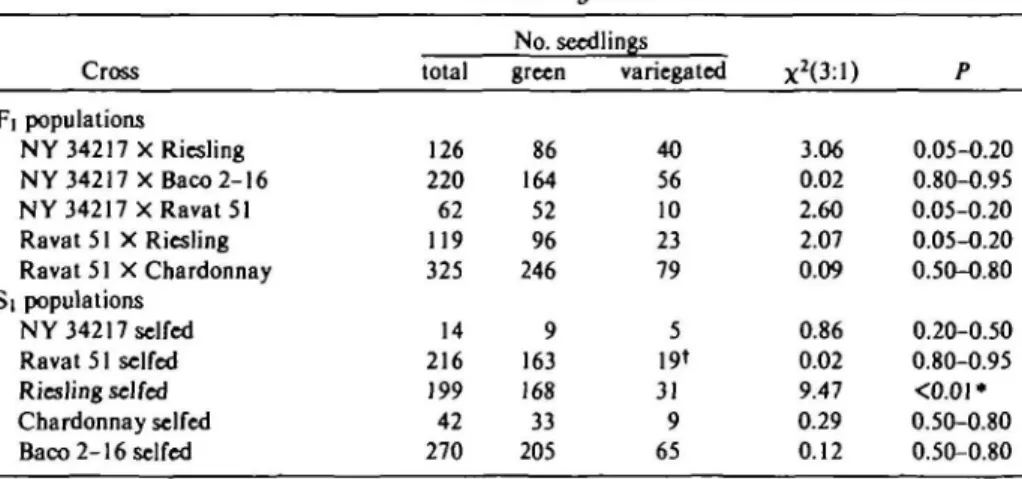
It is proposed that NY 34217, Riesling, Chardonnay, Ravat 51, and Baco 2-16 are het-erozygous ( + var) for the variegated trait. Hence, hybrid and selfed progeny within this group should have 25 percent variegated seed-lings. Only one of 10 populations (Table I) ana-lyzed using the chi-square test did not fit this hypothesis. In that atypical case, a self-pollinated population from Riesling included only 16 per-cent variegated seedlings. Misclassification at an early growth stage and possible temperature ef-fects on variegation5 would help to explain a de-ficiency of seedlings classed as variegated.
Albinos occur at very low frequencies (<0.5 percent) in many grape seedling populations. They occurred at a frequency of 16 percent among self-pollinated seedlings of Ravat 51 (Table I) and were considered in the statistical analysis to be an extreme form of expression for the variegated trait. Albinism has been consid-ered to be an extension of leaf variegation traits in other studies as well7.
In 14 progeny having one parent in common with those segregating for leaf variegation, all observed seedlings were green (Table II). The cross involved would represent + + X +oar, with the expectation of producing all green seedlings. Self-pollinated progeny of three putative + + genotypes also produced only green seedlings (Table II).
Studies on the grape cultivar Aramon sug-gested monogenic inheritance of a variegated trait5. Since Ravat 51 derives approximately 9.0 percent of its genetic makeup from Aramon
FIGURE 2 Leaf variegation in a 31-year-old Vilis seedling.
through four independent sources (Figure 1) it is possible that the gene investigated is identical to that found in Aramon and now identified in the four other grape stocks reported here.
Grapevines grown in pot culture from cuttings are being developed as an attractive florist crop6'9. A variegated stock might have additional ornamental value.
The mutant trait presently under study also may be of some importance in the production of new grape cultivars that resist oxidation in their wine. Grapevine variegation has been found in association with Bruce's sport, a variant of the Sultana grape, which was characterized by a decreased tendency of the fruit to brown while
Table I. Segregation data and chi-square tests for green and variegated (var) leaf traits among
Vitis seedlings Cross Fi populations NY 34217 X Riesling NY 34217 X Baco 2-16 NY 34217 X Ravat 51 Ravat 51 X Riesling Ravat 51 X Chardonnay Si populations NY 34217 selfed Ravat 51 selfed Riesling selfed Chardonnay selfed Baco 2-16 selfed total 126 220 62 119 325 14 216 199 42 270 No. seedlings green 86 164 52 96 246 9 163 168 33 205 variegated 40 56 10 23 79 S 19t 31 9 65 X2(3:D 3.06 0.02 2.60 2.07 0.09 0.86 0.02 9.47 0.29 0.12 P 0.05-0.20 0.80-0.95 0.05-0.20 0.05-0.20 0.5O-O.80 0.20-0.50 0.80-0.95 <0.01* 0.50-0.80 0.50-0.80
drying1. A form of polyphenol oxidase charac-terized by greatly reduced activity was respon-sible for resistance to oxidation of grape phenolic compounds sensitive to browning8. This altered form of polyphenol oxidase may be a valuable . trait in retarding oxidation in commercial wines. The genetic relationship between variegation and altered forms of polyphenol oxidase has not yet been elucidated. However, if the variegated trait presently under study is identical to that found in Bruce's sport and is associated with an inactive form of polyphenol oxidase, it may be a useful trait to manipulate for the benefit of a wine grape ' breeding program.
References
1. ANTCLIFF, A. J. and W. J. WEBSTER. Bruce's sport—a mutant of the sultana. Australian J. Expt. Agr. Anim. Husb. 2:97-100. 1962.
2. B O O D L E Y , J. W. and R. S H E L D R A K E , J R . Cornell *
peatlite mixes for commercial plant growing. Inf. Bui. 43. Cornell Coop. Extension, Ithaca, NY. 1982. 3. DE LATTIN, G. Zur Genetik der Reben. Bisherige
Ergebnisse der Faktoranalyse bei der Gattung Vilis.
Vitis 1:1-8. 1957.
4. ElNSET, J. and C. P R A T T . Grapes. In Advances in , Fruit Breeding. J. Janick and J. N. Moore, Eds. Purdue Univ. Press, Lafayette, IN. p, 130-153. 1975. H 5. G A L Z Y , R. and P. GALZY. Action de la temperature
sur la panachure blanche de la vigne. Le Progres
Agricoleet Viticole 162:271-280. 1964.
6. JANICK, J. Production of fruiting grapevines for pot culture. HortScience 18:56-57. 1983.
7. O R A K W U E , F. C. and L. V. CROWDER. Inheritance of variegation in Brassica campestris. L. J. Hered. '
74:65-67. 1983.
8. RADLER, F. The prevention of browning during r
drying by the cold dipping treatment of sultana grapes. J. Sd. Food Agric. 15:864-869. 1964. 9. ROB1TA1LLE, H. A. and J. JANICK. Rapid
pro-duction of small fruiting grapevines from softwood cuttings. HortScience 14:161. 1979.
Table II. Other crosses and sells related to segregating populations in which no variegated
seedlings were observed
Cross*
NY 65.444.4 X Riesling NY 65.533.13 X Riesling GW 5 X Riesling Horizon X Riesling Cayuga White X Riesling S. 13047 X Riesling J.S. 23-416 X Riesling JS. 26-627 X Riesling NY 65.444.4 X Chardonnay S. 10173 X Chardonnay 111. 172-7 X Chardonnay Horizon X Baco 2-16 NY 65.533.13 X Ravat 51 Cayuga White X Ravat 51
}S. 23-416 selfed NY 65.444.4 selfed Horizon selfed N o . seedlings observed 93 37 51 5 186 75 105 141 49 92 47 32 22 39 54
200
54• Does not fit expected ratio t + 34 albino
* Abbreviations used: N Y - New York; GW = Geneva White; S. - Seibel; JS. •= Joannes-Seyve; III. - Illinois