DOI 10.1007/s00027-006-0843-4 © Eawag, Dübendorf, 2007
Aquatic Sciences
Research Article
Geographic distribution of Tetracapsuloides bryosalmonae
infected fi sh in Swiss rivers: an update
Thomas Wahli1,*
, Daniel Bernet1
, Pascale April Steiner1,2
and Heike Schmidt-Posthaus1
1
Centre for Fish and Wildlife Health, Laenggassstrasse 122, P.O. Box 8466, CH-3001 Bern, Switzerland
2
Federal Offi ce for the Environment, CH-3003 Bern, Switzerland Received: 1 November 2005; revised manuscript accepted: 3 July 2006
Abstract. Proliferative kidney disease (PKD) has been
recognized as a potential threat to brown trout (Salmo
trutta) populations in Switzerland. A study performed in
2000/2001 on 139 sampling sites from 127 rivers in Swit-zerland revealed a wide distribution of fi sh infected by
Tetracapsuloides bryosalmonae, the causative agent of
PKD. The present study aimed to complement this data-set by studying a further 115 sample sites from 91 rivers and 4 fi sh farms. Mainly brown trout were investigated for the presence of T. bryosalmonae by a combination of macroscopical, histological and immunohistochemical examination. In approximately 56% of the examined
sampling sites, T. bryosalmonae-infected fi sh were found. The prevalence of infected fi sh at individual sites ranged from 0% to 100%. Infection intensity, judged on the basis of histological and immunohistochemical eval-uation for the degree of parasite infection, varied greatly between and within sites. PKD-positive sites were found in all areas of Switzerland. The wide distribution of the disease in Swiss rivers indicates that PKD may be a caus-ative factor for the catch decline of brown trout, which was suggested over recent decades in Switzerland.
* Corresponding author phone: +41-31 631 24 65; fax: +41-31 631 26 11, e-mail: [email protected] Published Online First: March 2, 2007
Key words. Proliferative kidney disease; Switzerland; brown trout; geographic distribution.
Introduction
Proliferative kidney disease (PKD) has become a poten-tial threat to the culture of salmonids in Europe and in North America (Hedrick et al., 1993). The disease has been demonstrated in farmed salmonids and in wild fi sh (MacConnell and Peterson, 1992; Feist et al., 2002; Wahli et al., 2002). In farmed fi sh, PKD is not always fatal itself but is often followed by secondary infections which lead to the death of infected fi sh (Feist and Bucke, 1993) and can cause up to 100% mortality. No data are available on
the impact of the disease on wild fi sh populations. How-ever, a nation wide project (FISCHNETZ) looking for causes of catch decline of brown trout in Switzerland raised the hypothesis that PKD might contribute to this situation (Fischnetz, 2004; www.fi schnetz.ch).
The causative agent of PKD, Tetracapsuloides
bryo-salmonae (Canning et al., 2000), belongs to the phylum
Myxozoa. The life cycle of the parasite includes bryo-zoans as invertebrate hosts. This was shown by exposure of naïve fi sh in tanks with resident infected bryozoans which resulted in infected fi sh (Feist et al., 2001). Salmo-nids and pike have been demonstrated as vertebrate hosts. However, the full cycle of T. bryosalmonae is not yet fully understood. Experiments to transmit the parasite from fi sh to fi sh failed (Ferguson and Ball, 1979; D’Silva
et al., 1984) and no transmission from bryozoans to bryo-zoans has been achieved to date (Tops et al., 2004). Re-lease of spores from bryozoans into the environment has been shown (Morris et al., 2002a; Hedrick et al., 2004). An infection of bryozoans with kidney material from PKD-diseased fi sh was possibly demonstrated once, but failed in a repeat experiment (Morris et al., 2002b). No preliminary control for contamination of the bryozoans used was performed in the experiment described by Mor-ris et al. (2002b). Tops et al. (2004) could not demon-strate transmission of parasites from fi sh to bryozoans. These fi ndings lead to the question of whether salmonids are dead end hosts and if other yet unknown hosts are included in the cycle (Tops et al., 2004).
In addition to the knowledge of the life cycle of T.
bryosalmonae, a further key factor to understand the
epi-demiology of PKD is the knowledge of the geographic distribution of the disease. Few data are available on the occurrence of the invertebrate host. Okamura et al. (2001) showed that the distribution of T. bryosalmonae in bryozoan populations is patchy in space and time, which makes epidemiological studies particularly diffi cult. However, recent fi ndings have given some evidence for cryptic stages of T. bryosalmonae in bryozoans (Oka-mura and Tops, 2003) indicative for a permanent pres-ence of the parasites in the bryozoans. PKD has been demonstrated in single locations in many countries (He-drick et al., 1993), but results from monitoring studies covering larger connected areas or countries are rare. Seagrave et al. (1981) and Feist et al. (2002) presented the results of studies looking at the distribution of PKD in rivers of England and Wales.
In Switzerland, a fi rst survey on the distribution of PKD was performed in 2000/2001 (Wahli et al., 2002). The present paper presents the results of a second survey in 2004 which aimed to close some geographic gaps in the 2000/2001 survey and to further elucidate the status of PKD in Switzerland.
Materials and methods Selection of sampling sites
Cantons and fi sheries associations throughout Switzer-land were asked to identify rivers and brooks where fi sh had never been investigated for the presence of PKD. Special attention was requested for rivers from which adult fi sh are caught for offspring production or where young fi sh are raised for restocking measures. In addi-tion, sites were chosen with the purpose to complete the geographic survey of 2000/2001 (Wahli et al., 2002). A total of 111 sites from 91 rivers were included in the present study. The sites were located in three completely distinct river systems with different tributaries. In addi-tion, samples from four fi sh farms were taken.
Sample size and sampling methods
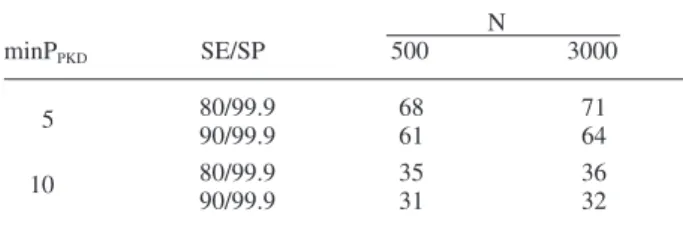
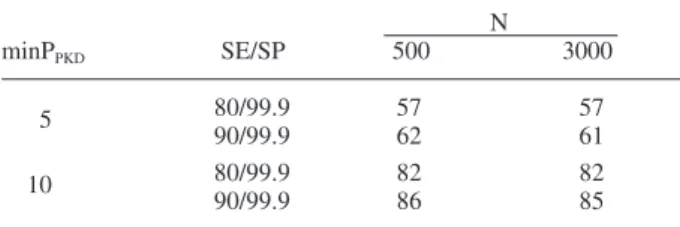
In order to calculate the sample size which whould be large enough to exclude the presence of PKD at a sam-pling site, the statistical approach “freedom from disease” was applied by using the freeware program “Survey Tool-box” (http://www.ausvet.com.au/content.php?page=res_ software). Depending on the PKD-prevalence, a sample size of 31 to 71 fi sh would be needed to detect diseased fi sh with a confi dence level of 95% (Table 1). This calcu-lation is based on the following assumptions: 80% or 90% sensitivity of the diagnostic methods used (macroscopy, histology, immunohistochemistry); 99.9% specifi city for the serial combination of methods; a minimum observable prevalence of the disease in the population of 5 or 10% (Feist et al., 2002 and personal experiences) and a popula-tion size of 500 or 3000 fi sh per sample site (realistic numbers that may be encountered on a sampling stretch of 200 m). However, due to manpower, fi nancial, techni-cal and ethitechni-cal reasons, it was impossible to collect or process that large sample size. Therefore we decided to set the sample size to 20 fi sh per site (which was fi nally obtained at 82 of the 115 sampling sites), knowing that there will be diffi culties in detecting PKD in sites of low prevalence. For instance, the confi dence levels drop to 57–62% for a minimum expected PKD prevalence of 5% in the population if only 20 fi sh are examined (Table 2). Therefore, from a population with a disease prevalence of 5% we would detect in 57–62% of the cases one or more diseased fi sh. In populations with a disease prevalence of 10%, the confi dence level is 82–85%. At sites with a high-er PKD prevalence, the sample size of 20 fi sh is suffi cient to detect the disease.
The sampling period took place from the beginning of August to the end of October 2004. The target fi sh were young-of-the-year. Sampling was done by electro fi sh-ing, except in four fi sh farms where fi sh could be netted. The farmed fi sh had been raised in earthen ponds at low densities and were produced for restocking purposes. Fish were caught and kept alive until further processing. After euthanasia with an overdose of clove oil (100 ppm),
Table 1. Sample size needed to detect disease or prove freedom
from PKD of a sample site at a confi dence level of 95%. Assump-tions for the calculaAssump-tions: Sensitivity (SE) of combined methods at 80 and 90%; specifi city (SP) of combined methods = 99.9%, for population sizes of target fi sh at a site (N) = 500 or 3,000, and mini-mal prevalence of T. bryosalmonae infection at a site when parasite present (min PPKD) = 5 or 10%. N minPPKD SE/SP 500 3000 5 80/99.9 68 71 90/99.9 61 64 10 80/99.9 35 36 90/99.9 31 32
length and estimated age were recorded (75% were esti-mated to have the target age of <1 year). Fish were opened ventrally and assessed for macroscopic symp-toms of PKD (exophthalmia, darkening, ascites, general anaemia and kidney hyperplasia). Subsequently, kidneys were excised and fi xed in 4% buffered formalin.
In total, 2085 fi sh were analysed whereof 94% were brown trout (Salmo trutta). The remaining 6% were com-posed of rainbow trout (Oncorhynchus mykiss), brook trout (Salvelinus fontinalis) and grayling (Thymallus
thy-mallus). The data presented include all samples
irrespec-tive of the species.
Preparation of kidneys for histology and immunohistochemistry
Fixed kidneys were processed for paraffi n-embedding according to routine methods. One haematoxilin & eosin (H&E) stained slide containing the full length of the kid-ney was produced per fi sh. For immunohistochemical staining, an anti-Tetracapsuloides bryosalmonae (PKX) antibody (AquaMAb-P01, Aquatic Diagnostics Ltd., Stirling, Scotland) was used. The staining procedure was based on a protocol by Adams et al. (1992) with minor modifi cations. Briefl y, unstained sections were incubated overnight using an antibody dilution of 1/100. Unspecifi c background staining was blocked with goat serum. A bi-otin-streptavidin-horseradish peroxidase staining kit (Kit Dako LSAB 2 System HRP Code Nr. K0675; DakoCyto-mation, Zug, Switzerland) followed by AEC (Amino-Ethyl-Carbazole) staining (DAKO AEC K3464) was used to visualize antibody-antigen complexes. Counter-staining of the sections was not performed. Positive con-trol sections were taken from fi sh with known positive infection status, negative controls from uninfected kid-neys were derived from farmed fi sh with no history of T.
bryosalmonae infection.
Assessment of samples for PKD
Three different methods were performed: macroscopic examination, histology and immunohistochemistry. A
se-rial combination of these methods was considered the most reliable means to detect infected fi sh and to refl ect the true infection status. The assessment using the vari-ous methods was performed as follows:
a) Fish from 114/115 sampling sites in rivers and farms were assessed macroscopically upon opening the fi sh (fi sh from one sampling site were exclusively exam-ined histologically and immunohistochemically). Fish showing enlarged kidneys or kidneys with grey-ish focal to coalescing spots were graded as macro-scopically positive for T. bryosalmonae.
b) One H&E stained kidney section from every fi sh was investigated for the presence of parasites within the interstitial tissue or within the tubules. Kidneys were graded as histologically positive when at least one parasite could be found. For the infection level a score from 0 (= no parasites) to 6 (at least 10 para-sites per high power fi eld (magnifi cation 400x) was used.
c) Immunohistochemistry was applied on those sections where H&E histology revealed no clear results (e.g. proliferation of kidney but no parasites detectable, myxozoan parasites exclusively in tubules). Further, at sampling sites where no parasites had been found in any fi sh by examination of H&E stained kidney sections, three kidneys were randomly selected for immunohistochemical staining to verify the negative fi nding.
The fi nal diagnosis “PKD-positive” based on the detec-tion of T. bryosalmonae by histology or immunohisto-chemistry.
The site infection intensity B was calculated by the following formula (1):
B = sum of scores (1)
sample size
Results
Sampling site specifi c results
PKD-positive fi sh were detected in 49 out of 91 rivers (54%) and at 62 out of 111 river sampling sites (56%). In three out of four farms PKD-positive fi sh were found. While in most positive sites at least some fi sh showed macroscopic symptoms typical for PKD, in fi sh from 12 positive sites no macroscopic symptoms were seen.
North of the Alps 44 out of 81 rivers (54%) and 56/100 sites (56%) were PKD positive (Fig. 1). The four farms examined, of which three were positive for PKD, are situated north of the Alps. In the central al-pine valley (canton Valais) 3/7 sites (43%) were found to be positive. Each site represented a different river. South of the Alps, three out of four sites (75%) were
Table 2. Probability (%) of observing at least one
Tetracapsuloides-infected fi sh in a sample of 20 animals from a population with PKD. Assumptions for the calculations: Sensitivity (SE) of combined methods at 80 and 90%; specifi city (SP) of combined methods = 99.9%, for population sizes of target fi sh at a site (N) = 500 or 3,000, and minimal prevalence of T. bryosalmonae infection at a site when parasite present (min PPKD) = 5 or 10%.
N minPPKD SE/SP 500 3000 5 80/99.9 57 57 90/99.9 62 61 10 80/99.9 82 82 90/99.9 86 85
diagnosed as PKD positive. Two of the positive sites were located in the same river. Therefore, in 67% of the rivers fi sh were affected.
At four of the 62 positive sites <10% of the analysed fi sh were infected by T. bryosalmonae (Fig. 2). This cor-responds to 3.4% of all sites. In one of these sites, a posi-tive result was based on a very low number of parasites found in one single fi sh by immunohistochemical stain-ing only. At six sites, more than 90% of the examined fi sh
proved to be positive and at four of these sites all fi sh were infected with T. bryosalmonae. Considering all sites with positive fi sh, the average prevalence was found to be 53% (minimum 5%, maximum 100%).
At PKD-positive sites values for the infection inten-sity were found to be between 0.1 and 3 (Fig. 3). Values higher than four were found in seven sites only. The mean infection intensity for all positive sites was 1.8 (minimum 0.1, maximum 5).
Figure 1. Distribution of sites with fi sh positive and negative for Tetracapsuloides bryosalmonae in a monitoring performed in 2004.
0 2 4 6 8 10 12 1-10 11-20 21-30 31-40 41-50 51-60 61-70 71-80 81-90 91-100
Percentage of fish infected with T. bryosalmonae
Number of sites
Figure 2. Number of sites in 2004 with a given prevalence of T. bryosalmonae infected fi sh. Only sites with fi sh positive for T. bryo-salmonae included. 0 2 4 6 8 10 12 14 0.1-0.5 0.6-1 1.1-1.5 1.6-2 2.1-2.5 2.6-3 3.1-3.5 3.6-4 4.1-4.5 4.6-5
Classes of infection intensity
Number of sites
Figure 3. Distribution of investigated sites in 2004 according to
mean infection intensities of fi sh by T. bryosalmonae. Only sites with fi sh positive for T. bryosalmonae are included.
Fish specifi c results
T. bryosalmonae was detected histologically or by
im-munohistochemistry in 28% (590/2085) of fi sh. Of these, 2,048 fi sh were analysed by both, by macroscopical and histological methods. Thereby, 578 of these 2,048 fi sh were classifi ed as PKD-positive. Of the positive fi sh, 157 showed neither clinical nor macroscopic alterations and were classifi ed macroscopically as negative. Among the 226 fi sh that were not unequivocally identifi ed as PKD-positive by H&E histology, 73 were found to be PKD-positive by immunohistochemical staining.
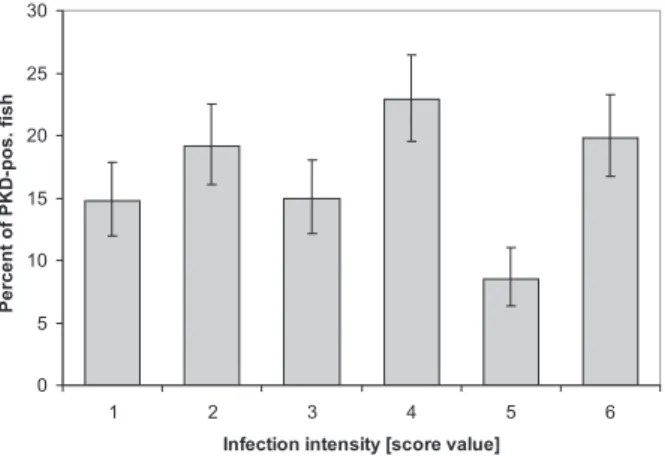
Half of the fi sh showed a moderate to high intensity of infection (score values of 4–6) (Fig. 4).
Many of the infected fi sh showed a prominent hyper-plasia of the interstitial tissue accompanied by a severe granulomatous infl ammation and fi broblast proliferation in the kidney. However, histology and immunohisto-chemistry did not identify T. bryosalmonae in all fi sh that showed marked pathological kidney alterations. The ma-jority of such fi sh displaying kidney pathology but no parasites were caught at the end of September and in October.
In many fi sh with marked infl ammatory reaction and development of fi brous tissue, the density of T.
bryosal-monae cells was very patchy. Also marked differences in
the size of parasites were evident, it ranged from 10 µm to 16.5 µm. In a number of fi sh, degenerated parasites, characterized by loss of structural integrity, were ob-served.
Discussion
PKD-positive fi sh were found in 56% of all sample sites investigated including rivers north and south of the Alps. The results confi rm the fi ndings of an earlier monitoring,
which stated, that PKD occurs in a high prevalence in Swiss rivers (Wahli et al., 2002). The majority of positive sites in both monitorings has been found north of the Alps in the Swiss Midland (Fig. 5), though it has to be considered, that the majority of sites included in this study was as well located in the Midland. Nevertheless, there is some evidence that PKD can be found more fre-quently in areas with higher water temperatures in sum-mer. This hypothesis has still to be confi rmed. Similar investigations have been performed in rivers in England and Wales (Seagrave et al., 1981; Feist et al., 2002). The study by Feist et al. (2002) identifi ed positive fi sh in fi ve out of 14 examined rivers, a percentage clearly lower than in our investigations.
It has to be emphasized that our results may not re-fl ect the true prevalence of PKD in Switzerland for two main reasons. 1.) Both of our investigations in Swiss riv-ers have been based on samplings performed only once per site thus refl ecting the ad hoc situation. As shown by Okamura et al. (2001) the presence of T. bryosalmonae infected bryozoans shows considerable temporal varia-tions. Whether this applies also to the presence of PKD in trout has still to be elucidated. Repetitive samplings at the same sites could clarify this question. 2.) The sample sites investigated in this study have not been randomly selected. Cantons and fi sheries associations throughout Switzerland defi ned rivers and brooks where fi sh should be investigated. With this selection we wanted to expand on earlier studies (Wahli et al., 2002) and to gather knowledge on the status of rivers from which spawners are taken or fry are raised for restocking purposes. Nev-ertheless, the results demonstrate that T. bryosalmonae is widely distributed in wild fi sh of Swiss rivers.
The prevalence of PKD-positive fi sh at a site was nor-mally >10%. This is in accordance with data found in England and Wales (Feist et al., 2002), where prevalences were between 11 and 43%. This indicates that fi sh are commonly diseased if T. bryosalmonae is present in the river. At only four sites the prevalence of PKD-positive fi sh was <10%. However, negative results have to be in-terpreted with caution because of the fair confi dence level (82–85% for a minimum expected PKD prevalence of 10%) due to our target sample size of 20 fi sh to prove freedom from disease. In order to confi rm the negative status of sites, it is planned for further studies to analyse a sample size of 60 fi sh per selected sites, which would allow us to prove freedom from disease with a confi dence level of almost 95%. Those target sample sites will be chosen in rivers previously shown to be negative for PKD but likely to be a suitable environment for T.
bryosalmo-nae according to the geographic situation and structure of
the brown trout population.
The infection intensities ranged from very low (1) to high (6). Such variations, also found amongst individual fi sh within one sample site, might be infl uenced by
dif-0 5 10 15 20 25 30 1 2 3 4 5 6
Infection intensity [score value]
Percent of PKD-pos. fish
Figure 4. Prevalence of PKD-positive fi sh with a particular
infec-tion intensity ranging from 1 (= single parasites) to 6 (>9 parasites per high power fi eld). Bars indicate the 95% confi dence levels of the binomial distribution.
ferent factors. PKD is known to have a seasonal occur-rence (Foott and Hedrick, 1987; Hedrick et al., 1993) with overt PKD developing mainly at temperatures of 15 °C or higher (Ferguson, 1981; Clifton-Hadley et al., 1986). In the present study, fi sh were sampled from Au-gust to October. In the vast majority of fi sh showing macroscopic symptoms the presence of parasites could be demonstrated either by histology or immunohisto-chemistry. Particularly in fi sh sampled towards the end of this period, kidney alterations typical for PKD (Fergu-son and Needham, 1978), such as proliferation, infl am-mation and induration of fi brous tissue were present but no or only few parasites could be found. The pathology in these fi sh indicates a strong infection, however para-sites might have left the host or been destroyed by the host’s immune system at this time of the year. Therefore, to facilitate the diagnosis of PKD irrespective of the di-agnostic method, samples should be taken at the peak period of the disease i.e. from July to mid-September. The lower frequencies for infection intensity classes of 3.1–3.5 and 3.6–4 might be due to the limited number of samples taken.
Spawners to produce broodstock for restocking meas-ures are regularly taken from many of the rivers investi-gated. However, as vertical transmission has never been
demonstrated, spread of PKD via eggs obtained from in-fected parent fi sh is unlikely. On the other hand, in some of the rivers and fi sh farms investigated, fry are raised for restocking measures. As certain infected salmonids can excrete small numbers of malacosporean like spores (He-drick et al., 2004) an introduction of PKD into rivers so far free from T. bryosalmonae might occur if T.
bryosal-monae infected young fi sh are stocked, though an
infec-tion of bryozoans by spores excreted from fi sh has not been achieved so far (Hedrick et al., 2004). It remains uncertain whether introduction of infected fry can spread the disease unless an infection of bryozoans by spores released from fi sh can be demonstrated.
Earlier studies in Switzerland pointed to a possible association between PKD and increased mortality in brown trout (Schmidt et al., 1999) and PKD was identi-fi ed as a possible factor contributing to the declining brown trout catches in Switzerland. This hypothesis is supported by a negative correlation between the presence of PKD and the brown trout catches in fi ve investigated cantons (Fischnetz, 2004; www.fi schnetz.ch). Feist et al. (2002) showed a positive correlation between mala-cosporean infections and renal hypertrophy. These au-thors also suggested that infected fi sh are physically compromised. However, so far no published data showed
Figure 5. Distribution of sites with fi sh found positive for Tetracapsuloides bryosalmonae in two monitorings performed in 2000/2001 and
a clear correlation between the occurrence of PKD and a decrease in wild trout populations. Mortalities in wild fi sh populations directly attributable to a T.
bryosalmo-nae infection have not been reported so far although an
effect on a wild trout population has been shown for other myxozoans e.g. Myxobolus cerebralis (Hedrick et al., 1998; Modin, 1998).
Assessment of the impact of PKD on wild popula-tions requires long-term, multidisciplinary, observational studies.
There is evidence that temperature plays a major role in the development of T. bryosalmonae in its bryozoan host (Gay et al., 2001) and the clinical disease of PKD is usually found during the warm water months of the year (Clifton-Hadley et al., 1986, Schmidt-Posthaus et al., 2001). There is some evidence for a general rise in water temperature in Switzerland (Hari et al., 2006) which might infl uence the disease development. Global changes leading to increasing water temperatures support the im-portance of follow-up studies of temperature dependent diseases (Fischnetz, 2004). A second possibly infl uential factor is water pollution (Schmidt et al., 1999; Schmidt-Posthaus et al., 2001). While Okamura et al. (2001) found bryozoans infected with T. bryosalmonae in all types of water irrespective of its quality, Hoffmann and Dangschat (1981) and El-Matbouli and Hoffmann (2002) suggested an infl uence of water quality on the course of PKD. Water contaminants can infl uence the disease via development of the parasite in the bryozoan host or in its fi sh host. Indeed, it is likely that the prevalence of PKD is highly infl uenced by environmental factors affecting the distribution of the invertebrate host (Okamura et al., 2001). Until now, there is little information on the distri-bution of bryozoans in Swiss rivers.
This study presents an extended data set on the pres-ence of PKD in Swiss rivers. Time series and spatial analyses are necessary to investigate the importance of time-dependent risk factors, such as water temperature, and spatial variation of other environmental factors, re-spectively. Further research to investigate the occurrence of bryozoans and to identify factors infl uencing the de-velopment of PKD needs to be done. Such additional re-search is necessary for a better understanding of the epi-demiology of PKD and its impact on wild brown trout populations.
Acknowledgments
This work was funded by the Federal Offi ce for the Envi-ronment. Thanks goes also to the „Stiftung zur Förderung der wissenschaftlichen Forschung an der Universität Bern“ for supporting travel expenses. We also thank two anonymous reviewers for their helpful and constructive comments.
References
Adams, A., R. H. Richards and M. de Mateo, 1992. Development of monoclonal antibodies to PK’X’, the causative agent of prolif-erative kidney disease. Journal of Fish Diseases 15: 515–521. Canning, E. U., A. Curry, S. W. Feist, M. Longshaw and B.
Oka-mura, 2000. A new class and order of myxozoans to accommo-date parasites of bryozoans with ultrastructural observations on
Tetracapsula bryosalmonae (PKX organism). Journal of
Eu-karyotic Microbiology 47: 456–468.
Clifton-Hadley, R. S., R. H. Richards and D. Bucke, 1986. Prolifera-tive kidney disease (PKD) in rainbow trout Salmo gairdneri: Further observations on the effects of water temperature. Aqua-culture 55: 165–171.
D’Silva, J., M. F. Mulcahey and D. de Kinkelin, 1984. Experimental transmission of proliferative kidney disease in rainbow trout,
Salmo gairdneri Richardson. Journal of Fish Diseases 7: 235–
239.
El-Matbouli, M. and R. W. Hoffmann, 2002. Infl uence of water quality on the outbreak of proliferative kidney disease – Field studies and exposure experiments. Journal of Fish Diseases 25: 459–467.
Feist, S. W. and D. Bucke, 1993. Proliferative kidney disease in wild salmonids. Fisheries Research 17: 51–58.
Feist, S. W., E. J. Peeler, R. Gardiner, E. Smith and M. Longshaw, 2002. Proliferative kidney disease and renal myxosporidiosis in juvenile salmonids from rivers in England and Wales. Journal of Fish Diseases 25: 451–458.
Feist, S. W., M. Longshaw, E. U. Canning and B. Okamura, 2001. Induction of proliferative kidney disease (PKD) in rainbow trout Oncorhynchus mykiss via the bryozoan Fredericella
sul-tana infected with Tetracapsula bryosalmonae. Diseases of
Aquatic Organisms 45: 61–68.
Ferguson, H. W., 1981. The effect of water temperature on the devel-opment of proliferative kidney disease in rainbow trout Salmo
gairdneri Richardson. Journal of Fish Diseases 4: 175–177.
Ferguson, H. W. and H. J. Ball, 1979. Epidemiological aspects of pro-liferative kidney disease in rainbow trout, Salmo gairdneri Rich-ardson, in Northern Ireland. Journal of Fish Diseases 2: 219–225. Ferguson, H. W. and E. A. Needham, 1978. Proliferative kidney
disease in rainbow trout, Salmo gairdneri Richardson. Journal of Fish Diseases 1: 91–108.
Fischnetz, 2004. Dem Fischrückgang auf der Spur. Schlussbericht des Projekts Netzwerk Fischrückgang Schweiz. Dübendorf, Bern, Eawag, BUWAL, 184 pp.
Foott, J. S. and R. P. Hedrick, 1987. Seasonal occurrence of the in-fectious stage of proliferative kidney disease (PKD) and resist-ance of rainbow trout, Salmo gairdneri Richardson, to reinfec-tion. Journal of Fish Biology 30: 477–484.
Gay, M., B. Okamura and P. de Kinkelin, 2001. Evidence that infec-tious stages of Tetracapsula bryosalmonae for rainbow trout
Oncorhynchus mykiss are present throughout the year. Diseases
of Aquatic Organisms 46: 31–40.
Hari, R. E., D. M. Livingstone, R. Siber, P. Burkhardt-Holm and H. Güttinger, 2006. Consequences of climatic change for water temperature and brown trout populations in Alpine rivers and streams. Global Change Biology 12: 10–26.
Hedrick, R. P., D. V. Baxa, P. De Kinkelin and B. Okamura, 2004. Malacosporean-like spores in urine of rainbow trout react with antibody and DNA probes to Tetracapsuloides bryosalmonae. Parasitology Research 92: 81–88.
Hedrick, R. P., M. El-Matbouli, M. A. Adkison and E. MacConnell, 1998. Whirling disease: re-emergence among wild trout. Im-munological Reviews 166: 365–376.
Hedrick, R. P., E. MacDonnell and P. de Kinkelin, 1993. Prolifera-tive kidney disease of salmonid fi sh. Annual Review of Fish Diseases 3: 277–290.
Hoffmann, R. and H. Dangschat, 1981. A note on the occurrence of proliferative kidney disease in Germany. Bulletin of the Euro-pean Association of Fish Pathologists 1: 33.
MacConnell, E. and J. E. Peterson, 1992. Proliferative kidney dis-ease in feral cutthroat trout from a remote Montana reservoir: a fi rst case. Journal of Aquatic Animal Health 4: 182–187. Modin, J., 1998. Whirling disease in California: a review of its
his-tory, distribution, and impacts, 1965–97. Journal of Aquatic Animal Health 10: 132–142.
Morris, D. C., D. J. Morris and A. Adams, 2002a. Development and release of a malacosporean (Myxozoan) from Plumatelle repens (Bryozoa: Phylactolaemata). Folia Parasitologia 49: 25–34. Morris, D. C., D. J. Morris and A. Adams, 2002b. Molecular
evi-dence of release of Tetracapsula bryosalmonae, the causative organism of proliferative kidney disease from infected salmo-nids into the environment. Journal of Fish Diseases 25: 501– 504.
Okamura, B., C. L. Anderson, M. Longshaw, S. W. Feist and E. U. Canning, 2001. Pattern of occurrence and 18S rDNA sequence variation of PKX (Tetracapsula bryosalmonae), the causative agent of salmonid proliferative kidney disease. Journal of Para-sitology 87: 379–385.
Schmidt H., D. Bernet, T. Wahli, W. Meier and P. Burkhardt-Holm, 1999. Active biomonitoring with brown trout and rainbow trout in diluted sewage plant effl uents. Journal of Fish Biology 54: 585–596.
Schmidt-Posthaus H., D. Bernet, T. Wahli and P. Burkhardt-Holm, 2001. Morphological organ alterations and infectious diseases in brown trout (Salmo trutta) and rainbow trout (Onchorhyn-chus mykiss) exposed to polluted river water. Diseases of Aquatic Organisms 44: 161–170.
Seagrave, C. P., D. Bucke, E. B. Hudson and D. McGregor, 1981. A survey of the prevalence and distribution of proliferative kidney disease (PKD) in England and Wales. Journal of Fish Diseases
4: 437–439.
Tops, S., D. V. Baxa, T. S. McDowell, R. P. Hedricks and B. Oka-mura, 2004. Evaluation of malacosporean life cycle through transmission studies. Diseases of Aquatic Organisms 60: 109– 121.
Tops, S. and B. Okamura, 2003. Infection of bryozoans by Tetracap-suloides bryosalmonae at sites endemic for salmonid prolifera-tive kidney disease. Diseases of Aquatic Organisms 57: 221– 226.
Wahli, T., R. Knuesel, D. Bernet, H. Segner, D. Pugovkin, P. Burkhardt-Holm, M. Escher and H. Schmidt-Posthaus, 2002. Proliferative kidney disease in Switzerland: current state of knowledge. Journal of Fish Diseases 25: 491–500.
To access this journal online: http://www.birkhauser.ch/AS