Evidence of Substantial Carbon Isotope Fractionation among
Substrate, Inorganic Carbon, and Biomass during Aerobic
Mineralization of 1,2-Dichloroethane by
Xanthobacter
autotrophicus
D. HUNKELER* AND R. ARAVENA
Department of Earth Sciences, University of Waterloo, Waterloo, Ontario, Canada
Carbon isotope fractionation during aerobic mineralization of 1,2-dichloroethane (1,2-DCA) by Xanthobacter autotrophicus GJ10 was investigated. A strong enrichment of 13C in residual 1,2-DCA was observed, with a mean
fractionation factor ␣ ⴞ standard deviation of 0.968 ⴞ 0.0013 to 0.973 ⴞ 0.0015. In addition, a large carbon isotope fractionation between biomass and inorganic carbon occurred. A mechanistic model that links the fractionation factor ␣ to the rate constants of the first catabolic enzyme was developed. Based on the model, it was concluded that the strong enrichment of 13C in 1,2-DCA arises because the first irreversible step of the
initial enzymatic transformation of 1,2-DCA consists of an SN2 nucleophilic substitution. SN2 reactions are
accompanied by a large kinetic isotope effect. The substantial carbon isotope fractionation between biomass and inorganic carbon could be explained by the kinetic isotope effect associated with the initial 1,2-DCA transformation and by the metabolic pathway of 1,2-DCA degradation. Carbon isotope fractionation during 1,2-DCA mineralization leads to 1,2-DCA, inorganic carbon, and biomass with characteristic carbon isotope compositions, which may be used to trace the process in contaminated environments.
1,2-Dichloroethane (1,2-DCA) has been produced in larger quantities than any other chlorinated hydrocarbon (35). This compound is mainly used as a precursor for poly(vinyl chlo-ride) production and as a solvent. 1,2-DCA is frequently de-tected in the environment and has been classified as a priority pollutant by the United States Environmental Protection Agency. Because of its high aqueous solubility and low sorp-tion coefficient (37), 1,2-DCA is likely to contaminate ground-water if it is released into the environment. Under abiotic conditions, dissolved 1,2-DCA is transformed slowly and toxic products such as vinyl chloride may be formed (26). In con-trast, microorganisms can rapidly degrade 1,2-DCA to non-toxic end products. Under anaerobic conditions, ethene is usu-ally the main degradation product (12), but chloroethane and ethane production has also been observed (19). Under aerobic conditions, 1,2-DCA is completely mineralized to CO2and Cl⫺
(15, 24, 25, 40, 45). Anaerobic degradation of 1,2-DCA to ethene has been observed at several field sites, while aerobic degradation has been reported less frequently (6, 10, 28, 29). Aerobic biodegradation of 1,2-DCA is more difficult to dem-onstrate at field sites than anaerobic degradation because the end products of aerobic degradation, inorganic carbon and Cl⫺, often occur at high background concentrations in
ground-water while the main end product of aerobic degradation, ethene, is less common.
The use of compound-specific isotope analysis is a promising tool for substantiating intrinsic biodegradation of organic con-taminants in groundwater (1, 21, 47). This method relies on the frequent occurrence during abiotic and biotic transformation processes (2, 39) of a kinetic isotope effect, which consists of differences in reaction rates for molecules of a compound
containing light (12C, H, or35Cl) and heavy (13C, D, or37Cl)
isotopes, respectively. As a result, precursor and products iso-tope ratios differ; this is called (kinetic) isoiso-tope fractionation. Usually the product is depleted of heavy isotopes relative to the precursor and, therefore, the precursor becomes increas-ingly enriched in heavy isotopes as the reaction proceeds. Large kinetic isotope effects frequently occur with respect to atoms that constitute the bond that is broken or formed during the reaction step (primary isotope effect), while small effects occur with respect to atoms at other positions (secondary iso-tope effect). The occurrence of kinetic isoiso-tope effects has been used extensively in organic chemistry and enzymology to in-vestigate reaction mechanisms and to identify rate-limiting steps in multistep transformation processes (see, e.g., refer-ences 9 and 13).
During microbial degradation, an enrichment of heavy iso-topes in the remaining substrate is expected if the initial en-zymatic transformation step is accompanied by a kinetic iso-tope effect (17). Such an effect has been observed during reductive dechlorination of tetrachloroethene, trichloroethene,
cis-1,2-dichloroethene, and vinyl chloride (4, 21, 38) and
oxi-dation of dichloromethane (18). In contrast, only a small or no carbon isotope fractionation was observed during aerobic or anaerobic degradation of aromatic hydrocarbons (27, 31, 38). Isotope analysis can be used not only to demonstrate that a contaminant is being degraded but also to link nonunique degradation end products, such as ethene, ethane, and dis-solved inorganic carbon (DIC), to degrading contaminants. Recent studies (4, 21) have shown that ethene produced by reductive dechlorination of chlorinated ethenes is initially very depleted in13C. In contrast, during biodegradation of
hydro-carbons, only a small carbon isotope fractionation between substrate and inorganic carbon has been observed (14, 16). Analysis of13C/12C ratios in DIC has been used to distinguish
between inorganic carbon produced by contaminant
degrada-* Corresponding author. Mailing address: Department of Earth Sci-ences, University of Waterloo, Waterloo, Ontario, Canada N2L 3G1. Phone: (519) 885 1211. Fax: (519) 746 7484. E-mail: dhunkele@sciborg .uwaterloo.ca.
of 1,2-DCA degradation at contaminated sites. Several micro-organism, in pure cultures, are known to be capable of aerobic degradation of 1,2-DCA (15, 25, 40, 45). For this study,
Xan-thobacter autotrophicus GJ10 was chosen since the organism is
well characterized (24) and has previously been used to treat contaminated groundwater (41). Furthermore, the reaction mechanism of the enzyme that catalyzes the initial transforma-tion of 1,2-DCA, haloalkane dehalogenase, is thoroughly doc-umented (36, 48). In previous studies of isotope fractionation during biodegradation of organic contaminants, an empirical model was used to quantify isotope fractionation (4, 18, 38). In contrast, in this study we developed a mechanistic model to explain the origin and magnitude of the observed high degree of isotope fractionation. The use of a mechanistic model makes it possible to draw some general conclusions with regard to the occurrence and characteristics of isotope fractionation during contaminant degradation.
MATERIALS AND METHODS
Organism and growth conditions.X. autotrophicus GJ10 was obtained from
D. B. Janssen (Department of Biochemistry, University of Groningen, Gro-ningen, The Netherlands). The organism, originally isolated from a mixture of activated sludge and chemically polluted soils, is capable of growing on 1,2-DCA as a sole carbon and energy source (25). It constitutively produces two different dehalogenases (24): one is specific for halogenated alkanes, while the other is specific for halogenated carboxylic acids. In the initial step, which may cause enrichment of heavy isotopes in the residual substrate, 1,2-DCA is transformed to 2-chloroethanol by hydrolytic dehalogenation (24).
The mineral medium employed was similar to the one used by Janssen and coworkers (25) except that the strength of the phosphate buffer was reduced since lower 1,2-DCA concentrations were used. The medium, which contained (per liter) 3.22 g of Na2HPO4䡠 12H2O, 0.81 g of KH2PO4, 0.5 g of (NH4)2SO4, 0.2 g of MgSO4䡠 7H2O, and 0.015 g of CaCl2䡠 2H2O, was supplemented with 1 ml of trace element solution (42) per liter and adjusted to pH 7.2 before being autoclaved. Afterward, 0.1 ml of a sterile vitamin solution (44) was added per liter of medium. The culture was grown in 250-ml glass bottles which contained 185 ml of medium and were closed with Mininert-Valves (Vici Precision Sam-pling, Baton Rouge, La.). Before the experiments were begun, the culture was transferred three times. Each subculture received 0.61 mM (60 ppm) of 1,2-DCA at four time points.
Experiments.For all experiments, 15 ml of the previous subculture was added to bottles containing 170 ml of autoclaved medium. To remove DIC, the medium was purged for 2 h with helium by the use of a sterile stainless steel needle. Afterward, 20 ml of O2and 1,2-DCA (99.8% purity; Aldrich, Milwaukee, Wis.) were added and the bottles were placed on a shaker. After 1 h of shaking, samples representing initial concentrations were removed.
In experiment I, 1,2-DCA was added at a concentration of 0.61 mM (60 ppm). The cultures were incubated in duplicate at 10 and 23°C, respectively, and continuously shaken. The concentration and 13C/12C ratio of 1,2-DCA were determined at various time points during degradation. Furthermore, the con-centrations and13C/12C ratios of inorganic carbon and biomass were determined at the beginning and the end of the experiment.
In experiment II, 1,2-DCA was added at a concentration of 1.22 mM (120 ppm). A higher concentration than that used in experiment I was chosen in order to obtain inorganic carbon and biomass at concentrations sufficient to determine 13C/12C ratios at intermediate stages. Six bottles were prepared and incubated at 23°C. The concentration and13C/12C ratio of 1,2-DCA in one of the cultures were determined at various times during degradation. The other cultures were stopped at different time points by adding HgCl2(25 ppm Hg2⫹), and the concentrations and13C/12C ratios of 1,2-DCA, inorganic carbon, and biomass were measured. In addition, the Cl⫺concentration was measured at the begin-ning and the end of the experiment to confirm that 1,2-DCA mineralization had reached completion.
Sampling.For concentration and13C/12C ratio analyses of 1,2-DCA, liquid samples (2-ml volume) were taken and preserved with HgCl2(25 ppm of Hg2⫹). To determine the concentration and13C/12C ratio of CO2, 0.5 ml of headspace gas was removed and analyzed immediately. For concentration and13C/12C ratio analyses of DIC, 2.5-ml volumes of liquid sample were dispensed into
helium-adding HgCl2(25 ppm of Hg2⫹) and purged for 3 h with helium to remove volatile compounds before centrifugation. The precipitate was washed twice with 15 mM phosphate buffer and freeze-dried.
Analytical methods.All stable-isotope analyses were performed in the Envi-ronmental Isotope Laboratory of the University of Waterloo.13C/12C ratios are reported in the usual delta notation (␦13C). The␦13C value is defined as␦13C⫽ (Rs/Rr⫺ 1) ⫻ 1,000, where Rsand Rrare the13C/12C ratios of the sample and the
international standard Vienna Peedee Belemnite (VPDB), respectively. The␦13C of pure-phase 1,2-DCA was determined as previously described (20). The␦13C values of dissolved 1,2-DCA and headspace CO2were determined with a gas chromatography-combustion-isotope ratio mass spectrometry (GC-C-IRMS) system. The GC-C-IRMS system consisted of an Agilent (Palo Alto, Calif.) gas chromatograph equipped with a split/splitless injector, a Micromass (Manchester, United Kingdom) combustion interface operated at 850°C, and a Micromass Isochrom isotope-ratio mass spectrometer. For headspace analysis of CO2, the gas chromatograph was equipped with a GS-GasPro column (J&W Scientific, Folsom, Calif.). The␦13C values of dissolved 1,2-DCA were deter-mined by a method based on solid-phase microextraction as described by Hunkeler and Aravena (20). Concentrations of CO2and 1,2-DCA were deter-mined based on the peak areas of the mass 44 signal for samples and external standards. The analytical system was verified daily by using reference compounds with known␦13C values (20). The standard uncertainty of the␦13C measurement was⫾ 0.5‰ for CO2and 1,2-DCA (n⫽ 3). The relative standard uncertainty of the concentration measurement was⫾ 8% for CO2and 1,2-DCA (n⫽ 3).
Carbon isotope ratios and concentrations of DIC were determined with a Gas breath analyzer coupled to a Micromass Isochrom isotope-ratio mass spectrometer (Micromass). External DIC standards were prepared by dissolution of NaHCO3with a known␦13C in distilled water that had been purged with helium for 0.5 h. Standards and samples were shaken for at least 1 h prior to carbon isotope analysis. DIC concentrations were quantified based on the peak areas of the mass 44-ion trace of samples and external standards. The standard uncertainty of the␦13C measurement was⫾ 0.15‰ for DIC (n ⫽ 6). The relative standard uncertainty of the concentration measurement was⫾ 4% for DIC (n⫽ 6).
Carbon isotope ratios and carbon content of biomass were determined with a CE Instruments (Rodano, Italy) elemental analyzer coupled to a Micromass Isochrom isotope-ratio mass spectrometer. Samples of 1 mg were packed into tin cups and combusted at 1,030°C. The standard uncertainty of the␦13C of biomass was⫾ 0.6‰, while the relative standard uncertainty of the carbon content was ⫾ 10% (n⫽ 4).
Chloride concentrations were analyzed with a Dionex (Sunnyvale, Calif.) ion chromatography system equipped with an AS4A-SC column (Dionex). Optical densities were determined at 600 nm using an Ultraspec Plus UV/visible spec-trophotometer (Amersham Pharmacia Biotech).
Calculations.For 1,2-DCA and inorganic carbon, expected concentrations if the total masses of these compounds were present in the aqueous phase are reported. This allows for easy comparison of 1,2-DCA consumption and produc-tion of inorganic carbon, biomass, and Cl⫺. For 1,2-DCA,␦13C values deter-mined by solid-phase microextraction of the aqueous phase are given. They correspond to the␦13C of the total mass of 1,2-DCA since only a very small carbon isotope fractionation between 1,2-DCA in the aqueous phase and head-space occurs (20) and since the mass of 1,2-DCA in the headhead-space is small. In contrast, a significant pH-dependent carbon isotope fractionation occurs be-tween headspace CO2and DIC. At pH 7.2, CO2in the headspace is depleted of 13C by 7‰ compared to DIC (8). Therefore, the␦13C of the total inorganic carbon was calculated based on concentrations and␦13C values of DIC in the aqueous phase and CO2 in the headspace. The biomass concentration was calculated by multiplying the carbon content by the total mass of freeze-dried biomass and dividing the result by the volume of the aqueous phase. The␦13C of the produced biomass was calculated based on the concentrations and ␦13C values of biomass at the beginning of the experiment and at the time of sampling. The13C-mass balance was calculated by multiplying the concentrations of 1,2-DCA, inorganic carbon, and biomass by their␦13C values, adding the contribu-tions, and dividing the sum by the total concentration of these compounds.
Isotope fractionation during biodegradation of 1,2-DCA was quantified using a Rayleigh-type evolution model (7, 8, 30). According to this model, the isotopic composition of the substrate is given by
RS⫽ RS0䡠 ƒ
共␣⫺1兲 (1)
where ƒ is the fraction of substrate remaining, RSis the substrate isotope ratio at
a remaining fraction ƒ, RS0is the initial isotope ratio of the substrate, and␣ is the fractionation factor. The fractionation factor (30) is defined by
␣ ⫽dPS13/dP1213/S12 (2) where dP13and dP12are increments of product containing13C and12C, respec-tively, which appear in an infinitely short period of time (instantaneous product) and S13and S12are the concentrations of substrate with13C and12C, respec-tively.
By using the␦13C notation for carbon isotope ratios, equation 1 transforms to ln␦ 13C S⫹ 1,000 ␦13C S0⫹ 1,000 ⫽ 共␣ ⫺1兲 䡠 ln ƒ (3) where␦13C
Sis the carbon isotope ratio of the substrate at a remaining fraction
ƒ and␦13C
S0is the initial carbon isotope ratio of the substrate. The fractionation
factor␣ was quantified on the basis of equation 3 by linear regression.
RESULTS
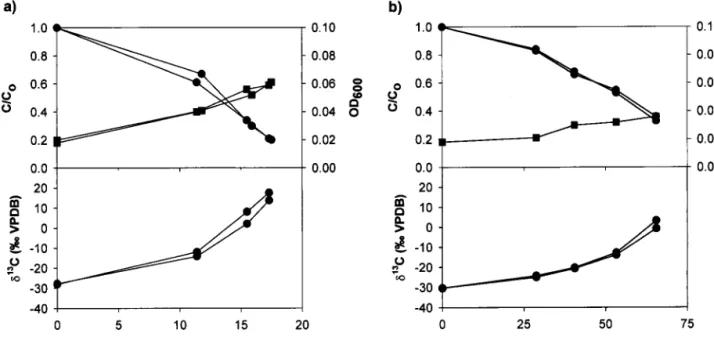
Concentrations and carbon isotope ratios. (i) Experiment I. At 23°C, 1,2-DCA (60 ppm) was consumed by X. autotrophicus GJ10 within about 20 h and the optical density increased (Fig. 1a). The ␦13C of added 1,2-DCA (initial␦13C,⫺30.6‰)
in-creased to values of more than⫹10‰ during the experiment. Similar concentrations and␦13C values were obtained for
du-plicate batch cultures. The produced inorganic carbon was depleted in13C (␦13C⫽ ⫺46.2‰) and the biomass was
en-riched in 13C (␦13C ⫽ ⫺17.2‰) compared to the initially
added 1,2-DCA (␦13C⫽ ⫺30.6‰). Degradation of 1,2-DCA
took about four times longer at 10°C than at 23°C. Again, a strong increase in the␦13C of 1,2-DCA was observed during its
biodegradation (Fig. 1b).
(ii) Experiment II.In experiment II, 120 ppm of 1,2-DCA was consumed within about 30 h and the optical density in-creased (Fig. 2). The amount of inorganic carbon relative to the carbon initially added as 1,2-DCA reached a final value of 0.4 (Fig. 2). The ␦13C of 1,2-DCA increased from ⫺30.6 to
⫹28.0‰. The ␦13C of inorganic carbon in the continuous
microcosm was⫺78.0‰ in the first intermediate sample and increased to a final value of⫺47.4‰ (Fig. 2). Similar concen-trations and ␦13C values were obtained for continuous and
sacrificial microcosms at similar points in time (Fig. 2). The
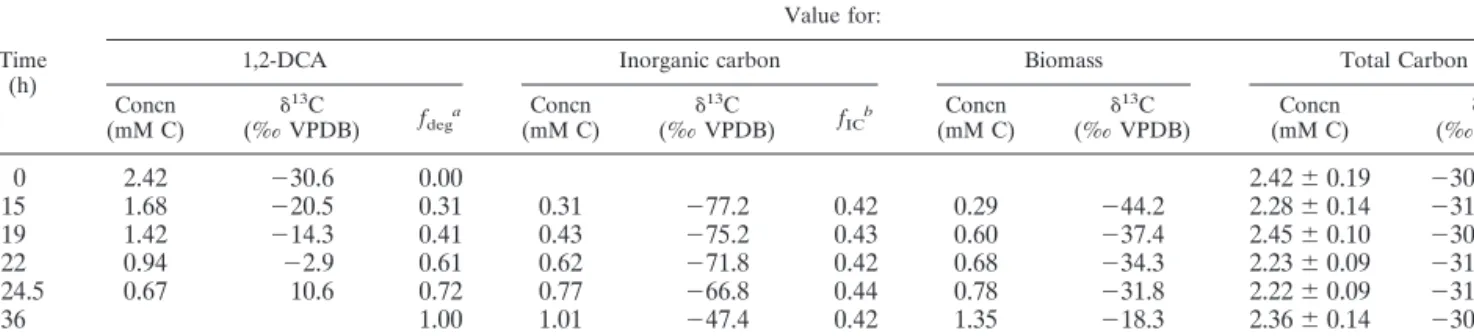
yield of inorganic carbon (inorganic carbon production divided by 1,2-DCA consumption in millimolar concentration of C) remained nearly constant throughout the experiment, with an average of 0.42 (Table 1). The␦13C of produced biomass was
⫺44.2‰ in the first intermediate sample and increased to ⫺18.3‰ (Table 1; Fig. 2). The concentration and ␦13C of the
FIG. 1. Experiment I: relative concentration of 1,2-DCA (closed circles, top panel),␦13C of 1,2-DCA (closed circles, bottom panel), and optical density (closed
squares) in batch cultures of X. autotrophicus GJ10 at 23°C (a) and 10°C (b). The initial concentration of 1,2-DCA was 60 ppm.
FIG. 2. Experiment II: relative concentration of 1,2-DCA (closed circles, top panel), yield of DIC (closed inverted triangles, top panel), ␦13C of 1,2-DCA
(closed circles, bottom panel),␦13C of inorganic carbon (closed inverted
trian-gles, bottom panel), and optical density (closed squares) in batch culture of X.
autotrophicus GJ10 incubated at 23°C. Open symbols are corresponding values in
sacrificial batch cultures. The initial concentration of 1,2-DCA was 120 ppm. Open diamond,␦13C of biomass in sacrificial batch cultures; dashed line,␦13C of
sum of 1,2-DCA, inorganic carbon, and biomass in intermedi-ate and final samples corresponded to the initial concentration and␦13C of 1,2-DCA (Table 1). This indicates that all products
containing carbon were recovered and that accumulation of intermediate degradation products was negligible. The total production of chloride was 2.45 mM, which confirmed that complete degradation of 1,2-DCA took place.
Fractionation factors. To be able to compare the magni-tudes of isotope fractionation during the different experiments, fractionation factors were calculated based on equation 3. The regression coefficients are close to 1 (ⱖ0.9878), indicating that the fractionation factor remained essentially constant through-out the experiments (Table 2). Fractionation factors of dupli-cate experiments agreed closely, and only small differences were observed for different initial concentrations and temper-ature.
DISCUSSION
Aerobic mineralization of 1,2-DCA by X. autotrophicus GJ10 is accompanied by a strong carbon isotope fractionation. The obtained fractionation factors are the largest yet reported for biodegradation of two-carbon organic compounds. Signif-icant carbon isotope fractionation has previously been ob-served during reductive dechlorination of trichloroethene (0.993 to 0.998 [4, 21, 38]), cis-1,2-dichloroethene (0.985 to 0.988 [4, 21]), and vinyl chloride (0.974 to 0.975 [4, 21]) and during aerobic oxidation of dichloromethane (0.958 [18]). In contrast, during both aerobic and anaerobic degradation of toluene, only a small carbon isotope fractionation occurred (0.997 to 0.998 [31]). As shown in the present study, aerobic oxidation of 1,2-DCA is accompanied not only by a strong enrichment of13C in 1,2-DCA but also by an unusually large
fractionation of carbon isotopes between inorganic carbon and biomass.
Carbon isotope fractionation during initial transformation. The magnitude of the fractionation factor␣ depends on the magnitude of the isotope fractionation occurring during trans-port of 1,2-DCA across the cell membrane, the magnitude of the isotope fractionation during its initial transformation, and the relative rates of these two processes. Since the cell mem-brane of X. autotrophicus GJ10 does not act as a barrier to permeation of 1,2-DCA (46), it can be concluded that the observed fractionation factor mainly reflects isotope fraction-ation during initial 1,2-DCA transformfraction-ation. This is consistent with the observation that the magnitude of the fractionation factor␣ can be explained only by the action of an enzymatic process and not by a transport process. Since the catalytic mechanism of the haloalkane dehalogenase is well understood, it is possible to evaluate in more detail the origin of the large isotope fractionation during the initial transformation of 1,2-DCA. Using basic equations of enzyme kinetics, the fraction-ation factor␣ can be linked to parameters that characterize the kinetics of the haloalkane dehalogenase. If substrate with12C
and13C at the reactive center is simultaneously available, as in
this study, the amount of product with12C, d12P, that is formed
during an infinitely short time period dt is given by (39, 43)
d12P ⫽ V12䡠 S12
S12⫹ Km12䡠 共1 ⫹ S13/Km13兲 䡠
dt (4)
where V12 is the limiting rate for substrate with 12C at the
reactive center, S12and S13are the concentrations of substrate
with12C and13C, respectively, at the reactive center, and K
m12
and Kmare the Michaelis constants for substrate with12C and
13C, respectively, at the reactive center.
By inserting equation 4 and an analogous equation for dP13
into equation 2, the following equation for␣ is obtained: ␣ ⫽ dP13S13/dP/S 12 12 ⫽ V13/Km13 V12/Km12 ⫽ 13共V/K兲1 (5) where13(V/K), defined by 13共V/K兲 ⫽ V12/Km12 V13/Km13
is the isotope effect on V/K (32). Thus, biodegradation exper-iments with isotope ratios at natural abundance levels reflect isotope effects on V/K, analogous to enzyme studies under competitive conditions (labeled and unlabeled substrate simul-taneously present [33]). For the haloalkane dehalogenase (Fig. 3), V/K is given by 0 2.42 ⫺30.6 0.00 2.42⫾ 0.19 ⫺30.6 ⫾ 0.5 15 1.68 ⫺20.5 0.31 0.31 ⫺77.2 0.42 0.29 ⫺44.2 2.28⫾ 0.14 ⫺31.3 ⫾ 0.6 19 1.42 ⫺14.3 0.41 0.43 ⫺75.2 0.43 0.60 ⫺37.4 2.45⫾ 0.10 ⫺30.6 ⫾ 0.8 22 0.94 ⫺2.9 0.61 0.62 ⫺71.8 0.42 0.68 ⫺34.3 2.23⫾ 0.09 ⫺31.5 ⫾ 0.8 24.5 0.67 10.6 0.72 0.77 ⫺66.8 0.44 0.78 ⫺31.8 2.22⫾ 0.09 ⫺31.2 ⫾ 0.8 36 1.00 1.01 ⫺47.4 0.42 1.35 ⫺18.3 2.36⫾ 0.14 ⫺30.9 ⫾ 0.8
afdeg, fraction of 1,2-DCA degraded. bfIC, yield of inorganic carbon.
TABLE 2. Fractionation factors (␣) determined by least-squares linear regression based on the Rayleigh equation
Expt
(temp, °C) concn (ppm)1,2-DCA ␣ R2 n
I (23) 60 0.973 0.0015 0.9994 4 I (23) 60 0.972 0.0022 0.9878 4 I (10) 60 0.970 0.0014 0.9934 5 I (10) 60 0.971 0.0014 0.9933 5 II (23) 120 0.970 0.0014 0.9930 5 II (23) 120 0.968 0.0013 0.9931 5
V/K⫽k1k⫺1䡠 k⫹ k2䡠 Et
2 (6)
where k1and k⫺1are the rates of formation and dissociation,
respectively, of the substrate enzyme complex, k2is the rate of
the first irreversible catalytic step, and Etis the total enzyme concentration. Isotope fractionation during formation and dis-sociation of the substrate-enzyme complex is small compared to that during irreversible transformation steps and can usually be neglected (34). Under this assumption, the following ex-pression for␣ in terms of the kinetic constants of the enzyme is obtained by inserting equation 6 into equation 5:
1
␣ ⫽13共V/K兲 ⫽
12k2/13k2⫹ C
1⫹ C (7)
where C⫽12k2/k
⫺1; C is usually referred to as commitment to
catalysis since it represents the tendency of the enzyme-sub-strate complex to go forward through catalysis rather than to break down to free enzyme and substrate (32). The ratio12k2/ 13k2 is usually denoted as the intrinsic isotope effect since it
represents the full isotope effect originating from a single re-action step (32). Several important conclusions can be drawn from equation 7. First, the fractionation factor␣ is expected to be constant since the right-hand side of equation 7 contains only rate constants. Thus, equation 7 justifies the hypothesis that␣ is constant, which has been postulated in this and in previous studies (4). Second, the magnitude of␣ or 13(V/K)
depends only on the steps up to and including the first irre-versible step, as previously observed for isotope effects in en-zyme studies under competitive conditions (34, 39). It does not depend on whether the rate-limiting step is accompanied by isotope fractionation. Indeed, for the haloalkane dehaloge-nase, the slowest step is the release of the Cl⫺(Fig. 3), which
is not accompanied by carbon isotope fractionation. Third, the degree to which the intrinsic isotope effect (12k2/13k2) is
de-tectable depends on the commitment to catalysis. The larger the rate of catalysis (12k2) is, compared to the rate of
dissoci-ation of the substrate-enzyme complex (k⫺1), and thus the
larger C is, the smaller is 13(V/C) for a given value of the
intrinsic isotope effect (equation 7). The equations given above are specific for the case discussed in this study. For other enzyme mechanisms (e.g., two substrates), a different expres-sion for C is obtained (33). Furthermore, if the rate of sub-strate transformation by the first catabolic enzyme is high com-pared to the rate of substrate export from the cell, a more complex relationship between␣ and13(V/C) arises.
Based on equation 7, it is possible to relate the magnitude of the fractionation factor␣ to the intrinsic isotope effect associ-ated with the first irreversible step of 1,2-DCA transformation. For the haloalkane dehalogenase, the first irreversible step consists of an SN2 nucleophilic substitution ((48)), in which a
carboxylate group of a side chain of the enzyme acts as a
nucleophile and displaces a chloride ion. From numerous stud-ies in organic chemistry, it is known that SN2 processes are
prone to a large kinetic isotope effect with12k/13k ratios of up
to 1.080 (13). In the present study, an average fractionation factor of 0.970 was observed, which was measured with respect to both carbon positions of 1,2-DCA. However, in the first irreversible step (SN2 reaction), only one of the two carbon
atoms is involved in the reaction mechanism. Assuming that no significant secondary isotope effect occurs, which is a reason-able assumption for carbon isotopes (23), the fractionation factor with respect to the reactive carbon is 0.940. Using this value and the known value of C (2.5 [Fig. 3]), the magnitude of the intrinsic isotope effect (12k2/13k2) for the S
N2 step of the
enzyme can be estimated using equation 7. A value of 1.090 is obtained, which is in the range typical for SN2 reactions. In
summary, the large carbon isotope effect associated with 1,2-DCA transformation by X. autotrophicus GJ10 can be ex-plained by a combination of (i) a large kinetic isotope effect during the first irreversible step of the initial enzymatic trans-formation (SN2 reaction), (ii) a relatively small commitment to
catalysis leading to a large13(V/K), and (iii) rapid transport of
1,2-DCA into and out of the cell, which makes isotope frac-tionation detectable outside the cell.
Carbon isotope fractionation between inorganic carbon and biomass.In this study, the inorganic carbon is depleted in13C
by 29.1 to 37.8‰ compared to the biomass (Table 1). In previous studies with different substrates, a similar, though much smaller, 13C depletion in inorganic carbon has been
observed. Inorganic carbon produced by biodegradation of glucose was depleted in 13C by 2.8‰ (3), while inorganic
carbon from phenol and benzoate mineralization was depleted by up to 8‰ (16). The unusually large carbon isotope frac-tionation between biomass and inorganic carbon during 1,2-DCA mineralization can be explained based on the metabolic pathway. 1,2-DCA is transformed via 2-chloroethanol, 2-chlo-roaldehyde, and chloroacetate to glycolate (Fig. 4), which
en-FIG. 3. Reaction scheme for dehaloalkane dehalogenase. The rate constants have the following values (means⫾ standard deviations): k1⫽ 9 ⫻ 103⫾ 1 ⫻
10⫺3M⫺1s⫺1, k
⫺1⫽ 20 ⫾ 5 s⫺1, k2⫽ 50 ⫾ 10 s⫺1, k3⫽ 14 ⫾ 3 s⫺1, and k4⫽
8⫾ 2 s⫺1(36). C⫽ k
2/k⫺1⫽ 2.5.
ters the central metabolic pathway (24). Glycolate is usually oxidized to glyoxylate and transformed to acetyl coenzyme A (acetyl-CoA) via the glycerate pathway by bacteria. Two of the reactions on the way to acetyl-CoA, the transformation of two glycoxylate molecules to tartronate semialdehyde and the transformation of pyruvate to acetyl-CoA, involve a decarbox-ylation step (Fig. 4). In both of them, the liberated CO2
mol-ecule originates from the carboxyl position of the glycolate (the carbon boldfaced in Fig. 4). In contrast, the carbon in the acetyl-CoA corresponds to the hydroxyl carbon of the glyco-late. Given a position-specific␣ of 0.940 for the initial 1,2-DCA transformation, the carboxyl carbon is expected to be depleted in 13C by approximately 60‰ relative to the
sub-strate while the hydroxyl carbon has a␦13C similar to that of
the concurrent substrate. The ␦13C of the inorganic carbon
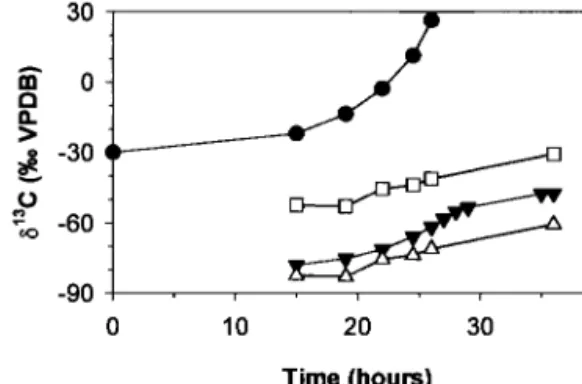
depends on the relative amount of inorganic carbon originat-ing from the two decarboxylation steps on the way to and from acetyl-CoA, respectively. In Fig. 5, the calculated average␦13C
of glycolate and the average␦13C of its carboxyl-carbon
posi-tion are plotted and compared to the ␦13C of the inorganic
carbon. If all inorganic carbon originated from the carboxyl-carbon position, the␦13C of the inorganic carbon would
cor-respond to that of the carboxyl position of the glycolate. If carboxyl and hydroxyl positions equally contributed to inor-ganic carbon production, the ␦13C of the inorganic carbon
should correspond to that of the glycolate. Figure 5 shows that the ␦13C of the inorganic carbon lies between the two
calcu-lated curves, indicating that more inorganic carbon originates from the carboxyl carbon than from the hydroxyl carbon. Cor-respondingly, a larger fraction of isotopically heavier hydroxyl carbon is incorporated into biomass via acetyl-CoA, glycolate, and/or pyruvate, which leads to an enrichment of13C in
bio-mass compared to inorganic carbon. In addition to this effect associated with position-specific␦13C differences in glycolate,
isotope fractionation at branch points of the intracellular car-bon flow may also contribute to differences between biomass and inorganic carbon␦13C values (17). Such an effect is known
to occur at the branch point downgradient of pyruvate (11). However, this effect alone cannot explain the large isotope fractionation between biomass and inorganic carbon observed in this study.
Summary and conclusions.A very large kinetic isotope ef-fect accompanied by an unusually strong carbon isotope frac-tionation between biomass and inorganic carbon, was observed during aerobic transformation of 1,2-DCA by X. autotrophicus GJ10. These effects led to very characteristic␦13C values for
DCA and inorganic carbon during biodegradation of
1,2-A prerequisite for the occurrence of a detectable carbon iso-tope fractionation during biodegradation of organic com-pounds is the occurrence of a significant intrinsic isotope effect during the first irreversible step of the first enzymatic transfor-mation. Whether this effect is detectable depends on several factors, including (i) the number of carbon atoms in the mol-ecule, since the intrinsic isotope effect usually occurs with re-spect to a specific position in the molecule while the isotope ratio measurement is usually compound specific; (ii) the mag-nitude of the commitment to catalysis; and (iii) the rate of transport of the substrate into and out of the cell. The large number of factors that affect the magnitude of the observed isotope fractionation makes it difficult to predict isotope frac-tionation. Not only the degradation mechanism but also the relative rates of the various processes must be known. To determine the effect of factor ii, the rate constants of the enzyme have to be known. The effect of factor iii could be evaluated by comparing isotope fractionation by whole cells with isotope fractionation by cell extracts. Factors i and iii may explain why a large isotope fractionation has been observed for small molecules, as in this study, while only a small isotope effect occurs during degradation of larger molecules. In the context of intrinsic biodegradation, the fate of small mobile molecules is commonly of particular concern. For such mole-cules, a detectable isotope fractionation is more likely to occur and may be a valuable tool to demonstrate intrinsic biodegra-dation, as suggested by the first field trials (21). For practical application of the method, more information about variations of fractionation factors between different cultures and under different environmental conditions is required.
ACKNOWLEDGMENTS
This project was supported by grants from the National Sciences and Engineering Research Council of Canada, the Center for Research in Earth and Space Technology, and the University Consortium Solvents-in-Groundwater Research Program.
We thank D. B. Janssen for providing samples of X. autotrophicus GJ10, W. Mark for support during isotope ratio measurements, and B. Butler for helpful discussions.
REFERENCES
1. Aravena, R., K. Beneteau, S. Frape, B. Butler, T. Abrajano, D. Major, and E.
Cox.1998. Application of isotopic finger-printing for biodegradation studies of chlorinated solvents in groundwater, p. 67–71. In G. B. Wickramanayake and R. E. Hinchee (ed.), Risk, resource and regulatory issues: remediation of chlorinated and recalcitrant compounds. Battelle Press, Columbus, Ohio. 2. Bigeleisen, J., and M. Wolfsberg. 1963. Theoretical and experimental aspects
of isotope effects in chemical kinetics. Adv. Chem. Phys. 1:15–76. 3. Blair, N., A. Leu, E. Mun˜oz, J. Olsen, E. Kwong, and D. Des Marais. 1985.
Carbon isotopic fractionation in heterotrophic microbial metabolism. Appl. Environ. Microbiol. 50:996–1001.
4. Bloom, Y., R. Aravena, D. Hunkeler, E. Edwards, and S. K. Frape. 2000. Carbon isotope fractionation during microbial dechlorination of trichlo-roethene, cis-1,2-dichloroethene and vinyl chloride: implication for assess-ment of natural attenuation. Environ. Sci. Technol. 34:2768–2772. 5. Bolliger, C., P. Hoehener, D. Hunkeler, K. Haeberli, and J. Zeyer. 1999.
Using stable carbon isotopes to assess biodegradation of heating oil in an aquifer. Biodegradation 10:201–217.
6. Bosma, T. N. P., M. A. van Aalst-van Leeuwen, J. Gerritse, E. van Heiningen,
J. Taat, and M. Pruijn.1998. Intrinsic dechlorination of 1,2-dichloroethane at an industrial site, p. 7–12. In G. B. Wickramanayake and R. E. Hinchee (ed.), Natural attenuation, vol. 3. Battelle Press, Columbus, Ohio. 7. Broecker, W. S., and V. M. Oversby. 1971. Chemical equilibria in the earth.
FIG. 5. Experiment II: measured␦13C of 1,2-DCA (closed circles), measured
␦13C of inorganic carbon (closed inverted triangles), calculated average␦13C of
glycolate (open squares), and calculated average␦13C of carboxyl-carbon
McGraw-Hill Book Company, New York, N.Y.
8. Clark, I. D., and P. Fritz. 1997. Environmental isotopes in hydrogeology. Lewis Publishers, Boca Raton, Fla.
9. Cook, P. F. (ed.). 1991. Enzyme mechanism from isotope effects. CRC Press, Boca Raton, Fla.
10. Cox, E. E., M. McMaster, D. W. Major, L. Lehmicke, and S. L. Neville. 1998. Natural attenuation of 1,2-dichloroethane and chloroform in groundwater at a superfund site, p. 309–314. In G. B. Wickramanayake and R. E. Hinchee (ed.), Natural attenuation, vol. 3. Battelle Press, Columbus, Ohio. 11. De Niro, M. J., and S. Epstein. 1977. Mechanism of carbon isotope
fraction-ation associated with lipid synthesis. Science 197:261–263.
12. Egli, C., R. Scholtz, A. M. Cook, and T. Leisinger. 1987. Anaerobic dechlo-rination of tetrachloromethane and 1,2-dichloroethane to degradable prod-ucts by pure cultures of Desulfobacterium sp. and Methanobacterium sp. FEMS Microbiol. Lett. 43:257–261.
13. Fry, A. 1970. Heavy atom isotope effect in organic reaction studies, p. 364–414. In C. J. Collins and N. S. Bowman (ed.), Isotope effects in chemical reactions. Van Nostrand Reinhold, New York, N.Y.
14. Grossman, E. L. 1997. Stable carbon isotopes as indicators of microbial activity in aquifers, p. 565–576. In C. J. Hurst, G. R. Knudsen, M. J. McIn-erney, L. D. Stetzenbach, and M. V. Walter (ed.), Manual of environmental microbiology. ASM Press, Washington, D.C.
15. Hage, J. C., and S. Hartmans. 1999. Monooxygenase-mediated 1,2-dichlo-roethane degradation by Pseudomonas sp. strain DCA1. Appl. Environ. Microbiol. 65:2466–2470.
16. Hall, J. A., R. M. Kalin, M. J. Larkin, C. C. R. Allen, and D. B. Harper. 1999. Variation in stable carbon isotope fractionation during aerobic degradation of phenol and benzoate by contaminant degrading bacteria. Org. Geochem.
30:801–811.
17. Hayes, J. M. 1993. Factors controlling13C contents of sedimentary organic compounds: principles and evidence. Mar. Geol. 113:111–125.
18. Heraty, L. J., M. E. Fuller, L. Huang, T. Abrajano, and N. C. Sturchio. 1999. Isotope fractionation of carbon and chlorine by microbial degradation of dichloromethane. Org. Geochem. 30:793–799.
19. Holliger, C., G. Schraa, A. J. M. Stams, and A. J. B. Zehnder. 1990. Reduc-tive dechlorination of 1,2-dichloroethane and chloroethane by cell suspen-sions of methanogenic bacteria. Biodegradation 1:253–261.
20. Hunkeler, D., and R. Aravena. 2000. Determination of stable carbon isotope ratios of chlorinated methanes, ethanes and ethenes in aqueous samples. Environ. Sci. Technol. 34:2839–2844.
21. Hunkeler, D., R. Aravena, and B. J. Butler. 1999. Monitoring microbial dechlorination of tetrachloroethene (PCE) using compound-specific carbon isotope ratios: microcosms and field experiments. Environ. Sci. Technol.
33:2733–2738.
22. Hunkeler, D., P. Hoehener, S. Bernasconi, and J. Zeyer. 1999. Engineered in situ bioremediation of a petroleum hydrocarbon-contaminated aquifer: as-sessment of mineralization based on alkalinity, inorganic carbon and stable carbon isotope balances. J. Contam. Hydrol. 37:201–223.
23. Huskey, P. W. 1991. Enzyme mechanism from isotope effects, p. 37–72. In P. F. Cook (ed.), Enzyme mechanism from isotope effect. CRC Press, Boca Raton, Fla.
24. Janssen, D. B., A. Scheper, L. Dijkhuizen, and B. Witholt. 1985. Degradation of halogenated aliphatic compounds by Xanthobacter autotrophicus GJ10. Appl. Environ. Microbiol. 49:673–677.
25. Janssen, D. B., A. Scheper, and B. Witholt. 1984. Biodegradation of 2-chlo-roethanol and 1,2-dichloroethane by pure bacterial cultures. Prog. Ind. Mi-crobiol. 20:169–178.
26. Jeffers, P. M., L. M. Ward, L. M. Woytowitch, and N. L. Wolfe. 1989. Homogeneous hydrolysis rate constants for selected chlorinated methanes, ethanes, ethenes, and propane. Environ. Sci. Technol. 23:965–969. 27. Kelley, C. A., B. T. Hammer, and R. B. Coffin. 1997. Concentrations and
stable isotope values of BTEX in gasoline-contaminated groundwater. En-viron. Sci. Technol. 31:2469–2472.
28. Klecka, G. M., C. L. Carpenter, and S. J. Gonsior. 1998. Biological trans-formations of 1,2-dichloroethane in subsurface soils and groundwater. J. Contam. Hydrol. 34:139–154.
29. Lee, M. D., L. Sehayek, B. E. Sleep, and T. D. Vandell. 1999. Investigation and remediation of a 1,2-dichloroethane spill. II. Documentation of natural attenuation. Ground Water Monit. Remediation 1999Summer:82–88. 30. Mariotti, A., J. C. Germon, P. Hubert, P. Kaiser, T. Letolle, A. Tardieux, and
P. Tardieux.1981. Experimental determination of nitrogen kinetic isotope fractionation: some principles; illustration for the denitrification and nitrifi-cation processes. Plant Soil 62:413–430.
31. Meckenstock, R. U., B. Morasch, R. Warthmann, B. Schink, E. Annweiler,
W. Michaelis, and H. H. Richnow.1999.13C/12C isotope fractionation of aromatic hydrocarbons during microbial degradation. Environ. Microbiol.
1:409–414.
32. Northrop, D. B. 1977. Determining the absolute magnitude of hydrogen isotope effects, p. 122–152. In W. W. Cleland, M. H. O’Leary, and D. D. Northrop (ed.), Isotope effects on enzyme-catalyzed reactions. University Park Press, Baltimore, Md.
33. Northrop, D. B. 1981. The expression of isotope effects on enzyme-catalyzed reactions. Annu. Rev. Biochem. 50:103–131.
34. O’Leary, M. H. 1977. Studies of enzyme reaction mechanisms by means of heavy-atom isotope effects, p. 233–251. In W. W. Cleland, M. H. O’Leary, and D. B. Northrop (ed.), Isotope effects on enzyme-catalyzed reactions. University Park Press, Baltimore, Md.
35. Pankow, A., and J. A. Cherry. 1996. Dense chlorinated solvents and other DNAPLs in groundwater. Waterloo Press, Waterloo, Ontario, Canada. 36. Schanstra, J. P., J. Kingma, and D. B. Janssen. 1996. Specificity and kinetics
of haloalkane dehalogenase. J. Biol. Chem. 271:14747–14753.
37. Schwarzenbach, R., P. Gschwend, and D. Imboden. 1993. Environmental organic chemistry. John Wiley & Sons, New York, N.Y.
38. Sherwood Lollar, B., G. F. Slater, J. Ahad, B. Sleep, J. Spivack, M. Brennan,
and P. MacKenzie.1999. Contrasting carbon isotope fractionation during biodegradation of trichloroethylene and toluene: implications for intrinsic bioremediation. Org. Geochem. 30:813–820.
39. Simon, H., and D. Palm. 1966. Isotope effects in organic chemistry and biochemistry. Angew. Chem. Int. Ed. Engl. 5:920–933.
40. Stucki, G., U. Krebser, and T. Leisinger. 1983. Bacterial growth on 1,2-dichloroethane. Experientia 39:1271–1273.
41. Stucki, G., and M. Thuer. 1995. Experiences of a large-scale application of 1,2-dichloroethane degrading microorganisms for groundwater treatment. Environ. Sci. Technol. 29:2339–2345.
42. Tanner, R. S. 1997. Cultivation of bacteria and fungi, p. 52–60. In C. J. Hurst, G. R. Knudsen, M. J. McInerney, L. D. Stetzenbach, and M. V. Walter (ed.), Manual of environmental microbiology. ASM Press, Washington, D.C. 43. Thorn, M. B. 1949. A method for determining the ratio of the Michaelis
constants of an enzyme with respect to two substrates. Nature 164:27–29. 44. Tschech, A., and G. Fuchs. 1987. Anaerobic degradation of phenol by pure
cultures of newly isolated denitrifying pseudomonads. Arch. Microbiol. 148: 213–217.
45. van den Wijngaard, A. J., K. W. H. J. van der Kamp, J. van der Ploeg, F.
Pries, B. Kazemier, and D. B. Janssen.1992. Degradation of 1,2-dichloro-ethane by Ancyclobacter aquaticus and other facultative methylotrophs. Appl. Environ. Microbiol. 58:976–983.
46. van den Wijngaard, A. J., R. D. Wind, and D. B. Janssen. 1993. Kinetics of bacterial growth on chlorinated aliphatic compounds. Appl. Environ. Micro-biol. 59:2041–2048.
47. Van Wanderdam, E. M., S. K. Frape, R. Aravena, R. J. Drimmie, H. Flatt,
and J. A. Cherry.1995. Stable chlorine and carbon isotope measurements of selected organic solvents. Appl. Geochem. 10:547–552.
48. Verschueren, K. H. G., F. Sejee, H. Rozeboom, K. H. Kalk, and B. W.
Dijkstra. 1993. Crystallographic analysis of the catalytic mechanism of haloalkane dehalogenase. Nature 363:693–698.