Applying Semantic Relation Extraction to
Information Retrieval
by
Edward Loper
Submitted to the Department of Electrical Engineering and Computer
Science
in partial fulfillment of the requirements for the degree of
Master of Engineering in Computer Science and Engineering
at the
MASSACHUSETTS INSTITUTE OF TECHNOLOGY
May 2000
DJr~ Q 'IXY
@
Edward Loper, MM. All rights reserved.
The author hereby grants to MIT permission to reproduce and
distribute publicly paper and electronic copies of this thesis document
in whole or in part.
[
MASSACHUSETTENG
Author ...-...
Department of Electrical Engineering and Computer Science
May 18, 2000
Certified by..
Boris Katz
Principal Research Scientist
Th,! is S iervisor
I)
Accepted by...
Arthur C. Smith
Chairman, Department Committee on Graduate Students
S INSTITUTE OFILCHULUUT
JUL 2 7 2000
Applying Semantic Relation Extraction to Information
Retrieval
by
Edward Loper
Submitted to the Department of Electrical Engineering and Computer Science on May 18, 2000, in partial fulfillment of the
requirements for the degree of
Master of Engineering in Computer Science and Engineering
Abstract
People often want to search a large number of articles, web pages, or other natural-language documents to find the answers to specific questions. Currently, the best techniques for performing such searches treat each document as an unordered col-lection of words, and disregard any information about how the words relate to each other. Although this approach has been quite successful, it has a number of funda-mental limitations. In order to explore the potential benefit of using more advanced, linguistically-motivated techniques, I built SQUIRE, a Semantic Question-answering Information Retrieval Engine. SQUIRE uses a number of independent transforma-tions to process individual sentences, converting them into sets of semantic relation-ships. It can then search those semantic relationships in response to a user's question. SQUIRE significantly out-performs traditional IR techniques in the task of returning the individual sentences that answer a question.
Thesis Supervisor: Boris Katz Title: Principal Research Scientist
Acknowledgments
I would like to thank Boris Katz and Sue Felshin, who helped to shape my thesis topic. I would also like to thank everyone who read and commented on early drafts of my thesis: Jee, Emil, Sue, and Boris.
Contents
1 Introduction 10
1.1 Searching Natural Language Databases . . . . 10
1.1.1 Traditional Information Retrieval Techniques . . . . 10
1.1.2 Limitations of Traditional Information Retrieval . . . . 11
1.1.3 Semantic Information Retrieval . . . . 12
1.2 O verview . . . . 14
2 Background Information 16 2.1 Information Retrieval Techniques . . . . 16
2.1.1 Removing Functional Words . . . . 16
2.1.2 Stemming . . . . 17
2.1.3 Weighting . . . . 19
2.1.4 Vector Space Model . . . . 21
2.2 Measuring Information Retrieval Performance . . . . 21
2.3 Linguistics . . . . 22
2.3.1 Syntax Trees . . . . 23
2.3.2 Arguments and Modifiers . . . . 27
2.3.3 Thematic Roles . . . . 28 2.3.4 Alternations . . . . 29 2.3.5 Verb Classes . . . . 30 2.3.6 Predicate Logic . . . . 31 2.3.7 Fregean Semantics . . . . 32 2.3.8 Semantic Trees . . . . 33
2.4 STA RT . . . . . . . .. 33
2.4.1 The Structure of Links . . . . 35
3 Exploring Semantic IR 37 3.1 SQUIRE's Task . . . . 37
3.2 Design Criteria . . . . 38
3.2.1 Response Criteria . . . . 38
3.2.2 System Properties . . . . 40
4 SQUIRE: A Semantic Information Retrieval Engine 41 4.1 W eights . . . . 41
4.2 T he Parser . . . . 42
4.2.1 Classifications of Parser Layers . . . . 43
4.2.2 Advantages of the Layered Architecture . . . . 44
4.2.3 Parsing in Parallel . . . . 46 4.3 Representations . . . . 46 4.3.1 Strings . . . . 47 4.3.2 Syntax Trees . . . . 47 4.3.3 Semantic Trees . . . . 48 4.3.4 Relations . . . . 49 4.4 Parser Layers . . . . 50
4.4.1 The Principar Layer . . . . 50
4.4.2 The Stemmer . . . . 52
4.4.3 The Clause Handler . . . . 52
4.4.4 The Conjunction Handler . . . . 53
4.4.5 The Trace Resolver . . . . 55
4.4.6 The Semantic Tree Maker . . . . 55
4.4.7 The Pronoun Resolver . . . . 59
4.4.8 The Property Adder . . . . 60
4.4.9 The Theta Assigner . . . . 61
4.4.11 The Relation Maker . . . . 65 4.5 The Database . . . . 65 4.5.1 Indexing . . . . 66 4.5.2 Retrieval. . . . . 68 5 Testing 70 5.1 Test Materials . . . . 70 5.1.1 Test Corpus . . . . 70 5.1.2 Test Questions . . . . 70 5.1.3 Test Indexes . . . . 71 5.2 Methodology . . . . 71 5.3 Control . . . .. . . . . .. . . . . 73 5.4 Results . . . . 73
5.4.1 Effects of the word parameter . . . . 73
5.4.2 Effects of the ur parameter . . . . 75
5.4.3 Effects of the fr parameter . . . . 76
5.4.4 Effects of the pro parameter . . . . 78
5.4.5 Effects of the syn parameter . . . . 80
5.5 Conclusions . . . . 81
6 Future Directions 83 6.1 Improving Existing Parser Layers . . . . 83
6.2 Creating New Parser Layers . . . . 84
List of Figures
1-1 Sentence Retrieval: Indexing Sentences as Simple Structures
2-1 Example Syntax Tree . . . . 2-2 Semantic Phrases with Lexical Heads . . . . 2-3 Semantic Phrases with Functional Heads . . . . . 2-4 Illustration of Syntactic Traces . . . . 2-5 Illustration of PRO . . . . 2-6 Commonly Used Thematic Roles . . . . 2-7 Example of Fregean Semantic Derivation . . . . . 2-8 Example Semantic Tree . . . .
4-1 Example Parser . . . . 4-2 Indexing the Relations in a Sentence . . . . 4-3 Indexing Words as Relations . . . . 4-4 SQUIRE's Parser Layers . . . . 4-5 Example Templates for the Semantic Tree Maker 4-6 Example Template for the Theta Assigner . . . . 4-7 Database Structure ...
4-8 Database Indexing . . . . 4-9 Database Retrieval . . . . 5-1 Precision-Recall Curve of the Control IR System .
5-2 Comparison of Control IR System to SQUIRE Indexing Words
15 . . . . 2 3 . . . . 2 4 . . . . 2 4 . . . . 2 6 . . . . 2 7 . . . . 2 9 . . . . 3 2 . . . . 3 4 43 49 50 51 56 62 66 67 69 72 . . . . 74
5-3 Precision-Recall Curve of SQUIRE Using the Pronoun-Resolution and Synonymy Layers to Index Words . . . . 74 5-4 Precision-Recall Curve of SQUIRE Indexing Underspecified Relations. 75 5-5 Precision-Recall Curve of SQUIRE Indexing Both Words and
Under-specified Relations. . . . . 76 5-6 Comparison of Indexing Underspecified Relations to Indexing Tagged
R elations . . . . 77 5-7 Precision-Recall Curves Illustrating the Effect of the Pronoun-resolution
Parser Layer . . . . 79 5-8 Precision-Recall Curves Illustrating the Effect of the Synonymy Layer
when Relations are Indexed . . . . 80 5-9 Precision-Recall Curves Illustrating the Effect of the Synonymy Layer
when Only Words are Indexed . . . . 81 5-10 Comparison of the Performance of SQUIRE with All Features Enabled
Chapter 1
Introduction
1.1
Searching Natural Language Databases
People often want to search a large natural-language reference source, such as an encyclopedia, to find the answers to specific questions. However, finding these answers can be a daunting task. Even when it is relatively certain that the answer is contained somewhere in the reference, it may not be apparent where the answer is stored. It is especially difficult to find answers in references that are large, that contain a wide variety of information, and that do not have well-defined organizations.
An example of a reference source with all of these properties is the World Wide Web. In general, it is very difficult to extract specific information from the web, since it is such a large, varied, and unorganized source of data. Other examples include news wires, scientific journals, and encyclopedias.
1.1.1
Traditional Information Retrieval Techniques
The task of automatically searching a large reference for answers to a specific ques-tion is known as informaques-tion retrieval (IR). Informaques-tion retrieval systems can be classified by what types of answers they return, and by how they process queries to arrive at those answers.
(100-5,000 word) self-contained documents, each of which discusses a specific topic. Given a question, they will return the set of articles which they find most likely to contain the answer to that question. To decide which articles answer a question, they model the question and all the articles in the database as unordered "bags of words." They then return the articles whose "bags of words" are most similar to the question's. This approach is exemplified by the SMART IR system [23].
1.1.2
Limitations of Traditional Information Retrieval
Although the traditional IR approach has been very successful, it has a number of important limitations.
1. By treating a document as an unordered set of words, the traditional IR ap-proach throws away all information about how the words relate to each other. As a result, it will return documents that don't answer the question but that have similar word content. A few examples of phrases which have different meanings but similar word content are:
The man ate the dog The dog ate the man The meaning of life A meaningful life The bank of the river The bank near the river
2. The set of words used to answer a question are not necessarily the same as those used to ask it. As a result, the traditional approach will fail to return documents that answer the question using different words than the question itself. For example, the following pairs of questions and answers use very different words:
" What color is the sky?
When viewed from the surface of the earth, the atmosphere looks pale blue. " Which European discovered America?
Columbus found the New World in 1492. " What do pigs eat?
3. Individual sentences contain only a few words, and use pronouns and other devices to refer to previously mentioned concepts. In fact, the word content of a question is very rarely similar to the word content of the sentence that answers it. This exacerbates the first two problems, and means that traditional IR techniques are very poor at deciding which sentence or paragraph from an article answers a question. For example, a traditional IR system would have no hope of discovering the following answers for questions, since they make only implicit reference to the objects in question:
* Who invented basketball?
It was initially conceived of by James Naismith.
* How many people live in Washington, D.C.?
The city has a population of 600,000 people. " What is grown in the Dominican Republic?
The fertile ground is farmed to produce oranges and rice.
These limitations are all fundamental consequences of the fact that traditional IR techniques treat queries and documents as unordered sets of words. In order to overcome them, information about the structure of the documents and queries must be extracted and stored.
1.1.3
Semantic Information Retrieval
Intuitively, we would like to be able to index all of the "knowledge" from a reference source. Questions could then be turned into "knowledge templates," that could be matched against the indexed knowledge. However, before we can construct such an index, we must answer three related questions:
1. How should we represent knowledge and questions?
2. How can we extract that representation from a reference source or a question? 3. How can we index and efficiently search the knowledge we extract?
Representation
Since sentences are, in a sense, the basic unit of knowledge, each sentence should have its own representation. Each sentence could be represented with a single complex structure, or with a set of several simpler structures. Larger structures tend to capture more information about the original content of the sentence, while simpler structures are usually easier to index and search.
Most semantically based information retrieval systems represent articles and ref-erences as unordered sets of sentences [12, 2], and do not encode information about how those sentences relate to each other.
The knowledge representation should optimally satisfy the following properties: " Canonical Representation: Two different sentences with the same basic
meaning should have the same representation.
" Generalization: If one sentence implies another, then the knowledge repre-sentation of the first should either be contained in the second, or be derivable by the retrieval algorithm.
Assuming that the knowledge representation satisfies these properties, we can simply represent questions as partial sentences, or as sentences with variables in them. Note, however, that if the knowledge representation is a complex, nested structure, then deciding which sentences answer a question may require individually processing each sentence in the database.
Parsing
Parsing is the process of constructing the representation that corresponds to a sen-tence. There are two basic approaches to parsing a sentence:
* In Deep Parsing, the sentence is first converted into a linguistically motivated tree-shaped structure. This structure explicitly encodes how different parts of the sentence relate to each other, and removes most ambiguity from the original
sentence. This structure is then used to construct a knowledge representation of the sentence.
9 In Surface Parsing, the sentence is treated as a sequence of words, and the knowledge representation is constructed directly from this sequence. Usually, this construction involves matching sequences of parts of speech against the sentence [12]. For example, if a surface parser encounters an adjective followed by a noun, it will encode the adjective as a modifier of the noun.
Indexing and Retrieval
The representations of a reference source's sentences must be indexed in such a way that they can be efficiently searched. In particular, searching the index should not require that a question be compared to every sentence. This can be a problem for complex knowledge representations, since it is hard to index them such that they will
be returned for just those questions that they answer.
For that reason sentences are usually broken up into sets of simple structures, which are indexed separately. To find the answers to a question, the index is searched for structures that match the question's structures. The source sentences of these matching structures are then returned as possible answers to the question. Source sentences that contain more matching structures are rated as more likely to be correct answers. This process is illustrated in Figure 1-1.
1.2
Overview
Although semantic information retrieval techniques have always seemed very promis-ing, traditional techniques have continually out-performed them [28, 2]. In order to explore the limitations and the potential of semantic IR techniques, I designed and built SQUIRE, a Semantic Question-Answering IR Engine. SQUIRE uses deep pars-ing techniques to convert sentences into sets of simple structures, representpars-ing the individual semantic relationships that comprise them. These relationships are then separately indexed in a database. When the user asks SQUIRE a question, SQUIRE
Question
Who thinks Mary hit Bill
someone thinks something Mary hit Bill
Source Sentences Sc
John saw something
M.y i b... ...
Bill hit someone Joe saw something_
John saw Mary hit Bill
- John saw something
-4 Mary hit Bill
Bill thinks Mary hit Bill
Bill thinks something Mary hit Bill
Joe thinks Bill hit someone
Joe thinks something
- Bill hit someone Joe saw Bill hit someone - Joe saw something -+- Bill hit someone
Figure 1-1: An example of sentence retrieval in a system where sentences are indexed as simple structures. In this case, the sentence is reduced to subject-verb-object triples. The question is first broken into two relations. Those relations are then looked up in the index, and the sentences which contain them are returned.
converts it into a set of semantic relationships, and searches the database for the sentences which best match those relationships.
This thesis describes the design and implementation of SQUIRE, and examines its performance using a test set of thirty-eight questions. Chapter 2 provides some background information about traditional information retrieval techniques and about linguistics. Chapter 3 describes the specific problem that SQUIRE tries to solve, and the properties that it should have to solve that problem. Chapter 4 describes SQUIRE's design and implementation. Chapter 5 describes the tests I ran to compare SQUIRE to traditional IR techniques, and discusses the results. Chapter 6 explores some future directions that the research into Semantic IR might take.
1
2
1
0 Scora
Chapter 2
Background Information
2.1
Information Retrieval Techniques
Traditional information retrieval systems treat both articles and questions as un-ordered sets of words. When given a question they return the articles whose repre-sentative sets of words best match the question's. Although this general description is true of most traditional IR systems, it leaves a number of details unspecified:
* What words are put in the unordered sets used to represent articles? " How does the system decide how well two sets of words "match?"
" Are weights associated with the words in the set? If so, what do they represent?
A number of answers have been given to each of these questions. In the following sections, I will describe the answers which seem to maximize performance in tradi-tional information retrieval systems. Most of these techniques have become standard, and are incorporated into almost every traditional IR system.
2.1.1
Removing Functional Words
Some words give us more information about the semantic content of a sentence than others. This is important to traditional IR systems, since a word that does not
convey much semantic content will not be as likely to correlate between questions and answers. Words can be divided roughly into two classes, based on how well their presence in a question correlates with their presence in an article that answers the question:
* Content words, such as "fern," "carpet,"and "elect" correlate well; if a ques-tion's content word is in an article, then we are more likely to believe that the article answers the question.
" Functional words, such as "of," "him," "the," and "throughout," do not correlate well; the presence of a question's functional word is in an article gives us no information about whether the article answers the question.
Since functional words do not provide traditional information retrieval techniques with any information, they are not usually included in the sets of words used to represent articles and questions; thus, the sets of words that represent articles contain only content words.
This is usually accomplished by using a stop list, which lists all of the functional words [27]. Any word in the stop list will not be included in the representation of the article or question. Note that it is unclear which words should be placed in a stop list, since some words have intermediate correlation, and many words have correlations that depend on the domains of the questions and of the articles. For example, when asking a question about Australia, it would probably be inappropriate to eliminate the words "down under," even though they appear in most stop lists.
2.1.2 Stemming
In English, many words in a sentence are given an affix, such as "-s" or "-es" for nouns, and "-ing" or "-ed" for verbs. However, these affixes are not part of the semantic content of the word itself. Instead, they give an indication of how the word relates to other words in the sentence.
It would be unreasonable for traditional IR systems to treat these affixes as part of the word. If it did, then only those articles whose words contain the same affixes
as the question would be returned. For example, it would not return "The cow eats grass" in response to "what do cows eat," since the affixes on both "cow" and "eat" do not match. For this reason, most IR systems use the root words, or stems, to encode articles and questions, and throw away any affixes. This process is known as stemming.
However, there are several different types of affixes in English, and it is not clear that all of them should be discarded. Affixes like "-s" in "cars" and "-ing" in "walking" serve to modify a basic concept. These are discarded by almost all stemmers. Affixes like "un-" in "unwanted," "-ize" in "nationalize," and "-er" in "hunter" can fundamentally change the meaning of their stem. Different stemmers make different decisions about which of these affixes should be kept and which can be discarded [27, 1].
It is not always clear how to decide what the stem of a word is, even once we decide what affixes we wish to remove. For example, a stemmer might want to strip the suffix "-tive" from "administrative" to give "administrate," but it shouldn't also strip the same suffix from "additive" to give "addite" or from "adjective" to give
"adject."
Most stemmers use a number of heuristics to produce the stems for a words. Typ-ically, such stemmers have an error rate of about 5% [27]. Another simple approach is to simply maintain a very large list of every word that we are likely to encounter, and its stem. The disadvantage of this approach is that it will not stem words that it has not encountered, most likely including specialized words like "Minke" (a type of whale). It might be possible to combine these techniques - use a table of stems for most words, and only revert to the heuristic stemmer for words that are not present in the table.
Lemmatization
The proper stem for a word is often dependent on how it is used in a sentence. One technique for improving the performance of stemming is to first derive the part of speech of the word, and then to use that information to decide what stem the word
should be given. This technique is known as lemmatization [2]. In order to find the part of speech of the words in an article, a statistical algorithm is usually used. One popular algorithm for finding parts of speech of words is Brill's Tagger [5].
2.1.3
Weighting
In addition to storing the set of words that comprise an article, almost every informa-tion retrieval system also assigns a weight to each word [27, 23]. This weight generally reflects how much that word tells us about the content of the article. The IR system can then use those weights to decide how well a question matches an article.
Weighting by Frequency in the Article
By reducing an article to a set of words, information about how often a word occurs in an article is lost. In order to preserve this information, most IR systems use the weights of the words to reflect their frequency of in an article [27]. Representing this frequency as an absolute number of occurrences would unfairly give higher weights to larger articles. Therefore, this frequency is often represented as a percentage of total number of words in the article. Let fiAd be the number of occurrences of word i in document d, and let nd be the number of words in document d. Then Wid, the weight of word i in document d, is:
Wid = E [0, 1]
nd
Weighting by Inverse Overall Frequency
In general, the more common a word is, the less likely it is to help decide whether an article is an answer to a question [27]. For example, a question about "heart defibril-lation" is more likely to be answered by an article containing the word "defibrildefibril-lation" than by one containing "heart," since "defibrillation" is a much less common word than "heart." For this reason, many IR systems take into account how common a word is to decide what weight it should receive. The commonness of a word can be
measured by its overall frequency in the corpus being indexed. Let N be the number of documents. Then the commonness of word i, Ci E [0, 1] is:
N
The commonness could also be measured using an independant corpus. Once the commonness of each word has been defined, we can find the weight of word i in document d:
fid
Wid
nd X Ci
Other Weighting Schemes
A variety of weighting schemes are possible, which may take into account the fre-quency of a term, the number of documents it occurs in, and other information. One commonly used weighting scheme is the Cornell ltc weighting [8]:
(log (fed) + 1) x log (N/md) 'Wid=
VEN 1 (log (fij) + 1) x log (N/mi) where md is the number of documents in which term d appears.
Weighting by Article Value
Sometimes, it is possible to determine through external means how reliable, informa-tive, or useful a document is. In this case, we would like to return articles which score higher on these criteria. One way to accomplish this is to scale the weights of every term in an article's representation by an overall measure of the value of the article.
For example, the Google search engine[9] uses the heuristic that pages to which more people make links are more likely to be useful. They therefore modify the weights of the articles to reflect this information - articles which more people link to will be more likely to be returned, and articles that few people link to will be returned less often [6].
2.1.4
Vector Space Model
Instead of thinking of an article as a set of weighted word stems, we could think of it as a mapping from word stems to weights. The weight of any word stem not present in the article is simply zero. By defining a vector containing all of the word stems in the corpus:
WORD = (word1, word2, ...,words, ..., wordM)
we can define the representation of an article or question to simply be the vector:
W = (wil, wi2, ..., WiM)
where Wid is the weight of word i in document d.
This representation reduces each document to a single high-dimensionality vector. These vectors are a convenient representation, because they can be manipulated and reduced using standard linear algebra techniques. For example, since many words tend to co-vary in articles, we can find a minimal basis for the vector space (i.e., a minimal set of perpendicular axes that allow us to encode all of the vectors). This cuts down on the space the vectors take, and on the time it takes to compare them
[27].
2.2
Measuring Information Retrieval Performance
Since the early 1960's, much research has gone into finding good metrics with which to measure information retrieval performance [25]. Since then, many alternative metrics have been proposed[25, 7, 22, 3]. However, only a few have become widely accepted. Most of the widely accepted metrics are based on the contingency table, which divides the sentences of the original corpus into four categories, based on whether they answer the question and on whether they are retrieved in response to the question [27]:
1- answers question (A) I doesn't answer question (A)
retrieved (B) AnB AnB
not retrieved (B) A
n
PA
n PGiven this table, we can define the two most commonly used metrics, precision and recall. Precision is the percentage of the responses retrieved that answer the question. Recall is the percentage of the correct answers that are retrieved:
AnBJ
precision =
I
recall =AnB |AI
In most information retrieval systems, there is a tradeoff between precision and recall. In particular, increasing the number of documents returned generally increas-es recall at the expense of precision, and decreasing the number returned increasincreas-es precision at the expense of recall. At the very extremes, returning every document would give a recall of 1 and a precision of 0; and returning no documents would give a precision of 1 and a recall of 0.
Although there is a tradeoff between precision and recall, the nature of this tradeoff varies widely between different IR systems. Because the nature of the tradeoff varies so widely, it is not clear how to reduce these two quantities to a single value that indicates the "overall performance" of the system. Therefore, most researchers report the performance of an IR system using a graph of its precision as a function of its recall [27].
2.3
Linguistics
Although sentences may seem to simply consist of simple strings of words, linguists have long recognized that sentences have a much more complex underlying struc-ture [11, 20]. This strucstruc-ture explicitly indicates how the constituent words of the sentence relate to each other, and how they combine to give the meaning of the sen-tence as a whole. In order to get an idea of what a sensen-tence means, and whether
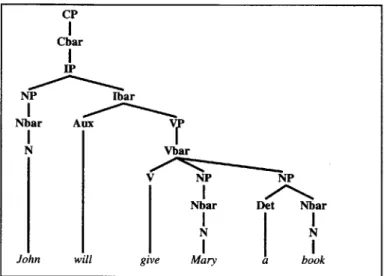
Figure 2-1: Example of a syntax tree, for the sentence "John will give Mary a book." it answers a question, we will need to extract this underlying structure from the sequence of words that make up the sentence.
2.3.1 Syntax Trees
Most linguists agree that sentences are best represented by a tree-based structure, known as a syntax tree [11]. The leaves of a syntax tree are the words of the sentence; the nodes represent phrases, or groups of words and sub-phrases that combine to form a single functional unit. An example of a syntax tree is given in Figure 2-1.
Phrases
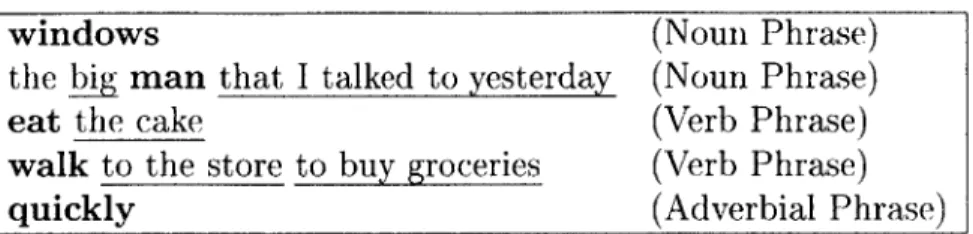
Each phrase consists of a head, which contains the main semantic idea of the sentence, and a number of adjuncts, which modify the head in some way. In addition, each phrase is assigned a type, based on what type of head it has. For example, phrases headed by nouns are noun phrases (NP), phrases headed by verbs are verb phrases (VP), and phrases headed by adverbs are adverbial phrases (AdvP). Some example phrases are given in Figure 2-2.
CP Cbar IP NP Ibar Nbar Aux N Vbar V NP NP I .0
Nbar Det Nbar
I I
N N
J w
windows (Noun Phrase) the big man that I talked to yesterday (Noun Phrase)
eat the cake (Verb Phrase)
walk to the store to buy groceries (Verb Phrase)
quickly (Adverbial Phrase)
Figure 2-2: Each phrase consists of a head and zero or more arguments. The head is in bold face, and each argument is underlined. Each of these phrases has a lexical head (i.e., a head that represents an independent semantic concept).
to the moon (Prepositional Phrase)
under the carpet (Prepositional Phrase)
the man (Determiner phrase)
John will walk the dog (Inflection phrase)
Figure 2-3: Each phrase consists of a head and zero or more arguments. The head is written in bold face, and each argument is underlined. Each of these phrases has a functional head (i.e., a head that does not represent an independent semantic concept).
Heads
Heads can be divided into two classes: lexical heads and functional heads. Lexical heads represent an independent semantic concept. All of the phrases above have lex-ical heads [11]. Functional heads are heads which do not represent an independent semantic concept. Functional heads generally take exactly one adjunct, and serve to modify that adjunct [11]. Some examples of phrases with functional heads are given in Figure 2-3
Movement and Traces
Sometimes, the phrases that make up a sentence are moved from their original posi-tions. For example, consider the following sentences:
(1) John likes Mary (2) Mary is liked
whose syntax trees are shown in Figure 2-4, parts (a) and (b). In both sentences, "Mary" relates to the verb "to like" in the same way, although in sentence (1) "Mary" is an adjunct to "likes," while in sentence (2) "Mary" is an adjunct to "is."
Linguistic research suggests that, in sentence (2), "Mary" actually originated at the same position as it did in sentence (1), but was subsequently moved out of this position [11]. Thus, there are actually two syntax trees corresponding to sentence (2): a pre-movement tree and a post-movement tree. The post-movement tree is known as the surface structure of the sentence, since it reflects the ordering of words as they are pronounced. The pre-movement tree is known as the deep structure of the sentence, since it more closely reflects the semantic relations that make up the concept expressed by the sentence.
When a phrase is moved, its original location is marked with a special entity called a trace. Tr'aces are not directly pronounced, but they can be detected by a number of means, including monitoring the timing of speech [26]. The displaced phrase is called the trace's antecedent. A connection is maintained between a trace and its antecedent, and the trace and antecedent are said to corefer. Parts (c) and (d) of Figure 2-4 illustrate the deep structure and the surface structure of sentence (2). Non-overt Pronouns: PRO
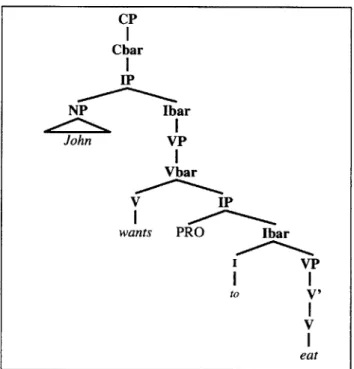
Sometimes, phrases can contain adjuncts which are not pronounced as part of the sentence, and have no overt marking. Traces are one example of these so-called empty categories. Another example is PRO, a pronoun which is sometimes implicit in a sentence [11]. Consider the sentences:
(3) John wants to eat.
(4) John is considering whether to talk. (5) To run away would be cowardly.
Each of these sentences contains a verb that does not have an overt subject: in sentence (3), it is the verb "to eat;" in sentence (4), it is the verb "to talk;" and in sentence (5), it is the verb "to run away." Each of these verbs actually has a non-overt pronoun, known as PRO, as its subject. Like traces, PRO is not pronounced. However, it is present in the syntax tree, and can sometimes be detected by the timing of speech or by other means [26]. The positions of PRO in sentences (3), (4), and (5) are:
CP CP Cbar Cbar IP IP NP Ibar NP Ibar John VP Mary I VP V is V V NP V
likes Mary liked
...)..(b)* CP CP Cbar Cbar IP IP Ibar NP Ibar I VP Mary I VP is V is V V NP .. v
liked Mary . liked
L - ..
Figure 2-4: Illustration of Syntactic Traces. (a) The syntax tree representing the sentence "John likes Mary." (b) Simplified version of the syntax tree representing the sentence "Mary is liked." This syntax tree does not include traces. (c) The deep structure of the sentence "Mary is liked." This structure encodes the fact that
"Mary" was originally an adjunct of the verb "like." (d) The surface structure of the sentence "Mary is liked." The trace indicates the original position of the noun phrase "Mary," and the co-indexing of the trace and the noun phrase indicate that they corefer. Arrows are also sometimes used to indicate coreference.
Figure 2-5: The syntax tree representing the sentence "John wants to eat." In this sentence, PRO acts as the subject of the verb "to eat." PRO is a non-overt pronoun.
(4') John is considering whether PRO to talk. (5') PRO to run away would be cowardly.
The syntax tree for (3) is also given in Figure 2-5.
2.3.2
Arguments and Modifiers
Syntactic phrases can take two distinct types of adjuncts: arguments and modifiers. Intuitively, arguments are necessary to complete the meaning of the verb, while modifiers just provide auxiliary information [11]. Consider the verb phrase:
(6) forcefully gave an apple to Mary on Wednesday
where the head is written in bold face, and each adjunct is underlined. In this phrase, the adjuncts "an apple" and "to Mary" are arguments, since they complete the mean-ing of the verb "to give." In contrast, the adjuncts "forcefully" and "on Wednesday" are modifiers, since they simply provide auxiliary information. Each head can take a fixed number of arguments, and the roles that these arguments can fill is dependent on the head. Most heads take from zero to four arguments, and very few heads take
CP I Cbar IP NP Ibar John VP Vbar V IP
wants PRO Ibar
I VP
I
I
to V9
V eat
more than six.
Another way to the express the difference between arguments and modifiers is that modifiers always give the same type of auxiliary information, independent of the head that they are attached to; but the type of information arguments give about the head depends directly on their head. For example, consider the sentences:
(7) John watched Mary in the park. (8) John greeted Mary in the park.
The semantic role played by the adjunct "Mary" in (7) is very different from its role in (8). In contrast, the adjunct "in the park" serves the same purpose in both sentences: it identifies the location of the event being described. Thus, in these sentences, "Mary" is an argument of its verb, while "in the park" is a modifier.
In addition to the intuitive and functional distinctions between arguments and modifiers, there are syntactic reasons to believe that they are different. For example, arguments can receive case, while modifiers can not [11].
The distinction between arguments and modifiers is important when trying to determine how an adjunct relates to its head. If an adjunct is a modifier, then the way it relates to its head is implicit in the type of modifier: location modifiers always specify the location of an event, time modifiers always specify the time of an event, and size modifiers always specify the size of an object. However, the relation of an argument to its verb cannot be derived from the argument itself; instead, it must be explicitly encoded.
2.3.3
Thematic Roles
The most common way of encoding the relation between a head and its arguments is through the use of thematic roles. Thematic roles, or 0-roles, are symbolic labels for each of the different relations an argument can have with its head. Some commonly used thematic roles are listed in Figure 2-6.
There has been some dispute about what set of labels should be used for thematic roles [11]. However, the exact set of labels used is not important to an IR system, as long as every argument of a head is assigned a unique thematic role. This ensures
Thematic Role Example
BENEFACTIVE John gave Mary a book. THEME John gave Mary a book. EXPERIENCER Murder mysteries please John. SOURCE John took the book from Mary.
DOMAIN The president of France
THEME proud of the pig
Figure 2-6: Commonly Used Thematic Roles. The argument whose 9-role is specified is underlined, and its head is written in bold face.
that, when two phrases are matched against each other, the proper arguments can be compared to each other, even if they occur in different positions, as in the following sentences:
(9) John gave Mary the ball in the park. (10) John gave the ball to Mary in the park.
Often, linguists use thematic roles to encode the relationship between a head and a phrase that is not technically an argument of the head [11, 21]. For example, in the sentence "John will give the book to Mary," "John" is said to fill the AGENT thematic role of "give," even though it is an argument of "will," not "give." Although this practice of assigning theta roles to phrases that are not arguments is very common, recent research suggests that it may not accurately reflect the way humans process language [17].
2.3.4
Alternations
Often, one semantic notion can be expressed using a number of alternations, or syntactic variants [18, 16, 11]. In this case, the thematic roles assigned to the argu-ments are the same in each sentence, even though the location of the argument is different [11]. For example, consider the following sets of sentences:
(11) John gave the ball to Mary. (11') John gave Mary the ball.
(11") Mary was given the ball by John. (12) I took John's hand.
(13) We threw the ball around in the park. (13') In the park, we threw around the ball.
In each of these sets of sentences, the same basic idea is expressed, using the same words, but different word orders are used. In order for a semantic information retrieval system to successfully decide when a sentence understands a question, it must be capable of determining which thematic roles should be assigned to which
arguments.
2.3.5
Verb Classes
Many different verbs allow the same types of alternations. For example, the verbs "throw," "toss," and "smash" can undergo many of the same alternations [18]. Build-ing on this intuition, Beth Levin has found evidence that English verbs can be divided into a relatively small number of distinct classes, each of which defines which alter-nations are possible for its verbs [18].
Each of these verb classes specifies a fixed set of thematic roles, which each of the verbs in the class can take. Additionally, it specifies the alternations which the verb and its arguments can undergo. A semantic IR system can greatly reduce the possible ways that the verb's thematic roles can be assigned to its arguments if it can decide which class the verb belongs to. Often, this can be accomplished by simply looking the verb up in a table.
However, a single verb often belongs to multiple verb classes. For example, the verb "take" most likely belongs to different verb classes in each of the following sentences:
(14) John took Mary to the store. (15) John took the apple.
(16) John took a walk along the river.
This multiplicity of verb classes for a single verb occurs most commonly when one word has multiple meanings. Detecting the correct verb class requires more advanced techniques than simple table look-up. However, it is possible that the verb class information itself will actually allow us to disambiguate the verb, if the sentence's structure is only consistent with one of its possible verb classes' alternations.
Beth Levin restricted her discussion of word classes to verbs. But in principle, any lexical head can assign a thematic role. The notion of verb classes can be easily extended to cover all lexical heads. Each lexical head is assigned a semantic class, which describes the set of thematic roles that the head can assign, and the set of alternations that it can undergo. Note that words with different parts of speech might share the same semantic class. For example, it might be reasonable to assign the same semantic class to "destroy" and "destruction" in the following phrases, since it assigns the same set of thematic roles to its arguments:
(17) John destroyed the city (18) John's destruction of the city
2.3.6
Predicate Logic
The relationships between the heads of a sentence and their adjuncts gives a great deal of information about the semantic content of the sentence. However, these relationships alone fail to capture what we think of as the "meaning" of the sentence. For example, as mentioned above, the subject of a sentence is not an argument of its verb, even though it clearly serves to complete the meaning of the verb. Another example of adjunct-level relationships failing to capture what we think of as the
"meaning" of a sentence is the relationship between determiners, such as "every" or "the," and the nouns they modify.
One approach to finding all these relations is based on predicate logic [13]. Pred-icate logic assumes that, to each verb, there corresponds a predPred-icate that describes that verb. The arguments of the predicate include both the proper arguments of the verb, and any external arguments, or phrases which serve to complete the meaning of the verb even though they are not proper arguments. For example, the sentence
"John gave the book to Mary" might be expressed by the predicate:
give(John, book, Mary)
compar-lJohnl = John
Mary = Mary
likes] = Ax.Ay.likes(y, X) likes Mary = likesI (Mary])
- (Ax.Ay.likes(y,x)) (Mary) - Ay.likes(y, Mary)
John likes Mary]= likes Mary (John )
- (Ay.likes(y, Mary)) (John)
= likes(John,Mary)
Figure 2-7: Example of Fregean Semantic Derivation. This figure illustrates the Fregean semantic derivation of the predicate corresponding to the sentence "John likes Mary." It makes use the [*] operator, which finds the semantic value of any syntactic phrase. Functions are expressed using lambda-calculus. The first three lines give the definitions of the values of each of the words in the sentence. Note that the value of likes is a function. These values are then combined via functional application to yield the final predicate, likes(John,Mary).
ing the question's predicate to the predicates of the corpus's sentences can give us information about which sentences might answer the question.
2.3.7
Fregean Semantics
A common way of deriving the predicates that describe a sentence is known as Fregean Semantics, based on the work of Gottlob Frege in the late nineteenth and early twentieth centuries [13]. Fregean Semantics is based on the notion that the derivation of predicates from sentences is best modeled with the use of functional application. Each node in a syntax tree is given a value, which can be an object, a predicate, or a function. The value of each node is simply derived by applying the value of the head (which should be a function) to the values of each of the arguments. As an example, the derivation of the sentence "John likes Mary" is given in Figure 2-7. Fregean Semantics allows syntactic trees to be compositionally combined to yield logical expressions containing the predicates that describe the sentences. The types of transformations allowed by Fregean Semantics can be quite complex, and are powerful enough to account for many linguistic phenomena, including quantifiers (such as
However, a number of obstacles make it difficult to use Fregean systems for infor-mation retrieval. First, whenever a Fregean system is designed to handle anything beyond very simple sentence, the functions used to represent words become very com-plex. Indeed, no one has been able to develop a Fregean system that can can assign a set of predicates to most English sentences. Second, the Fregean system requires that each individual word be given its own definition. This fact makes it very difficult to build a high-coverage Fregean system. Finally, Fregean systems do not have any method of recovering from inputs that they don't know how to process. For example, if a Fregean system is given words that it does not have definitions for, or if words are used in ways that the system was not designed to handle, the system will simply fail. Until Fregean analyses of language become more advanced, it will be difficult to incoroperate them into information retrieval systems.
2.3.8
Semantic Trees
A more practical approach for an information retrieval system might be to use a hybrid between predicate logic and syntax trees. This hybrid would retain much of the original structure of the sentence, but would include both internal and external arguments of a head as its children.
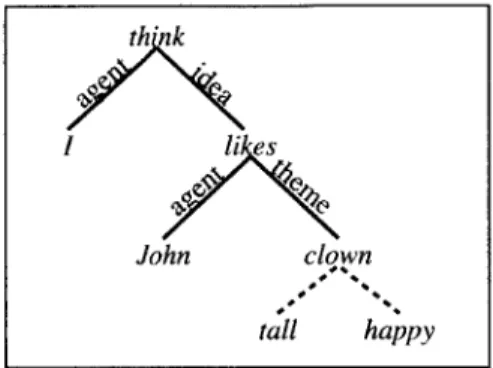
To that end, I propose a simple structure, which I will call a semantic tree. A se-mantic tree is a tree-structured representation of a sentence, composed of sese-mantic phrases, where each semantic phrase consists of a single lexical head, its modifiers, and all of its internal and external arguments. Each of the phrase's arguments is labelled with its thematic role. An example semantic tree is given in Figure 2-8.
2.4
START
The design of SQUIRE was heavily influenced by the START system, which answers questions by comparing them to individual assertions [16, 15]. The START engine is quite successful at answering questions about a natural language reference source. It can respond to a wide range of questions about several domains, including MIT's
Figure 2-8: Semantic Tree for the sentence "I think John likes the tall, happy clown." Each semantic phrase consists of a lexical head and its arguments and modifiers. Arguments are connected with solid lines, labeled by their thematic role. Adjuncts are connected with dotted lines.
Artificial Intelligence Lab, movies, and world geography [16, 15]. Abstractly, START works by examining a question and matching it against each declarative sentence that it has been told. If it finds a sentence that answers the question, it will return that sentence, and the result of matching the sentence is running the procedure.
Internally, START converts each declarative sentence into one or more links, each of which encodes a basic relationship from the sentence, in the form of a subject, relation, and object. For example, the sentence "John eats the green apple" will be encoded with the links <john, eat, apple-i> and <apple-1, is, green>. These links are then stored in START's knowledge database.
When START is given a query, it converts the query into links, and tries to match these links against those stored in the database. A query link matches a database link if the database link implies the question link. For example, "John ate an apple" implies that "John ate," and "John gave Mary the ball" implies that "John gave the ball to Mary." If each of the query's links match a database link, then START uses them to answer the question. Otherwise, START reports that it doesn't know the answer to the question.
If a query link and a database link are identical, then clearly they should match. However, non-identical links can also match each other, under two circumstances. First, two different links can encode syntactic alternations of the same form. Second, the relationship encoded by one link might imply the relationship encoded by another
les
John clown
link. In either of these cases, the links should match. To handle both of these cases, START uses S-rules, each of which states that one class of links implies another class of links. If the application of START's S-rules to a database link results in a query link, then the two links match.
2.4.1
The Structure of Links
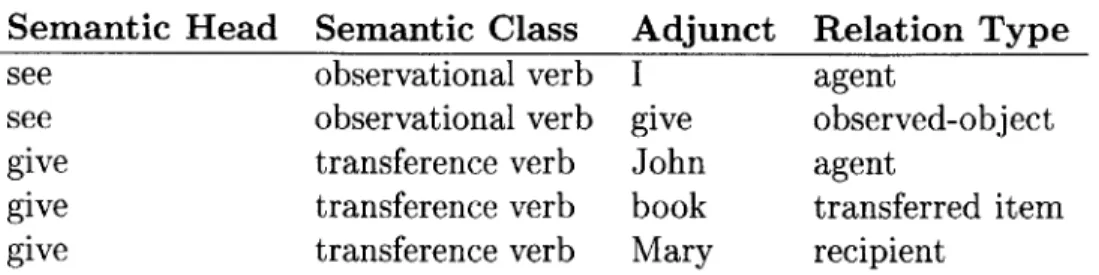
In order to process sentences, START needs to translate them into a simpler internal representation. START parses each sentence into links, each of which encodes some sub-part of the sentence. Currently, each link consists of a relation, a subject, an object, and a history:
" The relation is usually derived from the main verb of a clause. It is a symbol, such as "eat," "run," or "is-a."1
" The subject is usually derived from the subject of a clause. It is either a symbol (usually representing a concrete object) or a link.
* The object is usually derived from a direct object of a clause. Like the subject, the object can be either a symbol or a link.
" The history contains any other information about the sentence, including ad-verbs, verb tense, and indirect objects.
Note that START decides what to put in the subject or object positions of links purely on the basis of their syntactic position. For example, in the sentence "I told John," "John" is the object; but in the sentence "I told the fact to John," "the fact" is the object. Thus, in different sentences with the same verb, the subject and object can have very different relations to the verb.
Although the links derived from declarative statements and from questions have the same general structure, there is an important difference between them: query links can contain variables, whose values are the answer to the query. For example, the link representing the question "who does john like?" is <john, like, ?x>, where
?x is a variable. The variable ?x will match any value, and the answer to the question will be the value that ?x matches.
Chapter 3
Exploring Semantic IR
Most researchers agree that it should be possible to use semantic information to improve the performance of information retrieval systems [12, 28, 2]. However, it is unclear which of the many possible methods of incorporating semantic information into an information retrieval system will yield substantial improvements [14, 24]. In order to explore which of these methods seem most promising, I designed and built SQUIRE, a Semantic Question-Answering Information Retrieval Engine. SQUIRE is intended to be a test-bed which can be used to explore the effects of a variety of semantic improvements to traditional IR systems.
3.1
SQUIRE's Task
The task I chose for SQUIRE was to find the individual sentences which answer a natural language question from a large corpus (on the order of 1 million sentences). The types of questions given to SQUIRE should be specific questions, that can be answered by single sentences. Some examples of such questions are:
* What do whales eat?
" What is the capital of Norway?
" Where are factories located in Honolulu?
* Who invented football?
SQUIRE is not optimized to answer general questions that ask for information about a single entity, such as:
* Tell me about monkeys. " What are missionaries? " Who was Shah Jahan?
Since these questions do not contain any semantic relationships, they would best be answered using traditional information retrieval techniques. However, ideally, SQUIRE should perform as well as traditional systems when faced with such ques-tions.
I chose the task of sentence-level IR because it is a task at which traditional IR performs poorly, and a task for which semantic IR techniques show promise. Sentence-based IR is an important task, and is often preferable to article-Sentence-based IR, since it is much easier to skim several sentences to find the answer to a question than it is to skim several articles. Additionally, the cost of returning incorrect sentences is decreased, since the user can usually determine immediately if a sentence returned does not answer their question. In contrast, returning incorrect articles often requires the user to skim most of the article before they can determine that it does not answer their question.
3.2
Design Criteria
Although precision and recall provide simple metrics for measuring the performance of a system, there were many other criteria that SQUIRE was designed to satisfy. These criteria can be divided into properties of the system's question-answering behavior
(response criteria), and properties of the system itself (system criteria).
3.2.1
Response Criteria
* Wide Coverage: Often, semantic systems are built to perform very well in a
the usefulness of information retrieval systems comes from the fact that they can be applied to novel situations. Although SQUIRE makes use of domain-specific information, I designed SQUIRE to behave reasonably when operating outside of known domains, such that it can always perform at least as well as traditional IR systems. For example, if SQUIRE can't determine the structure of a sentence, it still tries to index the constituent pieces that make up the sentence.
" High Precision: The amount of textual information available from electronic sources, including the Internet, has been increasing at a phenomenal rate for the past 10 years. The information necessary to answer almost any question is most likely available from many different sources. But users are usually only interested in retrieving one, or perhaps a few, answers to a question. Thus, as the amount of information available grows, precision becomes more important than recall. I therefore designed SQUIRE to primarily maximize precision, and only secondarily maximize recall.
* Linguistic Normalization: A single idea can be formulated using many different
words and constructs. This linguistic variation can make it difficult to decide whether a sentence answers a question. This task becomes much easier if all linguistic variants of the same idea are reduced to a normalized form. I there-fore designed SQUIRE to detect linguistic variation and produce normalized representations of its input whenever possible.
" Rapid Query Response: It is unreasonable to ask users to wait more than a few seconds for a response to their question. Since SQUIRE indexes such a large amount of information, it is important that it not have to search through all of that information every time it responds to a query. For that reason, SQUIRE was designed to provide rapid responses to questions, even when indexing very large corpora.
3.2.2
System Properties
* Modularity: SQUIRE is designed to explore the impact of a number of different
semantic improvements to traditional IR techniques. In order to place minimal restrictions on the types of improvements that can be tested within the SQUIRE framework, I used a very modular design. Each improvement is implemented within its own self-contained module. These modules communicate with each other through a simple, well-specified interface. This allows SQUIRE to be easily extended to test further semantic improvements. Additionally, this allows SQUIRE to test the interactions between various potential improvements. " Domain Extensibility: In order for an information retrieval system to effectively
extract the meaning from a sentence, it must have information about the syntax and semantics of the language. In particular, it must have specific information about words, types of words, and syntactic constructs. However, the task of encoding information about all of the words, types of words, and constructs in English is a daunting task. Therefore, I designed SQUIRE to ensure that the new information about specific words and constructs could easily be added. In addition, following the criterion of wide coverage, I designed SQUIRE to use reasonable default information whenever it encountered unknown words, word types, or constructs.
* Simplicity: A simple model is easier to understand, reason about, implement,
and maintain.
" Efficiency: SQUIRE's performance is affected by a large number of parameters, whose values are best determined by experimentation. Changing some of these parameters requires the entire index to be rebuilt. To allow rapid exploration of the effects of changing these parameters, SQUIRE was designed with efficiency in mind.
Chapter 4
SQUIRE: A Semantic Information
Retrieval Engine
The SQUIRE system is divided into two modules: a parser and a database. The parser converts sentences and questions into weighted sets of relations, each of which partially encodes a semantic concept. The database maintains an index of the weight-ed relations that represent a corpus. When the user asks SQUIRE a question, the parser converts it into a weighted set of relations, and the database then uses those relations to retrieve the sentences most likely to answer the user's question.
4.1
Weights
SQUIRE makes extensive use of weights. These weights indicate SQUIRE's confidence that a given piece of information is useful. This confidence is derived from a number of sources, including:
" An overall valuation of the original source of the information. For example, information derived from an encyclopedia might carry a higher weight than information derived from an unknown web page.
" The likelihood that the information correctly represents the original source. When SQUIRE performs a transformation that might be incorrect or



![Figure 2-7: Example of Fregean Semantic Derivation. This figure illustrates the Fregean semantic derivation of the predicate corresponding to the sentence "John likes Mary." It makes use the [*] operator, which finds t](https://thumb-eu.123doks.com/thumbv2/123doknet/14059236.461138/32.918.266.672.86.322/example-fregean-semantic-derivation-illustrates-derivation-predicate-corresponding.webp)