HAL Id: hal-02808583
https://hal.inrae.fr/hal-02808583
Submitted on 6 Jun 2020
HAL is a multi-disciplinary open access archive for the deposit and dissemination of sci-entific research documents, whether they are pub-lished or not. The documents may come from teaching and research institutions in France or abroad, or from public or private research centers.
L’archive ouverte pluridisciplinaire HAL, est destinée au dépôt et à la diffusion de documents scientifiques de niveau recherche, publiés ou non, émanant des établissements d’enseignement et de recherche français ou étrangers, des laboratoires publics ou privés.
Anne-Francoise Adam-Blondon, M. Boulay, José Miguel Martinez Zapater
To cite this version:
Anne-Francoise Adam-Blondon, M. Boulay, José Miguel Martinez Zapater. Futur prospects. Genetics, Genomics, and Breeding of Grapes, Sciences Publishers, 390 p., 2011, 9781578087174. �hal-02808583�
14
Future Prospects
A-F Adam-Blondon,1,* M Boulay2 and J-M Martinez-Zapater3
ABSTRACT
Viticulture is a very valuable crop in terms of income and still attracts new producers. However, in order to stay this way, growers will have to meet several challenges with the help of scientists. First, the use of pesticides will have to be greatly reduced through the development of global strategies using fewer chemicals with other methods such as biological control, genetic resistance and new agronomical practices. The design of such integrated systems requires in-depth knowledge at several levels on how the grapevine functions in its biotic and abiotic environment. This will be achieved using metagenomics strategies to generate inventories of the Grapevine-Associated Micro-Flora, as well as transcriptomic, proteomic and metabolomic analyses of both grapevine and pests and pathogens during their interaction. Modern genome based approaches will also increase the effi ciency in the breeding of new varieties combining high quality and durable resistance. Second, viticulture will have to adapt to changing growing conditions due to global climate changes and to better and more rapidly meet consumer demands. This will require the ability to model the function of grapevine in the environment based on a combination of genomics, genetic and ecophysiologic information as a way to quickly target the relevant trait and the relevant strategy to address (breeding, training practices, enology practices, etc.).
Keywords: Pathogen and pest resistance, agrochemicals, global warming, grapevine breeding, genomics
1UMR INRA UEVE ERL CNRS Génomique Végétale, 2 rue Gaston Crémieux, BP5708, 91 057
Evry cedex, France.
260 rue de Vaux, 77000 Livry sur Seine, France, ex. Responsable du Développement Viticole
Moët & Chandon 20 Avenue de Champagne 51200 Epernay, France.
3Instituto de Ciencias de la Vid y del Vino (CSIC, Universidad de La Rioja, Gobierno de La
Rioja), C/Madre de Dios 51, 26006 Logroño, Spain. *Corresponding author: [email protected]
14.1 Evolution of Viticulture Around the World
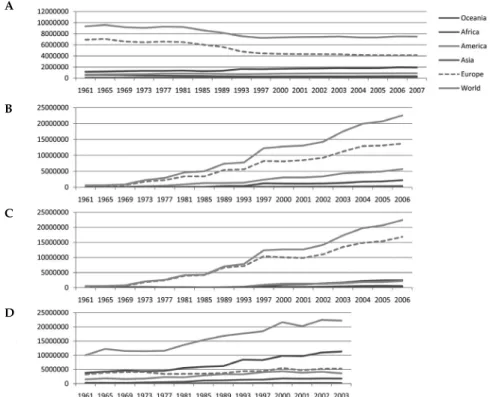
The analysis of viticulture, wine market and consumption around the world presented in Chapter 1 and summarized in Fig. 1-1 in terms of trends, shows that Europe has a traditional and strong viticulture and as such still maintains the largest vineyard areas, together with the largest wine exports and imports. European consumers still account for most of the worldwide consumption (Fig. 14-1). However, countries like North America and China will perhaps compete for this last point in the future. The only exception in the grapevine-related market is for fresh/dried berries consumption, where Europe lies just behind Asia (http://faostat.fao.org/; data not shown). During the last 60 years however, the vineyard areas have decreased roughly by one-third across Europe with a reorientation towards wine quality: low quality varieties have been replaced by high-quality ones and low quality
terroirs have been abandoned. After the genetic diversity bottleneck caused
in the European viticulture by the introduction of Phylloxera and fungal
Figure 14-1 World statistics for the wine sector (from FAOSTAT; http://faostat.fao.org/) (A)
Surface harvested (ha) (B) Wine imports (1000 $). (C) Wine exports in (1000$) (D) Wine consumption (t).
Color image of this figure appears in the color plate section at the end of the book.
A
B
C
pathogens in the second half of the 19th century, this market selection of high quality wines resulted in further reduction of cultivar diversity across the vineyards (Bouquet and Boursiquot 1999). In parallel, as pointed out in Chapter 1, drastic changes in consumer habits were also recently observed, mainly in France, Italy and Spain, with a shift towards less wine consumption but of higher quality and a progressive disappearance of regular wine consumers that, as a whole, resulted in a global reduction of wine consumption (Fig. 14-1d).
The worldwide vineyard area has remained roughly stable despite its reduction in Europe thanks to a sharp increase of plantations in America, Asia and Australia (Fig. 14-1a). This expansion has recently been particularly impressive in China (Fig. 14-2a), with Chinese wine production and importations (Fig. 14-2b) being completely devoted to supply the large increase of internal consumption (Fig. 14-2d). This is quite different from the situation in most of the other producing countries that were expanding their exports timely with the increase of production (e.g., Australia: Fig. 14-2c), progressively reducing the position of Europe as the major wine exporter (Fig. 14-1c). All around the world, viticulture is still a very valuable crop with a total US $22,423 million value for worldwide wine exports and US $ 4,601 million value for worldwide grape and grape juices exports in 2006 (http://faostat.fao.org/). It may remain the same, provided viticulture copes with several important challenges in the near future which could be facilitated by major advances in scientifi c knowledge.
14.2 Viticulture Will Have to Reduce the Use of Pesticides and Perhaps to Face the Expansion of New Diseases due Either to Such Reduction or to Climatic Changes
The fi rst challenge is to drastically reduce the use of pesticides while maintaining the quality of the production. Until now, except for Phylloxera pest control, this was mainly achieved through the use of chemicals. However, it is now widely recognized that this approach is not sustainable as some pesticide active molecules can have effects on the environment and on human health. Their use has now become much more restricted in Europe (http://www.europarl.europa.eu/news/expert/briefi
ng_page/45150-012-01-03-20081217BRI45149-12-01-2009-2009/default_p001c004_en.htm), which may
lead to a technical dead-end for current practices. Although it will probably not be possible to protect the vineyard without using any chemicals, their use will continue to be reduced. In fact, insecticides have been intensively reduced by the use of biological control such as Phytoseids or pheromones, as well as herbicides by inter row under grassing. For fungicides, reductions are obtained thanks to the increased use of disease forecast models as well as prophylaxis techniques. Following these already initiated patterns, new
grapevine management technologies will probably include the use of fewer chemicals (more environmentally friendly) in a global strategy together with methods for biological control, genetic resistance and new agronomical practices for a more sustainable viticulture. The design of such integrated systems requires in-depth knowledge at several levels on how the grapevine functions in its biotic and abiotic environment.
14.2.1 Inventory of the Grapevine-Associated Micro-Flora
The fi rst layer of knowledge, which concerns the complete description of the microorganisms that live in vineyard soils, but also on leaves, trunks or berries as epiphytes or in perennial organs such as roots, or trunks as
Figure 14-2 Statistics for the wine sector in Australia and China (from FAOSTAT; http://faostat.
fao.org/) (A) Surface harvested (ha) (B) Wine imports (1,000 $) (C) Wine exports (1,000$) (D)
Wine consumption (t).
A
B
C
endophytes microorganisms is now-a-days a near complete black box. Yet, some of these microbial populations are known to have the potential to favor plant growth and adaptation to abiotic stresses, but also to prime defense responses against pathogens in plants (Ait Barka et al. 2002, 2006; Conrath et al. 2006; Van Wees et al. 2008), which may lead to the development of new strategies for pests and pathogens control (McMahan et al. 2001; Schmidt et al. 2001; Mohamed et al. 2007). However, the use of a living organism as a pesticide is always more complex than the use of a chemical and the activation by elicitors of the defense pathways normally switched on by these benefi cial microbes (Zimmerli et al. 2000) does not give a straight forward solution for field conditions either. These pathways may be antagonistic to other pathways also important for plant adaptation and in the molecular “dialog” that represents the host-parasite relationship, the parasite being at different stages of development under fi eld conditions, may always have time in advance to the host defence. Therefore, it is important to better understand the vineyard ecological system in order to develop new agronomical practices taking into account benefi cial microbial populations (Beckers and Conrath 2007). The fi rst step is to record all the microorganisms present in the vineyards in/on grapevines or in its immediate environment, to study the evolution of such communities in different conditions (healthy/ non healthy vine, under abiotic stresses, etc.) and the physiological reactions of grapevine and of individual microbes in interaction. This will require metagenomic approaches that are currently under massive development for instance to better understand human diseases or to fi nd solutions to polluted environments (Daniel 2005; Ventura et al. 2009), but are still in their infancy with regards to agriculture (Jiao et al. 2006; Rabosto et al. 2006; Van Elsas et al. 2008).
14.2.2 Inventory of Grapevine Interactions with its Main Pests and Pathogens with a “Both Sides” Point of View
Another important layer of knowledge concerns the molecular mechanisms underlying the interaction of grapevine with its major pests and pathogens. Many laboratories are currently studying grapevine transcriptome changes under pest stress as a fi rst step (Espinoza et al. 2007; Lin et al. 2007; Roper et al. 2007; Figueiredo et al. 2008; Fung et al. 2008; Polesani et al. 2008; Polesani et al. 2010) but it would also be very important to study gene regulation in pathogens in the same conditions to fully understand the molecular dialog between the two interacting organisms (e.g., Lambais et al. 2000; Choquer et al. 2007) as evoked above. For this purpose, it will be important to develop genomic tools for the main grapevine pests and especially those responsible for a lot of treatments in the vineyard (e.g., Erysiphe necator,
is available yet (the virus pathogen GFLV transmitted by the dagger type nematode Xiphinema index, the bacterial pathogen Xylella fastidiosa, as well as some other viral diseases like GLRaV, leaf roll viruses, etc.). A few of those pathogens have their genome sequenced [e.g., X. fastidiosa (Van Sluys et al 2003), B. cinerea (Fillinger et al. 2007) and GFLV (Naraghi-Arani et al. 2001)] and two others, responsible for the stolbur and the fl avescence dorée are under way (Cimerman et al. 2006; Malembic-Maher et al. 2008). Unfortunately, so far comprehensive collections of express sequence tags (ESTs) have only been produced for B. cinerea (Viaud et al. 2005).
14.2.3 Inventory of the Genetic Diversity for Resistance to Diseases in the Vitis Genus and Grapevine Improvement
Last but not the least, as in other crops, it is important to introduce resistant varieties in viticulture. These varieties will have to produce high quality wine given the current trends of the market and the resistance will have to be durable (plantations have an average duration of 30 years or even more for high quality red wines!). Regarding resistance durability, it will be important to characterize the natural pathogen populations, their genetic diversity, their epidemiology, but also the selective pressures exerted by their host and the management system (McDonald and Linde 2002). From the plant side, it will be very important to combine in the resistant varieties different resistance mechanisms against a given pest (pyramiding resistance; see Chapter 7 Section 7.3), which supports the interest to characterize genetic resources in the genus Vitis and to study the genetic basis of their pathogen resistance mechanisms. The increase of grapevine research in China that will most probably come with the increase of vineyard areas will probably bring new such resources from the Asian pool, yet poorly known. The design of high quality varieties requires enough generations of backcrossing in order to recover the Vitis vinifera best quality level while retaining the resistance traits. Many groups are currently working at the development of molecular markers to facilitate and accelerate such programs (see Chapters 5 and 7) and some interesting varieties have been produced and are already planted (see Chapter 1 Section 1.3.2). They will have to prove their worth during the coming years, both in terms of resistance to diseases and of organoleptic qualities of their issued wines, before being considered into high quality production systems. However, if some variety proves in the future to be of such high interest, it is likely that it will succeed, especially if a technical dead-end is reached with regards to disease control. It was demonstrated in the past when the Phylloxera epidemic drew to the general use of rootstocks from either American Vitis species or hybrids between them and
Vitis vinifera, greatly reshaping the plant production chain (grafted plants
14.2.4 Is There a Place for Genetically Modifi ed Grapevine in the Future?
On the other hand, depending on social acceptance of genetically modifi ed grapevine, improving grapevine resistance to disease by gene transfer is also possible. This is particularly true for resistance to viruses or phytoplasms, where no major resistance sources are known in the Vitis genus and different transgene-based strategies are developed all over the world for resistance to GFLV or GLRaV (see for review, Laimer et al. 2009). Another possibility raised by such an approach is a quicker development of high quality varieties transformed with Vitis-derived resistance genes (see Chapter 8). However, the introduction of genetically modifi ed organism (GMO) in viticulture is still a challenging issue and will necessarily have to be co-developed within the society (Laimer et al. 2009). In this respect, an interesting and partly successful initiative has been set up in France (Joly and Rip 2007).
14.3 Viticulture Will Have to Adapt to New Climatic Conditions in Many Areas
Another challenge, global climatic change, may lead to changes in the cultivars planted. The projections for 2100 of the Intergovernmental Panel on Climatic Change (IPCC; http://www.ipcc.ch) include an increase of the average temperature, a change in the rain regime especially in the Mediterranean areas with less rain in summer combined with a water demand increase by plants and a doubling of atmospheric CO2 content. While the change in carbon dioxide concentration perhaps will have no or few effects on wine quality as demonstrated recently on a Portuguese red cultivar (Gonçalves et al. 2009), temperature increases will have. An elevation of summer temperatures and a consequent shortening of the grapevine growing period have already been observed during the last 10 to 15 years and have recorded consequences in viticulture production as reviewed by Jones (2007). For instance in France, vintages are now taking place generally one month earlier than 15 years ago. Furthermore, harvested berries show an increase of their sugar content, a reduction of their acidity and lower phenolic maturity. The berry ripening phase often occurs now during the hottest periods, which is not favorable for an optimal aromatic production. Finally, the increasing water defi cit in soils in spring and summer impairs nitrogen assimilation by grapevine resulting in less free amino acids content in the berries, which in turn may lead to problems in must fermentation and wine ageing. An indirect effect of climatic change may also be the further spreading of pests that were currently stopped by cold winters (e.g., vector of Pierce’s disease in Europe).
There is, therefore, a need to better understand the interaction of grapevine with its physical environment and its consequences on the process of plant production and berry content. This will need integrated system approaches combining more powerful phenotypic analyses including transcriptomic, proteomic and metabolomic studies in different plant tissues and under different environmental conditions (Castellarin et al. 2007a and b; Cramer et al. 2007; Deluc et al. 2007; Mori et al. 2007; Pilati et al. 2007; Vincent et al. 2007; Iandolino et al. 2008; Lund et al. 2008; Zhang et al. 2008; Bellin et al. 2009; Zenoni et al. 2010; see Chapters 11 and 12). In addition, this analysis should also integrate the existent genetic variation represented by the different grapevine cultivars as well as their differential interactions with the environment. This information will be the basis to develop better tools for the assessment of quality potential before harvest, to provide better criteria for the selection of new cultivars or to screen genetic resources for varieties that were abandoned because of their low potential under former climatic conditions but that could now be quite acceptable. Yet, the classifi cation of the grapevine varieties according to their optimal climate growing conditions proposed by Jones (2007) could be extended to other genetic resources using appropriate screening procedures (Duchêne et al 2010). Currently, the new available tools derived from genomic information are generating many opportunities in different wine producing countries to develop research programs together with the private sector, addressing these types of viticulture issues.
14.4 Viticulture Will Have to Adapt Better and Faster to Consumer Demands
Traditionally, the main consumers were located in countries having a wine culture. This means that they were more or less educated about wine history or wine culture and were willing and able to choose their wines among a large diversity of products from wine regions associating different cultivars, soils and viticulture practices. More recently, some cultivars have been pushed forward and used throughout the world, sometimes in association with new enological practices (e.g., use of oak chips) with the aim to obtain a more standard product, better adapted to a worldwide demand. This demand is evolving and diversifying for example towards wines that are more fruity and fresh on one hand or wines that could be drunk on occasions where they must compete with other beverages like spirits. In order to answer such diversifi ed demands, the enologists have a long tradition of improvement of the wine making process (development of new yeast strains, new extraction methods for aromatic compounds, better control of fermentation, etc.). However, a better understanding of the whole integrated process from berry composition and ripening to fermentation
and enological technologies can allow new approaches in the design of a desirable type of wine called “reverse engineering” (H. Ojeda, pers. comm.). Under this approach the design of a new wine would defi ne appropriate cultivar characteristics, viticulture practices and enological techniques.
Even, if the evolution of the berry composition in water, sugar, acids, phenolics and terpens is well known (for review see Ollat et al. 2002; Conde et al. 2007), there is a need for a better understanding of the regulation of metabolic pathways involved, of their crosstalks and of the molecular basis of the genetic variation shown by grapevine cultivars. Furthermore, it is important to understand the genotype environment interactions on berry composition that will help develop more precise diagnostic tools to monitor vintages.
As pointed above, genome derived technologies allowed for a more thoroughly phenotypic description of berry evolution at gene expression, protein synthesis and metabolic composition and several transcriptome, proteome and metabolome analyses of developing berries have been recently published, drawing a first rough sketch of the pattern of co-regulated genes (see Chapters 10, 11 and 12 for reviews). These preliminary data will be further completed with future analyses using either more representative genome microarrays or open expression analyses methods derived from the new high throughput sequencing techniques now that the genome sequence is available. Additional studies will also have to consider different genotypes as well as different growing conditions to develop a complete picture of berry development and the ripening process. However, the identifi cation of the key genes responsible for these processes will only be possible through a combination of system biology approaches including statistical and mathematical modelling based on these “omics” data and of genetic approaches. The latter relies on the study of natural or induced genetic variation. Quantitative trait loci (QTL) detection has been a quite useful approach in the identifi cation of genetic loci responsible for quality traits in grapes as well as resistance traits (see Chapters 6 and 7), although only the gene(s) behind one of these major loci is as yet close to being identifi ed (see Chapter 8). The study of natural somatic variants (reviewed in Chapter 3) has been successful in the identifi cation of specifi c genes involved in reproductive development and berry color (e.g., Boss and Thomas 2002; Kobayashi et al. 2004; Fernández et al. 2010). However, if one wishes to generalize such mutant studies, one caveat that has to be overcome is the production of large mutant collections in grapevine, such as those which have been developed for tomato (Menda et al. 2004) or pea (Dalmais et al. 2008) and that are very useful in the assignment of gene biological function. Limitations relate in this case to the need of space to maintain the genetic resources and the length of generation time required for segregation analyses. The diffi culties involving these genetic analyses
and the resources required has led the grapevine community to start the development of tools and knowledge for application of association genetics strategies (see for instance Barnaud et al. 2009; Fournier-Level et al. 2009; Myles et al. 2010 and Chapter 4 for review), as it is been done in human or animals genetics for similar reasons (Karlsson et al. 2007; Slatkin 2008; McCarthy et al. 2008). In addition, based on the fi nding of a natural somatic mutant derived from Pinot Meunier (Boss and Thomas 2002), short cycling grapevine genotypes suitable either for transformation or for genetic studies were recently successfully developed (Chaib et al. 2010). Such lines will be of tremendous interest as they are dwarf to semi-dwarf, needing therefore less space, and as they are produce fruits within 6 months (Chaib et al. 2010).
Within agricultural production viticulture and wine production results from a series of complex interactions between the plant, physical environment and human environment. The wine as the fi nal product summarizes this complexity and displays a large diversity representing the different ways and the different tools and environments that have been used in human history for its production. The complexity of interactions required to generate a high quality product have made viticulture and enology to be considered almost as an art. Understanding the grapevine genome as well as the genomes of other organisms such as yeast and Oenococcus oeni bacteria that participate in the process of wine making can help us to more deeply understand the complexities of berry development and ripening and wine production. The possibilities to manage large amounts of data enable us now to address the analysis of more complex processes and this can help explain scientifi cally all kinds of interactions taking place in the vineyard and in the fermentation vat. It is expected that this knowledge will help in the design of new strategies to cope with some of the described challenges in viticulture and perhaps other unforeseen ones. It will be diffi cult to make better wines than the current ones but the goal is to maintain this high quality level under the frame of sustainability within a changing environment.
References
Ait Barka E, Gognies S, Nowak J, Audran JC, Belarbi A (2002) Inhibitory effect of endophyte bacteria on Botrytis cinerea and its infl uence to promote the grapevine growth. Biol Control 24: 35–142.
Ait Barka E, Nowak J, Clément C (2006) Enhancement of chilling resistance of inoculated grapevine plantlets with a plant growth-promoting rhizobacterium, Burkholderia
phytofi rmans strain PsJN. Appl Environ Microbiol 72: 7246–7252.
Barnaud A, Laucou V, This P, Lacombe T, Doligez A (2009) Linkage disequilibrium in wild French grapevine, Vitis vinifera L. subsp. Silvestris. Heredity 104: 431–437.
Battilana J, Costantini L, Emanuelli F, Sevini F, Segala C, Moser C, Velasco R, Versini G, Grando MS (2009) The 1-deoxy-D: -xylulose 5-phosphate synthase gene co-localizes with a major QTL affecting monoterpene content in grapevine. Theor Appl Genet 118: 653–669.
Beckers GJ, Conrath U (2007) Priming for stress resistance: from the lab to the fi eld. Curr Opin Plant Biol 10: 425–431.
Bellin D, Ferrarini A, Chimento A, Kaiser O, Levenkova N, Bouffard P, Delledonne M (2009) Combining next-generation pyrosequencing with microarray for large scale expression analysis in non-model species. BMC Genom 10: 555.
Boss PK, Thomas MR (2002) Association of dwarfi sm and fl oral induction with a grape ‘green revolution’ mutation. Nature 416: 847–850.
Bouquet A, Boursiquot J-M (1999) Safeguarding old varieties and developing recently obtained new cultivars a joint step to conciliate tradition and innovation in France. Bull OIV 72: 753–761.
Castellarin SD, Matthews MA, Di Gaspero G, Gambetta GA (2007a) Water defi cits accelerate ripening and induce changes in gene expression regulating fl avonoid biosynthesis in grape berries. Planta 227: 101–112.
Castellarin SD, Pfeiffer A, Sivilotti P, Degan M, Peterlunger E, Di Gaspero G (2007b) Transcriptional regulation of anthocyanin biosynthesis in ripening fruits of grapevine under seasonal water defi cit. Plant Cell Environ 30: 1381–1399.
Chaïb J, Torregrosa L, Mackenzie D, Corena P, Bouquet A, Thomas MR (2010) The grape microvine– a model system for rapid forward and reverse genetics of grapevines. Plant J. 62: 1083–1092.
Choquer M, Fournier E, Kunz C, Levis C, Pradier JM, Simon A, Viaud M (2007) Botrytis cinerea virulence factors: new insights into a necrotrophic and polyphageous pathogen. FEMS Microbiol Lett 277: 1–10.
Cimerman A, Arnaud G, Foissac X (2006) Stolbur phytoplasma genome survey achieved using a suppression subtractive hybridization approach with high specifi city. Appl Environ Microbiol 72: 3274–3283.
Conde C, Silva P, Fontes N, Dias ACP, Tavares RM, Sousa MJ, Agasse A, Delrot S, Gerós H (2007) Biochemical changes throughout grape berry development and fruit and wine quality. Food 1: 1–22.
Conrath U, Beckers G, Flors V, Garcia-Agustin P, Jakab G, Mauch F, Newman M, Pieterse C, Poinssot B, Pozo M, Pugin A, Schaffrath U, Ton J, Wendehenne D, Zimmerli L, Mauch-Mani B (2006) Priming: getting ready for battle. Mol Plant-Microbe Interact 19: 1062–1071.
Cramer GR, Ergül A, Grimplet J, Tillett RL, Tattersall EAR, Bohlman MC, Vincent D, Sonderegger J, Evans J, Osborne C, Quilici D, Schlauch KA, Schooley DA, Cushman JC (2007) Water and salinity stress in grapevines: early and late changes in transcript and metabolite profi les. Funct Integr Genom 7: 111–134.
Dalmais M, Schmidt J, Le Signor C, Moussy F, Burstin J, Savois V, Aubert G, Brunaud V, de Oliveira Y, Guichard C, Thompson R, Bendahmane A (2008) UTILLdb, a Pisum sativum in silico forward and reverse genetics tool. Genome Biol 9: R43.
Daniel R (2005) The metagenomics of soil. Nat Rev Microbiol 3: 470–478.
Deluc LG, Grimplet J, Wheatley MD, Tillett RL, Quilici DR, Osborne C, Schooley DA, Schlauch KA, Cushman JC, Cramer GR (2007) Transcriptomic and metabolite analyses of Cabernet Sauvignon grape berry development. BMC Genom 8: 429.
Duchene E, Huard F, Dumas V, Schneider C, Merdinoglu D (2010) The challenge of adapting grapevine varieties to climate change. Climate Res 41: 193–204.
Espinoza C, Medina C, Somerville S, Arce-Johnson P (2007) Senescence-associated genes induced during compatible viral interactions with grapevine and Arabidopsis. J Exp Bot 58: 3197–3212.
Fernandez L, Romieu C, Moing A, Bouquet A, Maucourt M, Thomas MR, Torregrosa L (2006) The grapevine fl eshless berry Mutation. A unique genotype to investigate differences between fl eshy and nonfl eshy fruit. Plant Physiol 140: 537–547.
Fernandez L, Torregrosa L, Segura V, Bouquet A, Martínez Zapater JM (2010) Transposon induced gene activation as a mechanism generating cluster shape somatic variation in grapevine. Plant J 61: 545–557.
Figueiredo A, Fortes AM, Ferreira S, Sebastiana M, Choi YH, Sousa L, Acioli-Santos B, Pessoa F, Verpoorte R, Pais MS (2008) Transcriptional and metabolic profi ling of grape (Vitis
vinifera L.) leaves unravel possible innate resistance against pathogenic fungi. J Exp Bot
59: 3371–3381.
Fillinger S, Amselem J, Artiguenave F, Billaut A, Choquer M, Couloux A, Cuomo C, Dickman MB, Fournier E, Gioti A, Giraud C, Kodira C, Kohn L, Legeai F, Levis C, Mauceli E, Pommier C, Pradier JM, Quevillon E, Rollins J, Ségurens B, Simon A, Viaud M, Weissenbach J, Wincker P, Lebrun M-H (2007) The genome projects of the plant pathogenic fungi Botrytis cinerea and Sclerotinia sclerotiorum. In: P Jeandet, C Clément, A Conreux (eds) Macromolecules of Grape and Wines. Lavoisier, London, Paris, New York, pp 125–133.
Fournier-Level A, Le Cunff L, Gomez C, Doligez A, Ageorges A, Roux C, Bertrand Y, Souquet J-M, Cheynier V, This P (2009) Quantitative genetic bases of anthocyanin variation in grape (Vitis vinifera L. ssp. sativa) berry: a quantitative trait locus to quantitative trait nucleotide integrated study. Genetics 183: 1127–1139.
Fung R.W, Gonzalo M, Fekete C, Kovacs LG, He Y, Marsh E, McIntyre LM, Schachtman DP, Qiu W (2008) Powdery mildew induces defense-oriented reprogramming of the transcriptome in a susceptible but not in a resistant grapevine. Plant Physiol 146: 236–49.
Gonçalves B, Falco V, Moutinho-Pereira J, Bacelar E, Peixoto F, Correia C (2009) Effects of elevated CO2 on grapevine (Vitis vinifera L.): volatile composition, phenolic content, and
in vitro antioxidant activity of red wine. J Agric Food Chem 57: 265–273.
Iandolino A, Nobuta K, Goes da Silva F, Cook DR, Meyers BC (2008) Comparative expression profi ling in grape (Vitis vinifera) berries derived from frequency analysis of ESTs and MPSS signatures. BMC Plant Biol 8: 53.
Jiao JY, Wang HX, Zeng Y, Shen YM (2006) Enrichment for microbes living in association with plant tissues. J Appl Microbiol 100: 830–837.
Joly P-B, Rip A (2007) A timely harvest. Nature 450: 174.
Jones GV (2007) Climate change: Observations, projections, and general implications for viticulture and wine production. Proc of the Int Symp Global Warming, which Potential Impacts on the Vineyards? March 28–30, 2007, Dijon-Beaune, France:
http://www.u-bourgogne.fr/chaireunesco-vinetculture/Actes%20clima/Accueil.htm
Karlsson EK, Baranowska I, Wade CM, Salmon Hillbertz NH, Zody MC, Anderson N, Biagi TM, Patterson N, Pielberg GR, Kulbokas EJ 3rd, Comstock KE, Keller ET, Mesirov JP, von Euler H, Kämpe O, Hedhammar A, Lander ES, Andersson G, Andersson L, Lindblad-Toh K (2007) Effi cient mapping of mendelian traits in dogs through genome-wide association. Nat Genet 39: 1321–1328.
Kobayashi S, Goto-Yamamoto N, Hirochika H (2004) Retrotransposon-induced mutations in grape skin color. Science 304: 982.
Laimer M, Lemaire O, Herrbach E, Goldschmidt V, Minafra A, Bianco O, Wetzel T (2009) Resistance to viruses, phytoplasmas and their vectors in the grapevine in Europe: a review. J Plant Pathol 91: 7–23.
Lambais MR, Goldman MH, Camargo LE, Goldman GH (2000) A genomic approach to the understanding of Xylella fastidiosa pathogenicity. Curr Opin Microbiol 3: 459–462. Lin H, Doddapaneni H, Takahashi Y, Walker MA (2007) Comparative analysis of ESTs involved
in grape responses to Xylella fastidiosa infection. BMC Plant Biol 7: 8.
Lund S, Peng F, Nayar T, Reid K, Schlosser J (2008) Gene expression analyses in individual grape (Vitis vinifera L.) berries during ripening initiation reveal that pigmentation intensity is a valid indicator of developmental staging within the cluster. Plant Mol Biol 68: 301–315. Malembic-Maher S, Constable F, Cimerman A, Arnaud G, Carle P, Foissac X, Boudon-Padieu
E (2008) A chromosome map of the Flavescence dorée phytoplasma. Microbiology 154: 1454–1463.
McCarthy MI, Abecasis GR, Cardon LR, Goldstein DB, Little J, Ioannidis JPA, Hirschhorn JN (2008) Genome-wide association studies for complex traits: consensus, uncertainty and challenges. Nat Rev Genet 9: 356–369.
McDonald BA, Linde C (2002) Pathogen population genetics, evolutionary potential, and durable resistance. Annu Rev Phytopathol 40: 349–379.
McMahan G, Yeh W, Marshall MN, Olsen M, Sananikone S, Wu JY, Block DE, VanderGheynst JS (2001) Characterizing the production of a wild-type and benomyl-resistant Fusarium
lateritium for biocontrol of Eutypa lata on grapevine. J Ind Microbiol. Biotechnol 26:
151–155.
Menda N, Semel Y, Peled D, Eshed Y, Zamir D (2004) In silico screening of a saturated mutation library of tomato. Plant J 38: 861–872.
Mohamed N, Lherminier J, Farmer MJ, Fromentin J, Béno N, Houot V, Milat ML, Blein JP (2007) Defense responses in grapevine leaves against Botrytis cinerea induced by application of a Pythium oligandrum strain or its elicitin, oligandrin, to roots. Phytopathology 97: 611–620.
Mori K, Goto-Yamamoto N, Kitayama M, Hashizume K (2007) Loss of anthocyanins in red-wine grape under high temperature. J. Exp. Bot. 58: 1935–1945.
Myles S, Chia J-M, Hurwitz B, Simon C, Zhong GY, Buckler E, Ware D (2010) Rapid genomic characterization of the genus Vitis. PLOS One 5: e8219.
Naraghi-Arani P, Daubert S, Rowhani A (2001) Quasispecies nature of the genome of grapevine fanleaf virus. J Gen Virol 82: 1791–1795.
Ollat N, Diakou-Verdin P, Carde J-P, Barrieu F, Gaudillère J-P, Moing A (2002) Grape berry development: a review. J Int Sci Vigne Vin 36: 109–131.
Pilati S, Perazzolli M, Malossini A, Cestaro A, Demattè L, Fontana P, Dal Ri A, Viola R, Velasco R, Moser C (2007) Genome-wide transcriptional analysis of grapevine berry ripening reveals a set of genes similarly modulated during three seasons and the occurrence of an oxidative burst at véraison. BMC Genom 8: 428.
Polesani M, Desario F, Ferrarini A, Zamboni A, Pezzotti M, Kortekamp A, Polverani A (2008) cDNA-AFLP analysis of plant and pathogen genes expressed in grapevine infected with
Plasmopara viticola. BMC Genom 9: 142.
Polesani M, Bortesi L, Ferrarini A, Zamboni A, Fasoli M, Zadra C, Lovato A, Pezzotti M, Delledonne M , Polverari A (2010) General and species-specifi c transcriptional responses to downy mildew infection in a susceptible (Vitis vinifera) and a resistant (V. riparia) grapevine species. BMC Genomics 11: 117.
Rabosto X, Carrau M, Paz A, Boido E, Dellacassa E, Carrau FM (2006) Grapes and vineyard soils as sources of microorganisms for biological control of Botrytis cinerea. Am J Enol Vitic 57: 332–338.
Roper MC, Greve LC, Warren JG, Labavitch JM, Kirkpatrick BC (2007) Xylella fastidiosa requires polygalacturonase for colonization and pathogenicity in Vitis vinifera grapevines. Mol Plant-Microbe Interact 20: 411–419.
Schmidt CS, Lorenz D, Wolf GA (2001) Biological control of the grapevine dieback fungus
Eutypa lata I: screening of bacterial antagonists. J Phytopathol 149: 427–435.
Slatkin M (2008) Linkage disequilibrium: understanding the evolutionary past and mapping the medical future. Nat Rev Genet 9: 477–485.
Van Elsas JD, Costa R, Jansson J, Sjöling S, Bailey M, Nalin R, Vogel TM, van Overbeek L (2008) The metagenomics of disease-suppressive soils—experiences from the METACONTROL project. Trends Biotechnol 26: 591–601.
Van Sluys MA, de Oliveira MC, Monteiro-Vitorello CB, Miyaki CY, Furlan LR, Camargo LE, da Silva AC, Moon DH, Takita MA, Lemos EG, Machado MA, Ferro MI, da Silva FR, Goldman MH, Goldman GH, Lemos MV, El-Dorry H, Tsai SM, Carrer H, Carraro DM, de Oliveira RC, Nunes LR, Siqueira WJ, Coutinho LL, Kimura ET, Ferro ES, Harakava R, Kuramae EE, Marino CL, Giglioti E, Abreu IL, Alves LM, do Amaral AM, Baia GS, Blanco SR, Brito MS, Cannavan FS, Celestino AV, da Cunha AF, Fenille RC, Ferro JA, Formighieri EF, Kishi LT, Leoni SG, Oliveira AR, Rosa VE Jr, Sassaki FT, Sena JA, de Souza AA, Truffi D, Tsukumo F, Yanai GM, Zaros LG, Civerolo EL, Simpson AJ, Almeida NF Jr,
Setubal JC, Kitajima JP (2003) Comparative analyses of the complete genome sequences of Pierce’s disease and citrus variegated chlorosis strains of Xylella fastidiosa. J Bacteriol 185: 1018–1026.
Van Wees SC, Van der Ent S, Pieterse CM (2008) Plant immune responses triggered by benefi cial microbes. Curr Opin Plant Biol 11: 443–448.
Ventura M, Turroni F, Canchaya C, Vaughan EE, O’Toole PW, Sinderen D (2009) Microbial diversity in the human intestine and novel insights from metagenomics. Front Biosci 14: 3214–3221.
Viaud M, Legeai F, Pradier JM, Brygoo F, Bitton F, Weissenbach J, Brunet-Simon A, Duclert A, Fillinger S, Fortini D, Gioti A, Giraud C, Halary S, Lebrun I, Le Pêcheur P, Samson D, Levis C (2005) Expressed sequence tags from the phytopathogenic fungus Botrytis cinerea. Eur J Plant Pathol 111: 139–146.
Vincent D, Ergül A, Bohlman MC, Tattersall EAR, Tillett RL, Wheatley MD, Woolsey R, Quilici D, Joets J, Schlauch KA, Schooley DA, Cushman JC, Cramer GR (2007) Proteomic analysis reveals differences between Vitis vinifera L. cv. Chardonnay and cv. Cabernet Sauvignon and their responses to water defi cit and salinity. J Exp Bot 58: 1873–1892.
Zenoni S, Ferrarini A, Giacomelli E, Xumerle L, Fasoli M, Malerba G, Bellin D, Pezzotti M, Delledonne M (2010) Characterization of transcriptional complexity during berry development in Vitis vinifera using RNA-Seq. Plant Physiol 152: 1787–1795.
Zhang J, Ma H, Feng J, Zeng L, Wang Z, Chen S (2008) Grape berry plasma membrane proteome analysis and its differential expression during ripening. J Exp Bot 59: 2979–2990. Zimmerli L, Jakab G, Metraux J, Mauch-Mani B (2000) Potentiation of pathogen-specifi c
defense mechanisms in Arabidopsis by beta-aminobutyric acid. Proc Natl Acad Sci USA 97: 12920–12925.