by
CARL VICTOR ROBART
B.A., WASHINGTON STATE UNIVERSITY (1965)
M.U.P., UNIVERSITY OF WASHINGTON (1967)
SUBMITTED IN PARTIAL FULFILLMENT OF THE REQUIREMENTS FOR THE DEGREE OF DOCTOR OF PHILOSOPHY
at the
MASSACHUSETTS INSTITUTE OF TECHNOLOGY
February, 1972
Department of Urban Studies and* Planning, January 14, 1971 Certified by
Thesis Supervisor Accepted by
Chairman, Departmental Committee on Graduate Students
Rotch
ss INST. TECH.FEB 18 1972
t'13RARIV-9AIRPORT NOISE: ITS IMPACT AND ALLEVIATION by
CARL VICTOR ROBART
ABSTRACT
The Problem
Airport noise is a serious problem accutely felt in the cities and metropolitan areas served by large civil air-ports. The problem is based on the objection of people to aircraft noise that overspills the boundaries of airports and
interfers with sleep, conversation, teaching, recreation, and other activities. Present noise alleviation efforts have not yet brought the type of conclusive action which is needed to
significantly reduce exposure to high levels of aircraft noise. The inquiry seeks to outline and define in some specifics a
systematic approach to resolving the problem of airport noise. Method
Aircraft noise alleviation measures are evaluated by an analytic scheme involving four variables: effectiveness, scope, cost of implementation, and limitations. The three major categories of alleviation measures are studied:
insula-tion of the receiver, separainsula-tion of the source and receiver, and reductions at the source.
Results
The effectiveness of most measures in reducing noise exposure near airports is poor. Zoning is largely unsuccessful in excluding noise sensitive land uses near airports. Acoustic conditioning of structures is too expensive. The analysis did indicate that three methods are potentially capable of signi-ficantly reducing noise exposure: retrofitting present engines with acoustically treated nacelles, re-equipping the existing
fleet w;ith high-bypass-ratio engines, and noise abaement opera-tion procedures. Additionally, boch STOL nd1 VIOL pomise r
uc-ticns an aircraft noise exposure. An exam:ination oL mecnaisms
for coping with environmental problems -- setting standards, subsidies, and taxation or imposition of effluence charges --showed the latter to be potentially most effective.
Conclusions
The noise impact on people, their communities, and civil aviation, is large and costly and, barring unforeseen intervention, will be even more severe in the future. The most significant lack in present efforts to reduce flight
noise is not technology, but a focal point with sufficient authority and funds necessary to produce the comprehensive answer required. The transfer of authority for noise allevia-tion from the FAA to the Environmental Protecallevia-tion Agency . and the implementation of a combination of the more effective
measures -- backed by appropriate economic incentives
--are suggested.
Thesis Supervisor: Aaron Fleisher
Title: Associate Professor of Urban Studies.
ABSTRACT . . . . . . . . LIST OF FIGURES
LIST OF TABLES ACKNOWLEDGEMENTS .
BIOGRAPHY OF THE AUTHOR PART 1
CHAPTER
THE AIRPORT NOISE PROBLEM . Airport Noise and Environmental
Quality . . . . . . . . . . . . .
The Noise Problem . . . . . . . . . . . . Airports and the Increased Concern
With Environmental Quality . . . . . . . Growing Recognition of the Airport
Noise Problem . . . . . . . . . . . . . . . Objective of This Dissertation . . . . . . Dissertation Structure and Data
Sources . . . . . . . . . . . . . . . . . . THE COMMUNITY-AIRPORT INTERFACE .
Introduction . . . . . . . . . . Airport Case Studies . . . . . . Boston . . . . . . . . . . . . Surroundings . . . . . . . . Airport Development .
-.-.-.-Community Interface ..-.-.-. Airport Expansion Plans -New York . . . . . . . . . . .
.Surroundings . . . . . . . . Airport Development . . . . . Introduction of Jet Aircraft:
Meets the Community . . . .
Expansion of Kennedy Airport
PONYA 4 2 8 10 11 12 I 14 II 14 14 15 17 20 21 23 23 24 24 24 28 29 30 39 39 40 42 51 . . . .1 . s . . . . . . .a . . . . . .- .
Page Washington, D. C. . . . . . . .
Summary: The Community Airport Relationship. . . .. . . . . . . NOISE AND ITS MEASUREMENT -Acoustic Terminology . . . .
Measurement of Community Response Noise Exposure Forecasts. . . . Interpretation . . . - . -Application of Noise Measurement
Procedures . . . . . . . . . . . THE EFFECTS OF JET AIRCRAFT NOISE The Effect of Noise on People --The Effect of Aircraft Noise on
Human Activities. . . . . . . . . . . . 58 . . . 61 - - - 68 - - - 68 . . . 74 . . . 74 - - - 76 . . . 78 - - - 88-- - - 88 . . . 91-The Effect of Noise on Civil Aviation
Airports Require More Land. . . . .. Airport Capacity is Reduced .
Existing Airports are Threatened.
. 97
. 98
. 99
- 100 Suitable Locations for New Airports
Cannot be Found . . . . . . . . . . . 100 Short-Haul Aviation Growth is
Impeded . . . . . . . . . . . . Supersonic Aviation Growth is Impeded . . . . . . . . . . . . Flight Safety is Compromised. Loss of Good Will and Public
Support . . . . . . . . . . . . Noise From Aircraft: A Summary.
Engine Development..-.-..-.-.-Responsibility for Flight Noise
Being a Problem . .. .. .. ..
A New Awareness . . . . . . . . The Problem and Public Safety .
101 102 102 103 108 108 109 i1 114 Chapter e-III & IV 0 * * . . .
Chapter Page
PART 2
V METHODOLOGY FOR EVALUATING NOISE
REDUCTION TECHNIQUES . . . . . . . . . . . 120
Elements of the Methodology . . . . . .. 120
Effectiveness . . . . . . . . . . .. . 120
Scope . . . . . . . . . . . . . . . .. 122
Cost of Implementation - - - -. 122
Limitations. - - - -.-.-. -. 123
Noise Reduction Alternatives . o. . . . .. 123
VI AN EVALUATION OF METHODS TO CURB EXPOSURE TO AIRCRAFT NOISE . . . . . . . . 125
Introduction . . . . . . . . . . . . . . . 125
Land Use Management. . . . . . . . . . . . 125
Zoning . . . . . . . . . .. . .. . . . 125
Buildino- Codes and Acoustic Treatment . . . . . . . . ... . . . . 130
Taxation . . . . . . . . . . . . . . . . 134
- Land Acquisition and Avigation Easements . . . . . . . . . . . . . . . . 136
New Facilities . . . . . . . . . . . . . . 140
Reduction of Aircraft Noise at the Source . . . . . . .. . . . . . . . . . . 141
Re-equipping the Existing Jet Fleet. 142 Nacelle Retrofit . . . . - - - -. 151
Direct Operating Cost Estimates. -.. -.- 154
Operational Changes. . . . .. . - -.-.-.-. 163
Summary. . . . . . . . . . . . . - 169
VII NOISE ALLEVIATION THROUGH TRAFFIC DIVERSION. . . . . . . . . . . . . . . .. 187
Introduction. .... ... -. 187
Diversion as a Noise Reduction Technique . 188 Candidate Systems. . . . . . . . . . . . . 190
Chapter Page Diversion to Intercity Rail
Transportation . . . . . . . . . . . . . . 190
Aviation Systems . . . . . . . . . . . . . 192
Environmental Costs: Reduced or Transferred? . . . . . . . . . . . . . . . . 197
VIII POLLUTION ECONOMICS AND COSTS . . . . . . . 213
-Economics of Environmental Pollution . . . . 213
The Concept of Externalities. . . . . . . 214
Effect of Externalities . . . . . . . . . 216
Pollution Control . . . . . . . . . . . . 218
Mechanisms for Coping with Environmental Problems . . . . . . . . . . . . . . . . . . . 219
Setting Standards . . . . . . . . . . . . 219
Subsidies . . . . . . . . . . . . . . . . 221
Taxation or Imposition of Effluence Charges . . . . . . . . . . . . . . . . . 222
Present and Future Environmental Pollution Control . . . . . . . . . . . . . . . . . . 226
Affixing Responsibilities . . . . . . . . 226
Accepting the Costs . . . . ... 228
IX i A SYSTEMATIC APPROACH TO THE ALLEVIATION OF AIRPORT NOISE . . . . . . . . . . . . . .. 231
Introduction . . . . . . . . . . . . . . . . 231
Basis of the Proposed Approach ... 231
Conclusions and Recommendations . . . . . . 234
Organization .. . . . . . . . . . . . . 236
Elements . . . . . . . . . . . . . . . . 242
Implications for Air Transportation System Planning . . . . . . . . . . . . . . 243
BIBLIOGRAPHY . ... .. .. . . . . 248
i
9
II-1 11-2 11-3 11-4 11-5 III-1 111-2 111-3 111-4 VI-1 VI-2 VI-3 VI-4 VI-5 VI-6
Logan Airport and Vicinity:
Eastern Massachusetts . . . . . .
East Boston and Vicinity . . .
Logan Airport Neighborhood
Place Names and Zone Numbers . Kennedy Airport and Vicinity:
New York City . . . . . . . . . . Dulles International Airport
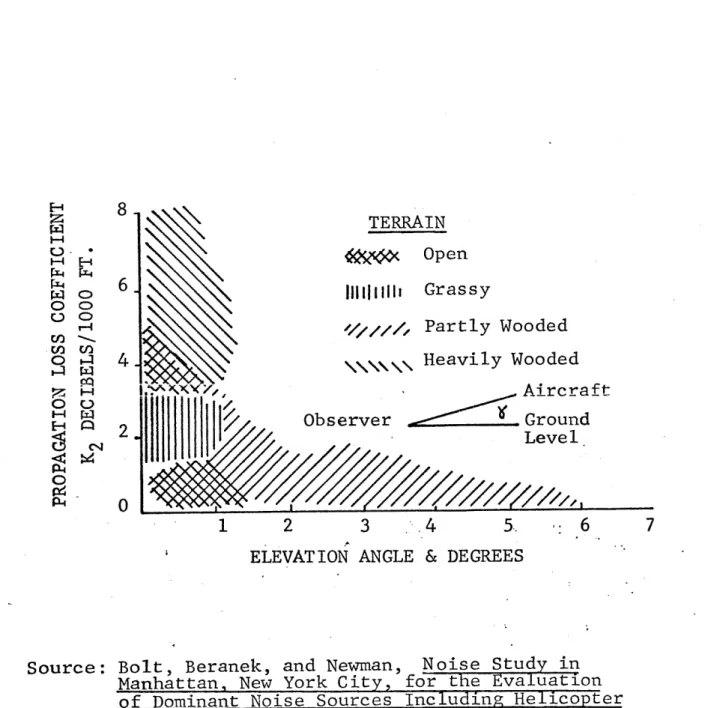
and Vicinity . . . . . . . . . . Attenuation Due to Terrain Effects
Equal Loudness Contours .. .. . Ambient and Specific Noise Levels
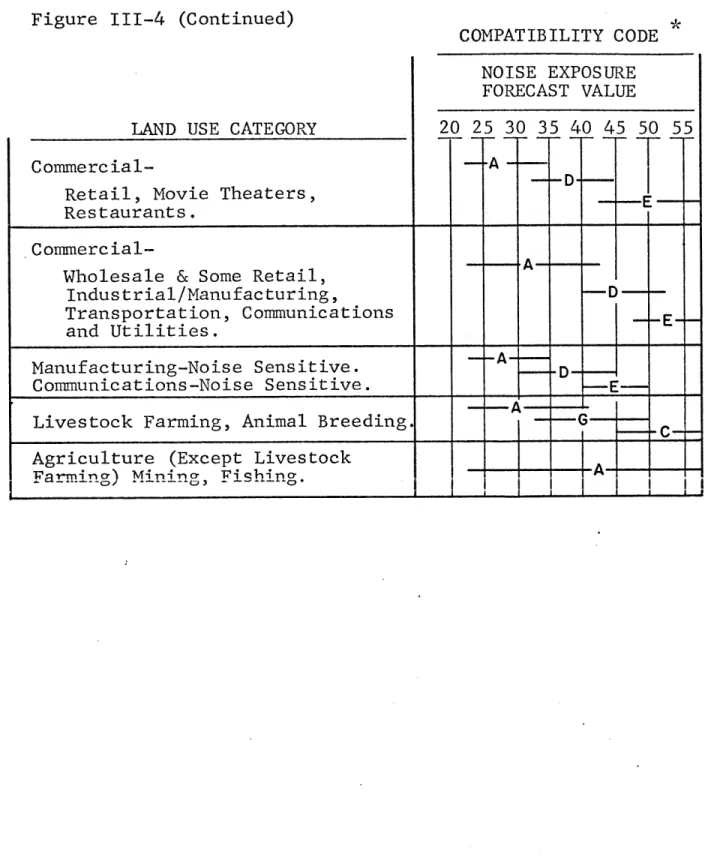
Land Use Compatibility Chart For Aircraft Noise . . . . . . . . .
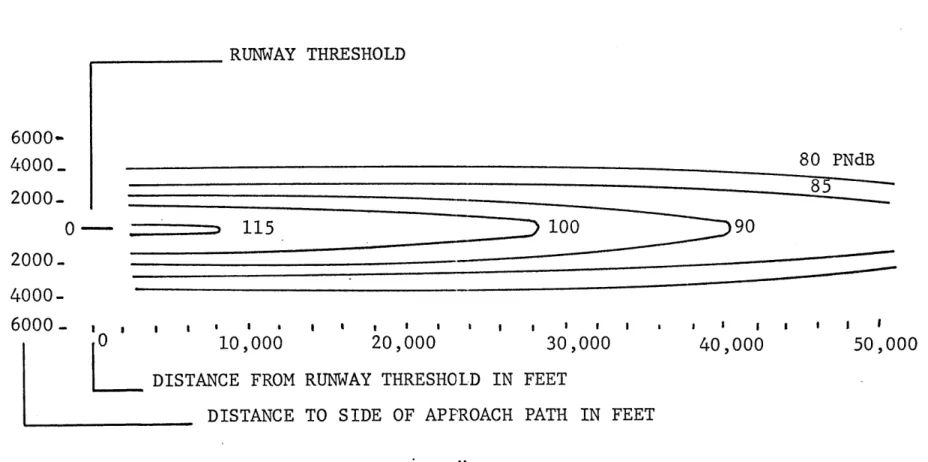
Perceived Noise Level Contours For Turbojet and Turbofan Aircraft
Landing . . .
Effect of Bypass Ratio on
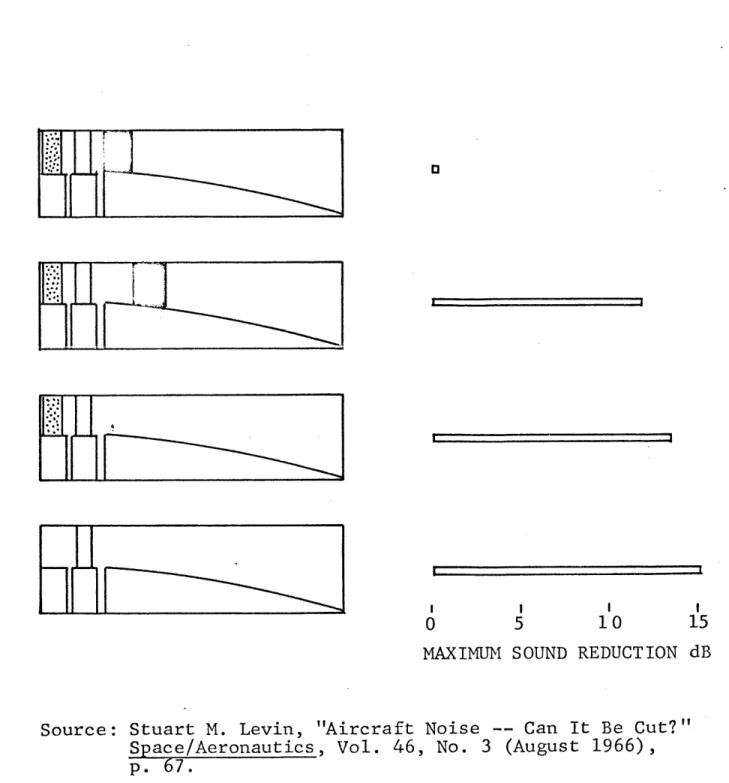
Jet Noise . . . . . . ... .. Effect of Rotor-Stator Spacing On Compressor Noise . . . . . . . Estimated Perceived Noise Level
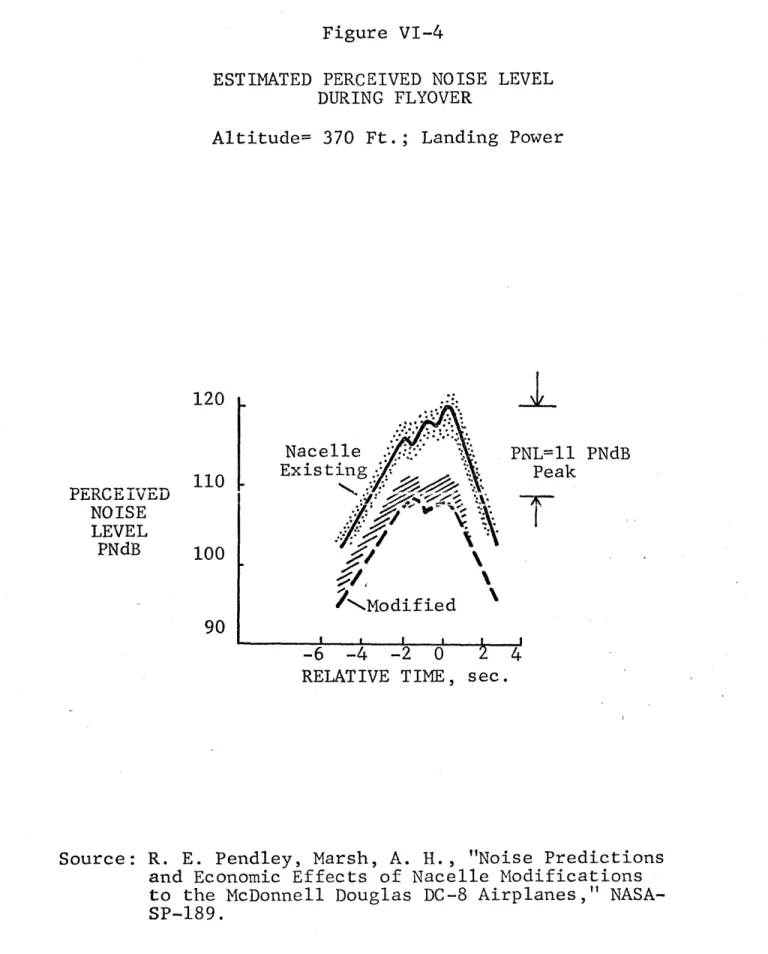
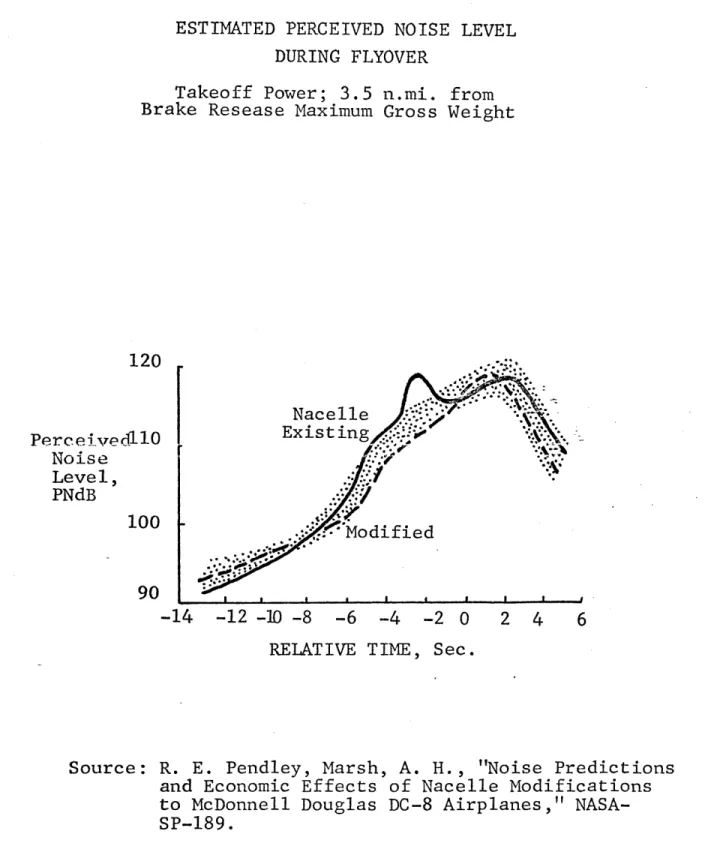
During Flyover . . . . . . . . . Estimated Perceived Noise Level During Flyover . . . . . . . . .
Estimated Perceived Noise Level Reductions Under Landing
Approach Path. . ... 177 14 8 . .63 64 65 66 67 82 83 84 85 172 173 174 175 . . 176 . .
Figure Page
VI-7 Estimated Perceived Noise Levels
Outdoors . . . . . . . . . . . . . . . . 178 VI-8 Nacelle Retrofit Schedule . . . . . . .
179 VI-9 One and Two Segment Landing Approach
Profiles . . . . . - - - -. 180 VI-10 Possible Approach Path Using Scanning
Beam Micro Wave Instrument Landing
System . . . . - - - 181 VII-1 Variations in Takeoff Sector Land
Areas Within NEF 30+ and NEF 40+
Contours With Number of Takeoffs . . . . 204
VII-2 Perceived Noise Level Contours for 80-Passenger Helicopter Based on
Current Design Practices . . . . . . . . 207 VII-3 Perceived Noise Level Contours for
80 Passenger Quiet Tilt Wing and
Quiet
Helicopter . . . . . . . . . . . . 208VII-4 Cost Penalties for Quiet VTOL
Aircraft . . . ... . . . . . . . . . . . 209
.
Table Page
III-1 Noise Compatibility Interpretations
For Use With Figure 111-4 . . . . 87
VI-1 Cost and Noise Transmission Loss. . . . . 182 VI-2 Number of People Located Within Current
and Projected Zones of High Noise
Exposure - NEF 30 . . . . . . . . . . . . 183 VI-3 Costs for Acoustic Conditioning of
Residential Structures in Three
U.S. Cities . . . . . . . . . . . . . .. 184 VI-4 Improvement Over Today's Noise Levels 185 VI-5 Summary of Major Results From the
Rohr Corporation Report . . . . . . . . . . 186 VII-1 Conventional Rail Alternatives. . . . . . 210 VII-2 Total Airbus System Investments . . . . . 211 VII-3 Airbus System Fleet Requirements. . . . . 212
A
Flight Transportation Laboratory for their advice and assist-ance throughout the preparation of this thesis.
I would also like to thank Professor Edward Allan, Professor Ralph Gagenheimer, and Mr. R. Dixon Speas for their suggestions at various points in my work; Dr. Aaron Fleisher for encouragement and advice in planning the thesis; and Dr. Robert W. Simpson whose influence is everywhere in this thesis, as it is in the laboratory he directs. With all this help, the thesis ought to be flawless, and to the extent it is not, I am to blame.
I was extremely fortunate in having Miss Candice Rive to type the several successive drafts and Mrs. Rosemary Furia to type the final manuscript.
A
No project requiring this much personal commitment is possible without full support and encouragement at home. For her continuing enthusiasm and her willingness to accept the conditions of thesis research, I am most grateful to my wife
A
Margaret.
Carl V. Robart was born in Seattle, Washington. After graduating from Washington State University in 1965 with a B.A. in Mathematics and completing the Master of Urban Plan-ning program at the University of Washington in 1967, he spent
three and one-half years at MIT, studying for a doctorate in Urban Studies and Planning. He now is Manager of Environmental and Urban Studies at R. Dixon Speas Associates in Manhasset, New York.
Mr. Robart, a member of the Tau Sigma Delta, has worked on the staff of the Flight Transportation Laboratory
at MIT, and as an Urban Planning Department Research Assistant at the University of Washington. His work has been published
'A
in the University of Washington Urban Planning/Development Series and industry publications. Mr. Robart and his wife, & 64 Margaret, have a daughter, age three.
V-4
The objective of this chapter is to introduce the specific problem to be studied in this dissertation, airport noise, to examine the status of the problem as a challenge, to environmental quality, and to use this information to frame the objective of the dissertation.
Airport Noise and Environmental Quality
It is imperative in applying technology to serve man's needs, to take into consideration the impact of the
applications on the environment. In this introductory sec-tion, the significance of noise as an adverse effect on en-vironmental quality is discussed.
The Noise Problem. Noise is everywhere, especially in urban areas. The roar of transportation, the general din and hum of construction projects, and industrial noise all pound against the ear.
In the decade of the 1960s, the President's Council on Environmental Quality reported the measured amounts and ex-tent of urban noise significantly. At the same time, public awareness of noise and the discomfort caused by it was in-creasing.
While much of the environmental noise is associated with activities which are essential to the economic vitality
of the country, the intrusion of excessive noise diminishes the quality of life and is unacceptable.
In airports and the area surrounding them, major noise problems have been created by the rapid growth of
aviation since World War II and the development of jets. Airports and The Increased Concern with Environ-mental Quality. The objective of this section is to deter-mine the significance attaching to problems of
environ-mental degradation, specifically those caused by airport noise. Federal Government action in response to environ-mental conditions is used as a measure.
Federal Government action has swelled in the past two years. The most important single action was the enact-ment of the National Environenact-mental Policy Act of 1969
(Public Law 91-190). This Act contains a declaration of national environmental policy which recognizes the import-ance of environmental quality and the government's responsi-bility to protect and improve the environment. The Act pro-vides for the Council of Environmental Quality and requires
that the policies, regulations, and public laws of the United States be interpreted and administered, in accord-ance with environmental policies and goals.
Section 102 (2), (c), of the Environmental Policy Act insures that all Federal agencies give attention and
appropriate weight to environmental goals in all their
decisions. Every airport development action potentially in-volving Federal financial aid falls within the purview of
the Environmental Act.
Another important legislative action which bears on airport development and environmental quality is the Air-port and Airway Development Act of 1970 (Public Law 91-258). In addition to providing for substantial expansion and im-provement in the nation's airport and airway system, the Act contains important environmental and planning
precondi-tions to the assistance of airport dCvclcpment projects. Sections of the Act direct that no major airport develop-ment project shall be authorized for receipt of Federal
financial aid unless:
. The project provides for the protection and enhancement of the natural resources and
the quality of the environment of the nation. . There is reasonable assurance that the
pro-ject will be located, designed, constructed, and operated so as to comply with applicable air and water quality standards.
. The interests of communities in or near which the project is proposed are considered.
Alternative actions that will minimize adverse impact have been explored and further, that the long and short-range implications to man, his physical and social surrounding, and to nature are evaluated.
The agency sponsoring the project affords the opportunity for public hearings to consider
what economic, social, and environmental effects the project may have.
Summed up, the new Federal thrust in environmental matters is that if development actions involving Federal
financial aid, including airport development, have environ-mental effects, the impacts should be explored along with
possible alternatives to the proposed actions. The strength of the Federal Government's commitment to preventing environ-mental degradation is reflected in-these two recently enacted
environmental acts and indicates the high level of signifi-cance attached to the problem.
Growing Recognition of the Airport Noise Problem
It was observed in the introductory section that de-gradation of the urban environment has resulted from many dif-ferent influences. The specific issue raised now is the pro-blem of jet aircraft noise. The objective is to assess present
this section describes the basis of the airport noise problem and comments on current alleviation efforts.
Airport noise has been a growing problem most accu-tely felt in the cities and metropolitan areas served by
large civil airports for over a decade. The problem is based on the objection of people to aircraft noise that overspills the boundaries of airports and interferes with sleep, conver-sation, teaching, recreation, and other activities.
Industrial safety standards have been set to limit noise exposure in manufacturing plants and other situations where permanent damage to hearing could occur, but
recogni-tion of noise as an environmental problem has arrived late in the country. Recently, it has been recognized that cities are confronted with serious aircraft noise problems.
Public Law 90-411 enacted in early 1969 added a new section to the Federal Aviation Act of 1958, legislating air-craft noise standards. The Act provides that:1
"The Administrator of the Federal Aviation Administration...shall prescribe...such rules and regulations as he may find nec-essary.... for the control and abatement of aircraft noise and sonic boom...."
The Federal Aviation Administration (FAA) requires that new subsonic aircraft be about ten EPNdB quieter than the loudest
jets currently flying. The maximum level for ground operation, takeoffs, and approaches is set at from 93 to 108 EPNdB, (the lower level for aircraft weighs under 75,000 pounds, the upper level for those weighing 600,000 pounds or more) -- down from. 110 to 120 decibels.
Steps are being taken to reduce aircraft noise at the source. NASA has sponsored several efforts to design, fabricate,
and test experimental techniques for quieting turbine engines. The FAA Office of Noise Abatement has investigated the economic
impact of implementing acoustically treated nacelle and duct
con-f igurations.
Growing public concern is reflected in the proliferation of associations, special study or task forces, and pressure
reaction groups concerned with noise; for example, Citizens
League Against the Sonic Boom; NOISE (National Organization to
Insure Sound-Controlled Environment), or Citizens for a Quieter New York.
These various efforts reflect a growing increase in cern and effort, but they have not yet brought the type of
con-clusive action which is needed to significantly reduce exposure
problems reached the point of widespread public response, the air transportation industry entrenched itself in heavy equip-ment investequip-ments and so committed itself to laissez-faire
rules of business that controls rigorous enough to bear on noise are constantly in danger of being compromised below the point of effective response. The time for effective action is before a problem becomes irresolvable. If aircraft noise exposure is to be controlled and even worse conditions pre-vented in the future, it is certain that a variety of decisive steps must be taken now based on available knowledge. To wait longer, is to be too late.
Objective of This Dissertation
From this examination of the airport noise problem, the need for immediate action to bring about its resolution has been identified. The objective of this dissertation is to outline and define in some specifics a systematic approach to resolving the difficult issue of airport noise.
To do this, calls first of all, for an understanding and explanation of the history of community response to air-port development and the noise buildup. It also demands per-ception of noise exposure measurement and the specific ways in which the effects of aircraft noise are felt. The first can be done by study of selected cases. The second calls for extensive investigation of noise as a physical phenomenon and environmental influence.
As with every form of environmental pollution, pre-vention or abatement of aircraft noise can be achieved only at an economic cost. Before costly actions are implemented, answers to a number of questions about noise alleviation are essential. Is there justification for expenditures to
alleviate noise? From where should the impetus to alleviate noise originate? How should the costs of noise alleviation be allocated and upon whom should they fall? The purpose of
the latter chapters of this dissertation is to answer these critical questions.
Dissertation Structure and Data Sources
This section describes the structure and data
sources of the dissertation. The dissertation is strucLured as follows: Chapter II is a resume of the history and
pre-sent status of airport-community relations developed by re-viewing circumstances at three major airports. Chapter III
examines the phenomenon of noise and how community exposure to aircraft noise is measured. In Chapter IV, some of the many ways in which noise problems have direct and indirect
effects on people, environmental quality, and civil aviation are discussed. Chapter V describes how noise reduction
programs may be evaluated. Chapter VI and Chapter VII
evaluate the means which exist to lower community noise expos-ure and conclude with an assessment of available noise alle-viation measures. Chapter VIII addresses the issues of
pollution economics and costs. Final conclusions of the dissertation are drawn in Chapter IX.
Data for this dissertation is derived from a variety of sources. Articles from technical journals; consultant reports; MIT Flight Transportation Laboratory Technical Reports; Federal Government publications (especially those of the FAA); and newspaper articles make up the bulk of sources from which information has been drawn. Extensive use was made of the Flight Transportation Laboratory Data File and the Technical Library of R. Dixon Speas Associates, Aviation Consultants. In addition, the author interviewed many airport, air carrier, and government officials charged with responsibility for airport noise problems . The author benefited from many discussions with the faculty and staff of the MIT Flight Transportation Laboratory and the
THE COMMUNITY-AIRPORT INTERFACE Introduction
Reference to the need for study of cases was made in Chapter I. Lack of documentation of airport-community rela-tions historically in a published form readily available makes
the examination of cases crucial to get a proper fit for the anticipated systematic approach to the resolution of the air-port noise problem. One objective of this chapter then is to provide needed insight into the character of the community-airport interface with specific reference to the issue of aircraft noise.
The principle that the airport noise problem should be resolved rests, in part, on the hypothesis that without' its res-olution the air transportation industry will be unsuccessful in obtaining needed community and political approval for future expansion of existing airports or development of major new facilities. The second objective of this chapter is to comment on the validity of this hypothesis.
The selection of cases for study must be made with
great care. One cannot take just any case and project the find-ings for a larger universe. Likewise, the selection of cases is limited by the mobility of the student. To be representative
of the range of metropolitan areas experiencing noise prob-lems, it is necessary that a sample be taken which covers major contingencies.
Material on three airports has been assembled to facilitate this task. The three airports selected for study are: Logan Airport in Boston, J. F. Kennedy Airport in New York, and Dulles Airport in Washington, D. C. Logan was sel-ected as an example of an airport fitting into a built-up, old, community; Dulles as an example of an airport fitting
into a development community of recent origin; and J. F. Ken-nedy Airport as an intermediate between the two. Comparisons between these three airports are possible because each
air-port serves a major metropolitan area within the same geo-graphic region, and thus, they share similar operational environments.
Airport Case Studies Boston.
1. Surroundings. General Edward Lawrence Logan In-ternational Airport ("Logan") is located adjacent to the com-munities of East Boston, Revere, and Winthrop in what were originally the northern tidal flats and shallows of Boston Harbor. The airport is well located in relation to downtown Boston, being only five-to-ten minutes from there (traffic permitting) by auto or rail. The geographic relationship bet-ween Logan, communities in the Boston area, and the harbor and ocean may be seen from the map, Figure II-1.
Today, the communities of East Boston and Winthrop, and the'portions of Revere which lie near the airport are largely residential. The 1967 "Comprehensive Land Use Inven-tory Report", by the Massachusetts Metropolitan Area Planning Council, described each municipality of the Eastern
Massachu-setts Regional Planning Project.1 "Residential Density", (number of dwelling units per acre) and the distribution of housing types (as single-family, two-family, and multi-family) were among the facts presented as averages for each entire city or town. Boston, Revere, and Winthrop were in the group having the highest density (more than eight
dwelling units per acre, average), but the distribution of housing types differed.
In the City of Boston, over 50 percent of the dwell-ing units were in multi-family structures. In both Winthrop and Revere, on the other hand, about one-half of the dwelling units were in single-family structures.
The June 1965, "Survey and Planning Application (R-101, East Boston)"' of the Boston Redevelopment Authority (BRA), for East Boston General Neighborhood Renewal Plan (GNRP), describes that part of East Boston which lies generally south
Eastern Massachusetts Regional Planning Project, Comprehensive Land Use Inventory Report, (1967).
and west of Eagle Square. This area is shown in Figure 11-2, as zones B-4, B-6, and B-7, and includes the
Jeffries Point, Maverick Square, Central Square, Eagle Hill, Day Square, and Eagle Square sections. The East Boston GNRP excludes the areas identified in Figure 11-2 as zones B-1, B-2, B-3, and B-5, which include the Bayswater Street/
Saratoga Street, the Neptune Road, and Orient Heights sec-tions, (Figure 11-3).
The BRA application described land use within the GNRP as largely multi-family residential, with industrial land use spread along the waterfront, and commercial land use mixed with both industrial and residential uses. The area
was said to be declining in population and in the number and nature of industrial and commercial activities. The popula-tion of all of East Boston declined from a peak of 64,000
in 1925 to 43,000 in 1960. Almost 10,000 persons left the GNRP area in the decade between 1950 and 1960, a 19 percent loss compared to 13 percent for Boston as a whole. However, the resident population was fairly stable with two-thirds of the population of the GNRP area remaining at the same residence during the period 1955-60, compared to a city-wide average of only 51 percent for the same period (U.S. Census Bureau data).
In 1960 in the GNRP area there were 9,820 dwelling units in 3,880 structures, of which 97 percent were judged by the BRA
2 Boston Redevelopment Authority, Survey and Plan-ning Application, No. R-101, East Boston (Boston: The Authority, June 1965). (Mimeographed).
as "deficient" in one or more respects. Single-family hous-ing, comprising only 6.7 percent of the total in the GNRP area, had in 1960 a median value of $7,700, as compared to an aver-age of $13,500 for all of Boston. Most of the housing con-tained two, three, or four units and were of frame, or frame and brick veneer, construction, ranging in height from two to four stories.
Growth of commercial and industrial activities rela-ted to the airport has been slight. Demand for vacant land near the airport has been virtually nonexistent. Attempts in 1964 to auction city-owned land along the East Boston water-front were unsuccessful.4 Two facts help explain these cir-cumstances. First, as a result of the community's close
association with transportation facilities -- even before the
airport,
East
Boston was the locus of transportation facili-ties -- it has taken much of its character from these instal-lations. The waterfront has been in decline for many years. Large areas in some sections which once bustled with activity are now vacant. On balance, the surrounding environment, marked by blight and deterioration has effectively curtailed development. Second, the proximity of the airport to downtownBoston Redevelopment Authority, East Boston General Neighborhood Renewal Plan, No. R-44, East Boston
(Boston:The Authority, May 1965). (Mimeographed). Public Auction, held 30 June 1964, of 260,381 square feet of land on New Street, East Boston.
Boston has mitigated against the construction of hotels, con-vention facilities, and other such uses to be found around
similarly sized airports elsewhere that are more remotely located.
Over the longer term, expected increases in the air transportation of people and goods should create a demand for airport-oriented uses. Requests made recently to the BRA for zoning variances and building permit applications suggest this to be true. Plans for several new hotels are indicated.
2. Airport Development. Logan Airport constitutes the largest external influence on the East Boston area. When acquired by the Commonwealth of Massachusetts in 1890, the future airport sitC was a tidal flat. Originally the land was intended for expansion of wharf and industrial facilities on the waterfront. More tidal flats were acquired in 1913. Bulk-heads were built around them and the.process of reclaiming the land from the sea was started by hydraulic dredging. Plans for several piers to be constructed in the area were set aside
during World War I. The war indicated the potential of powered flight and the need for aviation facilities to serve the area became apparent. The Commonwealth decided to convert the fil-led land into an airfield.
The airport was a cinder plot of 189 acres when it was dedicated on September 9, 1923. At first, the airport had two runways, each 1,500 feet long. Now the airport has five, the
shortest of which is used exclusively by general aviation air-craft. The longest runway is slightly more than 10,000 feet long. The field has been enlarged by filling to 2,200 acres. Responsibility for the operation and development of Logan Air-port was transferred from the Commonwealth to the Massachusetts Port Authority (MPA) on 7 February 1959.
3. Community Interface. Utilization of over-water ap-proach and departure paths helps to minimize community noise ex-posure. Runway 33 approaches (or the reverse, Runway 15 de-partures) over the water, are thus to be preferred. Unfortu-nately, this creates a simultaneous requirement for takeoffs
(or landings) over East Boston. This same problem exists for all runways. From a community noise standpoint, there are sev-eral such good-bad combinations, but no good-good combinations
available.
Noise abatement operating instructions exist for Logan Airport. Mainly these instructions seek to eliminate
over-flights in the Bayswater/Saratoga area of East Boston by giving lowest priority to Runway 22L landings and Runway 4R takeoffs. A left turn after takeoff from Runway 22R is specified for the
purpose of reducing noise in the City Point section of South Boston.
Noise abatement procedures not withstanding, East Bos-ton residents view the airport with both fear and hatred. Air-plane noises are evident in all parts of the community and are severe under the approach zones. These disturbances are
irritants to people and reduce the attractiveness of the commu-nity as a place of residence. A second factor agitating
resi-dents is airport expansion. The resiresi-dents feel that expansion of the facilities is gradually devouring the community. The tidal flats, park areas, and beaches along the eastern shore were once accessible to East Boston residents, but today they have been
filled in and taken over for airport use. For example, Bird
Island Flats are being filled out for the lengthening of two run-ways. The proposed extension of Runway 15R-33L involves the
taking of Memorial Park, while another project requires the tak-ing of Amerina playground. Still a third factor has been the taking of houses -- a development which heightens community agi-tation and splinters neighborhood ties. Safety is another fac-tor. The presence of oil farms on Chelsea Creek, about one
mile from the end of the runway, causes apprehension on the part of nearby residents.
4. Airport Expansion Plans. During the latter half of the 1960s, Massport attempted to obtain public approval for plans to build a regional major airport in the Boston area. As the
search for a site progressed, political opposition and public disenchantment with the proposal increased. As a result of this opposition and an awareness that PONYA had been unsuccessful in obtaining approval for anyone of the more than twenty sites con-sidered as the location of a fourth jetport for the New York region during a decade of searching, Massport in 1970
abandoned plans to build a second major airport in the Boston area. Attention was refocused on the alternative of enlarging Logan Airport.
A request for Federal financial assistance was sub-mitted under the Airport and Airways Development Act of 1970
for a project to expand Logan by adding parallel Runway 15L-33R, extensions to Runways 4L and 9, and STOL Runway 15-33 to the airport. Parts of three separate pieces of legislation, and the policies and procedures adopted to implement them, have environmental implications for airport development and required MPA to give careful consideration to a broad spectrum of
environ-5 mental issucs
5 The most relevant provisions are Section 4(f) of the Department of Transportation Act of 1966, Section 102(2)(C) of the National Environmental Policy Act of 1969, and Sections 16(c)(4), 16(d), and 16(e) of the Airport and Airway Development Act of 1970. Under Section 4(f) of the DOT Act,
it must be certified that there has been- all possible planning to minimize harm to valuable public lands. Section 102(2)(C) of the National Environmental Policy Act is designated to ensure that environmental considerations are given careful attention and appropriate weight in all decisions of the Federal Government. Specifically, this
section requires the submission of an environmental impact statement giving consideration to adverse environmental impacts, alternatives to the
pro-posed action, and any irreversable commitments of resources that might be involved. Section 16(c)(4) of the Airport and Airway Development Act directs
The Massachusetts Port Authority engaged several con-sultants to document the need for airfield improvements at Logan Airport, to develop the best means of meeting that need,
and to evaluate the environmental effect that would result. The findings and conclusions of the Port Authority and its
con-sultants are summarized in the "Boston-Logan Environmental Statement.", dated February 24, 1971.6
that no major airport development project shall be authorized for receipt of Federal financial aid unless that project provides for the pro-tection and enhancement of the natural resources
and the quality of the environment of the Nation; and further, that no project found to have an
adverse effect shall be authorized unless the Secretary finds in writing, after full and
com-plete review, that no feasible and prudent alternative exists and that all possible steps have been taken to minimize such adverse effect. -Section 16(d) establishes a requirement for
public hearings for consideration of economic, social and environmental effects of airport projects, and for certain other purposes, and Section 16(e) establishes criteria and procedures for protection of air and water quality in
connection with airport development.
6 Massachusetts Port Authority, Boston-Logan Environ-mental Statement (Boston, Massachusetts: Massachu-setts Port Authority, 24 February 1971).
According to the statement: 7
". ...the new runway is of highest priority and is urgently needed if Logan is to adequately serve the expanding air transportation require-ments of the region."
Traffic demand forecases indicate that air traffic volumes will exceed the rate annual capacity of the airport
before 1975. Since the addition of Runway 15L-33R would in-crease airfield capacity from its existing level of 368,000 annual movements to 417,000 annual movements, a continuation of adequate air service would be assured.
The Port Authority argues in this statement that operational flexibility of Logan's runway system is severely limited in comparison with other major airports by two
principal factors:
(1) only one set of parallel runways is availa-ble, and
(2) this single set of parallels is only par-tially useful for simultaneous operations due to noise abatement restrictions on heavy aircraft takeoffs to the northeast
and landings to the southwest (Runway 4L-22R).
Also, according to the environmental statement, "orienta-tion of the parallels to minimize community noise does not per-mit over-water approaches and departures.8 As evident from the
discussion in the foregoing section, heavily populated communi-ties are effected by the use of the existing parallel runway sys-tem.
"A second parallel runway system," states the Port Auth-ority, "(will) provide overall noise relief through added flexi-bility of choice in operational runway use and an orientation
permitting maximum utilization of over-water approaches and departures. Addition of the new parallel Runway 15L-33R will best satisfy these requirements while providing a runway with
approaches further removed from residential area." 9 Improved instrument landing capability and improved safety are also sug-gested by the Port Authority as justification for the project.
The remainder of the environmental impact statement mainly speaks to the probable impact this construction and subsequent
8 Ibid. p. 5.
airport operations will have on the natural environment and human living conditions in the vicinity of the airport.
To implement the project, a permit application was made to the U.S. Army Corps of Engineers. The work included dredging, construction of earth and stone dikes, slope protection and
drainage appurtenances in three areas contiguous to the existing airport.
As required by Section 102(2)(C) of the National Environ-mental Policy Act a public hearing was held by the U.S. Army Corps of Engineers on February 26, 1971 to consider the permit
applica-tion by the MPA for dike and land fill construcapplica-tion required by the project. Opposition to the project was strongly expressed by both public officials and private citizens. Senator Edward
Kennedy, for example, appeared to speak in opposition to the
project basing his opinion on the project's adverse environmental impact.
As a result of the first public hearing, it became evident that further environmental studies, substantially expanded in
depth and scope, would be necessary to answer the questions raised at the hearing. The objectives of this work, as spelled out in the Port Authority's Work Statement of April 16, 1971, were to
develop "appropriate supporting analyses demonstrating that: 0 . The plans for improvement of Boston-Logan have been
thoroughly reviewed to identify any features of those plans that produce or will produce a significant effect on the environment surrounding the airport.
Of the various practical alternative courses for im-provement of the airport, the preferred alternative represents the best course of action from the stand-point of the effect on the environment, safety, capa-city and costs.
. All reasonable steps have been taken to mitigate un-desirable environmental effects of the airport dv-elopment that cannot be avoided,
The consultant's report presenting the findings, with supporting analyses, of their comprehensive study of the pro-posed Boston-Logan construction program and its environmental consequences was finished in late May 1971.11
10 Massachusetts Port Authority, Work Statement, Environmental Impact Study, Boston-Logan
Tnternational Airport (Boston, Massachusetts: The Massachusetts Port Authority, 16 April 1971)
pp. 2-3. (Mimeographed).
Landrum and Brown, Inc., Boston-Logan Interna-tional Airport Environmental Impact Study,
Vol. 1 (Boston, Massachusetts: The Massachusetts Port Authority, May 1971).
Portions of the exhaustive study, issued in two volumes and
containing many hundreds of pages, addressed issues of air traf-fic demand, airport capacity, noise, biology, water, air pollu-tion, and economic impact. The combined efforts of six
consult-ing firms contributed to the final documents.
In general, the report favors the expansion of Logan Airport. After summarizing the main findings of the report, Landrum and Brown, Inc., principal consultants to the Port
Authority, conclude: "we highly recommend that Massport continue its efforts to improve the existing airport as planned. (As) our report shows, the improved airport presents the best opportunity
to realize a reduction of current social impacts. This better-ment is a result of noise and air pollution control provided only by the new runway without sacrificing economic benefits to
the entire community." 1 2
A public hearing to discuss the results of the study was scheduled for Saturday, July 10, 1971.
On Thursday, July 8, 1971, Francis Sargent, Governor of the Commonwealth of Massachusetts, addressed a regional meeting of the Metropolitan Area Planning Council.13 In his address,
12 Ibid. p.2 .
13 Opinion expressed by Massachusetts Governor Francis
W. Sargent in an address ("The Crisis in Transportation") at a regional meeting of the (Boston) Metropolitan Area Planning Council, 7 July 1971.
dealing with what he termed the "crisis in transportation", Governor Sargent strongly opposed the new runway. The Governor cited as reasons for his opposition: cost, demonstrable failure to meet its (i.e., MPA's) own goals, disruption of present air-port operation and an undeniable increase in airair-port noise im-pact, especially during the four-year construction period.
Following the Governor's speech, the Port Authority cancelled the impending public hearing.
The Massachusetts Port Authority has not made clear what actions it will take in the future. In his speech, the
Governor did not completely rule out the possibility of ex-14
panding Logan Airport. He said:
"I favor a proposed federal review of the noise impact of such a runway because there are those who contend
it can be proven to be not the liability to the en-vironment that today it appears to be, but actually an asset in that its location would not worsen but actually improve noise level problems plaguing the area today. Perhaps. That case is not proven today,
certainly -- but let further study go forward. This
must be very clear, however: the burden of proof rests with those who favor the expansion of the air-port, not those who oppose it.
Whether or not a case will or can be made for runway construction that is capable of winning public support for
expansion of Logan Airport, given the existing political climate, is doubtful.
New York.
1. Surroundings. John F. Kennedy International Air-port, "Kennedy", is a major international gateway to the United States. It is located in the southeastern section of
the Borough of Queens on Jamaica Bay, approximately fifteen highway miles from 42nd. Street, in midtown Manhattan. In
addition to the international air service, Kennedy also pro-vides extensive medium and long-haul domestic air service. Furthermore, Kennedy Airport also contains the nation's
largest air cargo center.
In close proximity to the airport are sections of Brooklyn, Queens, and the Town of Hempstead in Nassau County. Brooklyn is New York's largest Borough. The population of Brooklyn is about 2.6 million with a density of approxi-mately 33,000 people per square mile and in some areas.up
to 125,000 per square mile.' 5 The population of Queens is near two million. Queens is the only one of the four major
boroughs whose population increased during the last decade
--by 8.5 percent. The overall density of Queens is less than 18,000 per square mile, approximately that of Boston, but cer-tain areas have a density of 80,000 per square mile. Its resi-dential character and high-income per capita, as compared with the overall average of New York, are characteristics shared by neighboring Nassau County.
15 National Academy of Sciences, Jamaica Bay and Kennedy Airport: A Multidisciplinary Environ-mental
Study,
vol, 2, p. 45.Much of central Brooklyn is overcrowded and deter-iorating. Its population lacks job opportunities, recrea-tional facilities, and decent and safe housing. Parts of cen-tral Queens share these shortcomings. "Partly as a result of this", concludes the National Academy of Sciences in its study of Jamaica Bay and Kennedy Airport, "the development of the
areas on the periphery of Jamaica Bay has been accelerating. in the last twenty years, despite nuisances, such as the noise of the airport, the pollution of the water and the air, and relatively poor access."16 The major new use of the Bayshore area has been low-density housing.
At the present time, about 700,000 people live in areas near Kennedy Airport that are subject to high-noise ex-posure. About 120,000 of them live in homes subject to an exposure which should be considered tolerable only for commer-cial usage in which noise-proofed buildings are used. These
large numbers of noise-impacted residents are a result of two factors: the increasing population density in areas sur-rounding the airport, resulting from housing construction, and the increasing area subject to high-noise levels, caused by more and noisier aircraft operations.
2. Airport Development. Idlewild International, as Ken-nedy Airport was originally called, opened 31 July 1948. The
first years of operation were slow because Newark and LaGuardia 16 Ibid., p. 48.
Airports still claimed most of the attention of the commercial airlines. During the first five years of operation, activity
gradually shifted to the field. In the last five months of
-* 1948 there were 5,923 plane movements, by 1952 there were 105,205. 7 The Port of New York Authority (PONYA) operates Kennedy Airport under a 50-year lease, signed with New York City, June 1, 1947. The field was originally planned to cov'er only 1,100 acres. Mid-1953 found the field occupying 4,900 acres and operating five runways varying from 6,000 feet to nearly two miles in length.
Less than a year later, a New York Times survey of 18 facilities found the field not ready for jet transports. The greatest problems cited were long distance from downtown busi-ness areas, inadequate terminals, awkward handling of passen-gers and baggage, and weather delays. Inability to foresee air transport growth and unwillingness of proper agencies to provide funds were held to be the major causes. Passenger
traffic was reported up six-fold since 1944 but the field's capacities had only doubled. The Times' synopsis saw a
con-tinued facilities lag curbing industry growth.
Sensitive to these problems, in early 1955 PONYA an-nounced plans for a multi-million dollar airport city to rise
17 New York Times, July 31, 1953, p. 21, col. 1. 18 Ibid., May 24, 1954, p. 18, col. 1.
on the framework of Idlewild over the next five years. 9 As a first step, $60 million would be spent to develop a modern passenger terminal facility. Airline housing would be dis-persed over a 655-acre landscaped oval instead of being in one terminal. Main developments included a three-story inter-national arrivals building with flanking wing buildings for
foreign lines and seven terminals for U. S. lines. Austin J. Tobin, PONYA Executive Director stressed that the design pro-vided flexibility, versatility, expansibility, and
adapta-bility and that there would be no conflict between the flow of baggage, freight, mail and apron services.
3. Introduction of Jet Aircraft: PONYA Meets the Com-munity. The history of the introduction of civilian
jet-powered aircraft at Kennedy Airport perhaps more than any other issue, describes the character of the interface between this airport and the surrounding communities. The issue arose in 1955 when PONYA refused to allow a British Comet II jet-liner to land at Idlewild. 20 This action was held consistent with their policy established in 1951 which forbad jet
opera-tions at Authority airports until their noise could be re-duced.
19 Ibid., February 21, 1955, p. 1, col. 3.
The issue assumed major proportions as the Boeing Company prepared the first of its 707 aircraft for delivery.
The Port of New York Authority continued to bar jet landings because of noise after attending Boeing 707 demonstrations in Seattle. John Wiley, PONYA Aviation Director, was re-ported to have stated: "Jet transport operations of the 707 type could not be conducted at Idlewild, LaGuardia, or
Newark while the (aircraft's) present external noise charac-teristics remain unsupressed."2 1
Later, Mr. Wiley defended the ban in a speech say-ing it spurred companies to develop noise suppressors.
PONYA cranted landing rights to the French-built Caravelle jet in April 1957 after it passed noise tests.2 2 Summer 1958, The Port of New York Authority granted Pan American permission to operate the Boeing 707-120 on trial
runs, assured by consultant's reports that noise would be tolerable.2 3 It also scheduled noise tests for the Comet IV. In October, PONYA announced its decision to permit jet operations at Idlewild but imposed strict rules on minimum altitude, runways to be used, and hours of operation.24
-21 Ibid., March 8, 1957, p. 48, col. 6. 22 Ibid., April 13, 1957, p. 48, col. 1. 23 Ibid., July 17, 1958, p. 53, col. 1. 24 Ibid., October 4, 1958, p. 1, col. 1.
In August the next year, Queens political and civic leaders held a conference with aviation officials on
in-25
creasing publiccomplaints on jet noise. They agreed that the problem had intensified in recent months and an
in-creasing number of complaints had been made by borough resi-dents.
The Borough President threatened to close the air-port by beginning a sewer repair project that would block access to the airport. An official of the Queens Federa-tion of Civic Councils warned that neighboring residents around the airport had "had it" and wanted immediate action to reduce noise.
The Queens Borough President and other civic.
leaders appealed to New York Congressional members to curb noise at Idlewild. Representative Emanual Cellers agreed
to write a letter to the FAA asking for action. The letter planned to force the FAA Administrator to say whether his agency had authority to curb airliner noise. In Septem-ber, 1959, public hearings on aircraft noise were held.2 6
25 Ibid., August 18, 1959, p. 58, col. 6. 26 Ibid., September 8, 1959, p. 37, col. 8.
A Congressional Representative presided. Queens and Nassau residents and Representatives attended. The chairman read a letter from the FAA Administrator which claimed FAA juri-sdiction over the noise problem but said the agency would not act at present waiting for the outcome of studies.
After failing to receive an answer to his September 21 letter to the FAA Administrator asking when action from the FAA could be expected, the Queens Borough President appealed to President Eisenhower.27 In late November, he asked that the FAA be directed to set up anti-noise rules at Idlewild. "The President," said the Times, "had been ad-vised of the Administrator's earlier advisory to the Borough
President that his agency had jurisdiction over noise from planes."
On February 11, 1960, PONYA announced plans to allot $9,700,000 to add 4,150 feet to northeast-southeast oriented Runway 4L-22R.2 8 The new length would be the minimum desira-ble for heavy jets and would make takeoffs to the northeast possible under highly restrictive conditions. This would
send planes over the populated areas of central and southern Queens; however, the greater length would enable planes to
gain altitude more quickly and would mean no increase in noise levels. Also the extension would permit greater use of the
27 Ibid., November 22, 1959, p. 88, col. 3. 28 Ibid., February 11, 1960, p. 29, col. 6.
runway under adverse wind conditions for over-water takeoffs. The Port of New York Authority also planned an extension of Runway 13R-31L by 1,400 feet to minimize noise in areas to
the west and east of the airport.
In May, the FAA proposed the first fully enforceable rules to lessen aircraft noise in the New York area. 29 They. compelled jets using Idlewild to select runways headed away from nearby communities whenever possible. PONYA immediately announced that while the FAA move was encouraging the speci-fic rules were inadequate. They did not fix a maximum noise level that a community would have to tolerate and they did not impose stricter rules for nighttime sleeping hours than
for daytime.
The Port of New York Authority continued to turb night jet takeoffs and noise levels even though no mention was made in the new FAA rules. In October, the Authority
sought an injunction against Delta for jet noise violations. Prospects for a court test of PONYA's legal right to set noise rules dimmed when Delta secured a delay in replying to the Authority complaint. The extension was granted on Delta's
29 Ibid., May 12, 1960, p. 29, col. 1. 30 Ibid., October 27, 1960, p. 39, col. 3.
assurance that, given time, it could demonstrate its ability and willingness to comply with the rules. Observers antici-pated that if Delta's performance satisfied the Authority the court action would be stopped.
There was disappointment that a court test of PONYA's legal right to establish rules for aircraft operations would not materialize. "At least one major airline," reported the Times, believed the Authority was way out of bounds in
asserting the right to impose such rules."3 1 It thought the right was reserved to the FAA. This airline was pro-bably not alone. Nevertheless, no one had been willing to challenge PONYA. Most of the 27 airlines operating jets
at Idlewild had gone along with the anti-noise rules, whether or not they deemed them legal, at least to the extent nec-essary to avoid court action. The FAA also avoided'challen-ging the legality of the Authority's rules.
During the summer of 1962, flight patterns were shifted in an effort to cut noise.32 Planes that had been turning left to approach Runways 13L or 31L, among the most used runways, began to turn right. The old left-turn pattern
31 Ibid., November 9, 1960, p. 70, col. 5. 32 Ibid., August 18, 1962, p. 21, col. 7.