HAL Id: halshs-01091477
https://halshs.archives-ouvertes.fr/halshs-01091477v3
Submitted on 5 Feb 2015
HAL is a multi-disciplinary open access
archive for the deposit and dissemination of
sci-entific research documents, whether they are
pub-lished or not. The documents may come from
teaching and research institutions in France or
abroad, or from public or private research centers.
L’archive ouverte pluridisciplinaire HAL, est
destinée au dépôt et à la diffusion de documents
scientifiques de niveau recherche, publiés ou non,
émanant des établissements d’enseignement et de
recherche français ou étrangers, des laboratoires
publics ou privés.
recommendations
Alexis Michaud, Jacqueline Vaissière
To cite this version:
Alexis Michaud, Jacqueline Vaissière. Tone and intonation: introductory notes and practical
recom-mendations. KALIPHO - Kieler Arbeiten zur Linguistik und Phonetik, Institut für Skandinavistik,
Frisistik und Allgemeine Sprachwissenschaft (ISFAS) Abt. Allgemeine Sprachwissenschaft Christian
- Albrechts - Universität zu Kiel, 2015, Special Issue: ”Theoretical and empirical foundations of
ex-perimental phonetics”, 3, pp.43-80. �halshs-01091477v3�
43
2
Tone and Intonation – Introductory
Notes and Practical Recommendations
Alexis Michaud
International Research Institute MICA
Hanoi University of Science and Technology, CNRS, Grenoble INP, Vietnam
Langues et Civilisations à Tradition Orale, CNRS/Sorbonne Nouvelle, France
[email protected]
Jacqueline Vaissière
Laboratoire de Phonétique et Phonologie
Université Paris 3 - Sorbonne Nouvelle, CNRS, Paris
[email protected]
The present article aims to propose a simple introduction to the topics of
(i) lexical tone, (ii) intonation, and (iii) tone-intonation interactions, with
practical recommendations for students. It builds on the authors’ observations
on various languages, tonal and non-tonal; much of the evidence reviewed
concerns tonal languages of Asia. With a view to providing beginners with an
adequate methodological apparatus for studying tone and intonation, the
present notes emphasize two salient dimensions of linguistic diversity. The
first is the nature of the lexical tones: we review the classical distinction
between (i) contour tones that can be analyzed into sequences of level tones,
and (ii) contour tones that are non-decomposable (phonetically complex). A
second dimension of diversity is the presence or absence of intonational tones:
tones of intonational origin that are formally identical with lexical (and
morphological) tones.
1. Introduction
There are many brilliant publications on methodological issues relating to prosody. Strongly recommended readings include Volume 8 of the journal “Language Documentation and Conservation” (2014), which contains high-level introductions to the study of tone systems (“How to Study a Tone Language” article series, edited by Steven Bird and Larry Hyman). Concerning intonation, suggested places to start und Allgemeine Sprachwissenschaft (ISFAS), Christian-Albrechts-Universität zu Kiel
include the textbooks by Cruttenden (1986) and Hirst and Di Cristo (1998). But we feel that there is still room for a beginner-friendly introduction to the topics of (i) lexical tone, (ii) intonation, and (iii) tone-intonation interactions. The aim of the present notes is to provide beginners with an adequate methodological apparatus for studying tone and intonation, and to offer practical recommendations for engaging in research on these topics.
In particular, we wish to convey to students a sense of two salient dimensions of linguistic diversity. The first is the nature of the lexical tones. Section 2 reviews the classical distinction between (i) contour tones that can be analyzed into sequences of level tones, and (ii) contour tones that are non-decomposable (phonetically complex). A second dimension of diversity is the presence or absence of intonational tones: tones of intonational origin that are formally identical with lexical (and morphological) tones; section 3 examines the issue to what extent the various components of a language’s intonation are structured in tonal terms. Many examples come from the languages with which the authors have greatest familiarity, but the aim is to clarify a few basic distinctions which we think allow for a clear view of prosodic phenomena in tonal and non-tonal languages alike.
2. Complex tones and level tones
2.1 A synchronic view
2.1.1 Fundamental notions: level tones and decomposable contours
The notions of “level tone” and “contour tone” are used in two different ways. Let us first introduce what can be broadly termed as “Africanist” usage, in which “level tone” refers to a tone that is defined simply by a discrete level of relative pitch.
Level-tone systems have two to five levels of relative pitch: L(ow) vs. H(igh); L vs. M(id) vs. H; L vs. M vs. H vs T(op); or B(ottom) vs. L vs. M vs. H vs. T. Systems with two levels are most widespread; systems with more than three levels are relatively uncommon (Bariba: Welmers 1952; Bench, a.k.a. Gimira: Wedekind 1983, 1985). One single case of six-level system has been reported: Chori (Dihoff 1977), for which reanalysis as a five-level system is possible (Odden 1995). These languages are spoken in Subsaharan Africa, a domain where level tones are especially common. However, level-tone representations have proved useful beyond the Subsaharan domain, for which they were initially developed.1
In level-tone systems, a phonetic contour results from the combination of two or more level tones: typically, a LH sequence realized phonetically as a rise in F0, or a HL
sequence realized as a fall. The contours are phonologically decomposable; the
observed movement in F0 is the result of interpolation between the successive
levels. For instance, in Yongning Na (Sino-Tibetan), which has three level tones,
1On languages of the Americas: Gomez-Imbert 2001; Hargus and Rice 2005; Girón
Higuita and Wetzels 2007; Michael 2010; on languages of Asia: Ding 2001; Hyman and VanBik 2002, 2004; Donohue 2003, 2005; Evans 2008; Jacques 2011.
H(igh), M(id) and L(ow), the compound noun /bo˩-ɬv˧˥/ ‘pig’s brains’ in association with the copula /ɲi˩/ yields /bo˩-ɬv˧ ɲi˥/ ‘is (a/the) pig’s brains’: the rising contour present on ‘pig’s brains’ in isolation unfolds as M+H over the two syllables.
2.1.2. Notes on the phonetic realization of level tones
After phonological facts have been established through listening, practising and developing a feel for the language, it is revealing to explore phonetic detail in the realization of the tones. For instance, Figure 1 shows one token of /bo˩-ɬv˧˥/ ‘pig’s brains’ and /bo˩-ɬv˧ ɲi˥/ ‘is (a/the) pig’s brains’, from a set of recordings of compound nouns in Yongning Na.2
Figure 1. Spectrogram and F0 tracing of two Na phrases. The time scale of both
spectrograms is the same (70 centiseconds).
2 The entire data set is available online from the Pangloss Collection (Michailovsky et
al. 2014); direct link: http://lacito.vjf.cnrs.fr/pangloss/languages/Na_en.htm For more information on the tone system of Yongning Na, see Michaud (2008, 2013).
0 8000 Scale of spectrogram (Hz) 100 150 200 250 300 F0 (Hz) b o L ì v MH 0 8000 100 150 200 250 300 F0 (Hz) b o L ì v M ñ i H 70 cs 0
The clear rise in F0 on the rhyme /v/ in the top part of the figure is consistent with
phonological description as a MH tone; and the flatter shape on that same rhyme in the bottom part of the figure, followed by higher F0 on the copula, is consistent with
phonological description as a sequence of M on one syllable and H on the next. On the other hand, a fundamental point is that there is no way to read phonological
tones off F0 tracings (as emphasized e.g. by Cruz and Woodbury 2014 and Morey
2014). Figure 1, like any piece of experimental evidence, illustrates variability in the realization of tone. For instance, glottalization is found at the end of both tokens, exerting a detectable (lowering) influence on F0 towards the offset of voicing: /bo˩-ɬv˧˥/
‘pig’s brains’ and /bo˩-ɬv˧ ɲi˥/ ‘is (a/the) pig’s brains’ are both found in absolute final position (constituting entire sentences on their own), and glottalization is common in Na at this juncture of an utterance. Also, /bo˩/ ‘pig’ is realized with noticeably different F0 in the top part of the figure and in the bottom part. Tonal realizations have some
range of variation within tonal space (F0), like vowels have some range of variation
within the acoustic space (as characterized essentially by the first three formants, F1-F2-F3). The linguistic comment that can be proposed about the slight initial rise in the realization of the L tone of /bo˩/ ‘pig’ in the top part of Figure 1 is based on a phonological observation: in Na, rising tones are never found in initial position within a tone group (phonological phrase), and hence the identification of an initial L tone is not jeopardized by its realization with a slight rise as in the top part of Figure 1. Seen in this light, the existence of slightly rising ‘allotones’ does not come as a surprise: it makes sense in view of the phonological system – in the same way as, in a language that does not have contrastive aspirated consonants, plain (unaspirated) unvoiced consonants may sometimes be realized phonetically with some aspiration.
Back in the 1970s, at a time when F0 tracings were difficult to obtain – requiring
help from a specialized engineer –, a specialist of Bantu tone asked the second author of this paper to create an F0 tracing from a recording illustrating a specific phonological
phenomenon. After receiving the desired tracing, this famous specialist of tonology said that there must be a mistake, as the F0 tracing did not correspond to the tone pattern that
his trained ear discerned clearly in the recording. In fact, there was no error in F0
detection; the issue lay in this colleague’s expectation of a neatly binary F0 tracing,
straightforwardly reflecting the sequence of H and L tones. Experimental examination
of spoken language reveals that, even in languages with relatively straightforward prosodic systems, such as Standard Japanese, F0 curves are shaped by a number of
factors, and do not reflect phonological tone in a crystal-clear, transparent way.
(For auditory observations on phonetic realizations of tone in a two-tone language, see e.g. Guthrie 1940.)
2.1.3. Another fundamental notion: unitary contours
An important complement to the above discussion of “levels” and “contours” (2.1.1) is that there exist tone systems where contours are not phonologically decomposable. The use of the term “contour tone” to refer to a unitarycontour is sometimes referred to as an “Asianist” use of terms, because of the wealth of well-documented examples from East and Southeast Asia. A contour tone in the Asianist sense is a tone defined
phonologically in terms of an overall template specifying the time course of F0 over
the tone-bearing unit.
The two types of phonological contour tones – sequences of levels on the one hand, unitary contours on the other – can be phonetically indistinguishable. The
evidence for distinguishing the two types of contours is morpho-phonological.
In many languages, there is a wealth of evidence for the analysis of contour tones into sequences of level tones. A rising contour in an African language will
typically exhibit phonological behaviour showing that it consists of two levels: a low tone followed by a high tone (see in particular Clements and Goldsmith 1984; Clements and Rialland 2007). An example from Yongning Na (a language of China) was presented in paragraph 2.1.1. There are some languages for which attempts at the decomposition of contours into levels has been less successful, however, to the point of casting doubt on the relevance of decomposition for these languages. The discussion below will focus on tonal systems of East and Southeast Asia.
Chao Yuen-ren’s work on Mandarin Chinese in the early 20th century (Chao
Yuen-ren 1929, 1933) brought to the attention of linguists the complexities of its tone system. Following sustained exchanges with Chao Yuen-ren, Kenneth Pike proposed a typological divide between two types of tones: (i) register-tones, defined simply in terms of discrete pitch levels, and (ii) contour-tones, about which he concludes: “the glides of a contour system must be treated as unitary tonemes and cannot be broken down into end points which constitute lexically significant contrastive pitches” (Pike 1948:10). This is echoed by recent observations about the Tai-Kadai family: “I do not find the idea of binary features necessary or helpful in analysing the languages that I have worked on. In these languages, I do not believe that reducing the analysis of tones to a binary choice of H and L will assist in the understanding of the tonal system” (Morey 2014:639). Likewise, in Vietnamese (Austroasiatic), “there are no objective reasons to decompose Vietnamese tone contours into level tones or to reify phonetic properties like high and low pitch into phonological units such as H and L” (Brunelle 2009a, 94; see also Brunelle et al. 2010; Kirby 2010).
In the description of contour-tone systems, the term “level tone” is used to refer to a tone that does not exhibit any salient fluctuations in F0. For instance, Mandarin tone 1
and Vietnamese tone A1 (orthographic <ngang>) can be referred to as “level tones” because, unlike the other tones of Mandarin and Vietnamese, their F0 curve is relatively
stable in the course of the syllable. This does not entail that they are phonologically defined by a discrete level of relative pitch (on Mandarin: see Xu and Wang 2001). Later studies have brought out the importance of durational properties and
phonation-type characteristics. In some systems, phonation types are a redundant,
low-level phonetic characteristic of some tones (see e.g. an investigation into the role of creaky voice in Cantonese tonal perception: Yu and Lam 2014). In others, phonation types are a distinctive feature orthogonal to tone, as in the Oto-Manguean languages Mazatec (Garellek and Keating 2011) and Trique (DiCanio 2012). Finally, in a third type of system, phonation-type characteristics are part and parcel of the definition of tones. Experimental studies of this third type of tone system include Rose (1982, 1989a, 1990) for the Wu branch of Sinitic; Edmondson et al. (2001) for Yi and Bai; Mazaudon and Michaud (2008) for Tamang; and Andruski and Ratliff (2000), Andruski and Costello (2004), Kuang (2012) for Hmong.
A famous example of this type of system is Hanoi Vietnamese, whose tones contrast with one another through a set of characteristics that include specific phonation types in addition to the time course of F0 (Mixdorff et al. 2003; Brunelle, Nguyễn Khắc Hùng
and Nguyễn Duy Dương 2010). As an example, tone C2 has medial glottal constriction. Figures 2 and 3 shows two tokens of this tone. (In transcriptions, superscript indications A1, C2 etc transcribe lexical tone.) The syllable at issue is the last of the sentence /ɓaA1.ɗiA1.hokD2.ɗaC2/ ‘First, Ba (a person name) goes/will go to class’ (orthography:
<Ba đi học đã>). The top and bottom parts of the figures correspond to the realizations by a male speaker in two different contexts:
top: Ba’s friend asks him whether he has any plan for that morning. Ba says, in casual, conversational style, that first he will go to class. This reading will be referred to as Declaration.
bottom: as Ba is on his way to school, some friends ask him to come and hang out with them. Ba answers in such a way as to clarify that he obviously can’t join them, as he is going to class. This reading will be referred to as
Obviousness.
Figure 2. Spectrograms, F0 tracings and electroglottographic signals for the
Vietnamese syllable /ɗaC2/ under two reading conditions. Same tokens as in Figure 3.
40 cs 0 ‘Declaration’ 0 8000 Scale of spectrogram (Hz) 100 150 200 250 300 F0 (Hz) EGG Scale of spectrogram (Hz) ‘Obviousness’ 0 8000 100 150 200 250 300 F0 (Hz) EGG 40 cs 0
Figure 3. F0 and open quotient values during the rhyme of the Vietnamese syllable
/ɗaC2/ under two reading conditions. Same tokens as in Figure 2.
Figures 2 and 3 illustrate the presence of glottalization in the syllable /ɗaC2/. In the top
part of Figure 2 (‘Declaration’), the syllable is realized with a visible medial glottal constriction, evidenced by a sharp dip in F0. A few longer glottal cycles are visible on
the electroglottographic signal below the spectrogram. Then F0 rises again, to high
values. In the bottom part of Figure 2 (‘Obviousness’), F0 is much higher, and the F0 is
smoother, without a clear dip. Figure 3 reveals that laryngeal constriction is still present, however. Figure 3 shows the glottal open quotient (Oq) for these tokens,
excluding the portion corresponding to the initial consonant, which is less relevant for the study of tone. (On the glottal open quotient and its estimation from electroglottography, see seminal research by Henrich et al. 2004.) The figure reveals that the glottal open quotient dips to extremely low values – on the order of 25 % – in the first half of the rhyme, under the ‘Declaration’ reading condition as well as under the ‘Obviousness’ reading condition. Thus, laryngeal constriction is present in both realizations, despite the great difference in terms of overall F0 range. Figures 2 and 3
reveal a succession of rapid changes in phonation types. Open quotient values span a considerable range: the lowest values, under 25 %, are indicative of strong vocal fold adduction: extremely pressed voice. The highest values, on the order of 75 %, are indicative of highly relaxed phonation.
Additionally, the two tokens in Figures 2 and 3 illustrate the intonational plasticity of complex tones. Vietnamese tone C2 is specified for phonation type, in that it has glottal constriction mid-way through the syllable rhyme. On the other hand, there is no specification on its phonation type at the offset of voicing. Said differently, speakers are free to realize tone C2 with or without final glottalization: whether there is final glottalization or not has no bearing on tonal identification, so long as the syllable has the telltale characteristic of tone C2, namely medial constriction. This degree of freedom is exploited intonationally, in the expression of the speaker’s attitude. Under the ‘Declaration’ reading condition, the syllable has a soft offset of voicing: the vocal
0 10 20 30 40 cs
100 150 200 250
Blue squares: Declaration
Red stars: Obviousness
F0 (Hz)
open quotient (%)
25 50 75
folds separate, and airflow decreases. This is evidenced by the gradual decrease in the amplitude of the electroglottographic signal. On the other hand, under the ‘Obviousness’ condition, the syllable ends in glottalization, as evidenced by the final decrease in open quotient: the downward tilt in the Oq tracing in red stars in Figure 3.
No Oq values are displayed for the last few glottal cycles, as Oq could not be reliably
estimated for that portion of the electroglottographic signal, due to the absence of well-defined opening peaks in the derivative of the signal; but glottalized cycles are visible in the EGG signal at the bottom right-hand corner of Figure 2.3
In view of such phenomena, the “contour tones” of Pike’s typology can be considered part of a larger set: “complex tones”, including tones that comprise phonation-type characteristics.
A quick summary:
The term ‘level tone’ is used in different ways by different authors, and you should keep this polysemy in mind when reading papers. ‘Level tone’ can either refer to a discrete level of relative pitch, such as L or H; or it can refer to the plateau-like shape of a complex tone.
To recapitulate the terms used in the present discussion: level-tone
systems are based on discrete levels of relative pitch, unlike complex-tones systems, defined by an overall template specifying the time course
of F0 over the tone-bearing unit.4 Among complex-tone systems, a further
distinction is whether they comprise phonation-type characteristics.
3 For more data on how speaker attitude is reflected in the realization of tones in
Vietnamese, see Nguyen et al. (2013). The robustness of glottalization as a correlate of certain tones is confirmed statistically (Michaud and Vu-Ngoc 2004; Michaud 2004).
4 Note that this differs from the definition used in the World Atlas of Language
Structures, where “complex” refers to the number of oppositions, not to the nature of the tones: “[t]he languages with tones are divided into those with a simple tone system — essentially those with only a two-way basic contrast, usually between high and low levels — and those with a more complex set of contrasts” (Maddieson 2011). The map below shows the distribution of Maddieson’s ‘simple’ and ‘complex’ tone systems.
The recognition of this dimension of typological diversity is currently hampered by some difficulties, however, as outlined below.
2.1.2. The paucity of phonological models for complex tones: ‘What is the alternative?’
Specialists typically lend more weight to the geographical areas or phylogenetic groups with which they are most familiar, with the consequence that they tend to grant universal status to the characteristics that they repeatedly observe in these languages, and to grant prototype status to the languages they are most familiar with. While many authors are notfully aware of this bias, Eugénie Henderson makes her choice clear:
“My preference, derived both from professional training and experience, would be to present only material of which I have first-hand personal knowledge, since, though this may be fallible, one may at least suppose the same bias to run through the whole of it.” (Henderson 1965:403)
This can lead one to consider with some suspicion the work of colleagues who, on the basis of evidence from different languages, reach different conclusions. The problem is by no means specific to tonal typology, but it is made more acute by the limited geographical distribution of complex-tone systems. Eugénie Henderson, who is familiar with complex tones, warns that “… ‘tone’ is seldom, if ever, a matter of pitch alone” (Henderson 1965:404); this “if ever” amounts to casting doubt on the validity of tonal descriptions that do not mention phonation type and other potential phonetic correlates of tone (see also Jones 1986; Rose 1989b). Conversely, the “autosegmental” representations initially developed for the level tones of African languages (Clements and Goldsmith 1984; Hyman 1981) are promptly raised by some authors to the status of universal representation of tone (e.g. Yip 2002).
It hardly sounds realistic to expect researchers in the field of tonal studies to acquire first-hand familiarity with languages from all over the world, including within the sample a Tai-Kadai, Hmong-Mien, Sino-Tibetan or Austroasiatic language with complex tones. The next best option is to obtain second-hand familiarity through readings and exchanges with colleagues. But at this point, another obstacle crops up: little has been proposed in the way of phonological modelling for systems of complex tones. A course about level tones can start out from compelling examples of alternations, followed by an exposition of the autosegmental model.
“Here the evidence is clear: at least some contour tones must be analyzed as sequences of level tones because they can be seen to be derived from that source. In Hausa (Newman 1995; Jaggar 2001), some words have two variants, bi-syllabic and mono-syllabic. If the bisyllabic word is HL, then the monosyllable has a fall. If the fall is analyzed as simply a HL on a single vowel, then we can understand this as vowel deletion, with retention and reassociation of the remaining tone: mínì or mîn ‘to me’.” (Yip 2007:234)
It is much harder to convey a feel for tones that are phonetically complex and do not behave phonologically as levels or sequences of levels. The autosegmental model is an economical model, for which there is ample evidence from a broad range of languages;
it understandably creates hopes that it can eventually apply to all of the world’s languages. This goes a long way towards explaining the existence of quite a substantial literature on the autosegmental analysis of the tones of Mandarin, Thai... (e.g. Bao 1999; Yip 1980, 1989, 2002; Morén and Zsiga 2007), and its continuing popularity despite major concerns about the absence of language-internal evidence (e.g. Barrie 2007:345; Sun 1997:516; Morey 2014:639). From a cross-linguistic point of view, level tones are reported to constitute a vast majority (Maddieson 1978:364); “the most ‘normal’ tone system is one with only two level tones” (Maddieson 1978:369). Phonetically complex tones thus look ‘abnormal’; they have been presented as a geographical exception – a case of “Chinese and the ‘Sinosphere’ (Matisoff 1999) vs. the world” (Hyman 2011a:190).
It must be acknowledged that much remains to be done in proposing phonological models of complex tones, and bringing them to the stage where they can be tested through computer implementation (on the importance of computer implementation as a benchmark: Karttunen 2006; for proposals concerning Thai tones: Prom-on 2008). Even so, instead of positing that all tones can be decomposed into levels, it is at least as reasonable to adopt the opposite standpoint, viewing contours as nondecomposable
units unless there is positive evidence to the contrary (Nick Clements, p.c. 2008).
The systematic reduction of tones to levels may well turn out to be an example of a research agenda that eventually proves fruitless, even though it originally appeared highly desirable from a theory-internal point of view. This would be like the attempt to propose universal tone features, by analogy to the features commonly used in segmental phonology (Wang 1967): recent work re-examining the discussions that have taken place in the course of four decades suggests that the extension of feature analysis to tones is not warranted, and that tones may not call for an analysis into features (Clements, Michaud and Patin 2011; Hyman 2011b; a general critique of universal features is found in Chapter 1 of Ladd 2014).
This may come as a disappointment – the failure of an attempt at increasing theoretical parsimony. But it can also be viewed as a positive result, based on converging evidence, and opening into a new research agenda. As you grapple with the difficulties of tone and intonation systems, you will have ample occasion to verify the observation “that structural categories of language are language-particular, and we cannot take pre-established, a priori categories for granted” (Haspelmath 2007:129).
Learning about a rich tonal typology – not restricted to level-tone models – is a promising starting-point.
This situation could be compared to that of click consonant phonemes: the International Phonetic Alphabet’s [ʘ ǀ ! ǂ ǁ]. They have a limited geographical distribution, being found essentially in Khoe-San languages (Southern Africa); but that does not detract from their phonemic status, and clicks are therefore part of the IPA as a matter of course. Clicks constitute an interesting component of student’s phonetic/phonological apprenticeship, and a rich field for phonetic studies of coarticulation, speech aerodynamics and other topics (Miller et al. 2009). Likewise, phonetically complex tones are firmly attested, and interesting for phonetic/ phonological research. Concerning their distribution, if they have been described as a geographical exception – “Chinese and the ‘Sinosphere’ vs. the world” (Hyman 2011a:190) – this may partly be because of researchers’ greater interest in level tones,
which did not encourage an active search for instances of phonetically complex tones outside Asia. A knowledge of Asian facts is clearly a useful part of the prosodist’s toolbox, e.g. when grappling with the tone systems of Oto-Manguean languages (Cruz and Woodbury 2014).
Various disciplines and techniques hold promise for gaining evidence on representations of lexical tones in different languages. Among these, some, such as brain imaging, are still in early stages of development, and will not be discussed here; others can already contribute a wealth of evidence on phonetically complex tones. This constitutes the topic of the following paragraphs.
2.2. Evidence from speech errors and word games
Evidence for non-decomposable contour tones can be found in the analysis of speech errors and word games. If a contour tone consists of a sequence of level tones, one would expect to find speech errors in which only one of these levels is omitted or replaced by another: e.g., for a L+H tone, a L or H realization – the slip of the tongue consisting in omission of one of the levels – or a L+L or H+H realization, by accidental substitution of another level. But observations on complex tones suggest that, in
tonal speech errors, one of the tones of the system is substituted holus-bolus for another (Wan and Jaeger 1998 on Mandarin). This leads to the conclusion that
“phonological theories which require that all contour tones in every language must be represented as a sequence of level tones underlyingly may be missing an insight into the possible underlying differences among tone languages” (Wan and Jaeger 1998:458). Similar results emerge from word games where C1V1C2V2 is changed to C1V2C2V1 or
C2V2C1V1: speakers of Bakwiri, Dschang-Bamileke and Kru (i.e. languages with
level-tone systems) leave the level-tone pattern unchanged, whereas speakers of Mandarin, Cantonese, Minnan and Thai (i.e. languages with complex-tone systems) tend to move the tones with the syllables (Hombert 1986:180–181).
2.3. Diachronic insights into the phonetically complex tones of Asian languages It is extremely useful to compare dialectal variants and consult diachronic evidence where possible. This section recapitulates salient facts about the evolutions leading up to the creation of complex tones. Since the early 20th century, an increasing number of languages have come under linguistic scrutiny; together with synchronic descriptions, historical studies have attained an increasing degree of precision, and the diachronic origin of tones in many of the languages of the area is now well-understood. In addition to reviewing these findings, a hypothesis will be set out (in paragraph 2.3.3) about a possible relationship between the historical phasing of the various stages of tonogenesis and the properties of the resulting tones.
2.3.1. Background knowledge about phonation-type register systems
An important contribution to prosodic typology and to the evolutionary study of prosodic systems was made by studies of contrastive phonation-type registers, sometimes referred to as “voice quality registers” or “voice registers”. In languages
with a phonation-type register system, phonation type has a lexically distinctive role. Thus, the Mon language has a ‘clear’ voice (also called ‘modal’ voice) register
contrasting with a breathy/whispery voice register; this was still the case of Khmer less than a century ago (Henderson 1952). Even more than other linguistic features,
phonation-type registers tend to have multiple correlates: mode of vibration of the
vocal folds, but also greater duration of syllables carrying nonmodal phonation, differences in vowel articulation, and differences in F0 (instrumental studies of
phonation-type register systems include Lee 1983; Thongkum 1987, 1988, 1991; Edmondson et Gregerson 1993; Hayward et al. 1994; Watkins 2002; Wayland et Jongman 2003; DiCanio 2009; Brunelle 2009b, 2012). Phonation-type registers are one of the possible precursors of tone, as explained below.
2.3.2. Tonogenesis and registrogenesis
Tonogenesis can result from the loss of various phonemic oppositions, through a mechanism of compensation (transphonologization): lexical contrasts are preserved – at least in part – by means of a new phonological opposition, as illustrated in Table 1. These processes are now well understood (see Kingston 2011 for a worldwide survey). Taking the textbook case of Vietnamese (Haudricourt 1954, 1972), Table 1 recapitulates the evolution from a stage when the language did not have tone (Table 1a) up to the present-day system (1c) via a stage where there were three tonal categories (with stop-final syllables as a distinct, fourth set).
Table 1a. Late Proto-Viet-Muong: toneless stage. Open syllables without glottalization; final glottal constriction; final /h/; final /p/, /t/ or /k/ (after Ferlus 2004:24).
ta taˀ tah tap, tat, tak da daˀ dah dap, dat, dak
Table 1b. First stage of tonogenesis in Vietnamese: three tones originating in earlier laryngeal finals; no tonal oppositions on stop-final syllables.
ta tone A ta tone B ta tone C tap, tat, tak category D (toneless)
da da da dap, dat, dak
Table 1c. The tone system of contemporary Hanoi Vietnamese, after a tone split conditioned by the voicing feature of initial consonants. Tonal categories are provided in etymological notation, and tone names given in the orthography. Tones A1 to C2 only appear on open or nasal-final syllables, and tones D1 and D2 on stop-final syllables.
ta tone A1 (ngang) ta tone B1 (sắc) ta tone C1 (hỏi) tap, tat, tak tone D1 (sắc) ta tone A2 (huyền) ta tone B2 (nặng) ta tone C2 (ngã) tap, tat, tak tone D2 (nặng)
The details of the process whereby these transphonologizations take place are increasingly well understood. Voicing oppositions have, as one of their phonetic
correlates, slight differences in fundamental frequency on the following vowel: F0
is slightly depressed after voiced consonants, as compared with unvoiced consonants, as brought out by classical studies (see in particular Hombert 1978). In diachrony,
voicing oppositions can trigger a split of the tone system, as from 1b to 1c in Table 1
above. The study of Khmer by Henderson (1952) provided key insights on how a voicing opposition on initial consonants could become a phonation-type register opposition, formerly voiced consonants yielding breathy/whispery phonation on the following vowel, and formerly unvoiced consonants yielding modal or tense phonation on the following vowel. Henderson’s article sheds light on the diachronic links between consonants, phonation-type registers and tones: the loss of voicing oppositions on initial consonants resulted in the creation of a phonation-type register opposition, as can still be observed in Mon and Suai; the phonation-type register opposition evolved further into a two-way split of the vowel system in Khmer, and into a multiplication of the number of tones in Sinitic, Vietnamese and Thai. Here is a summary of the consequences of the weakening of the lenis (voiced) series of consonants during a voiced-unvoiced merger among initial stops:
“...the relative laxness of the laryngeal-oral muscles keeps the consonants ‘soft’ during their oral closure, and this type of articulation gets prolonged into the following vowel. The relaxation of the larynx lets breathy voice come through and lowers the pitch of the voice, while the relaxation of the muscles of the mouth results in a ‘lax’ vowel quality. When this process takes place in languages without tones, it is the difference in vowel quality that eventually becomes distinctive. A correlation of consonants disappears as a correlation of vowels appears, decreasing the number of consonants, while increasing that of vowels. On the other hand, when this happens in a tone language, it is the change of register that becomes relevant: the correlation between consonants disappears and a tonal correlation appears, decreasing the number of consonants while causing a two-way split of the tone system.” (Haudricourt 1965, translated by Paul Sidwell; about phonation types and tonogenesis, see also Egerod 1971 and Pulleyblank 1978: 173)
There is no hard-and-fast dividing line between phonation-type register systems and tone systems (Abramson and Luangthongkum 2009). It appears sufficient to adopt the following criterion: a system will be referred to as tonal if F0 is the main cue to
the opposition at issue – ‘main’ in the sense of primus inter pares, ‘first among equals’: not necessarily as the only cue. On this basis, experimental procedures can be devised to support the classification of a dialect as tonal or non-tonal (on Kammu, which has tonal and non-tonal dialects, see Svantesson and House 2006, and Karlsson, House and Svantesson 2012; on Kurtöp, which is currently undergoing tonogenesis, see Hyslop 2009).
2.3.3. The origin of complex tones vs. level tones: a hypothesis
Level tones can have various diachronic origins: they can result from the transphonologization of oppositions on initial consonants, as in Oceanic languages (the initial opposition was simple-vs.-geminated in some languages (Rivierre 1993, 2001) and voiced vs. voiceless in others (Ross 1993), or of laryngeal features of coda consonants, as in Athabaskan (Hargus and Rice 2005). As for complex tones – tones comprising phonation-type characteristics –, our conjecture is that they obtain in cases when the second stage of tonogenesis (Table 1c) begins before the first stage (Table 1b) is fully completed: before the transphonologization of final laryngeals reaches the pure-pitch tonal stage which would be its logical endpoint. Said differently, the conjecture is that complex tones arise when there is a temporally overlapping conjunction of
syllable-initial and syllable-final phonational effects.
This would shed light on the limited geographic extent of complex tones. Their appearance requires a specific conjunction of structural properties: the inception of a split of the tone system at a stage when a previous tonogenetic process is still in progress, i.e. when the tones still preserve lingering phonation-type characteristics associated with the earlier consonantal oppositions in which they originate. This conjunction took place in a number of East and Southeast Asian languages because of similar evolutions in their syllable structure: monosyllabicization resulted in the creation of consonant-replete monosyllabic morphemes, whose gradual consonantal depletion led to the development of phonation-type registers and tones, and to an increase in the number of vowels (see Michaud 2012 for an overview).
After they come into existence, tones involving phonation-type characteristics
may change, and their specific phonation type may disappear: for instance, Hanoi
Vietnamese has glottalization in two of its tones, whereas Southern Vietnamese does not retain any phonation-type characteristics (Brunelle 2009a). In complex-tone systems, various types of changes in phonation types can take place over time, not just the loss of phonation-type characteristics: as can be seen from Table 1, the two tones that are currently glottalized in Hanoi Vietnamese are B2 and C2; etymologically, the syllables with a final glottal constriction correspond to present-day B1 and B2. This shows that glottalization was lost in one of these categories (B1), whereas glottalization appeared in category C2, which did not possess it originally: C2 originates in syllables with a voiced initial and a final /h/. In the vast domain of Sinitic languages (“Chinese dialects”), the tones of some varieties clearly have specific phonation (see in particular Rose 1989a, 1990) whereas for others it can be debated to what extent the nonmodal phonation which is occasionally present for some tones is part of their phonological definition: e.g. to what extent the occasional presence of laryngealization for Mandarin tone 3 is a low-level phonetic consequence of its low F0, and to what extent it is a
language-specific, phonological characteristic.
The boundary between level-tone systems and complex-tone systems appears more clear-cut from a theoretical point of view, but borderline situations are likely to exist here, too. It has been suggested that “tone languages change type in the wake of change in morphological structure” (Ratliff 1992a:241); language contact also plays a major role, as when a level-tone system is in contact with a complex-tone system. Such is currently the case of all the level-tone systems of China, e.g. Pumi, Naxi and Na, in a
context of non-egalitarian bilingualism (Haudricourt 1961) where the national language, Mandarin, enjoys considerable prestige. Experimental investigation into such situations of contact between languages with different tone systems appears as a promising research direction.
2.3.4. Differences in evolutionary potential between level tones and complex tones
There appear to be salient differences in evolutionary potential between different types of tone systems. Non-decomposable tones such as those of Vietnamese, Thai and
Mandarin undergo a gradual phonetic evolution – apart from tone mergers, which
are categorical and irreversible: e.g. etymological tones C1 and C2 have merged in Southern Vietnamese, so that the language has only five tones, as against six in Hanoi Vietnamese. The evolution of level-tone systems, on the other hand, is punctuated
by categorical changes: under given circumstances, noncontrastive details in the
realization of tone – i.e. conditioned allotonic variation – can be reinterpreted as differences between tonal categories; as a result, the phonological system is modified. For instance, a comparison of Moba and Gulmancema (Rialland 2001) shows how a Top tone (super-high tone) can be created, leading to a change from a three-level system to a four level system. Gulmancema is more conservative than Moba: it has a three-level system (H, M, and L). In Gulmancema, there exists a phonetic precursor to the creation of a fourth level: a H tone preceding a L tone is phonetically raised. For instance, the syllable /Hkan/ will be realized phonetically higher in the sequence
/ LMo Hkan Ldi / ‘he stepped over’, where it precedes a L tone, than in / LMo Hkan Hdi /
‘he steps over’, where it precedes another H tone. This phonetic phenomenon does not affect the phonological nature of the tones. The closely related language Moba, on the other hand, is innovative: word-final vowels disappeared, as shown in Table 2; but the opposition between sentence pairs such as ‘he stepped over’ vs ‘he steps over’ is maintained. The super-high phonetic variant of the high tone has gained
contrastive status: a lexical Top tone has emerged.
meaning Gulmancema Moba
he stepped over LMo Hkan Ldi
( o kándì )
LMu XHkant
( u ka̋nt ) he steps over LMo Hkan Hdi
( o kándí )
LMu Hkant
( u kánt)
Table 2. A comparison showing the origin of the Top tone of Moba. Data and analysis from Rialland (2001:317). Tone is indicated in superscript at the beginning of the tone-bearing syllable. XH=extra-high tone (Top tone).
This is a case of transfer of distinctiveness, from the tone of the word-final vowel to the tone that precedes. Allotonic variation (as evidenced by Gulmancema) paves the way for diachronic change, but the change itself – the modification of the tone system – is triggered by the loss of final vowels.
Level-tone systems (like all linguistic systems) evolve in time, in ways which are increasingly well-documented; Boyeldieu (2009) sheds light on the development of new categories in a level-tone system. But we have not come across reports showing that, in a level-tone system, the tones could undergo a gradual change in phonetic shape, e.g. a H tone gradually acquiring a final downward tilt and eventually becoming H+L. By contrast, unitary contours are subject to gradual change. The evolution of
unitary contours can take place without any conspicuous phonological change.
These tones are defined in terms of an overall contour – as well as phonation-type characteristics in some cases –, which can vary somewhat so long as the oppositions among the tones present in the language are preserved. The Tamangic group of Sino-Tibetan is an especially well-documented example, revealing various evolutionary stages reflected in the spatial diversity of dialects, as well as a remarkable amount of cross-speaker differences within the same village, and even for one and the same speaker. Risiangku Tamang illustrates an early stage in the gradual phonetic evolution of complex tones: the four tones of this language, breaking off their last ties with the earlier voicing correlation on initial consonants, become free to evolve away from their original F0 range, namely: relatively lower tones after former voiced initials, higher
after former unvoiced initials. The evolution is more advanced in Marphali and in Taglung Tamang, where tone 4, which etymologically belongs in the low series, is now phonetically high; likewise for tone 3 in Manangke (Mazaudon 2005, 2012; Hildebrandt 2003). “Once it is established, the tonal system evolves without regard for
its old etymological pitch levels” (Haudricourt 1972:63; see also Ratliff 2010:224).
These arguments drawn from dialectology are confirmed by phonetic evidence, in the case of tone systems for which there is a sufficient time depth in experimental studies (although special precautions must be taken in interpreting phonetic data that were collected with widely different setups). A well-described example is Bangkok Thai, which has been documented experimentally at intervals for a hundred years. For instance, the tone which in 1908 was the highest, with a final fall, has now become rising (Pittayaporn 2007:fig. 2). The number of distinctive tones has remained the same; their phonetic evolution is gradual, and the evolution of one tone has consequences on that of the other tones with which the risks of confusion are greatest. In this process, one sees at play the familiar antagonist forces of (i) the tendency towards simplification, on the one hand, and (ii) the pressure towards the preservation of distinctive oppositions, on the other. (On the evolution of the tone systems of Tai languages in Northeast India: Morey 2005.)
From a synchronic point of view, there is no difficulty in proposing a level-tone analysis for any system, for instance labelling the five tones of Bangkok Thai as H, L, H+L, L+H and zero on the basis of a stylization of F0 tracings (for an example of such
analyses: Morén and Zsiga 2007). But the linguist is then at a loss to describe the diachronic change mentioned above: how come Thai tone 4 changed from high-falling to rising? Dialectal data offer a geographical projection of different stages of the evolution of tone systems; they provide confirmation of the view that complex tones undergo a gradual evolution, as was mentioned above for Tamang. Here as in many other cases, dialectology and diachrony provide precious insights for phonological modelling. (See also a detailed argument concerning the limitations of a flatly synchronic description of the Cantonese tone system: Yu 2003.)
3. Beyond lexical tone: How common are intonational tones?
3.1. Some definitions
As a preliminary to the discussion of intonation, some terminological clarifications appear useful. To take the example of the term ‘tone’, in some models it is synonymous with F0: Hyman and Monaka (2008) define the term ‘tonal’ in a phonetic sense, to mean
‘realized by F0’, and ‘non-tonal’ to mean ‘realized by parameters other than F0’ (such as
phonation types). The equation between ‘tone’ and ‘F0’ (and its perceptual counterpart:
pitch) appears so self-evident that it could seem unnatural to try to define tone in any different way. But from a classical linguistic perspective, it appears crucial to make a
distinction between F0, which is an acoustic parameter, and linguistic tone, which
is a functional concept. For the present discussion, a central point is the division of
prosody into several levels, distinguishing intonation from lexical prosody and
morphological prosody (Rossi 1999; Vaissière 2002, 2004; see also the discussion in
Zerbian 2010).
Lexically distinctive prosody includes stress, as in English, Russian, and Spanish,
tone, as in Yoruba, Vietnamese, and Puinave, and phonation-type register, as in Mon,
Kammu and Cham. There are also languages without any form of lexical prosody, e.g. Newar (Genetti 2007:69–89), Hindi and French. Morphologically distinctive prosody is found in fewer languages than lexically distinctive prosody; however, a survey shows that “tonal morphology (…) exhibits essentially the same range of morphological properties as in all of segmental morphology” (Hyman and Leben 2000:588; about East/Southeast Asian languages, see Henderson 1967; Downer 1967; Ratliff 1992b). ‘Tone’ is therefore used here mainly in the sense of lexical and morphological tone, although (as will be discussed in this section) there exist some languages that possess
intonational tones: tones that encode intonation, and that are formally identical with lexical tones.
Tone has the function of lexical and morphological differentiation, and intonation the functions of speech phrasing, of coding prominence and sentence mode, and of expressing emotions and attitudes towards the listener. Intonation is,
in Bolinger’s phrase, a “half-tamed savage” (Bolinger 1978:475). Phrasing is on the tamer, more intellectual side; it surfaces at its clearest in deliberate oral renderings of elaborately composed texts. Prominence is a less tame dimension of intonation: it can still be described in terms of a linguistic system, with clear cross-linguistic differences, but the intrusion of the stronger manifestations of prominence can interfere with phrasing as determined by syntactic structure. As for the expression of sentence mode, attitudes and emotions, it can partly be described in terms of ethological principles, such as the “Frequency Code” (Ohala 1983).
3.2. Instances of intonational tones
There are some well-established cases where intonation is encoded by tones that are
treated on a par with lexical tones and morphological tones: in some tonal languages,
tone can serve as a marker for functions at the phrasal level. These will be referred to as intonational tones. This extension of the notion of tone beyond its
primary meaning (lexical and morphological tone) is made in view of the structural similarities between lexical and morphological tone, on the one hand, and certain intonational phenomena, on the other hand; it does by no means amount to a broadening of the concept of tone to intonational phenomena in general, as is the case in some versions of autosegmental-metrical models of intonation (discussed in section 3.4).
First, tone may indicate sentence mode.
“The most commonly encountered cases involve a tonal means to distinguish interrogatives from declaratives. In Hausa, a L is added after the rightmost lexical H in a yes/no question, fusing with any pre-existing lexical L that may have followed the rightmost H (…). As a result, lexical tonal contrasts are neutralized. In statements, [káì] ‘head’ is tonally distinct from [káí] ‘you [masculine]’. But at the end of a yes/no question, they are identical, consisting of an extra-H gliding down to a raised L.” (Hyman and Leben 2000:61) This is described as a case of intonational tone, rather than a case of superimposition of an intonational pattern onto an underlyingly unchanged tone sequence. On superficial examination, one could be tempted to say that intonation in English or German is likewise expressed by tones: the final rise often found in question would be a rising tone, contrasting with a different tone for statements. But in-depth phonetic investigation reveals that the perception of sentence mode in German is influenced by “shape, slope, and alignment differences of the preceding prenuclear pitch accent” (Petrone and Niebuhr 2013), i.e. question intonation in German is distributed over
the utterance, quite unlike the addition of a final L tone in Hausa yes/no questions.
Second, tone may serve phrasing functions. In some languages, certain junctures of the utterance are characterized by the addition of boundary tones, which, though introduced by post-lexical rules, are integrated into the tone sequence of the utterance on a par with lexical tones. L. Hyman (personal communication) points out that such phenomena are “rampant in African tone systems”, taking the example of a phrase-final boundary tone in Luganda: this tone is transcribed as H%, where the %, representing a boundary, is a functional indication of the tone’s origin. It acts just like any level tone, except that it is inserted into the tonal string later than the lexical tones. Any sequence of preceding toneless moras will be raised to that H level (though there has to remain at least one L before it). For example, /omulimi/ ‘farmer’ is pronounced all-L as subject of a sentence (/òmùlìmì/), but at the end of an utterance marked by this H%, it is pronounced L-H-H-H: /òmúlímí/.
A third intonational function that may be served by tone is to convey prominence. A clear example of intonational tone (a tone of intonational origin) is encountered in Naxi, a Sino-Tibetan tonal language: a word that carries lexical L or M tone on its last syllable can be focused by addition of a H tone that aligns at the right edge of the word, causing the tone of the last syllable to become rising (Michaud 2006:72).
In order to understand how intonational tones emerge and evolve, it appears interesting to examine not only clear-cut cases as those reviewed in this paragraph, but also doubtful cases of intonational tones.
3.3. Doubtful cases of intonational tones: crossing the fine line between intonation and tone?
Scholars have long been aware of the phonetic similarities between (phrasal) intonation and (syllable-based) tones. In the mid-17th century, the European authors who devised a Latin-based writing system for Vietnamese (de Rhodes 1651) had to develop a notation for a six-way tonal contrast. One of the tones was left unmarked; grave and acute accents were used for two others, and tilde for a fourth one. For the remaining two tones, symbols from sentence-level punctuation were used: the full stop was added (below the vowel) to indicate tone B2 (orthographic nặng) on the basis of the perceived similarity between its final glottal constriction and the intonational expression of
finality; and the question mark (in reduced form, on top of the vowel) was used for
tone C1 (orthographic hỏi) due to its final rise (Haudricourt [1949] 2010). To the authors of this system, the newly coined tone marks served as mnemonic cues to the pronunciation of tone, via an analogy with intonation in Romance languages. In this instance, there is no possible confusion between lexical tone and intonation; but there exist cases where a language’s lexical tones are reported to serve intonational purposes. Phake (Tai-Kadai language family) exemplifies the diversity of situations found in Asian languages.
3.3.1. The expression of negation and sentence mode in Phake
Phake, a Tai-Kadai language of Assam (India), has six lexical tones, and cases of “changed tones” (Morey 2008:234–240). There are two different processes.
(i) If a verb has the second tone (High falling), it changes to rising when negated. This rising tone is identical in form to the rising tone (no. 6); this is perceived by the speakers as a categorical tone change. This process appears to be spreading to verbs carrying other tones (S. Morey, p.c.).
(ii) According to observations made in the 1960s and 1970s, changing the lexical tone of the last syllable in a sentence to the sixth tone (a rising tone) would express a question (Banchob 1987).
More recent fieldwork reports the same phenomenon, but instead of identifying the “changed tone” with one of the six lexical tones, it is suggested that it is “a special questioning tone (...). This questioning tone first rises and then falls, and here is arbitrarily notated as 7” (Morey 2008:234). Finally, an eighth tone is reported: an “imperative tone”, “that exhibited glottal constriction and creaky voice” (Morey 2008:239).
Observation (ii) can be reinterpreted as cases of neutralization of tonal oppositions: it does not appear implausible that question intonation in Phake overrides the lexical tone of the sentence’s last syllable in questions. Likewise, imperative intonation in Phake has a salient influence which may go so far as to override the lexical tone of some syllables. “The fluctuating needs of communication and expression are reflected more directly and immediately in intonation than in any other section of the phonic system” (Martinet 1957). The phonation type associated to imperative mode – a
contraction of the laryngeal sphincter, to convey an attitude of authority – appears to have a clear iconic motivation (see Fónagy 1983:113–126).
It is perhaps significant that “changed tones” are reported in an area where the dominant languages are non-tonal. Speakers of Phake are also fluent in Assamese, a non-tonal language, which may create a pressure towards the simplification of the Phake tone system, e.g. through neutralization of tonal contrasts in some contexts. Overall, it would seem that intonation does not easily win the day over lexical tone. Some experimental evidence on this topic comes from a study of the Austroasiatic language Kammu, one of few languages with two dialects whose only major phonological difference is the presence or absence of lexical tones. A comparison of the two dialects concludes that the intonational systems of the two Kammu dialects are basically identical, and that the main differences between the dialects are adaptations of intonation patterns to the lexical tones when the identities of the tones are jeopardized (Karlsson, House and Svantesson 2012).
3.3.2. Mandarin interjections: a case of spurious tonal identification
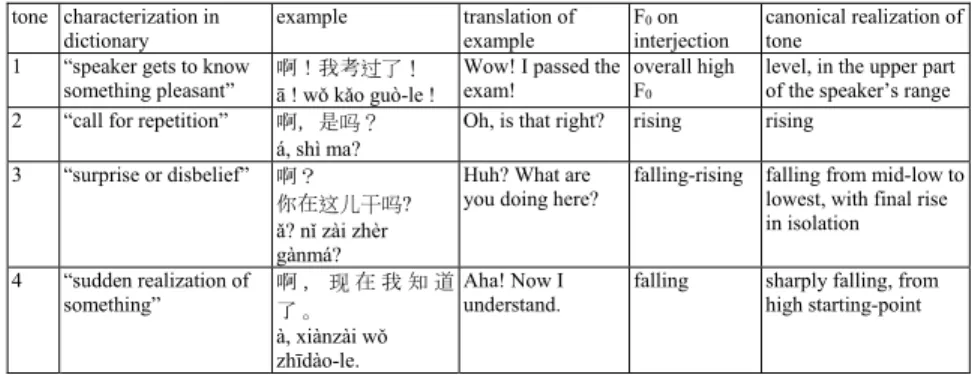
The treatment of the interjection /a/ (transcribed as 啊 in Chinese writing) in a learner’s dictionary of Standard Mandarin offers a clear case of spurious tonal identification. This dictionary treats the interjection as if it had lexical tone, and sets up four distinct entries for it, corresponding to the four tones of Standard Mandarin: with tone 1, the interjection would mean “speaker gets to know something pleasant”; with tone 2, it would signal a “call for repetition”; with tone 3, “surprise or disbelief”; and with tone 4, the “sudden realization of something” (Huangfu Qinglian 1994, entry “a”). This categorization is based on phonetic similarities between the pitch patterns of the four tones and intonational variants of the interjection, as recapitulated in Table 3.
There is in fact a considerable phonetic difference between the four-way division of the Mandarin tonal space, on the one hand, and the intonational gradations in the realization of interjections, on the other – involving not only F0, but also length and
other parameters. Interestingly, the authors of the dictionary gloss the “tone-4” realization of the interjection /a/ as the “sudden realization of something” (emphasis added). The interjection /a/ can just as well convey the realization of something, without any specific hint of suddenness (Lin Yutang 1972, entry “啊”). The F0 of the
interjection decreases gradually, in a manner that does not resemble tone 4 (an abruptly falling tone). The mention of suddenness was added because the intonational signalling of this extra nuance tends to shorten the interjection, thereby creating a surface similarity with tone 4. From the point of view of linguistic functions, there should be no confusion: the phonetic realization of interjections in Standard Mandarin is purely
intonational, “with varying, indeterminate accent, like English Oh! ah! aha!” (Lin
Yutang 1972, entry “啊”). Mandarin interjections bypass tonal coding; the interjection /a/ has a wide range of possible realizations, and of expressive effects. The four entries set up for this interjection in the dictionary single out four of these realizations, and grant them separate status merely because they happen to be phonetically close to the language’s four lexical tones. This example illustrates the potential for a
We now turn to an examination of “autosegmental-metrical” models of intonation. We would like to warn students about pitfalls of these models, which base the representation of intonation on “tones”.
tone characterization in
dictionary example translation example of F
0 on
interjection canonical realization of tone 1 “speaker gets to know
something pleasant” 啊!我考过了! ā ! wǒ kǎo guò-le !
Wow! I passed the
exam! overall high F0
level, in the upper part of the speaker’s range 2 “call for repetition” 啊,是吗?
á, shì ma?
Oh, is that right? rising rising 3 “surprise or disbelief” 啊?
你在这儿干吗? ǎ? nǐ zài zhèr gànmá?
Huh? What are
you doing here? falling-rising falling lowest, with final rise from mid-low to in isolation 4 “sudden realization of something” 啊 , 现 在 我 知 道了 。 à, xiànzài wǒ zhīdào-le. Aha! Now I
understand. falling sharply falling, from high starting-point
Table 3. Phonetic basis for the four-way categorization of the nuances expressed by the interjection /a/ in Mandarin, as proposed in a dictionary: Huangfu Qinglian 1994. 3.4. How autosegmental-metrical models blur the distinction between tone and intonation
Autosegmental-metrical models are based on concepts from Subsaharan tonology
(for a review: Rialland 1998). In autosegmental-metrical models, “lexical pitch
variations and intonational pitch variations are phonologically represented as tones, like H(igh) and L(ow)” (Gussenhoven 2004:xvii). The exciting paradox of these
models is summarized in John Goldsmith’s paradoxical description of “English as a tone language” (Goldsmith 1981): describing intonation patterns (in languages such as English) with the same tools as the tones of Bantu languages. In the Tones and Break Indices (ToBI) system, proposed as “a standard for labelling English prosody” (Silverman et al. 1992), intonation is transcribed “as a sequence of high (H) and low (L) tones marked with diacritics indicating their intonational function as parts of pitch accents or as phrase tones marking the edges of two types of intonationally marked prosodic units” (Beckman and Elam 1997:8).
In the wake of ToBI, adaptations for a wide range of other languages were developed. Leading researchers, some of whom initially argued against the modelling of intonation into discrete levels (Ladd 1978), now advocate the autosegmental-metrical model, which has become the mainstream model of intonation (Ladd 1996; Gussenhoven 2004; Jun 2005). Autosegmental-metrical models operate with the same concepts for all languages, as a matter of definition.5
5 Notions from autosegmental studies of tone that are carried over into intonation
studies include downstep: the categorical lowering of a High tone with respect to preceding High tones, typically due to an intervening Low tone, either overt or ‘floating’ (Connell 2001; Rialland 1997, 2001). (An argument for the usefulness of the
At this point it is worth pausing and asking to what extent the use of the same concepts for tone and intonation is useful and enlightening. Let us take as an example the notation “H%”, for a H boundary tone. It is used for tonal languages such as Kinande (Hyman 2010:207); for English (Pierrehumbert and Steele 1989); for French (Fougeron and Jun 1998); and for Vietnamese (Ha and Grice 2010), among other languages.
The linguistic facts are much less homogeneous than the use of the same label suggests, however.
In Kinande, the H% which marks the end of a phrase is a real (bona fide)
tone, which triggers the same phonological processes as H tones of lexical origin, e.g. causing neutralization of certain lexical tone oppositions on nouns
when they are said in isolation (Hyman 2010:207).
In French, in the absence of tones at the lexical level or at the morphological level, there is no language-internal evidence to decide whether the phenomenon at issue is tonal or not. (On the description of French intonation, without recourse to the notion of tone: see Delattre 1966; Rossi 1999; Vaissière and Michaud 2006; Martin 2009.)
For Vietnamese, H% is used for “rising final pitch movements” by Ha and Grice (2010); like in French, this choice of label is based on theory-internal motivations. Unlike in Kinande, there are no reasons to identify the phenomenon labelled as H% with one of the lexical tones of Vietnamese. The adoption of the same label, H%, may appear economical from the point of view of a universal model, but this leads to an artificial and counter-intuitive description. This is analogous to the use of the feature /ATR/ (Advanced Tongue Root) in the description of vowel systems. This feature was initially proposed for a set of languages of Africa; a crucial phonological test is the presence of ATR vowel harmony (see e.g. Hess 1992). The feature was later used to describe the four-way opposition in a vowel system containing /i-e-ɛ-a/ (Calabrese 2000). The argument is theory-internal: combining a binary /ATR/ feature with a binary /open/ feature yields 2x2=4 values, and thus obviates the need for a multi-valued /open/ feature for vowels, considered uneconomical. The pinch comes when typological considerations come in: should French, and other Romance languages, be included in cross-linguistic studies of ATR? A common-sense answer is that it is best to begin by identifying a core set of languages that uncontroversially possess ATR systems, and to apply due caution when considering extensions of the concept beyond this core domain.
To return to intonation, the generalized use of boundary-tone labels such as H% and L%, and of tonal notations such as H*, L*, L+H*, L*+H for “pitch accents”, veils
typological differences (Ladd 2008). In most East and Southeast Asian languages, the
available literature suggests that intonation does not seem to be implemented by the
addition of tones in the way described for Kinande, Hausa, Luganda and Naxi.
notion of downstep in the study of intonation is proposed by Ladd 1993.) Laniran and Clements (2003) point out that there are paradoxically more phonetic studies of downstep in widely-studied languages (e.g. English, Swedish, German, Dutch, or French) where it is posited as a component of intonation, than in the African languages where downstep was initially reported as a component of the tone system.
The widely-studied case of Standard Mandarin provides an example. Mandarin has salient intonational phenomena, which have a strong influence on the phonetic realization of tones, to the extent of making the automatic recognition of tone in continuous speech a great challenge. But these intonational phenomena do not affect
the phonological identity of the lexical tones. Instead, intonation is superimposed on
tone sequences. From the point of view of linguistic structure, intonation remains on an altogether different plane from tones: it does not modify the phonological sequence of tones, even in cases where it exerts a considerable influence on their phonetic realization. This has been studied since the pioneering work of Chao Yuen-ren (1929). Relevant evidence on this issue comes from the field of speech synthesis: some specialists choose to specify (i) full templates of the time course of F0 for each lexical
tone, and (ii) a “strength coefficient” for each syllable (Kochanski, Shih Chilin and Jing Hongyan 2003; Kochanski and Shih Chilin 2003). The strength coefficient, which correlates with informational prominence, plays a major role in the final shape of the synthesized F0 curve. This synthesis system provides indirect confirmation for the
observation that, although intonational parameters interact with the phonetic realization of tone, they do not modify the underlying phonological sequence of tones: there is no insertion or deletion of tones. The informational prominence of a syllable is indicated by local phenomena of curve expansion and lengthening on the target syllable, as well as some modifications in supraglottal articulation; conversely, a degree of phonetic reduction is found on other syllables, including a degree of post-focus compression of F0 range (see in particular Xu 1999).
3.5. Some suggested topics and directions for prosody research
Generalized use of the notion of ‘tone’ in autosegmental-metrical models of intonation has paradoxically slowed down the identification of real examples of intonational tones. The observation that intonational tones are uncommon across languages opens into interesting linguistic issues such as
(i) their relative frequency across languages: how many languages have tonal encoding for (some) intonational functions?
(ii) the factors facilitating their development, and their relationship to a language’s lexical tones, morphological tones, and intonation system. Concerning possible relationships between tone systems and intonation systems, it seems intuitively clear that multilevel tone systems (e.g. Ngamambo, Wobe) cannot allow the type of intonational flexibility in the realization of tone which is pervasive in Mandarin or Vietnamese, because such flexibility would jeopardize the identification of the utterance’s underlying tonal string. All other things being equal, it would seem that level tones constrain intonation to a greater extent than complex tones. The typological hypothesis could be phrased as follows: prosodic systems based on discrete pitch levels allow less allotonic variation, so that less information about phrasing and prominence can be encoded as modulations of F0 superimposed on the tonal string. This would
create a pressure towards privileging other means to convey phrasing and prominence: either by integration into the tonal string (i.e., intonational tones as defined here), or