Publisher’s version / Version de l'éditeur:
Vous avez des questions? Nous pouvons vous aider. Pour communiquer directement avec un auteur, consultez la première page de la revue dans laquelle son article a été publié afin de trouver ses coordonnées. Si vous n’arrivez pas à les repérer, communiquez avec nous à [email protected].
Questions? Contact the NRC Publications Archive team at
[email protected]. If you wish to email the authors directly, please see the first page of the publication for their contact information.
https://publications-cnrc.canada.ca/fra/droits
L’accès à ce site Web et l’utilisation de son contenu sont assujettis aux conditions présentées dans le site LISEZ CES CONDITIONS ATTENTIVEMENT AVANT D’UTILISER CE SITE WEB.
Technical Report (National Research Council of Canada. Institute for Marine
Dynamics); no. TR-2002-20, 2002
READ THESE TERMS AND CONDITIONS CAREFULLY BEFORE USING THIS WEBSITE. https://nrc-publications.canada.ca/eng/copyright
NRC Publications Archive Record / Notice des Archives des publications du CNRC :
https://nrc-publications.canada.ca/eng/view/object/?id=827ee40b-83f0-4684-9189-eb7f833e6fd3
https://publications-cnrc.canada.ca/fra/voir/objet/?id=827ee40b-83f0-4684-9189-eb7f833e6fd3
NRC Publications Archive
Archives des publications du CNRC
For the publisher’s version, please access the DOI link below./ Pour consulter la version de l’éditeur, utilisez le lien DOI ci-dessous.
https://doi.org/10.4224/8896095
Access and use of this website and the material on it are subject to the Terms and Conditions set forth at
Coast guard fishing vessel safety committee, research and
development session, December 2, 2002
National Research Council Canada Institute for Ocean Technology Conseil national de recherches Canada Institut des technologies oc ´eaniques
Technical Report
TR-2002-20
Coast Guard Fishing Vessel Safety Committee, Research
and Development Session, December 2, 2002
W. D. Molyneux
December 2002
Molyneux, W. D., 2002. Coast Guard Fishing Vessel Safety Committee, Research
and Development Session, December 2, 2002. St. John's, NL : NRC Institute for
Marine Dynamics, TR-2002-20.
J
M National Research Council Conseil national de recherches
Canada Canada
j Institute for Marine Institut de dynamique
Dynamics marine
COAST GUARD FISHING VESSEL SAFETY COMMITTEE,
RESEARCH AND DEVELOPMENT SESSION, DECEMBER 02,2002
TR-2002-20
W.D. Molyneux
DOCUMENTATION PAGE
REPORT NUMBER
TR-2002-20
NRC REPORT NUMBER DATE
December 2002
REPORT SECURITY CLASSIFICATION
Unclassified
DISTRIBUTION
Unlimited TITLE
COAST GUARD FISHING VESSEL SAFETY COMMITTEE, RESEARCH AND DEVELOPMENT SESSION, DECEMBER 2NP, 2002
AUTHOR(S)
W.D. Molyneux
CORPORATE AUTHOR(S)/PERFORMING AGENCY(S)
Institute for Marine Dynamics, National Research Council Canada -PUBLICATION
SPONSORING AGENCY(S)
Institute for Marine Dynamics and Canadian Coast Guard
IMD PROJECT NUMBER NRC FILE NUMBER
KEYWORDS
fishing vessel / safety / Coast Guard
PAGES 7 APPS. 1 TABLES 2 SUMMARY
This report summarizes a series of presentations on research relevant to fishing boat safety. The presentations were made to Canadian Coast Guard's Fishing Vessel Safety Committee by researchers from IMD, MUN, C-CORE and a new company, Cathexis. It makes recommendations for further research, based on the committee's requirements.
address National Research Council Institute for Marine Dynamics P.O. Box 12093, Station W St. John's, Newfoundland, Canada
A1B 3T5
TR-2002-20
Coast Guard Fishing Vessel Safety Committee Research and Development Session
December 2nd, 2002
Airport Plaza Hotel, St. John's, Newfoundland
Lj
INTRODUCTION
The Fishing Vessel Safety Committee was formed after the publication of a report by Canadian Coast Guard, (Reference 1). The report highlighted the disturbing trend of an increase in search and rescue incidents involving fishing vessels under 65 ft length. The Fishing Vessel Safety Committee has been focusing on developing programs to train fishers in the proper safety procedures. However, the Committee Co-Chair felt that it would be worthwhile to have the committee members briefed on ongoing research in areas relevant to fishing vessel safety.
The Committee approached David Molyneux, a Researcher at NRC's Institute for Marine
Dynamics, to organize and facilitate a session, drawing in people from the Newfoundland community with experience relevant to fishing vessel safety. The meeting was scheduled for December 2. This report provides a summary of the meeting.
The list of people attending is given in Table 1. The people who made presentations to
the committee are listed in Table 2.
PRESENTATIONS ON RESEARCH AND DEVELOPMENT RELATED TO FISHING VESSEL SAFETY
The format of the meeting was for short presentations followed by discussion related to that presentation. After all the presentations had been made there was further discussion on consolidated topics. This discussion is summarized in the next section.
Key points on each of the presentations are summarized below. Copies of the slides used
for the presentations are given in Appendix L
IMD's Safety Research Program
■ IMD provides the host for a database on offshore-related safety material ■ The links between research, simulation and training are critical
TR-2002-20
Fishing Vessel Safety and Related Research & Consulting
■ Bulbous bows can reduce pitch motions, making the ship safer
■ Anti-roll tanks can reduce roll motions, making the ship safer
■ Speed is a safety issue since shorter weather windows can be used
■ Vessel designs are growing in peculiar directions due to regulatory
constraints
■ Unconventional hull shapes (catamaran) are becoming accepted
■ Vessel safety should be factored in to vessel replacement rules
■ Vessel safety should be factored into vessel modifications
■ Small vessels get little attention from professional designers, but are
biggest risk
Personal Emergency Locator Tagfor Inshore Fishery
■ Personal locator tag can be an effective safety device for one or two man
crews
Must be affordable (<$200)
■ Must be capable of alerting SAR services
■ Must fit on person with minimum of disturbance to normal work
■ Details of working frequency and tracking device still to be worked out
Occupational Safety Onboard Fishing Vessels
■ Include attention to human performance in initial design considerations
■ Motion induced interrupts, motion sickness and body stability all
considered
■ Aim to detune ship from environmental conditions (natural periods)
■ Effective strategies for lowering motions are
- Speed and heading to waves - Location of task within ship
- Increase vessel size to reduce motions
■ Need data on real human performance during fishing against measured
numbers
■ Link measurements to operational limits
Safecatch-A Community Research Alliance on Fishing Health and Safety
■ Safecatch is project that focuses on fishing safety, with community
involvement throughout the life of project
■ Collect data on accidents and near misses into linked database
- 1989-present
- Trusted third party to collate and store data
- Data at depth for research and raising new questions
■ Comparison of regulatory regimes for fishing
U
TR-2002-20
■ Designing safer fishing vessels
■ Plan for creation of center focusing on workplace health and safety
research for Atlantic Canada
Application of Wireless Asset Management Systems to Fishing Vessel Safety
■ Cheap and effective short-range system for tracking location of crew
■ Can be used onboard ships of all sizes
■ Locator stays with the ship, tag goes on person
■ Can be linked to vessel's emergency distress system
Motions and Safety ofFishing Vessels
■ Ultimate stability (capsize) has been heavily researched
■ Definition of extreme motions not well defined for fishing vessel
■ Consider motion induced interrupts, motion induced fatigue and motion
induced sickness
■ Use damping devices to make roll more comfortable
- Bilge keels - Bilge fins
- Paravanes
- Anti-rolling tanks
■ Damping devices for pitch
- Bulbous bow ■— Beaver tail
■ Anti-roll tanks must be tuned to static and dynamic stability of each ship
DISCUSSION ON FUTURE RESEARCH REQUIREMENTS
There were six themes that moderators observed coming through in the course of the discussion, which will have an influence on future Research & Development related to Fishing Vessel Safety. The moderator identified these as follow:
1. Relevant Data Bases
2. Impact of Regulations & Constraints
3. Development of Protocols and Certifications 4. Engineering
5. Training and Delivery of Research Results 6. Community Input to Future Research
TR-2002-20
1. Relevant Data Bases
Management decisions must be based on accurate data. Within the fishing industry, many different groups collect data, but it is not linked together. A database that contains:
a. Accident information
b. Weather and environmental factors c. Level of crew training
d. Vessel data
e. Type of fishing
f. Policies
In a way that information can be extracted, in particular long term trends or effects of changes in regulation, will be very valuable. The Safecatch project will be a good start to data base creation, and will be able to identify what must be collected for the next generation of database.
2. Impact of Regulations and Constraints
There are a wide variety of policies and resulting regulations effecting fishing vessels, which include the control of total fishing effort (within and across species), the safety of the ship, the fishing vessel as a workplace, and the fishing vessel as a ship. Often the regulations are inappropriate as developments have changed what were thought to be practical upper limits, for example the growing size of vessels under 65 ft puts them over 500 GRT. Also vessels are modified with differing degrees of skill and knowledge throughout their lifetimes. Regulations take time to develop and are often responsive to immediate needs, so do not factor in possible long-term developments.
Also the degree of enforcement of regulations was discussed. The trend is towards voluntary compliance rather than mandatory. This requires different approaches from
both the industry and regulators than for a mandatory inspection scheme.
There was a great deal of discussion on this topic and other policy issues were discussed, such as the links between vessel replacement strategies and community development. If resource allocations are pooled then, it favours more industrial applications, whereas individual quotas may favour smaller independent enterprises. These approaches can have a big impact on the economy of small, rural communities.
One thing that is clearly missing is a simulation tool that enables the changes in these parameters to be effectively evaluated, prior to making the changes in policy.
3. Development of Protocols and Certifications
In contrast to the previous topic, there was very little comment on this theme. Safetynet was evaluating work gloves for fishing boat operations, but no other topics were suggested.
TR-2002-20 i !
^
4. Engineering
jj
Engineering was sub-divided into three sub-categories. These were
■ Vessel design
[J
■
Modeling and simulation
■ Product Development
U Friis's presentation was an example of a naval architect working with the fishing community to improve operational efficiency. The result was changes to the hull form,
I : which reduced fuel consumption and vessel motions. Alternative hull forms were also
Lj developed (catamaran). All of the work was done for large-scale fisheries.
| \ It was felt by committee members, that there was very little attention paid to small boat LJ design and construction standards. Whilst small boats may not withstand capsize in all
sea conditions, there is no real reason for a vessel and crew to sink and nobody know
[ j what has happened. Guidelines or standards for small boat construction would be
U
worthwhile. Other guidelines that would be useful were guidelines on vessel
modification, when modifications are often done with little engineering. This should
! include studies on the relevance of new materials for vessel construction.
LJ
Simoes-Re, Akinturk and Bass focused on modeling and simulation. Newfoundland has a
I superior capability in this area and it is logical for researchers to work with industry in
Lj
developing models and simulations for ship or safety equipment behaviour. This is
important information for regulators, operators and trainers in providing standards and
; procedures for the operation of equipment. This research should tie in with regulators'
^ policies.
! I Power and Taylor emphasized that safety can be a business, and new product ideas can
^ add value to a community. It is logical that products are inspired by the needs of the local
economy, but clearly there is a worldwide market for this equipment. It is hoped that
j
other equipment can be developed and tested using links between industry and
^
researchers and the result will be the development of practical, affordable and high
quality products.
! i
.
'~ 5. Training and Delivery of Research Results
j I
Newfoundland leads the country in its ability to bring together all players in a particular
^
industry. This can be capitalized on, and the Safecatch model provides a good basis for
expanding information exchange to other areas. Researchers tend to find a solution, and then go out and look for a problem to which to apply it. Industry sees the problem first. Constructive dialogue can bring the two groups together in such a way that everyone wins. However, the community should be aware of academic requirements and time
! |
scales.
TR-2002-20
It is important to have community involvement in planning, execution and delivery of
research results, as well as both sides receiving feedback on the outcomes. Topics must
be presented at the correct level. Whilst it is for researchers to present results to their peers, it is more important for the community that research results get acted upon in a timely and profitable manner.
6. Community Input to Future Research
The impact of training programs needs to be assessed. We must ask if the courses provide the right material, if does the participant retain it effectively, and when does it need to be refreshed or renewed?
The need for introductory training of fishing crews before they gain work experience must be studied. Typically someone will go to sea with no training, and only qualify for support for course when they have some sea time. This is the opposite of other industries (e.g. mechanics) who can obtain certification before starting work.
A measure of success of the fishing vessel safety committee would be to obtain courses related to the fishery (safety, work practices, economics, biology etc.) in the Province's High Schools.
Delivery and feedback mechanisms must be placed within the communities, through established groups (schools, unions, churches etc.).
CONCLUSIONS
This was the first time that the Fishing Vessel Safety Committee had met with researchers. Whilst many members of the committee were aware in general terms of the topics and levels of effort, it was a useful opportunity for the two groups to meet and discuss matters of mutual interest.
In terms of directions, it seems that the most promising areas for future cooperation can
be:
1) Development ofrelevant databases
2) Develop simulation models for evaluating the effect of changes in the fishery,
which includes the effects of: - Biology
- Environment
- Fishing technology - Vessel design
- Economics
TR-2002-20
4) Provide guidelines on best practicesfor vessel modification
5) Provide researchers with access to fishing operations to provide correlation
between measured vessel motions and real work task limits.
It is proposed that the Fishing Vessel Safety Committee meet regularly with researchers, to be updated on progress. An annual review would be the most likely interval.
REFERENCES
M. Wiseman and H. Burge, 'Fishing Vessel Safety Review (Less than 65 ft)\ Maritime Search and Rescue Newfoundland Region, Fisheries and Oceans Canada, Coast
Guard, November 2000.
TR-2002-20
Tables
TR-2002-20
u
j ({Name i i! j 2 3 Mervin Wiseman Brendan Condon | || i| Organization ]{Phone number j CCG/SAR 772-6501 t
Professional Fish Harvesters Board
Jj 722-8170
I || ||(902)426- |
I Pierre Murray jjTrasportation Safety Board j [§043 |
|| 4||MikeNoonan
l|FFAW
]|587-2410
I
II 5|
\, 6 John Porter George Chafe E-mail I wisemanm(8>df6-mpo.ac.ca I [email protected] [email protected][Fisherman
||786-7541
l|
FFAW/SFVl( 7l[chrisRodgers
l[WHSCC
I 9 I 10jI 11!
E
I 13 I 14!I 15
16 j! 171 || 18]!Lj9J
20 211 22 23 24! 25 26 27 28S
joj Carl Parsons Frank Corbett Jim Kenny J Mark Dolomount I Steve Taylor Antonio J. Simoes Re David Molyneux [Charles Roberts Greg Pretty i Graham Small Ayhan Akinturk Tom Curran David Foster Trish LeBlancFisheries & Marine Institute Fisheries & Marine Institute DFO-Policy and Economics Transport Canada Marine Safety
368-6118 | 778-1191 I (778-1191 | 786-3535 772-6835 772-6057
Professional Fish Harvesters Board j| 722-8170 \
Cathexis Innovations/MUN Institute for Marine Dynamics Institute for Marine Dynamics FFAW/SFV
FFAW/CAW Marine Institute
Institute for Marine Dynamics Inshore Fisherman/FFAW Dept. Fisheries & Oceans
Canadian Centre for Fisheries Innovation NRC/CISTI
Stephen Bornstein j [NLCAHR/MUN
Dag Friis Gordon Slade Ray Browne John Butler
MUN/Ocean & Naval Arch. Engineering One Ocean
CCG CCG
Desmond Power
j|C-CORE
Don Bass MUN/Ocean & Naval Arch. Engineering
727-3135 I 772-0914 772-4280 I 726-7601 576-7276 | 834-2076 I 772-8409 | 432-2704 772-2045 778-0542 I 772-2468 777-6768 ! 737-8945 778-0519 772-5494 ;
772-5150
I
737-8853 737-8950 I [email protected] [email protected] [email protected] I [email protected] [email protected] [email protected] [email protected] [email protected] ABtMJoS!^^ j David-M^ [email protected] I ffi^m:[email protected]__ J [email protected] (HaoA festengmLmun.ca _
J
IrishLeBlanc^nr^^ j Gordon.Slade(Q)mi.mun.ca [email protected] J [email protected] des. [email protected] [email protected] _|TR-2002-20 1 Name i I Antonio Simoes Re | 5 j 1 DagFriis I Des Power 1 Ayhan Akinturk i i Stephen Bornstein | Steve Taylor : ■ ■ i Don Bass | Organization
Institute for Marine Dynamics Ocean and Naval Architectural |
Engineering, MUN j
C-CORE
Institute for Marine Dynamics j NLCAHR/SafetyNet
Cathexis
Ocean and Naval Architectural
Engineering, MUN
Topic
|
IMD's Safety Research j
Program
j
Fishing Vessel Safety and Related Research &
Consulting j
Personal Emergency Locator |
Tag for Inshore Fishery j Occupational Safety Onboard j
Fishing Vessels j
Safecatch-A Community Research Alliance on Fishing
Health and Safety
|
Application of Wireless Asset
Management Systems to
Fishing Vessel Safety j
Motions and Safety of Fishing
Vessels
J
APPENDIX 1
PRESENTATIONS TO THE FISHING VESSEL SAFETY COMMITTEE
IMD#S SAFETY RESEARCH PROGRAM
by
Antonio Simoes Re
institute for Marine Dynamics,
SAFETY RESEARCH PROGRAM
Antonio J. Simoes Re
National Research Council Canada &
Brian Veitch
Memorial University of Newfoundland
Fishing Vessel Safety Committee Airport Inn, St John's
2 December 2002
NRC/MUN
SAFETY RESEARCH PROGRAM Safety projects < 1998
USCG-CCG Lifejacket program Heat Loss from immersion suits Tests of lifecraft system concepts Esperanto "OVATEK" certification trials Ltferaft capsizing / Drift
Lifeboat launching comparative study Offshore/marine studies
FRC/Ufeboat retrieval
NRC/MUN
SAFETY RESEARCH PROGRAM Safety projects > 1998
Escape Evacuation and Rescue (EER) research program Marine Escape Evacuation and Rescue (EER) Resource Centre
FPSO motion sickness study Survival craft training simulator
Advanced ship evacuation simulation (ASES)
NRC/MUN
SAFETY RESEARCH PROGRAM < 1998
I
^1
... - '1
USCG-CCG Lifejacket program
A Sea Water Instrumented Manikin (SWIM) buoyant motions in still water and in waves were evaluated to start the validation of a mathematical model. Both the manikin and the software are intended to evaluate the performance of personal flotation devices (PFO). The motions have been compared to those of humans.
NRC/MUN
SAFETY RESEARCH PROGRAM < 1998
Heat Loss from immersion suits
CoUaborative work with the CORD group of Halifax and the Defence Civil Institute for Environment Medicine allowed us to look into thermal characteristics of suits as well as comparative evaluation of lifevests.
SAFETY RESEARCH PROGRAM < 1998
Tests of lifecraft system concepts
Work on a conceptual lifecraft, gyrosphere. Mainly the work comprised of proof of concept.
SAFETY RESEARCH PROGRAM < 1998
Esperanto "OVATEK" certification trials
Work on a the Esperanto capsule "OVATEK" was conducted at the Institute. The work permitted TC to give initial conditional certification to the craft before it went in
NRC/MUN
SAFETY RESEARCH PROGRAM < 1998
Uferaft capsizing / Drift
The Institute studied the capsize
pnenomenon or innaiaoie HTerans
and the development of design and procedure changes that could improve performance and decrease capsizing. Along with this work the
Institute coliQcteci infonvtdtion on
wind and wave loads on inflatable liferatts with special focus on the effectiveness of
anchor designs
NRC/MUN
SAFETY RESEARCH PROGRAM
Lifeboat launching comparative study
Model test experiments on four different types of evacuation systems approved by Transport Canada (Davit. PROD, Seascape and FreefaH). The objective was to identify the smoothness of delivery of the lifeboat to the water surface, the ability of the systems to work in different conditions, i.e. even keel and damage, and the ability of the lifeboat to move away from the structure.
NRC/MUN
SAFETY RESEARCH PROGRAM < 1998
Offshore/marine studies
The study explained the regulatory regime pertaining the evacuation of offshore installations and associated safety issues and identified the legislative and regulatory authorities and their responsibilities.
As part of the study a survey of offshore evacuation systems applicable to fixed and floating structures was conducted.
The systems included those presently approved by Transport Canada, as well as those under development and awaiting approval and those at
concept stage.
FRC/Ufeboat retrieval
A mathematical model that represented either the launch or retrieval of a FRC was developed at the Institute. The model can be extended to include aspects of rescue of lifeboats, liferafts and humans.
NRC/MUN
SAFETY RESEARCH PROGRAM > 1998
Preliminary Trials Benchmark I
Extreme Weather, Payload, and Launch control Benchmark II Benchmark III Preliminary Full Scale Floating Platforms Full Scale Verification Fit for Purpose
(1999-2000) (2000-2001) Wave Steepness (2001-2002) (2001-2002) (2002-2003) (2003-2004) (2003- ) (2003- ) NRC/MUN
SAFETY RESEARCH PROGRAM > 1998
GOALS & APPROACHES
• In circumstances that necessitate a marine evacuation, personnel must have access to an evacuation system, be able to embark & launch safely, dear the installation, and survive until rescued,
.... and to have reasonable expectation of successfully escaping harm in the environmental conditions that can reasonably be expected to prevail during operations
Li
SAFETY RESEARCH PROGRAM > 1998
Escape Evacuation and Rescue (EER) research program
The objective of the study is to establish a baseline performance profile of evacuation system performance capability as a function of environmental conditions through a systematic series of model experiments for which a number of basic parameters are varied. The benefits from conducting this series of experiments ace the quantification of evacuation system performance degradation as a function of environmental conditions.
Determination of the effect of evacuation system design variation on
system performance and establishment of a non-proprietary database on evacuation system baseline performance that may be used by designers, operators and regulators to make rational decisions.
NRC/MUN
SAFETY RESEARCH PROGRAM > 1998
Preliminary Trials
(1999-2000)
NRC/MUN
SAFETY RESEARCH PROGRAM > 1998
Performance capabilities of evacuation systems in a range of wind and open water waves
NRC/MUN
I
SAFETY RESEARCH PROGRAM > 1998
Benchmark tl (2001-2002)
■
Hra^^H Extreme Weather, Payload, H^hHH| Wave Steepness andHHHfl Launch Control (2001-2002)
NRC/MUN
SAFETY RESEARCH PROGRAM > 1998 Benchmark III (2002-2003)
Free Fall Evacuation System
- Lifeboat is allowed to "free fall" to the water.
- Two Methods of launch
• Vertical drop > Skid launch
NRC/MUN
SAFETY RESEARCH PROGRAM > 1998
Marine Escape Evacuation and Rescue Resource Centre
Establish an Escape, Evacuation and Rescue (EER) Database and information centre.
The benefits expected from establishing the database and information centre the availability of EER information at one physical location (i.e. information centre) and a secure searchable database. The centre includes Web site dedicated to the EER with links to local, national and international databases.
www.nrc.ca/imd/eer
SAFETY RESEARCH PROGRAM > 1998
FPSO motion sickness study
Survival craft training simulator
Advanced ship evacuation simulation (ASES)
NRC/MUN
SAFETY RESEARCH PROGRAM > 1998
Funding agencies
> Transport Canada (TC)
> Natural Resources Canada (NRCan) - Canadian Association of Petroleum
Producers (CAPP)
> National Research Council (NRC)
NRC/MUN
-1 I
LJ
u
LJ
FISHING VESSEL SAFETY AND RELATED
RESEARCH AND CONSULTING
Dag Friis
_ Ocean and Naval Architectural Engineering
FISHING VESSEL SAFETY RELATED RESEARCH AND
CONSULTING
by
Dag A. Friis
Professor of Ocean and Naval
Architectural Engineering Memorial University
Research Projects:
• Bond Strength Investigation for Retrofitting Fibreglass Hulls with Bulbous Bows and Other Appendages • Performance Evaluation and Design Improvement of 65'
x 30' x 30' Fishing Vessel (2001/2002)
• Performance Evaluation and Design Improvement of 65' Wave Piercing Catamaran Fishing Vessel (2001) • Design and Performance Evaluation of Alternative
Bulbous Bow Designs for 65' x 24' Fishing Vessel (1996/1997)
SAFETY RELATED CONSULTING:
• Various Bulbous Bow Designs for 65' and Smaller Fishing Vessels (1999 to Present)
BULBOUS BOW RELATED WORK
PERSONAL EMERGENCY LOCATOR TAG FOR INSHORE FISHERY
by
Des Power
Personal Emergency Locator Tag for Inshore Fishery • Objective: to develop an inexpensive, compact and
lightweight personal emergency distress beacon • Main target sector commercial and recreational
inshore fishery
• To be useful for inshore fishery,
• Must have immediate notification of CCG of incident position
• EPIRB: Emergency Position Indicating Radio Beacon
- Simple homing beacons (121MHz)
♦ priced right (typically $200-$300) ♦ No automatic notification of CCG
• COSPAS/SARSAT (406MHz)
♦ Automatic notification via satellite
♦ Some have GPS ♦ Typically $1000 or more ♦ Large/bulky 121.5 MHz EPIRBs Sea Marshall MOB Wristwatch MINIB2 L-J Personal 406 MHz EPIRB
Fastfind mmtij^ Personal 406 MicroPLB
j / U
Personal Emergency Locator Tag for Inshore Fishery
LJ
Most desirable feature • Tag-like
■ Worn on clothing
s Should not hinder normal activities on a small boat or vessel
Device would also be useful in ■ offshore fishery
■ marine transportation sector
■ offshore oil production and exploration industry ■ inshore/freshwater recreational boating sector.
Features of Emergency Locator Tag Small, lightweight and wearable/attachable to clothing
Inexpensive (several hundred dollars) Automated and manual triggering of distress event
Provide notification to CCG a timely manner Features may include
■ onboard GPS, ■ VHF-DSC capabilities
• AIS (Automated Identification System) compliance • 406 MHz homing beacon (less expensive, lighter
weight version of COSPAS/SARSAT EPIRBs).
Three Elements: ^ Machine & Environment Occupational Safe Economics/ ' * EquipmeA -< Weight Groups "-v, s—\ \
(o)
V ^ Structural Design \stobly)W
3 h Motion Sickness^ Motion Induced Interruptions ^ Postural Stability
zA'M&AM
Shift of Peak Frequencies: & Ship Response and
Sea Energy
1
i fk
1
[Constraints on RMS heave and pitch-]
^ RMS heave < 0.7 [m] & RMS pitch < 5 degrees
Occupational Safety on Board of Fishing Vessels
[Postural Stability:!
0.22
M1 is the first moment of the acceleration spectrum
trti (dsnfd)
1.5 0.5 0 Sea state -B- 1 -&- 2 -*- 3 -*- 4 ~rr~ 5 tm limit Amidship -6 d fi "5 a 5 n 2 4 6 8 10 Ship Speed [knj +-O.1133M1Z < 0.22 . "¥&> 5 4-I3'
§2-1 0 t Sea state -a- 1 •^r- 2 -*- 3 ...:.r... 5 - - tm limit ~o ~5""c Fore Ship j ^-—•rrr i *— ^ Ja u "j " ' h—E3 E3 O ~5"~5"~D*~[ 4 6 Ship Speed [kn] 10 i < 8 -I 6jI4
2 0 1\
^^
-rr Amidship-S- Fore Ship\
\
^^~-~—
\
2 3 4!
Operational Sea State
S
10
'$&?: ■f^MSWMi ^SlEtk
50 100 150 200 250 300
Hold Capacity [LT]
^ Improvements in the algorithms to estimate
vessels' motion characteristics - ship motions & Better understanding of effects of motions
-human factors
Occupational Safety on Board of Fishing Vessels
i I
SafeCatch
-A Community Research -Alliance on Fishing Health and Safety
by
Stephen Bornstein NLCAHR/SafetyNet
LJ
A Community Research Alliance on Fishing Health ft Safety
SafetyNet
Community Research Alliance on Health & Safety in Marine and Coastal Work Human Cold Working Conditions:
Surface Exposure to Cold Cognition During Exposure to Coid Work and Performance in Cold Deep-Sea Conditions
Oil a Petroleum:
Offshore Employment: Implication* for Health ft Weil-6etng of Individuals, Families ft Communities Occupational Health and Safety in Petroleum Refining
Fish Processing: a In Snow Crab P
Cumulative Trauma Disorder! in Snow Crab Processing Workers
Fishing Vessel Repair:
Risks and Prevention in Flbreglass-Relnforced Boat Building 6 Repair
Fishing:
SafeCatch
SafeCatch Community Alliance Academic Partners:
Newfoundland ft Labrador Centre for Applied Health Research Memorial University of Newfoundland
Dalhousie University
Research Partners:
Canadian Coast Guard Department of Fisheries and Oceans
Health Care Corporation of St. Johns
institute for Marine Dynamics-National Research Council Maritime Search and Rescue, Newfoundland Newfoundland ft Labrador Centre for Health Information Newfoundland ft Labrador Workplace Health, Safety and Compensation Commission
Offshore Safety ft Survival Centre
Community Partners:
Fish Harvesters Resource Centre Professional Fish Harvesters Certification Board
Small Fishing Vessel Safety Committee
Funding:
Canadian Institutes for Health Research Memorial University School of Graduate Studies
Newfoundland ft Labrador Workplace Health, Safety and Compensation Commission
SafeCatch
Inter-sectoral, Inter-disciplinary and integrated research
Macro Level: Research of populations &
Fishing Vessel Safety Longitudinal Analysis (FVSIA)
Comparative Analysis of . Regulatory Regimes (CARR)
Micro Level:
Research of individuals ft
Injured Fishers (IF) Firsthand Perceptions of Causes
of Accidents ft Near-misses (FPCAN) Safer Fishing Vessel
SeakeeptngiSFVS)
Applied Level:
nQSQorch thot hos off effect on the research participan
Community Healthy Fisheries Program (CHFP)
SafeCatch-Flshing Vessel Safety Longitudinal Analysis
(FVSLA) Research on populations
Researchers: M. Binkley, B. Neis, J. Guernsey, P. Navarro Objectives: Identify and interpret the factors that influence the
rates of fish harvester injuries and fatalities and SAR
incidents.
Design: Linked database, statistical analysis
Applications: Fishing occupational health & safety evaluation tool Time Frame: Winter 2002-Winter 2003
Partnerships: Department of Fisheries and Oceans Fish Harvesters Resource Centre Maritime Search and Rescue, Newfoundland Newfoundland ft Labrador Centre for Health Information Professional Fish Harvesters Certification Board Small Fishing Vessel Safety Committee
Workplace Health, Safety and Compensation Commission
SafeCatch-Comparatfve Analysis of Regulatory Regimes
(CARR) Reseanh on systems
Researchers: Objectives: Design: Applications: Time Frame: Partnerships:
M. Binkley, B. Neis, S. Bornstein, P. Navarro
Assess the regulatory regime of Canada's East Coast
commercial fisheries to those of other selected countries.
Open-access contributions, comparative policy
analysis
Policy evaluation tool Winter 2002-Winter 2003
Department of Fisheries and Oceans
Arnrlravifr- muLiiiliiiiimil nulilti ■■■ Im liltnilini t II Acaaemc resoauJrtSfs ana puouc sector contributors from the
selected countries: Iceland, Norway, Denmark, France, Australia, United States
SafeCatch-lnjured Fishers (IF) Research on individuals Researchers: Objectives: Design: Applications: Time Frame: Partnerships:
M. /Murray, 0. Heath, T. Heath-Rogers
Identify and interpret the experiences of fishers with occupational-caused long term disability Interviews, qualitative analysis Foundation for future research, detailed understanding of long-term disability Winter 2002-Winter 2004
Health Care Corporation of St. Johns
Newfoundland & Labrador Workplace Health, Safety and Compensation Commission
SafeCatch-Firsthand Perceptions of Accidents &
Near-misses (FPCAN) Research on Individuals
Researchers: Objectives: Design: Applications: Time Frame: Partnerships:
M. Binkley, M. Murray, B. Neis
To investigate the perceived causes of fishing accidents and near-misses
Interviews, qualitative analysis Foundation for future research, detailed understanding of the chain of events surrounding accidents and near-misses
Winter 2002-Winter 2004
Offshore Safety & Survival Centre Professional Fish Harvesters Certification Board
SafeCatch-Safer Fishing Vessel Seakeeping (SFVS)
i on tncchonisms Researchers: Objectives: Design: Applications: Time Frame: Partnerships:
D. Bass, D. dimming, D. Molyneux
Validation and refinement of a numerical model for seakeeping and Motion induced Interrupts Naturalistic data collection (sea trials), numerical modelling (computer modelling)
Seakeeping computer models, evaluation tool for the effects of Motion Induced Interrupts
Spring 2003-Spring 2006
Canadian Coast Guard CEC Marine Consultants
Institute for Marine Dynamics-National Research Council Marine Search and Rescue, Newfoundland Marine Search and Rescue Auxiliary, Newfoundland
SafeCatch—Community Healthy Fisheries Program (CHFP)
Applied research on community safety education
Researchers: Objectives: Design. Applications: Time Frame: Partnerships: M. Murray, R. Rutherford
Develop and carry out a pilot project for a community-based fishing safety program Community participatory research
Community occupational health and safety education
program
Spring 2004-Winter 2005
Offshore Safety & Survival Centre Marine Search and Rescue, Newfoundland
SafeCatch-Fishing Vessel Safety Longitudinal Analysis
(FVSLA) Research on populations
VMMllMt mi wuia Mfltff MM GMT PMS im 1L SptdM cm Twtfwan Crastei SafeCatch
A Community Research Alliance on Fishing Health ft Safety
Contact
Newfoundland ft Labrador Centre for Applied Health Research 95 Bonaventure Avenue, Suite 300
St. John's, NL A1B2X5 Phone: (709) 777-8469 Fax: (709) 777-6734 Web: www.safetynetmun.ca
I I
APPLICATION OF WIRELESS ASSET MANAGEMENT SYSTEMS
TO FISHING VESSEL SAFETY
by
Steve Taylor
Cathexis
U
u
u
Lj
■
■
Overview
• Background on Cathexis Innovations Inc. • Introduction to RFIO • What is ITEMS™? • Technology Benefits • Questions uJ
U
Who We Are• Cathexis Innovations Inc. is a privately owned R&D and consulting company
• Headquarters based out of St John's, Newfoundland • Primarily focused on the asset management needs of the
industrial sector
• Spedaiize in providing turn-key solutions using wireless (RFID) technology
• Broad scope of experience in a number of fields.
ITEMS - Wireless Asset Management System
• Asset management presents a daunting problem to virtually all asset-intensive organizations
• Assets are everything from computers and tools to 'compressors and valves!
• Poor asset management results in a tremendous cost due to both lost assets and reduced productivity
• Current methods are labor intensive, inefficient and inadequate
• Paper tracking of asset location • Manual database entry «Inefficient with significant time lag
U
LJ Fixed Assets (AMS) & Mobile Assets (PL)
* ITEMS approaches the problem on two fronts
* Fixed Assets — in-field equipment, & infrastructure! pumps, compressors, etc
• Mobile Assets - Tools, laptops, inventory, etc
ITEMS AMS - Fixed Asset Management
• ITEMS (Integrated Tag Embedded Management System). • Employs a wireless (RFIO) technology to address the issues of asset management
• Provides features such as: • Asset Management • Access to critical data in-field • Commissioning and certification • Enhanced preventative maintenance
LJ
MOTIONS and SAFETY for FISHING BOATS
rive Motions can lead to potentially
hazardous situations threatening the health and
safety of the crew.
Extreme Motions endanger the lives of the crew
and the integrity of the vessel (possibly leading to
loss of lives and/or loss of vessel).
The symptoms or consequences of excessive
motion on human subjects are generally classified
under the headings;
(1) Motion Induced Interrupts (Mil)
Tipping, tumbling and slipping.
Can lead to physical injury, falling overboard, fatigue,
back injuries, etc.
(2) Motion Induced Fatigue (MIF).
Can lead to carelessness, poor judgement, etc
(3) Motions Induced Sickness (MIS)
I I
1. ROLL REDUCTION DEVICES.
1.1 The Need.
% occurrence of wave heights for different wave periods in N. North
Atlantic (world wide shown for comparison in totals).
Wave Ht.(m)
0- lm
l-2m
2-4m
> 4m
Wave
Period (seconds)
2.5
14.0 11.5 2.0 0.16.5
3.415.5
10.0
1.58.5
1.06.5
12.0
3.0 .10.5
0.30 1.5 7.0 3.5>10.5
0.4 1.0 4.0 2.0Total %
19.0 (31.0) 36.0 (41.0) 34.0 (23.0) 11.0(5.0)•Typical Natural Roll Periods for Fishing Boats between 55
ft. and 65 ft. in length, 5.5 to 8.5 seconds.
• 25% Probability of Waves of 2 m height and typical period
7.5 to 8.5 seconds.
• Typical Roll angle in 2 m beam waves is 17° for a 65' boat
1/3 of the time (without bilge keels).
1.2 Types.
(i) Bilge Keels,
(ii) Bilge Fins.
(iii) Paravane Outriggers,
(iv) Anti-Roll Tanks.
Expected % Reduction in Roll Motion.
Bilge Keels
Bilge Fins
Paravanes
Roll Tank
Slow Speed
25 - 45%
25 - 35%
20 - 30%
50 - 70%
Steaming Speed
30 - 50%
40 - 60%
40-50%
50 - 70%
Each result depends on the particular design of the device.
1 %Reduction may depend on Severity of Seastate
(a)t
=
Maximum
roll
rate
to
starboard;
maximum
stabilising
moment
to
port.
()
Maximum
roU
to
starboard;
zero
stabilising
moment.
()
Maximum
roll
rate
to
port;
maximum
stabilising
moment
to
starboard.
Maximum
roll
to
port;
zero
stabilising
moment
ANTI-ROLL TANK REDUCTIONS.
Stab.
Unstab.
Stab.
test 5
1.18"
6.95"
2.28"
test 6
4.9°
7.84°
3.54"
test 7
2.7"
6.16°
2.6"
test 8
2.58°
5.96°
2.24°
test 9
2.12"
4.58"
1.94°
% Reductions.
1st set
2nd set
Avrg.
82%
67%
75%
38%
55%
46.5%
56%
58%
57%
57%
62%
59.5%
54%
58%
56%
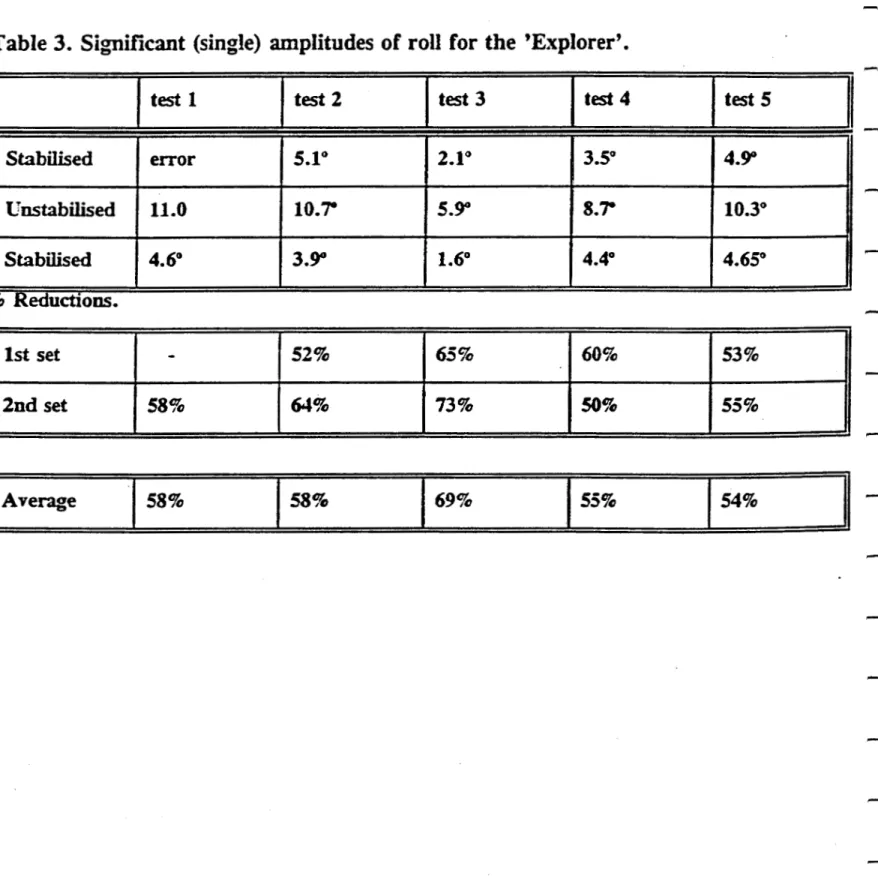
LJTable 3. Significant (single) amplitudes of roll for the 'Explorer'.
Stabilised
UnstabilisedStabilised
test 1 error 11.0 4.6° test 2 5.1° 10.7° 3.9°test 3
2.1°5.9°
1.6° test 4 3.5° 8.7* 4.4°test 5
4.9" 10.3° 4.65°Reductions.
1st set2nd set
-58%
52%
64% 65% 73% 60% 50% 53%55%
Average 58% 58%69%
55% 54%PARAVANE ROLL REDUCTIONS.
Stab
Unstab.
Stab.
Test
3.69°
6.61°
3.61°
% Reductions
1st set
2nd set
44%
45%
u• Histogram shows ;
o60% of roll angles less than 3 degrees with tank.
o35% of roll angles less than 3 degrees with paravanes.
o20% of roll angles less than 3 degrees 'unstabilised'.
o c 3 O O o *?
60
40
20
o0
■-.It \ % \ \A
\
V
2
H ^/ '
rollunstabilised
tank stabilised
paravane stabilised
4 6 8amplitude (deg.)
• ■10
15
10
5
o. h—h unstabilised
, *—v tank stabilised
. — paravane stabilised
-/
\
4
6
8
10
12
roll period (s.)
-14 16Lisa M, Sea Trials in Stern Seas 0.25 0.45 0.65 0.85 frequency (rad/s) 1.05 1.25 1.45
Bow Seas at 600 kg and 670 kg Displacement 10 9 8
7-V
!"
£ 4 3 2 • new bulb -new bulb,670kg old Bulb 1.5 2.5 3 a5Wave Frequency (radii)
4.5