Publisher’s version / Version de l'éditeur:
Vous avez des questions? Nous pouvons vous aider. Pour communiquer directement avec un auteur, consultez la première page de la revue dans laquelle son article a été publié afin de trouver ses coordonnées. Si vous n’arrivez pas à les repérer, communiquez avec nous à [email protected].
Questions? Contact the NRC Publications Archive team at
[email protected]. If you wish to email the authors directly, please see the first page of the publication for their contact information.
https://publications-cnrc.canada.ca/fra/droits
L’accès à ce site Web et l’utilisation de son contenu sont assujettis aux conditions présentées dans le site LISEZ CES CONDITIONS ATTENTIVEMENT AVANT D’UTILISER CE SITE WEB.
Research Report (National Research Council of Canada. Institute for Research in
Construction), 2003-05-01
READ THESE TERMS AND CONDITIONS CAREFULLY BEFORE USING THIS WEBSITE. https://nrc-publications.canada.ca/eng/copyright
NRC Publications Archive Record / Notice des Archives des publications du CNRC :
https://nrc-publications.canada.ca/eng/view/object/?id=5affcc11-5b8c-45a3-b992-bbff3bec8ee2 https://publications-cnrc.canada.ca/fra/voir/objet/?id=5affcc11-5b8c-45a3-b992-bbff3bec8ee2
NRC Publications Archive
Archives des publications du CNRC
For the publisher’s version, please access the DOI link below./ Pour consulter la version de l’éditeur, utilisez le lien DOI ci-dessous.
https://doi.org/10.4224/20379021
Access and use of this website and the material on it are subject to the Terms and Conditions set forth at
FIERAsystem Theory Report: Fire Spread Model (FSPM)
FIERAsystem Theory Report: Fire Spread Model (FSPM)
Kashef, A.; Bénichou, N.; Reid, I.; Hadjisophocleous, G.
IRC-RR-134
FIERAsystem Theory Report: Fire Spread Model (FSPM)
Ahmed Kashef, Noureddine Benichou, Irene Reid, and George Hadjisophocleous
Research Report No. 134
May 2003
Fire Risk Management Program Institute for Research in Construction National Research Council Canada
Table of Contents
Table of Contents ... i List of Figures... i 1. INTRODUCTION...2 2. FSPM DESCRIPTION...3 3. REFERENCES...4List of Figures
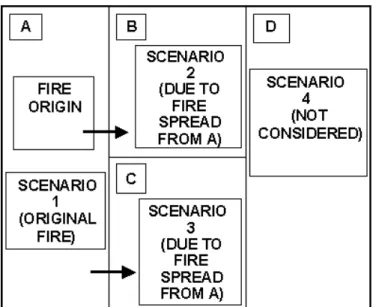
FIGURE 1 EXAMPLE OF FIRE SPREAD IN A MULTI-COMPARTMENT BUILDING...41. INTRODUCTION
As Canada and other countries move from prescriptive-based building codes to performance/objective-based codes, new design tools are needed to aid in demonstrating that compliance with these new codes has been achieved. One such tool is the computer model FiRECAM™, which has been developed over the past decade by the Fire Risk
Management Program of the Institute for Research in Construction at the National Research Council of Canada (NRC). FiRECAM™ is a computer model for evaluating fire protection systems in residential and office buildings that can be used to compare the expected safety and cost of candidate fire protection options.
To evaluate fire protection systems in light industrial buildings, a new computer model is being developed. This model, whose current focus is aircraft hangars and warehouses, is based on a framework that allows designers to establish objectives, select fire scenarios that may occur in the building and evaluate the impact of each of the selected scenarios on life safety, property protection and business interruption. This model will assist engineers and building officials in evaluating, in a clear and concise manner, whether a selected design satisfies the established objectives for a building. The new computer model is called FIERAsystem, which stands for Fire Evaluation and Risk Assessment system [1].
FIERAsystem uses time-dependent deterministic and probabilistic models to evaluate the impact of selected fire scenarios on life, property and business interruption. The main FIERAsystem submodels calculate fire development, smoke movement through a building, time of failure of building elements, and occupant response and evacuation. In addition, there are submodels dealing with the effectiveness of fire suppression systems and the response of fire departments.
This report describes the theoretical framework of the Fire Spread Model (FSPM) of the FIERAsystem. The FSPM code was developed to evaluate the different scenarios involving the fire spreading from a fully-developed fire in the compartment of fire origin to adjacent compartments, corridors, or stairwells in a building. The fire spread from one compartment to an adjacent compartment depends on the fire resistance performance of the boundary element that separates them. The FSPM calculates the time of fire spread to adjacent compartments (delay time) and the heat release rates, temperatures and heat fluxes in the adjacent compartments.
The FSPM can be run independently, or in conjunction with other models to perform a complete risk or hazard analysis. If used in a stand-alone mode, the user should input the fire characteristics in the compartment of fire origin (fire heat release rate, heat fluxes, temperatures) and the delay time.
2. FSPM DESCRIPTION
The FSPM requires the following input: Compartment of fire origin,
Type of fire,
Fire characteristics, such as heat release rates, temperatures, and heat fluxes, as functions of time,
Whether or not the fire department will arrive if notified, Whether or not the suppression system will activate properly.
In order to make fire spread calculations manageable, FSPM only considers fire spread to adjacent compartments. For example, in Figure 1, where the compartment of fire origin is Compartment A, only fire spread to Compartments B and C would be considered. Fire spread to Compartment D would be ignored.
The FSPM shifts the fire characteristic curves (specified by the user, in a stand-alone mode, or calculated by the Fire Development Model [2], in an integrated mode) by a delay time. The delay time is the time at which the boundary element of the compartment of fire origin would fail (fire resistance rating of the boundary element) or the compartment temperature reaches a critical value. For the current version of FSPM, the critical
temperature is set as 1000oC. This temperature represents the expected temperature, from the standard time-temperature curves [3], at a time of 120 min. Different values of the critical temperature could be chosen depending on the level of conservatism required. The feature of setting the value of the critical temperature is not available for the user in the current version, however, it could easily be accommodated in future releases.
The delay time is an input by the user, in the stand-alone mode, or if the FSPM is run in an integrated mode, is calculated automatically for the user. In which case, the delay time is the lesser of the failure time (predicted by Boundary Element Failure Model, BEFM [4]) and the time to reach 1000oC (predicted by the Smoke Movement Model, SMVM [5]). The FSPM main output is:
Time of fire spread to adjacent compartments.
Heat release rates, temperatures and heat fluxes in adjacent compartments.
Figure 1 Example of fire spread in a multi-compartment building
3. REFERENCES
1. Benichou, N., Kashef, A., Torvi, D.A., Hadjisophocleous, G.V., and Reid, I.,
“FIERAsystem: A Fire Risk Assessment Model for Light Industrial Building Fire Safety Evaluation,” IRC Research Report No. 120, Institute for Research in Construction, National Research Council Canada, Ottawa, ON, 2002.
2. Kashef, A., Benichou, N., Torvi, Raboud, D.W., D.A., Hadjisophocleous, G.V., and Reid, I., “FIERAsystem Enclosed Pool Fire Development Model: Theory Report,” IRC
Research Report No. 121, Institute for Research in Construction, National Research Council Canada, Ottawa, ON, 2002.
3. Buhanan, A.H., “Structural Design for Fire Safety”, John Wiley & Sons, Ltd., Baffins Lane, Chichester, England, ISBN 0-471-88993-8.
4. Benichou, N., Kashef, A., and Reid, I., “FIERAsystem Building Boundary Element Failure Model (BEFM): Theory Report,” IRC Research Report No. 135, Institute for Research in Construction, National Research Council Canada, Ottawa, ON, 2003.
5. Fu, Z., Kashef, A., Benichou, N., and Hadjisophocleous, G.V., “FIERAsystem Theory Documentation: Smoke Movement Model,” IRC Internal Report No. 835, Institute for Research in Construction, National Research Council Canada, Ottawa, ON, 2002.