ORIGINAL ARTICLE
DmOAZ, the unique Drosophila melanogaster OAZ
homologue is involved in posterior spiracle development
Anne Krattinger&Nanaë Gendre&Ariane Ramaekers&Nicola Grillenzoni&Reinhard F. Stocker
Received: 9 June 2006 / Accepted: 9 January 2007 / Published online: 15 February 2007 # Springer-Verlag 2007
Abstract In this paper, we study DmOAZ, the unique Drosophila melanogaster homologue of the OAZ zinc finger protein family. We show partial conservation of the zinc finger organization between DmOAZ and the verte-brate members of this family. We determine the exon/intron structure of the dmOAZ gene and deduce its open reading frame. Reverse transcriptase-polymerase chain reaction analysis shows that dmOAZ is transcribed throughout life. In the embryo, strongest DmOAZ expression is observed in the posterior spiracles. We suggest that dmOAZ acts as a secondary target of the Abd-B gene in posterior spiracle development, downstream of cut and ems. In a newly created loss-of-function mutant, dmOAZ93, the“filzkörper” part of the posterior spiracles, is indeed structurally abnormal. The dmOAZ93 mutant is a larval lethal, a phenotype that may be linked to the spiracular defect. Given the dmOAZ93mutant as a new tool, the fruit fly may provide an alternative model for analyzing in vivo the functions of OAZ family members.
Keywords C2H2zinc finger transcription factor .
OAZ protein family . Drosophila melanogaster . dmOAZ mutant . Spiracle development
Introduction
The OAZ (O/E-associated zinc finger protein) family of proteins was recently identified as part of the C2H2 type
zinc finger (ZF) superfamily of transcription factors (Knight and Shimeld 2001). Vertebrate OAZ members are charac-terized by 29–30 ZF domains, which are organized in clusters allowing interaction with either DNA or protein (Tsai and Reed 1997, 1998). OAZ members have been shown to interact with the Olf/EBF transcription factor family (Tsai and Reed1997) as well as with the BMP-Smad signaling pathway (Hata et al.2000). Distinct ZF clusters in OAZ are used in a mutually exclusive manner, participating either in Olf/EBF or BMP-Smad signaling.
To study a developmental role of putative OAZ homologues in Drosophila, we focused on a simple tissue model, i.e., the embryonic and larval posterior spiracles, which previously had served to analyze the genetic basis of differentiation and morphogenesis (Hu and Castelli-Gair
1999). The posterior spiracles are functional during the entire larval life, whereas the anterior pair becomes functional only during the second larval instar (Whitten
1980). The two main structures comprising the posterior spiracles, i.e., the stigmatophore and the spiracular cham-ber, are easily identifiable. The stigmatophore is a dorsal protrusion on the larval tail; the spiracular chamber contains a thin cuticular thread, the “filzkörper”, that may function as an air filter (Manning and Krasnow 1993).
On top of the genetic cascade controlling posterior spiracle development appears to be the homeotic gene Abd-B (Sanchez-Herrero et al. 1985). Ectopic Abd-B expression may induce ectopic filzkörper structures and associated spiracular hairs in thoracic and abdominal segments (Lamka et al. 1992; Castelli-Gair et al. 1994). Downstream of Abd-B, five early target genes [sal, cut (ct),
DOI 10.1007/s00427-007-0134-7
Communicated by P. Simpson
Electronic supplementary material The online version of this article (doi:10.1007/s00427-007-0134-7) contains supplementary material, which is available to authorized users.
A. Krattinger
:
N. Gendre:
A. Ramaekers:
N. Grillenzoni:
R. F. Stocker (*)Department of Biology, University of Fribourg, Ch. du Musée 10,
CH-1700 Fribourg, Switzerland e-mail: [email protected]
empty spiracles (ems), klumpfuss (klu), and nubbin (nub)] and four secondary target genes [engrailed (en), grain (grn), trachealess (trh), and grainy head (grh)] were identified (Hu and Castelli-Gair1999; Hombria and Lovegrove2003). Whereas sal, en, and grn are implied in stigmatophore development, the remaining genes are involved in spirac-ular chamber formation. Hence, the two cell populations comprising the posterior spiracle are distinct in terms of genetic control.
In this paper, we focus on the Drosophila melanogaster OAZ homologue, DmOAZ, the first invertebrate member of the OAZ family and the only member in the fruit fly. Although DmOAZ contains only 21 ZFs compared to 29– 30 ZFs in vertebrate OAZ members, ZF organization is partially conserved. We show that dmOAZ is transcribed throughout life and is strongly expressed in the posterior spiracle of the embryo and larva. In the cascade of transcription factors involved in spiracular development, dmOAZ appears to be a secondary target, downstream of ct and ems. Hence, it may be implied in spiracular chamber specification. dmOAZ93, a newly created loss-of-function mutant, is a larval lethal. dmOAZ93 larvae exhibit a morphologically aberrant filzkörper, suggesting that larval lethality may be due to defective gas exchange.
Materials and methods Fly strains
The following strains—all raised on standard cornmeal medium—were used: wild-type Canton-S, Abd-BM1
, ctdb7, ems9H83, Df(2L)enE, grhB32, Df(2)GR4, salIIB57, Df(2L)5, trh8, Df(2R)L48, and L02736. As marker constructs in which β-galactosidase expression was driven by specific enhancers, we used ct-D2.3, ems-1.2, and grh-D4 (Sarah Bray, unpublished). We also used ems-Gal4, UAS-GFP as reporter line (Merabet et al. 2005). All mutant alleles, deficiencies, and marker constructs were kindly provided by James Castelli-Gair Hombria (Universidad Pablo de Olavide, Sevilla), except Df(2R)L48 and L02736 (from Bloomington stock center). For complementation analysis, genotypes were balanced over CyO. The CyO+ phenotype was used to identify trans-heterozygous individuals result-ing from the cross (n>100 adults scored in all cases). dmOAZ mutants were generated by remobilizing the P[Gal4] element of the GH146 enhancer trap line (Stocker et al.
1997; Heimbeck et al.2001). Bioinformatics tools
For sequence alignment, we used LaLign, Clustal W, and Basic Local Alignment Search Tool (BLAST) athttp://www.
ch.embnet.org/. The BLAST tool offered by Flybase (http:// flybase.bio.indiana.edu/) was used to search conserved members in D. melanogaster and Prosite (http://www. expasy.org/prosite/) to determine the protein motifs. Reverse transcriptase-polymerase chain reaction
Total RNA was isolated from about 20μl of embryos, from 20 third-instar larvae, and 16 adult flies respectively, by using the RNeasy Mini kit and the OneStep Reverse Transcriptase-Polymerase Chain Reaction (RT-PCR) Kit (Qiagen®). Total RNA for homozygous dmOAZ93 mutant was isolated from ten first-instar larvae. RT-PCR was performed on Biometra UNO II, using the primers rp49 as control and the following dmOAZ-specific primers: ATG ATG GCC CTA AAG ATG TTA TAT CG located in exon 1 and GGT GAT GAT GGA AGT GTG GC located in exon 2, which generate two bands corresponding to mRNA (292 bp) and to DNA (1,506 bp).
Sample preparations
Flies were allowed to lay eggs for 17 h at 22°C on small Petri dishes containing 2% agar in 1:1 dH2O and grape
juice. After embryo collection, the chorion was removed by treating with bleach. Embryos were then rinsed with dH2O
and fixed for 20 min in 1:1 heptane and 3.7% formaldehyde in phosphate-buffered saline (PBS). The aqueous phase was removed, and methanol was added to devitellinize the embryos. Embryos were stored in methanol at −20°C. Larval brains were dissected in PBS containing 0.2% Triton X-100 (PBS–Tx 0.2%). They were fixed on ice for 2 h in 4% paraformaldehyde in PBS–Tx 0.2%. After three washes, tissues were dehydrated and then stored in 100% ethanol at−20°C. For adult brain preparation, the proboscis was removed, and the heads were fixed on ice for 2–3 h. Then the brains were dissected in PBS, rinsed in PBS–Tx 0.2%, and further treated as for larvae. For studying spiracular morphology, eggs were checked every hour to collect 0- to 1-h-old first-instar larvae, which were embedded in Dako glycergel.
Antibodies
We used the following primary antibodies and concentrations: preabsorbed sheep anti-Digoxigenin-AP Fab fragments (1:2,000; Roche); preabsorbed sheep anti-Digoxigenin-POD Fab fragments (1:300; Roche); preabsorbed rabbit anti-βgal (1:1,000; Cappel); mouse anti-Fasciclin II (1: 20; provided by C. Goodman, Berkeley); mouse anti-Cut 2B10 (1: 20; obtained from Developmental Study Hybridoma Bank, University of Iowa); and rabbit anti-Sal (1:25; provided by R. Schuh, Göttingen). The following secondary antibodies
were used: biotinylated anti-rabbit (1:500; Vectastain® kit, Vector laboratories); biotinylated anti-mouse (1:500; Vectas-tain); goat anti-mouse Alexa 488 (1:200; Molecular Probes); and goat anti-rabbit Alexa 488 (1:200; Molecular Probes). In situ hybridization and immunostaining
The RNA probe for dmOAZ was generated from the RT-PCR product obtained by using the primers ATG ATG GCC CTA AAG ATG TTA TAT CG located at the exon 1 start and GCT GCA GTT GAA CTC TGA GC located in exon 4 (fragment of 1,646 bp). This RT-PCR product was then subcloned in the pGEM-T easy vector (Promega). The vector was linearized by digesting with Nco I (antisense probes) and with Sal I (sense probes). The RNA probe for grh gene was generated from the RE30607 clone [from Berkeley Drosophila Genome Project (BDGP)], which contains the grh cDNA in the pFLC-1 vector. The linearization was obtained by digesting with Pfl MI. The trh RNA probe was obtained by digesting the RH17284 clone (provided by BDGP), which contains the cDNA of trh gene. It was linearized with Bbv CI. The DNAs were transcribed in vitro by using the Riboprobe Combination System T3/T7 (Promega) and a rNTPs mix containing Digoxigenin-11-UTP (Roche). Subsequently, DNAs were digested, and RNA probes were resuspended in 50% formamide, 50% Tris-EDTA pH 7.5, and 0.1% Tween 20. The yield of in vitro transcription was estimated in a spot test (protocol according to Roche Nonradioactive In Situ Hybridization Manual). The RNA in situ procedure (Tautz and Pfeifle 1989) was adapted for alkaline phosphatase revelation (see: http://www.fruitfly.org/about/methods/ RNAinsitu.html). Anti-Digoxigenin-AP Fab fragments (Roche) were used to detect the probes, and Vectastain® Elite was applied for diaminobenzidine reaction. Specimens were mounted in 80% glycerol.
For fluorescent in situ hybridization, anti-Digoxigenin-POD Fab fragments (Roche) were used to detect probes. The signal was amplified via the tyramide signal amplification system, TSA™-Plus Cyanine 3 System (Perkin-Elmer). The secondary antibody was incubated overnight at 4°C. Lethality counting, food ingestion
To determine lethality rates, 100 eggs were placed each in small Petri dishes containing grape juice agar. Eclosed larvae were counted, but only the homozygous larvae (or heterozygous Df/dmOAZ93larvae) were collected in a new Petri dish for further observation. Development was followed until death; stages were distinguished by mouth hook morphology. Kaplan–Meier survival analysis was performed to test the differences in larval longevity between the control dmOAZ43and the genotypes dmOAZ93,
dmOAZ93/Df, and Df(2R)L48. A total of 600 eggs for the balanced control dmOAZ43, 1,000 for dmOAZ93/CyO, 677 for dmOAZ93/Df(2R)L48, and 400 for Df(2R)L48/CyO were used. Tests were run in Statistical Package for the Social Sciences 13.0. Food ingestion, tested by gut staining, was monitored by placing larvae on food containing 0.05% bromphenol blue.
Results
Sequence analysis of a putative D. melanogaster OAZ homologue
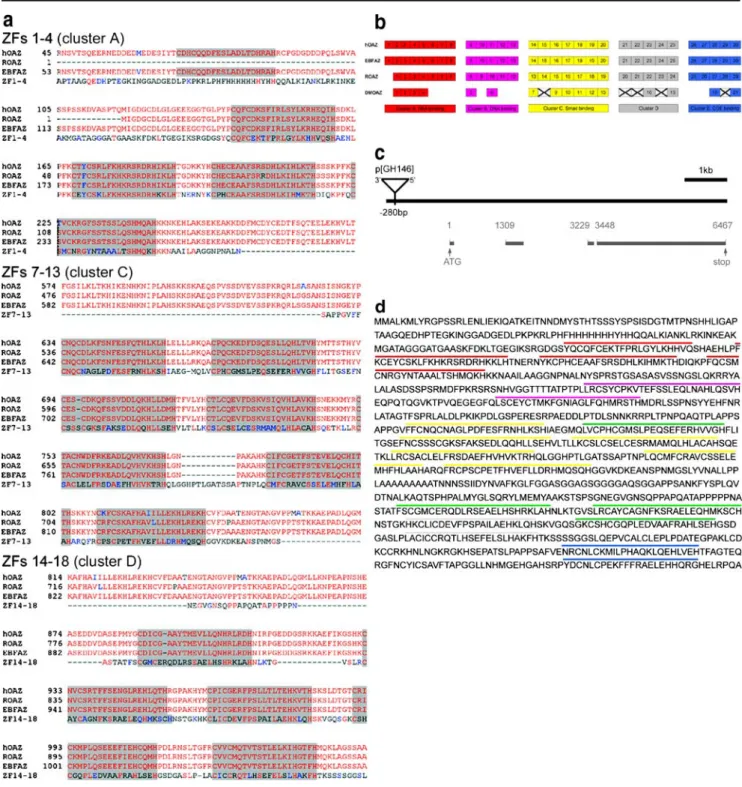
Among the 39 known families of ZF genes, CG17390 was identified as the gene encoding the putative homologue of the OAZ family in the fruit fly genome [referred to in this paper as DmOAZ (D. melanogaster OAZ homologue); (Knight and Shimeld 2001). By using Clustal W software (Thompson et al.1994), we confirmed conservation of the entire sequence of DmOAZ with the human OAZ gene. We obtained 21% identity and 50% similarity (Fig.1a), in spite of a reduced number of 21 ZF domains compared to the 29–30 ZFs present in vertebrates (Tsai and Reed 1997,
1998; Hata et al. 2000; Warming et al. 2003, 2004). We also confirmed that DmOAZ is the unique OAZ member in the fruit fly.
Hata et al. (2000) proposed a model in which the ZF motifs of the OAZ protein are organized in clusters according to their binding ability. They identified four sets of ZFs: (1) two DNA-binding domains (cluster A: ZFs 2– 8 implied in Olf/EBF pathway; cluster B: ZFs 9–13 in BMP-Smad pathway), (2) Smad-binding domain (cluster C: ZFs 14–19), (3) a cluster D with unknown function (ZFs 20–27), and (4) Olf/EBF-binding domain (cluster E; ZFs 28–30). The function of the ZF 1 was not yet characterized. By summarizing the different studies on OAZ family members, we noted that this organization was conserved (Tsai and Reed 1997, 1998; Hata et al.2000; Shim et al.
2002; Ku et al. 2003; Warming et al. 2003, 2004). To structurally analyze the DmOAZ protein, we determined the arrangement of the 21 ZFs in four clusters by using Simple Modular Architecture Research Tool software (http://smart.embl-heidelberg.de; Schultz et al. 1998; Letunic et al. 2004), and we aligned each DmOAZ cluster on the entire sequence of the orthologues. Although clusters A, C and D aligned correctly with their vertebrate counter-parts (Fig. 1a, Electronic Supplementary Fig. 1), no significant alignments were obtained for clusters B and E. When testing the sequence of each ZF motif individually against the entire sequence of the vertebrate homologues, we confirmed that each individual ZF motif belongs indeed to the clusters indicated above, except ZFs 8, 14, 15, 17,
Fig. 1 Protein sequence and ZF organization of DmOAZ and sequence alignment with vertebrate members of the OAZ protein family. a Alignment of the ZF clusters of DmOAZ (D. melanogaster) with the homologous sequences from human (hOAZ; accession number AAF28354), rat (ROAZ; accession number AAB58646), and mouse (EBFAZ; accession number AAG17053), using Clustal W. Significant alignment is obtained for clusters A, C and D (ZFs shown in grey, conserved residues in red). b Sequence alignment reveals considerable conservation of ZF cluster organization between verte-brate and Drosophila OAZ members. All ZFs align correctly except ZFs 8, 14, 15, 17, and 20 of DmOAZ (indicated by a green cross).
c Schematic representation of the dmoaz locus. The genomic map is shown on top, in black. The P[GawB] element of the GH146-Gal4 line is inserted 280 bp upstream of the ATG, in the orientation 3′–5′. ATG represents the initiation codon of the open reading frame. Exon/ intron organization of the transcript is shown below; exons are marked by grey lines, and their positions are indicated as relative distance from ATG (located at 9′973′599 in Flybase and 82′062 in the National Center for Biotechnology Information). Arrows indicate start and stop codons. d Deduced protein sequence of DmOAZ. The 21 zinc fingers are represented by a colored bar. The color corresponds to the different ZF clusters
and 20, which did not align correctly (Fig. 1b). In con-clusion, we obtained correspondence of most of the ZF clusters between DmOAZ and its vertebrate counterparts. However, functional experiments are required to confirm this proposed organization of the DmOAZ ZF domains. Determination of mRNA and DmOAZ encoding sequences in the fruit fly
The CG17390 sequence (Adams et al.2000) is located on the right arm of chromosome II at 51A3–4. It encodes a transcription factor characterized by 21 ZF domains. An incomplete expressed sequence tag (EST) AT08673 of 3,100 base pairs (bp) corresponding to the 3′ end of CG17390 was available from the“EST and BDGP project cDNAs” database. By performing RT-PCR on wild-type flies, we cloned a 1,653-bp fragment corresponding to the 5′ side of dmOAZ, consisting of three exons and the first 855 bp of the EST AT08673.
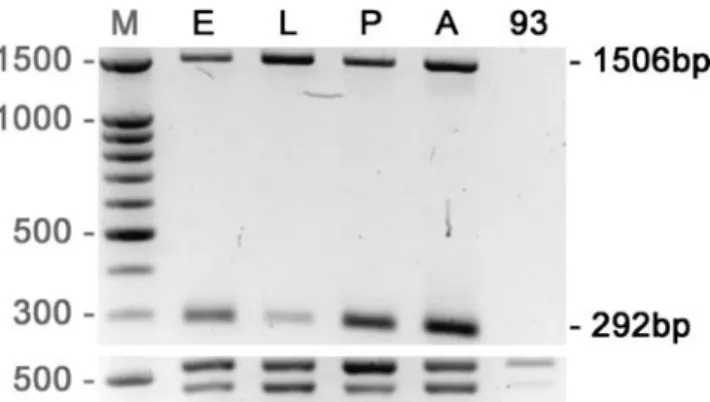
In an extensive RT-PCR analysis of the transcript corresponding to CG17390, we found that CG17390 is coding for a single 3,687-bp transcript (Fig.1c) and that the intron/exon structure of dmOAZ is slightly different from the theoretical structure reported in Flybase. Indeed, we determined an organization consisting of three introns and four exons (exon 3 mentioned in Flybase is missing) in the wild type. Accordingly, we deduced an open reading frame of 1,229 amino acids (Fig.1d). RT-PCR performed in the wild type demonstrated that dmOAZ is transcribed in embryos, first- and third-instar larvae, late pupae, and adults (Fig. 2). The 292-bp bands which were present at each developmental stage represent the dmOAZ mRNA. No
transcriptional difference was observed between males and females at larval and adult stages.
DmOAZ is strongly expressed in posterior spiracles of the embryo
We then focused on embryonic expression of CG17390. We confirmed previous results (cf. BDGP gene expression report; http://www.fruitfly.org/cgi-bin/ex/insitu.pl) also by performing in situ hybridization, and we found additional specific staining in the peripheral nervous system (PNS) from stage 14 (Campos-Ortega and Hartenstein 1997) onward. However, strongest dmOAZ expression was ob-served in the posterior spiracles. DmOAZ staining became visible in their anlage at stage 11 and persisted throughout embryogenesis (Fig.3a–c). Expression was also detected in
both anterior and posterior spiracles of third-instar larvae (Fig.3d), as well as in thoracic and abdominal spiracles of adults (Fig.3e), suggesting that dmOAZ may be involved in spiracle development and function. In the adult, we found additional staining in olfactory projection neurons, which link the primary and secondary olfactory centers.
To study the role of dmOAZ in posterior spiracle development, we determined in which of its two cell populations dmOAZ is expressed. When using an antibody against Spalt (Kuhnlein et al. 1994), which stains exclu-sively the stigmatophore-forming cells, we did not obtain any co-localization, ruling out a role of dmOAZ in this part of the spiracle. In contrast, when we used the reporter lines ems-1.2-lacZ (Jones and McGinnis1993) and grh-D4-lacZ (Sarah Bray, unpublished) that label different groups of cells in the spiracular chamber, about two thirds of the dmOAZ-positive cells were co-labeled by ems-1.2-lacZ (Fig. 3f) and about one third of them by grh-D4-lacZ (Fig. 3g). These lines allowed to show that, during spiracular development, the invagination of the spiracular chamber is accompanied by drastic cell shape changes, such as an elongation of the cells labeled by grh-D4-lacZ (Hu and Castelli-Gair1999). Applying an anti-Cut antibody in combination with dmOAZ in situ hybridization yielded co-labeling in slightly less than half of the dmOAZ-positive cells (Fig. 3h). Correspondingly, DmOAZ is co-expressed in a partially overlapping pattern with Ct protein and with ems and grh reporter lines.
dmOAZ acts downstream of ems and cut in posterior spiracle development
Previous works have shown that Abd-B—loss-of-function alleles of which lack the posterior spiracles—initiates the developmental cascade of this organ (Lamka et al. 1992) and that two categories of genes are the targets of Abd-B (Hu and Castelli-Gair1999; Hombria and Lovegrove2003;
Fig. 2 Transcription of dmOAZ in the wild-type Canton S and in the mutant dmOAZ93 of D. melanogaster. RT-PCR with a primer set specific for dmOAZ transcript shows the presence of the dmOAZ transcript in embryos (E), larvae (L), pupae (P), and adults (A) of the wild type but not in homozygous dmOAZ93first-instar larvae (93). We
used primers located in exon 1 and 2, respectively. Therefore, the 1,506-bp and 292-bp bands represent, respectively, the DNA and mRNA. As a control, we performed RT-PCR with the primer set specific for rp49 transcript to determine the presence of mRNA and DNA. Total RNA was efficiently isolated for each sample. M marker
Merabet et al. 2005). The sal gene (Kuhnlein et al.1994) and its targets en (Patel et al. 1989) and grn (Brown and Castelli-Gair Hombria 2000) are implicated in stigmato-phore development, whereas ct (Blochlinger et al. 1990), ems (Walldorf and Gehring 1992; Dalton et al. 1989), klu (Klein and Campos-Ortega1997), and nub (Ng et al.1995), as well as the two genes trh (Isaac and Andrew1996) and grh (Bray and Kafatos1991)—both downstream of ct and
ems—are involved in spiracular chamber formation. To localize dmOAZ in this cascade, we performed dmOAZ in situ hybridization on mutant embryos. As DmOAZ is specifically expressed in the cell population forming the spiracular chamber, we expected its expression to be affected specifically in mutants for genes involved in chamber development. Indeed, dmOAZ expression in the posterior spiracle was abolished in Abd-BM1 and ems9H83
mutants (Fig. 4a,b). This suggests that dmOAZ is not an early target of Abd-B but rather a secondary target acting downstream of ems. In addition, the number of dmOAZ-expressing cells in the posterior spiracle was also reduced by less than a half in the ctdb7mutant (Fig.4c). In contrast, the number of cells expressing Cut was not reduced in homozygous dmOAZ93mutant embryos as compared to CS embryos, confirming that dmOAZ does not act upstream of cut (Fig. 3h 2,i). This result suggests that dmOAZ expression may be regulated both by ems and ct. However, cut seems to control dmOAZ expression only in a subset of dmOAZ-expressing cells. With other spiracular chamber mutant lines, grhB32, trh8, and Df(2)GR4 [deficient for pdm-1 (nub) and the structurally related gene pdm-2], we obtained normal dmOAZ expression (Fig. 4d,e). We also studied the grh and trh expression patterns in the dmOAZ93
Fig. 3 Expression pattern of dmOAZ mRNA. (a–e) In situ hybridization with a dmOAZ-specific RNA probe and alkaline phosphatase staining in the Canton S wild type. Lateral view (a 1–c 1) and dorsal view (a 2–c 2) of embryos showing the presence of dmOAZ mRNA in spiracles (SP). a Stage 11, b stage 13, c stage 16. Addi-tional staining is revealed in the ventral PNS from stage 13. d In third-instar larvae, staining was observed in anterior (d 1) and posterior spiracles (d 2); e in adults, label was present in thoracic (e 1) and abdominal spiracles (e 2). f, g In stage 16 posterior spiracles, dmOAZ RNA (red) partially co-localizes withβgal expression (green) of ems- and grh-reporter lines (in-dicated on panels). h, i Cut protein and DmOAZ mRNA partially co-localize in posterior spiracles (h 1) and the cut-expressing cells are maintained in dmOAZ93(compare h 2 and i)
mutant. We performed in situ hybridization with RNA probes of the grh and trh genes, respectively, and we observed no difference in mRNA presence of these two genes in homozygous dmOAZ93 mutant embryos as
compared to CS embryos, confirming that dmOAZ does not act upstream of grh and trh genes (Fig.4g,h).
Not surprisingly, DmOAZ expression was not modified in mutants affecting stigmatophore development, i.e.,
Fig. 4 dmOAZ in situ hybrid-ization at embryonic stage 16 in the different mutants implied in the development of the posterior spiracle (black arrows). a, b dmOAZ-specific staining is abolished in the posterior spi-racles of Abdominal-B (a) and empty spiracles (b) mutants. c In cut, the number of dmOAZ-expressing cells (white arrow-head) is reduced (compare c 2 with c 3). d–f dmOAZ-specific staining is maintained at wild-type levels in grainy head (d), trachealess (e) and spalt (f 1). In spalt and spalt-r mutants (f 2), dmOAZ-expressing cells were observed to be split into two groups (white arrow) in 15% of the homozygous mutant embry-os. g–h Both grh-(g) and trh-specific staining (h) are maintained at wild-type levels in dmOAZ93mutant embryos
salIIB57 and Df(2L)enE (deficient for en and invected; Fig. 4f 1). Taken together, these data suggest that the dmOAZ gene is specifically involved in spiracular chamber development but not in stigmatophore development. Nev-ertheless, dmOAZ-labelled cells showed a certain disorga-nization in the Df(2L)5 line (deficient for sal and sal-r) in one sixth of the homozygous mutants (Fig. 4f 2). Specifically, some cells were separated from the main group of dmOAZ-expressing cells. This particular pattern could be a consequence of a general disorganization of the posterior spiracle due to the absence of both sal and sal-r. Generation of a dmOAZ loss-of-function mutation
To study the function of DmOAZ in spiracle development, we generated dmOAZ mutants. The P[GawB] transposable element of the GH146-Gal4 enhancer trap line (Stocker et al. 1997; Heimbeck et al. 2001) is inserted close to the dmOAZ map position at 51A3-4. We cloned and sequenced the P element-flanking sequences by inverse PCR (Dalby et al.1995). Blast analysis revealed that P[GH146] is ideally inserted 280 bp upstream of the dmOAZ start codon (at position 9′973′599 on 2R). Hence, we created dmOAZ mutants by remobilizing the P[GH146] transposable ele-ment. From the 180 isolated lines, we recovered 20 homozygous lethal lines and characterized one of them, dmOAZ93, in more detail.
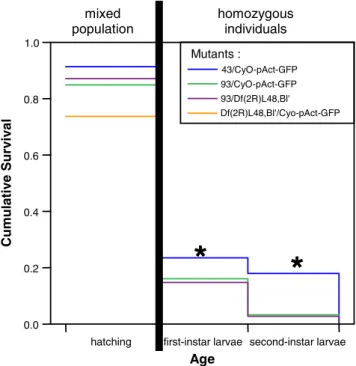
We first determined the developmental stage at which lethality occurred in dmOAZ93 (Fig. 5). To qualify and quantify this phenotype, we used the precise excision line dmOAZ43as a control. dmOAZ43individuals were observed to reach the third larval instar or subsequent stages. To determine if lethality was due to the loss-of-function of the dmOAZ gene, we studied heterozygous Df(2R)L48/ dmOAZ93 individuals, Df(2R)L48 covering the dmOAZ region (Jürgens 1985; Schüpbach and Wieschaus 1991; Chang et al. 1995; Dickson et al. 1995). The hatching column in Fig. 5 refers to a mixed population of homozygous and heterozygous embryos. We noted weak lethality due to the manipulation (Fig. 5). For the larval stages, only the fraction of non-balanced individuals from the eclosed larvae was considered (dmOAZ43, dmOAZ93, dmOAZ93/Df(2R)L48, and Df(2R)L48, respectively): there-fore, the maximal theoretical value that we can obtain is about 33%, as the homozygous CyO individuals are late-embryonic or early-larval lethals. The value of about 25% for the homozygous dmOAZ43 larvae is, in fact, a good control. Of course, the weak lethality due to the manipu-lation is also present in larval stages. However, Kaplan– Meier survival analysis showed that the lethality rate of homozygous dmOAZ93 individuals was not significantly different from dmOAZ93/Df(2R)L48, whereas dmOAZ43 was significantly different from all others (Fig.5; p≪0.01).
Hence, we conclude that dmOAZ93 is a genetically null allele. In agreement with this interpretation, both in situ hybridization and RT-PCR experiments did not reveal any dmOAZ mRNA in homozygous dmOAZ93embryos or first-instar larvae (Fig.2).
To verify whether lethality is due to a mutation in the dmOAZ locus rather than in adjacent loci, we performed complementation tests. On the one hand, we used Df(2R) L48, which covers the 5′ and 3′ regions surrounding the dmOAZ locus. On the other hand, we studied a homozy-gous lethal recessive allele of Lobe, L02736, mapping to the 3′ side of dmOAZ. A similar experiment for the 5′ side was not performed because PCR demonstrated that this region is intact in dmOAZ93(data not shown). From this experiment, we conclude that larval lethality is indeed due to dmOAZ loss-of-function.
The dmOAZ loss-of-function mutation impairs spiracle morphogenesis
To study whether larval lethality is due to a feeding defect, vital dye was added to the food. Homozygous dmOAZ93 first-and second- instar larvae showed characteristic gut staining, similar to balanced dmOAZ93larvae (data not shown). Hence, a feeding defect as a cause of lethality can be excluded.
hatching first-instar larvae
Age 0.0 0.2 0.4 0.6 0.8 1.0 Cumulat ive Sur viva l Mutants : 43/CyO-pAct-GFP 93/CyO-pAct-GFP 93/Df(2R)L48,Bl' Df(2R)L48,Bl'/Cyo-pAct-GFP second-instar larvae
*
*
mixed population homozygous individualsFig. 5 Survival rates of dmOAZ mutant larvae. The survival rate of dmOAZ93 is not significantly different from dmOAZ93/Df(2R)L48,
while the survival rate of the dmOAZ43 control is significantly
different from the other genotypes (asterisk p≪0.01; Kaplan–Meier survival analysis). The hatching column refers to a mixed population of homozygous and heterozygous individuals, while for first- and second-instar larvae, only the non-balanced individuals were consid-ered (dmOAZ43, dmOAZ93, dmOAZ93/Df(2R)L48, and Df(2R)L48, respectively)
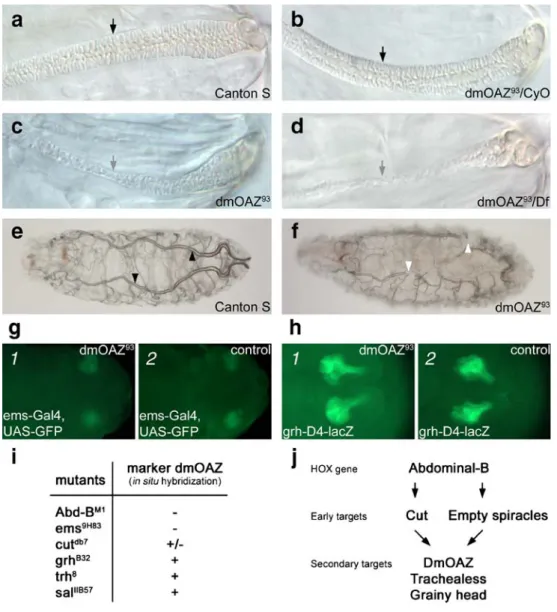
Given the strong expression of dmOAZ in posterior spiracles, we studied the morphology of this structure in newly eclosed first-instar larvae (0 to 1-h-old). Although heterozygous larvae dmOAZ93(Fig.6b) showed a filzkörper structure comparable to the wild type (Fig.6a), the filzkörper was obviously thinner and more elongated both in
homozygous dmOAZ93 (Fig. 6c) and in Df(2R)L48/ dmOAZ93larvae (Fig. 6d). In contrast, the spiracular hairs looked normal in these two mutant conditions. These results further support an implication of the dmOAZ gene in the morphogenesis of the posterior spiracle.
Fig. 6 a–h Structural and functional mutant phenotypes in the posterior spiracle and tracheae, i summary of dmOAZ expression in different mutant background, and (j) proposed model of genetic control of posterior spiracle development. a–f Mutant effects in posterior spiracles and tracheal branches of 0- to 1-hr-old dmOAZ93 larvae (Nomarski optics). While the filzkörper shows constant thickness (black arrows) in the wild type (a) and in heterozygous dmOAZ93 larvae (b), it is extended and thinner (grey arrows) in
homozygous dmOAZ93larvae (c) and in heterozygous dmOAZ93/Df
(2R)L48 larvae (d). e, f Air fills completely the main tracheal branch in the wild type (e, black arrowheads), but not in the dmOAZ93mutant (f, white arrowheads). g–h In two subsets of spiracular chamber cells, labeled by the reporter lines ems-Gal4, UAS-GFP (stage 12, g) and
grh-D4-lacZ (stage 14, h), respectively, no changes in shape and position were observed when comparing their patterns in the dmOAZ93
mutant background (g 1,h 1) and the control background (g 2,h 2). i Summary of dmOAZ expression in various mutants (+, normal expression; +/−, reduced expression; −, no expression). Note that the cutdb7 mutant partially removes dmOAZ expression. j Proposed genetic cascade controlling spiracular chamber formation (cf. Hu and Castelli-Gair1999; Hombria and Lovegrove2003). DmOAZ appears to be a secondary target of Abd-B, downstream of the cut and ems. However, cut controls only a subset of dmOAZ-expressing cells. The hierarchical interactions between dmOAZ, trh and grh remain to be determined
Because the posterior spiracle is the unique gas exchange site in first-instar larvae, we postulated that the spiracular mutant phenotype in dmOAZ93 may cause a defective air entry. Indeed, we observed the tracheal system, and we found that the main tracheal branches are only partially filled with air in dmOAZ93mutants (Fig.6f), whereas the air fills the entire tracheal system in the wild type (Fig.6e).
To further characterize the spiracular defect in dmOAZ93, we studied the staining patterns of the two reporter lines ems-Gal4, UAS-GFP, and grh-D4-lacZ that label subsets of spiracular chamber cells (see above). Yet, at embryonic stages 11 to 17, we did not observe any changes in these cells (concerning their shape or position) in homozygous dmOAZ93 mutant background compared to wild-type background (Fig. 6g 1,h 1 with g 2,h 2, respectively). Hence, the spiracular chamber cells labeled by ems-Gal4, UAS-GFP, and grh-D4-lacZ reporter lines develop normal-ly in dmOAZ93.
Discussion
In this paper, we focus on DmOAZ, the unique D. melanogaster homologue of the OAZ family and the first identified OAZ member in invertebrates. Given that the two-dimensional protein structure of DmOAZ is largely conserved compared to its vertebrate counterparts, we propose Drosophila as a new model for studying the function of OAZ proteins. A useful tool will be the newly isolated dmOAZ93null allele, allowing to study the genetic interactions of OAZ in vivo. Moreover, we found that DmOAZ plays a role in the development of the posterior spiracle, a model organ for investigating the genetic basis of tissue morphogenesis.
As members of the superfamily of C2H2ZF
transcrip-tion factors, OAZ proteins are able to interact with either DNA, RNA, and/or protein, depending on which clusters of ZFs are used (Iuchi 2001). The 21 ZF motifs of DmOAZ are arranged in four clusters comparable to their vertebrate counterparts. Are the functions of these four clusters conserved between the different members? The ZFs 1–3 of DmOAZ have a very high identity score (67 to 83%), suggesting that the N-terminal ZFs 1–3 in DmOAZ could also be involved in DNA-binding, similar to the corresponding OAZ ZFs 2–4. However, further experiments designed to test possible cluster interactions and DNA-and protein-binding capac-ities are required to confirm this hypothesis. Moreover, a systematic screen should be performed to determine possible partners of DmOAZ in D. melanogaster cDNA libraries. This would allow to further elucidate the functions of DmOAZ.
By remobilizing the transposable P[GawB] of GH146-Gal4 (Stocker et al. 1997; Heimbeck et al.2001), which is located just 280 bp upstream of the DmOAZ start codon, we created a number of mutant lines. From an initial 180 strains, no viable mutation in dmOAZ was recovered, arguing that this locus plays an important role in viability. By genomic analysis and complementation test, we de-duced that in the mutant characterized in more detail, dmOAZ93, exclusively the dmOAZ locus is affected by the P excision. Moreover, we determined by in situ hybridization, by RT-PCR, and by testing larval lethality of dmOAZ93over a deficiency that this allele represents a loss-of-function mutation.
The posterior spiracle is crucial for respiration, in particular during the first and second larval instars, when it is the only functional site for gas exchange. Our data show that the filzkörper morphology is defective in the dmOAZ93 mutant, and we also observed that the air does not completely fill the main tracheal branches. None of the other posterior spiracle mutants (sal, ct, ems, grh, and trh mutants) exhibit comparable filzkörper phenotypes. We thus propose that the dmOAZ gene is implicated in shaping this structure. Our data suggest that in the genetic cascade of posterior spiracle development (Hombria and Lovegrove
2003), dmOAZ is acting downstream of ct and ems. The proteins encoded by the three genes are co-localized in subsets of spiracular chamber cells. Hence, Ct and Ems transcription factors could interact either directly or indirectly with DmOAZ. Moreover, both grh and trh mRNA show wild-type localization in the dmOAZ93 mutant, suggesting that DmOAZ does not act upstream the grh and trh genes. Therefore, we postulate that DmOAZ on the one hand and Grh and Trh on the other act independently of each other in posterior spiracle develop-ment, at the same level of the cascade (Fig. 6j).
The posterior spiracles can be considered an interesting model for morphogenesis. They are easy to observe, and the two cell populations comprising this structure are formed by two different morphogenetic mechanisms (Hu and Castelli-Gair 1999). The inner cells develop into the spiracular chamber by a process of invagination and elongation, whereas the surrounding cells give rise to the stigmatophore by changing their relative positions. Each cell population requires different genes, all of which are early targets of Abd-B. We did not observe any changes concerning the elongation or invagination of the cells labeled by the two reporter lines grh-D4-lacZ and ems-Gal4, UAS-GFP, suggesting that DmOAZ does not act on shaping these groups of cells. However, we cannot exclude that DmOAZ plays a role in the elongation and/or invagina-tion of other cells that take part in posterior spiracle development, as the patterns of the used reporter lines do not overlap completely with DmOAZ-expressing cells.
The Smad-bone morphogenetic proteins (BMP) signal-ing pathway in D. melanogaster is involved in the regu-lation of numerous fundamental processes (Hogan 1996). Furthermore, signal transduction in the Smad-BMP path-way is conserved between vertebrates and invertebrates. A well-known member of the BMP signaling pathway in the fruit fly is represented by the morphogen Decapentaplegic (Dpp). Interestingly, hypomorphic dpp mutants show an abnormal or even missing filzkörper (Wharton et al.1993). Because an interaction between OAZ and BMP was shown in vertebrates and because the Smad-binding domains are conserved in DmOAZ, we suggest a possible interaction between DmOAZ and Dpp in the morphogenesis of the filzkörper. Such an interaction could be achieved either at the Smad step by a protein–protein interaction, and/or at the DNA level mediated by a BMP response element domain in the promoter region of Dpp-target genes.
The first identified member of the Olf/EBF family was shown to be implicated in the differentiation of the mammalian olfactory epithelium (Olf-1; Wang and Reed
1993) and of B-lymphocytes (EBF; Hagman et al. 1993). Crozatier et al. (1996) identified the Olf/EBF homologue of D. melanogaster and termed this family of transcription factors the Collier/Olf/EBF (COE) family. An association between COE and OAZ (indicated by the terminology: Olf/ EBF-associated zinc finger protein) was proposed in several studies (Hata et al. 2000; Tsai and Reed 1997, 1998). Collier is the unique fruit fly member of the COE family with a structure highly conserved with mammalian COE. Although we did not find conservation between the entire OAZ cluster E (Olf/EBF-binding domain) and DmOAZ (ZFs 19–21), we observed correct alignment of the ZFs 19 and 21 on the OAZ cluster E. Hence, it will now be very interesting to test a possible interaction between DmOAZ and Collier.
Acknowledgment This work was supported by the Swiss National Funds (grants No. 3100A0-105517 [RFS] and 3234-069273.02 [AR]), Roche Research Foundation, and Fondation Aetas. We are very grateful to Dr. James Castelli-Gair (Centro Andaluz de Biologia del Desarrollo, Universidad Pablo de Olavide, Spain) for providing numerous D. melanogaster strains. We also thank Dr. L.-F. Bersier (Université de Fribourg) for help with statistics and survival analysis, Dr. G. Heimbeck for advice, and J. Meuwly and S. Vuichard for complementation tests.
References
Adams MD et al (2000) The genome sequence of Drosophila melanogaster. Science 287:2185–2195
Blochlinger K, Bodmer R, Jan LY, Jan YN (1990) Patterns of expression of cut, a protein required for external sensory organ development in wild-type and cut mutant Drosophila embryos. Genes Dev 4:1322–1331
Bray SJ, Kafatos FC (1991) Developmental function of Elf-1: an essential transcription factor during embryogenesis in Drosophila. Genes Dev 5:1672–1683
Brown S, Castelli-Gair Hombria J (2000) Drosophila grain encodes a GATA transcription factor required for cell rearrangement during morphogenesis. Development 127:4867–4876
Campos-Ortega JA, Hartenstein V (1997) The embryonic develop-ment of Drosophila melanogaster. Springer, Berlin Heidelberg New York
Castelli-Gair JE, Greig S, Micklem G, Akam ME (1994) Dissecting the temporal requirements for homeotic gene function. Development 120:1983–1995
Chang HCY, Solomon NM, Wassarman DA, Karim FD, Therrien M, Rubin GM, Wolff T (1995) Phyllopod functions in the fate determination of a subset of photoreceptors in Drosophila. Cell 80:463–472
Crozatier M, Valle D, Dubois L, Ibnsouda S, Vincent A (1996) Collier, a novel regulator of Drosophila head development, is expressed in a single mitotic domain. Curr Biol 6:707–718 Dalby B, Pereira, AJ, Goldstein LSB (1995) An inverse PCR screen
for the detection of P element insertions in cloned genomic intervals in Drosophila melanogaster. Genetics 139:757–766 Dalton D, Chadwick R, McGinnis W (1989) Expression and
embryonic function of empty spiracles: a Drosophila homeo box gene with two patterning functions on the anterior–posterior axis of the embryo. Genes Dev 3:1940–1956
Dickson BJ, Dominguez M, van der Straten A, Hafen E (1995) Control of Drosophila photoreceptor cell fates by phyllopod, a novel nuclear protein acting downstream of the Raf kinase. Cell 80:453–462
Hagman J, Belanger C, Travis A, Turck CW, Grosschedl R (1993) Cloning and functional characterization of early B-cell factor, a regulator of lymphocyte-specific gene expression. Genes Dev 7:760–773
Hata A, Seoane J, Lagna G, Montalvo E, Hemmati-Brivanlou A, Massague J (2000) OAZ uses distinct DNA- and protein-binding zinc fingers in separate BMP-Smad and Olf signaling pathways. Cell 100:229–240
Heimbeck G, Bugnon V, Gendre N, Keller A, Stocker F (2001) A central neural circuit for experience-independent olfactory and courtship behavior in Drosophila melanogaster. Proc Natl Acad Sci USA 98:15336–15341
Hogan BL (1996) Bone morphogenetic proteins in development. Curr Opin Genet Dev 6:432–438
Hombria JC, Lovegrove B (2003) Beyond homeosis—HOX function in morphogenesis and organogenesis. Differentiation 71:461–476 Hu N, Castelli-Gair J (1999) Study of the posterior spiracles of Drosophila as a model to understand the genetic and cellular mechanisms controlling morphogenesis. Dev Biol 214:197–210 Isaac DD, Andrew DJ (1996) Tubulogenesis in Drosophila: a
requirement for the trachealess gene product. Genes Dev 10:103–117
Iuchi S (2001) Three classes of C2H2 zinc finger proteins. Cell Mol Life Sci 58:625–635
Jones B, McGinnis W (1993) The regulation of empty spiracles by abdominal-B mediates an abdominal segment identity function. Genes Dev 7:229–240
Jürgens G (1985) A group of genes controlling the spatial expression of the bithorax complex in Drosophila. Nature 316:153–155 Klein T, Campos-Ortega JA (1997) klumpfuss, a Drosophila gene
encoding a member of the EGR family of transcription factors, is involved in bristle and leg development. Development 124:3123–3134
Knight RD, Shimeld SM (2001) Identification of conserved C2H2 zinc-finger gene families in the bilateria. Genome Biol 2: RESEARCH0016
Ku MC, Stewart S, Hata A (2003) Poly(ADP-ribose) polymerase 1 interacts with OAZ and regulates BMP-target genes. Biochem Biophys Res Commun 311:702–707
Kuhnlein RP, Frommer G, Friedrich M, Gonzalez-Gaitan M, Weber A, Wagner-Bernholz JF, Gehring WJ, Jäckle H, Schuh R (1994) spalt encodes an evolutionarily conserved zinc finger protein of novel structure which provides homeotic gene function in the head and tail region of the Drosophila embryo. EMBO J 13:168–179 Lamka ML, Boulet AM, Sakonju S (1992) Ectopic expression of
UBX and ABD-B proteins during Drosophila embryogenesis: competition, not a functional hierarchy, explains phenotypic suppression. Development 116:841–854
Letunic I, Copley RR, Schmidt S, Ciccarelli FD, Doerks T, Schultz J, Ponting CP, Bork P (2004) SMART 4.0: towards genomic data integration. Nucleic Acids Res 32:D142–144
Manning G, Krasnow MA (1993) Development of the Drosophila tracheal system. In: Bate M, Martinez Arias A (eds) The development of Drosophila melanogaster, vol 1. Cold Spring Harbor Lab Press, pp. 609–685
Merabet S, Hombria JC, Hu N, Pradel J, Graba Y (2005) Hox-controlled reorganisation of intrasegmental patterning cues under-lies Drosophila posterior spiracle organogenesis. Development 132:3093–3102
Ng M, Diaz-Benjumea FJ, Cohen SM (1995) nubbin encodes a POU-domain protein required for proximal–distal patterning in the Drosophila wing. Development 121:589–599
Patel NH, Martin-Blanco E, Coleman KG, Poole SJ, Ellis MC, Kornberg TB, Goodman CS (1989) Expression of engrailed proteins in arthropods, annelids, and chordates. Cell 58:955–968 Sanchez-Herrero E, Vernos I, Marco R, Morata G (1985) Genetic organization of Drosophila bithorax complex. Nature 313:108– 113
Schultz J, Milpetz F, Bork P, Ponting CP (1998) SMART, a simple modular architecture research tool: identification of signaling domains. Proc Natl Acad Sci USA 95:5857–5864
Schüpbach T, Wieschaus E (1991) Female sterile mutations on the second chromosome of Drosophila melanogaster. II. Mutations blocking oogenesis or altering egg morphology. Genetics 129:1119–36
Shim S, Bae N, Han JK (2002) Bone morphogenetic protein-4-induced activation of Xretpos is mediated by Smads and Olf-1/
EBF associated zinc finger (OAZ). Nucleic Acids Res 30:3107– 3117
Stocker RF, Heimbeck G, Gendre N, de Belle JS (1997) Neuroblast ablation in Drosophila P[GAL4] lines reveals origins of olfactory interneurons. J Neurobiol 32:443–456
Tautz D, Pfeifle C (1989) A non-radioactive in situ hybridization method for the localization of specific RNAs in Drosophila embryos reveals translational control of the segmentation gene hunchback. Chromosoma 98:81–85
Thompson JD et al (1994) CLUSTAL W: improving the sensitivity of progressive multiple sequence alignment through sequence weighting, position-specific gap penalties and weight matrix choice. Nucleic Acids Res 22:4673–4680
Tsai RY, Reed RR (1997) Cloning and functional characterization of Roaz, a zinc finger protein that interacts with O/E-1 to regulate gene expression: implications for olfactory neuronal development. J Neurosci 17:4159–4169
Tsai RY, Reed RR (1998) Identification of DNA recognition sequences and protein interaction domains of the multiple-Zn-finger protein Roaz. Mol Cell Biol 18:6447–6456
Walldorf U, Gehring WJ (1992) Empty spiracles, a gap gene containing a homeobox involved in Drosophila head development. EMBO J 11:2247–2259
Wang MM, Reed RR (1993) Molecular cloning of the olfactory neuronal transcription factor Olf-1 by genetic selection in yeast. Nature 364:121–126
Warming S, Liu P, Suzuki T, Akagi K, Lindtner S, Pavlakis GN, Jenkins NA, Copeland NG (2003) Evi3, a common retroviral integration site in murine B-cell lymphoma, encodes an EBFAZ-related Krüppel-like zinc finger protein. Blood 101:1934–1940 Warming S, Suzuki T, Yamaguchi TP, Jenkins NA, Copeland NG
(2004) Early B-cell factor-associated zinc-finger gene is a frequent target of retroviral integration in murine B-cell lympho-mas. Oncogene 23:2727–2731
Wharton KA, Ray RP, Gelbart WM (1993) An activity gradient of decapentaplegic is necessary for the specification of dorsal pattern elements in the Drosophila embryo. Development 117:807–822
Whitten J (1980) The tracheal system. In: Ashburner M, Wright TRF (eds) The genetics and biology of Drosophila, vol 2d. Academic, London, 499–540