
Uniting local and global observers for the state estimation of nonlinear continuous-time systems
Texte intégral
Figure
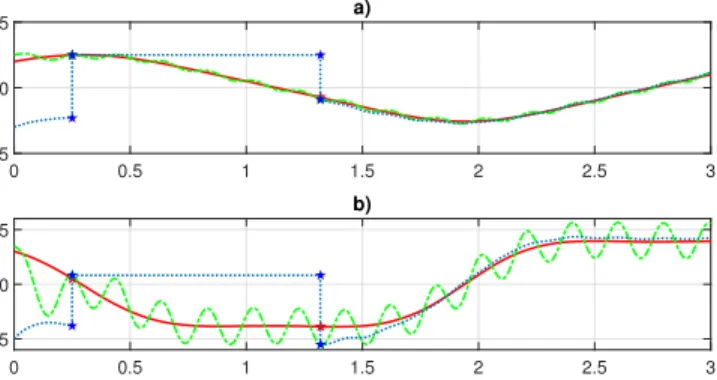
![Figure 1 shows the plots of x(t, j), x ˆ 0 (t, j) and x ˆ 1 (t, j), for (t, j) ∈ [0, 3]×{0, 1, 2}, while Figure 2 shows the plot of the error estimate e(t, j) defined as e := x − ˆ x and the value of the error norm estimator z(t, j), for (t, j) ∈ [0, 3]× {](https://thumb-eu.123doks.com/thumbv2/123doknet/14507351.529037/6.918.80.450.89.363/figure-shows-plots-figure-shows-estimate-defined-estimator.webp)
Documents relatifs
Abstract: In this work an observer for a class of delayed nonlinear triangular systems with multiple and simple time-delay is proposed.. The main feature of this observer is that it
Remark 3.1: In order to emphasize the relationship between the rate of the exponential decreasing to zero and the ultimate bound of the observation error given by the continuous
Our objective consists in designing an exponential continuous-discrete time observer that provides continuous- time estimates of the whole state of system (1) from the
In recent years, it has also been extended to systems with distributed dynamics, with examples in open channel level control (Besan¸ con et al., 2008) or monitoring (Bedjaoui et
This problem is solved next (locally at the origin). It is shown that this homogeneous approximation always exists and is explicitly constructed. Similarly to the case
The documents may come from teaching and research institutions in France or abroad, or from public or private research centers.. L’archive ouverte pluridisciplinaire HAL, est
This paper provides a global observer for uniformly observable systems which means that the parameters of the observer can be set once and then will provide finite time
Sufficient and necessary geometric conditions are given in order to transform a special class of nonlinear systems to the proposed nonlinear canonical form and the corresponding
