HAL Id: hal-00827042
https://hal.archives-ouvertes.fr/hal-00827042
Preprint submitted on 28 May 2013
HAL is a multi-disciplinary open access
archive for the deposit and dissemination of
sci-entific research documents, whether they are
pub-lished or not. The documents may come from
teaching and research institutions in France or
abroad, or from public or private research centers.
L’archive ouverte pluridisciplinaire HAL, est
destinée au dépôt et à la diffusion de documents
scientifiques de niveau recherche, publiés ou non,
émanant des établissements d’enseignement et de
recherche français ou étrangers, des laboratoires
publics ou privés.
Towards a theory of extremely intermittent pulsars I:
Does something orbits PSR B1931 + 24 ?
Fabrice Mottez, Jean Heyvaerts, Silvano Bonazzola
To cite this version:
Fabrice Mottez, Jean Heyvaerts, Silvano Bonazzola. Towards a theory of extremely intermittent
pulsars I: Does something orbits PSR B1931 + 24 ?. 2013. �hal-00827042�
May 29, 2013
Towards a theory of extremely intermittent
pulsars
I: Does something orbits PSR B1931 + 24 ?
F. Mottez
1, S. Bonazzola
1, and J. Heyvaerts
2,1,1 LUTH, Observatoire de Paris, CNRS, Unviersité Paris Diderot, 5 place Jules Janssen, 92190 Meudon,
France.
e-mail: [email protected]
2 Université de Strasbourg
e-mail: [email protected]
Preprint online version: May 29, 2013
ABSTRACT
Aims.We investigate whether one or many companions are orbiting the extremely intermittent pulsar PSR B1931+24.
Methods.We constrained our analysis on previous observations of eight fundamental properties of PSR B1931+24. The most puzzling properties are the intermittent nature of the pulsar’s activity, with active and quiet phases that alternate quasi-periodically; the variation of the slowing-down rate of its period between active and quiet phases; and because there are no timing residuals, it is highly unlikely that the pulsar has a massive companion. Here, we examine the effects that one putative companion immersed in the magnetospheric plasma or the wind of the pulsar might have, as well as the associated electric current distribution. We analysed several possibilities for the distance and orbit of this hypothetical companion and the nature of its interaction with the neutron star.
Results.We show that if the quasi-periodic behaviour of PSR B1931+24 was caused by a companion orbiting the star with a period of 35 or 70 days, the radio emissions, usually considered to be those of the pulsar would in that specific case be emitted in the companion’s environment. We analysed four possible configurations and conclude that none of them would explain the whole set of peculiar properties of PSR 1931+24. We furthermore considered a period 70 days for the precession of the periastron associated to an orbit very close to the neutron star. This hypothesis is analysed in a companion paper.
Conclusions.
1. Introduction
The pulsar PSR B1931+24, qualified as extremely intermittent, is characterised by two radiation regimes. The on regime corresponds to the normal radiation of a standard pulsar. The off regime consists of interruptions in the radio emissions that can last for days or months. We here discuss whether there may be a planet, or a stream of smaller bodies, in orbit around this atypical pulsar. Only two pulsars, PSR B1257+12 and PSR B1620-26, are known to host companions. They were detected through the pulsar timing method (Wolszczan & Frail 1992; Thorsett et al. 1993). The statistical analysis performed in Rea et al. (2008) has shown that the timing residuals of PSR B1931+24 do not give any clue that there might be an Earth-like companion, while the range of orbital inclination angle (with respect to the line of sight) that would allow a Jupiter-like companion is narrow.
We explore the possibility that a planet in orbit around PSR B1931+24, or several asteroid-like bodies that are small enough to be undetected through the pulsar timing method, behave like unipolar inductors and generate Alfvén wings that could explain PSR B1931+24’s singular behaviour.
We propose new ideas concerning the nature of these transient pulsars. This is based on simple orders-of-magnitude derivations. We do not claim, at this stage of our research, to provide a detailed analysis.
PSR B1931+24 has a number of peculiar properties that have been discovered, notably, by Kramer et al. (2006); they are summarised below and are numbered because we frequently need to refer to them in the following sections.
– P1 With two modes of radio emissions, PSR B1931+24 does not radiate in a standard way. It behaves like an ordinary pulsar during active (on) phases, then switches off and remains undetectable (silent / off phases).
– P2 The active phases last for 5-10 days, the off phases for 25-35 days long. This pattern is repeated quasi-periodically.
– P3 During the active phases, the pulsar slows down at a rate ( ˙Ωon = −10.24 × 10⁻¹⁴s−2) faster
than during the quiet phases ( ˙Ωo f f = −6.78 × 10⁻¹⁴s−2).
– P4 The period of PSR B1931+24 is P = 0.813 s. In the P/ ˙Pdiagram the pulsar is placed in the standard "second pulsar" family, far from the death line. Therefore, the origin of PSR B1931+24’s intermittency is not that the pulsar is on the verge of extinguishing.
– P5 Because ˙Po f f < ˙Ponthe difference between the two regimes is not a mere change of beam
direction, but also a change of the torque exerted on the star. Considering the variations of rotational energy, Kramer et al. (2006) have estimated that the additional torque ∆T during the active phase is due to an excess electric current ∆Ipcflowing in the polar cap plasma, such
that ∆T ∼ 2 3c∆IpcB0R 2 pcwith ∆Ipc= πR2pc∆ρc =8 × 10 11 A. (1)
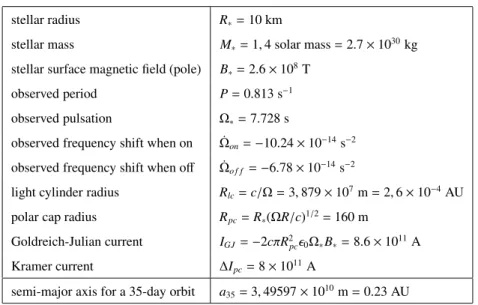
Table 1. Basic estimates about the PSR B1931+24.
stellar radius R∗=10 km
stellar mass M∗=1, 4 solar mass = 2.7 × 1030kg
stellar surface magnetic field (pole) B∗=2.6 × 10⁸T
observed period P =0.813 s−1
observed pulsation Ω∗=7.728 s
observed frequency shift when on Ω˙on= −10.24 × 10⁻¹⁴s−2
observed frequency shift when off Ω˙o f f = −6.78 × 10⁻¹⁴s−2
light cylinder radius Rlc= c/Ω =3, 879 × 107m = 2, 6 × 10⁻⁴AU
polar cap radius Rpc= R∗(ΩR/c)1/2=160 m
Goldreich-Julian current IGJ= −2cπR2pcǫ0Ω∗B∗=8.6 × 10¹¹A
Kramer current ∆Ipc=8 × 10¹¹A
semi-major axis for a 35-day orbit a35=3, 49597 × 1010m = 0.23 AU
The excess charge density ∆ρ ∼ 0.034 C m−3 is similar to the Goldreich-Julian charge
density, which for a corotating plasma is ρGJ = −2εoB∗·Ω. The polar cap radius Rpc =
(2πR3∗Ω/c)1/2 was computed for a star radius R∗ = 10 km, and the dipole magnetic field is
estimated from B∗/Tesla = 3.2 × 10¹⁵(− ˙Ωo f f/Ω3)1/2, i.e. from the well-known spin-down
rate of a rotating magnetic dipole in empty space (Deutsch 1955). In the following estimates, we kept the same values of R∗, B∗and M∗=1, 4M⊙as used in Kramer et al. (2006).
– P6 One transition from the on to the off phase has been observed. It was very abrupt, oc-curring in fewer than ten pulsar rotations. From this it can be inferred that the transitions between on and off phases may be sudden, but this does not imply that all transitions between on and off states are so.
– P7 The period change between the on and off phases is not measurable. Only the time deriva-tive of the period changes in a measurable way.
– P8 No companion is detectable from timing residuals.
The basic data about PSR B1931+24 used throughout the paper are displayed in Table 1. Can we explain these properties ?
We can reject the possibility that a body orbiting the neutron star induces a precession that would change the direction of the pulsar emission beam for two reasons: (1) the off and on phases are too irregular for a phenomenon only induced by gravitational effects, and (2) it would not explain why PSR B1931+24 does not radiate as regularly as most pulsars of its family. This is not caused by the pulsar itself, but by some peculiarity of its environment.
Cordes & Shannon (2008) proposed that pulsar nullings (periods without radio emission) are caused by in-falls of asteroids created in the supernova remnant. These satellites are supposed to fall as solid matter and would be evaporated in the vicinity of the neutron star. Then the plasma formed from the vaporized asteroid would be gravitationnally attracted to the polar cap of the pulsar and would interrupt a significant fraction of the Goldreich-Julian current, as shown by
Kramer et al. (2006). This model, however, does not explain very well why PSR B1931+24 would have such long and quasi-periodic nullings. We would instead expect a more chaotic sequence of nullings. A possible answer might be that the asteroids are grouped in a swarm. This would impose specific constraints on the distribution of these asteroid swarms. Why would the nullings last for days, when the nullings explained for other pulsars last only for a few seconds ?
Objects such as PSR B1931+24 and PSR J1841-0500 differ from rotating radio transients (McLaughlin et al. 2006), which typically radiate for only a few milliseconds once every few minutes or hours. These time scales considerably differ from those observed in PSR B1931+24 and PSR J1841-0500. According to Lyne et al. (2009), rotating radio transients could be ex-hausted magnetars. Most of them occupy the region of the P– ˙Pdiagram with periods of several seconds and ˙Phigher than 10−14, although one is surprisingly found in the region of normal radio-pulsars. The lack of quasi-periodicity for alternating emitting and non-emitting regimes in rotat-ing radio transients supports the view that their nature is different from that of PSR B1931+24 and PSR J1841-0500.
Because PSR J1841-0500 is less well documented than PSR 1931+24, we focused our in-vestigation on PSR 1931+24. We consider PSR J1841-0500 only in the companion paper Mottez et al. (2013) (now called paper II), in the light of our conclusions about PSR 1931+24.
Here, we examine possible explanations for the behaviour of PSR B1931+24, based, as in Rea et al. (2008), on a putative companion orbiting the neutron star. We consider the period of about 35 days mentioned in the observations by Kramer et al. (2006). We furthermore consider two families of hypothesis for the companions: in this paper we examine the consequences of a unique companion with an orbital period of 35 or 70 days; a much shorter orbital period is con-sidered in paper II, with a periastron precession period of 70 days. We begin by briefly reviewing the properties of Alfvénic wakes, which result from the interaction of orbiting bodies with the magnetospheric or wind plasma, and their possible effect on the orbital motion of a companion.
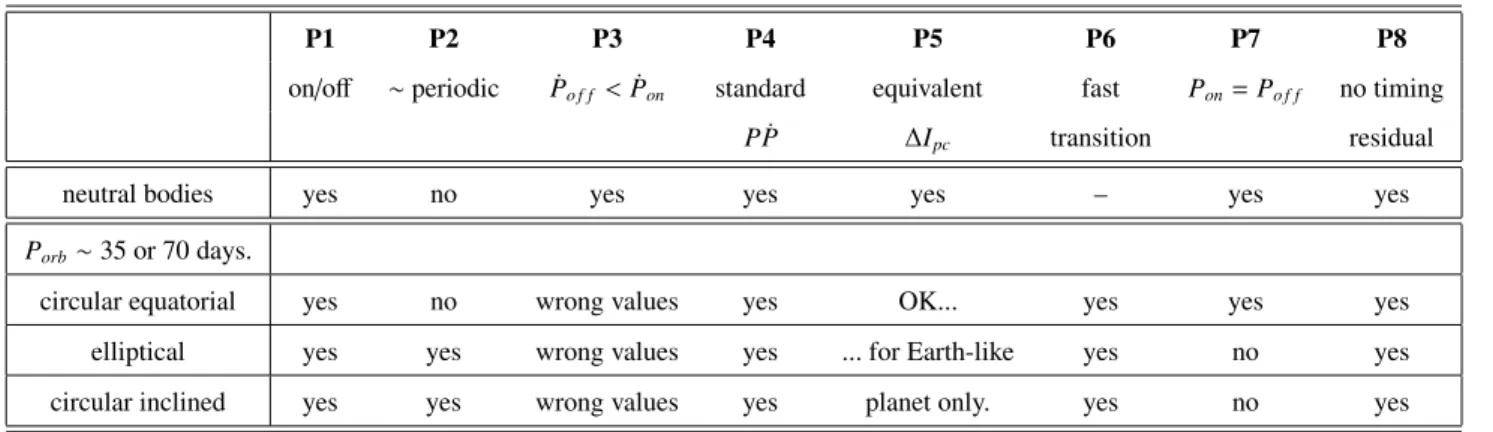
Table 3 presents a summary of the observed properties (P1 to P8) that eventually are satisfied or not, according to the various sets of hypotheses. This could serve as a field guide.
2. Unipolar inductor and Alfvén wings
2.1. Alfvén wings and associated electric currents
One of the main questions in connection with PSR B1931+24 is the interaction of the possible companion with the star’s environment. The main idea of this paper is based on a system of electric currents carried by a pair of stationary Alfvén waves, anchored in the pulsar’s companion. In a tenuous and strongly magnetized plasma, the formal Alfvén velocity cAmay be higher
than the speed of light. The derivation of the linear Alfvén wave propagation velocity VAmust
then take into account the displacement current. In the plasma frame of reference,
where ρ is the mass density as seen in this frame. When the wind flows at a velocity V0 > VA,
the companion is enclosed behind a fast-mode bow shock and does not directly interact with the wind. But when the pulsar wind flows at a velocity lower than VA, the companion is in direct
contact with the wind. It then behaves as a unipolar inductor, generating in itself an electromotive force E0 = −V0×B0, where B0 is the ambient magnetic field and V0 is the wind velocity
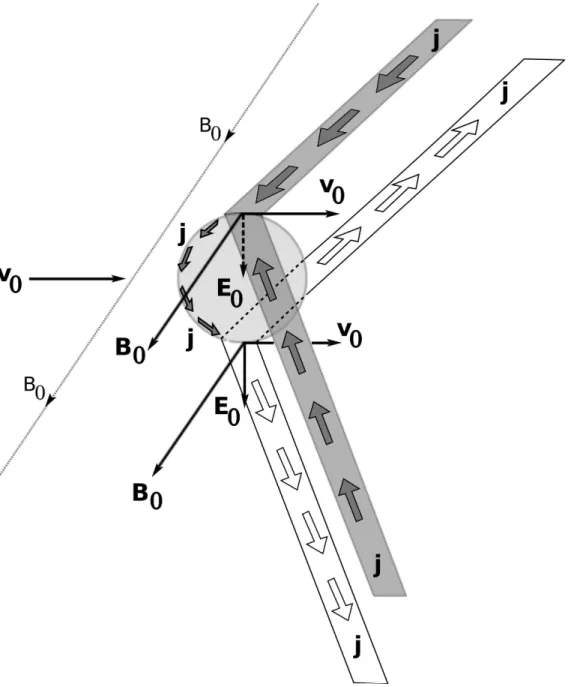
(Goldreich & Lynden-Bell 1969). This generates two systems of current that propagate in the surrounding plasma at an angle θ with the ambient magnetic field, forming a so-called Alfvén wing. Neubauer (1980) has developed a non-relativistic model of Alfvén wings to explain the interaction between Jupiter and its satellite Io. Mottez & Heyvaerts (2011b) have adapted a linear but relativistic version of that theory. The geometry of an Alfvén wing is sketched in Fig. 1. The Alfvén wing total electric current is
IA∼4(E0−Ei)RcΣA, (3)
where Rc is the companion radius. The factor ΣA is the Alfvén wing conductance. Mottez &
Heyvaerts (2011b) have shown that for a highly relativistic Poynting-flux-dominated wind, as expected around pulsars,
ΣA∼
1 µ0c
. (4)
The electric field Eiis caused by the internal resistance of the inductor. In the case of an optimal
energy coupling of the companion and the Alfvén wing, as in Neubauer (1980)
Ei= E0/2. (5)
2.2. Radio emissions
Alfvén wings are two long ribbons of direct electric currents. In each wing, part of the current is emitted from the companion and the other part returns to it. The outward and return currents close through the wing-emitting body. The distance between the two current lines in one wing is of the order of Rc, the companion’s radius. The current that circulates along a wing is related to
the Alfvén wave conductivity ΣA(Neubauer 1980). If there is a stationary flow, the Alfvén wings
carry a DC current. However, plasma and current instabilities may add an AC component to it. In that case, Alfvén wings would behave like two large electromagnetic antennas. For instance, the Alfvén wings associated to the Io-Jupiter flux tube are the sources of strong radio emissions (Queinnec & Zarka 1998). Small-scale Alfvén waves are trapped in the wings, which cause particle acceleration (Su et al. 2003; Ergun et al. 2006) and decametric radiation (Hess et al. 2007; Hess et al. 2008; Hess et al. 2009). In the highly relativistic pulsar wind, the acceleration and emission process may be quite different from those arising in the vicinity of Jupiter, but the current IA certainly constitutes an important source of free energy for radio emissions. Mottez
& Heyvaerts (2011b) have suggested that the strong current in the pulsar companion’s Alfvén wings could be unstable and might cause powerful radio emissions. The generation mechanism
Fig. 1. Schematic view of an unipolar inductor. In a pulsar wind, the unperturbed wind’s magnetic field B0and velocity v0are almost, but not exactly, perpendicular. The electric field E0created by the unipolar
inductor is perpendicular to these two vectors; it induces an electric current (of density j) along the body. This current then escapes into the surrounding plasma, forming two structures, each of them consisting of an outwards and an inwards current flow. The current density j flowing along the body causes a j × B force density to be exerted on it.
of these emissions has not been studied yet, but preliminary results are presented in Mottez (2011), assuming that the radio-source is convected with the pulsar’s wind when it passes the Alfvén wing. In that case, because of relativistic aberration and whatever the emission directions of the radio waves in the the wind frame, they would make a small angle θ∞ in the observer’s
frame with the direction of the wind velocity given by
where γ∞ is the asymptotic value of the wind’s Lorentz factor. The observer’s frame is that of
an observer on Earth. It is roughly the same as the frame defined by the motion of the pulsar’s companion. Fig 2 is a sketch showing the magnetic field line passing through the pulsar compan-ion. At this distance, it has almost the shape of an Archimedes spiral. The planet is represented by a black dot. Two thick lines emerging from it show the global shape of the two Alfvén wings, making a constant angle with the ambient magnetic field. The arrows show the direction (as seen in the observer’s frame) of the radio waves emitted by the pulsar wind when it crosses the Alfvén wing. The Lorentz factor γ∞, though unknown, is expected to be large (Michel 1969; Henriksen
& Rayburn 1971; Contopoulos et al. 1999; Michel 2005; Bucciantini et al. 2006), therefore the cone angle of the radio emission is very narrow and the radio emission associated to the Alfvén wing would be observable only during a brief lapse of time.
Alternatively, the source might be firmly connected to the planet. For instance, radio waves could be emitted from its (potentially present) ionosphere when it is disturbed by fluctuations of the current flowing along it. In that case, the radio source would not be fast in the observer’s frame and would not be subject to any relativistic aberration. Until a precise mechanism of radio emission is elaborated, it will not be possible to make any prediction concerning its directivity. Therefore, we assume (at least in some of the models) that the planet and / or the Alfvén wing is a radio source, but we make no a priori assumption on the directivity of their emission.
The assumption about the radio-waves from Alfvén wings does not imply that the radio waves from standard pulsars emanate from Alfvén wings. We follow the general proposition that pulsar radio emissions are emitted from well inside the light cylinder, and that the origin of these waves have no connection with Alfén wings. But in some of the models tested in this paper for extremely intermittent pulsars, we simply consider that the radio waves from Alfvén wings would mimic standard pulsar radio emissions, and this would happen only for the very small and very peculiar class of pulsars represented by PSR1931+24. Moreover, this is an hypothesis that we decide to consider, and not an assertion that we necessarily defend until the end of the paper.
2.3. Force exerted by the current system onto the companion
Figure 1 sketches the configuration of the current system in the vicinity of the companion. This figure represents the companion in the pulsar wind, at a large distance form the light cylinder. The current closing the Alfvén wing circuit through the companion shown in this figure generates a force density J × B acting onto the companion or its immediate environment by a magnetic thrust (Mottez & Heyvaerts 2011a). Whether this force is mainly radial or azimuthal depends on the orientation of the wind velocity and the magnetic field. The Lorentz force density can be integrated along the current flowing on the companion’s surface. Roughly estimated, the modulus of the total force exerted onto the companion is
where BF is the component of the magnetic field that is perpendicular to the plasma flow and I
the total current flowing in the Alfvén wings. As long as these wings exist, this force is continu-ously exerted and may ultimately influence the evolution of the companion’s orbit. In our other estimates, we denote with Frthe radial components of F and with Ftits ortho-radial component
lying in the orbital plane of the companion, whose mass is Mc. The pulsar’s spin frequency is
Ω∗. Mottez & Heyvaerts (2011a) have calculated that
Fr Mc = C r2 and Ft Mc = D r3, (8)
where C and D are constant factors,
C = 4R 2 cΩ2∗Φ2 µ0c2Mc , D = 4R 2 cΩ∗Φ2 µ0cMc , (9) and Φ = r2Br0 (10)
is the magnetic flux, which is a constant of motion along a streamline (Beskin et al. 1998; Bucciantini et al. 2006). A Keplerian orbit is represented in polar coordinates in the orbit’s plane by the equation
r = a(1 − e
2)
1 + e cos φ. (11)
The average changes of a and e over an orbital period (Mottez & Heyvaerts 2011a) are < da dt > = ∆a P =2a D p GM∗a5 2 + e2 2(1 − e2)2 ! (12) <de dt > = ∆e P = 3 2 D p GM∗a5 e (1 − e2). (13)
These variation rates both have the same sign as D, which is fixed by that of Ω∗. For a prograde
orbit, D > 0, a and e increase, the orbit becoming more eccentric and distant. Therefore, the Alfvén wing thrust tends to chase the body away from the star. A retrograd orbit evolves towards a circular shape with a decreasing semi-major axis.
2.4. Possible location of the fast-mode critical surface
All these considerations are valid if the planet is immersed in a sub-Alfvénic pulsar wind, by which we mean that the modulus of the relative velocity between the companion and the pulsar’s wind is lower than the modulus of the relativistic Alfvén speed VA. For a non-relativistic orbital
velocity of the companion, this condition essentially constrains the wind’s speed. It is therefore important to know if the pulsar wind can make a transition from a sub-Alfvénic to a super-Alfvénic velocity, and to know the distance to the star of this so-called fast-mode critical surface. Many pulsar wind models have been developed, one of the simplest is that by Michel (1969), which accounts for the magnetic field, the star’s rotation, and the wind particles masses, but neglects the dipole inclination and the gravitation. The model considers the poloidal field Brto
axisymmetric, but not necessarily radial, winds have been developed more recently (Beskin et al. 1998; Bucciantini et al. 2006). Their equations admit a set of integrals of motion along stream lines, in particular, the magnetic flux Φ defined in equation (10) and the mass flow f
f = ρvrr2, (14)
where ρ is the mass density and vrthe wind’s radial velocity. The magnetization parameter σ0of
the pulsar wind,
σ0=
Ω2Φ2 µ0f c2
, (15)
is also constant along a streamline. Mottez & Heyvaerts (2011b) have shown than in cold ideal magneto-hydrodynamic Poynting-flux-dominated winds, where the models show that asymptot-ically γ∞ ∼σ
1/3
0 , the wind is sub-Aflvénic, in the sense defined above, at any distance. But if
γ∞ ∼σa0, and a > 1/3, a transition from sub-Alfvénic to super-Alfvénic wind occurs at a finite
distance.
Observations of the equatorial sectors of winds in pulsar wind nebulae show lower values of the asymptotic magnetization (Kennel & Coroniti 1984a,b; Gaensler et al. 2002), and some authors have suggested that the asymptotic value of the Lorentz factor is γ∞∼σ0. Arons (2004)
has argued that to understand the observed high Lorentz factors and the low magnetisation, dissi-pation of magnetic energy probably occurs in the asymptotic wind zone. Begelman & Li (1994) have shown that when flux tubes diverge faster than radially, the fast magnetosonic point can oc-cur closer to the light cylinder. Then, the existence of Alfvén wings would depend on the distance from the star to the planet and would be a result of a non-radially-diverging wind flow and / or dissipation. According to Michel (2005), the finite angle between the pulsar rotation axis and the magnetic axis makes the standard axisymmetric models mostly inappropriate. It therefore cannot be taken for granted that the fast-mode critical surface is rejected to infinity. The latter is defined for a cold wind by vr = VA, where vr is the radial wind’s speed and VA the relativistic Alfvén
speed (Eq. (2)) calculated from the modulus of the field. It is possible that the companion spends only a finite part of its orbit in sub-Alfvénic wind regions (where vr< VA), or even that it never
finds itself in a sub-Alfvénic wind. In the latter case our suggestions would be pointless.
3. Companion with an orbital period of 35 days?
Our first hypothesis is that a companion orbits the star with a 35-day period. The size of the orbit is aR ∼0.23 AU ∼ 900c/Ω, where c/Ω is the light cylinder radius. The orbit can sometimes be
in a super-Alfvénic wind, and sometimes in a sub-Alfvénic wind. When in a sub-Alfvénic wind, two Alfvén wings are formed, and we assume that they emit radio waves. We examined whether these waves could be the signal that is observed when the pulsar is on. When the companion is in a super-Alfvénic wind, there would be no Alfvén wings and the pulsar would be off.
This hypothesis suggests that we would not see the actual radio emissions from the extremely intermittent pulsar itself (maybe because we are in the wrong direction to see them), but only radio waves emanating from the Alfvén wings of their companion.
3.1. Electric current carried by the Alfvén wing
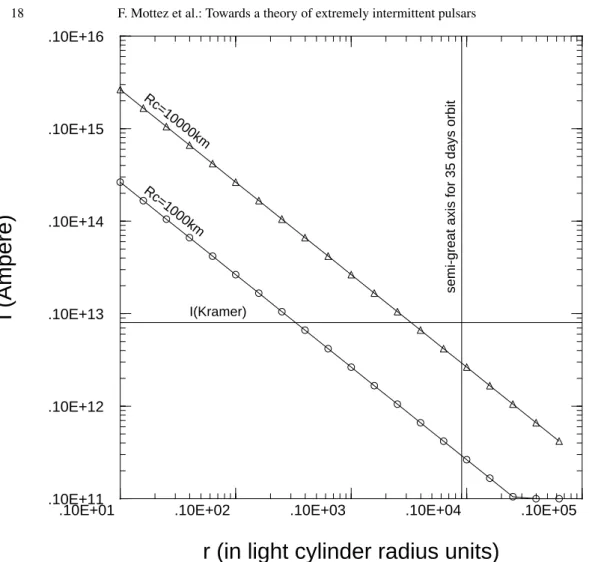
The lack of knowledge of the wind velocity does not preclude us from estimating the current carried by the Alfvén wing when the companion is in the sub-Alfvénic regime. Taking equations (3) and (5) into account, the definition of the induced electric field E0and the fact that at a large
distance from the light cylinder vφ<< Ωr, the electric current carried by an Alfvén wing is, for
the best energy coupling of the planet and the Alfvén wing (Mottez & Heyvaerts 2011b) IA=2
Ω∗Φ
r RcΣA. (16)
When the energy coupling of the companion to the Alfvén wing is less than optimal, equation (5) overestimates the current IA. In Fig. 3, the Alfvén wing currents deduced from equation (16) are
plotted as a function of the radial distance between the star and its companion for two different values of the companion’s radius. For a 10 000-km-wide planet, it is possible to reach a current weaker than, but comparable to, ∆Ipcgiven by Eq. (1), i.e. the Goldreich-Julian current expected
from the polar cap of PSR B1931+24. The Goldreich-Julian current is widely believed to be the source of the standard pulsar radio emissions. Accordingly, the Alfvén wing current associated to a 10 000-km-wide planet could be a radio source of comparable intensity.
3.2. What would we observe with radio telescopes?
Most of the theories of PSR B1931+24 (e.g. (Rea et al. 2008; Cordes & Shannon 2008)) consider that the off state results from an alteration of the polar cap current of the star. The fact that ∆Ipcof
Eq. (1) associated to the variation between ˙Ponand ˙Po f f(Kramer et al. 2006) is of the order of the
expected current from the polar cap of the star reinforces this way of considering the problem. But at the same time, an Alfvén wing starting from a companion with a 35-day period, and therefore far beyond the light cylinder of the pulsar, could not reach the star because the radial wind velocity exceeds the velocity of radially propagating shear Alfvén waves from the Alfvén radius on. This radius is slightly smaller than the light cylinder radius. An object orbiting the star at larger distances could then act on the star’s surface or on its inner magnetosphere only by dropping matter on it or by emitting fast-mode signals that could reach it. The first possibility has been explored by Cordes & Shannon (2008). Although fast magnetosonic waves could propagate down to the star provided they are emitted below the fast-mode critical surface, the isotropy of their propagation properties imply that the energy carried by such signals declines as the inverse square of the distance travelled. Therefore, only a negligible fraction of the energy emitted in this form at a large distance would eventually reach the star.
Since we examine here only electromagnetic types of coupling, we conclude that an object orbiting at a much larger distance than the light cylinder radius Rlc would be unable to affect
the emission process taking place closer than this distance from the star, and in particular, at the pulsar’s polar cap. This means that if the observed transient radio emissions are to result from the interaction of the companion with the pulsar wind, their source should be in the vicinity of the
companion itself. This is not impossible, because as we noted above, the current in the Alfvénic wake could be similar to the Goldreich-Julian current.
Because radio emissions are seen during several days without interruption there must be a large set of emission directions. Therefore, the radio source is probably not conveyed at the wind’s velocity. Instead it is probably connected to the planet, possibly to its ionosphere.
However, since the radiation is pulsating, these emissions are very likely still endowed with some directionality, so that the varying direction of the local magnetic field could result in some modulation of the radiation detected at Earth. The direction of the field would vary because of the inclination of the pulsar’s magnetic moment with respect to the rotation axis and oscillate around the neutron star equator. The periodicity of this modulation is the pulsar spin period. The observed frequency Ωobsof the signal received by the observer is the difference or the sum of the
pulsar’s rotation frequency Ω∗and the orbital frequency of the companion Ωorb:
Ωobs= Ω∗±Ωorb. (17)
It is a sum if the companion orbit is retrograde, and a difference if it is prograde. The wavelength of the modulation is λmod= VaPobs∼2πc/Ω∗.
The fact that we detect the radiation emitted by the companion does not mean that the pulsar does not radiate. Indeed, the position of PSR B1931+24 in the P− ˙Pdiagramm, far from the death line and typical of most pulsars, strongly suggests that the pulsar is active, and "normal". But we could simply be situated out of its emission beam. Otherwise, two kinds of emissions would be seen, those from the neutron star (possibly its polar cap), which would be permanently active, and those associated to the companion and the Alfvén wings, which would only be observable when the pulsar is on.
3.3. Does the orbit cross the sub to super-Alfvénic frontier in the pulsar wind?
Now, it should be explained why the radio emissions emanating from the two companion’s Alfvén wings sometimes stop. The on and off states may be simply arise because sometimes the companion is in a Alfvénic wind, sometimes in a super-Alfvenic wind. When in the sub-Alfvénic wind, Alfvén wings would be present, with subsequent radio emissions. When in the super-Alfvénic wind, the Alfvén-wings do not exist because the companion is separated from the wind by a shock front instead. The shutting down of the associated extended current branches causes the radio emissions to cease. This hypothesis can explain why the pulsar radio emissions stop so abrubtly: when the companion is at the limit of the sub-Alfvénic domain, the plasma flow is very fast, the magnetic field is still strong, and IAshows no sign of progressive extinction, in
accordance with property P6.
The hypothesis of a transition from a sub- to a super-Alfvénic regime also explains why the transitions between the "silent" and "active" states, in spite of being quasi-periodic, are neverthe-less unpredictable: because the position of the frontier between the two wind regimes is expected
to be highly fluctuating around an average value, as is the case of almost all frontiers in the magnetospheres explored up to now.
3.4. Circular or an elliptical orbit in the star’s equatorial plane?
We first consider a companion orbiting near the equatorial plane of its star. If its orbit is circular, then the orbital radius should correspond by chance to the region close to the sub- to super-Alfvénic transition. The changes from the off state to the on state would then not be periodic, but would depend on the fluctuations of the pulsar wind. Because there is no reason for a quasi-periodicity of 35 days in these fluctuations, there should be no quasi-perodicity in the pulsar mode transitions, which contradicts property P2. This is why we do not retain the hypothesis of an equatorial circular orbit. If the orbit is in the star’s equatorial plane, it must be elliptic and the ∼ 25 days of off mode correspond to the time spent near the apoastron, in the super-Alfvénic wind, the rest of the time corresponding to closer distances in the sub-Alfvénic wind. As the time spent in the on state (∼ 5-10 days) and in the off state (∼ 20-25 days) is well marked, the orbit ellipticity probably is not negligible.
This explanation nevertheless has a serious drawback: if the companion is in an elliptical orbit, its distance from the star varies and thus also the distance from the star to the radio source, whether it is attached to the companion or to the Alfvén wings. There must be a Doppler shift associated to this varying distance that induces a modulation of the pulsar’s observed period P, which contradicts the property P7. Furthermore, the time-varying orbital velocity of the com-panion is an another cause of variation of P. We consider the variation of the orbital frequency, i.e. the azimuthal frequency (equation (17)). The angular momentum conservation implies that the areal velocity H = Ω(r)r2/2 is a constant of the motion and H = Ωorba2(1 − e2)1/2/2. Let
λ = rmin/abe the ratio of the periastron to the semi-major axis, and k = Ωorb/Ω(rmin) the ratio of
the mean orbital frequency to the orbital angular velocity at the periastron. Some algebra shows that
k2= λ3/(2 − λ). (18)
For a circular orbit, the solution is obviously λ = 1 for k = 1. For a weakly elliptic orbit (λ and k close to unity), the solution is obtained by differentiation:
rmin a =1 − 1 4 1 − Ωorb Ω(rmin) ! . (19)
This relation combined with Eq. (17) shows that the circularity of the orbit is strictly constrained by the invariance of P = 2π/Ω(r) (condition P7). Numerically, a ratio rmin/a = 0.99 implies
Ωorb/Ω(rmin) = 0.96. In that case, there should be a periodic variation ∆P = −P∆Ω/Ω = 3.2 ×
3.5. Inclined circular orbit?
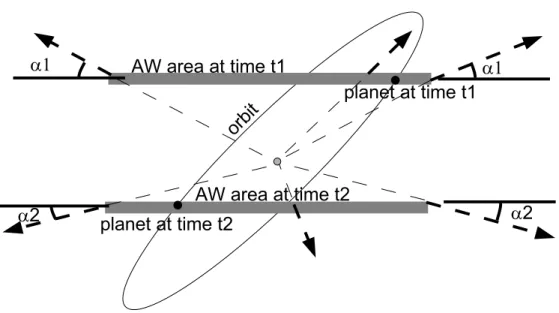
If the orbit is circular and inclined upon the star’s equatorial plane, the companion may be close to the equatorial plane (when it is near the nodes of its orbit in the star’s equatorial plane) or far from this plane. According to 2D pulsar wind models, such as those of Bucciantini et al. (2006), the wind’s velocity (or Lorentz factor) depends on the latitude. We assume that as for the low σ0
that these authors have simulated, the wind is faster near the equatorial plane than far from it, and we consider a 70-day orbit. We assume that the companion travels in a super-Alfvénic wind (for most of the time) near each node, then is in the off mode, and spends about five days at higher latitudes, and five days at lower negative latitudes in a sub-Alfvénic wind, then is in the on mode. This is consistent with property P2. If the radio source resides in wind material, the radio waves would be emitted almost radially, in a direction that differs according to whether the companion is at its highest latitude or nearer the equatorial plane. This is shown in Fig. 4. It may happen that in the on mode the companion is at a favourable latitude to being seen from Earth. Later, the Earth would be out of its emission beam and radio emissions would not be seen. This may explain the existence of an off and an on regime (property P1). But the companion should also only be on when it is in a particular physical regime, such that the rate of damping ˙Pon, ˙Po f f (property
P3). To adopt the hypothesis of an inclined circular orbit in a latitude-dependent wind, we would have to admit that the on regime simultaneously corresponds to a favourable line of sight and to a favourable physical regime. This coincidence seems too strong, which is an encouragement to reject the hypothesis of a circular inclined orbit.
3.6. Could the difference in period drift result from orbital evolution driven by the Alfvén drag?
When the companion is in the sub-Alfvénic wind and Alfvén wings are present, the associated electric current combined with the ambient magnetic field exerts a force that acts on the compan-ion’s orbit and causes a secular change ˙Porbof the mean orbital period. We now discuss whether
this phenomenon can explain the difference of the observed period time derivatives ˙Pon > ˙Po f f
(property P3).
If the difference of period derivatives in the on an the off regimes were to be caused by a non-zero derivative of the orbital period during the on regime, this difference could be found from Eq. (17), since
˙
Ωo f f = ˙Ω∗and ˙Ωon= ˙Ω∗± ˙Ωorb.
Substracting these two equalities, and expressing Ωorbas a function of Porb,
˙
Porb= ˙Porb,on= ±
P2orb
2π ( ˙Ωo f f− ˙Ωon). (20)
Table 2. Effect of the Alfvén wing force estimated for various bodies orbiting the pulsar in 35 days.
diameter volumic mass IA FAWr F t
AW ∆orba P˙orb,theory P˙orb,theory/ ˙Porb
(km) (kg.m−3) (A) (N) (N) (m, per orbit) (dimensionless) (dimensionless)
planet 10 000 5000 1.5 × 10¹¹ 3. × 1016 3.2 × 10¹³ 8,9 3, 8 × 10⁻¹⁰ ∼10−8
small body 100 km 3000 1.5 × 10⁹ 2.9 × 10¹² 3.2 × 10⁹ 1563 6.7 × 10⁻⁸ ∼10−6
asteroid 1 km 3000 1.5 × 10⁷ 2.9 × 10⁸ 3.2 × 10⁵ 156316 6.7 × 10⁻⁶ ∼10−4
Combining Eqs. (9) and (12), the electromagnetic forces should give rise to a variation of the semi-major axis per orbit given by
∆orba = 4R2 cΩ∗Φ2P2orb a3πµ 0Mc 2 + e2 2(1 − e2)2 ! . (21)
This can be transformed into a variation of orbital period by log-differentiating Kepler’s third law:
˙
Porb,theory= ∆orbPorb/Porb=3∆orba/2a. (22)
The values of ˙Porbdeduced from the observations, as given by Eq. (20), should be consistent
with the theoretical estimate ˙Porb,theoryin Eq. (22). We have considered the case of an Earth-like
planet, a 100-km-wide body and an 1-km-wide asteroid, with a circular orbit. The results are presented in Table 2. In this table, the current IAis derived from Eq. (16). It can be seen that the
secular orbital drift induced by the Alfvén wing force is too weak by many orders of magnitude. Any reasonable value of the eccentricity cannot compensate this large difference. This is one more reason to reject the hypothesis of a companion with a 35- (or 70-) day orbit: the difference between the period derivatives ˙Ponand ˙Po f f cannot be quantitatively explained. In other words,
it does not fit with property P3.
4. Companion at short distance and a periastron precession with a period of
∼
70 days?We have now accumulated enough arguments to reject the hypothesis of a 35- or 70-day orbital period and, together with it, all the inferences developed in section 3 (except for the rejection of the hypothesis that supports them).
A periodicity of 35 days could nevertheless be obtained if we assumed a short orbital period, the periodicity of 35 days being not the orbital period, but the period of the precession of the periapsis of the orbit. This is possible because the pulsar is a compact star. More exactly, as shown in paper II, the period of the precession of the periapsis should be twice as long, i.e. Pper ∼70 days. The rotation angle ∆ϕper of the periapsis per orbit, derived from the theory of
general relativity,
∆ϕper =
6πGM∗
c2a(1 − e2), (23)
and the period of the precession of the periapsis then is Pper= 2πPorb ∆ϕper =2πc 2a5/2 (1 − e2) 3(GM∗)3/2 . (24)
Asteroids originally orbiting along a common orbit keep on sharing the same orbit at later times, because the precession rate of each one’s orbit is the same. The idea that PSRB 1931+24 could be orbited by a close swarm of asteroids is discussed in paper II.
5. Conclusions
Our analysis was based on the series of observed peculiarities P1–P8 of the pulsar PSR B1931+24. We tried to identify a theoretical explanation that would be consistent with all these properties. We assumed that the quasi-periodicity of 35 days of the behaviour of PSR 1934+21 (property P2) results from a single body orbiting the neutron star at this period, or twice this period. We considered that the coupling between the planet, the star, and the radio emissions is caused by the Alfvén wings carried by the planet when it moves in a sub-Alfvénic plasma (the pulsar’s wind, or its magnetosphere). These models implied that the radio waves received from PSR 1934+21 were not the actual pulsar radio waves (emitted from inside the light cylinder), but waves attached to the pulsar’s companion. Therefore, these waves were supposed to mimic those of a normal pulsar. This might seem improbable and we could have discussed that point. But we did not because the models could be rejected on other bases that we judged better suited for quantitative investigation. No model based on the assumption of a body orbiting in 35 days or 70 days could be made to be consistent with all properties P1–P8 however.
Nevertheless, the quasi-periodic succession of on and off phases might be induced by a com-panion, if we consider that 70 days is not its orbital period, but the period of the precession of the periastron. This precession would be induced by the relativistic gravitation field of the neutron star. This implies that the body would be orbiting very close to and possibly inside the light cylin-der. Under these conditions, a large companion would be disrupted by tidal forces. A stream of smaller bodies, possibly asteroids, would result from this disruption. A direct electromagnetic in-teraction between the star and its companions could then be considered. A more detailed analysis of this idea is developed in the companion paper II.
Table 3. Summary of the different hypotheses and of the properties they satisfy, or fail to satisfy.
P1 P2 P3 P4 P5 P6 P7 P8
on/off ∼periodic P˙o f f < ˙Pon standard equivalent fast Pon= Po f f no timing
P ˙P ∆Ipc transition residual
neutral bodies yes no yes yes yes – yes yes
Porb∼35 or 70 days.
circular equatorial yes no wrong values yes OK... yes yes yes elliptical yes yes wrong values yes ... for Earth-like yes no yes circular inclined yes yes wrong values yes planet only. yes no yes
References
Arons, J. 2004, Advances in Space Research, 33, 466
Begelman, M. C. & Li, Z. 1994, The Astrophysical Journal, 426, 269
Beskin, V. S., Kuznetsova, I. V., & Rafikov, R. R. 1998, Monthly Notices of the Royal Astronomical Society, 299, 341
Bucciantini, N., Thompson, T. A., Arons, J., Quataert, E., & Del Zanna, L. 2006, Monthly Notices of the Royal Astronomical Society, 368, 1717
Contopoulos, I., Kazanas, D., & Fendt, C. 1999, Astrophysical Journal, 511, 351 Cordes, J. M. & Shannon, R. M. 2008, Astrophysical Journal, 682, 1152 Deutsch, A. J. 1955, Annales d’Astrophysique, 18, 1
Ergun, R. E., Su, Y.-J., Andersson, L., et al. 2006, Journal of Geophysical Research (Space Physics), 111, 6212
Gaensler, B. M., Arons, J., Kaspi, V. M., et al. 2002, Astrophysical Journal, 569, 878 Goldreich, P. & Lynden-Bell, D. 1969, Astrophysical Journal, 156, 59
Henriksen, R. N. & Rayburn, D. R. 1971, Monthly Notices of the Royal Astronomical Society, 152, 323
Hess, S., Mottez, F., & Zarka, P. 2007, Journal of Geophysical Research (Space Physics), 112, 11212
Hess, S., Mottez, F., & Zarka, P. 2009, Geophysical Research Letters, 36, 14101
Hess, S., Mottez, F., Zarka, P., & Chust, T. 2008, Journal of Geophysical Research (Space Physics), 113, 3260
Kennel, C. F. & Coroniti, F. V. 1984a, Astrophysical Journal, 283, 694 Kennel, C. F. & Coroniti, F. V. 1984b, Astrophysical Journal, 283, 710
Kramer, M., Lyne, A. G., O’Brien, J. T., Jordan, C. A., & Lorimer, D. R. 2006, Science, 312, 549 Lyne, A. G., McLaughlin, M. A., Keane, E. F., et al. 2009, MNRAS, 400, 1439
McLaughlin, M. A., Lyne, A. G., Lorimer, D. R., et al. 2006, Nature, 439, 817 Michel, F. C. 1969, Astrophysical Journal, 158, 727
neutron star
planet
--->
--->
--->
--->
--->
--->
Fig. 2. Hypothesis of a planet orbiting in 35 days. Sketch showing the magnetic field line passing through the companion (thin line) and the two Alfvén wings (thick lines). The star (thin dot) is at the centre of the figure. The companion is represented by a thicker dot. The arrows indicate the direction of propagation of the radio waves, seen from the observer’s reference frame. In the models where Porb ∼35 days, these
radiations are emitted from the Alfvén wings.
Michel, F. C. 2005, in Revista Mexicana de Astronomia y Astrofisica Conference Series, Vol. 23, Revista Mexicana de Astronomia y Astrofisica Conference Series, ed. S. Torres-Peimbert & G. MacAlpine, 27–34
Mottez, F. 2011, in Proceedings of the 7th International Workshop on Planetary, Solar and Heliospheric Radio Emissions held at Graz, Austria, ed. H. O. Rucker, W. S. Kurth, P. Louarn, & G. Fischer, 315–+
Paper II, Mottez, F. & Bonazzola, S., & Heyvaerts, J. 2011b, Astronomy and Astrophysics, THIS ISSUE, TO BE COMPLETED
Mottez, F. & Heyvaerts, J. 2011a, Astronomy and Astrophysics, 532, A22+ Mottez, F. & Heyvaerts, J. 2011b, Astronomy and Astrophysics, 532, A21+ Neubauer, F. M. 1980, Journal of Geophysical Research (Space Physics), 85, 1171
.10E+01 .10E+02 .10E+03 .10E+04 .10E+05 .10E+11 .10E+12 .10E+13 .10E+14 .10E+15 .10E+16
r (in light cylinder radius units)
I (Ampere)
Rc=10000km
Rc=1000km
I(Kramer)
semi-great axis for 35 days orbit
Fig. 3. Hypothesis of a planet orbiting in 35 days. The dependency of the electric current carried by the Alfvén wings as a function of the distance. Its algebraic expression is given by Eq. (16), with Ei= Ω∗Φ/2r
(case of an optimal electric coupling). The distances are given in units of the light cylinder radius Rlc. The
distance corresponding to the semi-major axis is indicated by the vertical line. For comparison, the current computed in (Kramer et al. 2006), given in Eq. (1) is indicated by the horizontal line.
Queinnec, J. & Zarka, P. 1998, Journal of Geophysical Research (Space Physics), 103, 26649 Rea, N., Kramer, M., Stella, L., et al. 2008, Monthly Notices of the Royal Astronomical Society,
391, 663
Su, Y.-J., Ergun, R. E., Bagenal, F., & Delamere, P. A. 2003, Journal of Geophysical Research (Space Physics), 108, 1094
Thorsett, S. E., Arzoumanian, Z., & Taylor, J. H. 1993, Astrophysical Journal Letters, 412, L33 Wolszczan, A. & Frail, D. A. 1992, Nature, 355, 145
List of Objects
‘PSR B1931+24’ on page 2 ‘PSR B1257+12’ on page 2 ‘PSR B1620-26’ on page 2
Fig. 4. Hypothesis of an inclined circular orbit. Sketch showing the orbit and the planet at two different times t1 and t2. The shaded area corresponds roughly to the area where the Alfvén wing is situated. The
dotted lines with an arrow are the directions of the radio emissions. They are emitted radially, from the Alfvén wings. The angle α that is made between the radial direction and the plane defining the position of the Alfvén wings determines the angle of view, i.e. the star’s equatorial plane. If the observer’s angle of view relative to the star’s equatorial plane is also α, he can see the radiation emitted from the Alfvén wings. This angle is not time invariant, it depends on the position of the planet on its orbit.