Design Evaluation of Naval Combatant Secondary Structure Under Hydrostatic Lateral Load
by
Jacques-Philippe Olivier B.E. Mechanical Engineering Royal Military College of Canada, 1991
Submitted to the Department of Ocean Engineering and the Department of Mechanical Engineering in Partial Fulfillment of the Requirements for the Degrees of
Master of Science in Naval Architecture and Marine Engineering and
Master of Science in Mechanical Engineering at the
Massachusetts Institute of Technology September 2003
MASSACHUSETTS INSTITUTE OF TECHNOLOGY
OCT 0 7 2003
LIBRARIES
( Jacques P. Olivier, MMIII. All rights reserved.The author hereby grants MIT permission to reproduce and to
distribute publicly paperV electonic copies of this thesis document in whole or in part. A u th o r... ...
Department of Ocean Engineering and Department of Mechanical Engineering July 23, 2003 C ertified by ... ... . . .
Klaus-Jtirgen Bathe Professor of Mechanical Engineering Thesis Supervisor Certified by... ...
(I
David V. Burke_______w Senior Lecturer, Department of Ocean Engineering
Thesis Advisor Accepted by...
Accepted by...
...
Ain Ants Sonin Chairman, Department Committee on Graduate Students Department of Mechanical Engineering
... ...
Michael Triantafyllou Chairman, Department Committee on Graduate Students Department of Ocean Engineering
Design Evaluation of Naval Combatant Secondary Structure Under Hydrostatic Lateral Load
by
Jacques-Philippe Olivier
B.E. Mechanical Engineering Royal Military College of Canada, 1991
Submitted to the Department of Ocean Engineering and the Department of Mechanical Engineering in Partial Fulfillment of the Requirements for the Degrees of
Master of Science in Naval Architecture and Marine Engineering and
Master of Science in Mechanical Engineering
ABSTRACT
The complexities of modem ships and the demand for greater reliability, efficiency, and economy require a scientific, powerful, and versatile method for their structural design. The central functions for the evaluation of such structural design are to create a mathematical idealization of the proposed structure which adequately replicates the real structure in all its important aspects; and to analyze the model and compare its performance against specified design criteria for the agreed failure modes. Regardless of the method used, an intimate
comprehension of the environmental conditions is pivotal: the geometry and material properties, the loading conditions and kinematics, the critical modes of failure, and the boundary conditions are only a few factors which constitute the essential ingredients to formulate a complete
mathematical model. That model is be accurately resolved using a reliability-based analytical method and also efficiently validated using a numerical method in order to truly generate reliable
and robust results. To describe this procedure, a specific example will be used whereby the design of a load-bearing secondary structure subjected to hydrostatic lateral pressure will be evaluated using analytical and finite element methods. The results will provide a comprehensive synopsis of the fundamental naval architectural design rules for stiffened panel under lateral load and furthermore, will crystallize the inevitable need for finite element methods. Finite element methods are particularly advantageous in problematic and sensitive areas such as complicated geometric structural arrangements because the model is based upon a structural definition rather than empirical rules, and because knowledge of the behaviour of the component can be
0 Captain! My Captain! Ourfearful trip is done;
The shjp has weather'd every rack, the prize we sought is won;
TABLE OF CONTENTS
C h ap ter 1 ... 9
1.1 SHIP STRUCTURAL DESIGN ... 9
1.1.1 Structural Design Philosophy ... 9
1.1.2 Rationally-Based Structural Design... 12
1.1.3 Reliability-Based Design of Ship Structures ... 13
1.2 FIN ITE ELEM ENT M ETHOD ... 15
1.3 PROBLEM DEFINITION ... 17
1.3.1 Submarine Frame... 17
1.3.2 Scope, Lim itations and Aim ... 19
C h ap ter 2 ... 2 0 2.1 BASIC STRUCTURAL SHIP CONCEPTS... 20
2.1.1 Classification of Structure and Stresses ... 20
2.1.2 Bulkhead Classification... 22
2.1.3 Load Bearing Bulkheads ... 23
2.1.4 Partition Bulkheads ... 23
2.2 M ATERIAL PROPERTIES... 24
2.2.1 Steel Advantages and Disadvantages ... 24
2.2.2 B Quality M ild Steel Properties ... 25
C h ap ter 3 ... 2 6 3.1 STRUCTURAL FAILURE M ODES... 26
3.1.1 Types of Failure M odes ... 26
3.1.2 Static Fracture: Ductile Yielding and Brittle Fracture ... 28
3.1.3 Fatigue Damage ... 28
3.2 STIFFEN ED PANEL BUCKLING M ODES ... 29
3.2.1 Plastic vs. Elasto-Plastic Buckling ... 29
3.2.2 Elastic vs. Inelastic Analysis ... 29
3.2.3 Buckling Failure M odes ... 30
3.2.3 Adamchak's M odel: Beam-Column Buckling (Yielding)... 32
3.3 SE LE CT IO N O F A N A LY SIS M ETH O D ... 34
Chapter 4 ... 35
4.1 ST IFFEN E D PA N EL D E SIG N ... 35
4.1.1 M odeling of Stiffened Panels... 35
4.1.2 D esign A gainst Lateral Loads ... 36
4.2 PLA T E T H ICK N E SS... 37
4.2.1 G eom etry ... 37
4.2.2 Plate T hickness A nalysis... 37
4.3 Scantling D esign ... 39
4.3.1 Scantling A rrangem ent... 39
4.4 ST IFFE N E R D ESIG N ... 40
4.4.1 Geometric Parameters and Governing Formulae... 40
4.4.2 Stiffener D im ensions... 42
4.4.3 Local Stiffener Buckling (Tripping) Criteria ... 43
Chapter 5 ... 44
5.1 PRELIMINARY FINITE ELEMENT ANALYSIS... 44
5.1.1 FEA A ssessm ent and Convergence... 44
5.1.2 Boundary Conditions ... 47
5.1.3 Bare Plate Stress Concentration ... 48
5.2 DETAILED FINITE ELEMENT ANALYSIS ... 50
5.2.1 V ertical Stiffening ... 50
5.2.2 M odel R efinem ent ... 52
Chapter 6 ... 53
6.1 RE SU LT S IN T E RPRETA T IO N ... 53
6.1.2 A nalytical M ethod Results ... 53
6.1.2 N um erical M ethod Results... 54
6.2 RECOMMENDATIONS AND WAY-AHEAD ... 55
6.2.1 Recom m endations ... 55
6.2.2 Structural Continuity ... 55
6.2.3 Post W elding Initial Im perfections ... 56
Conclusion... 58
LIST
OF
FIGURES
Figure 1-1: MIT Design Spiral (MIT)... 10
Figure 1-2: ASSET Ship Design Synthesis Program (ASSET)... 11
Figure 1-3: Rationally-Based Structural Design Process (Hugues) ... 12
Figure 1-4: Reliability-Based Ship Structural Design (Ayyub) ... 14
Figure 1-5: Finite Element Analysis Process (Bathe)... 16
Figure 1-6: Submarine Frame Drawing... 17
Figure 1-7: Isoview of Submarine Panel... 18
Figure 2-1: Prim ary Structure ... 20
Figure 2-2: Secondary Structure (Hugues)... 21
Figure 2-3: Tertiary Structure (Hugues)...21
Figure 3-1: Failure Modes Load-Deflection Curves (Hugues) ... 27
Figure 3-2: Buckling Modes (Hugues)... 30
Figure 3-3: Stiffened Panel Failure Modes (Paik) ... 31
Figure 3-4: Type I Beam-Column Failure (Assakkaf)... 33
Figure 3-5: Type II Beam-Column Failure (Assakkaf) ... 33
Figure 3-6: Stiffener Tripping (Hugues)... 33
Figure 4-1: Typical Stiffened Panel Structure (Paik) ... 35
Figure 4-2: Unstiffened Panel Idealization (dimensions in mm)... 37
Figure 4-3: Stiffener Arrangement with Thickened Strip... 38
Figure 4-4: Typical Bulkhead Stiffening Arrangement ... 39
Figure 4-5: Stiffener Geometric Parameters... 40
Figure 4-6: Stiffener Dimensions ... 42
Figure 5-1: Meshing with 136 (4-Nodes) and 136 (9-Nodes) Shell Elements... 45
Figure 5-2: Stress Concentration with 156 Nodes and 579 Nodes Meshing... 45
Figure 5-3: Meshing with 505 and 1980 Shell Elements ... 46
Figure 5-4: Stress Concentration with 547 Nodes and 2063 Nodes Meshing ... 46
Figure 5-5: Panel Boundary Conditions... 47
Figure 5-6: Stress Concentration with Fixed and Pinned Boundary Conditions ... 49
Figure 5-7: Stress Concentration with Free-Rotating and Fixed Roller Boundary Conditions ... 49
Figure 5-8: Panel Surface and Meshing with Vertical Webs ... 50
Figure 5-9: Panel Surface and Meshing with Vertical Stiffeners... 51
Figure 5-10: Stress Concentration with Vertical Webs and Stiffeners - Isoview ... 51
Figure 5-11: Stress Concentration with Vertical Webs and Stiffeners - Plane View ... 52
LIST
OF
TABLES
Table 2-1: Advantages and Disadvantages of Steel (SSP 23)... 24
Table 2-2: B Quality Steel Equivalent Grades... 25
Table 2-3: Chemical Composition of B Quality Steel... 25
Table 2-4: Material Properties of B Quality Steel... 25
Table 2-5: Mechanical Properties of B Quality Steel ... 25
Table 3-1: Structural Failure Modes (SSP 23) ... 27
Table 4-1: Stiffener Geometric Parameters ... 42
Table 5-1: Point-Wise Stress Concentration Convergence ... 44
Chapter 1
1.1
SHIP
STRUCTURAL
DESIGN
1.1.1 Structural Design Philosophy
The complexities of modem ships and the demand for greater reliability, efficiency, and economy require a scientific, powerful, and versatile method for their structural design[1]. Regardless of the philosophy adopted, the design of any ship structural system or element must provide for adequate safety and strength to permit proper functioning during the intended
service life[2]. The main objective of ship structural design is thus defined:
to ensure safety andfunctionalperformance requirements of a structural systemfor target reliabiliy levels, for a specified period of time, andfor a specified environment
The procedure by which this objective is achieved has been most straightforwardly described by the British Admiralty's Sea Systems Publication No. 23 (SSP 23) [3] as an iterative process consisting of the following main steps:
a. to decide which are the most important loads on the structure for its expected operational life, and the equivalent critical modes of failure;
b. to propose and develop a structural configuration and to make a preliminary estimate of weight and centre of gravity;
c. to create a model (or mathematical idealization) of the proposed structure which is sufficiently representative of the real structure in all important aspects;
d. to analyze the model and compare its performance against specified design criteria for the agreed failure modes; and
e. to modify the structural configuration to achieve adequate performance while at the same time avoiding the use of superfluous material and unnecessary cost. Moreover, the purpose of ships' structural design is to produce the most efficient structure for a set of requirements. "Efficient" can be defined in the widest sense as yielding the greatest earnings over expenditure over a defined life cycle. For a military vessel it is merely impossible to estimate the benefits in monetary terms, but an efficient naval combatant may be defined as one which maintains its mission capability while requiring minimum maintenance and
Another more categorical way of looking at the design process is through the concepts of synthesis, analysis and optimization whereby:
a. Synthesis -is the development of a system from its components while ensuring compatibility between components, loads and in-service functions;
b. Analysis -is the proof that the synthesized system will provide the required functions with acceptable reliability when subjected to service loads; and
c. Optimization -is the process of ensuring that the system as analyzed is the most efficient and economic means of providing the required function.
Clearly the design must proceed initially in the order synthesis, analysis, optimization, but the effort put into each and the methods used will differ widely in different contexts, and as the design iterations progress the three processes will overlap and become mixed[3]. Global ship design procedures such as the MIT Ocean Engineering Design Spiral or the ASSET Ship Design
Synthesis Program modules[4] further illustrate the recursive and iterative nature of this process.
Hull Geometry
Resistance
&EPowering
Arrangement
Ship Cc sWeights &
Stability
Requirements & ncept Payload Cost Manning & Automation Seakeeping & Maneuvering HM&EStructures
START HULL GEOMETRY HULL SUBDIVISION
H-AVIATION SUPPORT NO ADEQUATE BEAM DECKHOUSE APPENDAGE RESISTANCE PROPELLER MACHINERY AUXILIARY SYSTEMS WEIGHT SPACE DESIGN SUMMARYFigure 1-2: ASSET Ship Design Synthesis Program (ASSET)
As will be examined next, ship structural design is a much complex set of activities. The exploration of the current trends in ship structural design becomes essential in order to adequately identify the procedures and sequence of events involved in evaluating a structural member. NO CONVEREC END
I
I I I1.1.2 Rationally-Based Structural Design
Because ship design can no longer be based largely on empirical codes or "rules", it is crucial to provide a procedure which involves a thorough and accurate analysis of all the factors affecting the safety and performance of the structure throughout its life. A synthesis of this information together with the goal which the structure is intended to achieve must be provided to produce that design which best achieves the objective and which provides adequate safety. For these reasons, the general trend toward "rationally-based" structural design was promoted and defined
by Hugues[1] as:
Design which is directyy and entirey based on structural theory and computer-based
methods of structural analysis and optimization, and which achieves an optimum
structure on the basis of a designer-selected measure of merit.
From this definition it is possible to identify six essential tasks illustrated in the overall design process flow chart below. Of note is the crucial influence that load definition and analysis exert on the entire process.
0
ICALCULATION OF ENVIRONMENTAL. LOADS
UPDATE H.G. STRESSES
NEW SCANTLINGS
'I
OVERALL (HULL GIRDER) RESPONSE ANALYSIS Calculate Hull Girder Load Effects:
Deterministic (Stillwater) & Statistical (Wave-Induced)
j
HULL MODULE RESPONSE ANALYSIS
Calculate Load Effects Q
at Hull Module 8 Principal Member Levels
FOR EACH
LIMIT STATE ANALYSIS HULL MODULE
Calculate Lifit Values of Load Effects OL
(Hull Module and Principal Members) PARTIAL SAFETY
,-FACTORS 7load 'YL
FORMULATE CONSTRAINTS <--OTHER CONSTRAINTS
71oad Q (x) < QL (X)/YL DESIGN EVALUATION
Constraints Satisfied? Objective Achieved /Maximized ?
YES
STOP
OBJECTIVE-- NO
OPTIMIZATION
The essential tasks of the rationally-based design procedure are as follows:
(1) calculation of environmental loads; (2) overall response analysis;
(3) substructure response analysis; (4) limit state analysis;
(5) formulation of reliability-based structural constraints; and
(6) solution of a large nonlinear optimization problem.
The application of loads will define the structure's boundaries and to which level of detail the response analysis will be performed. For a given level, the analysis may require a dynamic or static structural analysis. The need depends solely on whether that level of structure is subjected to any significant rapidly varying loads, that is, loads for which the shortest component period is the same order of magnitude or shorter than the longest natural period of that level of
structure[1]. Furthermore, the loads will dictate the limit state, that is, the condition in which a structure or a structural member has become unfit for its intended roles, due to one or more loads and/or load effects.
The designer's measure of merit is translated into a mathematical quantity referred as the "objective function". Optimization is achieved by maximizing or minimizing the objective function which is expressed in terms of design variables. As will be seen in the case study of this paper, the designer's objective function will be to minimize the effective stress at the point of interest.
1.1.3 Reliability-Based Design of Ship Structures
The probabilistic nature of the ocean environment leads to statistical uncertainties with regards to the loads combinations and application, the material properties, the modeling errors and analysis technique, and the quality of construction. These factors can be defined in terms of risk which in turn is converted into safety. This approach has led to the development of methods such referred to as "Limit States Design", Partial Safety Factor Method (PSFM), Load and Resistance Factor Design (LRFD) or namely, "Reliability-Based Design"[5]. Reliability-based design of ship structures requires the consideration of the following three components:
a. loads;
b. structural strength; and
The reliability-based design approach for a system starts with the definition of a mission and an environment for that system. Then, the general dimensions and arrangements of the structural members need to be estimated or assumed in order to evaluate the weight of the structure and to ensure its conformance to a prescribed limit. Using a specified loading condition, response analysis results are produced which are compared to defined performance functions that correspond to limit states for significant failure modes. As such, the appropriate loads, strength variables, and failure definitions need to be selected for each failure mode.
Define Mission Operational-Sea
and Environment Profile
LinearorNon tearSSthctuan l
OperaLonal-Sea Analy is
S ses
Distribution | Dmage Strength
Estliate Weight gar i
LRD (ad SeShet
Amplification Factors Fatigue
Analysis of Ship Motion Details
De1lopment of Fatigue
Response (ILoad) and Dt o
T
~
Strength Factors (Fig. 2)Details
Modeling Stillwater, and Wave-Induced LRFD ResponseN
Uncertainty RepneCombinations
Extreme Respons Combined Response
Stress Frequency Aayi
DisriutonStructural
Fatigue
Stochastic Response Combinations Analysis OK?
Fatigue DataInerci s
for Deatis
Linear or Nolimar Structural Stresses or Forces for
Analysis Plates, Pawels, Grillages,
Failure Definitions in and Hull Girder Temperature Servicebability & Ultimat
Defamaton and tresses Strength for Plats, Panels, pa e
Fradure Data Grillages, and Hull Girder Srnt
Reduction
Failue Prbabiity ailur Defitio for Failure Probability Failure ProbabilityFat - FrcueD a in Ftigu Fraturein F.,er in Serviceability or
ltmte StrengthP Fr Reliabilit Rtreistd of en OK? OK? FailYrs Yes Defietio
foalre Prability-se Deoig LdadR saNceFcor
Figue 14: Reliability- se Ship Stutua D sg (yyb No evls Ye Wegh N A4e
1.2
FINITE ELEMENT METHOD
The use of finite element methods (FEM) for the solution of practical engineering design problems is succinctly defined by Bathe[6] and is summarized herein. The first step is the creation of a geometric representation which idealizes the physical problem. Then, the task is to convert the actual structural component subjected to certain loads into a mathematical model using certain assumptions. The model leads to governing differential equations which the finite element analysis (FEA) then solves. Since the finite element solution technique is a numerical procedure, it is necessary to assess the solution accuracy. If the accuracy criteria are not met, the numerical solution has to be repeated with refined solution parameters until a sufficient accuracy is reached.
Once a mathematical model has been solved accurately and the results have been interpreted, the mathematical model may be further refined in order to increase insight into the response of the physical problem. Nevertheless, the exact response to a physical problem is impossible to predict because even the most refined mathematical model cannot reproduce all the information that is present in nature and therefore contained in the physical problem.
In general, a comprehensive mathematical model is a fully three-dimensional description that also includes non-linear effects. Important points regarding the mathematical model are offered as follows:
a. Selection. The selection of the mathematical model must depend on the response to be predicted, i.e. the question asked from nature;
b. Effectiveness. The most effective mathematical model is that one which will yield the required response with sufficient accuracy and least cost; and
c. Reliability. The chosen mathematical model is reliable if the required response is known to be predicted within a selected level of accuracy measured against the response of a comprehensive model or based on test results.
The reliability and robustness of the finite element procedure itself is defined by the consistency
by which a reasonably fine mesh will always yield an accurate solution regardless of the material
data, boundary conditions, and loading conditions used. The solution from such an analysis should not be greater or smaller than one order of magnitude from the exact solution.
Moreover, the finite element solution cannot predict any more information than that contained in the model. Figure 1-5 illustrates a typical FEA process, one can see that FEM is an integral extension of reliability-based structural design.
The method of finite element analysis provides a powerful design tool in circumstances best confined to particularly problematic and sensitive areas such as complicated geometric structural
arrangements close to exciting forces, areas supporting sensitive machinery, or large unsupported deck areas where vibration may cause degradation of equipment or personnel performance[3]. Finite element methods can overcome many of the empirically based methods
-7----' --- - - - - -~
and has the advantage that the model is based upon a structural definition and that knowledge of the behaviour of individual structural components can be accounted for.
Physical Problem Interpretation of Results Change of Physical Problem Improve Mathematical Model Refine Analysis Design Improvements Structural Optimization
Figure 1-5: Finite Element Analysis Process (Bathe) Mathematical Model
Governed by Differential Equations
Assumptions on: * Geometry * Kinematics * Material Laws * Loading * Boundary Conditions * Etc.
1.3
PROBLEM DEFINITION
1.3.1 Submarine Frame
A submarine frame serves as a lateral load-bearing secondary structure separating a cargo fuel
tank forward and a seawater compensating tank aft. The frame is located amidships with its curved port side against the submarine's ring frame (thickness 12 mm) and its starboard side against a longitudinal bulkhead (thickness 6.5 mm) running amidships and carrying no internal axial in-plane load onto the frame. No heavy equipment thus significant in-plane loading from the top side (deckhead thickness 10 mm) exists. The panel is stiffened on the fuel tank side only.
rd
Starboa
PART SECTION AT FR,
iIYVCInI AFT %MiT Ani Mov=1,a,
as0&-1
dlIm
Figure 1-6: Submarine Frame Drawing
4SPIM
IWA
II=Ali
The fuel tank contains distillate Naval Fuel Oil 3-GP-1 1M (NATO F76) with a specific gravity
(Q
of 0.820 to 0.900 at 15.5 *C (Imperial Oil -Material Safety Data Sheet). The fuel tank has a maximum capacity of 19.93 tonnes and is almost always full as it is the first tank to be filled andthe last one to be drawn from. The tank's maximum internal pressure occurs when being filled or emptied and is no more than 90 KPa.
The compensating tank's water level will vary but its capacity is however always kept above 0.5 tonnes for firefighting purposes. When utilized as such it is pressurized at 200 KPa with a relief set at 240 KPa.
Non-destructive testing using magnetic particle inspection was performed on the welds, bulkhead plate and vertical stiffeners of the frame. The inspection revealed that two of
stiffeners were cracked where the web connects with the ring frame just above the top toe of the weld. Additionally, the fillet weld where the bulkhead meets the ring frame on the compensating
tank side was also cracked transversely to the top toe of the weld. The submarine maintenance history indicated that buckling was observed on many bulkheads.
DECKHEAD
RING FRAME
Transverse Fracture
Stiffener Web Cracked BULKHEAD
1.3.2 Scope, Limitations and Aim
This thesis will follow the main steps of structural design and will offer guidance on the
concepts of synthesis and optimization, however, it will emphasize on defining a suitable analysis methodology for use in the design evaluation of secondary structure. Because it is beyond the scope to precisely describe the procedures for structural design of all elements in all
circumstances, a specific example will be used. In this case, the submarine stiffened panel will be considered in its worst condition with the fuel tank filled to its vent height and the
compensating tank completely empty. The problem definition thus becomes:
Design evaluation of a load-bearing secondary structure subjected to 4ydrostatic lateral
pressure using probabilistic analytical methods andfinite element methods.
Probabilistic refers to the approach used to define the loads and to calculate the load effects, that is, the characteristic values of load effect are calculated explicitly for the particular structure and load[1]. Given the limitations of the proposed design methodology, cognizance must be taken of the assumptions made regarding the following[7]:
a. type and number of significant load;
b. dynamic effects;
c. failure mode;
d. structural model intrinsic formulation; and e. manufacturing processes and imperfections.
Ultimately, the aim is to achieve a probabilistic design procedure where all the uncertainties in loading, material properties, analysis methods, fabrication factors, and in-service effects are
allowed for in a fully integrated optimized structure.
The fuel hydrostatic pressure as a function of depth can be defined as:
P(h) = pfuelgh = ypfwgh (1.1)
Where: _fuel: density of fuel = 900 kg/m3
_fw: density of fresh water = 1000 kg/m3
g: gravitational acceleration
=
9.81 M/sec2h: depth of tank from vent top = 0 - 2.25 m
Chapter 2
2.1
BASIC STRUCTURAL SHIP CONCEPTS
2.1.1 Classification of Structure and Stresses
The classification of ship structures is said to have originated in Germany with Lienau (1913) who proposed the following categorization[3]:
a. Primary Structure. The primary structure is the complete hull as a beam, including the shell, principal decks, main transverse bulkheads (required for maintenance of the form of the hull) and possibly superstructure depending on its effectiveness;
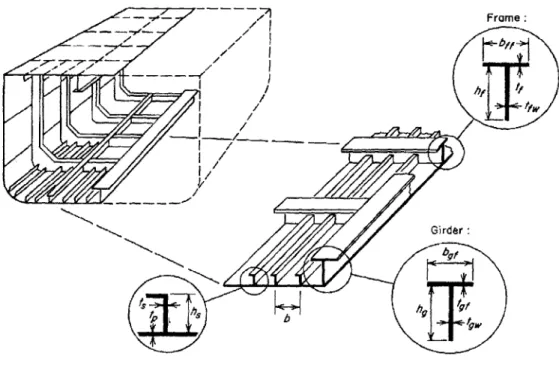
b. Secondary Structure. Secondary structure consists of stiffened panels and grillages bounded by decks, bulkheads and the shell; and
C. Tertiary Structure. Panels of plate bounded by stiffeners or elements of stiffeners themselves.
The simplification that results from such a breakdown is the analysis of each component independently of others. Because cross coupling effects are thereby neglected, care must be
taken with boundary and support conditions. Although modern computing techniques allow the complete structure to be analyzed all at once, the utility of the distinction remains valuable during the synthesis phase when individual elements of the structure need to be sized and assembled into a composite whole. Secondary and tertiary structures will be the focus of subsequent sections.
Frame:
hpIf //W
Girder:
Figure 2-2: Secondary Structure (Hugues)
Stresses can also be classified in a similar way to the structure as follows:
a. Primary Stresses
(_).
Stresses due to bending, shear and torsion in the main hull girder;b. Secondary Stresses (9). Stresses in a stiffened grillage due to bending and membrane effects; and
c. Tertiary Stresses (___3). Membrane stresses in panels between stiffeners. Loads which cause the stress include, but are not limited to:
a. in-plane and bending loads transmitted by the pressure hull; b. accidental flood pressures;
c. escape compartment pressures;
d. static and dynamic forces from payload items; and e. containment pressures.
In general, each structural element may contain a combination of all types of stresses and loads. The utility of these definitions is similar to that for ship structures classification, that is, it is frequently convenient to calculate stresses at each level separately and to superimpose them to obtain a complete solution.
2.1.2 Bulkhead Classification
The primary functions of submarine bulkheads are identical to those of surface ship bulkheads. The bulkhead maintains hull cross-sectional shape and supports the pressure hull envelope. In addition to this the bulkhead provides the mechanism to subdivide the hull[7]. It is from these operating requirements that bulkheads can be divided into three types as follows:
a. Main. Structural bulkheads which form part of the main strength of the ship and are usually watertight and gas-tight;
b. Load Bearing. Structural bulkheads which support local loads (weapons, items of equipment, etc) but which may not contribute to the main strength of the ship; and
a. Partition. Non-structural bulkheads designed only to provide divisions and carry items attached.
2.1.3 Load Bearing Bulkheads
Load bearing bulkheads are to be dealt with in a similar manner to main bulkheads. Without being unnecessarily exhaustive, below are guidelines for the design of load bearing bulkheads which will be verified in this paper[9].
a. watertight subdivision bulkheads are to extend to the shell plating;
b. bulkheads are to be constructed of flat plating butt welded and stiffened by 'T' bar stiffeners continuously welded thereto on one side only;
c. great care is to be taken to ensure the alignment of stiffeners above and below strength decks in order to maintain continuity of the bulkhead stiffening throughout the full height of the bulkhead;
d. where the bulkhead plating differs in thickness over its height or width the plating is to be worked such that one side is flush to enable the stiffening to be welded to the flush side and so avoid cropping of the webs of stiffeners to accommodate the differences in thickness;
e. bulkhead plating is to be welded directly to the deck, shell or inner bottom. Where it is not possible to avoid the coinciding of bulkhead with frame, beam, girder or longitudinal, the bulkhead plating is to be welded directly to the rider or table of the structural member;
f. bulkhead stiffeners are to be vertical, with head and heel connected to
longitudinals, girders, beams, floors, stringers or other structure which must span at least one frame space;
g. to achieve suitable head and heel connection, stiffeners may be slightly inclined from the vertical;
h. penetrations are to be kept to a minimum, lightening or other holes are not to be cut in bulkhead stiffeners; and
i. all openings in bulkheads are to have rounded corners. The radius of the corners is to be as large as possible but not less than 1/8 the width of the opening.
2.1.4 Partition Bulkheads
Partition bulkheads both longitudinal and transverse may be constructed of mild steel, aluminum alloy, or of composite construction. Mild steel bulkheads are to be stiffened by swaging or by mild steel stiffeners, the plates being worked vertically and welded to deck and deckhead, or to a thicker curtain and plate. Where the head or heel of a stiffener does not connect with a
structural member, the stiffener is to be stopped 25mm away from the deck or shell and the web is to be snapped back at 450 [8].
2.2
MATERIAL
PROPERTIES
2.2.1 Steel Advantages and Disadvantages
Steel remains the most popular material in naval ship construction due to its multiple attributes. Nonetheless, among its disadvantages is the ease with which steel corrodes in a wet environment leading to heavy expenditure on protective measures, and the fact that a welded steel structure has no lower fatigue limit. Fatigue limit is defined as the threshold level of stress range (S) below which fatigue damage does not occur, regardless of the number of cycles (N)[1]. Advantages and disadvantages of steel in the marine environment are described as shown below[3].
Steel Pro
perties
Advantages Disadvantages
* Normally ductile * Corrodes readily
* Virtually isotropic 0 Has no lower fatigue limit in sea water or * Easily formed and fabricated complex arrangements
* Plentiful * Low strength to weight ratio (heavy)
* High stiffness to weight ratio * Brittle at low temperatures * Easily alloyed or heat treated for special * Magnetic
properties * Easily repaired
Table 2-1: Advantages and Disadvantages of Steel (SSP 23)
Moreover, mild steel has the particular disadvantage that no toughness (crack arresting property) is specified. For this reason, high strength quenched and tempered steels which have very high resistance to cracking but which are relatively difficult to weld are largely used, specially for
submarine hulls. In ships of any size it is desirable to use either a steel with a guaranteed toughness, such as BS4360 Grade 43D or to use some form of crack arrestor. This may be
either a riveted seam or a strake of much tougher steel; in the latter case Grade 50EE would probably be necessary to absorb the energy of a running crack.
2.2.2 B
Quality
Mild Steel Properties
The load-bearing bulkhead studied is made completely of B Quality Mild Steel (BS4360 Grade
50EE) which material[3] and mechanical[8] properties are described below.
Description
Lloyd's Rules
British Standard
B
Quality
Mild Steel EH32 BS 4360 Grade 50EETable 2-2: B Quality Steel Equivalent Grades
Carbon
Silicon
Manganese
Sulfur
Phosphorus
% max % m% max % min % max % max % min
0.19 0.10 0.35 1.20 1.70 0.04 0.04
Table 2-3: Chemical Composition of B Quality Steel
Density Young's Modulus of Poisson's Thermal Expansion
Elasticity Ratio Coefficient
E
kg/m_3
GPa
-_m/i
7850 207 0.3 11.9
Table 2-4: Material Properties of B Quality Steel
Thickness Elongation Minimum Toughness
of Plate Tensile Strength Yield Stress on gauge length of Charpy V Notch
5.65 S Impact Test
t mi max _V min Temp Energy
mm MPa MPa MPa % 0C
t<22 480 590 310
22 < t 32 460 580 295 20 -30 40
32< t 75 450 560 280
Chapter 3
3.1
STRUCTURAL FAILURE MODES
3.1.1 Types of Failure Modes
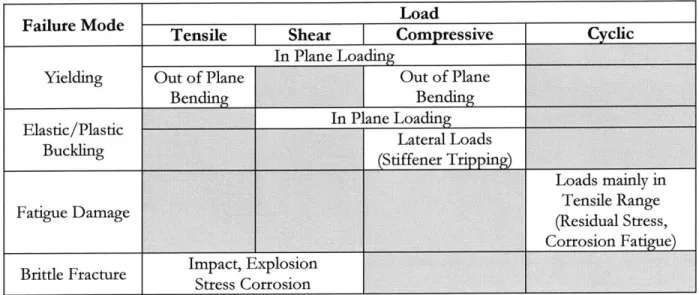
Structural failure is nearly always nonlinear, either a geometric non-linearity (buckling or any other large deflection) and/or a material non-linearity (yielding and plastic deformation) [1]. During structural design and limit state analysis, care must be taken to ensure that all possible
failure modes are considered. Structural failures can essentially be divided into two groups, those which involve fracture without gross deformation and those that do involve gross deformation but not fracture in the first instance[3]. Each of these groups can be additionally subdivided as follows.
a. plastic deformation (large local plasticity);
b. instability (buckling): (1) bifurcation, and (2) non-bifurcation; c. fracture:
(1) direct (tensile rupture), (2) fatigue, and
(3) brittle.
Bifurcation buckling is best explained with a simple elastic column which, under a given axial load, will adopt an alternative equilibrium position corresponding to a bent shape. As the load increases, the stress-strain curve will reach a peak and then fall due to a rapid loss of stiffness. In non-bifurcation buckling, the lateral deflection commences as soon as the axial load is applied, and it increases progressively, at an increasing rate, causing the member to progressively lose its stiffness from the very beginning of the loading, until finally the stiffness vanishes[1].
Moreover, these various failure mode can combine and also interact, depending on the member properties and on the loading. Figure 3-1 illustrates load-deflection curves for
individual types of members and the varying types of loading and support which they receive: (a) failure by plastic deformation, (b) bifurcation buckling of beams and columns, (c) bifurcation buckling of plates, and (d) non-bifurcation buckling.
Load
Failure Mode
Yielding Elastic/Plastic Buckling Fatigue Damage Brittle FractureTensile
I
Shear
I
Compressive
In Plane Loading
ut of Plane Out of Plane
Bending Bending
In Plane Loading
Lateral Loads (Stiffener Trinnino)
Table 3-1: Structural Failure Modes (SSP 23)
8
f
8
Figure 3-1: Failure Modes Load-Deflection Curves (Hugues)
3.1.2 Static Fracture: Ductile Yielding and Brittle Fracture
Ductile Yielding
The provision of adequate safety against failure by static fracture is achieved by keeping the stress level throughout each member sufficiently below the ultimate tensile strength -UTS of the material. The constraint against failure by fracture is thus:
ACT CUTS (3.1)
The safety factor () is chosen according to the uncertainty of the applied stress (_), the importance of the member, and the seriousness of the consequence of failure.
Brittle Fracture
Brittle fracture refers to the fact that below a certain temperature the ultimate tensile strength of steel diminishes sharply[1]. The susceptibility of a structure to brittle fracture is almost entirely dependent on the chemical composition of the material from which it is constructed. The risk is additionally increased by the presence of stress concentrations, notches and notch like defects, exposure to low temperatures, impact or high rates of loading, and the use of thick material. Constructional techniques and metallurgical processes, particularly welding procedures, also play a crucial role on the value of the transition temperature at which brittle fracture occurs [3].
3.1.3 Fatigue Damage
Because the majority of the loads imposed on ships are cyclic, fatigue damage is the cause of most structural failures that occur in service. In steel and other metals, a fluctuating stress can initiate microscopic cracks which gradually increase in size until, after a large number of cycle, the cracks have become so large that fracture occurs. There are two principal philosophies of fatigue design which are applicable to ship structures. The first is fail-safe design which is intended to ensure that any local failure in the structure cannot extend to cause total structural failure, and the second is safe-life design which ensures that no significant crack growth will occur in the working life of the structure. Except where it is clearly uneconomic, safe-life design should be used in design of ship structures, as it leads to a more robust structure with lower maintenance and repair costs.
In general, fatigue failure is prevented by controlling the cyclic stress amplitude by increasing the local scantlings and/or modifying the local geometry so as to reduce stress concentrations, eccentricities, and discontinuities[1]. The design authority is to identify all significant stress
concentration areas where fatigue cracking is likely during the ship's life. A detailed stress analysis of each of the areas is then undertaken to establish the stress concentration factor and the resultant stress range under the design loads. The problem in the design of a ship's structure is therefore to ensure that the integrated number of stress cycles in all areas does not exceed the limit for the material during the ship's
life[14].
In this case study, it will be assumed that cyclic loads are at a sufficiently low frequency that they can be treated as static[3].3.2
STIFFENED
PANEL
BUCKLING
MODES
3.2.1 Plastic vs. Elasto-Plastic Buckling
Plastic buckling can take many different forms. It may be confined to the plating, or the webs, or the flanges of stiffeners; it may occur by tripping or by flexure of one set of stiffeners
between an orthogonal set; or it may involve an entire grillage. Care must be taken to ensure all possible buckling modes are taken account of, noting that stiffener tripping and some other modes of local buckling can be caused by lateral loads as well as by in-plane loads [3]. The different buckling failure modes will be examined in more details in subsequent sections.
In efficient structures, elastic buckling loads are usually higher than loads to first yield of material and therefore collapse will involve a combination of buckling and yield failure known as elasto-plastic buckling. Because of the non-linear nature of the phenomenon and its dependence of
factors such as initial deformation and welding residual stress, the mode shape and stress at failure can only be predicted using numerical methods [3].
3.2.2 Elastic vs. Inelastic Analysis
As described above, stiffened panels can buckle in essentially two different ways. In overall buckling, the stiffeners buckle along with the plating; in localbuckling either the stiffeners buckle prematurely, because of inadequate rigidity or stability, or the plate buckles between the
stiffeners, thus shedding extra load into the stiffeners so that eventually the stiffeners buckle in the manner of columns. This process is invariably inelastic which means an actual failure of the structure. It is however best to perform an elastic buckling analysis because that approach[1]:
a. is relatively simple, consisting mostly of explicit formulae;
b. gives a good indication of the likely modes of failure; elastic buckling of one type or another may be possible and may be one of the governing failure modes;
c. provides a foundation for more complex question of the inelastic buckling and ultimate strength of stiffened panels including whether or not an inelastic analysis is required; and
d. provides the elastic buckling parameters needed for the inelastic analysis. The first and most basic principle in regard to stiffeners is that they should be designed at least as strong as the plating. Also, they should be sufficiently rigid and stable so that neither local stiffener buckling nor overall buckling occurs before local plate buckling.
Although elastic design analysis methods are in general simpler and less stringent than elasto-plastic ones, they are not always conservative. As a consequence, elasto-elasto-plastic and inelastic analyses should also be considered, especially since it is known that both buckling and yielding occurred in the case study.
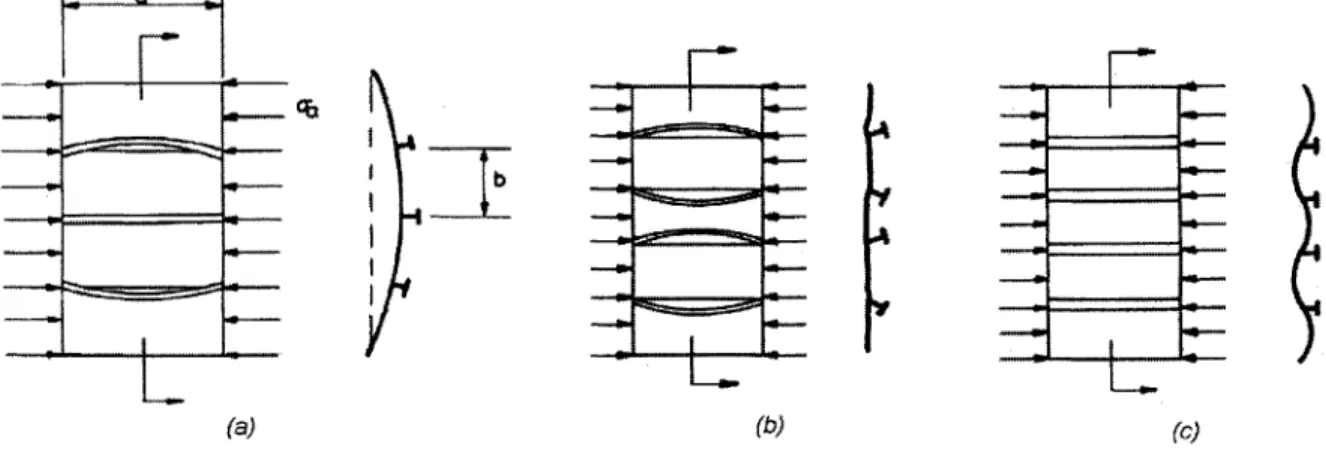
(a) (b) (c)
Figure 3-2: Buckling Modes (Hugues)
(a) Overall Buckling; (b) Local Torsional Buckling (Tripping) of Stiffeners;
(c) Local Plate Buckling
3.2.3 Buckling Failure Modes
Buckling can occur in any member or part of a member which carries an axial or in-plane compressive load. It is understood that the case study deals with a lateral load but examining all failure modes for steel stiffened panels will proved to be a necessity. Further to Hugues and as described in detail by Paik[1 1], theoretically, the primary modes of overall failure for a stiffened panel subject to predominantly compressive loads may be categorized into the following six groups, namely:
a. Mode I. Overall collapse after overall buckling of the plating and stiffeners as a unit, see Figure 3-3(a);
b. Mode II. Plate-induced failure by yielding at the corners of plating between stiffeners; see Figure 3-3(b);
c. Mode III. Plate-induced failure by yielding of a plate-stiffener combination at mid-span; see Figure 3-3(c);
d. Mode IV. Stiffener-induced failure by local buckling of stiffener web, see Figure
3-3(d);
e. Mode V. Stiffener-induced failure by lateral-torsional buckling of stiffener, see Figure 3-3(e); and
(b)
(C)
4
L
Figure 3-3: Stiffened Panel Failure Modes (Paik)
Mode I typically represents the collapse pattern when the stiffeners are relatively weak. In this case, the stiffeners can buckle together with plating -the overall buckling behaviour remaining elastic. The stiffened panel can normally sustain further loading even after overall buckling in the elastic regime occurs and the ultimate strength is eventually reached by formation of a large yield region inside the panel and/or along the panel edges. In Mode I, the panel behaves as an orthotropic plate.
The other groups (Modes II-VI) normally take place when the stiffeners are relatively strong so that the stiffeners remain straight until the plating between stiffeners buckles or even collapses locally. The stiffened panel will eventually reach the ultimate limit state by failure of stiffeners
N1
Rqo
(e)
Mode II typically represents the collapse pattern wherein the panel collapses by yielding at the corners of plating between stiffeners, which is usually termed a plate-induced failure at ends. Let us note that the actual panel failure in the case study bears a physical resemblance to Mode
II failure. This type of collapse can also occur in some cases when the panel is predominantly subjected to biaxial compressive loads. Mode III indicates a failure pattern in which the ultimate strength is reached by column or beam-column type collapse of the plate-stiffener combination with the associated effective (reduced) plating. Mode III typically takes place by yielding of the
plate-stiffener combination at span, which is usually termed a plate-induced failure at mid-span. In most cases, these two local plate buckling modes are the weakest failure mode.
Modes IV and V failures typically arise when the ratio of stiffener web height to stiffener web thickness is too large and/or when the type of the stiffener flange is inadequate to remain straight so that the stiffener web buckles or twists sideways. Mode IV represents a failure pattern in which the panel collapses by local buckling of stiffener web, while Mode V can occur when the ultimate strength is reached by lateral-torsional buckling (also called tripping) of stiffener. Mode VI typically takes place when the panel slenderness is very small (i.e., the panel is very stocky or thick) and/or when the panel is predominantly subjected to the axial tensile loading so that neither local nor overall buckling occurs until the panel cross section yields entirely.
3.2.3 Adamchak's Model: Beam-Column Buckling (Yielding)
According to Adamchak's model (1979) which was based on a variety of empirically based strength of material solutions, the most probable ductile failure modes for stiffened and
unstiffened plate structures include section yielding or rupture, inter-frame Euler beam-column buckling, and inter-frame stiffener tripping (lateral-torsional buckling)[12]. Euler beam-column buckling is further categorized as having two distinct types of failure patterns.
a. Type I -is characterized by all lateral deformation occurring in the same
direction as shown in Figure 3-4. Although this type of failure is depended on all geometrical and material properties that define the structural element, it is
basically yield strength dependent. Type
Ifailure is assumed to occur only when
either lateralpressure or initial distortion, or both, are present. The bounday conditions
at the beam-column ends are assumed to be clamped (rigidlyfixed); and
b. Type II -is modulus (E) depended, as far as initial buckling is concerned. This type of failure can be initiated whether or not initial distortion or lateral pressure, or both, are present. In this mode of failure however, the beam-column can fail in a mode in which the lateral deflections alternate in directions from one bay to
the next as shown in Figure 3-5. In this case, the beam-column acts as if it is simply-supported by the transverse web frames or bulkheads.
Figure 3-4: Type I Beam-Column Failure (Assakkaf)
x
Figure 3-5: Type II Beam-Column Failure (Assakkaf)
3.2.4 Local Buckling of Stiffener (Tripping)
As described by Hugues, a stiffener may buckle by twisting about its
line
of attachment to theplating.
Theplate
may rotate somewhat to accommodate the stiffener rotation, and the direction of rotation usually alternates as shown in Figure 3-6 because this involvesless
elastic strain energy in theplating.
Stiffener tripping andplate
buckling interact but may occur in either order depending on the stiffener and plating proportions. As noted earlier, tripping failure is regarded as collapse because once tripping occurs, theplating
is left with no stiffening and so overall buckling follows immediately. Also, elastic tripping is a quite suddenphenomenon
and hence it is a most undesirable mode of collapse, akin to elastic overallpanel
buckling.shear
centre
3.3
SELECTION
OF
ANALYSIS
METHOD
The behaviour of steel stiffened panels normally depends on a variety of influential factors, namely: geometric/material properties, loading characteristics, initial imperfections (post-weld initial deflection and residual stress), boundary conditions, and existing local damage related to corrosion, fatigue crack and denting. In a typical analysis, the panel ultimate strengths for each of the six collapse modes are calculated separately and then compared to each other to find the minimum value which is then taken to correspond to the real panel ultimate strength[10]. The different types of failure mode being enunciated, the physical problem can better be characterized. For the purpose of this thesis, the panel was idealized as an isotropic plate analyzed under static loading. An "elastic" analysis process was selected because of the reasons aforementioned and because the bulkhead is designed for repeated loading[7]. It was observed from the case study that two stiffeners' web failed at the location where they connect to the ring frame (higher stress concentration) and that the plate itself also failed in such a manner. This indicates an overall plate-stiffener failure mode. The question remained as to whether the instability was initially caused by the plate, the stiffeners, or a combination of both.
The available techniques for buckling-yielding analysis of stiffened panel structures fall into two categories: analytical methods and numerical methods. Analytical methods of solution involve solving the governing differential equations, either discretely or by means of a series
representation for the solution in conjunction with an energy approach[1]. Analytical methods in this case may be used validly to solve independent aspects of the problem such as stiffeners' buckling bounds. Given the geometry of the panel and the initial conditions, no analytical method was found to accurately predict the maximum allowable stresses due to lateral pressure. Hence the need for a numerical method such as finite element analysis which involves large-order matrix equation whose coefficients are numerically evaluated functions of the material properties, geometry, and applied loads.
Chapter
4
4.1
STIFFENED PANEL DESIGN
4.1.1 Modeling of Stiffened Panels
A typical steel stiffened plate structure is shown below. Its response can be studied at three
levels, namely the entire structure level, the stiffened panel level and the bare plate level[1 1]. Although this thesis is primarily concerned with the second level in which a stiffened panel is supported by frames of greater stiffness along all edges, exhaustive analysis will be performed on the bare plate as a discerning preamble.
Stiffeners are very important structural components that are used to strengthen plates and increase their load carrying capacity. Moreover, the purpose of stiffeners is to carry the whole load at the point of application and to distribute it progressively into the plating, at the same time as taking bending moments due to the inevitable eccentricity of the load in relation to the neutral axis of the combination of stiffener and plate. The stiffener will always carry stress greater than or equal to that in the plate due to shear lag effects and initial distortions, so that the main part of the procedure involves sizing the stiffener[3].
Longitudinal girders Stiffened panels
Plating Transvcrse frames
Stiffeners
4.1.2 Design Against Lateral Loads
The design procedure of transverse bulkhead against lateral loads is succinctly described in the British Admiralty's Sea Systems Publication No. 23[3] and is summarized herein in the next sections. Because lateral pressures have such a large influence on the response of bulkheads it is best to design the bulkhead taking account of lateral loads before checking the resistance to other loads.
The first task is to select an arrangement for the stiffening and plating. Since bulkheads are usually divided by decks into a number of wide short rectangular panels the stiffening will be best arranged vertically. Additionally, under resistance to explosive loading, the stiffeners must be arranged so that they end on longitudinals in the hull bottom, but even where a bulkhead does not extend to the bottom it is desirable that bulkhead stiffeners all end on either deck longitudinal stiffeners or other stiff structure so that a hard spot which creates a stress concentration and, potentially, a fatigue failure point, is not introduced. If the layout of deck and bottom stiffeners leaves any choice in the positioning of bulkhead stiffeners it should be remembered that close spacing leads to thinner
plating
and lighter weight, but less robustness and greater sensitivity to corrosion. More widely spaced stiffeners and thicker plate will be heavier buteasier to build and maintain, with less welding distortion and associated rework when fitting decks and items of equipment to the bulkheads. Thicker plating also contributes to ballistic and blast protection and hence improves survivability.
When the arrangement of stiffeners has been determined, it is next necessary to decide the scantlings and for this either elastic or plastic design methods may be used. Plastic methods relate an extreme design load to the ultimate collapse condition of the structure and may save some weight provided that the normal working loads are low and that a fairly flexible structure is acceptable. As earlier described, if normal working loads are relatively high, which is the case in tanks, or if it is important to limit deflections, then elastic methods must be used.
4.2
PLATE
THICKNESS
4.2.1 Geometry
The panel was geometrically idealized as an isotropic composite of sub-panels with different thickness illustrated below.
y 2750 tX 2150 1750 150 M750-f350 4 6 2400
Figure 4-2: Unstiffened Panel Idealization (dimensions in mm)
4.2.2 Plate Thickness Analysis
Plate thickness over the main part of the panel should be determined to ensure adequate
strength under normal or accidental load. However, at the edges of the bulkhead where it meets the bottom and side of the ship, the panel plating should be thickened to give increased strength and stability under explosive loading. The depth of this thickened strip (measured normal to the hull plating) should be not less than 1.5 times the spacing of the longitudinals
(excluding occasional deep members) at the point considered[3]. In the case study, since no longitudinals were present, the vertical stiffeners' spacing was used.
The plate thickness in any case should not be less than all of the following: a. 80% of the thickness of the adjacent shell plating;
Furthermore, the plate thickness in any case shall not be less than 5 mm to avoid weld distortion and cracking[7]. For the hull and wet spaces such as tanks and bilges, a recommended 0.5 mm corrosion allowance should be added to the mean thickness. The basis for this figure is that corrosion in ship's steel structure is usually in the form of local, relatively deep, pitting where the protective system has broken down. A few pits have little effect on overall strength, but they become more significant as they increase in number, and an average loss of strength equivalent to 0.5 mm thickness is reasonable[3].
For the case study, the requirement for the plate thickness to ultimately be not less than 5.5 mm is satisfied. Adjacent plate section thickness' are within 80% of each other, 6 mm to 8 mm to 7 mm. However, the portion of the panel with thickness of 6 mm should be thicker by 0.5 mm to meet the minimum thickened plate requirement of 6.5 mm. This discrepancy is considered negligible given that the panel has several transverse flat bar stiffeners along the length between the vertical "T" type stiffeners. The case study is in fact highly stiffened and thus can
accommodate thin plating.
I
Lx y = 1.5x x = 0.5 M y = 0.75 m x = 0.5 M y = 0.75 m x = 0.565 M y = 0.8475 m4.3
SCANTLING DESIGN
4.3.1 Scantling Arrangement
The scantlings of transverse bulkheads are usually determined by the requirement to resist lateral pressures. Such pressures may be caused by accidental flooding, hydrostatic or dynamic
pressures in tanks, water and air-tightness tests or accidental missile ignition. The normal arrangement of vertical stiffening previously described should be continued through to the hull but subject to the following requirements[14].
a. wherever hull longitudinals pass through, or end on, a bulkhead, there must be a bulkhead stiffener connected to each hull longitudinal, and vice versa. This is most important because, unless every longitudinal is "backed up" by a bulkhead stiffener, the bulkhead plating may easily rupture under explosive attack; and
b. bulkhead stiffeners in the peripheral zone should lie as nearly as possible at right angles to the hull plating;
The function of the bulkhead in withstanding water pressure must not be forgotten when deciding the arrangement of stiffeners. The requirements of (a) and (b) above usually lead to diagonal stiffeners in way of the lower part of the turn of bilge as shown in Figure 4-4. In the case study, the scantling arrangement follows the guidelines aforementioned. The panel is not only strengthened by vertical "T" type stiffeners but is also interlaced with transverse flat bar stiffeners as shown in Figure 4-3.
PLATING
Strip of Thicker Plating
STIFFENERS
.7
Short Stiffeners at each Longitudinal
Diagonal Stiffener
Stiffeners and Longitudinals Aligned
Figure 4-4: Typical Bulkhead Stiffening Arrangement
4.4
STIFFENER DESIGN
4.4.1 Geometric Parameters and Governing Formulae
bf
j
tf
hhc
hw
*1-w
-z
Panel Neutral Axis
Figure 4-5: Stiffener Geometric Parameters
The geometric parameters are defined as follows:
b: stiffener spacing (along plate)
bf: flange width
h: distance from plate centerline to flange centerline he: distance from stiffener toe to flange centerline hw: web height t: plate thickness tf: flange thickness t: web thickness and
A =
bt
+(hWtW+btf)
=
AP
+(
A,+ Af)= AP + A
(4.1)
A: panel cross sectional area (plate and stiffener)
Af: flange cross sectional area
Ap: plate cross sectional area
As: stiffener cross sectional area (flange and web)
The governing geometric formulae are provided in the following set of equations [14]:
Et
3D
= 2 (4.2) G = (4.3)2(1+v)
=(h t
+tfb)
(4.4)
12J =
-(h t3 +b t
3(4.5)
-t h
2+bt he
z - 2 (4.6) where: D: flexural rigidity G: shear modulusIz: second moment of area about centroid axis through web (excluding plate)
J:
torsion constant (excluding plate)4.4.2 Stiffener Dimensions
The failed stiffeners in the case study have the following dimensions and geometrical characteristics. 6 1/2" 33/81, 48 deg 2 1/4" 3 1/2 1t2" t') 1/2 "
Figure 4-6: Stiffener Dimensions
Description Symbol Unit Value
flange width bf m 0.0889 flange thickness t m 0.0127 web height hw m 0.1651 web thickness tw m 0.0127 plate thickness t m 0.0060 stiffener spacing b M 0.5000
flange cross sectional area Af m 2 1. 129E-03
web cross sectional area Aw m 2 2.097E-03
stiffener cross sectional area As m2 3.226E-03
plate cross sectional area A1 m2 3.OOOE-03
panel cross sectional area A m2 6.226E-03
centro d height z m 0.11367
second moment of area Iz m4 4.336E-08
torsion constant J m4 1.734E-07