Decentralized Planning for Autonomous Agents
Cooperating in Complex Missions
MAby
Andrew Whitten
Submitted to the Department of Aeronautics and Astronautics
in partial fulfillment of the requirements for the degree of
Master of Science in Aeronautics and Astronautics
at the
MASSACHUSETTS INSTITUTE OF TECHNOLOGY
SACHUSE-7S INSTITUTE OF TECHLRIE
OCT 18
L IRR F 3
I
ARCHNES
September 2010
@
Massachusetts Institute of Technology 2010. All rights reserved.
9
I jA u th or
.. . . . .. . . . .. . . . . ... .. .. . . . . .. . . . . .Department of Aeronautics and Astronautics
August 13, 2010
C ertified by ...
...
...
-.
--.-.
Jonathan P. How
Richard C. Maclaurin Professor of Aeronautics and Astronautics
Thesis Supervisor
/71
I.
.
A ccepted by ...
Associate Professor
.-1.. . . . .. . . .' . . . . . -.. -.-Pr fessor Eytan H. Modiano
of Ae onautics and Astronautics
Chair, Graduate Program Committee
Decentralized Planning for Autonomous Agents Cooperating
in Complex Missions
by
Andrew Whitten
Submitted to the Department of Aeronautics and Astronautics on August 13, 2010, in partial fulfillment of the
requirements for the degree of
Master of Science in Aeronautics and Astronautics
Abstract
Planning for autonomous vehicles remains an important and challenging research topic. This thesis focuses on decentralized planning for autonomous agents perform-ing complex missions. These types of missions often involve a set of tasks, each representing a component of the mission. Task planning algorithms may be used as part of the mission planner to assign agents to tasks; however, the decentralized task assignment problem becomes increasingly difficult when there exists coupling in the task set. Coupling may be in the form of assignment relationships, where the value of a task is condition on whether or not another task has been assigned, or temporal relationships where the value of a task is conditioned on when it is performed relative to other tasks. In this work, task coupling is treated as a constraint, and a task planning framework is introduced which is specifically designed to ensure that all coupled constraints are satisfied by the assignment. The new algorithm is developed from a baseline Consensus-Based Bundle Algorithm (CBBA) and is called Coupled-Constraint CBBA, or CCBBA. The new algorithm is compared to the baseline in a complex mission simulation and is found to outperform the baseline by up to a factor of 3 with respect to assignment score. A separate extension to CBBA is also developed for satisfying refuel constraints in the task assignment process, and the technique is verified through numerical simulation.
Lastly, this thesis examines the autonomous search problem where a fleet of sensor-equipped agents are deployed to find objects of interest in an environment. A local search strategy developed for the Onboard Planning System for UAVs in Support of Expeditionary Reconnaissance and Surveillance (OPS-USERS) program is described, which is a receding horizon optimization technique. A global search strategy is also described which extends the planning horizon of the local search strategy by incor-porating larger amounts of information into the planning. The two strategies are compared both with and without an artificially simulated human operator, and the global search strategy is shown to outperform the local search strategy in terms of number of targets found.
Thesis Supervisor: Jonathan P. How
Acknowledgments
I would like to thank my advisor, Professor Jonathan How, for the opportunity to
come to MIT and contribute to the technologies being developed by the Aerospace Controls Laboratory. I would also like to thank the members of the ACL for helping me in numerous way, and making my time here enjoyable: Alborz Geramifard, Albert Wu, Justin Teo, Sameera Ponda, Vishnu Desaraju, Georges Aoude, Buddy Michini, Dan Levine, Josh Redding, Aditya Undurti, Frank Fan, Luke Johnson, Brandon Luders, Kenneth Lee, Frant Sobolic, Cameron Fraser, Karl Kulling, Brett Bethke, Luca Bertuccelli, Sergio Cafarelli, Han-Lim Choi, and Kathryn Fischer. I also want to thank Olivier Toupet for helping me in my research during both OPS-USERS, and Sensor Fusion.
I cannot thank my family enough for their support and encouragement: my mom
Eileen; my dad Daniel; and my sister Emily. A special thanks goes to my wife, Dana, for her patience, understanding, and faith. I could not have done this without you.
This work was funded in part by: ONR # N00014-08-C-0707, AFOSR
#
FA9550-08-1-0086, and AFRL # FA8750-10-C-0107.Contents
1 Introduction
1.1 Previous W ork . . . .
1.2 Summary of Contributions . . . .
1.3 Thesis Overview. . . . .
2 Background on Baseline Task Planning Algorit
2.1 2.2 2.3 2.4 2.5 2.6 Information Structures . . . . Phase I: Task Selection . . . . Phase II: Consensus . . . . Convergence and Performance Properties CBBA with Time Windows . . . . Sum m ary . . . .
3 CBBA with Coupled Constraints
3.1 Task Allocation with Constraints . . . .
3.2 Task Set Partitioning . . . .
3.3 Pessimistic Bidding Strategy . . . . 3.4 Optimistic Bidding Strategy . . . .
3.5 Mutual Exclusions . . . . 3.6 Satisfying Temporal Constraints . . . .
3.7 Enforcing Constraints . . . .
3.8 Algorithm Changes . . . .
3.9 Examples of Encoding Real-World Constraints . .
3.10 Numerical Results for Coupled-Constraint CBBA 3.11 Sum m ary . . . . 4 Satisfying Refueling Constraints with CBBA
4.1 Problem Statement . . . . .] . . . . 18 . . . . 23 . . . . 24 m 25 . . . . 25 . . . . 27 . . . . 29 . . . . 31 . . . . 32 . . . . 35 39 . . . . 39 . . . . 42 . . . . 45 . . . . 46 . . . . 49 . . . . 50 . . . . 52 . . . . 55 . . . . 55 . . . . 60 . . . . 68
4.2 A pproach . . . . 70
4.3 Numerical Comparison of Refuel Time Schedulers . . . . 73
4.4 Sum m ary . . . . 77
5 UAV Search Strategy Comparison 81 5.1 Introduction and Background... . . . . . . . 81
5.2 Description of Algorithms . . . ... . . . . 83
5.3 Simulation Parameters and Environment Description . . . . 94
5.4 Numerical Comparison of Performance... . . . . .. 97
5.5 Sum m ary . . . . 99
6 Conclusions 103 6.1 Thesis Sum m ary . . . . 103
6.2 Future W ork . . . . 105
A Consensus Table for CBBA 107 B OPS-USERS Demonstration and Results 109 B.1 Description of Testbed... . . . . . . . .. 109
B.2 OPS-USERS Demonstration... . . . . . . . . 112
List of Figures
3-1 Example of task set partitioning... . . . . . . . . 43
3-2 Cooperative CBBA vs. Baseline CBBA, Assignment Score . . . . 66
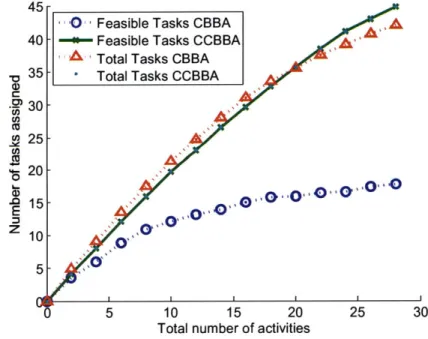
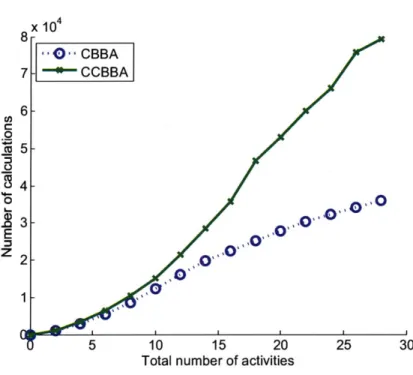
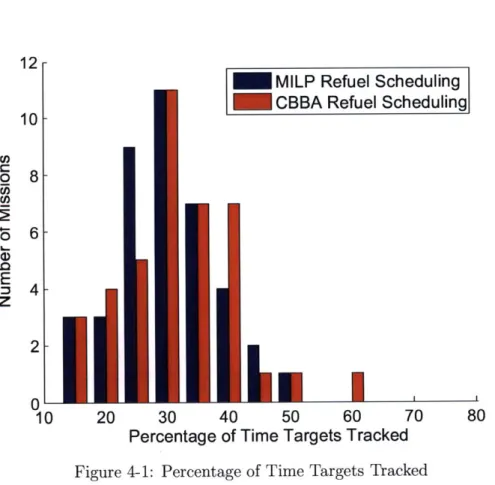
3-3 Cooperative CBBA vs. Baseline CBBA, Number of Tasks Assigned 66 3-4 Cooperative CBBA vs. Baseline CBBA, Computation Complexity . 67 3-5 Cooperative CBBA vs. Baseline CBBA, Communication Complexity 67 4-1 Percentage of Time Targets Tracked . . . . 78
4-2 Reaction Time to New Targets . . . . 78
4-3 Total Number of Targets Found . . . . 79
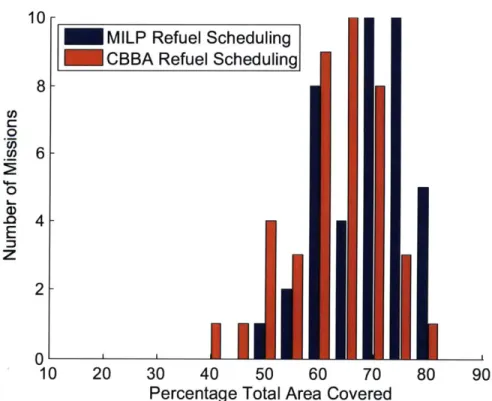
4-4 Percentage of Total Area Covered . . . ... 79
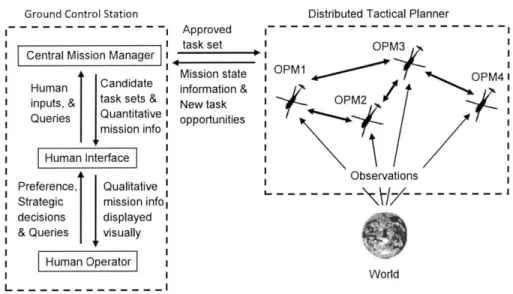
5-1 OPS-USERS high-level system architecture . . . . 84
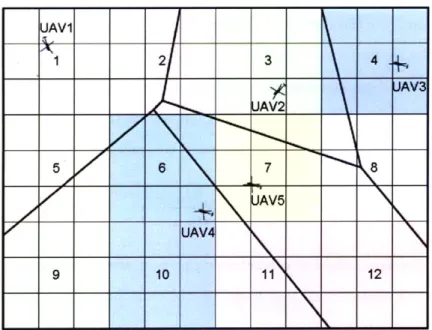
5-2 Voronoi regions for agents searching an environment . . . . 90
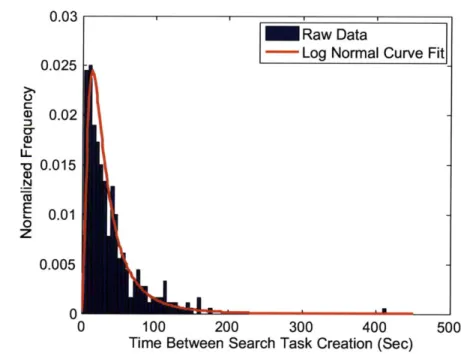
5-3 Distribution of time between search task creation for human operator 93 5-4 A priori probability distribution for informed initial conditions study 96 5-5 A priori probability distribution for uninformed initial conditions study 96 5-6 Average number of targets found as a function of time, informed . . . 100
5-7 Histogram of total number of targets found, informed . . . . 100
5-8 Average number of targets found as a function of time, uninformed . 101 5-9 Histogram of total number of targets found, uninformed . . . . 101
5-10 Performance score for each strategy tested . . . . 102
B-i RAVEN Flying Space . . . . 110
B-2 Quadrotor Helicopter Equipped with Wireless Camera . . . . 112
B-3 Ground Platform for Unmanned Cooperative Control (GPUCC) . . . 113
B-4 Refuel Base Locations and Target Routes . . . . 115
B-5 Takeoff Sequence and Initial Search Task Selection . . . . 116
B-6 Autonomous Task Allocation and Path Planning . . . . 116
B-8 WUAV Engages Hostile Target After Operator Approval . . . . 117
B-9 UAV Refueling During OPS-USERS Mission... . . . . .. 118
B-10 Convoy Protection Task Execution... . . . . .. 118
B-11 Mission Time Targets Tracked . . . . 119
B-12 Fraction of Ground Searched as Function of Time . . . . 119
List of Tables
3.1 Code for Dependency Matrix Entry Dj (q, u) . . . . 44
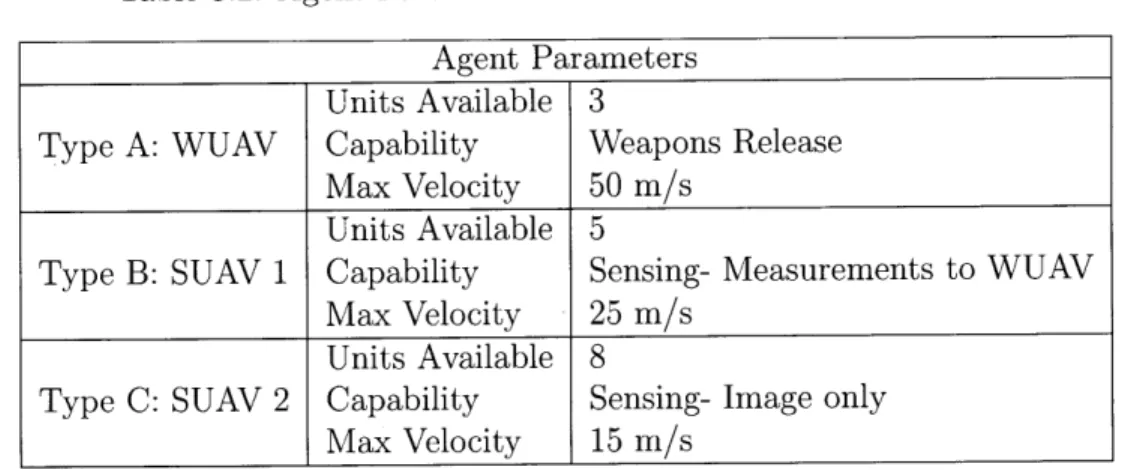
3.2 Agent Parameters for Simulated Mission Scenario . . . . 61
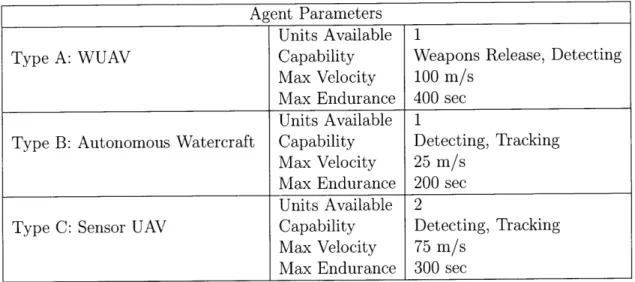
4.1 Agent Parameters for Simulated Mission Scenario, Refueling Algorithm Com parison . . . . 75
4.2 Average Performance Metrics for Refuel Algorithm Comparison . . . 77
5.1 Corresponding zones for a five agent fleet . . . . 90
5.2 Simulation parameters, environment... . . . . . . . . 95
5.3 Simulation parameters, agents . . . ... 95
5.4 Simulation parameters, targets . . . . 95
A. 1 CBBA Action rules for agent
i
based on communication with agent kregarding task
j...
. . . .
. . . .
..
108
B. 1 Agent Parameters for Demonstrated Mission Scenario . . . . 114
List of Algorithms
1 Task Selection Process for Agent i, Original CBBA . . . . 28 2 Task Selection Process for Agent i, CBBA w/ TW . . . . 36
3 Calculate marginal score of task j given pi for agent i . . . . 37
4 Enforce Constraints and Update Permissions for Cooperative CBBA . 56
5 Calculate marginal score of task
j
given pi for agent i, CBBA with Refuel Constraint . . . . 72List of number of iterations in constraint violation for agent i Times: list of execution times corresponding to the tasks in plan pi Time required to travel from task A to task B
Bundle: list of tasks agent i has selected, descending order of score Path: list of tasks agent i has selected, in order they are to be executed Times stamps: list last communication time between agent i and all other agents
List of arrival times for all tasks that agent i believes to have a current winner
Permission to bid any Permission to bid solo
Winning Bids: list of winning bids according to agent i Winning Agents: list of winning agents according to agent i Set of all activities
Set of all tasks in activity
j
Dependency matrix for activityj
Set of all agent indicesNomenclature
vi ri A(A, B) pi Si tzi Wany Wi Wsolo w. yi zi A A DiI
7; @n rarliest Tend j latest 7-. rstart rallowed opt cii
dj
lb LtNt
Nu
Nreq(jq) Ojq S. Spath (Pi) canBid (jq)Set of all task indices
Temporal constraint matrix for activity
j
Insertion operatorSet difference operator
Minimum allowed start time for task
j,
constraints considered Maximum allowed start time for taskj
Maximum allowed start time for task
j,
constraints considered Minimum allowed start time for taskj
Set of times agent i can begin task
j
and still have time to perform all tasks in their planVisit time that gives greatest score for agent i performing task
j
Marginal score for agent i interested in taskj
Duration of task
j
Current length of bundle, equivalently current length of path Maximum bundle length
Number of tasks Number of agents
Number of dependency constraints associated with task jq Timeout parameter for task jq
Score function for task j Score for path pi
Chapter 1
Introduction
Missions involving multiple autonomous agents require planning and control on many levels. Mission planners of varying complexity have been developed to take in high level mission objectives and measurement data from the agents to decide on actions for each of the agents in the network [1-4]. Typically, mission planners have many layers, each dedicated to an aspect of the decision making process. This thesis inves-tigates two of the planning problems associated with autonomous agents cooperating in complex missions: 1) the task planning problem with coupled constraints, and 2) the autonomous search problem in a partially unknown environment.
The Task Planning Problem with Coupled Constraints To simplify the
plan-ning problem, missions are often broken down into tasks, where each task represents some aspect of the mission that needs to be performed [5]. Task planning decisions are made regarding which agent should carry out which task, and when each task should be performed. Decisions are made such that the mission is accomplished with the lowest cost, or equivalently the largest reward.
In simple mission scenarios, each task may be assigned independently, as long as two agents are not assigned to the same task. However, in a complex mission setting, coupling exists between certain tasks in the task set. The importance of a task may depend on whether or not another task is assigned, and the value a task adds to a mission may be a function of when it is performed in relation to other tasks. This
thesis investigates the task planning problem with coupled constraints.
The Autonomous Search Problem in a Partially Unknown Environment
Mission objectives often include locating objects of interest in the environment. The object's initial positions are typically unknown, but there may exist an a priori prob-ability distribution that is known. The objects may be mobile, and so the possible trajectories of the objects must be considered. The autonomous agents in a search problem are equipped with some type of sensor with a finite field of view, and some limited range. An object may be observed if it is contained within the sensor field of view. The first time an object is observed, it is said to be found. The goal of the autonomous fleet is to find as many objects as possible, and each object should be found as soon as possible.
1.1
Previous
Work-Complex missions involving a fleet of autonomous agents pose a difficult planning problem. The architecture of the mission planner used in such a scenario may be ei-ther centralized, or decentralized. In a purely centralized planning architecture [6-9], all decisions are made by a single computation source, and each agent in the network receives its plan from this centralized node. In a decentralized architecture, multiple nodes in the planning network contribute to the decision-making process. Each ar-chitecture posses both advantages and disadvantages, and many modern systems are not purely one or the other, but use elements of each.
One advantage of a centralized architecture is that all computation can be per-formed from a ground control station, enabling lighter and less expensive vehicles. Furthermore, techniques have been developed to specify a general set of constraints, allowing very complex mission scenario. However, this type of architecture requires a global information set, which may be difficult or impossible to obtain in real time. As a result, centralized architectures often rely on a high bandwidth communication infrastructure.
Ideally, the communication link between all elements of the system (command station, autonomous vehicles, manned vehicles, etc.) is high bandwidth, low latency,
low cost, and highly reliable. However, even the most modern communication
infras-tructures do not posses all of these characteristics. If the inter-agent communication mechanism has a more favorable combination of these characteristics compared to agent-to-base communication, then a decentralized planning architecture offers per-formance and robustness advantages. In particular, response times to changes in situational awareness can be significantly faster via decentralized control than those achieved under a purely centralized planner. In addition, decentralized planning schemes are well-suited for situations where the information needed for decision mak-ing is local with respect to the network diameter. This is particularly noticeable in the task assignment consensus problem where agents near each other will require the most communication to resolve task assignment conflicts, whereas agents that are spatially separated are less likely to choose the same tasks. Decentralized algorithms with strong inter-agent communication should support this scenario more efficiently than centralized approaches. Therefore, the focus of this thesis is on decentralized methods for planning in complex missions. However, this work also attempts build an architecture that possesses advantages commonly found in centralized methods, most importantly, the ability to handle coupled constraints.
1.1.1
Previous Work in Task Planning
Centralized Techniques for Satisfying General Coupled Constraints The work described in [10] provides a framework to solve the task assignment problem while enforcing timing constraints. The task assignment problem can be formulated as a Mixed Integer Linear Program (MILP) and solved exactly by a commercially available numerical solver. Alternatively, a suboptimal solution can be found using Tabu search. The contributions in [11] provide a method for encoding detailed mission specific constraints into a MILP, using the language of Linear Temporal Logic (LTL). This work enables the user to rapidly, and intuitively encode the correct temporal and dependency constraints.
In [12], three types of timing constraints are considered: simultaneous arrival where agents must begin a task at the same time, tight sequencing where the difference in arrival times between agents is specified exactly, and loose sequencing where the difference in arrival times between agents is constrained to fall within a specified range. The solution technique focuses on the cooperative path planning problem in the context of multiple UAV task planning and scheduling.
These centralized methods are very power because of the constraint specification generality. The characteristics of these methods are desirable for the planning systems for complex missions, but since the techniques are centralized, they may be unsuitable for certain communication infrastructures.
Decentralized Techniques and Market Based Methods One approach to
de-centralized planning is to instantiate multiple instances of the same planner on each autonomous agent [13]. Each agent plans for the entire fleet, and executes only the plan it generated for itself. If all agents begin with the same information set, or Sit-uational Awareness (SA), then they will generate identical plans, and this is referred to as implicit coordination. However, in real-world applications, the SA may not be completely consistent across the fleet. Consensus protocols can be used to share in-formation such that the agent network approaches a consistent SA [14-21]. However, in a dynamic environment, consensus schemes can be slow to converge, introducing latency, or never converge at all. The work in [22] attempts to add robustness to the task assignment process via implicit coordination by communicating plan information as well as parameter information.
Other methods for solving the task assignment problem are market-based ap-proaches [23, 24], which are tractable for real-time applications. Many successful market-based approaches use an auction mechanism [25, 26]. Auctions may be run via an auctioneer [27-29], where each agent computes the reward associated with a task based on their own SA, and uses that as their bid. Each agent communicates their bid to the auctioneer, and the auctioneer determines the winner for each task. These types of methods guarantee conflict free solutions since the auctioneer only selects
one agent as the winner. They are decentralized in the sense that the computation is distributed, but they do rely on a centralized auctioneer.
Some auction-based protocols do not need to designate a single agent as the auc-tioneer, but utilize a different protocol where the winner is decided based on a set of self-consistent rules [30]. One such method is the Consensus-Based Bundle Al-gorithm (CBBA) [31, 32], which is a polynomial-time, market-based approach that uses consensus to reach agreement on the plan as opposed to the mission parameters. Several extensions to CBBA has been made recently including predictive planning
[33] where the task duration in uncertain, time windows [34] where each task is
time-sensitive, asynchronous communication [35] which enables realistic decentralized im-plementation, and cooperative assignment [36] which enforces some limited coupling relationships in the task set.
Techniques for Enforcing Priority Levels The task planning problem with
pri-ority has drawn some attention in the cooperative control community [37-40]. The mission scenario involves groups of tasks which posses a distinct priority. The con-straints specify that lower priority tasks must not be assigned unless their correspond-ing higher priority task is executed first. This type of framework is commonly applied to the cooperative search, track, and engage mission. Each target in the environment must be first tracked to confirm they are hostile, then engaged, and finally observed to provide a battle damage assessment (BDA). These tasks must be executed in this order, and cannot be assigned if the preceding task is not assigned.
Solutions to the single assignment problem with priority constraints are given in
[37, 38]. The single assignment problem is characterized by each agent planning at
most one task in advanced, whereas in the multiple assignment problem, a list of tasks is planned for each agent. Multiple assignment is a more complex planning problem than single assignment, but offers a significant performance increase [32]. The primary objective in this thesis is to develop a solution strategy for the multiple-assignment task planning problem with coupled constraints.
1.1.2
Previous Work in Search
One standard approach to the UAV search problem is to discretize the world into cells, and utilize a cognitive map to guide the search [38, 41-43]. The cognitive map contains information pertaining to the value of observing each cell. Quantities represented in the map can include the probability that a target is present in a cell at a given time step, the current level of uncertainty in each cell, or the time-since-last-visit for each cell. Path planning decisions are made based on the cognitive maps, and often a coordination strategy is employed to increase efficiency of the search. Several authors have demonstrated the benefits of coordinating the search effort to avoid redundant efforts.
Cognitive maps may be implemented according to various architectures. Maps can be centralized [38] and continuously accessed by agents in the network. Conversely, they may be distributed, where each agent carries their own version of the map, which reflects what that agent believes about the world. The advantage of a shared centralized map is that all agents have the same information set. Since situational awareness pertaining to information in the world is consistent across the fleet, implicit coordination is possible: Agents can infer the plan for the fleet as a whole, and execute their respective portion of that plan. The disadvantage is that large amounts of communication are required to update and access the central map. An alternative, is the distributed map approach where each agent carries their own version of the map. Since communication is prone to drop outs and latency, these maps likely differ in a quantitative sense, but contain similar qualitative information. Inconsistent situational awareness is inherent in the distributed map approach, so coordination must be planned explicitly.
Ideally, the planning system generates trajectories that maximize the collective information gained over the course of the mission, and minimize the expected time until each of the targets are found. However, constructing full trajectories that span the entire mission is often intractable for real-world applications. Therefore, the planner only generates trajectories over a small planning horizon, which can be done
in real-time.
The practice of optimizing over a short planning horizon is a tractable method for searching an environment. However, this strategy alone is prone to local minima because of its inherent near-sightedness. For instance, the area around the refuel base may be heavily traveled if all agents refuel from the same base. The uncertainty around the base will then be very low for most of the mission. An agent that has recently refueled, will plan a locally optimal trajectory, but that trajectory may not lead the agent into the most interesting portions of the map. The best place to search (an area yet to be explored, for example) may be beyond the agent's planning horizon, thus ignored. To overcome these issues the second objective of this thesis is to develop a method for effectively extending the planning horizon of an autonomous team searching for targets in an environment.
1.2
Summary of Contributions
This thesis presents a decentralized method for solving the task assignment problem with coupled constraints. The method builds on an existing task assignment algo-rithm called the Consensus Based Bundle Algoalgo-rithm (CBBA). The new framework is able to handle both assignment constraints, which specify which combinations of tasks are permissible, and temporal constraints, which specify the permissible relationships between the start times for certain tasks. The performance of the new method is com-pared to the baseline algorithm in a numerical simulation and the results indicate the the new method achieves a performance increase of up to a factor of three.
This thesis also presents a decentralized method for autonomous searching. The search algorithm presented builds off of an existing algorithm and effectively extends its planning horizon. Mission simulations confirm that the search algorithm presented
out performs the original algorithm in maximizing the number of targets found, and minimizing the amount of time required to find each target.
1.3
Thesis Overview
The remainder of this thesis is organized as follows: Chapter 2 provides a description of the baseline task assignment algorithm. It first explains the information struc-tures specific to the method, then describes the task assignment process. Chapter
3 describes an extension to the baseline task assignment algorithm which is
capa-ble of handling coupled constraints. Chapter 3.10 presents numerical results for the algorithmic extension described in Chapter 3. Chapter 4 discusses an algorithmic extension for handling refuel constraints in the task assignment process. Numerical results for the extension are also presented in this chapter. Chapter 5 introduces several strategies for solving the autonomous search problem, including a newly de-veloped algorithm. The strategies are compared in several mission scenarios, and the results are presented with commentary in this chapter as well.
Chapter 2
Background on Baseline Task
Planning Algorithm
The Consensus-Based Bundle Algorithm (CBBA) is a decentralized, polynomial-time, market-based task planning protocol. CBBA consists of two phases which alternate until the assignment converges. In the first phase: task selection, each agent sequen-tially adds tasks to its plan, attempting to maximize the total score for its plan. In the second phase: conflict resolution, plan information is exchanged between neigh-bors, and tasks go to the highest bidder. CBBA is guaranteed to reach a conflict free assignment.
2.1
Information Structures
During the task assignment process, each agent i stores several information structures that are described below:
Bundle: The bundle, b A {bj,. .. , bisl)}, whose elements are bic E j for n =
1, ., 1b, contains the indices of the tasks agent i is currently winning. The length of the bundle, denoted 1
b, is restricted to be no longer than some maximum Lt. Therefore, the parameter Lt sets the planning horizon for the system. The bundle is ordered chronologically with respect to when the tasks were chosen: task bin was
chosen before task bi(,+1). If agent i is not currently winning any tasks, b=
0, and
lb = 0.
Path: The path, pi A {pi,... ,Pitib)}, whose elements are pin
J
for n = 1, ., 1b, also contains the set of tasks agent i is currently winning. However, the path is ordered according to when agent i plans to carry out each task: pin is scheduled to begin before pi(n+1). The path is the same length as the bundle, and thus is also not permitted to be longer than Lt.Times: The vector of times, -r {Ta,--- , T7(l)}, whose elements are Tin C R+ for n= 1,...1, l, contains the set of planned arrival times corresponding to each of the
tasks in the path, pi. Since the path is sorted according to arrival times, the elements in the time vector monotonically increase. The vector of times is the same length as the path by definition.
Winning Agents: The winning agents list, zi {zi,... , ziNt
},
whose elements are zin E I U{0}
for n = 1, ... , Nt, stores information pertaining to which agent is currently winning each task. Specifically, the value in element zin is the index of the agent who is currently winning task n according to agent i. If agent i believes that there is no winner for task ni, zin =0.
Winning Bids: The winning bids list, yj A {yi, ... , yiNt
},
whose elements are yin E R+ for n = 1, . . ., Nt, contains the highest current bid for each task in the task set. If agent i believes that there is no winner for task n, yin = 0.Time Stamps: The time stamp list, si = {sii, ... , SiN}, whose elements are sin C R+ for n = 1, ... , Na, indicates the amount of time elapsed since agent i received an
information update from each of the other agents in the network. The time stamp list is used to keep track of the age of a given piece of information for tie-breaking purposes. New information is trusted over old information.
2.2
Phase I: Task Selection
In the first phase of CBBA, task selection, each agent iteratively adds tasks to its bundle. The selection process is sequentially greedy; given an initial bundle, bi, agent i adds the task that will result in the largest marginal increase in score, and repeats the process until the bundle is full, or no more tasks can be added. Each time agent i adds a task
j
to its bundle, it enters its own index into the winning agent list, zij <- i, and its corresponding bid into the winning bids list, yij <- S (i, tij). Agent i is only allowed to add taskj
to its bundle if agent i can place a higher bid than the current highest bidder, yij.Agent i computes the marginal scores for each task as
0 if
j1
E pi~21cij (pi) = fjCP (2.1)
maxfglb Spath(Pi n
j)
- Spath(Pi) otherwisewhere ci(pi) is the marginal score for agent i performing task j, Spth(Pi) is the score
for agent i performing the tasks in the path pi, and @n denotes the operation that
inserts the second list right after the nth element of the first list.
The task selection process for agent i is given by Algorithm 1, where its inputs are the initial bundle bi, path pi, and the most recent list of winning bids available yi.
Notice that the calculation of the arrival times are not explicitly described in Algorithm 1. Instead, the arrival times are uniquely defined by the path, pi.
ri = arg maxr ER l ' 1 Spi, (z, Tin) (2'2)
-R n-i
subject to: Tur + A(aloci, tlocp,,) < Tn for n = 1
Ti(n-1) + d_(n 1) + A(tloc, , tlocin) < Tin for n = {2,...,lb}
where Si (-) is the score function for the task located in the nth position of the path of agent i, dp,, is the duration of the task located at the nth place in agent i's path,
Algorithm 1 Task Selection Process for Agent i, Original CBBA 1. Calculate marginal scores for all tasks
c..(P() - 0 if j E Pi
c maxlb Spath(pi
on j)
- Spath(Pi) otherwise 2. Determine which tasks are winnablehij = I[(cij > yij) VjE
3. Select the index of the best eligible task,
j*,
and select best location in the plan to insert the task, nj*
= arg max ci - hi jEJn =
arg maxSpath(pioGj)
SnE{0,...,l4}4. If ci7 < 0, then return. otherwise, continue to 5.
5. Update agent information
bi = b,
j*1b
. Pi = Pi Dn; * 6. Update shared information vectorsYi(j*) = cW
7. if lb = Lt, then return, otherwise, go to 1.
the current location of agent i, tloc is the location of task
j,
and Tcu is the current time. The constraints ensure that an agent has sufficient time to complete each task and travel from each task location to the next, provided that the durations are known, and the travel times are deterministic.The score for a given path, Spath(Pi) can be written similarly:
Spath(pi) = max 1 Sp1
(i,
Ti) (2.3)Ti(n-1) + d i( _ ] + A(tlocp(,,_ , tlocp,,) < Tin for
n=
{2,...,l}The solution to (2.2) and (2.3) may be difficult to find if the score function for each task is a general function of time, since it is an optimization over an entire set of parameters. However, if the score function Sj is monotonically decreasing with respect to time for all tasks, the optimal solution can be found easily in polynomial time with respect to the length of the path. The procedure is to first select the time for the task that appears first in the path as
rii = Tcur + A(aloci, tlocp21) (2.4)
Then, for each subsequent task, choose the time to be:
Tin = ri(n-1) + dp, (1) + A(tlocP _,1)' tloc,.) (2.5)
The rational, is that if the score function for each task is monotonically decreasing, and the order in which tasks are to be executed is given, then the tasks should each be executed as early as possible.
2.3
Phase II: Consensus
After all agents complete a round of the task selection phase, agents communicate with each other to resolve conflicting assignments within the team. After receiving information from neighboring agents about the winning agents and corresponding winning bids, each agent can determine if it has been outbid for any task in its bundle. Since the bundle building recursion (Section 2.2) depends at each iteration upon the tasks in the bundle up to that point, if an agent is outbid for a task, it must release it and all subsequent tasks from its bundle. If the subsequent tasks are not released, then the current best scores computed for those tasks would be overly conservative, possibly leading to a degradation in performance. It is better therefore to release all tasks after the outbid task and redo the task selection process to add
these tasks (or possibly better ones) back into the bundle.
This consensus phase assumes that each pair of neighboring agents synchronously share the following information vectors: the winning agent list zi, the winning bids list
yi, and the list of time stamps si representing the time stamps of the last information
updates received from all the other agents. The time stamp list for any agent i is updated using the following equation,
Sik = Tr,
if 1ik
max{smk | m E T gim = 1} otherwise,
which states that the time stamp Sik that agent i has about agent k is equal to the message reception time Tr if there is a direct link between agents i and k (i.e. gi -- 1 in the network graph), and is otherwise determined by taking the latest time stamp about agent k from the set of agent i's neighboring agents.
For each message that is passed between a sender k and a receiver i, a set of actions is executed by agent i to update its information vectors using the received information. These actions involve comparing its vectors zi, yi, and si to those of agent k to determine which agent's information is the most up-to-date for each task. There are three possible actions that agent i can take for each task
j:
1. Update: zij = Zkj, yij = Yk3
2. Reset: zij =
0,
yij = 0
3. Leave: zij = zij, yij = yij.
The decision rules for this synchronous communication protocol were presented in [44] and are provided for convenience in Table A.1 in Appendix A. The first two columns of the table indicate the agent that each of the sender k and receiver i believes to be the current winner for a given task; the third column indicates the action that the receiver should take, where the default action is "Leave".
If either of the winning agents or winning bids lists (zi or yi) are changed as an
tasks were in its bundle. If so, those tasks, along with all others added to the bundle after them, are released. Thus if n is the location of the first outbid task in the bundle (h = min{n | Zi(b,,) f i} with bis denoting the nth entry of the bundle), then for all
bundle locations n > h, with corresponding task indices bi, the following updates are made:
Zi(bin) = 0 and Yi(bin) = 0 (2.7)
The bundle is then truncated to remove these tasks,
b <- {b , ... , bi(nl)} (2.8)
and the corresponding entries are removed from the path and times vectors as well. From here, the algorithm returns to the first phase where new tasks can be added to the bundle. CBBA iterates between these two phases until the information lists, zi and yj stop changing for all agents in the network.
2.4
Convergence and Performance Properties
2.4.1
Convergence
It has been previously shown that if the scoring function satisfies a certain condition, called diminishing marginal gain (DMG), CBBA is guaranteed to produce a conflict-free assignment and converge in at most max{N, LtNs}D iterations, where D is the network diameter (always less than N,) [44]. The DMG property states that the score for a task cannot increase as other elements are added to the set before it. In
other words,
cij (pi) ;> cij(pi
onrm)
(2.9)
for all pi, n, m, and
j,
where m /j
and m, j V pi. The convergence proof is given in [44] if more details are desired by the reader. The proof assumes that the network is strongly connected (Each agent can communicate with all other agentsthrough some communication path), but not necessarily fully connected (Each agent can communicate directly with all other agents).
2.4.2
Performance
CBBA is a suboptimal task assignment algorithm, but it posses a performance guar-antee. Given a strongly connected network of agents, each with accurate situational awareness, CBBA converges to an assignment with a score that is at least 50 per-cent of the optimal assignment score [44]. The performance guarantee is empirically shown to be very conservative; numerical results demonstrate that CBBA achieves assignments that are typically 95 percent of optimal or better for randomly generated test cases [44].
2.5
CBBA with Time Windows
The CBBA with Time Windows algorithm extension [34] is designed to provide task assignments when each task is constrained to begin inside of a specific time window of validity. To begin, some terminology is defined:
Score function: The score function from the original CBBA can be written S (aj, tj) and it gives the score an agent receives from task
j
when it arrives at the task at timetj. This score is typically composed of two parts: 1) the nominal reward for the task,
Rj(aj), which is a function of aj, the index of the agent assigned to task j, and 2) the discount function, which is a function of the arrival time for task
j,
tj. For example, for time discounted cases this quantity can be defined as Sj(aj, tj) - e- AtjR(a),where A is a discount parameter that determines how quickly the score decays with time.
Time Window: In a more general formulation, each task j is given a time window of validity defined as [Tart, rjnd]. A task begun outside this window gains no reward,
so the score function may be augmented to include an additional term
(tj -Tjtart) [start Tend]
Sj (aj, tj) = e-" -r - Rj (aj) - R[(tj c [r j) , rE
where I(.) is the indicator function which returns 1 if the argument is true, and 0 otherwise. Alternatively, the time window can be treated as an additional constraint:
ri = arg max ± Spa (r (2.10)
subject to: Tur + A(aloci, tlocpn) < Tin for n = 1
Ti(n-1) + dP,(n_ + A(tloc , tlocin) < rcP for
n =
{2,. l}ri - Pin for n = {1, ... , lb}
r< rend for n={1,...,l}
During the task selection phase of CBBA, a constraint is added such that adding a task to agent i's path is not allowed to alter the starting times of each of the tasks
already in the path. With the this restriction, cij(pi) can be written
ciy (pi) = max Sj (i, t) (2.11)
tc7Tj'owed(po)
and the start time,
Tij (pi) = arg max Sj (i, t) (2.12)
teTaIlowed (p,)
where Tfllowed(p,) is the set of allowable start times for task
j,
conditioned on thecurrent path, pi, and is calculated
r
eallowed
(P)=[jtart Tnd] i2.pi i2.13where Qin(pi,
j)
is the interval of time that is invalid as a start time for taskj
because of thenth
task in path pi, and\
is the set difference operator. Specifically, taskj
is not allowed to begin inside Qin(pi,j),
because it would be temporally too close to rin, meaning that agent i would be either late to task pin, or late to taskj.
Qin(pi, j) is given by
Qin(pi, j) = [Ti - dj - A (tloc±A, tloc,,), Ti, + d,, + A (tloc,,, tlocj)] (2.14)
To verify that the time-windows framework satisfies the DMG property it must be shown that for all
j
( pi, m ( pi, andnm
E{,..
.
, b}Cij(pi) ;> Cij(Pi
on.
m) (2.15)Notice that
T allowed(Pi em m) (Tallowed(pi i(nm)(pi
@nm
m,(j))(2.16)
and so Talowed(p Gnm m) is necessarily a subset of Tllowedp) for all nm
1,
.. ,ib}-Therefore, cij(pi
enm
rm) must be no greater than cij(pi), hence DMG is preserved. Therefore, given a strongly connected network of agents, and a score function that satisfies DMG, CBBA with Time Windows will converge to a conflict-free solution in max{N, LtN,}D or fewer iterations, where D is the network diameter.Solving (2.11) requires continuous optimization over a non-convex space, which can be computationally expensive for large problems. However, the problem can be decomposed into a set of smaller problems, where the task
j
is inserted into the pathpi after each position, nj, and the marginal score is taken to be the maximum over
the calculated values.
tij (nj I pi) = arg maxtij ER+ S ' i)(.7
subject to: Tcur + A(aloci, tlocj) < tij if nj = 0
Ti(n-) + dP() + A(tlocP,( n, tloc) < tij if
nj
> 0tij +
dj + A(tlocj, tlocPi(fl l)) < Tj±it41) ifn
< lbTi(nj)
< tj
yif
nj > 0
tjj ;> rjstart
ti < T7end
If a constraint feasible solution to (2.17) cannot be found, then the nh location is not
a valid place to insert task
j
into pi. If no valid location can be found, the marginal score for adding taskj
to pi is zero.An efficient algorithm is provided next for calculating the marginal score, cij, the visit time, Ti() and the optimal index n for a task
j
given agent i's path pi. The algorithm assumes that the score function has some unique time r .t that results in the maximum reward for visiting that task. Furthermore, the score is strictly monotonically increasing for time less than T , and strictly monotonically decreasing for time greater than Z3.T.If the score structure for each task has these properties, then Algorithm 2 and
Algorithm 3 are used for the task selection phase, and the consensus process is un-changed from the original CBBA. The algorithm as it is presented here is the baseline algorithm from which the coupled-constraint extension is described.
Notice that Algorithm 2 and Algorithm 3 feature a feasibility vector, Fij. This vector comprises Booleans for each location
j
in path pi. Each Boolean Fij(n) indi-cates whether or not it is feasible to insert taskj
into the nth location of path pi. The vector is initialized at the beginning of each task selection phase, and effectively prunes the decision space as the task selection process continues. Once the algorithm determines that an insertion location for taskj
is infeasible, that location does not need to be checked again in this phase, so it is pruned from the list by setting its Boolean to false.2.6
Summary
In this chapter explains the baseline task assignment algorithm that is used in the remainder of this thesis. CBBA comprises two phases. In this first phase, task selec-tion, agents build a bundle by sequentially selecting tasks which result in the greatest
Algorithm 2 Task Selection Process for Agent i, CBBA w/ TW 1. Initialize Feasibility Vector
Fij(k) = true V k {,. .. , }
2. Determine which marginal scores are to be calculated, set all others to zero
Jicalc
cij = 0 Vj E Jj V jcalc
3. Calculate marginal scores for all tasks,
j
E Jicalc using Algorithm 3. Inputs: pi, Si, and [Tria T nd] Outputs: cij, nij, tij for each taskj
4. Determine which tasks are winnable
Vj E J
5. Select the index of the best eligible task,
j*
= arg max cj
-6. If cij < 0, then return. otherwise, continue. 7. Update agent information
bi = b
o1b j*
P; =Pi
oIn
,j*
ri =7i GniL* ti38. Update shared information vectors
Yi(j) = cij* zi(*) = z
9. Update the feasibility vector
F= Fzj
en,
true10. if lb =
Lt,
then return, otherwise, go to 2.hij = ]I(cij > yij)
Algorithm 3 Calculate marginal score of task
j
given pi for agent i1. For All n E .0. . ., Ib} where Fij(n) = true
(a) Find Tearliest and rlatest such that agent i has sufficient time to carry out the task before
j
and the task afterj.
earliest max ((Ttt),I (Tr + A(aloci, tlocj)))
max (('tart), (Ti, + dp,, + A(tloci,,, tloc)))
Tlatest mend
mj ((Tend)(-(±) - dj- A(tlocj, tlocP~f~))
if n = 0 otherwise
if n = lb
otherwise
(b) Initialize score and time for n location to be zero, which are rewritten if [Tearliest, Tlatest] is feasible.
s(n)=0 t(n)=0
(c) if (rearliest > yiatest) then
Fi (n) = false
else
i. if (Tearliest i. if(T <T opt , A Tlatest > >T t) Pt thenthe
s(n) = Sj(i,rT)
ii. if (Tearliest
T-pt
o A Tiatest < o~pt)then
Z3 - Z3
s(n) = Sj (, Tlatest)
iii. if H~~~> if (rearliest opt
tT
A T iatest aet> TJ Ptheot) thent(n) = t
t(n) T Tlatest
t(n)= earliest
2. Record marginal score for task
j,
the location to insert it if it is chosen, and the time to perform it if it is chosen.cij = max s(n)
nC{O,...,b}
lij = arg max s(n) nE{0...,b}
tij = t(nij)
score increase for their bundle. In the second phase, consensus, agents communicate with neighboring agents to resolve conflicts in the assignment. CBBA is guaranteed to converge to a conflict-free assignment that is at least 50 percent of optimal under mild assumptions. CBBA with Time Windows is also introduced in this chapter, which enables the algorithm to produce assignments for time-sensitive tasks. CBBA with Time Windows is shown to satisfy sufficient conditions to guarantee convergence.
Chapter 3
CBBA with Coupled Constraints
This chapter presents an algorithmic extension to CBBA which enables handling ofcoupled constraints in the task set. CBBA with Time Windows, as presented in Section 2.5, is the baseline algorithm from which this algorithm is developed. The new framework is named the Coupled-Constraint Consensus Based Bundle Algorithm (CCBBA).
3.1
Task Allocation with Constraints
Consider a bounded environment containing a network of, N, autonomous agents, and a set of Nt tasks. For notational convenience, both agents and tasks are given
integer indices. The set of all agent indices is denoted I {1, ... , N,}, while the set of all task indices is denoted J A {1, ... , N}.
Each task,
j
E J, is given a score function, Sj(aj, tj) E R+ which represents the value that task adds to the mission as a function of aj c{l
U0},
the index of the agent assigned to task j, and tj E {R>o U 0} the time the agent plans to arrive at thejth
task location. The symbol 0 denotes a null entry in the corresponding set. The goal of the task planner is to assign agents to tasks in such a way that the cumulative score over all tasks in the task set is maximized. The task assignment problem at agiven mission time has an objective function expressed as
Nt
max
S
Sj (aj, tj)
(3.1)
j=1
Note that in this formulation, there exists no requirement to assign an agent to every task, and in fact doing so may be infeasible. However, a task only earns a positive score if an agent is assigned to it, Sj(aj, tj) > 0 only if a3 -#
0
. Therefore, the task planner must determine an appropriate subset of tasks to assign, and select the agent, and visit time for each assigned task. The assignment is thus completely determined by selecting a3 and tj for each taskj
(- J.The problem is subject to two types of constraints: 1) non-coupled constraints, and 2) coupled constraints. The defining characteristic of a non-coupled constraint is that it affects the options available to a given agent i independently of decisions made with respect to all other agents. Non-coupled constraints include:
1. Capability constraints: Each task has a requirement, and each agent has a
set of capabilities. Compatibility matrix, M captures each agent's fitness for performing the task. If entry M(i, j) > 0 agent i is allowed to perform task
j.
If entry M(i, j) = 0 agent i is not allowed to perform taskj.
2. Time window of validity: Each task j, has a time window of validity given by
[Tit, rjnd]. The task must be started on the interval of time specified by the
time window. If a task is not time sensitive, it is given a time window of [0, oc].
3. Vehicle dynamics: Each agent has a set of dynamics that impose a set of
con-straints on that agent. Agent i has a maximum speed, vnax, a maximum
ac-celeration, ijax, and a minimum turn radius rnif". These parameters determine
the minimum amount of time required between each task the agent performs. 4. Fuel constraints: At a given time t, agent i has remaining fuel mass, mi
and has nominal fuel consumption rate, Tufuei. These parameters determine the maximum remaining time aloft for agent i.
Coupled constraints include any situation where the decisions regarding one agent alter the options available to another agent. Often, in a complex mission, there are a variety of such constraints due to rules of engagement or simply the nature of the tasks involved. Coupled constraints include:
" Assignment constraints: Assignment constraints deal with the relationship
be-tween tasks with respect to which combination of assignments are permitted. Examples:
1. Conflict-freeness: Each task may have at most one agent assigned to it.
(Note that this is a simplifying assumption: mission activities requiring or benefiting from multiple agents may be represented by multiple instances of the same task.)
2. Unilateral Dependency: A task, A is dependent on another task B, but task B is not dependent on A. In other words, task A cannot be assigned unless B is also assigned, but B may be assigned independently of task A.
3. Mutual Dependency: A task A is dependent on another task B, and task
B is dependent on task A. Task A and task B must be assigned together or not at all.
4. Mutually Exclusive: A task A cannot be assigned if another task B is assigned, and task B cannot be assigned if task A is assigned.
" Temporal constraints- Temporal constraints include any specified relationship
between the chosen visit times within a subset of tasks. Common temporal constraints include, but are not limited to:
1. Simultaneous: task A and B must begin at the same time.
2. Before: task A must end before task B begins.
3. After: task A must begin after task B ends.
5. Not during: task A must either end before task B begins, or begin after
task B ends.
6. Between: task A must begin after task B ends and end before task C
begins.
The baseline CBBA is capable of handling non-coupled constraints including ca-pability constraints, time windows, and basic vehicle dynamics such as top speed. Note that minimum turning radius is not explicitly accounted for in this framework. However, if the minimum distance between tasks is much larger then the greatest min-imum turning radius of the agents, then Euclidean distance is a good approximation for path length between tasks. That assumption is made here.
The baseline algorithm is also capable of guaranteeing conflict-free assignments, assuming a strongly connected network, which is one type of coupled constraint. However, it is not able to account for the other types of coupling which are common in complex missions. This chapter describes the necessary machinery for enforcing the following types of coupled constraints within the CBBA framework: 1) unilateral dependency constraints, 2) mutual dependency constraints, 3) mutual exclusions, and 4) temporal constraints.
The procedure for enforcing these coupled constraints is split between the task selection phase of CBBA, and the conflict resolution phase. The additional protocols for handling coupled constraints which are specific to the task selection phase are described in Sections 3.3, 3.4, 3.5, and 3.6. The additional protocols which are specific to the conflict resolution phase are described in Section 3.7.
3.2
Task Set Partitioning
For book-keeping purposes, the task set is partitioned into sub-groups of tasks that share coupled constraints. Each of these sub-groups is called an activity. For no-tational convenience, each task in an activity is referred to as an element of that activity, and is given an index, q E Z+. Each task in the task set can be uniquely