RESPIRATION AND THE AIRWAY
Effect of tracheal tube cuff shape on fluid leakage
across the cuff: an in vitro study
M. H. Dave*, A. Frotzler, N. Spielmann, C. Madjdpour and M. Weiss
Department of Anaesthesia, University Children’s Hospital, Steinwiesstrasse 75, CH 8032 Zurich, Switzerland * Corresponding author. E-mail: [email protected]
Key points
† Optimizing tracheal sealing is of clinical interest: fluid leakage past the tube cuff plays an important role in the pathogenesis of VAP. † Tapered shaped tube cuff
offering a sealing zone with reduced folds and channels is a new strategy to minimize fluid leakage past the tracheal tube cuff.
† Tracheal tube cuffs made from PVC show much more and faster fluid leakage than cuffs made from PU in a simulated artificial model.
† Tracheal sealing with tapered shape PU tube cuff is as efficient as the conventional cylindrical PU tube cuff in smaller tracheal diameters and more efficient at higher tracheal diameter with regard to tracheal sealing against fluid leakage.
Background.This study compared the fluid leakage in the new ‘tapered’ shaped against the classic ‘cylindrical’ shaped tracheal tube cuffs when placed in different sized tracheas.
Methods.The 7.5 mm internal diameter (ID) tracheal tube cuffs—Tapered Seal Guard (TSG), Standard Seal Guard (SSG), Hi-Lo, Microcuff, Ruesch, and Portex Profile—were compared in an in vitro apparatus. Vertical artificial tracheas with 16, 20, and 22 mm ID were intubated, 5 ml clear water was applied above the unlubricated tube cuffs, and fluid leakage was measured up to 60 min. Data of tapered vs non-tapered tube cuffs (16 observations) were compared for each tracheal diameter using the Mann –Whitney test.
Results.Median (range) fluid leakage (ml) at 60 min was 2.14 (0.05– 4.88), 1.14 (0.00 –4.84), and 0.13 (0.00 –1.32), respectively, for 16, 20, and 22 mm tracheas in the TSG tube studies when compared with 4.58 (0.44 –4.88), 2.21 (0.00 –4.81), and 0.00 (0.00 –4.81) in the SSG tube and 4.54 (1.54 –4.82), 0.90 (0.00 –4.49), and 4.85 (4.40– 4.99) in the Microcuff tube studies. Leakage in all polyvinylchloride (PVC) tube cuffs was almost complete (5 ml) within 5 min (P,0.001).
Conclusions.The tapered PU tube cuff was as effective as the cylindrical PU cuffs in smaller tracheal diameters and was more efficient than the cylindrical Microcuff PU tube cuff in larger tracheal diameter in preventing subglottic fluid leakage across the tube cuff tested in this in vitro study. PVC tube cuffs leaked much more and faster than PU cuffs.
Keywords:airway; tracheal tube Accepted for publication: 5 June 2010
When high volume–low pressure cuffs (HVLP) are inflated in the trachea to achieve a seal, the excess material folds over itself, developing channels and thus allowing leak.1–4There is clear evidence that leakage of subglottic contaminated secretions past the tracheal tube cuff plays a major role in the develop-ment for ventilator-associated pneumonia (VAP).5 It is now widely accepted that VAP is an important cause of morbidity and mortality in critically ill patients and also a major killer in intensive care medicine.6Critically ill adults receiving mechan-ical ventilation have an incidence of VAP between 20% and 60% and an associated mortality reported at 27%.7
The recently introduced tapered-shaped tracheal tube cuff made from polyurethane (PU) (Tapered Seal Guard Tracheal Tube, Covidien, Athlone, Ireland) represents a new strategy to reduce fluid leakage across the cuff (Fig. 1). The tapered cuff design ensures that there is always a ‘sealing zone’ where the outer cuff diameter corresponds to the internal tracheal diameter.
The object of this study was to compare the tapered-shaped PU tracheal tube cuff with different cylindrical tra-cheal tube cuffs for fluid leakage when placed in different sized tracheas in an in vitro model.
Methods
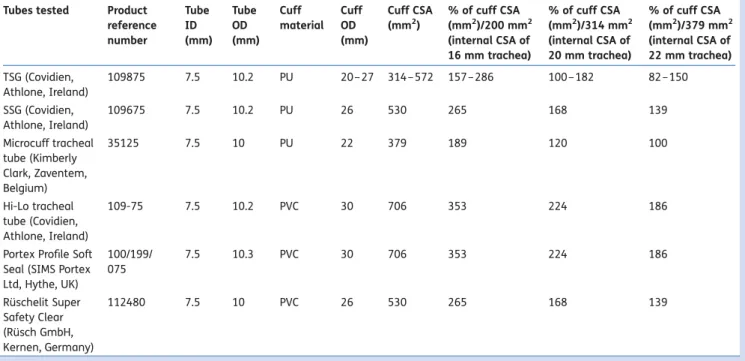
In an in vitro apparatus, we investigated the efficacy of six different commercially available tracheal tubes with an internal diameter (ID) of 7.5 mm (Table 1) in preventing fluid leakage past the tube cuff. We chose conventional tra-cheal tube cuffs with PU and polyvinylchloride (PVC) cuff material that are currently most widely used in Europe.
Artificial PVC tracheas with 16, 20, and 22 mm ID corresponding to a wide range of human tracheal size8 9 were vertically placed and intubated with tracheal tubes without cuff wall lubrication. The range of the human adult tracheal diameter varies from 1.5 to 2.5 cm.9Tracheal
anteroposterior and transverse diameter range in females is 12.7 –23.8 and 17.3 –27.8 mm, respectively.10 A 7.5 mm ID tracheal tube is used for female patients and hence we considered 16, 20, and 22 mm ID artificial trachea appropri-ate for testing.
The tube cuff was inflated to 25 cm H2O cuff pressure and
continuously monitored by a digital automated cuff pressure manometer (VBM Cuff Controller, VBM Medizintechnik GmbH, Sulz a.N., Germany). The tube was positioned with its lower cuff border 2.5 cm above the lower tracheal edge.
At room temperature of 20– 228C, 5 ml of clear water was applied above the tube cuff and fluid leaking past the cuff was collected in a container below the model and weighed using an electronic balance (AG 204-Delta-Rangew, Mettler
Toledo, Schwerzenbach, Switzerland; sensitivity 0.0001 g). Fluid leakage was measured at 0, 0.5, 1, 2, 3, 4, 5, 10, 15, 30, and 60 min in this static setup. Measurements were dis-continued when we did not see any fluid level above the top of the cuff if earlier than 60 min. The end time and fluid amount was noted in each trial. We chose 1 h as an endpoint as already studied in similar benchtop studies.3 11 12 We intentionally did not ventilate the tracheas since PEEP and positive pressure ventilation are known to protect against cuff leakage and hence differences between sealing charac-teristics of various tubes might remain concealed.13
We calculated the cross-sectional area (CSA) of a given tracheal tube cuff from its outer diameter (OD) (mm) as pro-vided by the manufacturer. Similarly, internal CSA of a given trachea was calculated and a percentage ratio was obtained by dividing the abovementioned areas. For the TSG tube, a similar ratio was obtained over a range.
Fig 1 TSG tracheal tube (Covidien, Athlone, Ireland) inflated to 25 cm H2O cuff pressure.
Table 1 HVLP tracheal tube cuffs investigated (all ID 7.5 mm). CSA, cross-sectional area; ID, internal diameter; OD, outer diameter Tubes tested Product
reference number Tube ID (mm) Tube OD (mm) Cuff material Cuff OD (mm) Cuff CSA (mm2) % of cuff CSA (mm2)/200 mm2 (internal CSA of 16 mm trachea) % of cuff CSA (mm2)/314 mm2 (internal CSA of 20 mm trachea) % of cuff CSA (mm2)/379 mm2 (internal CSA of 22 mm trachea) TSG (Covidien, Athlone, Ireland) 109875 7.5 10.2 PU 20 – 27 314 –572 157 –286 100 –182 82 –150 SSG (Covidien, Athlone, Ireland) 109675 7.5 10.2 PU 26 530 265 168 139 Microcuff tracheal tube (Kimberly Clark, Zaventem, Belgium) 35125 7.5 10 PU 22 379 189 120 100 Hi-Lo tracheal tube (Covidien, Athlone, Ireland) 109-75 7.5 10.2 PVC 30 706 353 224 186
Portex Profile Soft Seal (SIMS Portex Ltd, Hythe, UK) 100/199/ 075 7.5 10.3 PVC 30 706 353 224 186 Ru¨schelit Super Safety Clear (Ru¨sch GmbH, Kernen, Germany) 112480 7.5 10 PVC 26 530 265 168 139
Experiments were performed twice using eight different tracheal tubes from each manufacturer in a randomized order (thus 16 observations) with three different artificial trachea models (48 observations per tube brand). Tracheal tube cuffs were inflated and checked by inspection before each test. Between experiments, the model was cleaned and dried.
Statistics
The amount of fluid leakage at 5 and 60 min in each cylind-rical tube cuff was compared with that of the tapered-shaped tube cuff in all the three different sized tracheal models tested, using a separate non-parametric Kruskal– Wallis test for each tracheal diameter. When statistical sig-nificance was obtained, we proceeded with planned pairwise comparisons using the Bonferroni-corrected Mann– Whitney U-tests comparing fluid leakage (ml) in the TSG tube with that of all the other five tracheal tubes included in this study. Again, to assess the effect of cuff material, a similar planned pairwise Mann –Whitney U-test was done between the PVC and the PU groups of tracheal tube cuffs. The level of significance was set at a¼0.007 after the Bonferroni cor-rection. SPSS version 16.1 (SPSS Inc., Chicago, IL, USA) was used for this purpose.
Results
Fluid leakage (ml) at 5 and 60 min is described in Table2. Overall sealing characteristics of the new tapered-shaped TSG tube cuff were superior to all other tube cuffs tested at both 5 and 60 min time point (Fig.2) in different dimensions of trachea tested. The fluid leakage past the tube cuff was less with the TSG tube when compared with five other tubes of different cuff shape and material in both 16 and 22 mm trachea, and the difference was found to be statisti-cally significant (P,0.001, Mann–Whitney U-test with the Bonferroni correction, Table2) for all PVC tube cuffs.
When considering the PU cuff material, the Microcuff tracheal tube cuff was not able to seal the 22 mm ID trachea, although there was no significant difference
between this tube and the TSG tube when tested in the 16 and 20 mm tracheal models (Table2).
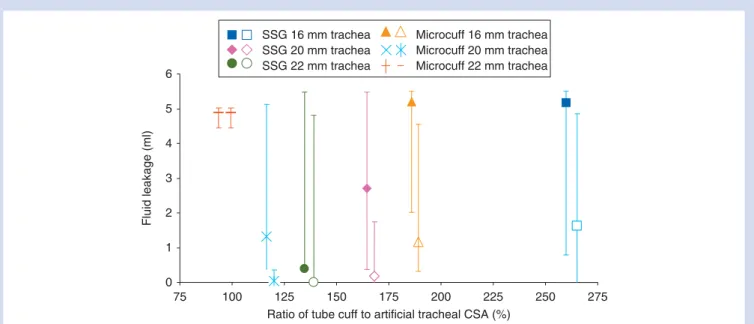
Tracheal tube cuffs made from PVC allowed a considerably higher fluid leakage than those made from PU (P,0.001) (Table 2). Fluid leakage across cylindrical PU cuffs was faster and higher in parallel with the percentage ratio of tube cuff to artificial trachea CSA (Table1; Fig.3).
Discussion
This in vitro study compared the ability of a ‘tapered’ shaped cuff design to the conventional ‘cylindrical’ cuff design for the prevention of tracheal fluid leakage in three different sized artificial tracheas. The main finding was that the tapered-shaped cuff was effective in preventing cuff leakage in the three different sized tracheas tested and that cuffs made from PU were superior to those made from PVC.
Folds and channels in HVLP tube cuffs leading to silent aspiration of secretions into the trachea to date remain a chal-lenging problem awaiting a scientifically advanced solution. Numerous attempts have been made by researchers in the past to design a cuff that would provide a more effective seal without leakage at lower transmitted cuff pressures.11 14–19
One such novel concept to reduce the folds in the HVLP tube cuff comes from Zanella and colleagues.17 They pro-posed wrapping the standard HVLP cuff with a low protein latex rubber supported by gel lubrication between the two layers to ensure an even surface without folds. It claimed effective sealing at low transmitted pressures to the tracheal wall in static in vitro models. They also described a ‘no-pressure’ laryngeal seal design that uses a series of com-pliant gills rather than a cuff in an attempt to prevent the leakage from subglottis into the trachea and to minimize airway injury.19 20 Low volume –low pressure tubes intro-duced by Young and colleagues21 have a highly compliant silicone cuff wall and preliminary in vitro testing showed excellent sealing characteristics.
Recently, tracheal tube cuffs made from PU have been shown to reduce microaspiration and the rate of postopera-tive nosocomial pneumonia.12 22 The introduction of
Table 2In vitro fluid leakage (ml) measured in HVLP tracheal tube cuffs (ID 7.5 mm). Cuffs inflated to 25 cm H2O cuff pressure. Data represented
in median (range). *P,0.001, Mann –Whitney U-test (Bonferroni’s correction); PU, polyurethane; PVC, polyvinyl chloride Tracheal ID Cuff
material
Fluid leakage (ml) in artificial trachea at 5 min Fluid leakage (ml) in artificial trachea at 60 min
16 mm 20 mm 22 mm 16 mm 20 mm 22 mm TSG PU 0.59 (0.00 –2.74) 0.11 (0.00 –0.82) 0.00 (0.00 –0.06) 2.14 (0.05 –4.88) 1.14 (0.00 –4.84) 0.13 (0.00 –1.32) SSG PU 1.62 (0.00 –4.84) 0.18 (0.00 –1.74) 0.00 (0.00 –4.81) 4.58 (0.44 –4.88) 2.21 (0.00 –4.81) 0.00 (0.00 –4.81) Microcuff tracheal tube PU 1.17 (0.32 –4.56) 0.03 (0.00 –0.35) 4.85 (4.40 –4.99)* 4.54 (1.54 –4.82) 0.90 (0.00 –4.49) 4.85 (4.40 –4.99)* Ruesch tracheal tube PVC 4.67 (4.34 –4.89)* 4.55 (3.14 –4.98)* 4.66 (2.28 –4.97)* 4.67 (4.34 –4.89)* 4.69 (4.39 –4.98)* 4.75 (4.39 –4.97)* Portex tracheal tube PVC 4.61 (4.45 –4.83)* 4.27 (0.04 –4.92)* 4.65 (4.01 –4.97)* 4.61 (4.45 –4.83)* 4.68 (1.24 –4.92)* 4.65 (4.01 –4.97)* Hi-Lo tracheal tube PVC 4.64 (4.45 –4.89)* 4.43 (0.04 –4.99)* 4.71 (4.22 –4.97)* 4.64 (4.45 –4.89)* 4.69 (1.24 –4.99)* 4.71 (4.22 –4.97)*
0 1 2 3 4 5 6 A B C Fluid leakage (ml) 0 1 2 3 4 5 6 Fluid leakage (ml) 0 1 2 3 4 5 6 0 10 20 30 40 50 60 Time (min) 0 10 20 30 40 50 60 Time (min) 0 10 20 30 40 50 60 Time (min) Fluid leakage (ml) SSG TSG Microcuff Ruesch Portex Hi-Lo SSG TSG Microcuff Ruesch Portex Hi-Lo SSG TSG Microcuff Ruesch Portex Hi-Lo
Fig 2 Fluid leakage across the tracheal tube cuff in (A) 16, (B) 20, and (C) 22 mm ID artificial trachea (cuff pressure 25 cm H2O, 16
ultrathin wall PU cuff membrane technology seems to be a major step forward providing cuffs with improved tracheal air and fluid sealing characteristics3 16 23 24 as confirmed by the present study, which, to the best of our knowledge, is the first study comparing three PU and three PVC tracheal tube cuffs in an in vitro setup. Poelaert and colleagues22have shown that the PU cuff can reduce the frequency of early postoperative pneumonia in cardiac surgical patients and compared the SSG tube with the Hi-Lo tube in their study. Similarly, Lucangelo and colleagues12 showed that the SSG tube with PU cuff is much more resistant to leak when com-pared with the Hi-Lo tube.
The tapered-shaped tracheal cuff represents a further step in improving sealing characteristics of PU cuffs by the proposed mechanism of accommodating natural variations in the size of the trachea. On the basis of our findings, the TSG tube cuff showed overall efficient protection against cuff leakage in all the three diameters tested up to 60 min. The SSG tracheal tube which has a cylindrical PU cuff decreased the fluid leak in all the tracheal diameters, but the measured leak was more than the TSG tracheal tube at all time points in all the three different tracheal diameters tested, although this difference did not achieve statistical significance.
The Microcuff tracheal tube cuff sealed equally well in 16 and 20 mm diameter tracheas but completely failed to prevent fluid leak in the 22 mm diameter trachea. On the basis of Table 1for a given 7.5 mm ID tracheal tube cuff, the Microcuff tracheal tube has the smallest cuff diameter and is not a true HVLP cuff. Hence, the cuff seals very well in a 20 mm trachea where a small outer cuff diameter results in fewer longitudinal folds and hence better sealing.
The smaller cuff diameter is then too small to cover larger trachea (22 mm) and hence the tube allows a large leak in this model. Comparisons between Microcuff and TSG should be done with caution as the Microcuff tube cuff does not function as a real HVLP cuff in a 22 mm trachea. If the Micro-cuff tube had a larger Micro-cuff diameter sealing in the smaller tracheas would be expected to be worse, as fluid leakage was more in the 16 mm compared with the 20 mm ID artifi-cial trachea (Table1).
Another interesting observation was that a percentage ratio of the CSA of the tracheal tube cuff to the artificial trachea of more than 150% facilitated excessive longitudinal cuff fold formation that allowed rapid fluid leak (Fig.3). In con-trast, a percentage ratio of CSA of between 120% and 140% favoured better sealing and less fluid leakage. The ‘dynamic sealing area’ of the TSG tube provided a wide range for this ratio for the three different tracheas tested and thus exhibits efficient sealing over a range of tracheal sizes (Table1).
In the near future, a tapered-shaped tube cuff may offer greater advantage in paediatric patients where the natural variation in tracheal diameter is considerable from birth to adolescence.8 The new cuff design is likely to reduce cuff length of paediatric tracheal tube cuffs and to seal the pae-diatric airway at lower cuff pressures.16 25
Our study model of an intubated trachea did not attempt to simulate the surface of contact between the tracheal mucosa and the cuff, the static or dynamic properties of the tracheal and extra-tracheal tissues during ventilation, and the properties of different consistencies of secretions or the effect of mucus on the cuff –tracheal interface. In vivo, the posterior tracheal wall is compliant and dynamic and our rigid cylindrical model trachea cannot simulate
0 1 2 3 4 5 6 75 100 125 150 175 200 225 250 275 Ratio of tube cuff to artificial tracheal CSA (%)
Fluid leakage (ml) SSG 16 mm trachea SSG 20 mm trachea SSG 22 mm trachea Microcuff 16 mm trachea Microcuff 20 mm trachea Microcuff 22 mm trachea
Fig 3Comparison of fluid leakage (ml) in median (range) and the percentage ratio of tube cuff to artificial trachea CSA in PU tube cuffs. Fluid leakage at 60 and 5 min, respectively. Data points have been offset for clarity. Data for the TSG tube are not shown because the tapering shape of the tube cuff means that a single value for the ratios of the CSA cannot be calculated.
this. A vertical model at room temperature does not mimic the real-life situation and a re-evaluation is required in the supine position and at body temperature. However, the model used here allowed testing the new cuff shape in a standardized and comparable way under ‘stringent’ con-ditions (no lubrication and no positive pressure ventilation) which might otherwise mask differences in fluid leakage past the tracheal tube cuff due to design and cuff material. In conclusion, the tapered PU tube cuff was as effective as the cylindrical PU cuffs in smaller tracheal diameters and was more efficient than the cylindrical Microcuff PU tube cuff in larger tracheal diameter in preventing subglottic fluid leakage across the tube cuff tested in this in vitro setup. The tapered-shaped cuff offers a sealing zone with reduced folds and channels along a wide range of diameters and thus is capable of sealing different sized tracheas. However, clinical studies are needed to confirm the protec-tive effect of the tapered-shaped cuff design in prevention of fluid leakage, intraoperative aspiration, and VAP.
Conflict of interest
The tracheal tubes tested were ordered from the local distri-butors. Prof. M.W. was involved in the development and evaluation of new cuffed tracheal tubes in co-operation with Microcuff GmbH, Weinheim, Germany, and Covidien, Athlone, Ireland.
Funding
This study was supported by departmental resources.
References
1 Young PJ, Rollinson M, Downward G, Henderson S. Leakage of fluid past the tracheal tube cuff in a benchtop model. Br J Anaesth 1997; 78: 557– 62
2 Oikkonen M, Aromaa U. Leakage of fluid around low-pressure tra-cheal tube cuffs. Anaesthesia 1997; 52: 567 –9
3 Dullenkopf A, Gerber A, Weiss M. Fluid leakage past tracheal tube cuffs: evaluation of the new Microcuff endotracheal tube. Inten-sive Care Med 2003; 29: 1849–53
4 Seegobin RD, van Hasselt GL. Aspiration beyond endotracheal cuffs. Can Anaesth Soc J 1986; 33: 273 –9
5 Young PJ, Ridley SA. Ventilator-associated pneumonia. Diagnosis, pathogenesis and prevention. Anaesthesia 1999; 54: 1183– 97 6 Chawla R. Epidemiology, etiology, and diagnosis of
hospital-acquired pneumonia and ventilator-associated pneumonia in Asian countries. Am J Infect Control 2008; 36: S93– S100 7 Fagon JY, Chastre J, Hance AJ, Montravers P, Novara A, Gibert C.
Nosocomial pneumonia in ventilated patients: a cohort study evaluating attributable mortality and hospital stay. Am J Med 1993; 94: 281– 8
8 Chandler M, Crawley BE. Rationalization of the selection of tracheal tubes. Br J Anaesth 1986; 58: 111 –6
9 Mehta S, Myat HM. The cross-sectional shape and circumference of the human trachea. Ann R Coll Surg Engl 1984; 66: 356– 8
10 Kamel KS, Lau G, Stringer MD. In vivo and in vitro morphometry of the human trachea. Clin Anat 2009; 22: 571 –9
11 Young PJ, Blunt MC. Improving the shape and compliance charac-teristics of a high-volume, low-pressure cuff improves tracheal seal. Br J Anaesth 1999; 83: 887– 9
12 Lucangelo U, Zin WA, Antonaglia V, et al. Effect of positive expira-tory pressure and type of tracheal cuff on the incidence of aspira-tion in mechanically ventilated patients in an intensive care unit. Crit Care Med 2008; 36: 409 –13
13 Dave M, Koepfer N, Madjdpour C, Frotzler A, Weiss M. Tracheal fluid leakage in benchtop trials. Comparison of static versus dynamic model with and without lubrication. J Anesth 2010; 24: 247 –52
14 Young PJ, Ridley SA, Downward G. Evaluation of a new design of tracheal tube cuff to prevent leakage of fluid to the lungs. Br J Anaesth 1998; 80: 796 –9
15 Young PJ, Basson C, Hamilton D, Ridley SA. Prevention of tracheal aspiration using the pressure-limited tracheal tube cuff. Anaes-thesia 1999; 54: 559 –63
16 Dullenkopf A, Gerber AC, Weiss M. Fit and seal characteristics of a new paediatric tracheal tube with high volume-low pressure polyurethane cuff. Acta Anaesthesiol Scand 2005; 49: 232– 7 17 Zanella A, Cressoni M, Epp M, Stylianou M, Kolobow T. A
double-layer tracheal tube cuff designed to prevent leakage: a bench-top study. Intensive Care Med 2008; 34: 1145– 9
18 Kolobow T, Berra L, DeMarchi L, Aly H. Ultrathin-wall, two-stage, twin endotracheal tube: a tracheal tube with minimal resistance and minimal dead space for use in newborn and infant patients. Pediatr Crit Care Med 2004; 5: 379– 83
19 Kolobow T, Tsuno K, Rossi N, Aprigliano M. Design and develop-ment of ultrathin-walled, nonkinking endotracheal tubes of a new ‘no-pressure’ laryngeal seal design. A preliminary report. Anesthesiology 1994; 81: 1061–7
20 Reali-Forster C, Kolobow T, Giacomini M, Hayashi T, Horiba K, Ferrans VJ. New ultrathin-walled endotracheal tube with a novel laryngeal seal design. Long-term evaluation in sheep. Anesthesiology 1996; 84: 162 –72, discussion 27A
21 Young PJ, Pakeerathan S, Blunt MC, Subramanya S. A low-volume, low-pressure tracheal tube cuff reduces pulmonary aspiration. Crit Care Med 2006; 34: 632 –9
22 Poelaert J, Depuydt P, De Wolf A, Van de Velde S, Herck I, Blot S. Polyurethane cuffed endotracheal tubes to prevent early post-operative pneumonia after cardiac surgery: a pilot study. J Thorac Cardiovasc Surg 2008; 135: 771– 6
23 Dullenkopf A, Schmitz A, Frei M, Gerber AC, Weiss M. Air leakage around endotracheal tube cuffs. Eur J Anaesthesiol 2004; 21: 448–53
24 Weiss M, Doell C, Koepfer N, Madjdpour C, Woitzek K, Bernet V. Rapid pressure compensation by automated cuff pressure con-trollers worsens sealing in tracheal tubes. Br J Anaesth 2009; 102: 273 –8
25 Ho AM, Aun CS, Karmakar MK. The margin of safety associated with the use of cuffed paediatric tracheal tubes. Anaesthesia 2002; 57: 173– 5