Sorption Behaviour of W, Hf, Lu, U, and Th
on Ion Exchangers from HCI/H2O2 Solutions.
Model Experiments for Chemical Studies of Seaborgium (Sg)
By D. Schumann, M. Andrassy, H. NitscheInstitut für Analytische Chemie, FG Radiochemie, Technische Universität Dresden, D-01062 Dresden, Germany A. F. Novgorodov
Joint Institute for Nuclear Research, Dubna, Russia R. Misiak
H. Niewodniczanski Institute of Nuclear Physics, Krakow, Poland M. Schädel, W. Brüchle, B. Schausten
Gesellschaft für Schwerionenforschung, Darmstadt, Germany J. V. Kratz
Institut für Kernchemie, Universität Mainz, Germany and H. Bruchertseifer
Paul Scherrer Institut, Villigen, Switzerland
(Received March 17, 1997; accepted in revised form August 12, 1997)
Hf, W, Lu, Th, and U radionuclides / Ion exchange / HCI-H2O2 solutions / Separation of seaborgium
Summary
In model experiments with W, Hf, Th, and U radionuclides, a chemical system was developed for the Separation of seaborgium from element 104 and heavy actinides, i.e., cation exchange on Dowex 50X8 from solutions containing 0.1-1.0 M HCl and 0.5-2.0 vol% H2O2. The system should be suitable for fast on-line experiments if seaborgium exhibits a non-uranium-like behaviour. Adding hydrogen peroxide to mixed HCl/HF solu-tions suppresses the partial Sorption of W and, presumably sea-borgium, on the cation exchanger. This way, the elution volume can be minimized. Prospects for anion exchange separations of group 6 from group 4 elements are also briefly discussed.
Introduction
In [1], we reported on a chemical system which can be used to separate group 4 elements and lanthanides from the group 6 elements W and Mo through the use of cation exchange from diluted aqueous solutions of HCl/HF. These batch studies were aimed at developing chemical conditions suitable for the Separation of seaborgium from heavy actinides and element 104 produced simultaneously in heavy ion reactions. First applications with the ARCA II [2] apparatus showed that a good sorption of Hf onto the cation exchange resin AMINEX A6 can be obtained using the proposed solutions, but the reaction is partially influenced by hydrolysis if very diluted solutions are used [3]. The
first successful Separation of seaborgium in aqueous Solution was done by use of cation exchange on AMINEX A6 with 0.1 M HNO^/SXlO'^M HF as eluent [4]. Unfortunately, the concentration of HCl (or HNO3) and HF cannot be increased, because then adsorption of group 4 elements is incomplete [1, 3]. Hence, the system is very sensitive to small changes in acid concentrations and adsorption on surfaces due to hydrolytic processes can take place in some cases. Another disadvantage is that Mo, and even W, show a partial sorption on the cation exchanger, too [1], which results in a relatively large elution volume using the ARCA apparatus. Therefore, it is desirable to develop chemical systems with a higher content of acid to suppress hydrolysis completely. W and Mo are known to form stable anionic complexes with H2O2 in acid solutions up to 10 M HCl [5]. A similar behaviour can be expected for the group 6 element seaborgium. Zr, Hf and lanthanides form positively charged Com-pounds [6] in acid, neutral and slightly basic solutions. This makes the system possibly suitable for the Separa-tion of group 6 from group 4 elements.
Relativistic calculations [7] showed that in some cases chemical similarities of transactinide elements with the corresponding lighter actinides might be expected. For instance, similarities in the chemical properties of hahnium with protactinium were ob-served [8]. Therefore, in the present work, the behav-iour of U and Th was taken into consideration. Detail-ed batch studies were carriDetail-ed out with carrier-free and small amounts of carrier isotopes of Hf, W, Lu, U, and
Th as model Clements for the Clements 104 and 106 and for trivalent actinides. The aim was to test the Utility of HCI/H2O2 containing solutions for separating scaborgium on cation exchange resins. Furthcrmorc, H2O2 was added to HCl/HF solutions used in [1] with the aim of improving the Separation. Separations of seaborgium from HCI/H2O2 solutions on anion ex-change resins are discussed altemativcly.
Experimental
The irradiations for the production of ^^'Lu, and ^'^U were carried out with 650 MeV protons at the Phasotron "F" (Laboratory of Nuclear Problems, JINR Dubna, Russia). MetaUic Ta was irradiated for 7 hours in the extemal bcam to producc both and "^Lu. Tungsten was separatcd from the irradiated target by thermochromatography using moist air. Carricr-frec W was Condensed onto the surface of a thermochromato-graphic column [9] and was subsequently dissolved in 0.5 M HCl. Rare earth Clements wcrc scparated by gradient elution with a-HIB as reportcd in [10],
Carrier-free ^^^U was obtained as a decay product of ^^^Pa (ß , r,/2 = 1.31 d) which was produccd via the nuclear reaction "='"Th(p,n)""PaOff-). After decay of ^^^Pa, a pure sample was obtained which contained only ^'^U and its decay products. the a-decay product of was separatcd immcdiatcly bcfore the experiments by adsorbing the ^'^U on the anion ex-change resin Dowex 1X8 from 9 M HCl Solution. The ^^^Th passes through the column without Sorption. ^^^U can then be eluted from the column with 2 M HCl.
'^'Hf was produccd by irradiating '^"HfOz at the IBR-2 reactor (neutron flux 5 X 10'^ n/cm^s, Laboratory of Neutron Physics, JINR Dubna, Russia) for two weeks. A specific activity of 63 MBq/mg Hf was ob-tained. Sample preparation has been dcscribed earlier
[11].
For the batch experiments, 5 ml of the radioactive solutions were contacted with 200 mg of either Dowex 50WX8 or Dowex 1X8 ( 2 0 - 5 0 mesh) for onc hour. The y-activities of the solutions containing "^Lu or '^^Hf were measured before and after the contact with the resin using a Ge(Li) detector. The distribution of ^^^U was determined by evaporating 0.1 ml of the Solution before and after contact and mcasuring the ß-activity using a Si(Au) detector (resolution 35 keV). The results on were obtained by determining the y-activity of its decay products (^'^Pb) one month after the experiment using a Ge(Li) detector. The distri-bution coefficients were calculated, by use of the following formula, as described in [1, 11]:
D =
As titj
with Ai activity on the ion exchanger (Bq) rrii amount of ion
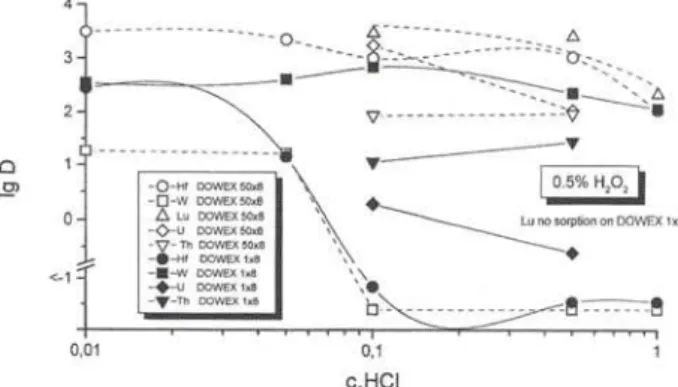
exchanger (g) activity of the Solution (Bq) volume of the Solution (ml). Q - 0 - H f DOWEX 50x8 - O - W DOWEX 50x8 A Lu DOWEX 50x8 - < > - U DOWEX 50x8 - V - T " OOWEX50X8 - # - H f DOWeXlxS - • - W DOWEX 1x8 - ^ - U DOWEX 1x8 - W - T h DOWEX 1x8 Lu no sorplion on DOWEX 1x8
Fig. 1. Distribution coefficients of Lu, Hf, W, Th and U on Dowex 50X8 and Dowex 1X8 as a function of the HCl
concen-tration at a fixed concenconcen-tration of 0.5 vol.% H2O2.
Results and discussion
I z n l . S o r p t i o n of H f , L u , W, and Th
as a f u n c t i o n of t h e H C l c o n c e n t r a t i o n In Fig. 1, the lg D values of Hf, Lu, W, Th, and U on Dowex 50X8 and Dowex 1X8 as a function of HCl concentration in the presence of 0.5 vol.% H2O2 are plottcd. The suitable concentration ränge of H2O2 was determined in preliminary studies. It can be seen that W exhibits strong sorption on the anion exchanger Over the hole ränge of HCl concentrations, while the Sorption is very weak on the cation exchanger at con-centrations higher than 0.05 M HCl. This is due to the formation of anionic Compounds. At concentrations lower than 0.05 M HCl, W shows also sorption on Dowex 50X8.
The behaviour of hafnium is influenced by hy-drolysis. This group 4 dement is known to hydrolyze strongly in weak acid Solution [12]. While it is completely sorbed on Dowex 50X8 over the hole HCl concentration interval, it shows also strong sorption on the anion exchange resin at concentrations lower than 0.1 M HCl. With increasing HCl concentration, the sorption on Dowex 1X8 decreases but the strong sorption on Dowex 50X8 remains. From this, one can propose the formation of a positively charged complex, which is (partially) hydrolyzed in weak acid Solution.
Th like Hf, is sorbed on the cation exchange resin as expected for a typical tetravalent dement. On Dowex 1X8, it also exhibits a somewhat high distribution coefficient. This is probably caused by
formation and partial sorption of neutral Compounds.
From this work and from literature [5, 13] it can be expected that Lu as the model dement for trivalent lanthanides and actinides, shows strong sorption on Dowex 50X8 and no sorption on the anion exchange resin over the whole ränge of HCl concentration (Fig. 1).
From these results, it is expected that conditions for a good Separation of W from tri- and tetravalent Clements can be found at HCl concentrations between 0.1 and 1.0 M. Over this ränge of HCl concentrations.
D O) O Hf DOWEX50xa # Hf DOWEX 1x8 - • - W DOWEX5DX8 - B - W DOWEX 1x8 - A - l - U DOWEX soxe A l u D O W E X I x B - ^ H J DOWEX 50x8 - • - U DOWEX 1x8 - y - T h DOWEX 50x8 - y - T t l DOWEX 1x8 • O • 1 0 , 0 1 0 , 5 —I 1 , 0 "HA 2 , 0
Fig. 2. Distribution coefficients of Lu, Hf, W, Th, and U on Dowex 50X8 and Dowex 1X8 as a function of the H2O2
concen-tration at a fixed concenconcen-tration of 0.1 M HCl.
2 , 5 2 , 0 1,5 1,0 0 , 5 0 , 0 - 0 , 5 - 1 , 0 - 1 , 5 - 2 , 0 q A - A —I— 0 , 0 O Hf DOWEX 50x8 • Hf DOWEX 1x8 - • - W DOWEX 1x8 A Lu DOWEX 60x8 Lu no Sorption on DOWEX 1x8 W (10 Sorption on DOWEX 50x8 1 0 , 6 1 , 0 % H,0, 1,5 2 , 0
Fig. 4. Distribution coefficients of Lu, Hf, W, Th and U on Dowex 50X8 and Dowex 1X8 as a function of the H2O2
concen-tration at a fixed concenconcen-tration of 1.0 M HCl.
- - A
•o-0 Hf DOWEX 5•o-0x6 # Hf DOWEX 1x8 - ö - w DOWEX 50x8 • W DOWEX 1x8
A Lu DOWEX 50x8
-O-u DOWEX 50x8 - • - U DOWEX 1x8 - V - T h DOWEX 50x8 " Y - T h DOWEX 1x8 Lu no Sorption on DOWEX 1x8
0,0 0,5 1,0
% H,0,
1.5 2 , 0
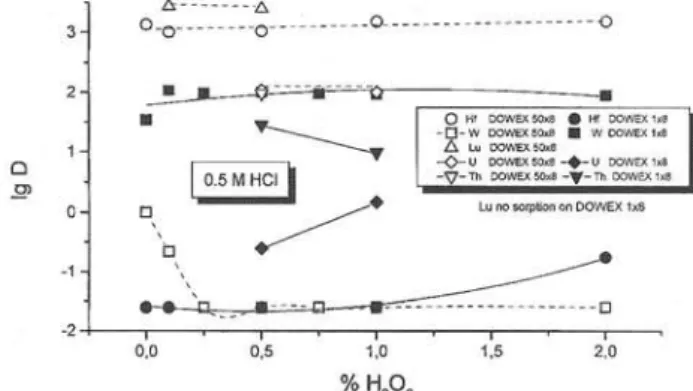
Fig. 3. Distribution coefficients of Lu, Hf, W, Th and U on Dowex 50X8 and Dowex 1X8 as a function of the H2O2
concen-tration at a fixed concenconcen-tration of 0.5 M HCl.
the influence of H2O2 concentration was studied in detail.
2. S o r p t i o n of H f , Lu, W, a n d Th
as a f u n c t i o n of the H2O2 c o n c e n t r a t i o n The dependence of the lg D values for sorption of the Clements investigated on Dowex 50X8 and Dowex 1X8 on the H2O2 concentration with several concen-trations of HCl is shown in Figs. 2—4. With the excep-tion of very low H2O2 concentraexcep-tion ( < 0 . 5 vol.%), the Sorption of Hf, Lu, W, and Th is nearly independent of the H2O2 concentration both on the cation and on the anion exchange resin. This behaviour does not change if the concentration of HCl is varied (0.1 M HCl Fig. 2, 0.5 HCl Fig. 3, l.OM HCl Fig. 4). This means that solutions containing 0 . 5 - 2 . 0 vol.% H2O2 and 0 . 1 - l . O M HCl are useful as eluting agents for the Separation of W from tri- and tetravalent elements on a cation or anion exchange resin. This chemical system is not as sensitive to small changes in the con-centrations as the HNO3/HF system and conditions can be selected which allow the suppression of hydrolytic effects completely. Therefore, if a W-like behaviour of
seaborgium is expected, this procedure can be recom-mended for the fast on-line Separation.
3. S o r p t i o n of U
Experience with dement 105 showed that extra-polations of chemical properties within a group often fail, at least partially, due to relativistic effects which influence the electronic structure of heavy elements. Element 105, in some cases, does not behave like its lighter homolog Ta, but like Nb or Pa [8, 14,15]. Until now, there are no serious indications that seaborgium may show similarities to U [16], but the possibility should be taken into consideration. Under the con-ditions described above, U does not behave similar to group 6 elements but shows strong sorption on the cation exchange resin at a wide ränge of HCl concen-trations at constant H2O2 concentration (Fig. 1) and as a function of H2O2 concentration in the presence of various HCl concentrations (Figs. 2—4). Therefore, if seaborgium behaves like U, then the HCI/H2O2 system is not suitable for fast Separation experiments because Sg would remain completely on the cation exchange column. Nevertheless, it can be used in future experi-ments to distinguish between a W-like or U-like be-haviour of Sg. This will require an extra Separation Step from element 104 if Sg exhibits U-like properties.
4. S t r u c t u r e of t h e c o m p l e x e s
Hydrogen peroxide Compounds of transition metals are well-known. The compositions of the Compounds differ widely depending on the amount of metal, pH value, concentration of H2O2, State of aggregation and so on. Most of the studies conceming this subject deal with macro amounts of metal, and, therefore, classical physical and chemical methods can be used for deter-mining the structure of the Compounds. Furthermore, in many cases, polynuclear complexes are the main products. For our specific conditions - very low metal concentration (<10^®M), dilute acid Solution and
relatively small amounts of hydrogen peroxide — the information available from literature is rather limited [6].
From literature data [17] lanthanides and trivalent actinides are not expected to interact with H2O2 under the conditions described here. They sorb as cations (M(H20)D on Dowex 50X8 and are not sorbed on the anion exchanger.
Group 4 elements form several complexes with H2O2. In analogy with Ti, for Hf, we expected a struc-ture of the form [Hf(02)(H20)2]^^ in acid S o l u t i o n
[18], This means that positively charged complexes are formed in good agreement with our results.
Th is sorbed both on the cation and the anion exchange resin in our experiments (Fig. 1). Simul-taneous presence both of cationic and anionic species would be the most likely explanation of this behaviour. Certain data are not available from literature.
In contrast to Cr, Mo and W form peroxy pounds only in the + 6 valence State. Several Com-pounds with varying content of H2O2 are known [6]. In weak acid Solution, an anionic complex of the struc-ture [M(02)2(0)2]^~ dominates [5, 6]. The observed Sorption of W on the cation and anion exchange resins is consistent with such a species.
Anionic complexes of U are, in contrast to W and Mo, only formed in alkaline media because uranium Compounds of the form [002(02)3]"", hydrolyze at low pH [6], Therefore, we found strong sorption on the cation exchanger.
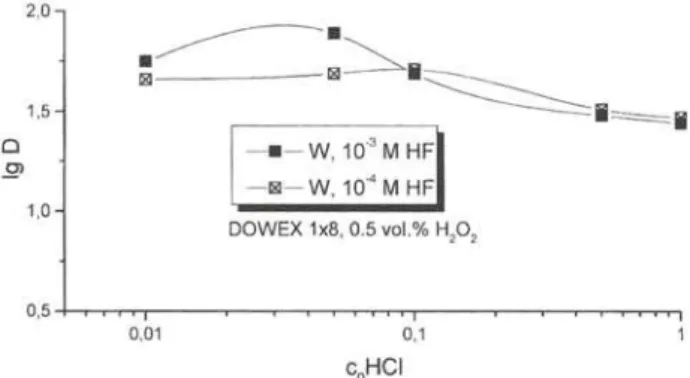
1,5-Q O) 1 , 0 -0,5 W, 10 MHF - H - w , I Q - ' m h f •-n— 0,01 0 , 1 c„HCI
Fig. 5. Distribution coefficients of W on Dowex 1X8 as a function of the HCl concentration at 0.5 vol.% H2O2 and
l.OX 10"" M HF, l.OX 10"' M HF, respectively.
Sorption behaviour of W did not appreciably change in the interval of 0.1-0.5 vol.% hydrogen peroxide. The results on Dowex 1X8 obtained with 0.5 vol.% H2O2 are plotted as an example in Fig. 5. Sorption on Dowex 50X8 was not observed at all. The lg D values on the anion exchanger are nearly independent of HCl concentration and only slightly lower than in the ex-periments without HF (Fig. 1). So, by adding H2O2 to the HCl/HF solutions used in [1], the partial sorption of W on the cation exchanger can be suppressed and, in this way, a considerably lower elution volume should be needed in experiments with the ARCA ap-paratus.
5. S o r p t i o n of W in HCI/H2O2/HF c o n t a i n i n g media
For the Separation of group 6 elements from group 4 elements 0.05-0.1 M HCl Solution containing HF concentrations up to 10"^ M can be used as described in [1]. For higher HF concentration desorption of HF and Zr from the cation exchange resin was observed due to formation of fluoride complexes. Similarly, the lg D values decrease when the HCl concentration is increased. Therefore, the HCl and HF concentrations can only be varied in the ranges 0.05-0.1 M HCl and 10""-10"^ M HF as reported in [1]. Unfortunately, a partial sorption of W on the cation exchanger observed in the batch experiments [1] leads to a relatively high elution volume in column experiments with the ARCA apparatus [22]. Adding H2O2 to these solutions does not effect the sorption behaviour of lanthanides and group 4 elements because their peroxy complexes are weaker than the respective fluoride complexes [21]. However, for W it is the opposite. The peroxy com-plexes are much stronger than the fluoride comcom-plexes [21], and this gives the possibility to decrease the partial sorption of W on the cation exchanger.
Using concentrations of 10"' M and lO'" M HF plus 0.1-0.5 vol.% H2O2, we determined the distri-bution coefficients of W on Dowex 50X8 and Dowex 1X8 as a function of the HCl concentration. The
Conclusions
1. a) Ion exchange on Dowex 50X8 from solutions containing 0.1-1.0 M HCl and 0.5-2.0 vol.% H2O2 is proposed as a suitable chemical system for the Separation of tungsten from hafnium, thorium and the lanthanides. This system can be applied in fast on-line experiments for the Separation of seaborgium using the ARCA II apparatus. A detailed description of the Separation scheme of this setup can be found in [2]. b) Uranium shows a completely different sorption behaviour on Dowex 50X8 in comparison to that of tungsten. It is sorbed on the cation exchange resin with high distribution coefficients from solutions in the concentrations interval of 0.1 —1.0 M HCl and 0.5— 2.0 vol.% H2O2.
2. This chemical system can only be applied for the Separation of seaborgium from element 104 and heavy actinides if a tungsten-like behaviour of seaborgium is expected. However, it can be used to distinguish be-tween W-like or U-like properties of Sg.
3. Adding 0.1-0.5 vol.% H2O2 to solutions of 0.05-0.1 M H C y i 0 - ' - 1 0 - " M HF suppresses the partial sorption of W on Dowex 50X8 described in [1]. This system should improve the method for the Separation of seaborgium in applications with the ARCA apparatus by lowering the elution volume needed in comparison to the use of HCl/HF solutions without hydrogen peroxide.
4. Ion exchange on Dowex 1X8 from solutions con-taining 0 . 1 - 1 . 0 HCl and 0 . 5 - 2 . 0 vol.% H2O2 is an alternative chemical system for the Separation of tungsten from hafnium, thorium and the lanthanides.
References
1. Schumann, D., Fischer, S., Dressler, R., Taut, St., Nitsche, H., Trautmann, N., Schädel, M., Brüchle, W., Schausten, B., Novgorodov, A. F., Misiak, R., Eichler, B., Gäggeler, H., Jost, D., Türler, A., Bruchertseifer, H.: Radiochim. Acta 72, 137 (1996).
2. Schädel, M., Brüchle, W., Jäger, E., Schimpf, E., Kratz, J. V., Scherer, U. W., Zimmermann, H. R: Radiochim. Acta 48, 171 (1989).
3. Günther, R., Paulus, W., Posledni, A., Kratz, J. V., Schädel, M., Brüchle, W., Jäger, E., Schimpf, E., Schausten, B., Schumann, D., Binder, R.: GSI-Scientific Report 1994, p. 302.
4. Schädel, M., Alstad, J., Andrassy, M., Brüchle, W., Dressler, R., Eberhardt, K., Eichler, B., Fricke, B., Gäggeler, H. W., Gärtner, M., Günther, R., Gregorich, K. E., Heimann, R., Hoffman, D. C., Hübener, S., Jäger, E., Jost, D. T., Kadkho-dayan, B., Kratz, J. V., Lee, D. M., Malmbeck, R., Mendl, M., Misiak, R., Nähler, A., Nagame, Y., Omtvedt, J. R, Oura, Y., Paulus, W., Pershina, V., Rocker, F, Schausten, B., Schimpf, E., Schumann, D., Seibert, A., Skamemark, G., Sylvester, E., Taut, St., Timokhin, S., Tharun, U., Thörle, R, Trautmann, N., Türler, A., Wiehl, N., Wierczinski, B., Wirth, G., Yakuschew, A., Zauner, S.: GSI Scientific Report 1995, May 1996, S. 10.
5. Korkisch, J.: Handbook of Ion Exchange Resins: Their
Application to Inorganic Chemistry, CRC Press, Inc., Boca
Raton, Florida 1989.
6. Connor, J. A., Ebsworth, E. A. V.: Adv. Inorg. Chem. Radiochem. 6, 279 (1964).
7. Pershina, V., Sepp, W. D., Fricke, B.: J. Chem. Phys. 96, 8367 (1992).
8. Zimmennann, H. R, Kratz, J. V., Gober, M. K., Schädel, M., Brüchle, W., Schimpf, E., Gregorich, K. E., Türler, A., Czerwinski, K. R., Hannink, N. J., Kadkhodayan, B., Lee, D. M., Nurmia, M. J., Hoffman, D. C., Gäggeler, H., Jost, D., Kovacs, J., Scherer, U. W., Weber, A.: Radiochim. Acta 60, 11 (1993).
9. Bayar, B., Novgorodov, A. F., Vocilka, I., Zaitseva, N. G.: Radiochem. Radioanal. Lett. 22, 53 (1975).
10. Lebedev, N. A.: Diss. A, State University Leningrad, 1973. 11. Schumann, D., Fischer, S., Taut, St., Novgorodov, A. F., Misiak, R., Lebedev, N. A., Bruchertseifer, H.: J. Radioanal. Nucl. Chem. Lett. 187, 9 (1994).
12. Baes, C. R, Mesmer, R. E.: The Hydrolysis ofCations, John Wiley and Sons, New York 1976, p. 412.
13. Marhol, M.; Ion Exchangers in Analytical Chemistry, Academia Prague, 1982, p. 277.
14. Kratz, J. V., Zimmennann, H. R, Scherer, U. W , Schädel, M., Brüchle, W , Gregorich, K. E., Gannett, C. M., Hall, H. L., Henderson, R. A., Lee, D. M., Leyba, J. D., Nurmia, M. J., Gäggeler, H., Jost, D., Baltensperger, U., Ya Nai-Qi, Türler, A., Lienert, Ch.: Radiochim. Acta 48, 121 (1989). 15. Gober, M. K., Kratz, J. V., Zimmermann, H. R, Schädel,
M., Brüchle, W , Schimpf, E., Gregorich, K. E., Türler, A., Hannink, N. J., Czerwinski, K. R., Kadkhodayan, B., Lee, D. M., Nurmia, M. J., Hoffman, D. C., Gäggeler, H., Jost, D., Kovacs, J., Scherer, U. W., Weber, A.: Radiochim. Acta 57, 77 (1992).
16. Pershina, V., Fricke, B.: GSI-Scientific Report 1995, May 1996, p. 14.
17. Seifer, G. B., lonova, G. A.: Zh. Neorg. Khim. 5, 223 (1960).
18. Schwarz, R., Giese, H.: Z. Anorg. Allg. Chem. 176, 209 (1928).
19. Dupuis, T , Duval, C.: Anal. Chim. Acta 3, 589 (1949). 20. Schwarz, R., Heinrich, F : Z. Anorg. Allg. Chem. 233, 387
(1935).
21. Sillen, L. G., Martell, A. E.: Stability Constants of Metal-lon Complexes, Burlington House, London 1971.
22. Kratz, J. V.: University of Mainz, private conununication, 1996.