Journal of Antimicrobial Chemotherapy (1994) 33, 1191-1200
Comparative efficacies of imipenem, oxacillin and vancomycin for
therapy of chronic foreign body infection due to methicillin-susceptible
and -resistant Staphylococcus aureus
Heinz J. Schaad*, Christian Chuardf, Pierre VaudauxJ, Peter Rohner, Francis A. Waldvogel and Daniel P. Lew
Division of Infectious Diseases, University Hospital, Geneva, Switzerland
The efficacies of imipenem when directed against methicillin-susceptible (MSSA) and methicillin-resistant (MRSA) strains of Staphylococcus aureus were compared with those of oxacillin and vancomycin in a subcutaneous rat model, using chronically infected tissue cages. At three weeks after inoculation, stable chronic infections were established with average bacterial counts exceeding 106cfu/mL tissue cage fluid for both strains. Intraperitoneal administration (twice a day for 7 days) of imipenem (80 mg/kg) or oxacillin (200 mg/kg) produced peak levels of 23 or 45 mg/L and trough levels of < 0-1 and 5-7 mg/L, respectively. The therapeutic regimens of either imipenem (P < 0-001) or oxacillin (P < 0-02) administered for 7 days led to signifi-cant reductions in bacterial counts in the tissue cage fluids of animals chronically infected with MSSA. In contrast, imipenem was not effective against chronic MRSA tissue cage infections, despite the relatively low MIC of the infecting strain and the use of high dose (120 mg/kg) therapy. In-vitro susceptibility testings of MRSA performed before and after imipenem therapy demonstrated the emergence of a highly resistant subpopulation.
Introduction
Foreign body infections are a major source of patient morbidity and implant failure. They can affect not only orthopaedic prostheses but also intravascular catheters and artificial heart valves (Bisno, 1989; Brause, 1989; Karchmer & Bisno, 1989). Several clinical and experimental studies have documented the frequent failure of antimicrobial agents to eradicate staphylococcal infections associated with foreign implants or devices (Bisno, 1989; Brause, 1989; Karchmer & Bisno, 1989). The reasons for this lack of effectiveness are still poorly understood and may involve alterations in the surfaces of the bacteria colonizing implants (Gristina & Costerton, 1985; Chuard et al., 19916), impairment in the host defense mechanisms (Zimmerli, Lew & Waldvogel, 1984; Vaudaux, Lew & Waldvogel, 1989), or both.
•Present address: Division of Clinical Pharmacology, Johns Hopkins University School of Medicine, Baltimore, Maryland, USA.
fPresent address: Laboratory of Clinical Microbiology, Duke University Medical Center, Durham, NC 27710, USA.
^Corresponding author: P. Vaudaux, Division of Infectious Diseases, University Hospital, 1211 Geneva 14, Switzerland.
1191
1192 H . J. Schaad et al.
To screen for new agents or to test new regimens for effective therapy of chronic foreign body infections, we recently developed a rat model of subcutaneous foreign body infection. This model has provided useful information in showing the advantage of combination therapy over monotherapy, over periods of 1 (Lucet et al., 1990) to 3 weeks (Chuard et al., 1991a).
Imipenem is a highly active, broad-spectrum antibiotic with good tissue penetration (Drusano, 1986; Wise et al., 1986) and a low frequency of side effects (Calandra et al., 1986). Imipenem is extremely resistant to the staphylococcal /Mactamase and shows high activity against methicillin-susceptible strains of Staphylococcus aureus (Witte, Sapico & Canawati, 1982). The first aim of this study was to evaluate the efficacy of imipenem, as compared to oxacillin, in the experimental model of chronic tissue cage infection by a methicillin-susceptible strain of S. aureus. The second objective was to evaluate the response of a heterogeneous methicillin-resistant strain of S. aureus to a high dose imipenem therapy and compare this to the response to vancomycin in the tissue cage model of chronic infection, because, although the use of imipenem against methicillin-resistant strains is not recommended (Chambers, 1988; Brumfitt & Hamilton-Miller, 1989), determination of its efficacy in vivo in the clinical situation (Fan et al., 1986) and in animal models of infections by methicillin-resistant strains of staphylococci has yielded conflicting data (Berry, Johnston & Archer, 1986; Chandrasekar et al., 1988).
Materials and methods Antimicrobial agents and media
For in-vitro studies, laboratory standards of the antimicrobials used with known potency were supplied as follows: imipenem by Merck Sharp & Dohme-Chibret, USA, oxacillin by Sigma, USA, and vancomycin by Eli Lilly, Germany. For animal studies, a 1 : 1 ratio of imipenem and cilastatin, (Tienam, Merck Sharp & Dohme-Chibret, Switzerland) and vancomycin (Eli Lilly, Germany) were used and were dissolved in solvents as recommended by their manufacturers. Oxacillin (Sigma) was freshly dissolved in distilled water at a concentration of 20 mg/mL.
A single batch of Mueller-Hinton broth (Difco, USA), with low contents of Ca2+
(16mg/L) and Mg2+ (7 mg/L), was used. To estimate antibacterial activity in vitro,
Mueller-Hinton broth was supplemented (MHB-S) with Ca2+ 50 mg/L and Mg2+
25 mg/L. When indicated, MHB-S was supplemented with 2% NaCl (w/v).
Bacteria
The methicillin-susceptible (MSSA) and methicillin-resistant (MRSA) strains of
S. aureus used for the animal studies were MSSA strain 120 (Chuard et al., 1991ft) and
MRSA multiresistant strain MRGR3 (Lucet et al., 1990). Both strains were isolated from patients with catheter-related sepsis and were selected for their virulence proper-ties in the rat model of chronic tissue cage infections. Strain MRGR3 is resistant to methicillin and shows additional resistances to benzylpenicillin, gentamicin, chlor-amphenicol, erythromycin, tetracycline and polymyxin B.
One hundred and seven strains of S. aureus isolated at the University Hospital of Geneva were also tested for in-vitro susceptibility to imipenem. They comprised 57 MSSA and 50 MRSA strains.
Imipenem in staphylococcal foreign body infections 1193
In-vitro studies
The MICs of imipenem for the 107 clinical isolates of S. aureus were determined by a previously described agar dilution method (Rohner et al., 1992). The medium used was Mueller-Hinton agar (Oxoid, Basingstoke, UK) and plates were inoculated with 104 cfu
as previously described (Rohner et al., 1992). The MIC was determined as the lowest concentration of imipenem which completely inhibited growth, disregarding a single colony or a faint haze of growth.
The MICs and MBCs of imipenem and oxacillin for MSSA strain 120 and of imipenem and vancomycin for MRSA strain MRGR3 were determined by a macrodi-lution broth method using MH-S medium as indicated above and a standard inoculum of 106 cfu/mL. MIC tests were read after 24 h or, when indicated, after 48 h incubation
at 37°C. To test for possible carry-over effects of each antibiotic during MBC determinations, 01 mL portions were taken from all tubes with no visible growth. These were subcultured, either undiluted or serially diluted 10-fold in saline, on Mueller-Hinton agar (Difco) for 24 h or, when indicated, for 48 h at 35°C. The MBC was denned as the lowest concentration of antibiotic that killed 99-9% of the original inoculum (National Committee for Clinical Laboratory Standards, 1987). For MRSA strain MRGR3, MICs and MBCs were also tested in MH-S broth supplemented with 2%NaCl.
Time kill studies were performed with antibiotic concentrations corresponding to those found in tissue cage fluid (TCF), namely oxacillin 8 mg/L with MSSA and imipenem 8 mg/L or vancomycin 8 mg/L with MRSA. These levels are equivalent to 8-16 times the MICs for the respective strains. A much lower concentration (0-2 mg/L) of imipenem, equivalent to ten-times its MIC for MSSA, was used for time kill studies with this strain to avoid significant carryover effects. Glass tubes containing 10 mL of Mueller-Hinton broth were inoculated to a cell density of 106cfu/mL from a culture
that had been grown exponentially for 3 h, in a shaking waterbath at 37°C. The number of viable organisms was determined by spreading 005 mL of ten-fold serially diluted portions of culture on Mueller-Hinton agar after 0, 2, 4, 6 and 24 h incubation. Bacteria were spread wth a spiral plater (Spiral System, Cincinnati, USA) and colonies counted with a laser colony counter (Spiral System) after 24 h incubation at 37°C. The detection limit was 2 log,0 cfu/mL with all antibiotics tested. Comparison of viable
counts obtained with the ten-fold serially diluted portions following a procedure previously described in detail (Lucet et al., 1990; Chuard et al., 1991a, 1992) indicated the absence of significant carryover of antibiotics under these experimental conditions.
Treatment of chronic foreign body infections
Animal experiments received the approval of the Ethical Committee of the University Hospital and of the State Veterinarian Office of Geneva. Four polytetrafluorethylene (Teflon) tissue cages were implanted subcutaneously in each Wistar rat as described previously (Lucet et al., 1990). At three weeks after implantation, a 50//L-portion of the fluid that had accumulated (approximate volume: 1 mL) in each cage (designated tissue cage fluid) was aspirated and checked for sterility. Then the cages were inoculated with 01 mL of saline containing 0-2 x 10⁶ to 2 x 10⁶cfu of MSSA or MRSA. Three weeks
later, all tissue cages containing more than 1 x 10⁵cfu/mL TCF were included in the
therapeutic protocol. Rats infected with MSSA were randomized to receive (by intraperitoneal route twice a day for 7 days) either imipenem (80 mg/kg) plus cilastatin,
1194 H. J. Schaad et al.
or oxacillin (200 mg/kg), or were left untreated. Rats infected with strain MRGR3 received (twice a day for 7 days) either imipenem (120 mg/kg) plus cilastatin, or vancomycin (50 mg/kg), or were left untreated. Twelve hours after the last injection of antibiotic, viable counts in 10-fold serially diluted TCF were obtained on Mueller-Hinton agar. Possible clumps of bacteria were disrupted by sonication of TCF for 1 min at 60 W (Branson 2200, Branson Ultrasonics, Danbury, USA) before plating. Quantitative bacterial counts were determined, with a detection limit of lOOcfu/mL, and expressed as log,0 cfu/mL. For each cage, the difference between cfu counts from
day 1 and day 8 were determined and expressed as delta log,0 cfu/mL.
For each group and treatment regimen, results were expressed as means+ S.E.M.
Comparisons of bacterial counts in the different groups were done using the non-parametric Kruskall-Wallis test and the Dunn procedure for comparison of specific groups (Rosner, 1990). Data were considered significant when P was < 005, using two-tailed significance levels.
Pharmacokinetics of antimicrobial agents
The pharmacokinetic properties of vancomycin in the TCF of rats were already known from previous studies (Lucet et al., 1990). Concentrations of imipenem and oxacillin in serum and TCF of non-infected animals were measured by bioassay at various time intervals (30 min, 1, 2, 4, 6, 8 and 12 h) after administration of the antibiotics. The test organism was a spore suspension of Bacillus subtilis. To prevent degradation of imipenem samples, serum or TCF were mixed with an equal volume of 1 M morpho-lineoethane sulfonate buffer (Fluka, Sargans, Switzerland) at pH6 and ethylene glycol (Fluka). In rats, the pharmacokinetics of imipenem and oxacillin were determined at both day 1 and day 7 of therapy.
Results
Treatment of chronic MSSA tissue cage infections
The MIC/MBC of oxacillin and imipenem for MSSA strain 120 were 0-5/1 mg/L and 0-02/0-02 mg/L, respectively. The MIC of imipenem for strain 120 fell within the range of MICs of a group of 57 clinical isolates of MSSA, all of which were inhibited by imipenem 006 mg/L.
In time kill studies, incubation of MSSA with a low concentration (0-2 mg/L) of imipenem, selected to avoid antibiotic carry over, resulted in a rapid in-vitro elimina-tion of the bacteria by at least 3 log,0cfu/mL within 4 h. A similar decrease in viable
counts was observed when the MSSA strain was exposed to oxacillin 8 mg/L (not shown).
Addition of 50% T C F to MHB-S medium, when estimating antibacterial activity
in vitro, did not significantly modify the MIC, the MBC or the bactericidal activity of
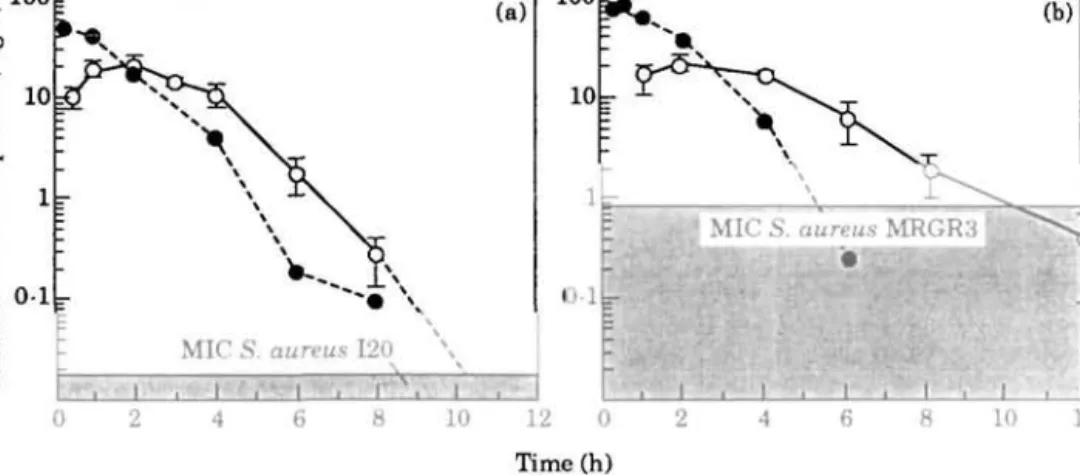
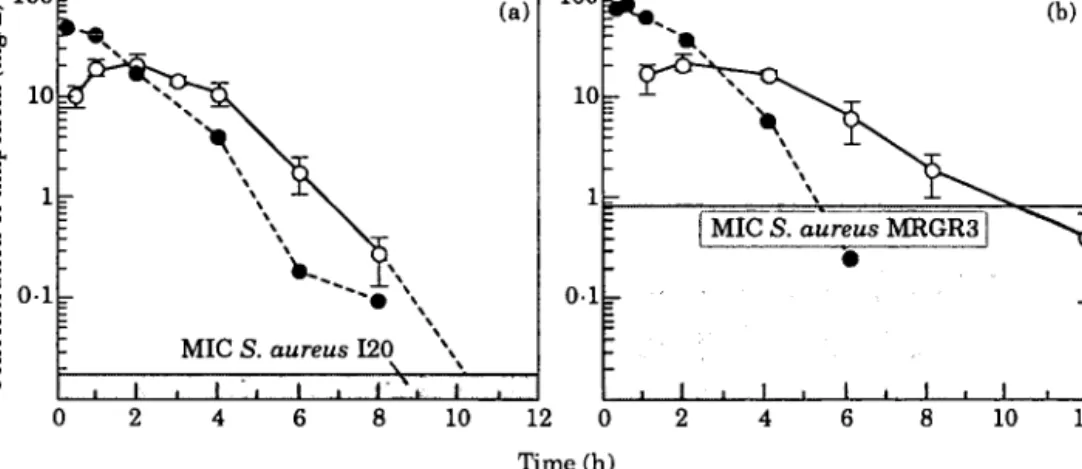
each antibiotic compared with unsupplemented MHB-S medium (not shown). During therapy with imipenem (80 mg/kg) plus cilastatin twice a day, average concentrations of imipenem peaked at 23 mg/L in rat TCF 2 h after administration. The rate of elimination of imipenem from TCF was rapid, with residual levels of 0-29 and < 0 1 mg/L after 8 and 12 h, respectively. The pharmacokinetic properties of imipenem in TCF, which were similar at day 1 (not shown) and day 7 (Figure l(a) indicated an average concentration of antibiotic exceeding the MIC for MSSA for a
1 0 0 IT
Imipenem in staphylococcal foreign body infections
100 E
1195
10 12 0 Time (h)
Figure 1. Concentration of imipenem in serum ( # ) and tissue cage fluid (O) of rats at day 7 after twice a day intraperitoneal administration of imipenem plus cilastatin. (a) Imipenem 80 mg/kg twice a day; (b) imipenem 120 mg/kg twice a day.
10h-period during each 12-h cycle of therapy. In comparison, administration of oxacillin (200 mg/kg twice a day) resulted in average TCF levels that continually exceeded the MIC for MSSA (peak: 45 mg/L; trough: 57 mg/L).
Of 71 tissue cages inoculated with strain 120, 11 with bacterial counts less than 105cfu/mL TCF before the onset of therapy were excluded from the study. At day 1,
before antibiotic treatment, similar average bacterial counts were found in the fluids of the residual 60 tissue cages. The animals were subdivided into three groups with the following TCF counts: 6-85 + 0-27 for the 19 cages of control rats, 6-58 + 0-18 for the 23 cages of rats receiving imipenem, and 6-82 + 0-17 logl0cfu/mL for the 18 cages of rats
receiving oxacillin. At the end of the 7-day treatment period, cfu counts in TCFs of untreated animals increased slightly and non-significantly by 0-48 + 0-24 log|0cfu/mL
(n = 19). Both imipenem and oxacillin therapy led to significant decreases in viable counts of TCFs by 1-76 + 0-26 (n = 23, P < 0001) and 0-92 + 0-21 (« = 18, P < 002) log10 cfu/mL, respectively (Figure 2(a)).
Treatment of chronic MRS A tissue cage infection
The MIC/MBC values of oxacillin and vancomycin for MRSA strain MRGR3 were 16/64 and 1/2 mg/L, respectively. In repeated experiments (« = 6), the MICs of imipenem for the MRSA strain MRGR3 ranged from 0125-1 mg/L and the MBCs from 16-32 mg/L. This MIC of imipenem for strain MRGR3 was at the lower end of the range of those obtained (0-06 to > 64 mg/L) for a group of 50 clinical isolates of MRSA using agar dilution testing.
In time kill studies, MRSA strain MRGR3 exposed to imipenem 8 mg/L showed incomplete elimination of 1-2-5 log10cfu/mL during the initial 6 h, followed by partial
regrowth thereafter. In similar conditions, vancomycin eliminated the test strain by > 3 log,0 cfu/mL at 24 h (data not shown).
To achieve TCF levels of imipenem active against MRSA strain MRGR3, a high dose regimen of 120 mg/kg was administered to infected animals twice a day for 7 days. This resulted in peak and trough levels of imipenem in TCF averaging 26 and 0-5 mg/L,
Imipenem in staphylococcal foreign body infections 1195 1 0 0 IT g 10
I
I 1
S o - i , 0 r _ • 1 -O-^-ir \\ \ \\ MICS. . t i aureus I • V 120 \ i\ l (a) 10 1 0 1 i lu iL \ T
-: [MIC S. aureus MRGR3 r ' • . I , i , 1 i 1 . (b) • -8 10 12 0 8 10 12 Time (h)Figure 1. Concentration of imipenem in serum ( # ) and tissue cage fluid (O) of rats at day 7 after twice a day intraperitoneal administration of imipenem plus cilastatin. (a) Imipenem 80 mg/kg twice a day; (b) imipenem 120 mg/kg twice a day.
10h-period during each 12-h cycle of therapy. In comparison, administration of oxacillin (200 mg/kg twice a day) resulted in average TCF levels that continually exceeded the MIC for MSSA (peak: 45 mg/L; trough: 57 mg/L).
Of 71 tissue cages inoculated with strain 120, 11 with bacterial counts less than 105cfu/mL TCF before the onset of therapy were excluded from the study. At day 1,
before antibiotic treatment, similar average bacterial counts were found in the fluids of the residual 60 tissue cages. The animals were subdivided into three groups with the following TCF counts: 6-85 + 0-27 for the 19 cages of control rats, 6-58 ±0-18 for the 23 cages of rats receiving imipenem, and 6-82 ± 0 1 7 logl0cfu/mL for the 18 cages of rats
receiving oxacillin. At the end of the 7-day treatment period, cfu counts in TCFs of untreated animals increased slightly and non-significantly by 0-48 + 0-24 log|0cfu/mL
{n = 19). Both imipenem and oxacillin therapy led to significant decreases in viable
counts of TCFs by 1-76±0-26 (n = 23, P < 0001) and 0-92 + 0-21 (n = 18, P < 002) log10 cfu/mL, respectively (Figure 2(a)).
Treatment of chronic MRS A tissue cage infection
The MIC/MBC values of oxacillin and vancomycin for MRSA strain MRGR3 were 16/64 and 1/2 mg/L, respectively. In repeated experiments (« = 6), the MICs of imipenem for the MRSA strain MRGR3 ranged from 0125-1 mg/L and the MBCs from 16-32 mg/L. This MIC of imipenem for strain MRGR3 was at the lower end of the range of those obtained (0-06 to > 64 mg/L) for a group of 50 clinical isolates of MRSA using agar dilution testing.
In time kill studies, MRSA strain MRGR3 exposed to imipenem 8 mg/L showed incomplete elimination of 1-2-5 log10cfu/mL during the initial 6 h, followed by partial
regrowth thereafter. In similar conditions, vancomycin eliminated the test strain by > 3 log|0 cfu/mL at 24 h (data not shown).
To achieve TCF levels of imipenem active against MRSA strain MRGR3, a high dose regimen of 120 mg/kg was administered to infected animals twice a day for 7 days. This resulted in peak and trough levels of imipenem in TCF averaging 26 and 0-5 mg/L,
1196 H. J. Schaad et al. MSSA MBSA £ 0 5 --1-5 -Control Oxacillin (n = 19) (n = 18) Imipenem (n = 23) 0 5 1 5 -Control Vancomycin (n = 17) (n = 22) Imipenem (n = 23)
Figure 2. Reduction in bacterial counts of S. aureus in chronic tissue cage infection during a 7 day antimicrobial therapy, (a) Methicillin-susceptible strain 120; (b) methicillin-resistant strain MRGR3.
respectively, almost continuously exceeding the MIC for MRSA during therapy (Figure l(b)). In comparison, animals receiving vancomycin (50mg/kg) twice a day had average antibiotic levels that constantly exceeded the MIC for MRSA, with peak and trough levels of 12 and 2 mg/L at 4 and 12 h, respectively.
For the comparative therapeutic trial, 78 cages were infected with MRSA strain MRGR3. Subsequently, 16 with inadequate bacterial counts were excluded from the study. At day 1, before therapy was started, average bacterial counts were similar in TCFs of untreated animals (6-26 ±0-22; « = 1 7 ) and those receiving imipenem (6-33 ±0-20; n = 23) or vancomycin (6-11 ±0-21; n = 22). At the end of the seven-day treatment period, TCFs from vancomycin-treated animals showed a significant (P < 0-002) decrease in their viable counts of 111 ±0-26 logl0cfu/mL (Figure 2(b)). In
contrast, high dose therapy with imipenem plus cilastatin did not lead to a reduction in TCF bacterial counts, but rather to a slight increase of 0-30 ± 0 1 6 logl0cfu/mL, similar
to that recorded in TCFs of untreated animals (0-31 ±0-33 logl0cfu/mL, Figure 2(b)).
To investigate further the lack of activity shown by imipenem for MRSA in tissue cage infections, additional in-vitro and in-vivo studies were performed. Various altera-tions in culture media and incubation condialtera-tions, known to influence expression of methicillin resistance, were made to determine the effects on the MIC of imipenem. These changes included addition of sodium chloride to the medium, a lower tempera-ture of incubation, and an incubation time extended to 48 h. Whereas adding 2% NaCl to the medium or incubation at 30°C did not alter the MIC of imipenem for strain MRGR3 when the plates were read at 24 h (range from 0-125—1 mg/L in repeated experiments (n = 6)), the MICs of imipenem were increased to 16-32 mg/L when plates were read at 48 h. Such a large ( > 32-fold) increase in MIC obtained simply by extending the incubation time from 24 to 48 h could be accounted for by the presence of a slowly growing subpopulation of bacteria highly resistant to imipenem. Microcolonies were faintly visible at 24 h, but could not properly be enumerated before at least 48 h of incubation. A similar situation was observed at the end of time
Imipenem in staphylococcal foreign body infections 1197
kill studies performed with imipenem 8 mg/L. After 24 h incubation, tubes contained a majority of faintly visible microcolonies which, following further growth and suspen-sion in MHB-S showed high resistance to imipenem (MIC: 32 mg/L) in the macrodilu-tion broth method.
Two experiments were performed in vivo to study the selection or induction of imipenem resistance during imipenem therapy. In the first experiment, six animals were treated twice a day for 4 days with imipenem 80 mg/kg and the number of imipenem-resistant cells, namely those able to grow on agar supplemented with imipenem 8 mg/L, were scored before and after therapy. In 16 TCF samples, containing at least 105cfu/mL at the onset of therapy, the median frequency of highly resistant organisms
was 2-8 x l O "4 (range 2-8 x 10~5-10x 10"3). After 4 days of therapy, the median
frequency of imipenem-resistant organisms increased to l-5xl0~2 (range
1-3 x 10⁻³-10-').
A second therapeutic trial, using a higher imipenem dose (120 mg/kg) administered twice a day, for 7 days essentially confirmed the findings of the first trial. Whereas before therapy (day 1), the median proportion of highly resistant organisms was 1-3 x l O "4 (range 0-4-41 x 10"4), this value rose to 2-3 x l O "3 (range 10 x 10"4 to
4 0 x 10"2) after therapy. Taken together, both therapeutic trials demonstrated the
persistence of a highly resistant subpopulation of MRS A during high dose therapy of chronically infected tissue cages.
Discussion
The major objective of this study was to compare the activity of imipenem against methicillin-susceptible (MSSA) and methicillin-resistant (MRSA) strains of S. aureus in an experimental model of chronic tissue cage infections (Lucet et al., 1990), which represent a significant challenge to antimicrobial therapy (Chuard et al., 1991a). In-vitro studies have reported high antimicrobial activity (Wise, Andres & Patel, 1981; Witte et al., 1982) of imipenem against methicillin-susceptible strains of S aureus and pharmacokinetic studies (Drusano, 1986; Wise et al., 1986) have shown that it is possible to achieve high levels in humans and animals, suitable for therapy of Gram-positive bacterial infections. In an experimental model of staphylococcal infec-tion, namely aortic-valve endocarditis in rats (Baumgartner & Glauser, 1983) and rabbits (Apellaniz et al., 1991), the activity of imipenem was recorded as at least equivalent to that of the standard agent, cloxacillin, and even to that of cloxacillin-gentamicin combination therapy. Our results, which demonstrate significant imipenem activity against tissue cage infection by MSSA strain 120, agree with those previously reported for this antibiotic in both animals and humans. Although imipenem is not considered as a first line agent with which to treat staphylococcal infections, because of its lack of selectivity, a number of experimental and clinical observations have provided arguments for its clinical efficacy against MSSA strains.
An interesting and useful feature of imipenem is high resistance to /Mactamases. High levels of /Mactamase have recently been documented in so-called borderline-susceptible strains of 5. aureus (Kernodle & Kaiser, 1993), which are devoid of intrinsic methicillin-resistance. High production of /Mactamase by MSSA strain 120 was recently observed (Berger-Bachi, B., personal communication), after completion of this study. It is therefore possible that the high amounts of /Mactamase produced by MSSA strain 120 decreased, in part, the efficacy of oxacillin against the chronically infecting
1198 H. J. Schaad et al.
strain. In contrast, the high stability of imipenem to /J-lactamase hydrolysis is likely to have contributed to the good activity of this agent against MSSA strain 120.
The lack of activity of imipenem against MRSA strain MRGR3 in the rat model of chronic infection was not anticipated, in view of pilot in-vitro tests performed in standard conditions and because of the favourable pharmacokinetic properties of this antimicrobial agent administered at a high dose regimen (120 mg/kg). One significant factor which contributed to the failure of therapy was the emergence of a highly resistant subpopulation which grew slowly in the presence of antibiotic. The detection of such slow-growing imipenem-resistant colonies turned out to be difficult, because it required a long incubation time for accurate quantification of these organisms. Surprisingly, the addition of sodium chloride to the growth medium or the use of a lower temperature of incubation, as usually recommended for the detection of oxacillin resistance, was not useful in the imipenem context, because neither of these modifica-tions shortened the time of incubation required for detection of imipenem resistant organisms.
When the in-vitro and in-vivo data were compared with those in the literature, we also found that detection of imipenem resistance had been an important part of some earlier studies (Berry et al., 1986; Chandrasekar et al., 1988). Whereas Chandrasekar
et al. (1988) grew MRSA for 18-24 h at 35°C on mannitol and sodium
chloride-supplemented agar and found good in-vitro and in-vivo activity of imipenem against these organisms, opposite results and conclusions were obtained by Berry et al. (1986) who enumerated colonies of methicillin-resistant Stapylococcus epidermidis after 72 h of growth at 30cC. These major differences in incubation times and temperatures could
afford an explanation for the conflicting results obtained from the studies, in particular because the former group selected a 24 h growing period which was likely to have been insufficient to detect the slow-growing, highly resistant subpopulations of MRSA.
In conclusion, imipenem showed good activity in an experimental model of chronic foreign body-associated infection caused by a methicillin-susceptible strain of
S. aureus. However, the lack of activity of imipenem against the methicillin-resistant
strain of S. aureus in the same model and the observation that an imipenem-resistant subpopulation grew very slowly and could easily be overlooked in standard culture and susceptibility testing conditions, are further indications that this antibacterial agent should not be used for therapy of chronic foreign body infections caused by MRSA.
Acknowledgements
This work was supported in part by a research grant from MSD, Glattbrugg, Switzerland and by grant 32-30161.90 from the Swiss National Research Foundation. C. Chuard is the recipient of fellowship 32-27222.89 from the Swiss National Research Foundation. We thank Manuela Bento for outstanding technical assistance.
References
Apellaniz, G., Valdes, M., Perez, R., Martin, F., Soria, F., Garcia, A., Gomez, J. & Vicente. T. (1991). Comparison of the effectiveness of various antibiotics in the treatment of methicillin-susceptible Staphylococcus aureus experimental infective endocarditis. Journal of
Chemotherapy 3, 91-7.
Baumgartner, J. D. & Glauser, M. P. (1983). Comparative imipenem treatment of
Staphylococcus aureus endocarditis in the rat. Journal of Antimicrobial Chemotherapy 12, Suppl. D, 79-87.
Imipenem in staphylococcal foreign body infections 1199 Berry, A. J., Johnson, J. L. & Archer, G. L. (1986). Imipenem therapy of experimental Staphylococcus epidermidis endocarditis. Antimicrobial Agents and Chemotherapy 29, 748-52.
Bisno, A. L. (1989). Infections of central nervous system shunts. In Infections Associated with Indwelling Medical Devices (Bisno, A. L. & Waldvogel, F. A., Eds), pp. 93-109. American Society for Microbiology, Washington, DC.
Brause, B. D. (1989). Infected orthopedic prostheses. In Infections Associated with Indwelling Medical Devices (Bisno, A. L. & Waldvogel, F. A., Eds), pp. 111-27. American Society for Microbiology, Washington, DC.
Brumfit, W. & Hamilton-Miller, J. (1989). Methicillin-resistant Staphylococcus aureus. New England Journal of Medicine 320, 1188-96.
Calandra, G. B., Wang, C , Aziz, M. & Brown, K. R. (1986). The safety profile of imipenem/ cilastatin: worldwide clinical experience based on 3470 patients. Journal of Antimicrobial Chemotherapy 18, Suppl. E, 193-202.
Chambers, H. F. (1988). Methicillin-resistant staphylococci. Clinical Microbiology Reviews 1, 173-86.
Chandrasekar, P. H., Levine, D. P., Proce, S. & Ryback, M. J. (1988). Comparative efficacies of imipenem-cilastatin and vancomycin in experimental aortic valve endocarditis due to methicillin resistant Staphylococcus aureus. Journal of Antimicrobial Chemotherapy 21, 461-9.
Chuard, C , Hermann, M., Vaudaux, P., Waldvogel, F. A. & Lew, D. P. (1991a). Successful therapy of experimental chronic foreign-body infection due to methicillin-resistant Staphylococcus aureus by antimicrobial combinations. Antimicrobial Agents and Chemotherapy 35, 2611-6.
Chuard, C , Lucet, J. C , Rohner, P., Herrmann, M., Auckenthaler, R., Waldvogel, F. A. & Lew, D. P. (19916). Resistance of Staphylococcus aureus recovered from infected foreign body in vivo to killing by antimicrobials. Journal of Infectious Diseases 163, 1369-73.
Chuard, C , Rohner, P., Dunand, V., Auckenthaler, R. & Lew, D. P. (1992). In-vitro and in-vivo evaluation of the antistaphylococcal activity of S-5556, a new 16-membered macrolide. Journal of Antimicrobial Chemotherapy 30, 327-37.
Drusano, G. L. (1986). An overview of pharmacology of imipenem/cilastatin. Journal of Antimicrobial Chemotherapy 18, Suppl. E, 79-92.
Fan, W., del Busto, R., Lore, M., Markowitz, C , Cendrowski, C , Cardenas, J., Quinn, E. & Saravolatz, L. (1986). Imipenem-cilastatin in the treatment of methicillin-sensitive methicillin-resistant Staphylococcus aureus infections. Antimicrobial Agents and Chemotherapy 29, 26-9.
Gristina, A. G. & Costerton, J. W. (1985). Bacterial adherence to biomaterials and tissues. Journal of Bone and Joint Surgery 67A, 264-73.
Karchmer, A. W. & Bisno, A. L. (1989). Infections of prosthetic heart valves and vascular grafts. In Infections Associated With Indwelling Medical Devices (Bisno, A. L. & Waldvogel, F. A., Eds), pp. 129-59. American Society for Microbiology, Washington, DC.
Kernodle, D. S. & Kaiser, A. B. (1993). Efficacy of prophylaxis with lactams and beta-lactam-beta-lactamase inhibitor combinations against wound infection by methicillin-resistant and borderline-susceptible Stapylococcus aureus in a guinea pig model. Antimicrobial Agents and Chemotherapy 37, 702-7.
Lucet, J.-C, Hermann, M., Rohner, P., Auckenthaler, R., Waldvogel, F. A. & Lew, D. P. (1990). Treatment of experimental foreign body infection caused by methicillin-resistant Staphylococcus aureus. Antimicrobial Agents and Chemotherapy 34, 2312-7.
National Committee for Clinical Laboratory Standards. (1987). Methods for Determining Bactericidal Activity of Antimicrobial Agents; Approved Standard M26-P. NCCLS, Villanova, PA.
Rohner, P., Peebo, M., Lew, D. P., Auckenthaler, R. & Pechere, J. C. (1992). Comparative in-vitro activity of new quinolones against clinical isolates and resistant mutants. Journal of Antimicrobial Chemotherapy 29, 41-8.
Rosner, B. (1990). Fundamental of Biostatistics. PWS-Kent Publishing Company, Boston, MA. Vaudaux, P. E., Lew, D. P. & Waldvogel, F. A. (1989). Host factors predisposing to foreign body infections. In Infections Associated with Indwelling Medical Devices (Bisno, A. L. & Waldvogel, F. A., Eds), pp. 3-26. American Society for Microbiology, Washington, DC.
1200 H. J. Schaad et al.
Wise, R., Andres, J. M. & Patel, N. (1981). N-formimidoyl thienamycin, a novel beta-lactam: an in vitro comparison with other beta-lactam antibiotics. Journal of Antimicrobial Chemotherapy 7, 521-9.
Wise, R., Donovan, I. A., Lockeley, M. R., Drumm, J. & Andrews, J. M. (1986). The pharmacokinetics and tissue penetration of imipenem. Journal of Antimicrobial Chemotherapy 18, Suppl. E, 93-101.
Witte, J. L., Sapico, F. L. & Canawati, H. N. (1982). In vitro susceptibility of methicillin-resistant and methicillin-susceptible Staphylococcus aureus strains to N-formimidoyl thienamycin. Antimicrobial Agents and Chemotherapy 22, 906-8.
Zimmerli, W., Lew, D. P. & Waldvogel, F. A. (1984). Pathogenesis of foreign body infection. Evidence of a local granulocyte defect. Journal of Clinical Investigation 73, 1191-200.