Dual-regulated expression of C/EBP-a and BMP-2
enables differential differentiation of C2C12 cells into
adipocytes and osteoblasts
Cornelia Fux, Barbara Mitta, Beat P. Kramer and Martin Fussenegger*
Institute of Biotechnology, Swiss Federal Institute of Technology, ETH Hoenggerberg, HPT D74, CH-8093 Zurich, Switzerland
Received July 9, 2003; Revised October 20, 2003; Accepted November 3, 2003 ABSTRACT
CCAAT/enhancer-binding proteins (C/EBPs) as well as bone morphogenic proteins (BMPs) play essen-tial roles in mammalian cell differentiation in shaping adipogenic and osteoblastic lineages in particular. Recent evidence suggested that adipo-cytes and osteoblasts share a common mesenchy-mal precursor cell phenotype. Yet, the molecular details underlying the decision of adipocyte versus osteoblast differentiation as well as the involvement of C/EBPs and BMPs remains elusive. We have engineered C2C12 cells for dual-regulated expres-sion of human C/EBP-a and BMP-2 to enable inde-pendent transcription control of both differentiation factors using clinically licensed antibiotics of the streptogramin (pristinamycin) and tetracycline (tetracycline) classes. Differential as well as co-ordinated expression of C/EBP-a and BMP-2 revealed that (i) C/EBP-a may differentiate C2C12 myoblasts into adipocytes as well as osteoblasts, (ii) BMP-2 prevents myotube differentiation, (iii) is incompetent in differentiating C2C12 into blasts and (iv) even decreases C/EBP-a's osteo-blast-speci®c differentiation potential but (v) cooperates with C/EBP-a on adipocyte differenti-ation, (vi) osteoblast formation occurs at low C/EBP-a levels while adipocyte-speci®c differenti-ation requires maximum C/EBP-a expression and that (vii) BMP-2 may bias the C/EBP-a-mediated adipocyte versus osteoblast differentiation switch towards fat cell formation. Dual-regulated expres-sion technology enabled precise insight into com-binatorial effects of two key differentiation factors involved in adipocyte/osteoblast lineage control which could be implemented in rational reprogram-ming of multipotent cells into desired cell pheno-types tailored for gene therapy and tissue engineering.
INTRODUCTION
Mesenchymal stem cells are multipotent cells which can differentiate into adipocyte, chondrocyte, myoblast and osteoblast lineages (1±4). Recent evidence suggested that adipocytes and osteoblasts originate from a common mesen-chymal precursor cell (5), which raises particular interest on how molecular lineage control is implemented in those cells. CCAAT/enhancer-binding proteins (C/EBPs) comprise a family of transcription factors that have key metabolic and differentiation missions in many tissues (6±8). To date, six members of the C/EBP family (C/EBP-a, -b, -d, -g, -e, -z) have been identi®ed, which are expressed in various cell types including adipocytes and osteoblasts (9±11). All C/EBPs share a highly conserved DNA-binding domain as well as a bZIP dimerization domain (12,13), which enables homo- and heterodimeric binding to sequence-speci®c operators (14, 15). While ectopic expression of C/EBP-a was suf®cient for differentiation of mouse ®broblasts into adipocytes (16), fat-cell-speci®c differentiation of G8 mouse myoblasts required coordinated expression of C/EBP-a and PPARg (a member of the nuclear hormone receptor family) as well as addition of diverse lipids and/or lipid-like compounds including 5,8,11,14-eicosatetrayonic acid (ETYA) to the culture medium (17±19).
Previous studies have implied that the bone morphogenic protein 2 (BMP-2) promotes osteoblast-speci®c differentiation of C2C12 myoblasts via induction of several osteogenic master transcription factors including Runx2 and Osterix (20± 23). BMP-2 belongs to the transforming growth factor b family of differentiation factors that play key roles in chondrogenic or osteogenic lineage control, bone remodeling as well as differentiation of mesenchymal cells (24,25). However, BMP function seems not to be restricted to bone or cartilage formation since some family members have been found (i) to prevent myotube differentiation of myoblasts (26), (ii) to commit pluripotent mouse ®broblast cells (C3H10T1/2) to osteoblasts, chondroblasts and adipocytes (27±29) and (iii) to stimulate adipocyte formation of mesenchymal precursor cells (30).
Based on recent advances in heterologous transcription control technology, we have designed dual-regulated expres-sion con®gurations which enable independent regulation of two different transgenes (31±37). Pioneering dual-regulated *To whom correspondence should be addressed. Tel: +41 1 633 34 48; Fax: +41 1 633 12 34; Email: [email protected]
Nucleic Acids Research, 2004, Vol. 32, No. 1 e1 DOI: 10.1093/nar/gnh001
expression technology combined two compatible gene regu-lation systems, the streptogramin-(PIP) and tetracycline-(TET) responsive transgene control con®gurations which follow a similar design concept (38): a Streptomyces coelicolor/Escherichia coli antibiotic resistance response regulator (Pip [pristinamycin-induced protein]/TetR) fused to a mammalian transactivation domain (VP16) (39) recon-stitutes a streptogramin-/tetracycline-dependent transactivator (PIT/tTA) that binds and activates speci®c promoters [PPIR/ PhCMV*-1; assembled from Pip-/TetR-speci®c tandem operator sites (ptr/tetO) and minimal eukaryotic promoters (PhCMVmin)] in a pristinamycin-/tetracycline-adjustable manner (38). Whereas in the presence of pristinamycin/tetracycline, PIT/ tTA fails to bind and transactivate PPIR/PhCMV*-1, desired transgene expression is fully induced in the absence of regulating antibiotics (34,38). Combination of PIP and TET systems enabled four different digital expression con®gur-ations: ON/ON, OFF/ON, ON/OFF and OFF/OFF (34,36, 37,40).
In this study we used dual-regulated expression of C/EBP-a and BMP-2 for rational reprogramming of C2C12 to reveal mechanisms underlying C2C12 to adipocyte and C2C12 to osteoblast differentiation. Multiregulated multigene-based therapeutic interventions as presented here are expected to enable design of desired cell phenotypes for gene therapy and tissue engineering in the not-too-distant future.
MATERIALS AND METHODS Vector constructions
pCF141 was constructed by excising human C/EBP-a [pCMVa (41)] from pCF50 (pAI-C/EBPa¬PhCMV*-1 -stuffer-PPIR8®E7-HA-pAII; C.Fux et al., unpublished) using BamHI/ ClaI and cloning it into the corresponding sites (BamHI/ClaI) of pCF93 (PhCMV*-1-MCS-pAI-PPGK-puro-pAII; C.Fux, unpublished) to result in pCF141 (PhCMV*-1-C/EBPa-pAI -PPGK-puro-pAII). pCF240 was constructed following a two step procedure: (i) C-terminally hemagglutinin A (HA)-tagged human BMP-2 (BMP-2-HA) was constructed by amplifying BMP-2 cDNA (W.Weber, unpublished) using oligonucleotides OWW15: 5¢-ggaagcttgaattcCCACCATG-GTGGCCGGGACCCGC-3¢ (annealing sequence upper case, HindIII and EcoRI sites underlined) and OWW16: 5¢-ggagatctgaattcatttaaatTCAAGCGTAATCTGGAACA-TCGTATGGGTAgcgacacccacaaccctccacaac-3¢ (annealing sequence upper case, BglII, EcoRI and SwaI sites underlined, HA-Tag in italic) followed by subsequent cloning in sense orientation into pEF6/V5-His TOPO (Invitrogen, Carlsbad, CA) to create pWW16. (ii) BMP-2-HA was excised from pWW16 using EcoRI and cloned into the corresponding site (EcoRI) of pCF217 (PPPI8-MCS-pAI-PPGK-zeo-pAII; C.Fux, unpublished) to give pCF240 (PPPIR8-BMP2-HA-pAI-PPGK -zeo-pAII). Lentivector pBP252 was constructed by excising C/ EBP-a from pCF257 by EcoRI/StuI and ligating it into the EcoRI/SwaI of pMF359 (42). Likewise, BMP-2 was excised from pCF241 using EcoRI/MluI and cloned into EcoRI/MluI-restricted pMF359 to give pBP253. Details on pCF257 and pCF241 are available upon request.
Cell culture, transfection, lentiviral particle production and transduction
Wild-type C2C12 (C2C12, ATCC:CRL-1772) were cultivated in Dulbecco's modi®ed Eagle's medium (DMEM, Invitrogen, Carlsbad CA) supplemented with 10% FCS (PAA Laboratories GmbH, Linz, Austria; catalog no. A15-022, lot no. A01129-242) (basic medium). The cell line C2C12PIT/tTA stably expressing the streptogramin-(PIT) and the tetra-cycline-(tTA) dependent transactivators was cultivated in basic medium that also contained 800 mg/ml G418. The cell line C2C12PIT/tTA-C/EBPaTET, a C2C12PIT/tTA derivative harboring a tetracycline-responsive CEBP-a expression unit (pCF141; PhCMV*-1-CEBPa-pAI-PPGK-puro-pAII) was culti-vated in basic medium supplemented with 800 mg/ml G418 and 1 mg/ml puromycin. The cell line C2C12PIT/tTA -CEBPaTET-BMPPIP, a C2C12PIT/tTA-C/EBPaTET engineered for streptogramin-responsive BMP2 expression (pCF240; PPIR8-BMP2-HA-pAI-PPGK-zeo-pAII) was cultivated in medium supplemented with 800 mg/ml G418, 1 mg/ml puromycin and 40 mg/ml zeocin. Transfection of C2C12 derivates was performed using a modi®ed CaPO4-based protocol (32). 120 000 cells per 6 well were transfected with 1.2 mg DNA, which resulted in a typical transfection ef®ciency of 40 6 5%. Production and transduction protocols using replication-incompetent self-inactivating lentiviral particles have been described before (42).
Construction of stable cell lines
The stable cell line C2C12PIT/tTA-CEBPaTET was generated by transfection of pCF141 (PhCMV*-1- C/EBPa-pAI-PPGK -puro-pAII) into C2C12PIT/tTA. The mixed stable population was selected for 3 weeks in basic medium supplemented with selective (800 mg/ml G418, 1 mg/ml puromycin) and regulat-ing (5 mg/ml tetracycline) antibiotics prior to FACS-mediated single-cell sorting. Similarly, stable cell line C2C12PIT/tTA -CEBPaTETBMP2PIP was produced by transfecting pCF240 (PPIR8-BMP-HA-pAI-PPGK-zeo-pAII) into C2C12PIT/tTA -CEBPaTET followed by a 3-week expansion of a stable mixed population in medium supplemented with various selective and regulating antibiotics (800 mg/ml G418, 1 mg/ml puromycin, 40 mg/ml zeocin, 5 mg/ml tetracycline and 2 mg/ml pristinamycin) prior to FACS-meditated single-cell cloning. Western blot analysis
For preparation of whole cell extracts, cells were washed with ice-cold PBS and scraped into lysis buffer (Roche Diagnostics AG, Basel, Switzerland). Cells were allowed to lyse for 15 min prior to centrifugation of the lysates for 20 s at 23 000 g. Protein concentrations of whole cell extracts were determined using a BCAÔ Protein Assay (SOCOCHIM, Lausanne, Switzerland). Prior to resolution on a 12% polyacrylamide gel, proteins mixtures contained in whole cell extracts and cell culture supernatants were denatured by boiling for 10 min in sample buffer (10% glycerol, 50 mM Tris±HCl, 1% SDS and 0.005% bromophenol blue). Proteins were then blotted onto polyvinylidene di¯uoride (PVDF) membranes (Millipore, Bedford, MA), which were subsequently blocked using 5% non-fat dry milk in TTBS (50 mM Tris, pH 7.5, 150 mM NaCl, 0.05% Tween-20). Blots were probed with speci®c primary antibodies (C/EBPa: Santa Cruz, 14AA, catalog no. sc-61, lot
no. F080; HA-probe: Santa Cruz, Y-11; catalog no. sc-805, lot no. G070) and visualized using an appropriate horseradish peroxidase-coupled secondary antibody (Amersham, catalog no. NA934V, lot no. 211112) linked to an ECL detection readout (Amersham, Buckinghamshire, UK; catalog no. RPN 2106).
Characterization of cell phenotypes
In order to visualize adipogenic cell phenotypes, cells were cultured to 80% con¯uence in basic medium and then transferred to medium supplemented with 1 mM dexametha-sone, 5 mg/ml insulin and 50 mM ETYA [Dex/ETYA/Insulin, DEI; (19)]. Fourteen days post-DEI induction, the cells were ®xed in a 3.7% aqueous formaldehyde solution 1 h. Excess formaldehyde was removed by rinsing three times 30 s with ddH2O prior to immersion of cells for 30 min with an Oil Red O working solution. Subsequently, the cells were washed three times with ddH2O for 30 s and the nuclei were stained for 60 s with Mayer's haematoxylin (Sigma Chem. Co., St Louis, MO). Finally, the cells were rinsed in ddH2O for 10 min and covered with a coverslip using 10% glycerol in PBS (43). Alkaline phosphatase-speci®c staining of osteogenic cell phenotypes was visualized following a 5-day cultivation using the Sigma Kit 85 according to the manufacturer's instructions (Sigma Chem. Co., St Louis, MO).
Antibiotics and chemicals
Pyostacinâpills (500 mg; Aventis Inc., France; lot no. 27404)
were ground in a mortar and dissolved in DMSO (50 mg/ml). Alternatively, antibiotic discs containing 15 mg pristinamycin (bioMeÂrieux, Geneva, Switzerland) were soaked in 7.5 ml 4°C cell culture medium for 30 min. Pristinamycin I (PI) (2 mg/ml) was routinely used for regulation studies in cell culture and calculated based on the ®xed 70:30 ratio (w/w) of the non-regulating pristinamycin II and PI in the composite antibiotic pristinamycin (44). Pyostacin- or antibiotic disc-derived PI was as ef®cient in regulating streptogramin-responsive expression systems as the pure PI reference compound kindly provided by Aventis Inc. (RP27404, lot no. SOU2890IICA; France). G418 was obtained form Calbiochem-Novabiochem Inc. (La Jolla, CA), puromycin from ALEXIS Inc. (San Diego, CA), zeocin from Invitrogen (Carlsbad, CA) and tetracycline from Sigma Chemicals (St Louis, MO). Dexamethasone was purchased from Fluka Chemie (Buchs SG, Switzerland), insulin and ETYA from Sigma Chemicals (St Louis, MO). For an Oil Red O (Fluka Chemie, Buchs SG, Switzerland) stock solution 500 mg Oil Red O were dissolved in 100 ml 60% triethyl-phosphate (Fluka Chemie, Buchs SG, Switzerland). Prior to staining, a 36% triethyl-phosphate working solution containing 12 ml Oil Red O stock solution and 8 ml ddH20 was prepared. Puri®ed human BMP-2 was purchased from PeproTech EC Ltd (London, UK) and used at concentrations of 3 ng/ml.
RESULTS
Production of C2C12 cells engineered for tetracycline-responsive C/EBP-a expression
In order to enable tetracycline-responsive expression of C/EBP-a in C2C12 cells we transduced this cell line with
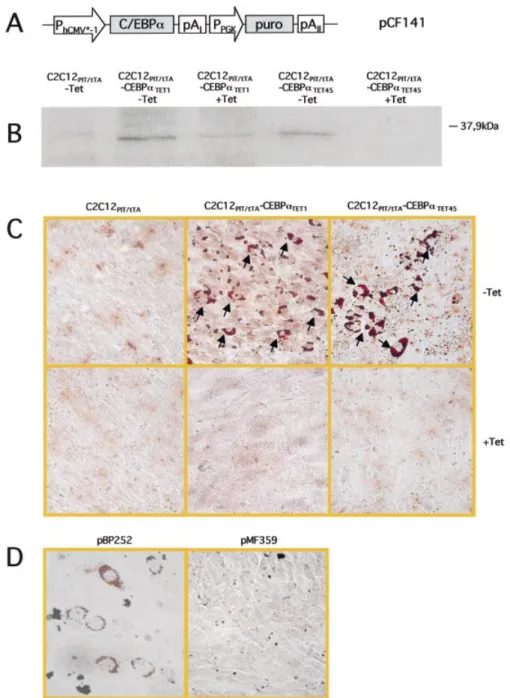
pRetroTWIN3-derived retroviral particles encoding the tetra-cycline-dependent as well as the pristinamycin-dependent transactivators. Resulting C2C12PIT/tTAwas stably transfected with pCF141, which contains human C/EBP-a under control of the tetracycline-responsive promoter (PhCMV*-1) and encodes a puromycin resistance-conferring gene driven by the constitutive phosphoglycerate kinase promoter (PPGK) (Fig. 1A). In order to prevent any differentiation/growth bias, C/EBP-a expression was repressed by addition of tetracycline during the entire selection and cloning procedures. Two randomly chosen C2C12PIT/tTA-CEBPaTETclones (numbers 1 and 45) showed tetracycline-responsive C/EBP-a expression pro®les (Fig. 1B). Also, both cell clones differentiated into myotubes when C/EBP-a was repressed by addition of tetracycline while myotube formation was repressed following cultivation of C2C12PIT/tTA-CEBPaTET under C/EBP-a-induced and low serum conditions (data not shown). These ®ndings support an earlier report correlating C/EBP-a expression and low-serum cultivation of G8 myoblasts with inhibition of myotube-speci®c differentiation (19).
C/EBP-a is suf®cient to convert C2C12 cells into adipocytes
Previous initiatives to differentiate G8 myoblasts into adipocytes required concomitant expression of C/EBP-a and PPARg as well as addition of DEI to the culture medium. Either of the two determinants alone was not suf®cient for adipocyte commitment of this muscle cell type (19). In order to assess the potential of C2C12PIT/tTA-CEBPaTET cells to differentiate into adipocytes we cultivated this cell line for 14 days in DEI-containing medium in the presence (+Tet; C/ EBP-a repressed) and absence of tetracycline (±Tet; C/EBP-a induced) prior to Oil Red O-mediated staining of adipocyte-speci®c triglyceride droplets. Both C2C12PIT/tTA-CEBPaTET clones showed increased adipocytic lineage commitment following sustained expression of C/EBP-a (Fig. 1C). In the control settings consisting of C2C12PIT/tTA-CEBPaTET culti-vated in the presence of tetracycline or the parental cell line C2C12PIT/tTA no adipogenic cell phenotypes could be observed (Fig. 1C). Likewise, transduction of C2C12 wild-type cells with lentiviral particles engineered for constitutive C/EBP-a expression induced adipocyte-speci®c differenti-ation in contrast to control transductions using isogenic lentiviral particles (Fig. 1D). Despite their equivalence, clone C2C12PIT/tTA-CEBPaTET45was used for further analysis. Design of a C2C12-derived cell line transgenic for dual-regulated expression of human CEBP-a and BMP-2
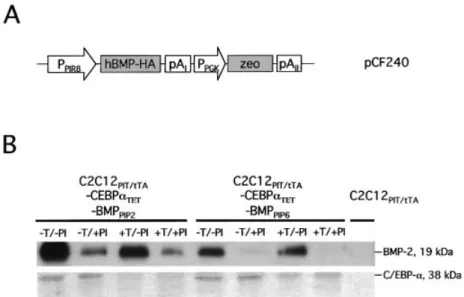
Dual-regulated expression technology enables independent control of two different transgenes (34,36,37). We have engineered C2C12 cells for tetracycline-responsive expression of human CEBP-a as well as streptogramin-responsive expression of the human BMP-2. Therefore, C2C12PIT/tTA -CEBPaTET45 was stably transfected with pCF240 which provides streptogramin-responsive expression of BMP-2-HA and enables selection for zeocin (Fig. 2A). Two randomly chosen cell clones C2C12PIT/tTA-CEBPaTET-BMP2PIP2 and C2C12PIT/tTA-CEBPaTET-BMP2PIP6 showed independent regulation of BMP-2 and CEBP-a following 5-day cultivation of engineered cells in media supplemented with different
combinations of regulating pristinamycin and tetracycline antibiotics (Fig. 2B).
BMP-2 cooperates with C/EBP-a on conversion of C2C12 into adipocytes
Recent reports associated BMP-2 with promoting adipogenic differentiation of the murine pre-adipocyte cell line 3T3-L1 following coexpression with peroxisome pro-liferator-activated receptor gamma (PPARg) (30). In order
to evaluate the potential of BMP-2 to differentiate C2C12 cells into adipocytes, C2C12PIT/tTA-CEBPaTET-BMPPIP2 and C2C12PIT/tTA-CEBPaTET-BMPPIP6 (C2C12PIT/tTA -CEBPaTET-BMPPIP2/6) were cultivated for 12 days in DEI-containing medium supplemented with different cock-tails of regulating antibiotics: ±Tet/±PI, ±Tet/+PI, +Tet/±PI and +Tet/+PI. Adipocyte-speci®c Oil Red O staining revealed increased adipocyte formation in the ±Tet/±PI combination (C/EBP-a and BMP-2 expressed; Fig. 3A and E) compared to Figure 1. C/EBPa expression of C2C12PIT/tTAcells stably transfected with pCF141 (C2C12PIT/tTA-CEBPaTET). (A) Schematic representation of pCF141.
pCF141 encodes human C/EBP-a under control of the tetracycline-responsive promoter (PhCMV*-1). The gene conferring resistance to puromycin (puro) is
driven by the constitutive phosphoglycerate kinase promoter (PPGK). Polyadenylation sites are indicated (pA1, pAII). (B) Western blot analysis of whole-cell
extracts (20 mg total protein) of C2C12PIT/tTA-CEBPaTET1and C2C12PIT/tTA-CEBPaTET45 grown for 5 days in the presence (+Tet) and absence (±Tet) of
tetracycline. The parental cell line C2C12PIT/tTA was used as a control. (C) Adipocyte-speci®c differentiation of C2C12 cell derivatives following
tetra-cycline-responsive expression of C/EBP-a. (D) Adipocyte-speci®c differentiation of C2C12 wild-type cells after transduction of lentiviral particles engineered for constitutive C/EBP-a expression (pBP252) or isogenic control lentiviruses (pMF359). Oil Red O-mediated staining of triclyceride droplets of C2C12 derivatives cultivated for 14 days in DEI-containing medium supplemented with tetracycline where indicated (C and D).
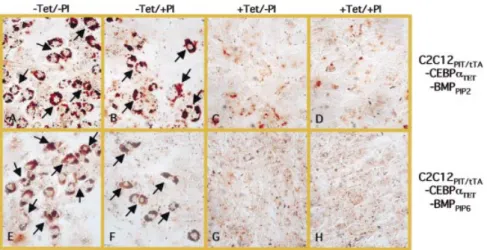
the ±Tet/+PI (only C/EBP-a expressed; Fig. 3B and F) con®guration suggesting that BMP-2 cooperates with C/EBP-a for mC/EBP-aximum C/EBP-adipocyte commitment compC/EBP-ared to ±Tet/ +PI (only C/EBP-a expressed; Fig. 3B and F). Clone C2C12PIT/tTA-CEBPaTET-BMPPIP6 showed less prominent adipocyte differentiation compared to C2C12PIT/tTA -CEBPaTET-BMPPIP2 which correlates with its lower maxi-mum BMP-2 expression levels (see Fig. 2B). Interestingly, following exclusive BMP-2 expression no adipogenic differentiation could be observed in either of the two cell clones (Fig. 3C and G). Likewise, no fat cells were detected for the +Tet/+PI setting when both genes were not expressed (Fig. 3D and H).
Differential lineage control of a C2C12-derived cell line engineered for independent control of C/EBP-a and BMP-2
BMP-2 has ®rst been identi®ed as a factor that induces bone and cartilage formation (23,26,45,46). We have assessed the potential of C2C12PIT/tTA-CEBPaTET-BMPPIP2/6 to form osteoblasts following growth for 5 days in medium containing different combinations of regulating tetracycline and pristi-namycin antibiotics (±Tet/±PI, ±Tet/+PI, +Tet/±PI and +Tet/ +PI). Speci®c staining for the osteogenic alkaline phosphatase (ALP) revealed highest osteoblast formation following exclu-sive expression of C/EBP-a (±Tet/+PI) (Fig. 4B and F). Coordinated expression of C/EBP-a and BMP-2 resulted in reduced osteoblast-speci®c differentiation (Fig. 4A and E). Expression of BMP-2 (+Tet/±PI) failed to induce osteogenic differentiation in C2C12PIT/tTA-CEBPaTET-BMPPIP2/6 cells, yet prevented myotube formation (Fig. 4C and G). In the control con®guration in which transgene expression was silenced by addition of both regulating antibiotics, C2C12PIT/tTA-CEBPaTET-BMPPIP2/6 retained its C2C12 typical cell morphology (+Tet/+PI) (Fig. 4D and H). In order to con®rm our ®nding that BMP-2 blocks myotube
formation in C2C12 cells we cultivated C2C12 wild-type cells for 5 days in medium containing 100 ml/ml supernatant of C2C12PIT/tTA-CEBPaTET-BMPPIP2/6cultivated under BMP-2-induced conditions or of C2C12 wild type as control. BMP2-mediated inhibition of myotube formation was also observed following transduction of C2C12 with BMP-2-encoding lentiviral particles or addition of puri®ed BMP-2 to C2C12 wild-type cultures (Fig. 5). BMP-2 seems to set C2C12 cells for adipocyte differentiation as it blocks or reduces commitment of myoblasts for myotubes and osteoblasts. Dose-dependence of C/EBP-a-induced adipocyte versus osteoblast differentiation
The capacity of C/EBP-a to induce adipocytes as well as osteoblasts raised the question of how lineage decision is implemented. In order to establish a direct correlation between C/EBP-a levels and osteoblast as well as adipocyte formation we cultivated C2C12PIT/tTA-CEBPaTET45 for 5 days in medium supplemented with increasing tetracycline concen-trations and scored adipocyte as well as osteoblast differen-tiation as a consequence of different C/EBP-a dosing. Figure 6 shows dose-dependent osteoblast formation starting at low C/EBP-a levels while adipogenesis requires maximum expression of this differentiation factor. This ®nding suggests that C/EBP-a mediates osteoblast-speci®c differentiation at low and differentiation of fat cells at high intracellular concentrations.
DISCUSSION
Mesenchymal precursor cells can differentiate into adipo-cytes, chondroadipo-cytes, myoblasts and osteoblasts following a program which remains elusive in many cell types. Based on C2C12 cells engineered for dual-regulated expression of C/EBP-a and BMP-2, we studied single as well as combinatorial gene expression impact on the differentiation Figure 2. C2C12 cells (C2C12PIT/tTA-CEBPaTET-BMPPIP) engineered for pristinamycin-responsive expression of human BMP-2. (A) Diagram pCF240
encoding HA-tagged BMP-2 (BMP2-HA) under control of an optimized streptogramin-responsive promoter (PPIR8) and a zeocin resistance-conferring gene
(zeo) driven by the phosphoglycerate kinase promoter (PPGK). (B) BMP-2- and C/EBP-a-speci®c western blot analysis of 20 ml culture supernatants (60/20 mg
total protein [BMP-2/C/EBP-a]) derived from C2C12PIT/tTA-CEBPaTET-BMPPIP2and C2C12PIT/tTA-CEBPaTET-BMPPIP6clones cultivated for 5 days in the
presence (+) or absence (±) of different combinations of tetracycline (T) and pristinamycin (PI) antibiotics. The parental cell line C2C12PIT/tTAwas used as
of myoblasts into adipocytes or osteoblasts. Dual-regulated expression enabled gene-function correlations of four differ-ent expression con®gurations (C/EBP-aON/BMP-2ON; C/EBP-aOFF/BMP-2ON; C/EBP-aON/BMP-2OFF; C/EBP-aOFF/BMP-2OFF).
Previously, differentiation of myoblasts (G8 type) into adipocytes required coordinated expression of C/EBP-a and PPARg as well as addition of fatty acids and adipogenic hormones to the culture medium (19). G8 myoblasts exclu-sively expressing C/EBP-a failed to differentiate into adipocytes and muscle-speci®c differentiation was prevented by repression of myogenic factors. In contrast, the mutant C2C12 cell line C2C12N supported development of fat cell precursor cells following cultivation in medium supplemented with fatty acids and thialidinediones (47). To date, only ®broblasts differentiated into adipocytes following ectopic expression of a (16). We have demonstrated C/EBP-a-mediated myoblast to adipocyte transition of C2C12 in the presence of DEI.
Besides C/EBPs, BMPs play key roles during adipocyte-and osteoblast-speci®c differentiation processes (20,22,48). BMP-2 was reported to stimulate adipocyte differentiation of 2T3 and 3T3-L1 cells (5,30). In both cell lines BMP-2-mediated fat cell formation required activation of PPARg induced by addition of PPARg ligand to the culture medium. We have shown that BMP-2 cooperated with C/EBP-a for increased fat cell differentiation of C2C12 cell derivatives grown in DEI-containing medium. BMP-2-boosted adipocyte differentiation of C/EBP-a-expressing C2C12 cells was dose-dependent since clones expressing increased BMP-2 levels committed to fat cells at a higher frequency. Based on its name BMP-2 was expected to rather drive osteogenic differentiation of C2C12 than adipocyte lineage control (26). In fact, transgenic C2C12 cells set for BMP-2 expression did not differentiate into bone cells as did C2C12 cells grown in supernatants of BMP-2-producing cell lines. Yet, BMP-2 was active and inhibited myotube formation in C2C12 cells. This unexpected ®nding may either represent a new function of the Figure 4. Osteoblast-speci®c differentiation of C2C12 clones expressing different combinations of C/EBP-a and BMP-2. C2C12PIT/tTA-CEBPaTET-BMPPIP2
and C2C12PIT/tTA-CEBPaTET-BMPPIP6were grown for 5 days in medium supplemented with different combinations of regulating tetracycline (Tet) and
streptogramin (PI) and stained for osteoblast-speci®c expression of alkaline phosphatase. (A and E), ±Tet/±PI; (B and F), ±Tet/+PI; (C and G), +Tet/±PI; (D and H), +Tet/+PI.
Figure 3. Adipogenic differentiation of C2C12 derivatives following different C/EBP-a and BMP-2 expression pro®les. Adipocyte formation of C2C12PIT/ tTA-CEBPaTET-BMPPIP2(A±D) and C2C12PIT/tTA-CEBPaTET-BMPPIP6(E±H) cell clones cultivated for 14 days in medium containing different combinations
master differentiation regulator BMP-2 and/or results from integration of mutual interference between BMP-2-/C/EBP-a regulatory networks.
Recently, BMP-2 was reported to differentially trigger adipocyte and osteoblast differentiation via different BMP receptor isoforms IA and IB, respectively (5). The fact that C2C12 cells express type IA BMP receptors (49) substantiates our ®nding of synergistic BMP-2/C/EBP-a-mediated induction of fat cell formation in myoblasts.
Analysis of C2C12PIT/tTA-CEBPaTET-BMPPIP2/6 capacity to differentiate into bone cells when cultivated in different
C/EBP-a and BMP-2 expression con®gurations revealed maximum osteoblast formation following exclusive expres-sion of C/EBP-a, while the osteoblast frequency decreased following coexpression of BMP-2. Similar to the situation in ST-2 stromal cells, BMP-2 may reduce endogenous C/EBP-a levels and therefore bias differentiation against osteoblasts (50). Although expression of C/EBP family members has been reported for various cell lines, including adipocytes and osteoblasts in which they function as transactivators for bone-speci®c osteocalcin expression (11,50), this is, to our knowledge, the ®rst time that C/EBP-a-induced osteoblast-speci®c differentiation could be shown. C/EBP-a's potential to induce differentiation into adipocytes as well as osteoblasts raises questions on how a particular lineage commitment is controlled. C/EBP-a dose-differentiation pro®les revealed Figure 5. BMP-2-mediated inhibition of myotube formation in C2C12 cells.
C2C12 wild-type cells were grown to con¯uence and then cultivated for 5 days in standard medium (A), in conditioned medium containing BMP-2 produced by C2C12PIT/tTA-CEBPaTET-BMPPIP2(B), in conditioned medium
derived from C2C12 PIT/tTA (C), followed by transduction with
BMP-2-encoding lentiviral particles (D), supplemented with puri®ed BMP-2 (3 ng/ml) (E). All cultures were stained for osteo-speci®c alkaline phosphat-ase expression. While BMP-2 fails to induce osteoblasts it inhibits myotube formation typical for C2C12 differentiation.
Figure 6. Dose-dependence of C/EBP-a-mediated osteoblast versus adipo-cyte lineage control. C2C12PIT/tTA-CEBPaTET45 was grown for 5 days at
increasing tetracycline concentrations correlating with decreased C/EBP-a expression pro®les. Osteoblast-speci®c differentiation was assessed by alkaline phosphatase staining while adipocytes were visualized by Oil Red O-mediated staining of triglycerides.
that osteoblast-speci®c differentiation occurs at lower C/EBP-a levels while C/EBP-adipocyte formC/EBP-ation only tC/EBP-akes plC/EBP-ace C/EBP-at maximum C/EBP-a expression. This ®nding suggests that C/EBP-a triggers osteoblast versus adipocyte differentiation in a dose-dependent manner. In addition, BMP-2 may reduce C/EBP-a-mediated osteoblast differentiation and bias lineage control towards adipocytes.
Our study demonstrated that C/EBP-a plays an important role in adipocyte- and osteoblast-speci®c differentiation of myoblasts and that this lineage control switch is modulated by BMP-2. Novel insight into fat±muscle±bone transdifferen-tiation my pave the way towards rational reprogramming of desired cell phenotypes for gene therapy and tissue engineering.
ACKNOWLEDGEMENTS
We thank Valeria Nicolini for critical comments on the manuscript. This work was supported by the Swiss National Science Foundation (grant no. 631-065946), the Swiss Federal Of®ce for Education and Science (BBW) within EC Framework 5, and Cistronics Cell Technology GmbH, Einsteinstrasse 1±5, CH-8093 Zurich, Switzerland.
REFERENCES
1. Pereira,R.F., Halford,K.W., O`Hara,M.D., Leeper,D.B., Sokolov,B.P., Pollard,M.D., Bagasra,O. and Prockop,D.J. (1995) Cultured adherent cells from marrow can serve as long-lasting precursor cells for bone, cartilage and lung in irradiated mice. Proc. Natl Acad. Sci. USA, 92, 4857±4861.
2. Taylor,S.M. and Jones,P.A. (1979) Multiple new phenotypes induced in 10T1/2 and 3T3 cells treated with 5-azacytidine. Cell, 17, 771±779. 3. Friedenstein,A.J., Chailakhyan,R.K. and Gerasimov,U.V. (1987) Bone
marrow osteogenic stem cells: in vitro cultivation and transplantation in diffusion chambers. Cell Tissue Kinet., 20, 263±272.
4. Prockop,D.J. (1997) Marrow stromal cells as stem cells for nonhematopoietic tissues. Science, 276, 71±74.
5. Chen,D., Ji,X., Harris,M.A., Feng,J.Q., Karsenty,G., Celeste,A.J., Rosen,V., Mundy,G.R. and Harris,S.E. (1998) Differential roles for bone morphogenetic protein (BMP) receptor type IB and IA in differentiation and speci®cation of mesenchymal precursor cells to osteoblast and adipocyte lineages. J. Cell Biol., 142, 295±305.
6. Hanson,R.W. (1998) Biological role of the isoforms of C/EBP minireview series. J. Biol. Chem., 273, 28543.
7. Johnson,P.F. and McKnight,S.L. (1989) Eukaryotic transcriptional regulatory proteins. Annu. Rev. Biochem., 58, 799±839.
8. Yamanaka,R., Lekstrom-Himes,J., Barlow,C., Wynshaw-Boris,A. and Xanthopoulos,K.G. (1998) CCAAT/enhancer binding proteins are critical components of the transcriptional regulation of hematopoiesis (Review). Int. J. Mol. Med., 1, 213±221.
9. Darlington,G.J., Ross,S.E. and MacDougald,O.A. (1998) The role of C/EBP genes in adipocyte differentiation. J. Biol. Chem., 273, 30057±30060.
10. Lane,M.D., Tang,Q.Q. and Jiang,M.S. (1999) Role of the CCAAT enhancer binding proteins (C/EBPs) in adipocyte differentiation. Biochem. Biophys. Res. Commun., 266, 677±683.
11. Gutierrez,S., Javed,A., Tennant,D.K., van Rees,M., Montecino,M., Stein,G.S., Stein,J.L. and Lian,J.B. (2002) CCAAT/enhancer-binding proteins (C/EBP) beta and delta activate osteocalcin gene transcription and synergize with Runx2 at the C/EBP element to regulate bone-speci®c expression. J. Biol. Chem., 277, 1316±1323.
12. Vinson,C.R., Hai,T. and Boyd,S.M. (1993) Dimerization speci®city of the leucine zipper-containing bZIP motif on DNA binding: prediction and rational design. Genes Dev., 7, 1047±1058.
13. Lekstrom-Himes,J. and Xanthopoulos,K.G. (1998) Biological role of the CCAAT/enhancer-binding protein family of transcription factors. J. Biol. Chem., 273, 28545±28548.
14. Landschulz,W.H., Johnson,P.F. and McKnight,S.L. (1988) The leucine zipper: a hypothetical structure common to a new class of DNA binding proteins. Science, 240, 1759±1764.
15. Agre,P., Johnson,P.F. and McKnight,S.L. (1989) Cognate DNA binding speci®city retained after leucine zipper exchange between GCN4 and C/EBP. Science, 246, 922±926.
16. Freytag,S.O., Paielli,D.L. and Gilbert,J.D. (1994) Ectopic expression of the CCAAT/enhancer-binding protein alpha promotes the adipogenic program in a variety of mouse ®broblastic cells. Genes Dev., 8, 1654±1663.
17. Keller,H., Dreyer,C., Medin,J., Mahfoudi,A., Ozato,K. and Wahli,W. (1993) Fatty acids and retinoids control lipid metabolism through activation of peroxisome proliferator-activated receptor-retinoid X receptor heterodimers. Proc. Natl Acad. Sci. USA, 90, 2160±2164. 18. Issemann,I. and Green,S. (1990) Activation of a member of the steroid
hormone receptor superfamily by peroxisome proliferators. Nature, 347, 645±650.
19. Hu,E., Tontonoz,P. and Spiegelman,B.M. (1995) Transdifferentiation of myoblasts by the adipogenic transcription factors PPAR gamma and C/EBP alpha. Proc. Natl Acad. Sci. USA, 92, 9856±9860.
20. Lee,M.H., Kwon,T.G., Park,H.S., Wozney,J.M. and Ryoo,H.M. (2003) BMP-2-induced Osterix expression is mediated by Dlx5 but is independent of Runx2. Biochem. Biophys. Res. Commun., 309, 689±694. 21. Musgrave,D.S., Bosch,P., Ghivizzani,S., Robbins,P.D., Evans,C.H. and
Huard,J. (1999) Adenovirus-mediated direct gene therapy with bone morphogenetic protein-2 produces bone. Bone, 24, 541±547. 22. Nakashima,K., Zhou,X., Kunkel,G., Zhang,Z., Deng,J.M.,
Behringer,R.R. and de Crombrugghe,B. (2002) The novel zinc ®nger-containing transcription factor osterix is required for osteoblast differentiation and bone formation. Cell, 108, 17±29.
23. Okubo,Y., Bessho,K., Fujimura,K., Iizuka,T. and Miyatake,S. (1999) Expression of bone morphogenetic protein-2 via adenoviral vector in C2C12 myoblasts induces differentiation into the osteoblast lineage. Biochem. Biophys. Res. Commun., 262, 739±743.
24. Reddi,A.H. (1997) Bone morphogenetic proteins: an unconventional approach to isolation of ®rst mammalian morphogens. Cytokine Growth Factor Rev., 8, 11±20.
25. Reddi,A.H. and Cunningham,N.S. (1993) Initiation and promotion of bone differentiation by bone morphogenetic proteins. J. Bone Miner. Res., 8 (Suppl. 2), S499±S502.
26. Katagiri,T., Yamaguchi,A., Komaki,M., Abe,E., Takahashi,N., Ikeda,T., Rosen,V., Wozney,J.M., Fujisawa-Sehara,A. and Suda,T. (1994) Bone morphogenetic protein-2 converts the differentiation pathway of C2C12 myoblasts into the osteoblast lineage. J. Cell Biol., 127, 1755±1766. 27. Wang,E.A., Israel,D.I., Kelly,S. and Luxenberg,D.P. (1993) Bone
morphogenetic protein-2 causes commitment and differentiation in C3H10T1/2 and 3T3 cells. Growth Factors, 9, 57±71.
28. Ahrens,M., Ankenbauer,T., Schroder,D., Hollnagel,A., Mayer,H. and Gross,G. (1993) Expression of human bone morphogenetic proteins-2 or -4 in murine mesenchymal progenitor C3H10T1/2 cells induces differentiation into distinct mesenchymal cell lineages. DNA Cell Biol., 12, 871±880.
29. Asahina,I., Sampath,T.K., Nishimura,I. and Hauschka,P.V. (1993) Human osteogenic protein-1 induces both chondroblastic and osteoblastic differentiation of osteoprogenitor cells derived from newborn rat calvaria. J. Cell Biol., 123, 921±933.
30. Sottile,V. and Seuwen,K. (2000) Bone morphogenetic protein-2 stimulates adipogenic differentiation of mesenchymal precursor cells in synergy with BRL 49653 (rosiglitazone). FEBS Lett., 475, 201±204. 31. Weber,W., Fux,C., Daoud-el Baba,M., Keller,B., Weber,C.C.,
Kramer,B.P., Heinzen,C., Aubel,D., Bailey,J.E. and Fussenegger,M. (2002) Macrolide-based transgene control in mammalian cells and mice. Nat. Biotechnol., 20, 901±907.
32. Weber,W., Schoenmarkers,R., Spielmann,M., Daoud-el Baba,M., Folcher,M., Keller,B., Weber,C.C., Link,N., van de Wetering,P., Heinzen,C., Jolivet,B., SeÂquin,U., Aubel,D., Thompson,C.J. and Fussenegger,M. (2003) Streptomyces-derived quorum-sensing systems engineered for adjustable transgene expression in mammalian cells and mice. Nucleic Acids Res., 31, e71.
33. Weber,W., Marty,R.R., Link,N., Ehrbar,M., Keller,B., Weber,C.C., Zisch,A.H., Heinzen,C., Djonov,V. and Fussenegger,M. (2003) Conditional human VEGF-mediated vascularization in chicken embryos using a novel temperature-inducible gene regulation (TIGR) system. Nucleic Acids Res., 31, e69.
34. Fussenegger,M., Morris,R.P., Fux,C., Rimann,M., von Stockar,B., Thompson,C.J. and Bailey,J.E. (2000) Streptogramin-based gene regulation systems for mammalian cells. Nat. Biotechnol., 18, 1203±1208.
35. Fussenegger,M. (2001) The impact of mammalian gene regulation concepts on functional genomic research, metabolic engineering and advanced gene therapies. Biotechnol. Prog., 17, 1±51.
36. Fux,C., Moser,S., Schlatter,S., Rimann,M., Bailey,J.E. and
Fussenegger,M. (2001) Streptogramin- and tetracycline-responsive dual regulated expression of p27(Kip1) sense and antisense enables positive and negative growth control of Chinese hamster ovary cells. Nucleic Acids Res., 29, e19.
37. Fux,C. and Fussenegger,M. (2003) Toward higher order control modalities in Mammalian cells-independent adjustment of two different gene activities. Biotechnol. Prog., 19, 109±120.
38. Gossen,M. and Bujard,H. (1992) Tight control of gene expression in mammalian cells by tetracycline-responsive promoters. Proc. Natl Acad. Sci. USA, 89, 5547±5551.
39. Triezenberg,S.J., Kingsbury,R.C. and McKnight,S.L. (1988) Functional dissection of VP16, the trans-activator of herpes simplex virus immediate early gene expression. Genes Dev., 2, 718±729.
40. Moser,S., Rimann,M., Fux,C., Schlatter,S., Bailey,J.E. and
Fussenegger,M. (2001) Dual-regulated expression technology: a new era in the adjustment of heterologous gene expression in mammalian cells. J. Gene Med., 3, 529±549.
41. Timchenko,N.A., Wilde,M., Nakanishi,M., Smith,J.R. and
Darlington,G.J. (1996) CCAAT/enhancer-binding protein alpha (C/EBP
alpha) inhibits cell proliferation through the p21 (WAF-1/CIP-1/SDI-1) protein. Genes Dev., 10, 804±815.
42. Mitta,B., Rimann,M., Ehrengruber,M.U., Ehrbar,M., Djonov,V., Kelm,J. and Fussenegger,M. (2002) Advanced modular self-inactivating lentiviral expression vectors for multigene interventions in mammalian cells and in vivo transduction. Nucleic Acids Res., 30, e113.
43. Koopman,R., Schaart,G. and Hesselink,M.K. (2001) Optimisation of oil red O staining permits combination with immuno¯uorescence and automated quanti®cation of lipids. Histochem. Cell Biol., 116, 63±68. 44. Fussenegger,M., Bailey,J.E. and Varner,J. (2000) A mathematical model
of caspase function in apoptosis. Nat. Biotechnol., 18, 768±774. 45. Lutolf,M.P., Weber,F.E., Schmoekel,H.G., Schense,J.C., Kohler,T.,
Muller,R. and Hubbell,J.A. (2003) Repair of bone defects using synthetic mimetics of collagenous extracellular matrices. Nat. Biotechnol., 21, 513±518.
46. Hogan,B.L. (1999) Morphogenesis. Cell, 96, 225±233. 47. Teboul,L., Gaillard,D., Staccini,L., Inadera,H., Amri,E.Z. and
Grimaldi,P.A. (1995) Thiazolidinediones and fatty acids convert myogenic cells into adipose-like cells. J. Biol. Chem., 270, 28183±28187. 48. Aubin,J.E., Liu,F., Malaval,L. and Gupta,A.K. (1995) Osteoblast and
chondroblast differentiation. Bone, 17, 77S±83S.
49. Namiki,M., Akiyama,S., Katagiri,T., Suzuki,A., Ueno,N., Yamaji,N., Rosen,V., Wozney,J.M. and Suda,T. (1997) A kinase domain-truncated type I receptor blocks bone morphogenetic protein-2-induced signal transduction in C2C12 myoblasts. J. Biol. Chem., 272, 22046±22052. 50. Pereira,R.C., Delany,A.M. and Canalis,E. (2002) Effects of cortisol and
bone morphogenetic protein-2 on stromal cell differentiation: correlation with CCAAT-enhancer binding protein expression. Bone, 30, 685±691.