EUR-ASSESS PROJECT SUBGROUP
REPORT ON COVERAGE
Dr. Richard Cranovsky, Co-Chair
Swiss Medical Association, Aarau, Switzerland
Professor Yves Matillon, M.D., Co-Chair
National Agency for the Development of Medical Evaluation (ANDEM), Paris, France
Professor David Banta, Secretary
Netherlands Organization for Applied Scientific Research (TNO), Leiden, The Netherlands
Participants: Dr. Michael Bos, Health Council, Rijswijk, The Netherlands; Dr. Per Carlsson, Center for Medical Technology Assessment, Linkoping, Sweden; Mr. Loic Geffroy, National Social Security System for Salaried Workers, Paris, France; Dr. James Goldberg, National Agency for the Development of Medical Evaluation (ANDEM), Paris, France; Professor Katrien Kesteloot, Catholic University, Leuven, Belgium; Dr. Pedro Koch, Swiss Federal Office of Social Insurance, Bern, Switzerland; Dr. Simon van der Kooij, Health Insurance Council (retired), Amstelveen, The Netherlands; Professor Lycurgus Liaropoulos, University of Athens, Athens, Greece; Dr. Laura Sampietro-Colom, Catalan Agency for Health Technology Assessment (CAHTA), Barcelona, Spain; and Dr. Julian Schilling, Institute for Social and Preventive Medicine, University of Zurich, Zurich, Switzerland. Contributors: Dr. Jose Conde-Olasagasti, National Agency for the Evaluation of Health Technology (AETS), Madrid, Spain; Professor Chris Ham, Health Services Management Centre, University of Birmingham, Birmingham, England; Dr. Elias Mossialos, London School of Economics, London, England; and Dr. Thomas Seeger, Auggen, Germany.
CONTENTS Executive Summary
1. Introduction
Information on Coverage and HTA The Future of Coverage and HTA Structure of This Report
2. General Information on HTA and Health Insurance Coverage Policy Synthesis of the Literature
Survey of Selected Organizations Conclusions
3. Description of Health Care Systems, Coverage and HTA Health Care Systems in General
Regulation of Coverage
Health Care Systems of Eight Countries 287
Synthesis: Input of HTA for Coverage Decisions
Other Input of HTA in Health Care Policy: Third-Party Payers Conclusions
4. The Impact of Technology Assessment on Coverage Decisions: Cochlear Implants as an Example
Technology of Cochlear Implants
Coverage of CI in Different European Countries Major European HTA Studies/Assessments on CI Open Questions
Conclusions
5. Health Technology Assessment and Coverage Policy in Five European Countries: PTC A as an Example
Dynamics of the Technology Regulation of PTCA
Effect of PTCA HTA Studies on Coverage Policy Decisions Discussion
Conclusions
6. Pharmaceutical Coverage
The Pharmaceutical Marketplace and Its Regulation Consolidating the European Internal Market
Market Authorization and Development of the European Medicines Evaluation Agency
Definition of Innovation
The International Conference on Harmonization Coverage and Positive and Negative Lists
Pricing and Reimbursement Policies Toward Pharmaceuticals The Actions of Member States
Conclusions
7. Models for Coverage Policy EXECUTIVE SUMMARY
The issue of health benefits coverage —and its relation to health technology assess-ment (HTA) —has gained increasing attention in recent years. Economic constraints on health care, as well as the rapid pace of technological change, have forced Euro-pean countries to face difficult choices in providing such care. The active use of coverage decision making has been proposed as a tool to help rationalize health care, and HTA has been advocated as a necessary activity to improve coverage decisions. Coverage of health care interventions - called "benefits" from the perspective of the members of a health care plan —means that the costs of these health care interventions are fully or partly financed by a health care plan. Such a plan may be a national health care system or any social or private health insurance system.
Coverage is an important issue in health care policy. Health care policy today aims at improving health care quality within a comprehensive and accessible health care system while controlling costs. This goal can only be reached if safe and cost-effective interventions are stimulated and the use of inefficient and unsafe interven-tions is discouraged. One of the means to channel technology in health care is only to cover cost-effective interventions and to exclude others.
Preferably, decisions to include an intervention in the benefit package should be based on sound information about needs, effectiveness, safety, and costs. In the
United States, it was found that the largest barrier to decision making for all insurers is "the paucity of reliable information on the effectiveness, safety, and cost-effectiveness of new technologies at the time coverage decisions have to be made" (43). The same is undoubtedly true in Europe. Health technology assessment can generate such necessary information.
The idea of linking HTA and coverage is spreading. For example, a national commission in the Netherlands (the Dunning Commission) was asked by the govern-ment for advice on making difficult choices in health care (23). The commission acknowledged serious problems of ineffective and cost-ineffective technologies and overuse of effective technologies in the Dutch health care system. It proposed, as part of health care reforms, that a basic benefit package for the population be defined using formal studies of effectiveness and cost-effectiveness. Similar developments are under way in a number of countries. The situation is changing rapidly in such countries as the Netherlands, France, and Spain (particularly Catalonia). Other Euro-pean countries are considering more explicit coverage policies and their links to HTA. The goal of this report is to compare the content and process of decision making on coverage in a number of European countries. The hypothesis was that HTA does exert some degree of influence on coverage, but that there are significant differences among the countries of the European Union. The subgroup also aimed to suggest changes for the future to bring coverage and HTA closer together.
Method of the Subgroup
This report is different from the others in the EUR-ASSESS project. Priority setting, methodology, and implementation all take HTA as their starting point. This report takes a different starting point. It tries to define the decisions in health care policy where HTA can offer valuable input for decision-making processes. The question is not "What has HTA to offer?" but rather "How can coverage decision making be improved by the input of HTA?"
The methods of the subgroup that prepared this report included literature review, a survey of a number of those involved in coverage, development of country case studies, exploration of HTA impact on coverage with two technologies (cochlear implants and invasive cardiology therapy), discussion in the subgroup, and synthesis. Because coverage policy is generally more developed in the area of Pharmaceuticals, a special contract was let to gather specific information in this field. The literature was of limited value in making this report, so the knowledge and experience of this subgroup's participants probably had a larger role than in other subgroups.
Based on the collected information, the subgroup had extensive discussions on optimal models of decision making concerning coverage policy. It was a working hypothesis that the role of HTA should be strengthened in coverage.
Background
From the beginning, organized health care systems and payment plans have had to define a package of benefits. Traditionally, these have been defined by what doctors do. In other words, doctors have determined what they thought to be effective, and the system has provided payment for application of those technologies.
Evidence of many problems in health care, including the widespread application of ineffective technologies and the widespread inappropriate application of effective technologies, has brought this traditional system into question. An example of this can be found in the Netherlands, where the Health Insurance Board published a list of 126 health technologies that lack evidence of effectiveness.
The growth in the field of HTA has led to an alternative: to determine benefits coverage through a process of HTA. As will be seen, this alternative is not yet a predominant method of decision making. Indeed, it is still a marginal activity, al-though a growing one. As one participant in the subgroup noted, "We must take as a basic assumption that those things that doctors do now are effective. Otherwise, we have to assess everything in health care in a short period of time, which is impos-sible." In short, all systems continue to function with an undefined and unevaluated benefit package. HTA activities related to decisions on the benefit package so far deal mainly with a few specific types of technologies, especially new, expensive tech-nologies and Pharmaceuticals.
Studying coverage is difficult. The first reason it is difficult is that coverage regulation is a policy measure on the macro-level. It is not effective in restricting decisions to use ineffective, unsafe, or unnecessary interventions at the bedside (at the micro-level). Indeed, the vast majority of decisions at the bedside is essentially unaffected by coverage policy itself. Mental health care, home health care, chronic disease care, and nursing home care are examples of huge areas of activity that are essentially not affected by coverage policy. There may be implicit restrictions from contracts at the meso-level between regional or local associations of providers and health care plans or payers of any kind, but it is very difficult to discover the input of HTA in these decisions.
The second reason that studying coverage is difficult is that coverage decisions in a certain country depend on the health care system of that country. Time and resources did not allow studying all countries. Therefore, only a few European coun-tries were taken by the subgroup as examples to illustrate the differences in the use of HTA in coverage policy decisions in relation to the health care system of that country.
The Importance of Indications
Cost-effectiveness and necessity of a technology are related to the indications for its use, in terms of symptoms or suspected diagnosis and other factors such as age. Indications reflect both the prevailing theory concerning the health problem and the empirically established approaches to it. Both indications and outcomes show significant differences among countries and/or regions.
Bone marrow transplantation is effective for some hematologic diseases, but may be questioned in others, such as metastatic breast cancer. Magnetic resonance imaging (MRI) is useful for the diagnosis of certain neurologic diseases, but not for the diagnosis of most cases of headache. Periodic mammographic screening can reduce breast cancer mortality, but there are questions if it does so for women under 50 years of age.
It is impossible to list all covered interventions on such a specified level that all possible indications for a technology are included. Therefore, description or restric-tion of coverage is not a sufficient instrument to restrict undesirable intervenrestric-tions. Other measures must be added to influence the providers of health care, such as incentives, professional protocols, feedback, budgets, contractual agreements, edu-cation of physicians, and provision of reliable information to consumers of care. These measures help assure that justice is done to the professional responsibility of physicians and to the specific circumstances of each patient.
The Diversity of European Health Care Systems
Health care systems of European countries diverge significantly and in many ways. The diversity has its roots in each country's history and in political and cultural
differences. This diversity has influenced the content and, even more, the process of coverage decisions and other regulatory measures that are intended to improve quality of care and reduce costs.
Coverage decisions are often made by the central government, but in decentral-ized or market-oriented systems there are other decision makers. Private insurers may enlarge the package of benefits in order to attract more clients; this may lead to inclusion of interventions lacking evidence of effectiveness. Governments may intervene in such cases by restricting the number of providers, by regulating the private sector, or even by forbidding certain health care interventions. This dynamic mix of government and private decision making makes coverage particularly complex. There are three principal methods by which provision of health care benefits can be arranged:
1. Patients are reimbursed for their medical bills (the reimbursement model)', in this model there is no relationship between provider and payer.
2. The state owns the hospitals and the individual providers are salaried {the integrated model). 3. There are contracts between providers and third-party payers (the contract model). Most countries have a combination of two or even three of these systems. Often there are different systems for primary care, secondary care, Pharmaceuticals, long-term care, and other types of care. In some countries voluntary and obligatory health insurance are complementary; sometimes the higher income classes are privately insured.
In terms of the relations between payment and HTA, it is interesting that the health care systems of most European countries seem to converge to a publicly fi-nanced system with payments by third-party payers under defined contractual rela-tions, with competing providers of health care and a more or less moderate degree of competition between payers. These systems allow both cost-containment measures and decentralization, giving providers a high degree of clinical autonomy. In these systems there remains a certain amount of government regulation of prices, budgets for third-party payers, and/or hospitals, restricted volumes of providers, and some-times big-ticket technologies.
An important conclusion is that there seems to be a moderate but general shift in regulatory power from providers and from governments to the third-party payers.
Coverage in Different European Health Care Systems
Coverage decisions are different in different countries and depend on the nature of the health care system. They can be made on a central or regional level. They can be made by government, by third-party payers, or not explicitly at all. They can be different in varying fields of health care, such as Pharmaceuticals, medical devices, and medical procedures. They can emphasize different sources of information, such as data from prospective studies, formal meta-analyses, or opinion of clinical experts. In the strict sense, coverage means that health care technologies are paid for by a health plan. Technologies are admitted or removed from the "list of benefits." But there are other possibilities to withhold or restrict the use of health technologies. A government can refuse to admit technologies to the "market" of the country, often for safety reasons, as in the case of thalidomide, a drug with severe teratogenic effects. Since the thalidomide case in the 1960s, all European countries have estab-lished approval procedures for admittance to the market. Pharmaceuticals are not admitted when they are unsafe, ineffective, or (more recently) when they are less
cost-effective than drugs with the same therapeutic objective. However, the assess-ment done in these cases is quite limited and has not considered such factors as relative advantages over other drugs, comparison to alternative treatments (such as lifestyle changes or surgery), and societal implications (see report of the Subgroup on Methods).
There is an increasing trend to regulate medical devices in a similar manner. However, assessment here tends to be quite technical, and clinical efficacy and safety are generally not part of the process.
Medical procedures, especially complicated technologies such as transplants or treatments for end-stage renal disease, can also be forbidden or restricted by govern-mental regulation (licensing and "planning"), for reasons of efficiency, distribution, and/or quality of care. Such decisions are part of the social policy of a country and are not necessarily responsive to HTA results.
There are also methods to influence the use of technologies by health care pro-viders through contracts concerning volume, payment regulations, budgets, in-creasing responsibility for effectiveness, and disseminating information on cost-effectiveness to providers to try to change their knowledge and practice. Such methods are of particular interest to affect decisions by physicians (micro-level). One important goal is to diminish the use of technologies that have not been proven to be effective for the intended application. Another goal is to increase the use of scientifically proven and needed technologies.
Strictly speaking, admittance to the market and promotion of cost-effectiveness cannot be called coverage policy, but they aim at the same goals. They also need HTA as an indispensable input.
Among countries included in this study, Switzerland has perhaps gone farthest to develop an explicit and transparent process for coverage policy. Extensive positive lists for Pharmaceuticals, medical devices, and procedures have been developed. New technologies are systematically reviewed. In case of questions, HTA can be required, or data banks for continuing surveillance of the technology can be established to collect data after the technology comes into widespread use. Under a 1995 law, all technologies in the Swiss health care system could be subject to assessment.
The Netherlands is another country that has made HTA a centerpiece of its coverage decisions. In the area of Pharmaceuticals, national premarketing approval requires evidence of safety and efficacy, but the Health Insurance Board also presents extensive information on cost-effectiveness to all physicians. A license is required for a number of technologies that are restricted and regionalized, and these decisions are based on HTA. A small but growing number of procedures is not covered or only covered on restricted indications by the national health insurance funds; these decisions are based on HTA. The Netherlands has a special fund, administered by the Health Insurance Board, for studying the cost-effectiveness of devices and pro-cedures.
Spain has a national law requiring HTA in the coverage of new procedures. In Catalonia, coverage is frequently based on synthetic reports by the HTA agency. For some technologies, coverage is allowed for restricted indications until adequate data on efficacy and efficiency are available. In case of lack of data, a fund is available to carry out original research.
In the United Kingdom, there are no formal coverage decisions by the National Health Service, but the District Health Authorities are regularly informed on the cost-effectiveness of medical procedures, which may influence their priorities in pur-chasing health care.
While these experiences are still developing and have had only a moderate impact so far (outside the field of Pharmaceuticals), they are growing and indicate the trend for the future. The other countries examined by the subgroup show similar trends, although generally not so well developed.
Reasons identified for lack of use of HTA information among the countries studied included the political nature of the decisions and lack of information on effectiveness, costs, and appropriateness.
Developments in the United Kingdom are particularly interesting since the strict split between providers and purveyors has proceeded further than in other countries. Contracts are meant to specify volume, quality, and costs of health care that are "bought" by District Health Authorities or fund-holding general practitioners. The thrust to develop information on cost-effectiveness gives good opportunities in this system to improve the efficiency of health care. This indicates that one of the conse-quences of the introduction of market principles in health care is not only a power shift from the central government and providers to third-party payers, but also an increasing sharing of responsibility of these parties who become partners in trying to improve health care and efficiency. Such developments offer many opportunities to HTA.
The Cochlear Implant Case
Cochlear implants (CI) were chosen as an interesting and well-documented case study to illustrate the relevance of HTA for coverage decisions with regard to a well-defined procedure. Cochlear implants were chosen with full knowledge that they concern only a small percentage of people and so have a comparably insignificant economic impact.
The technology of cochlear implants was developed during the last 30 years and was first introduced to Europe in 1984. Today, cochlear implants are widely accepted as an appropriate treatment for deafness. More than 10,000 implantations have been performed worldwide; in Europe there are currently more than 130 active cochlear implant clinics located in nearly all countries. CI is a technology that is rapidly progressing technologically.
However, there is still considerable controversy with regard to the indications for the procedure, whether to exclude prelingually (i.e., before the acquisition of language) deaf children on the one hand and/or whether to include older persons with some degree of hearing loss on the other hand. Moreover, parts of the deaf community (those who use sign language and are concerned about the impact on their subculture) fight against cochlear implants and its coverage (see report of Sub-group on Methods). Because of these questions, decision makers have been unsure of how to proceed and have asked for HTA studies as a basis for coverage decisions. CIs have been evaluated in a number of clinical and cost-effectiveness studies in Europe. Several HTA programs have evaluated CIs. Coverage decisions have been closely linked to the outcomes of these studies.
Throughout Europe, reimbursement for CIs varies from full coverage for all who qualify for a CI to countries without any provisions for reimbursement of this treatment. Full coverage of CI is available in six countries and is provided either by public health insurance schemes, as in Scandinavia, or by sickness funds that operate in Belgium, Germany, and the Netherlands. In most other countries, the number of patients is limited, mostly by limited public or hospital budgets or by restrictions on patient selection criteria.
The case study shows that HTAs have had a general influence on health policy relating to CIs in France, Catalonia, Spain, Germany, and Switzerland. HTAs have
had a direct influence on coverage and reimbursement decisions in the UK, Switzer-land, France, the Netherlands, Germany, and Catalonia.
Because of continued controversy on indications for CIs and subsequent rehabili-tation and social integration, especially with regard to deaf-born infants, several countries are undertaking long-term assessment studies concerning cost-benefit and quality of life. The results obtained are expected to be a basis for a revision of indications expressed in coverage decisions.
Cochlear implants are a case in which HTA has had a clear effect on coverage decisions. However, there are great national differences in the requirements as to scope and strength of evidence in the requested evaluative studies. The requests for HTA have depended strongly on the structure and financing of the health care system of the specific country. In addition, studies have been conducted independently and often in parallel in many European countries. CI is also a case illustrating that coordi-nation of assessment efforts among European countries could be very rewarding. The Case of Percutaneous Transluminal Coronary Angioplasty
Invasive cardiologic therapy was chosen as a case study in the project as a more complex technology affecting many people. Invasive cardiology therapy is a very dynamic field that includes such technologies as cardiac surgery, percutaneous trans-luminal coronary angioplasty (PTCA or balloon angioplasty), and other newer methods, including lasers and stents. Because PTCA is widely diffused yet still in a state of dynamic development, it was chosen as the test case for description in this report.
The case was developed by country case studies of Catalonia, Greece, the Nether-lands, Sweden, and Switzerland, each carried out by a member of the subgroup, supplemented by published information and data on the extent of diffusion in dif-ferent countries.
PTCA was introduced to Europe during the period 1980-83. At the time of PTCA's introduction, it was considered a partial substitute for coronary artery bypass grafts (CABG), especially in cases of single-vessel disease. This substitution took place most rapidly in university cardiac centers (by 1990 in Switzerland and the Netherlands), while nonuniversity cardiac centers continued to use CABG, even for single-vessel disease. In the early 1990s, indications for PTCA expanded greatly. As a result of different factors, the number of PTCA procedures has increased 5 to 10 times during the last 8 or 9 years. At the same time, the number of CABG procedures has doubled in most countries.
Central and regional governments have tried to implement planning measures directed at invasive cardiology, including PTCA, both through legislation and recom-mendations, with some success. Limitations in success may be related to improve-ments in the technology, new indications for PTCA, more revascularization proce-dures due to restenosis after PTCA, and size of the payment per procedure.
HTA has been carried out on PTCA in several countries, especially in Catalonia, the Netherlands, and Sweden. Most studies have been requested by third-party payers or organizations indirectly related to the establishment of coverage policy. The diver-sity of policy questions addressed can explain the range of study methods found in the HTA documents. Planning-related issues have been the most extensively studied issues.
HTA studies have had some effect on the planning of PTCA services. In Cata-lonia, PTCA and CABG studies have been the basis for creating a geographical
preferential reference pattern for these technologies and specific contracts with pro-viders of the technology. The Netherlands developed planning decrees on cardiac catheterization and cardiac surgery on the basis of an HTA study.
HTA studies have also affected coverage of PTCA. In the Netherlands, the use of laser revascularization has been discontinued since a coverage decision not to pay for it on the basis of a cost-effectiveness analysis comparing PTCA and laser vascularization including PTCA. In Catalonia, changes in the payment system to increase activity in this field were developed based on HTA results.
A structure for HTA (an organized agency or council) has been an important prerequisite for such studies to have an impact on coverage policy decisions in PTCA. Coverage decisions in Greece, for example, have been made without reference to a formal HTA. It is not known how coverage decisions are made in such a case. The case study points out that an organized HTA program may be necessary if coverage is to be used to improve the quality and efficiency of health care.
A Model for Coverage Policy
Coverage decisions largely remain implicit, not transparent, and political. Improving the quality and cost-effectiveness of care seems to require a large input of HTA. In addition, it requires a coverage policy that is more explicit, rational, and transparent. Integrating HTA into coverage decision making requires that those making coverage decisions and those doing HTA work closer together. They must consult regularly, understand each others' problems, and work together to improve care.
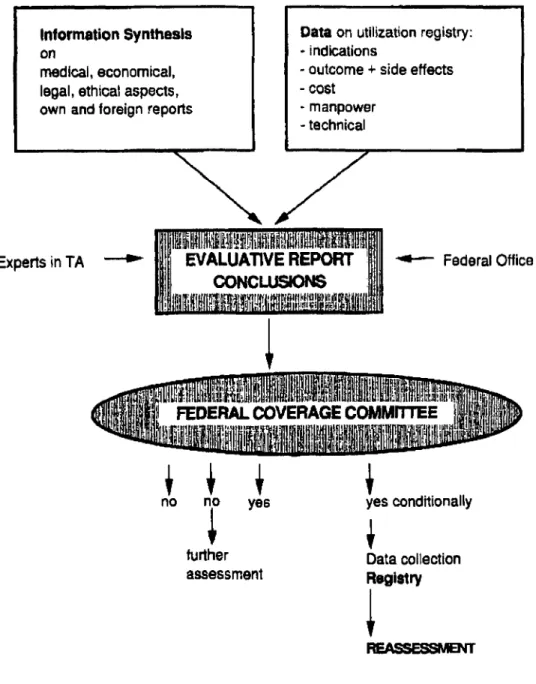
An idealized model for coverage policy involving HTA might involve these steps (see report of the Subgroup on Methods for a more extensive discussion of methods): 1. Identification of the technology in question. The identification might be done by either the coverage body or the HTA program. The coverage body must determine if the technology is a potential priority for an assessment. If so, it would ask the HTA body for an assessment. 2. Literature review to determine availability of information. If sufficient information for
an HTA is available, the HTA body would propose an assessment to the coverage body, including a time frame for the assessment. If not, the HTA body would propose supporting an appropriate high-quality study, such as a randomized clinical trial (RCT), and perhaps a simultaneous cost-effectiveness analysis. If this proposal is accepted, a delay of several years in the decision can be expected. Naturally, the coverage body may reject the option for an assessment and make the decision on other grounds.
3. Synthesis of available information, including clinical, economic, ethical, and social data, leads to an HTA. Extensive expert input is sought in this synthetic process. The synthesis leads to judgments and perhaps recommendations from the HTA body to the coverage body. 4. A coverage proposal is developed by the coverage body. After expert review, including
review by the HTA body, the coverage decision is made, published, and promulgated. As already noted, several countries have worked to develop such a process. Switzerland has developed an extensive manual describing the coverage process used in that country. This manual is available in German, French, and English. The manual goes far to meet the goal of spelling out a rational, explicit, transparent process. Conclusions
Benefits coverage is a potential tool for improving the quality and efficiency of health care. However, it is only one of the possibilities for meeting these goals. Other possibilities include planning/regulation (admission to the market, control of volume
and location), contracts of third-party payers, and payment decisions (general or specific budgets, price setting, reference systems, co-payment by the users). Mecha-nisms for regulation (reimbursement and authorization) differ greatly from one country to the other and are difficult to compare because of differing approaches and mechanisms. In the majority of European countries, reimbursement programs are administered separately from regulatory programs, which seek to assure safety and to protect the public health.
Benefits coverage has, until fairly recently, been done almost entirely implicitly. Benefits have been extended to the "usual," "customary," or "standard" practice of physicians, hospitals, and other health care providers. Exclusions have been based on such terms as "experimental," "investigational," "not proven," "cosmetic," or "too expensive."
Efforts have begun to make benefits coverage more explicit. So far, most of these efforts have been at the margin, concerning only new, visible technologies. Overall, the connection between benefits coverage and HTA is quite limited at this time.
There have also been proposals to stop using terms such as "investigational," which cannot be precisely defined, and to use instead "effective" based on scientific information, with clinical input, and "cost-effective." Societal acceptability can be another criterion. Such proposals have been implemented partially in a few countries, such as Switzerland, Catalonia, and the Netherlands.
The legal basis of changes in coverage policies needs to be examined in any country that contemplates such process alterations. For example, the law may state that "customary medical practice" is to be covered. Laws may need to be changed to make decision making on grounds of effectiveness explicit.
Proposals have been made to define a basic benefit package and to base it on effectiveness, cost-effectiveness, and societal acceptability. Efforts in this direction have begun in Switzerland, Spain, and the Netherlands. This is a long-term task, not to be accomplished within a decade. So far, as indicated, efforts have focused on the examination of new technologies for inclusion in a benefits package. Some countries, such as the Netherlands, are also examining accepted older technologies and beginning to exclude them from coverage by a "negative list."
Limitations of HTA Impact on Decision Making
Effectiveness (and efficacy) can be reliably determined by clinical trials and synthesis of existing scientific information in many cases. Still, good scientific information and data are lacking for many existing technologies. Cost-effectiveness is more difficult to determine, since analyses always depend on assumptions, which are open to manipula-tion. Societal acceptability raises other obvious problems and has not been studied very thoroughly. Therefore, human judgment, including expert opinion, will always play an important role in coverage decisions. Furthermore, HTA and coverage deci-sions may be subject to political pressures, including commercial efforts to influence decisions and professional lobbies. It is important that HTA be institutionalized in such as way as to assure the excellence of its results. Decision makers must be prepared to reject recommendations that are not based on the best quality of information (see report of Subgroup on Methods).
HTA, Coverage Bodies, and Insurance
Health care technology assessment agencies need to work interactively with those making coverage decisions to learn what information would be most useful. It is
clear that any coverage recommendations need to be clear and definitive, including a clear-cut statement of recommended indications for use.
Doubtful or negative HTA results should also be explicitly communicated to the coverage body and to the medical community. The conclusion may be that more and/or better data are necessary to make valuable recommendations. The HTA may also lead to a simple, well-documented but negative conclusion concerning the inclusion of the technology in the benefit package of an insurance plan.
Depending on HTA results and coverage decisions, payers, including insurance companies, can do much more to influence health care practice. A possibility that is gaining increasing attention is to use contracts to assure efficiency and quality of health care. For example, when there is a threat that a contract will be moved to an alternative provider, the incentive to improve services is probably greater.
Perspectives
The foundation for an effective activity in HTA has been developed in Europe. A number of successful assessments have been carried out, HTA is respected throughout Europe, and the impact of assessments is growing. During the work of the Subgroup on Coverage, several examples of the influence of HTA results on insurance coverage policy have been identified.
The two key needs at thg^moment, from the perspective of the subgroup, are for more national and regional resources in assessment and for an international network of institutions, programs, and people. In time, organizations such as HTA agencies and the Cochrane Collaboration will produce an increasing amount of infor-mation of value to policy and practice.
The point is that those responsible for health policy and insurance benefits need to demand better information for their decision making. To meet this goal requires educating and orienting those decision makers to the potentials of HTA in coverage decisions. It would be beneficial as well if coverage bodies developed and used system-atic, standard, transparent approaches to making coverage decisions. A publicly available manual describing the process of making coverage decisions, as has been developed in Switzerland, is potentially beneficial in this regard.
Recommendations
1. Health technology assessment agencies must be prepared to give appropriate and compre-hensive information to coverage bodies in a timely fashion. HTA programs need to improve their relationships with coverage decision makers.
2. Research into health care policy is important for HTA agencies. Studies of direct policies such as coverage policy are important, as are related policies such as those of the courts. HTA agencies need to learn much more about how health care deals with decision making. Case studies of successes and failures of HTA may be particularly valuable.
CHAPTER 1: INTRODUCTION
Health technology assessment (HTA) has been progressively developed during the last two decades throughout the world, but especially in Europe. During the last decade, under the pressure of economic constraints, major changes have been initiated in the health care systems of most industrialized countries. The combination of limited resources for health care and technological progress has forced those responsible for health care policy making to set priorities and make "enlightened" choices.
One important aspect of choice is that new health care technologies should be-come accessible to the entire population and obsolete technologies abandoned. Effec-tiveness, costs, and ethical and legal issues in health care have become important to everyone: health care providers, policy makers, and the public. HTA has come to be seen as an indispensable tool to assist all partners in health care in making the often painful choices that are necessary (29).
In this context, health insurance coverage has come to be seen as a policy that could benefit greatly from HTA. One major issue has been to define a package of basic benefits that would be available to the entire population. The Netherlands gives perhaps the clearest indication of this philosophy (12). A special government commission, chaired by a prominent professor of cardiology, stated that limits to care are necessary and that coverage is an important tool for defining limits to care and for making a basic package of benefits explicit. The Dunning Commission stated that technologies covered by health insurance could be subject to four "screens" or "sieves" (23). First, is the care necessary, meaning (for example) is it necessary to assure normal function or to protect life? Second, is the intervention proven to be effective by controlled clinical trials? Third, is the care efficient, meaning is it shown to be cost-effective by a formal analysis? Is the cost reasonable when compared to the benefits? Fourth, is it possible to leave the care to individual responsibility? For example, the commission concluded that in vitro fertilization and homeopathic medicines could be left to individual responsibility. The commission concluded that applying these four screens in selecting technologies to be included would result in a rather extensive benefit package without excessive costs.
Because of this growing attention to coverage as a tool for making health care more effective and cost-effective, the EUR-ASSESS Project supported a Subgroup on Coverage to examine issues in this area.
From the beginning of the project, the partners in the project had the impression that health benefits coverage was not equal or comparable in European countries and that decisions were rarely based on HTA results. An analysis of decision processes was expected to give a better picture of the current situation and perhaps stimulate a more intensive application of HTA methods in coverage decisions. Actions fol-lowing an analysis of the existing situation should result in decisions more in accord with the wish to spend limited health care resources more effectively, improving quality of care and the health of the population.
Information on Coverage and HTA
A review of accessible literature (reviewed briefly below) resulted in little usable information. Therefore, the subgroup carried out an exploratory survey concerning the coverage decision process in several countries (also reviewed briefly below). Infor-mation gathered from these sources, plus discussions in the subgroup, made it clear that the question of coverage and HTA in Europe can only be studied in the context of national, continually changing, health care systems. In short, the context for coverage is extremely important. Therefore, a brief description of health care systems in selected countries, focusing on health benefits coverage and HTA, was made by the subgroup's participants. It was also decided to analyze two technologies, cochlear implants and invasive cardiology therapy, to gain insights in coverage decisions in various countries. In addition, information on coverage and Pharmaceuticals was an-alyzed.
The organization of the health care systems in European countries varies greatly from country to country, so it should come as no surprise to find that coverage
decisions also vary greatly. There are relatively few commonalities in coverage deci-sions from country to country, considering the diversity and complexity of this pro-cess. As will be shown below, coverage of medical devices and procedures is often not the result of any explicit processes. When it is, the processes are often not trans-parent and are undocumented. In many cases, no explicit decisions are taken, but a new technology just diffuses into care with no analysis of its possible benefits. Overall, even after the subgroup's work, relatively little is known about how countries decide which technologies to cover in health care. This issue deserves much more concentrated study.
The issue with Pharmaceuticals is also complex, but they are better regulated. However, generally speaking, the decisions on Pharmaceuticals are made by regula-tory agencies that consider only a limited aspect of the possible consequences of adoption and use of a particular drug.
HTA results are integrated in coverage decisions to a very different degree in individual countries. First, HTA is not developed equally in all European countries. Second, policy makers are often not aware of the possible advantages of implementing HTA results. Finally, the role of the main partners in the health care system is changing in a number of countries, with a tendency to base decisions more on "health market" considerations than on scientific arguments that could be the result of HTA studies.
Again, the situation with Pharmaceuticals is quite different. A degree of common information on the safety and efficacy of Pharmaceuticals is available through regula-tion, and coverage is more uniform and based to an extent on HTA information. However, since the information used by regulatory agencies is generally limited, in a sense regulation impedes the development and use of HTA information in policy decisions, including coverage.
The Future of Coverage and HTA
For the good of patients, health care providers, and those responsible for paying for care, the involvement of HTA in policy making, including that concerning health care benefits coverage, needs to be strengthened. The Subgroup on Coverage feels that it has confirmed the initial hypothesis that it is important to strengthen the relationship between coverage and HTA.
This report identifies some critical issues and hopefully will contribute to the idea of better utilization of HTA results in coverage decisions. While these are preliminary, some elements of models for improvement of the relationship between HTA and coverage policy are also identified below.
Structure of This Report
Chapter 2 reviews publication concerning HTA and coverage and presents the results of the survey. Chapter 3 summarizes information on the countries selected. Chapters 4 and 5 present the cochlear implant and invasive cardiology therapy cases. Chapter 6 discusses the situation with coverage of Pharmaceuticals. Chapter 7 presents some models for integrating coverage and HTA.
While the subgroup is responsible for the entire report, some members had special responsibilities. Richard Cranovsky developed and carried out the survey of those involved in coverage decisions. Yves Matillon and Richard Cranovsky had the main responsibility for the literature review. Simon van der Kooij and Per Carlsson col-lected and analyzed the material on country health care systems (an extended version is available from Carlsson). Thomas Seeger and Richard Cranovsky developed the
case of cochlear implants (an extended version is available from Cranovsky). Laura Sampietro and Mike Bos were mainly responsible for the invasive cardiology therapy case (an extended version is available from Sampietro). Elias Mossialos wrote a paper on pharmaceutical coverage that was the basis for material in the chapter on that subject (the full version is available from Mossialos). The overall synthesis, including the information on explicit models, was developed primarily by Richard Cranovsky, Julian Schilling, Siem van der Kooij, Pedro Koch, and David Banta.
CHAPTER 2: GENERAL INFORMATION ON HTA AND HEALTH
INSURANCE COVERAGE POLICY
Synthesis of the Literature
General references related to coverage policy are abundant in the United States as well as in other industrialized countries. ANDEM (the French HTA agency) has maintained a bibliographic database since 1993 that has identified about 150 publica-tions on this subject worldwide. These publicapublica-tions are of different sorts, mainly in English, and contain some information relating to HTA, regulatory issues, or the financing of health technologies. However, on examination, few of these references give any realistic information on HTA and coverage issues.
At the same time, the papers treating the relationship between HTA and coverage or insurance benefits policy in Europe are very few (20;23;58;69). Those identified that are useful include papers on the Netherlands (9; 12), Sweden (34), Germany (35), Switzerland (36), the United Kingdom (54), and France (68). However, while these papers gave valuable information on the health systems of the particular countries, they generally did not give detailed information on the real processes of coverage decision making.
Besides these few references, several documents fall in the category of "gray literature" and generally will not be found in computerized data banks. Among them are policy papers of social sickness funds or private insurers, governmental decrees, and regulatory documents. The Spanish Real Decreto 63/1995 on the Organization of Health Services Provided by the National Health System (40) and the Swiss Manual for Standardization of Clinical and Economic Evaluation of Medical Technology
(63) can serve as examples of such documents. The Swiss approach is presented in some detail in Chapter 7. The documents do indicate the growing visibility and importance of the coverage process for European countries.
A fundamental issue in coverage is the language used in exploring the relationship between HTA and coverage policy or that presenting a specific coverage recommenda-tion. The literature uses terms such as "usual and necessary," "experimental," and "cosmetic." These terms actually hide the real issue of coverage. This complex issue was very well analyzed in the article "Benefit Language" by Eddy (24). Eddy proposes the replacement of such essentially unusable or subjective terms by explicit terms that can be defined scientifically, such as "efficacy" or "effectiveness." Most of the definitions concerning, e.g., medical conditions, health interventions, indications, evidence, and outcomes are universal and can be applied to other countries than the United States.
There are several other examples of articles treating the problems in non-European countries that contain information that might be useful for decision makers and payers in Europe (10;14;15;25;28;30;31;38;46;49;52;53;66). However, the use-fulness of these articles seems quite limited, partly for historical reasons. It is impor-tant to keep in mind that HTA is currently of importance not only for "social insurance
Table 1 . Cost and Effectiveness in Medical Coverage Decisions: Percentage of
Respon-dents Who Would Cover a New Technology Given a Cost and Effectiveness Profile Relative to a Standard Technology Relative cost Greater cost Equal cost Less cost Greater effect 90% 99% 98% Relative effectiveness Equal effect 24% 95% 99% Less effect 3 % 4% 14% Source: Steinberg et al. (55)
plans" or traditional sickness funds but also for the growing sector of private health care organizations and private insurers.
The literature on the change in the meaning of some definitions is not only semantic but also practical. A few years ago it was much easier to agree with defini-tions of coverage and reimbursement such as those given in Chapter 1. In changing health care systems, with modifications in the way that resources are distributed (e.g., fundholders system in the United Kingdom or different forms of managed care), some classic concepts and definitions have taken on a different meaning (32). With these cautions in mind, a few papers are worthy of mention, although they do not refer to European health care systems. One good example is the document published by the U.S. Office of Technology Assessment (OTA) in 1995, Coverage of Laser Technologies (43). The report states that the largest barrier to decision making for U.S. insurance is ". .the paucity of reliable information on the effective-ness, safety, and cost-effectiveness of new technologies at the time coverage decisions have to be made." It contains general chapters on coverage decision making by private insurers and by the Health Care Financing Administration (HCFA). The Blue Cross and Blue Shield Association makes coverage recommendations based on a formal process that includes a medical advisory panel. A technology can be eligible for coverage if five criteria are met:
1. The technology must have final approval from a regulatory body;
2. There must be scientific evidence concerning the effect of the technology on health outcomes;
3. The technology must improve health outcome (e.g., survival, quality of life, functional status);
4. The technology must be as beneficial as technologies currently existing; and 5. The improvements must be also attainable outside research settings.
The coverage decision-making process of HCFA is more complex and not as explicit as one might expect. The coverage decisions are made by Technology Advisory Com-mittees, sometimes with advice from the Office of Health Technology Assessment (OHTA) of the federal government. The proposals are published in the Federal Register for comments and subsequent adjustments. But in reality, Medicare contrac-tors review technologies themselves and make their own coverage decisions. National coverage decisions refer to a few selected technologies (43;53).
What is the basis for coverage decisions? Little is known in this area. Steiner, Powe, and Anderson (56;57) carried out a study in the United States that examined some aspects of this question. Table 1 shows the relationship between cost and effec-tiveness in medical coverage decisions.
Table 2. Who Should Pay for Clinical Care Associated with Use of "Special-Priority"
Tech-nologies: A Proposal
Entity to pay for care surrounding
use of the technology Type of technology Entity to pay for the technology itself
Drug Device or expen-sive biotech-nology product Procedure Manufacturer
Insurers and HMOs (for substituting for cov-ered products)
Manufacturer or trust fund (for other product substituting for covered products)
Manufacturers or trust fund (for other products)a Trust funds Insurers and HMOs Insurers and HMOs Insurers and HMOs Abbreviation: HMO = Health maintenance organization.
a
If a trust fund is used, the manufacturer would pay a percentage of future profits to the fund. Source: Steinberg et al. (55)
The table shows that cost makes little difference if effectiveness is greater. With equal effectiveness, however, cost becomes more important. Few would cover a technology with less effectiveness, although if it were also less costly it might be of interest.
Among the critical issues in coverage decision making, the problem of innovative technologies was treated in several papers (20;52;55) (Table 2). The exhibit "who should pay for clinical care associated with use of special-priority" technologies is based on the situation in the United States, but is also informative for Europeans. The proposal is to assure that high priority technologies can enter the benefit package in an era where it is increasingly difficult. Increased cost pressure threatens to curtail development of new technologies. The proposal seeks to assure that experi-mental technologies can be tested. As the authors say, "Controversy over how to pay for and study experimental technologies goes beyond devices . . . and reflects the absence of a broader policy for ensuring that potentially valuable new technologies can be introduced and tested in a rational, efficient manner. . . ."
The reason for this situation was given by Telling (65): "Cost is becoming a dominant factor in the decision of third-party payers and appears to be replacing patient benefit as the principal factor for determining whether an innovative tech-nology is adopted and used."
Finally it is worthwhile to quote the synthetic view of Fineberg (27) concerning HTA and coverage decisions: "First, universal coverage may be attained in a single-payer system or in multisingle-payer system. Second, universal coverage alone does not ensure cost control. Third, even the combination of universal coverage and cost control does not guarantee that resource allocation decisions will be made rationally or after careful evaluation."
Survey of Selected Organizations
Because of the limitations of published literature, a pilot survey was carried out to test the feasibility of collecting information by this method. The goal of the survey was to explore, in selected countries, whether it is possible to establish any relationship
between HTA results and coverage decisions (the basic decision to allow implementa-tion and payment of any assessed technology). The quesimplementa-tion of the influence of HTA on the reimbursement process (payment of a specific amount of money for the technology through one of several possible mechanisms of financing health ser-vices) was also addressed in the survey.
The survey was organized around these main questions: • Definition of medical technology;
• Who initiates HTA;
• Types of evaluation conducted;
• Required strength of evidence of effectiveness;
• Laws and regulations concerning medical technologies; and • Relationship between HTA results and insurance coverage policy.
It was not possible to define a universe to be sampled, so the survey was distributed by subgroup members and others to relevant organizations. Ultimately, 41 usable questionnaires were returned from eight countries (Belgium, France, Germany, the Netherlands, Spain, Sweden, Switzerland, and the United Kingdom). Most of those responding were either government agencies, sickness funds or insurance companies, or advice bodies to government or to payers (25 responses came from public organi-zations).
Because of the unclear sampling frame and the small number of responses, the results can only be considered to indicate some interesting areas for consideration. Furthermore, the answers seemed to indicate difficulties in understanding concepts such as HTA, efficacy, and cost-effectiveness.
Respondents indicated that formal decisions relating to coverage/reimbursement of new health technology are made very frequently in responding countries/organiza-tions, especially in the public health services (77%), and less frequently in private health care organizations (62%). There is often a formal requirement to include HTA results in coverage/reimbursement decisions, according to the respondents. This ap-plies less often to the private sector.
Respondents stated that it can be documented that HTA results influenced deci-sions by official bodies regarding:
• Implementation of innovative health technology in public health care: 64%; • Coverage/reimbursement (public sector): 57%;
• Implementation of innovative HT in private health care: 35%; and • Revaluation of already utilized HT (in general): 58%.
The kind of evidence considered (or required) when deciding insurance coverage policy are, in order of preference:
1. Experts' opinions;
2. Retrospective clinical studies;
3. Structured information synthesis on state of knowledge; 4. Prospective studies with a control group;
5. Structured information synthesis on clinical practice; 6. Any foreign official documents or assessment reports;
7. Randomized control trials (never used by 8 out of 25 respondents); and
8. Formal meta-analysis (50% said that they made use of this method, but the other 50% had never used it).
The answers indicate, despite the small sample size and other problems, that respon-dents are more likely to use, for practical decision making, low or medium strength of evidence rather than rigorous prospective studies or meta-analysis. Taking the strength of assessment results into consideration, a combination of evidence obtained from experimental clinical studies for efficacy, economic analysis, and formal infor-mation synthesis represents an acceptable basis for decisions concerning a medical technology. This combination of assessment methods was used by nine organizations (22%). Half of these organizations reported the application of combined strong assessment methods for implementation of coverage decisions.
Conclusions
The literature review and the survey only yielded some interesting ideas and indicated some problems with coverage decisions. The idea of moving to a standard, such as effectiveness instead of established, is one such important idea. The literature also reflects the difficulty of linking HTA with coverage, especially in a decentralized system such as the U.S. Medicare Program.
Because of limitations of this background information, the subgroup could not depend on these standard methods. It decided to examine some countries in detail to try to achieve some insight into the reality of coverage decision making. CHAPTER 3: DESCRIPTION OF HEALTH CARE SYSTEMS, COVERAGE, AND HTA
Health Care Systems in General
The health care systems of different European countries are very divergent (1;11; 45). In some countries general practitioners have a prominent role as suppliers of primary care and as gatekeepers to the system; in other countries primary care is also given by specialists and secondary care is freely accessible. Hospitals can be public and private. Doctors and other individual providers of health care can be independent or salaried. Health insurance can be voluntary or obligatory; social and private health insurance can be complementary or intended for different socioeco-nomic groups.
Health insurance may function by a reimbursement system (indemnity insur-ance), or health care providers may have contracts with insurers and be paid via different systems such as fee for service, diagnosis-related systems, or capitation. Home care may be part of the national health care system or it may be part of a locally organized social security system.
In most countries there are mixed systems with different regulations for primary care, secondary care, mental health care, Pharmaceuticals, and so on. These diverse systems have their origins in cultural differences, historical backgrounds, or political conceptions in the pluriform European society.
The objectives of health care policy of the different countries are, however, very comparable, even while the means they use to reach these objectives differ widely. Objectives include:
• Equity: It is of value that all inhabitants of the country have equal rights to what is often called "essential health care," whatever is understood by this term.
• Accessibility: There should be no geographical, financial, or bureaucratic barriers for anyone in gaining access to health care; individual and social well-being should not be based on income (health protection).
• The quality of care: In terms of the structure, process, and outcomes of health care, the quality of care should be good. Good outcome means good health care results as perceived by autonomous individuals (patients). Quality is also considered in terms of expectations for the national figures for life expectancy, neonatal mortality, etc.. At the same time, quality refers to the satisfaction of the people with the functioning of the health care system. • Cost containment: National costs of health care should not exceed a certain fraction of the
Gross Domestic Product.
• Efficiency: This is a combination of the two foregoing objectives. It applies to efficiency on the national level: macro-efficiency. However, in the field of health care it is the combina-tion of all kinds of individual decisions by health care providers and consumers that makes up the cost-effectiveness of the total system. Many of these decisions are made at the bedside. Here professional freedom and the wishes of the patients come into play. Micro-efficiency means that optimal selection of health services and health technology leads to the combina-tion of optimal outcome, minimal damage or side effects for each patient and his or her social surroundings, and minimal costs.
Most European countries would support the idea that these objectives cannot be accomplished without some "interference" in the health care system by national governments. A health care system that is largely left free, such as that of the United States, may reach acceptable and even excellent quality in selected areas but leads to low accessibility for certain groups and very high costs. The problem of a real free market for health care is that it may lead to lower accessibility for the lower socioeconomic classes, the older population, and the chronically ill, especially when it depends heavily on copayment to decrease over consumption of services. Another problem is that indemnity insurance may lead to risk selection by insurers and moral hazard. Furthermore, consumers frequently judge the necessity and quality of health care, which makes patients dependent on the decisions of professionals.
Government "interference" takes two general forms:
1. Detailed top-down regulation of health care by the central government (command-and-control type, also the integrated model). The amount of health insurance premiums, total number of medical providers, the extent of covered health care provisions, and prices and tariffs are all under governmental control. This system was usual in the former communist countries and somewhat in the National Health System before recent reforms. Problems in such a system tend to arise in the form of lack of motivation of the medical personnel, poor quality of care and loss of medical freedom, bureaucracy, and waiting lists. 2. Pro-market or pro-competition regulation, generally with encouragement of choice among
consumers, and of autonomy and competition among insurers and/or providers. In a regulated health care market system there are four parties:
a) Consumers/patients;
b) Health care providers (doctors, dentists, pharmacists, hospitals, home nursing, ser-vices, etc.);
c) Third-party payers (private insurers, sickness funds, health authorities, etc.); and d) The central government.
In such a system there is direct payment of third-party payers to providers. This system is normally combined with contracts spelling out the mutual obligations between payers and providers of health care. Both parties negotiate the details of these obligations, which may concern agreements on quality of care, volume, use of guidelines, etc. This payment system has become rather popular with reformers of health care because it offers means to influence microeconomic efficiency. Payment within this system may be implemented by many different methods: fee for service, prospective capitation, salaries, fixed budgets, diagnosis-related groups, etc.
The idea of pro-market regulation is that competition will lead to lower prices and that it will stimulate good quality of care. But the problems with a free market-like system lead governments to keep a strong say in health care, which leads to a mixture of the two types of regulation. In practice this means that there is a restricted amount of autonomy for insurers (and sickness funds) and for providers of health care who are meant to act as each others' countervailing powers.
In some countries there is not a general voluntary or obligatory insurance system, but health care is publicly financed by taxes or special health care premiums. In such countries pro-market regulation is realized by a split between the provision and purchasing of health care.
In the United Kingdom health care purchasing is done by more or less autono-mous district health authorities and partly by general practitioner fundholders (32). In Sweden the same function is executed by the county councils. District health authorities dispose of a centrally assigned budget that is based on the characteristics of the population, and they have a certain freedom to purchase and contract selec-tively health care provisions such as hospital care. It is probable that it makes a difference whether the third-party payers insurers are to compete among each other, not only on the height of premium, but also on quality, health technology utilization, and the amount of medical services that are covered by insurance. It is also important that the third-party payers are allowed to selectively contract with the providers. If this is not the case, there is no real competition between providers.
There are three principal methods by which provision of the benefits, including health technologies, can be arranged:
1. Patients are reimbursed for their medical bills (reimbursement model);
2. The state owns the hospitals and the individual providers are salaried (integratedmodel); and 3. There are contracts between providers and third-party payers (contract
model)-Most countries have a combination of two or three of these systems. Often, there are different systems for primary care, secondary care, Pharmaceuticals, long-term care, and other services. In some countries voluntary and obligatory health insurance are complementary; sometimes the higher income classes are privately insured.
In the context of the relationship between health care technology assessment and payment arrangements, it is important to note that the health care systems of most countries seem to converge in a publicly financed system with payments by contracts with third-party payers. These systems comply mostly with cost-containment mea-sures and decentralization, and they allow clinical autonomy. There remains a certain amount of government regulation of prices, budgets for third-party payers and/or hospitals, restricted volumes of providers, and sometimes limitations of big-ticket technologies.
In the scope of this study, it is an important conclusion that there seems to be a moderate but general shift in regulatory power from providers and governments to the third-party payers.
Regulation of Coverage
The following short descriptions of the health care systems of eight European coun-tries make clear that mechanisms of coverage decisions are very different. They may be made systematically by government, by third-party payers, or left open. They can also vary in strength and explicitness between field of health care, such as pharma-ceuticals, medical devices, and medical procedures.
Insurance coverage in the strict sense means that health technologies are paid by a health plan: technologies can be admitted or removed from the "list of benefits." But there are other possibilities to withhold or restrict the use of health care technolo-gies. A government can refuse to admit technologies to the "market" of a country, often for safety or cost reasons.
Drugs are not admitted when they are unsafe, ineffective, or —and this is new — when they are less cost-effective than drugs with the same therapeutic objective and effectiveness. Recent European policy changes apply similar rules to medical devices. Medical procedures, especially complicated technologies such as organ or tissue trans-plantation, can also be forbidden or restricted by governmental regulation (licensing and "planning") for reasons of quality of care and distributional or economic reasons. Last, but not least, there are methods to influence the use of technologies by health care providers such as hospitals and/or physicians. These methods include contracts concerning volumes, payment regulations, and budgets. They also include increasing providers' responsibility for cost-effectiveness by delivering information on cost-effectiveness to providers and trying to change their attitudes and utilization patterns (see report of the Subgroup on Dissemination). Such a development is espe-cially important for decision making by physicians at the micro-level because they largely determine the indications for use of the technology. Increasing providers' responsibility is also essential for diminishing the use of technologies that never have been proved to be effective.
Strictly speaking, "admittance to the market" and promotion of cost-effectiveness cannot be called coverage policy, but they aim at the same goals. They also need HTA as an indispensable input.
Health Care Systems of Eight Countries
The country profiles were developed by members of the subgroup. An important reference in most cases was an OECD publication (45).
France
In France, 99% of the population is compulsorily insured; nonprofit insurers (mutu-elles) and private insurers provide supplementary insurance. There are considerable copayments by patients (30% for "necessary drugs," 60% for other drugs). The voluntary health insurers (80%) act as third-party payers; they are large administrative bodies with little autonomy. The government has a strong influence through price control, budget control of public hospitals, and by planning of equipment and new construction of all hospitals, but not over volumes and type of interventions. A 1991 law transfers the main responsibility for the health facility planning process to regional representatives of the central government; however, private physicians are
not included in the provisions of this law. The government is currently introducing a program of cost containment and rational use of health services.
There are independent general practitioners and specialists for ambulatory care. Municipal medical centers and public hospitals have salaried doctors; private hospi-tals usually have doctors working on a fee-for-service principle. There is no referral (gatekeeper) system.
The basis of the financing system is the reimbursement model. Ambulatory care and private hospitals have a contract model. Public hospitals are paid by the inte-grated model.
For coverage of pharmaceuticals there is an established pre-market approval procedure. After approval the Commission of Transparency (Commission de la Transparence) makes pricing and coverage decisions, considering cost-effectiveness. There is a positive and a negative drug list.
For medical devices pre-market approval is necessary only for reasons of safety. A license of the central government is necessary for a number of big-ticket technolo-gies, such as hemodialysis, CT scanners, MRI, lithotripsy, radiotherapy, etc. This is mainly for reasons of equal distribution around the country.
For procedures a governmental license is necessary for major care, such as trans-plants, cardiac surgery, neurosurgery, burn treatment, rehabilitation, and treatment for problems of reproduction. Health insurance medical officers are working together with physicians on reference protocols (appropriate institutions) in the context of annual agreements.
Traditionally, explicit coverage decisions have been made in France in the area of pharmaceuticals. With recent changes in public policy, explicit coverage decisions are expected to become an important tool for cost containment and cost-effectiveness. Germany
In Germany, the entire population with an income up to a certain limit (5100 DM in 1991) is insured in a mandatory sickness fund. Family members are insured without making any contribution and receive the same benefits. About 90% of the population are members of 500 sickness funds (Krankenkassen), which operate as non-profit statutory corporations. The remainder of the population is generally covered by private insurance.
Most specialists and all general practitioners are independent health care pro-viders. The hospitals are partly private, partly public, with salaried doctors (though doctors may have private practice, too). There is a firm separation between ambula-tory health care and intramural care. An effort is being made to integrate office-based and hospital care because this separation causes inefficiencies. Patients have direct access to specialist and hospital care.
Kassenartzliche Vereinigungen (societies of clinic doctors) represent the ambula-tory physicians. They and the hospitals contract with the sickness funds. Beginning in 1999, such contracts will also apply to the investments of the hospitals. The German health care system is essentially an example of the public contract model.
Since 1996 hospital payment has been based on a system of procedural payments and extra payment for 142 surgical procedures. Contract physicians are paid ac-cording to a system of points. The point value depends on the negotiated budget and the number of accomplished procedures and is calculated retrospectively by the Kassenarztliche Vereinigung.
Pharmaceuticals approved in the regulatory process are generally paid for by the sickness funds. However, since 1988 the German government has tried to use the reimbursement and pricing system to control expenditures for pharmaceuticals.