Raoudha Kebaili, Imed Harrabi, Jihene Maatoug, Rim Ghammam*, Slama Slim
and Hassen Ghannem
School-based intervention to promote healthy
nutrition in Sousse, Tunisia
Abstract
Introduction: Obesity among children is a major risk factor
for chronic diseases. School interventions programs can represent a mean to implement healthy nutrition attitudes at early ages. Our objective was to evaluate the effects of a school intervention program to promote healthy nutrition among adolescents, in terms of knowledge, behaviors and intention.
Methods: Quasi experimental study among urban students
in Sousse, Tunisia with 2 groups, intervention and control. The intervention group had an interactive program inte-grated with school courses that promoted healthy nutri-tion habits. Both groups had a pre post evaluanutri-tion.
Results: 2200 students aged from 12 to 16 participated to
the pre post evaluation. In the intervention group, there were significant changes form pre to post test in knowl-edge, intentions, and behaviors. In the control group, almost no significant changes were observed.
Conclusion: School intervention programs can represent
an interesting approach to promote healthy nutrition hab-its among adolescents.
Keywords: adolescents; nutrition; obesity; school
inter-vention program.
*Corresponding author: Rim Ghammam, Department of
Epidemiology, University Hospital Farhat Hached, Sousse 4000, Tunisia, Phone: +22509115, E-mail: [email protected]
Raoudha Kebaili, Imed Harrabi, Jihene Maatoug and Hassen Ghannem: Department of Epidemiology, University Hospital Farhat
Hached, Sousse, Tunisia
Slama Slim: Department of Community Medicine, Primary care and
Emergency, University Hospitals of Geneva, Switzerland
Introduction
Throughout the world, children are becoming overweight and obese at progressively younger ages (1). In the US, the prevalence of obesity and overweight has doubled in the past 20 years. In fact, 15% of children aged 6–19 years are either at or above the 95th percentile (2). Middle and low
income countries are also concerned with this phenom-enon. In Tunisia, a survey conducted in the city of Sousse showed that its population had a similar cardiovascular risk (CVR) profile to those of cities found in developing countries, namely, Quebec (3). This increase of obesity and overweight among children and adolescents is intimately correlated with a decline in their diet quality, which have deteriorated over the past 20 past years (4). Indeed, according to a recent study conducted among US youth on 2007, only 20.1% of teenagers had eaten the recommended servings of fruits and vegetables, and 16.2% had drunk 3 or more glasses of milk in the 7 days preceding the survey (5). Unhealthy eating habits also include skipping breakfast, replacing lunch meal with snack food, and increasing soft drink intake (6).
Obesity represents a real and public health problem by its magnitude and heavy consequences. In fact, obese children and adolescents have an increased risk for short- and long-term cardiovascular complications that include hemodynamic changes as well as structural and func-tional changes in the heart and blood vessels (7). System-atic review and meta analyses also assessed the strength of associations between body mass index and common cancers such as breast, endometrial, colon cancers and adenocarcinoma of the esophagus (8). Prevention is one the best remedies to this problem. Indeed, early manage-ment of obesity can abate or reverse almost all of the car-diovascular consequences of obesity (7).
Given that schools have been identified as major venues for health promotion programs (9), a survey among young adolescents in an academic setting was conducted. The purpose of the study was to evaluate the effects of a school intervention program towards the pro-motion of healthy nutrition among adolescents, in terms of knowledge, behaviors, and intention.
Materials and methods
Design
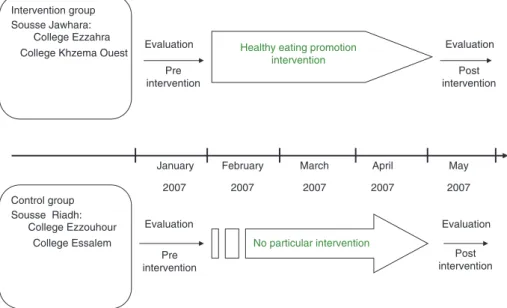
This study adopted a pre-post quasi-experimental design with two groups, namely, intervention and control (Figure 1). Both groups
underwent initial evaluation. Only students from the intervention group received special courses and actions that promoted healthy nutrition. Then, a second evaluation was undertaken in both groups in order to compare the eventual effects of the intervention on knowl-edge, intentions, and behaviors.
Population
The study concerned pupils of public schools in Sousse, Tunisia aged 12–16 years. Two districts from the city of Sousse (Sousse Jawhara and Sousse Riadh) served as the locations for the inter-vention and control groups, respectively. The interinter-vention was implemented in two public schools (Ezzahra and Khzema Ouest) from which a total of 1965 participants were selected. Two control public schools were selected (Ezzouhour and Essalem) from which a total of 1737 participants were selected. The selection of schools was based on age and on socioeconomic and demographic charac-teristics. A stratified and proportional sampling was performed in each school to determine the minimal required number of students to answer the pre-post evaluations. This was based on the following parameters: α = 5%, β = 20%, and an expected increase of 10% in the knowledge of the schoolchildren after an intervention promoting healthy nutrition. The calculated minimal sample size was 958 stu-dents in each group.
We consciously monitored this number by considering the possible dropped out and the unequal repartition of students among classes. However, 2338 students participated to the first evaluation, intervention = 1247 (39 classes) and control = 1091 (37 classes). At the second evaluation conducted at the end of the school year, 138 students dropped out (intervention = 58, con-trol = 80). Thus a final number of 2200 students participated in the pre-post evaluations.
Variables and their measurements
A pre-tested self-administered questionnaire was used in the current study. Data collected by the questionnaire concerned sociodemo-graphic variables (e.g., age, sex, parents’ educational attainment, etc.), students’ knowledge, behaviors, and intentions about healthy nutrition and dietary habits. The pre-assessment was conducted in January 2007 and the evaluation at the post-intervention was con-ducted at the end of the school year in May 2007.
Statistical analysis
Statistical analysis was performed using the Statistical Package for Social Sciences (SPSS). Data are presented as frequencies, means, and standard deviations. Statistical significance was at p < 0.05.
Description of the intervention
All schoolchildren in the intervention schools participated in the in-tervention, which lasted for 3 months (Figure 1).
Intervention consisted of interactive lessons and activities that were delivered by pre-formed teachers, in collaboration with doctors who were also members of the project. Each class in the intervention group received a visually supported course during (biological science hours), which provided the main information concerning healthy and unhealthy diet. The course had the following features:
– explanation of the principles of dietary pyramid; – discussion of the ideal composition of principal meals;
– explanation of the importance of breakfast and its place in dietary balance; Pre intervention May 2007 April 2007 March 2007 February 2007 January 2007 Post intervention Evaluation Evaluation Evaluation Post intervention Pre intervention Evaluation Intervention group Sousse Jawhara: College Ezzahra College Khzema Ouest
Control group Sousse Riadh:
College Ezzouhour
College Essalem No particular intervention Healthy eating promotion
intervention
– explanation of the difference between healthy and unhealthy food through examples;
– presentations on the effects of each kind of diet on health, with a focus on obesity complications and cardiovascular risk factors; and
– provision of suggestions for healthy eating habits and a balanced diet.
After this course, students were asked to prepare productions of their choice (drawings, posters, theatrical plays, etc.) concerning healthy/ unhealthy food and its consequences. They were also encouraged to take part in different activities, such as those of local radio or biologi-cal science clubs, where additional discussions and presentations took place. Mural posters that promoted healthy nutrition were dis-played on the school walls. Finally, during the ceremony of the end of the school year, students presented their productions with the pres-ence of parents, teachers, team leaders, and other members of the community. The best presentations were rewarded.
Ethical considerations
The study was conducted with the approval of the Farhat Hached Hospital Ethics Committee. Parents gave their consent for their chil-dren’s participation, and the questionnaires were anonymous.
Results
Socio demographic characteristics
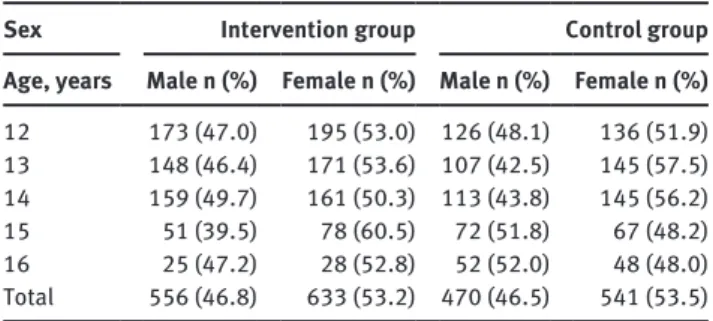
The population consisted of 2200 students, with 1189 in the intervention group and 1011 in the control group. Boys comprised 46.8% and 46.5% of the intervention and control groups, respectively. Students’ ages ranged from 12 to 16 years, with mean ages of 13.3 ± 1.1 and 13.5 ± 1.2 years in the intervention and control group, respectively (Table 1).
Pre-assessment comparison between the
intervention and control groups
The comparison between the intervention and control groups at pre-intervention showed that the levels of their knowledge were similar. Nutrition behaviors were also similar concerning ideal breakfast intake (p = 0.94), snacking at the evening (p = 0.19), daily soft drink intake (p = 0.73), and fast-food intake at three times or more per week (p = 0.34). Daily breakfast, dairy products, and fruit and vegetable intake showed significant differences between the two groups. Intention to take breakfast daily in the future was similar in the two groups (p = 0.25), but intention to take fruits and vegetables daily was different.
Table 1 Distribution of students in the intervention and control
groups.
Sex Intervention group Control group Age, years Male n (%) Female n (%) Male n (%) Female n (%)
12 173 (47.0) 195 (53.0) 126 (48.1) 136 (51.9) 13 148 (46.4) 171 (53.6) 107 (42.5) 145 (57.5) 14 159 (49.7) 161 (50.3) 113 (43.8) 145 (56.2) 15 51 (39.5) 78 (60.5) 72 (51.8) 67 (48.2) 16 25 (47.2) 28 (52.8) 52 (52.0) 48 (48.0) Total 556 (46.8) 633 (53.2) 470 (46.5) 541 (53.5)
Effects of the intervention
Intervention group
In our study, knowledge was assessed by the question: “Do you know what you should eat for breakfast?” The number of students who gave the right answer as to the composition of an “ideal breakfast” increased after the intervention (15.7%–40.8% p < 10–3). For intention, pupils were more likely to take breakfast, fruits, or vegetables every day in the future, which showed a significant dif-ference from pre- to post-intervention (p < 10–3) (Table 2).
There were significant changes in behaviors as well between pre- and post-intervention in the intervention group. It concerned 6/10 items as follows: daily breakfast intake (58.2%–67.5%, p < 10–3); an “ideal” composition of breakfast that contains dairy products, slow-burning sugar product and a fruit (4.4%–10.5%, p < 10–3); dairy product intake every day (61.3%–74.4%, p < 10–3); decrease in snack intake in the evening (59.4%–52.1% p < 10–3); decrease in daily soft drink intake (22.6%–18.8%, p = 0.003); and decrease in the number of students who ate fast food products three or more times per week (42.5%–30.9% p < 10–3). There was an increase in the number of students who ate five or more fruits and vegetables a day, but it was not a significant one (Table 2).
Control group
There were some differences in knowledge, intentions, and behaviors between pre- and post-evaluations in the control group. However, we observed significant improve-ment only in the number of students who took dairy products every day (51.6%–57.1%, p = 0.001), and those who expected to eat vegetables every day in the future (62%–67.1%, p = 0.001) (Table 3).
Comparison intervention and control group in post assessment
At the end of the study, the comparison between the inter-vention and control groups showed better nutrition knowl-edge, intentions, and behavior in the intervention group in majority of the tested variables. In fact, the proportion of schoolchildren who knew about the ideal composition of breakfast and who took ideal breakfast daily were signifi-cantly higher in the intervention group (p < 10–3). Only the variable concerning consumption of soft drinks daily was not different between the two groups (p = 0.32). School-children who ate fast food products three times or more per week and who ate snacks at the evening were signifi-cantly less in intervention group (p < 10–3). More over, the intention of schoolchildren to take breakfast daily in the intervention group showed a significant improvement than in the control group at post-assessment.
Discussion
The current study was an outcome evaluation of a school intervention program to promote healthy nutrition among teenagers in an urban environment in Tunisia. It is par-ticular as it represents a pilot study in Tunisia and North Africa. The intervention consisted in different courses and activities provided to students of the intervention group, whereas no particular actions were carried out in the control group. Pre- and post-tests were conducted in both groups in order to assess the effects of the intervention in terms of changes in the students’ knowledge, behavior, and intentions.
One of the limitations of this study is the absence of randomization of intervention and control groups. However, we verified the comparability between the two groups in the tested variables. In addition, we did not compare between the intervention and control groups at post-assessment when the variables were different at the pre-assessment. The other limit was the duration of the study. In fact, it lasted only for 6 months. However, even in such a short period, improvements in almost all tested variables were already observed. At this stage, we essen-tially tried to evaluate the feasibility of such intervention with this pilot study, which should be followed by a more durable project that will target a larger population.
Several studies demonstrated the positive effects of school intervention programs in improving knowledge concerning healthy nutrition habits among students of different ages. In our study, knowledge was assessed by the question, “Do you know what you should eat for break-fast?” The number of students who gave the right answer as to the proper composition of an “ideal breakfast” was computed. There was a significant improvement from the pre- to post-tests in the intervention group but not in the control group. A pilot study to examine the Michigan Model Nutrition Curriculum on nutrition knowledge, effi-cacy expectations, and eating behaviors in middle school students showed a positive change in nutrition knowledge (10). Meanwhile, a multicomponent nutrition education program among African American kindergarten and first-grade students attending an urban school also showed a high change of improved knowledge from pre to post in the experimental group (11).
With regards changes in eating behaviors observed in the current study, at post-test, students in the inter-vention group made significant improvements in several
Table 2 Comparison of knowledge, intentions, and behaviors before and after the intervention in the intervention group.
Pre intervention Post intervention p-Value
n % n %
Know the ideal composition of breakfast 170 15.7 443 40.8 < 10–3
“Ideal” breakfast intake 45 4.4 107 10.5 < 10–3
Daily breakfast intake 692 58.2 803 67.5 < 10–3
Daily dairy products intake 725 61.3 879 74.4 < 10–3
FVC of five or more times every day 58 29.3 62 31.1 0.683
Snacking at the evening 701 59.4 615 52.1 < 10–3
Soft drink intake every day 266 22.6 222 18.8 0.003
Fast food intake of three or more times per week 453 42.5 329 30.9 < 10–3
Intend to take breakfast every day 978 83.5 1076 91.9 < 10–3
Intend to take vegetables every day 628 53.2 861 72.9 < 10–3
themes relative to schoolchildren in the control group and relative to their own pretest habits. Improving daily fruit and vegetable consumption (FVC) was one of the most important aims of our study and the majority of similar ones. In fact, recent studies suggested that increasing FVC as part of an overall healthful diet may reduce the risks for obesity, non-insulin-dependent diabetes mel-litus, cancer, hypertension, hyperlipidemia, coronary heart disease, as well as other health problems in adults (12). According to meta and pooling analyses from seven studies, school-based interventions can successfully increase FVC among students (13). This purpose was not completely achieved in our study. Though we observed a moderate improvement in percentage of students who took at least five fruits and vegetables a day in the inter-vention group, this was not a significant one (p = 0.683). This can be partly attributed to the fact that our interven-tion did not contain a school lunch component, where an additional promotion of FVC could have been provided through tasting sessions or served meals, as it was the case in other studies.
As part of a healthy diet, reducing fast food consump-tion among young people was another important objec-tive of our intervention. According to Bowman et al., children who ate fast food, compared with those who did not, consumed more total energy, energy per gram of food, total fat, total carbohydrate, added sugars, and sugar-sweetened beverages; they also consumed less fiber and milk as well as fewer fruits and nonstarchy veg-etables (14). A study with white young adults found that eating fast food more than twice vs. less than once per
week was associated with 86% increased risk of becom-ing obese (15).
Healthy nutrition behaviors also include improving quality of beverage intake by increasing dairy product consumption and reducing carbonated sugary beverage, in order to prevent bone fractures (16), obesity (17), and tooth decay (18). In our study, daily consumption of dairy products improved significantly in both intervention and control group. A decrease in carbonated beverages intake was also observed in both groups, but this was signifi-cant only in the intervention group. In the fluids used effectively for living (FUEL) program (19), a decrease in sugary beverage intake was observed after a peer educator school-based nutrition education approach.
Our results concerning expectations for the future nutrition behavior showed significant improvement in the intervention group at post-test. This improvement indicates a degree of enthusiasm among students and reflects the impact of the provided actions on their minds. These find-ings, however, have to be confirmed by long-term studies.
Conclusion
This was a school intervention program to improve nutri-tion knowledge, habits and expectanutri-tions among urban teenagers. It also represented also a pilot study that aimed to evaluate the feasibility and acceptability of such an intervention. Positive effects were observed in several items in the intervention group. Our results mostly tallied
Table 3 Comparison of knowledge, behaviors, and expectations before and after the intervention in the control group.
Behaviors Pre intervention Post intevention p-Value
n % n %
Know the ideal composition of breakfast 157 16.5 173 18.2 0.28
“Ideal” breakfast intake 38 4.5 24 2.8 0.44
Daily breakfast intake 541 53.5 538 53.2 0.883
Daily dairy products intake 518 51.6 573 57.1 0.001
FVC of five or more times every day 50 25.3 68 34.3 0.38
Snaking at the evening 621 62.1 591 95.1 0.087
Soft drink intake every day
Yes 221 22 206 20.5 0.319
Fast food intake of three or more times per week 369 40.5 375 41.2 0.765
Intend to take breakfast every day 820 81.6 850 84.6 0.23
Intend to take vegetables every day 626 62 677 67.1 0.001
with those of similar studies, thereby supporting the concept that school intervention programs can play an important role in improving students’ dietary intake. It seems necessary to broaden the scope of such interven-tions among young people, including school and extra
school activities, to ensure the acquisition and persistence of healthy habits.
Received May 28, 2013; accepted July 4, 2013; previously published online October 4, 2013
References
1. WHO Fact Sheet No. 311; Sept 2006. Obesity and overweight. Geneva: World Health Organization, 2006.
2. Krebs NF, Baker RD, Greer FR, Heyman TB, Jaksic T, et al. Prevention of pediatric overweight and obesity. Pediatrics 2003;112:424–30.
3. Ghannem H, Hadj Fredj A. Eating habits and cardiovascular risk factors. La Presse Médicale 1999;28:1005–8.
4. St-Onge MP, Keller KL, Heymsfield SB. Changes in childhood food consumption patterns: a cause for concern in light of increasing body weights. Am J Clin Nutr 2003;78:1068–73. 5. Eaton DK, Kann I, Kinchen S, Ross J, Hawkins J, et al. Youth
risk behavior surveillance- United States, 2005. J Sch Health 2006;76:353–72.
6. Spear BA. Adolescent growth and development. J Am Diet Assoc 2002;102:S23–9.
7. Ting T. Cardiovascular risks associated with obesity in children and adolescents. Ann Acad Med Singapore 2009;38:48–56. 8. Schlienger L, Luca F, Vinzio S, Pradignac A. Obesity and cancer.
JLa Revue de médecine interne 2009;30:776–82.
9. Power TJ, Blom-Hoffman J. School as a venue for managing and preventing health problems: opportunities and challenges. In: Brown RT, editor. The handbook of pediatric psychology in school settings. Mahwah, NJ: Lawrence Erlbaum Publishers, 2004:37–48.
10. Fahlman MM, Dake JA, McCaughtry N, Martin J. A pilot study to examine the effects of a nutrition intervention on nutrition knowledge, behaviors and efficacy expectations in middle school children. J Sch Health 2008;78:216–22.
11. Blom Hoffman J, Kelleher C, Thomas J, Stefan S, Leff J. Promoting healthy food consumption among young children: Evaluation
of a multi-component nutrition education program. Sch Psychology 2004;42:45–60.
12. Vainio H, Bianchini F, editor. IARC Handbook of Cancer Prevention, Volume 6: Weight Control and Physical Activity. Lyon, France: International Agency for Research on Cancer (IARC), 2002.
13. Howerton MW, Bell BS, Dodd KW, Berringan D, Stolzenberg-Solomon R. School-based nutrition programs produced a moderate increase in fruit and vegetable consumption: meta and pooling analyses from 7 studies. J Nutr Educ Behav 2007;39:186–96.
14. Bowman SA, Gortmaker SL, Ebbeling CB, Pereira MA, Ludwig DS. Effects of fast-food consumption on energy intake and diet quality among children in a national household survey. Pediatrics 2004;113:112–8.
15. Pereira MA, Kartashov AI, Ebbeling CB, et al. Fast food consumption, obesity, and risk of type 2 diabetes in young adults: the CARDIA Study. Circulation 2003;107:36–42. 16. Petridou E, Karpathios T, Dessypris N, Simou E, Trichopoulos
D. The role of dairy products and non alcoholic beverages in bone fractures among school age children. Scan J Soc Med 1997;25:119–25.
17. Mrdjenovic G, Levitsky DA. Nutritional and energetic consequences of sweetened drink consumption. J Pediatr 2003;142:604–10.
18. Dinçer B, Hazar S, Sen BH. Scanning electron microscope study of the effects of soft drinks on etched and sealed enamel. Am J Orthod Dentofacial Orthop 2002;122:135–41.
19. Lo E. Beverage intake improvement by high school students in Saskatchewan, Canada. Nutr Res 2008;28:144–50.