SIZE IN A TREMATODE-MOLLUSC SYSTEM: EVIDENCE FOR
EVOLUTIONARY GIGANTISM IN THE FRESHWATER SNAIL GALBA
TRUNCATULA?
ELODIE CHAPUIS
1,21Department of Ecology and Evolution, Biophore, University of Lausanne, CH-1015 Lausanne, Switzerland; and 2
Present address: Institut des Sciences de l’E´volution UMR 5554, Place Euge`ne Bataillon, CC 65 – Universite´ Montpellier 2, 34095 Montpellier cedex 5, France (Received 14 January 2009; accepted 5 May 2009)
ABSTRACT
The snail-trematode host-parasite system has been widely studied, as trematodes are known to greatly influence the fitness of their hosts. Indeed, during their development, the trematodes castrate the snail and one possible consequence of infection is gigantism of the snail. Snail gigantism is usually investigated experimentally by comparing the size of healthy and artificially infected snails. Here, I focused on naturally infected populations in order to investigate if snails submitted to trematode pressure have evolved specific life-history traits to respond to the parasite prevalence in their natural population. To this end, I estimated the correlations between measures of size (obtained from healthy laboratory individuals originating from populations) and the parasite prevalence at the population level. I found that the adult size of populations was positively correlated with population prevalence, an indication that gigantism might be operating. Moreover, I found a positive relation between growth and fecundity in healthy populations, while no such trade off was found in highly parasitized populations, suggesting that there may be a cost in fecundity to this gigantism.
INTRODUCTION
Parasites play a major role in the evolution of their host’s life history, because they greatly influence the survival, growth and fertility of the host (e.g. in snails: Minchella, 1985; in Drosophila: Jaenike, 1992; in fish: Loot et al., 2002). A good model for studying host-parasite interactions is the mollusc-trematode system as mollusc-trematodes castrate, most of the time, the host by infecting the gonads (Wright, 1971). Several studies have highlighted that snails increase their body size after exposure to trematodes, a phenomenon termed ‘gigantism’ (Minchella et al., 1985; Mouritsen & Jensen, 1994; Ballabeni, 1995; Gorbushin, 1997; Keas & Esch, 1997; but see Taskinen, 1998). Three explanations have been put forward to explain gigantism. First, gigantism may be due to a manipulation by the parasite: with an increased survival of its host, the parasite benefits for a longer reproductive period and from a larger amount of host tissue to exploit (Baudoin, 1975). Second, it could be a host adaptation: if the host is not completely castrated by the parasite then it will benefit from investing in growth in order to survive the parasite and reproduce later (Minchella, 1985). Last, gigantism could simply be a side effect of infection: as the host’s reproduction is reduced, it can invest more energy in growth (Keas & Esch, 1997). Hence, whether gigantism is adaptive remains largely debated (Sousa, 1983; Minchella, 1985; Gorbushin & Levakin, 1999; Sorensen & Minchella, 2001).
Up to now, studies of gigantism in the snail-trematode system have focused on the short-term response of individual snails to the presence of parasites. This short-term response of individual snail sizes to trematode infection implies that size is plastic. Ballabeni (1995), however, suggested that a genetic component is involved since only snails from populations pre-viously exposed to parasites showed gigantism when infected.
In this idea of a genetic component in gigantism, it is suggested that if some populations of snails often encounter parasites, a genetic response of the snail to trematode infection and selection for a larger size in these snail populations would be expected (Agnew, Koella & Michalakis, 2000). I will refer, in this paper, to this genetic response in snail size to trematode infection as ‘evolutionary gigantism’.
As mentioned above, trematodes have an impact on snail life history through gigantism (snail’s body size) and castration (snail’s fecundity), but their possible influence on the trade-offs between those traits is not understood. Indeed, life histories are made of correlations between fitness components such as growth, reproduction and survival (Stearns, 1992). For instance, a classical life-history strategy prediction is a positive correlation between size at the adult stage and fecundity (Stearns, 1992; Roff, 2002). The simplest explanation for this pattern is that with an increase in body size, the amount of space for the eggs increases at the same time. In the case of gigantism, snails increase their body size by either a delayed maturity or a faster growth rate. Both strategies may have a cost in fecundity or survival (Roff, 2002), and thus the expected positive correlation between size and fecundity may not be observed in the case of gigantism.
The pulmonate snail Galba truncatula is an appropriate model for exploring the snail-trematode relationship. It is known to be the main intermediate host of the liver fluke, Fasciola hepa-tica, in Europe, but also of several other species of trematodes (Abrous, Rondelaud & Drefuss, 1999). Direct gigantism due to trematode infection has already been suggested in this species (Wilson & Denison, 1980). However, nothing is known about any genetic component of this gigantism in G. truncatula, which is why I chose to investigate it. Additionally, the impact of tre-matodes on trade-offs between host life-history traits, and more precisely size and fecundity, has never been explored.
To answer these questions, I estimated trematode prevalence from 15 G. truncatula populations, and measured for several
Correspondence: E. Chapuis; e-mail: [email protected]
laboratory-born healthy individuals originating from these 15 populations pre-mature sizes, age and size at sexual maturity, size after sexual maturity, and fecundity. If evolutionary gigant-ism exists in those populations, I expect a positive correlation between size and trematode prevalence per population. However, gigantism may have a cost in fecundity because less resources are attributed to reproduction. Thus I expect a nega-tive relation between size and fecundity linked because of tre-matode prevalence.
MATERIAL AND METHODS
Biological material
Galba truncatula reproduces almost exclusively by self-fertilization, with a selfing rate above 90% (Trouve´ et al., 2003; Trouve´, Degen & Goudet, 2005; Chapuis et al., 2007). It lays eggs in places of high humidity such as moist mud (Kendall, 1953). Two periods of egg laying, one in the spring and one in autumn, have been recorded in the laboratory and in the wild (Morel-Vareille, 1973; Fretter & Peake, 1975). Galba truncatula can be found in both permanent water (e.g. streams or ponds that do not dry out) and temporary water
habitats (e.g. pools or wet meadows that freeze during winter and dry during summer), even within the same locality (Trouve´ et al., 2005; Chapuis et al., 2007).
Sampling and estimation of parasite prevalence per population
Galba truncatula individuals were collected in 15 populations from western Switzerland in spring and summer 2003 (Fig. 1; more details on those populations are available on Chapuis et al., 2007). For these two sampling periods, the field-collected individuals were brought back to the laboratory in order to estimate the parasite prevalence of populations. The presence of trematodes was detected by dissecting each individual under a binocular microscope. I recorded whether snails were parasi-tized by trematodes (1) or healthy (0). The different species of trematodes were not identified. Mean parasite prevalence for each population was estimated by averaging prevalence over spring and summer.
The random geographical distribution of parasite prevalence between populations was tested using a Mantel test carried out between the matrices of geographic distance and prevalence difference between pairs of populations, using the software FSTAT 2.9.4 (Goudet, 1995).
Figure 1. Localities of the 15 sampled populations in western Switzerland. Three groups can be defined according to the prevalence of the parasite: five highly parasitized populations, six intermediate populations and four healthy populations.
Life-history measures on the laboratory generation
Individuals sampled in the summer (G0) were kept isolated in
the laboratory until they laid eggs, and were dissected after col-lection of their egg capsule. A family consisted of an egg capsule per G0. To avoid potential maternal effects, only
off-spring (G1) born from uninfected mothers (G0) were measured.
On average, three individuals per family were measured from 10 families per population. G1 individuals were kept isolated
from the 20th day in a Petri dish filled with filtered Lake Leman water and fed ad libitum with an alimentary concentrate used for snail rearing (TEXTIERw, France). The laboratory conditions were homogeneous and controlled, with room temp-erature kept at 19 + 18C and a photoperiod of 12 h light: 12 h dark. The size of each individual was estimated by measuring shell length with a micrometer under a binocular microscope ( precision of 0.01 mm) at three and 33 days after hatching, at maturity, and at 31 days after reaching sexual maturity. An individual was considered as sexually mature when it laid its first egg capsule. Fecundity was estimated as the total number of eggs laid during a 30-day period following sexual maturity. In laboratory conditions the snails stop laying eggs beyond this period ( personal observation); consequently, this measure of fecundity provides a good estimation of reproduction of G. trun-catulaunder laboratory conditions.
Statistical analyses
Analyses were done using the statistical software R (R Development Core Team, 2007). For each trait, I estimated a population and a family mean. The gigantism was estimated at the population level, so population means were used to esti-mate the Spearman rank correlation between the traits and parasite prevalence. On the contrary, in order to look at the correlation between traits, I worked on individuals, i.e. on family means. Because the presence of parasites could influence the magnitude and sign of the correlations between traits, I estimated these Spearman rank correlations for healthy and parasitized populations independently. Tests for the corre-lations between measures of size and prevalence were one-tailed, since I postulated a positive correlation between adult size and prevalence. Similarly, life-history theory predicts a
positive relationship between size and fertility in healthy populations. Thus I used a one-tailed test for assessing the significance of this correlation. All other tests were two-tailed.
RESULTS
Variation in parasite prevalence throughout time and populations
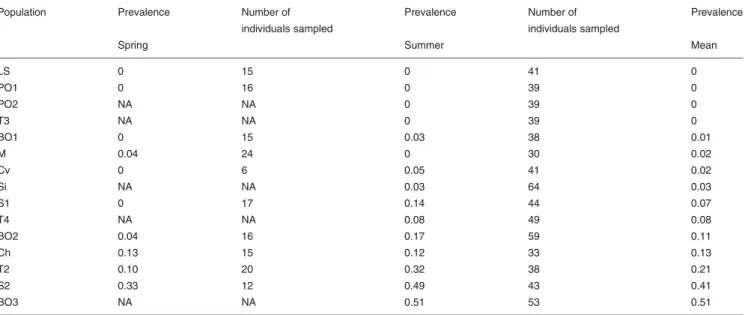
Between the two sampling periods (spring and summer), esti-mates of prevalence remained stable (R2¼ 0.45, P , 0.05) (Table 1). Thus, I used the mean parasite prevalence per population for all subsequent analyses.
Parasite prevalence varied among the 15 sampled popu-lations. In four populations (LS, PO1, PO2, T3), I did not find parasites (Table 1), while five populations (BO2, Ch, T2, S2, BO3) were strongly parasitized (with estimates . 10% and up to 51%, Table 1). Six populations (BO1, M, Cv, Si, S1, T4) were intermediate, with prevalence between 0 and 10% (Table 1). For these intermediate populations, prevalence was often 0 in one season (Table 1). It was therefore difficult to assign these populations to the non-parasitized or the parasi-tized groups, and they were then excluded from tests of adult size and fecundity. No correlation was found between parasite prevalence and geographic distance (Mantel test, R2¼ 0.26, P ¼0.61, Fig. 1).
Correlation between parasite prevalence and life-history traits
The size after maturity in highly parasitized populations was significantly higher than in healthy populations (t-test, P , 0.001, data not shown). Significant positive correlations between mean trait value and parasite prevalence were found for the size at maturity (rho ¼ 0.44, one-tailed test P ¼ 0.05; Fig. 2C) and size 31 days post-maturation (rho ¼ 0.57, one-tailed test P ¼ 0.01; Fig. 2D). On the contrary, no correlation between population parasite prevalence and age at maturity was found (rho ¼ 20.09, two-tailed test P ¼ 0.75; Fig. 2E), nor between fecundity and population prevalence (rho ¼ 20.32, two-tailed test P ¼ 0.24; Fig. 2F). Conversely, during pre-maturation life stages, no correlation was found between size and population prevalence (one-tailed tests: at
Table 1 . Measure of parasite prevalence in spring and summer.
Population Prevalence Number of
individuals sampled
Prevalence Number of
individuals sampled
Prevalence
Spring Summer Mean
LS 0 15 0 41 0 PO1 0 16 0 39 0 PO2 NA NA 0 39 0 T3 NA NA 0 39 0 BO1 0 15 0.03 38 0.01 M 0.04 24 0 30 0.02 Cv 0 6 0.05 41 0.02 Si NA NA 0.03 64 0.03 S1 0 17 0.14 44 0.07 T4 NA NA 0.08 49 0.08 BO2 0.04 16 0.17 59 0.11 Ch 0.13 15 0.12 33 0.13 T2 0.10 20 0.32 38 0.21 S2 0.33 12 0.49 43 0.41 BO3 NA NA 0.51 53 0.51
3 days rho ¼ 20.43, P ¼ 0.94; Fig. 2A; and at 33 days rho ¼ 0.01, P ¼ 0.49; Fig. 2B).
Correlation between adult size and fecundity
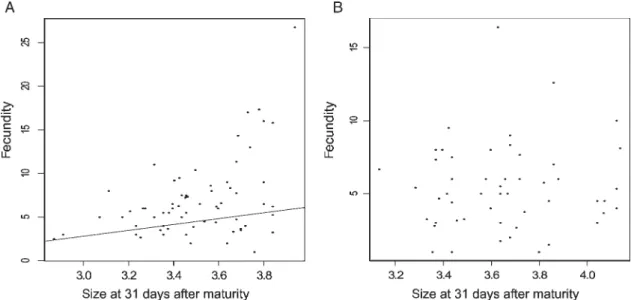
For healthy populations (four populations and 86 families), I found a significant positive correlation between family fecun-dity and size at maturity or with size 31 days after maturity (rho ¼ 0.20 and 0.34, one-tailed test P ¼ 0.04 and P ¼ 0.002, respectively; Fig. 3A for the second correlation). On the con-trary, when using the family mean of the highly parasitized populations (five populations and 52 families), no significant correlation was found between size at maturity and size at 31 days after maturity and fecundity (rho ¼ 0.10 and 0.05, one-tailed test P ¼ 0.76 and P ¼ 0.35 respectively; Fig. 3B for the second correlation)
DISCUSSION
I found significant positive correlations between trematode prevalence and population means of adult sizes in the fresh-water snail Galba truncatula, a suggestion of gigantism. Interestingly, no correlation was found between adult size and fecundity in highly parasitized populations, while a positive correlation was found in healthy populations, suggesting that there may be a cost in fecundity to this gigantism.
Trematodes are an important evolutionary force because they can have strong fitness consequences on their host (Wright,
1971). Since I only measured offspring from healthy mothers, the indications from this study of gigantism are not byproducts of parasite-mediated effects. Thus, gigantism seems not to be simply a side effect of infection in G. truncatula. The stability of the parasite prevalence per population observed between the two sampling periods indicates that parasitic pressure may be a constant evolutionary force in G. truncatula. A previous study on the freshwater snail Potamopyrgus antipodarum has already showed a pattern suggestive of a parasite-associated selection for an early reproduction of the host in relation to trematode prevalence (Jokela & Lively, 1995). In G. truncatula, I found that the more a population is infected by trematodes, the larger are the individ-uals at the adult stage. I found no relationship between parasite prevalence and age at maturity: the parasitized populations do not take longer to reach a greater size. This showed that snails did not respond genetically to trematode infection by maturing earlier in order to reproduce before castration. Additionally, because no relation was found between sizes at the early stage of life and parasite prevalence in the population, there was a further indication that gigantism was not due to an increase in growth rate at early life stages, but rather just before sexual maturity. Finally, in highly parasitized populations, I did not find the classical positive relationship between size and fecund-ity. It seemed that individuals invested energy to reach a larger size at the possible expense of fecundity.
Proximal gigantism has been suggested to allow molluscs to survive trematode infection, and might be selected in parasitized populations (Sorensen & Minchella, 2001). However, it is still
Figure 2. Relationships between parasite prevalence and mean size, age at maturity and fecundity in 15 populations of Galba truncatula. Only significant correlations are represented by a line.A. Length at 3 days after hatching. B. Length at 33 days after hatching. C. Length at maturity. D. Length at 31 days after maturity. E. Age at maturity. F. Fecundity.
debated whether it is beneficial to the snail or to the parasite. Minchella (1985) suggested that, by surviving, the snail could have additional reproductive events to compensate for parasitic infestation. On the other hand, when the snail increases its life span through a bigger size, it allows the parasite to reproduce for a longer time also (Baudoin, 1975). However, here, I show a genetic response of the snails to trematode prevalence, suggesting evolutionary gigantism as a host adaptation. Two arguments reinforce this idea of gigantism as a host adaptation in G. trunca-tula. First, a host, in order to compensate for parasitism by repro-duction, should be a long-lived species (life span . 1.5 year) or a species having several periods of reproduction (Minchella, 1985). In contrast, Sousa (1983) predicted that, in short-lived mollusc species (life span , 1.5 year) or species having only one period of reproduction, gigantism might not be adaptive to the host. In G. truncatula, two generations a year (autumn and spring) have been observed in nature and in the laboratory (Morel-Vareille, 1973; Belfaiza, Moncef & Rondelaud, 2005). These two reproductive periods suggest the possibility of host adaptation through gigantism by G. truncatula.
Second, gene flow of both host and parasite have been shown to be key factors in the adaptation of the parasite. The trematodes infecting snails use birds as definite hosts, which have a great ability for dispersion. Consequently, parasites dis-perse widely and are probably not able to be locally adapted to snail populations (Fredensborg & Poulin, 2006). This might be the case in the G. truncatula-trematode system since trema-todes may be dispersed by ducks or mammals.
In conclusion, I have shown that the life history of the fresh-water snail G. truncatula is influenced by trematode infection. In particular, I found that populations of snails, where parasites are frequent, produce larger adults, a likely evolutionary response of snails to trematode presence in the population. However, further investigations are necessary to confirm gigant-ism as a host response to parasites, and to fully understand the interaction between G. truncatula and trematodes. I also suggest the need to investigate the differential investment of resources between growth, reproduction and survival in the parasites.
ACKNOWLEDGEMENTS
I am very grateful to K. McCoy, G. Evanno, J-S. Escobar and an anonymous reviewer as well as the Editor, for helpful
comments on the manuscript. I was hosted during my PhD at the Department of Ecology and Evolution (University of Lausanne, Switzerland) in Je´roˆme Goudet’s laboratory. Funding of this study was provided by a Swiss National Science Foundation National grant (3100-68325.2) to Je´roˆme Goudet.
REFERENCES
ABROUS, M., RONDELAUD, D. & DREYFUSS, G. 1999. Paramphistomum daubneyi and Fasciola hepatica: influence of temperature changes on the shedding of cercariae from dually infected Lymnaea truncatula. Parasitology Research,85: 765 – 769. AGNEW, P., KOELLA, J.C. & MICHALAKIS, Y. 2000. Host life
history responses to parasitism. Microbes and Infection,2: 891 – 896. BALLABENI, P. 1995. Parasite-induced gigantism in a snail: a host
adaptation? Functional Ecology,9: 887 – 893.
BAUDOIN, M. 1975. Host castration as a parasitic strategy. Evolution, 29: 335 – 352.
BELFAIZA, M., MONCEF, M. & RONDELAUD, D. 2005. Premie`res investigations sur les populations de Galba truncatula (Mollusca Gastropoda: Lymnaeidae), le mollusque hoˆte de Fasciola hepatica, dans le secteur irrigue´ des Doukkala (nord-ouest du Maroc). Revue Me´dicale Ve´te´rinaire,156: 606 – 611.
CHAPUIS, E., TROUVE´, S., FACON, B., DEGEN, L. & GOUDET, J. 2007. High quantitative and no molecular differentiation of a freshwater snail (Galba truncatula) between temporary and permanent habitats. Molecular Ecology, 16: 3484– 3496.
FREDENSBORG, B.L. & POULIN, R. 2006. Parasitism shaping host life-history evolution: adaptive responses in a marine gastropod to infection by trematodes. Journal of Animal Ecology,75: 44 – 53. FRETTER, V. & PEAKE, J. 1975. Pulmonates, Vol. I. Functional
Anatomy and Physiology. Academic Press, London.
GORBUSHIN, A.M. 1997. Field evidence of trematode-induced gigantism in Hybrobia spp. (Gastropoda: Prosobranchia). Journal of the Marine Biological Association of the United Kingdom,77: 273 – 279. GORBUSHIN, A.M. & LEVAKIN, I.A. 1999. The effect of
trematode parthenitae on the growth of Onoba aculeus, Littorina saxatilisand L. obtusata (Gastropoda: Prosobranchia). Journal of the Marine Biological Association of the United Kingdom,79: 273 – 279. GOUDET, J. 1995. FSTAT: a computer program to calculate
F-statistics. Journal of Heredity,86: 485 – 486.
Figure 3. Correlation between size at 31 days after maturity and fecundity. A. The relation analysed at the family level for healthy populations (four populations, 86 families). B. For highly parasitized populations (five populations, 52 families). The line corresponds to a significant correlation.
JAENIKE, J. 1992. Mycophagous Drosophila and their nematode parasites. American Naturalist,139: 893 – 906.
JOKELA, J. & LIVELY, C.M. 1995. Parasites, sex and early reproduction in a mixed population of freshwater snails. Evolution, 49: 1268– 1271.
KEAS, B.E. & ESCH, G.W. 1997. The effect of diet and reproductive maturity on the growth and reproduction of Helisoma anceps (Pulmonata) infected by Halipegus occidualis (Trematoda). Journal of Parasitology,83: 96 – 104.
KENDALL, B.S. 1953. The life history of Lymnaea truncatula under laboratory conditions. Journal of Helminthology,27: 17 – 28.
LOOT, G., POULIN, R., LEK, S. & GUE´GAN, J.-F. 2002. The differential effects of Ligula intestinalis (L.) plerocercoids on host growth in three natural populations of roach, Rutilus rutilus (L.). Ecology of Freshwater Fish,11: 168 – 177.
MINCHELLA, D.J. 1985. Host life-history variation in response to parasitism. Parasitology,90: 205 – 216.
MINCHELLA, D.J., LEATHERS, B.K., BROWN, K.M. & MCNAIR, J.N. 1985. Host and parasite counteradaptation: an example from a freshwater snail. American Naturalist,118: 876 – 881. MOREL-VAREILLE, C. 1973. Contribution a` l’e´tude du cycle
biologique de Lymnaea truncatula Mu¨ller dans le Nord-Ouest du Limousin. Revue Me´dicale Ve´te´rinaire,124: 1447– 1457.
MOURITSEN, K.N. & JENSEN, K.T. 1994. The enigma of gigantism: effect of larval trematodes on growth, fecundity, egestion and locomotion in Hydrobia ulvae (Pennant) (Gastropoda: Prosobranchia). Journal of Experimental Marine Biology and Ecology, 181: 53 – 66.
R DEVELOPMENT CORE TEAM. 2007. R: a language and environment for statistical computing. Vienna, Austria. http:// www.R-project.org.ISBN3-900051-00-3.
ROFF, D.A. 2002. Life history evolution. Sinauer Associates, Sunderland, MA.
SORENSEN, R.E. & MINCHELLA, D.J. 2001. Snail-trematodes life history interactions: past trends and future directions. Parasitology, 123: S3 – 18.
SOUSA, W.P. 1983. Host life history evolution and the effect of parasitic castration on growth: a field study of Cerithidea californica Haldeman (Gastropoda: Prosobranchia) and its trematode parasites. Journal of Experimental Marine Biology and Ecology, 73: 273 – 296.
STEARNS, S.C. 1992. The evolution of life histories. Oxford University Press, Oxford.
TASKINEN, J. 1998. Influence of trematode parasitism on the growth of a bivalve host in the field. International Journal of Parasitology,28: 599 – 602.
TROUVE´, S., DEGEN, L., RENAUD, F. & GOUDET, J. 2003. Evolutionary implications of high selfing rate in the freshwater snail Lymnaea truncatula. Evolution,57: 2303 – 2314.
TROUVE´, S., DEGEN, L. & GOUDET, J. 2005. Ecological components and evolution of selfing in the freshwater snail Galba truncatula. Journal of Evolutionary Biology,18: 358 – 370.
WILSON, R.A & DENISON, J. 1980. Parasitic castration and gigantism of Lymnaea truncatula infected with the larval stages of Fasciola hepatica. Zeitschrift fur Parasitenkunde,60: 109 – 119.