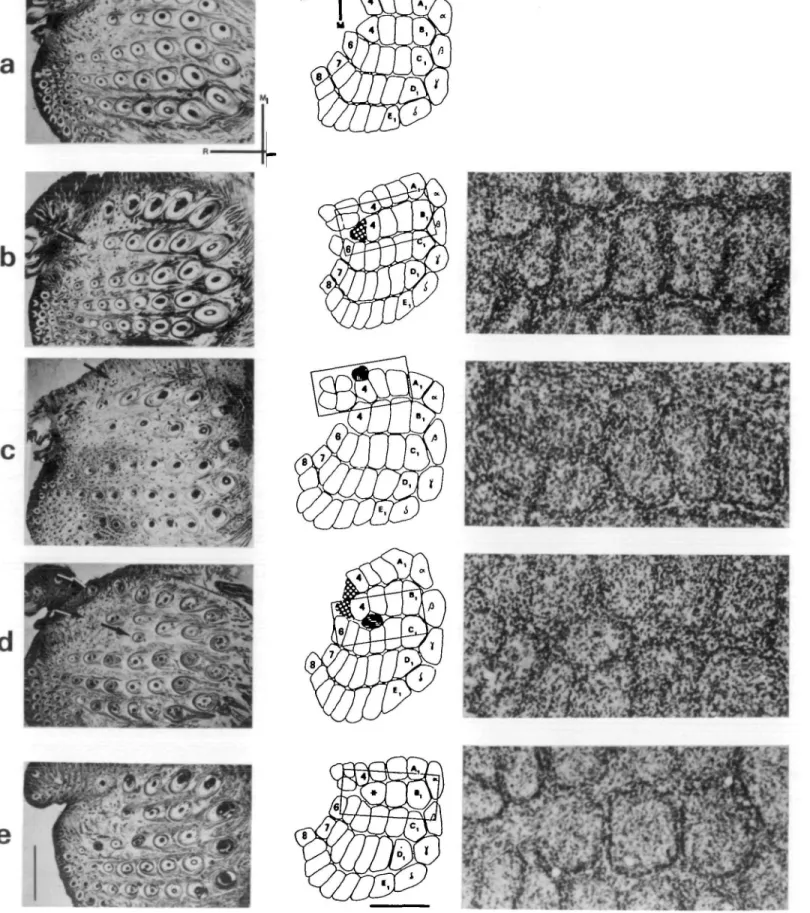
FIGURE 1 The left and middle columns show five sets of representations of whiskerpads and corresponding barrelfields. For the sake of comparison all whiskerpads arc shown as if they are from the left side; all barrelfields, as if they are from the right side. Orientation is the same for all sets and is indicated by compasses in a: R = rostral; M = mediodorsal; thus, for the barrelficld (camera
lucida) drawings the brains are turned upside down: in neocortex, the somato-sensory periphery is represented roughly upside-down. In all illustrations of left and middle column, rows A are at the top, rows E at the bottom, a, /3, y, 5 are the caudal, "straddling" elements (see Figure 2H and text). Numbers delimit standard field (see text) except for e where the rostralmost element of B row
The Journal of Heredity 75:326-336. 1984.
Variation in pattern of mystacial
vibrissae in mice
A quantitative study of ICR stock and several inbred strains
H. Van der Loos
J. Ddrfl
E. Welker
The authors arc affiliated with the Institute of Anatomy, University of Lausanne, Rue du Bugnon 9, 1011 Lausanne, Switzerland. This work was supported by the Swiss National Science Foundation (grants 3.776, 3.516, 3.238), the Banque Cantonale Vaudoise, Emil Barcll-Stiftung(F Hoffmann-La Roche), Geigy Jubilaums-Stiftung, Sandoz-Stiftung zur Fordcrung dcr Mcdizinisch-Biologischen Wissenschaftcn, and Wild & Lcilz AG, Zurich. During part of this study E W. was the recipient of a NATO Science Fellowship from the Netherlands Organization for the Advance-ment of Pure Research (Z. W.O). The authors thank N. Van der Loos for assistance throughout this study, M. C Cruz for histology, G. Escher for statistical, and E. J Gubbels (Central Institute for the Breeding of Lab-oratory Animals TNO, Zeist, The Netherlands) for genetic expertise, V.S. Cavincss (Harvard University) .ind P. P. Giorgi (University of Queensland) for critical discussion, K. Van der Saag for help with analysis and artwork, K. Meier and M Marfurt for help with animal keeping, S. Daldoss for photography, and C. Vaclavik for typing. F. Andres provided Figure 6, and the man-agement of Hotel de la Forclaz, ambiance and shelter during the final analysis of the data and the preparation of the manuscript.
«5 1984, American Genetic Association
ABSTRACT: We report on the variation in the pattern of mystacial vibrissae In ICR mice, of which one-half of the about 600 animals investigated showed one or more supernumerary whiskers (SWs). The SWs and their follicles—in all respects identical to the units of the standard pattern except for their smaller size—occurred at a restricted number of sites. In addition, a limited number of mice from two BALB/c strains were analyzed. Half of them also had one or more SWs, but mainly at one site. Mice of the C3H/HeJ and DBA/2J(a) strains were virtually without SWs, whereas animals from the NMRI strain were standard without exception. Nearly all animals of the C57BL/6J strain lacked between 1 and 4 vi-brissae, always from one or two of the same adjacent sites. There was a slight overall pre-dominance for the left side of the face to bear SWs and there was no clear-cut association with sex; the entire population was without obvious defects. The sites where extra or lack-ing whiskers occur are associated with the lines of fusion between the medial and the lat-eral nasal fold, and between the latter and the maxillary arch. Where tested, we always found a topologic equivalency between the pattern of the whisker follicles and the con-tralateral pattern of the "barrels"—multineuronal units in layer IV of the parietal cerebral cortex—whether the pattern was standard, "enriched," or lacking In elements. The data presented in this paper provided a basis for several studies carried out subsequently on animals that are the offspring of those characterized here, studies suggesting that the oc-currence of supernumerary and of lacking whiskers has a genetic basis.
T H E PATTERN of the mystacial whiskers on the muzzle of the mouse is amazingly con-stant. "Amazing" when one considers vibrissae as banal hairs; not amazing, perhaps, when one considers vibrissae as structural entities that have "phylogenetic individuality"3 much
as, for example, the fingers of the hand. Our interest in that pattern was inspired by the existence of the barrelfield—the area of whisker representation in parietal neocortex26.
In layer IV of that area, there are multineu-ronal units—barrels—arranged in a pattern that is homeomorphic with that of the whisk-ers on the whiskerpad. Whiskwhisk-ers are part of
important tactile organs: each one of them issues from a sinus-hair follicle, a structure containing a high number of receptors. From each follicle, a follicular nerve arises that contributes to the formation of the infraorbital nerve, which, as part of the trigeminal nerve, enters the central nervous system (pons).
On the basis of differences in size and, particularly, shape of the barrels, a postero-medial barrel subfield (PMBSF) has been delineated: the cortical area where the large, posterior mystacial vibrissae project26. Further
support for the distinction between the PMBSF and the anterolateral
small-barrel-is marked by astersmall-barrel-isk. In ft, c, and d supernumerary whsmall-barrel-iskers (SWs) are indi-cated by arrows, supernumerary barrels (SBs) arc hatched. Significant regions in drawings are boxed and represented as photomicrographs in right-hand column. I n a a normal pad and field are shown; in b, those that have a SW and corresponding SB at the B5 site; in c, those with a SW and a SB at the A4' site; in d, those with a SW and a SB at C 3 ' and in positions A5, B5; in e, those with clement B4 missing. For all sets, muzzle and (contralateral) cortex stem from the same animal, except fore where cortex is from a littermate of animal whose
whiskcrpad is depicted. Whiskerpads are cut at 40 /im and tangential to the surface of the skin, and stained with a modified Lillie technique. Barrelfields are cut at 40 fim, tangential to the surface of the cortex, and stained with mcthylcnc blue. Because of the curvature of the parietal cortex the barrelfields as depicted here have been taken from three or more serial sections. The bar in e is 2 mm for the whiskerpad photographs in the lefthand column; the bar is 0.5 mm for the barrelfield drawings in the center column.
B
ULNAft-CARPAL • b c d e f i j k§ t t t I
E 0 21 16 10 7 27t t t t n
~ 23 18 11 6 29t 0 • • •
9 — 9
in
0 § 24 .7 12 8 4 270 • • § •
9 — 9
9 iv
H ^ 23 16 12 9 6 4 279 9 9 9 9
9—9
9 | v
21 14 12 9 6 3H
field came from physiological recordings (Nussbaumer and Van der Loos, ms. submit-ted). The barrels in the PMBSF receive only whisker input and no input from fur between the whiskers, whereas in the anterolateral small-barrelfield no such distinction could be made: it receives signals from both whiskers and intervening common fur.
For the purpose of the present paper we delimited a "standard" mouse whiskerpad. It bears 33 whiskers, 29 of which are aligned in five rows named E: 4 whiskers in the A-row, 4 in B, 6 in C, 7 in D, and 8 in the E A-row, while four elements termed a, /9, y, and 6 are straddling the caudal ends of the rows. Figure la shows the standard whiskerpad as well as the corresponding barrelfield. Figure 2H shows the standard whiskerpad with the above nomenclature entered. These definitions of whiskerpad and barrelfield proved convenient in that large numbers of whiskerpads in new-born mice could be screened within a reason-able time while the corresponding cortical domain in the adult—roughly coinciding with the PMBSF—could be delineated consistently and with ease. This proved of particular im-portance for subsequent quantitative studies of the whiskerpad and the barrelfield, per-formed on several lines of mice that are the offspring of the animals discussed in the present paper25.
This article turns to the periphery only. Notwithstanding the constancy of the stand-ard pattern, we as well as others have found variation in detail. The present paper is about that variation.
Several investigators have studied the ar-rangement of vibrissae of the mouse and, while trying to quantify it, were struck by its con-stancy. Often these studies considered not only the array of the so-called mystacial vibrissae (the "moustache") but also the other groups of them, all situated on the head and the neck
FIGURE 2 A-G show reproductions of drawings accompanying the articles of authors who have de-scribed the pattern of vibrissal follicles in the mouse. • /4—Danforth3; fl—Griinebergl2;C— Davidson and
Hardy4; D—Dun6; £—Fraser and Kindred";
F—Ibrahim and Wright13; and G—Yamakado and
Yohro29. Sizes of drawings were adapted to fit the
plate. H shows our own scheme, derived from a section taken tangential to the skin of a left whisk-erpad. It shows our nomenclature: lettered and numbered follicles delimit the pattern used as ' standard; shaded areas are the two zones of skin in which we found supernumerary whiskers. Black dots denote the sites in which we grouped the whiskers for the purpose of simplification (same convention as used in Figures 3 and 4): for the upper (medial) shaded zone these sites from caudal to rostral are A2', A4', and A5; for the lower (lateral), C3', C5', and B5. These zones fall within the medial and the ' lateral "fusion lines" (see text).
except for the ulnar-carpal vibrissae. Dan-forth's study3 of fur hairs and tactile vibrissae
in the mouse pioneered in this direction. On the basis of a comparison of hair in mammals, feathers in birds, and scales in fish, he con-cluded that vibrissae—but not fur hairs—have what he called phylogenetic individuality.
In the following paragraphs we review the pertinent literature. Our own nomenclature is placed in brackets. Figure 1A-G assembles the • figures in which the listed authors summarize their findings; Figure 2H illustrates our notation, based on an earlier study21.
Danforth (1925)3, in the study referred to
above, describes a vertical row of 4 whiskers termed E-H [our "straddlers" a-5] and 5 horizontal rows named I-V. I [A] has 3,4, or 5 hairs (4 is common) termed a,b,c, etc. (Figure 2A). Rows II-V [B-E] have a series of hairs that, going rostrad, gradually become smaller. Danforth chose to analyze 3 vibrissae per horizontal row; thus he counts until 19. He finds various exceptions to the pattern.
Gruneberg (1943)12, in a study of anomalies
associated with congenital hydrocephalus in mice, also states that in normal animals mys-tacial vibrissae occur in 5 rows. In hydroce-phalic animals this pattern remained un-changed while other sets of whiskers did ex-hibit modifications. He does not make mention of the straddlers, but his Figure 1 clearly demonstrates their existence (Figure IB). While the numbers of vibrissae per row are not given, the figure shows all five rows to contain 8 whiskers.
Davidson and Hardy (1952)4 studied the
development of vibrissae of the mouse in vivo and in vitro. They accept, with minor modifi-cations as to the number of vibrissae per row, the pattern of the two preceding authors. Be-sides the vertical row of 4 large follicles [straddlers], they find in rows 1 [A] and 2 [B] always 4 follicles; in row 3 [C], always 5. In row 4 [D] they find at least 6, and in row 5 [E] at least 8 follicles (Figure 2C).
Dun (1958)6, in his quantitative description
of the various sets of vibrissae of the mouse, uses Danforth's terminology and characterizes the standard mystacial pattern as follows: rows I [A] and II [B] have 4 vibrissae each, while rows III [C], IV [D], and V [E] average 10, 11, and 11 vibrissae, respectively (Figure ID). With Danforth, Dun recognizes a vertical row of 4 vibrissae [the straddlers]. This pattern and those of the other vibrissal groups (submental, post-oral, supra- and post-orbital, inter-ramal and ulnar-carpal) were to serve as baseline for breeding experiments in which the spatial distribution of the vibrissae was modified. In a subsequent study7 an attempt was made to
define the time of action of two genes (tabby and raggy) that influence the development of
vibrissae, and confirms essentially the stand-ard pattern he had described before. The same can be said with regard to a next paper8
re-porting on the results obtained through the introduction of these genes into the original stock.
Fraser and Kindred (1962)11, in a study
that is a sequel to that of Dun and Fraser8, use
a somewhat different system of notation, al-though their pattern is identical to that of Dun6. These authors, with regard to the
mys-tacial vibrissae, draw into consideration vi-brissae A 1-5 [a and A 1-4], B 1-5 [/3 and B 1-4], C 1-5 [7 and C 1-4], D 1-5 [5 and D 1-4], and E 1-4 [E 1-4] (Figure IE). The basis for singling out these 4 or 5 posterior whiskers per row was that they are of about equal length and noticeably taller than those placed more anteriorly.
Ibrahim and Wright (1975)13, in an
anal-ysis of size and growth of the mystacial vi-brissae in mice and rats, adopt Danforth's notation. They restrict their observations to the straddlers, to the 4 whiskers of our rows A and B, to the 5 posterior elements of row C, and to the 6 posterior elements of rows D and E (Figure IF).
Yamakado and Yohro (1979)29, basing
themselves on observations made in a number of mouse strains, confirm the vibrissal pattern as proposed by Dun6 and by Woolsey and Van
der Loos26, while using the notation of the
latter authors. On embryologic grounds, they divided the mystacial vibrissae into three groups: the lateral nasal, maxillary, and labial (the whiskerpad as defined in the present paper comprises elements of the first two groups). They described variations in number and arrangement of vibrissae and barrels. Rows A and B, forming the lateral nasal group, each contain 4 whiskers, whereas rows C, D, and E, forming the maxillary group, bear 8,9, and 11 vibrissae, respectively. In the view of these authors, straddlers a and (3 probably belong to the lateral nasal group; 7 and 5, to the maxillary group (Figure 2G).
It was a chance observation of an additional barrel in an odd place that, upon checking, turned out to be accompanied by an extra whisker in the corresponding place of the whiskerpad22, that set off the present
investi-gation: a quantitative study of the variation in the pattern of mystacial vibrissae in mice from different populations. These populations were an outbred stock, ICR, and five inbred strains: albinos, BALB/c and N M R I ; black, C57BL/6J; dilute brown, DBA/2J(a); and agouti, C3H/HeJ.
Arguments, based on the occurrence of supernumerary whiskers (SWs) and corre-sponding barrels, led to the hypothesis that the peripheral pattern is responsible for the
tablishment of the patterns in the central nervous system. The timing of critical, devel-opmental events (peripheral pattern originates first, "brain maps" later)2 2 and the fact that
the SWs occur only in the facial lines of fu-sion23 were used in the elaboration of this idea,
which also was supported by the observation that skin from presumptive, never-innervated whiskerpad cultured on chorioallantoic membrane will grow a follicle pattern akin to that found in vivo1'2.
From animals described in the present paper, a selection was made that served as origin of several lines of mice that were inbred (mostly by brother-sister matings) for par-ticular whisker patterns including the standard one (work to be reported in subsequent pub-lications).
Materials and Methods Six populations of mice were used: 1. ICR. From June 1977 to March 1978 we
obtained 45 pregnant mice from the In-stitut fur Zuchthygiene of the University of Zurich (8057 Zurich, Switzerland). This institute had obtained its stock in 1964 from the Charles River Mouse Farms (Wilmington, MA 01887, USA) where the line, known as CD-1(1CR)BR, was outbred. In Zurich, the animals had been bred without a rigor-ous system, although full sib mating was carefully avoided, until January 1976. From that date, the animals were outbred according to Robertson9. The 45
litters that we analyzed contained a total of 597 mice. Littersize varied from 5 to 20.
2. BALB/c. In January 1980 three preg-nant females were obtained from the Institut fur Humangenetik of the Uni-versity of Heidelberg (6900 Heidelberg, West Germany). This strain, BALB/ CTr(d), had been inbred for more than 100 generations. They yielded a total of 13 young. In the same period we received two pregnant females from the Swiss Institute for experimental Cancer Re-search ("ISREC," 1066 Epalinges, Switzerland). Their animals, from BALB/cByJ stock, are inbred. The stock had been obtained three genera-tions earlier from the Jackson Labora-tory. (Bar Harbor, Maine 04609, USA). The two females gave birth to a total of
11 young.
3. C3H/HeJ. In March 1980 we obtained one couple from the Heidelberg Insti-tute. Animals were from a strain that had been inbred for more than 100 generations. It generated 28 young.
4. C57BL/6J. From January to March 1980, three pregnant females were ob-tained from the Heidelberg Institute. The strain had been inbred for more than 100 generations. They yielded a total of 30 young.
5- DBA/2J(a). From January to March 1980, eight pregnant females were ob-tained from Heidelberg. Strains had been inbred for more than 100 genera-tions. There were 31 young from these females.
6. NMRl. In February 1980 one couple was received from Heidelberg. Animals were from a strain that had been inbred for five generations. The couple yielded a total of 13 young.
The evaluation procedure was identical for all animals. It followed usually within 24 hours after birth and was made, with the aid of a dissecting microscope, on all newborns with intact faces, living (almost all) or dead; their bodies, including the muzzles, at that time are still free of common fur. While we aimed at listing, for each animal, all deviations from the standard whisker pattern, our evaluation was directed to the following points (see Figure
2H):
1. In a standard whiskerpad, rows A and B have 4 vibrissae each. For these rows, with one exception, the supernumerary elements were situated at the rostral ends of the rows and termed A5 and B5. Whenever elements were missing, it was from loci A4 and B4.
2. Two other narrow strips of skin in which extra elements were observed, were 1) just medial to row A—vibrissae here were called A'; and 2) medial to row C (i.e., between rows C and B)—these vi-brissae were called C . The localization of A' and C whiskers was further spec-ified by recording the position of the extra element with reference to the whiskers in the row adjacent and lateral to it. In the strip of skin medial to row A the SWs occurred in positions between A2' and A4'; in the strip medial to row C, between C 2,3' and C 6,7'. We sim-plified notation by grouping SWs in A' loci into two sets: A2' and A4'; and those in C loci into two sets: C3' and C5'. 3. Three odd cases could not be classified
according to 1 and 2. These were of paired vibrissae, i.e., two equally large hairs issuing from one double follicle. We did not count the total number of whiskers in rows C, D, and E: they are nu-merous (about 10 per row) and the rostral ones are densely spaced and very smajl. This is the one restriction in our evaluation.
No SWs were seen between rows A and B,
C and D, and D and E, and between the straddlers.
The sex of 95 of the ICR animals as well as in all those of the inbred strains was deter-mined by measuring the distance between anus and urogenital orifice.
Animals of different variations in whisker pattern were prepared for histology: they were anesthetized with Nembutal i.p. and perfused with 10 percent neutralized formalin in 0.9 percent NaCl. Brain and whiskerpads were removed and postfixed in the same solution. The brain was bisected in the mid-sagittal plane, embedded in celloidin, and the hemi-spheres were cut tangentially to the pial sur-face over the barrelfield17; whiskerpads were
soaked in sucrose and cut on a cryostat. The brains were Nissl-stained for cell bodies (methylene blue); whiskerpads were stained for myelin according to a modified Lillie method (Cruz et al., ms. in preparation) or with Mallory-azan.
Results
Over 700 newborn mice have been screened for their whisker patterns. A summary of our observations is given in Table I.
The ICR animals showed the largest variety in deviations from the standard: all deviations and several combinations of them were ob-served, with the exception of the missing A4 and B4 that, when it occurred (it occurred in all litters), was the unique character of C57BL/6J. The only deviation in C3H/HeJ was an occasional A5 and in DBA/2J(a), an A'. In BALB/or(d), C occurred in all litters; in BALB/cByJ, in one. In each one of the BALB/c strains, one B5 occurred. NMRl mice were invariably standard.
When surveying all the mice screened we can add that in all but two litters with devia-tions there was one or more than one animal with the standard pattern and, although not the subject of specific investigation, no obvious defects were observed.
The data on the ICR animals—the most numerous lot—are presented in detail in Fig-ure 3. Of the 45 litters analyzed, only one consisted of animals (n = 13) that showed no deviation from standard, while all others had one or more animals with one or more than one A5 and/or B5. For 28 of these, A5 and/or B5 whiskers were the only deviation from stand-ard. Nine litters had one or more animals with one or more than one C ; two litters had one or more animals with one or more than one A'. Each one of the remaining five litters con-tained animals of which some had one or more A's and of which others had one or more C's, or, in one case, an animal with SWs in both positions, or animals that had a double follicle
(from which issued two whiskers). Of the total of 37 animals with A's and/or C's, 20 had one or more than one A5 and/or B5 as well, and 17 had not.
With respect to consistency in the site of SWs expressed by a particular litter, those litters that showed SWs in the A5 position only are most numerous. Among those there are four with a (marked) tendency to have these whiskers to the left (Figure 3, nos. 05,09,12, and 21). There were no such litters with an opposite tendency. Although there are animals with SWs in the B5 site only, this was never the characteristic of an entire litter. Three litters showed a high overall occupancy of sites A5 and B5 (Figure 3, nos. 27, 28, and 29). Such a disposition was even more marked in litters that had one or more than one animal with C loci occupied (Figure 3, nos. 42,35,39, 45). This tendency also is illustrated by com-paring the mean number of A5 and/or B5 whiskers per animal belonging to a group of litters that have only A5 and/or B5 whiskers (Figure 3, nos. 02-29), with that belonging to the group of litters that have one or more than one C (Figure 3, nos. 35-45). This value is for the first group 0.67, and for the second group 1.21. Litters containing, besides whiskers A5 and B5, also and only those in A' loci, do not show a higher incidence of A5 and B5 whisk-ers than littwhisk-ers with A5 and B5 whiskwhisk-ers only.
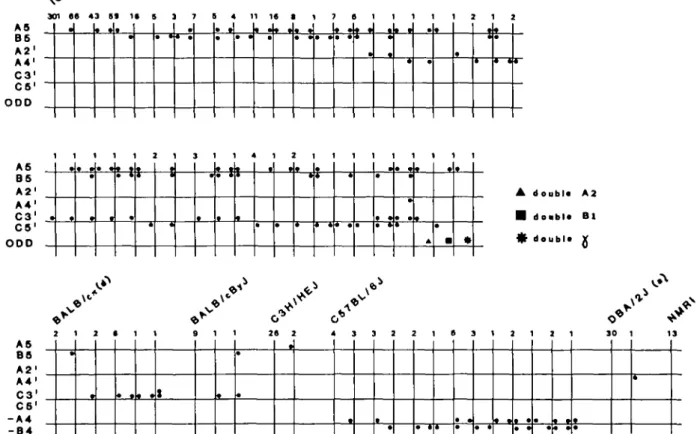
Figure 4 summarizes all data; in it the ani-mals are not grouped by litter, but first by stock and strains, and then by phenotype (whisker pattern).
When tested, the barrel pattern, deviation and all, was homeomorphic with respect to the contralateral whisker pattern. Some of these cases are illustrated in Figure \b-e. It should be noted here that the SWs as well as the barrels associated with them, were identical
to the elements belonging to the standard pattern, except for their size (they were smaller). Notably, the whisker follicles were provided with muscle slings (for description of this general feature see Dorfl5) and caused the
SWs to whisk in harmony with surrounding vibrissae. SWs, or lacking whiskers at certain loci, often occurred on one side only, and al-though there were litters that for one location (A5) showed a left preference, no clear overall asymmetries were noted (Figures 3 and 4).
For the ICR stock, sex was determined for 15 percent of the young; for the other strains, all animals were sexed. The male/female ratio of the 220 sexed animals was 1.04:1. We did not observe a link between sex and the occur-rence of SWs and of lacking whiskers, al-though in the animals with C whiskers fe-males dominated (17 fefe-males, 7 fe-males); in those with A's, males dominated (8 males, 2 females).
Discussion
This paper is on supernumerary whiskers, and on lacking ones, on the whiskerpad of the mouse. A characteristic of the distribution of these special tactile hairs over the surface of the whiskerpad, an elevated patch of skin, is its constant pattern. It is highly regular, and arguments have been advanced to state that the pattern is responsible for that of "barrels" in thebrain1-2-22-23.
For the present study the muzzles of some 700 newborn mice were inspected. It was found that about half of the animals of ICR stock and of the BALB/c strains carry one or more supernumerary whiskers. In DBA/2J(a) we found one animal with a SW; in C3H/HeJ, two, but the total number of animals was small. One strain (NMRI) showed only the standard pattern, while in another
(C57BL/6J) most animals lacked certain whiskers. In what follows we shall advance arguments for the notion that there is a genetic
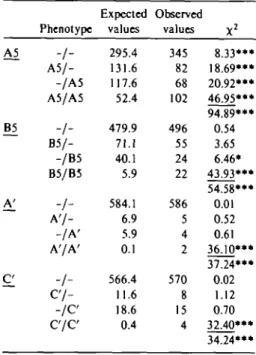
Table II. Expected and observed occurrences in four sets of phenotypes of the ICR population
involving the A5, B5, A', and C vibrissae, respectively. The left hand column lists the phenotypes per set, i.e., no whisker of given type; presence of whisker on left; presence of whisker on right; presence of whiskers on both
sides. The expected values were obtained by multiplying the number of individuals out of
the total ICR population with the given character on the left, with the number of those
with the same character on the right, and dividing the product by the total number
of animals A5 B5
c
Phenotype / A 5 / -- / A 5 A5/A5 / - B5/--/B5 B5/B5 / - A7-- / A ' A'/A' /-
C7--/c
c/c
Expected values 295.4 131.6 117.6 52.4 479.9 71.1 40.1 5.9 584.1 6.9 5.9 0.1 566.4 11.6 18.6 0.4 Observed values 345 82 68 102 496 55 24 22 586 5 4 2 570 8 15 4 X2 8.33*** 18.69*** 20.92*** 46.95*** 94.89*** 0.54 3.65 6.46* 43.93*** 54.58*** 0.01 0.52 0.61 36.10*** 37.24*** 0.02 1.12 0.70 32.40*** 34.24*** * Rejection at P <0.05 of null hypothesis that the presence of a given vibrissa on one side is independent of the presence of the same element on the other• • • P £0.005
Table I. Summary of numbers of various supernumerary whiskers (SWs) and lacking whiskers (-) in the mouse strains studied. Each strain is represented by a vertical bar. Data pertain to an analysis of 723 mice. The SWs are listed in the left-hand column (see Figure 1H for locations of A5, B5,
A', C , -A4 and -B4. A' whiskers were grouped together, as were the C's. The "oddities" are SWs mentioned in text (see page 330, pt. 3) and defined in Figures 3 and 4. Numbers on the left and right sides of each vertical bar correspond to the total number of a particular SW on the left and right
whiskerpad, respectively. Si gives totals of SWs per side, Sj, the sums of those totals; ni is the number of animals analyxed; nj, the number of animals with SWs ICR A5 B5 A' C Oddities -A4 -B4
s,
s
2 n.
n-> 184 77 7 13 3 284 170 46 6 21 0 243 527 597 296 1 4 5 14 13 1 BALB/cir(d) BALB/cByJ C57BL/6J 10 8 18 15 16 31 3 11 2 2 28 2 49 30 26 DBA/2J(a) 31 NMRI 0 13 001 02 03 04 05 06 07 08 09 1 3 1 1 1 2 1 3 1 1 1 1 0 1 1 2 4 2 7 1 1 1 0 3 2 8 1 1 1 1 0 2 2 * 5 I I .1 I. |_jj It tit | t| B5 I I I I I I I I 1 1 2 4 2 7 1 1 10 3
HH—H—HH—H
10 11 12 1 3 14 15 12 1 1 1 1 6 1 1 1 12 7 1 11 3 1 1 1 1 3 1 1 1 1 7 1 1 1 * s | }. + J 4, M It .It I tl t|. I t| It t|.t -I fr
1-AS B5 16 17 18 19 20 21 22 12 4 2 1 1 10 1 1 2 ( 3 1 3 0 2 4 1 4 2 1 1 14 5 1 3 1 1
-HHHHi—H-
J
Hr-—H^H>—HhH*—PhM*—H—11 h 11
2 3 24 25 26 1 2 1 4 1 4 2 1 3 6 1 1 2 1 1 4 1 3 A S I .1 I. .1. . U I .1 I. .1. I .1 I. .1. I . U BS1 I't'fr
27 1 3 4 4 1 2 2'I I' t I- t 1 1 I- t -I
+++-AS BS 78 29 2 3 1 2 2 1 1 1 1 1 1 1 2 1 4 1 1 2
I H !•
•!•
J L j H. >
•!•
!•
•!•
I I* *h I .1 >
3 I AS I BS A21 A41 C31 C51 ODD 0 : 1 • * • 3 i 1 i 3 4 2 t * • 3 ( * 3 * 1 3 I 4 ! 1 • 3 • AS J BS A21 A41 C31 C51 ODD 5 • • • • t ••• • 1 • • • • 1 • • 1 > 3 1 • i • 6 1 • 1 • 3 [ • / 1 t 1 ! • f• • • • • 3 ( • 8 • ( • • • •• • ff 4 39 40 41 2 2 1 6 2 1 1 1 1 1 1 1 2 1 1 1 6 1 2 1 1 1 2 1 AS BS A21 A41 C3' C61 ODD # • •s
• •
*
*
t •f • • t # • * t t f • * * * • • • dooblt I I • doubl* Y • doubl* A2 42 43 4 4 4 5 AS 1 BS • A2' A41 C31 CS1 ODD • • • 3 f •• • •* •• • * • r • 3 • 1 • • • •• • • • • 1 • •t 1 • f • • • • • • 2 • • • • • • • • •f « • * • • • • • • • • •AS B6 A21 A41 C31 C6' ODD 3Cn e6 4 3 BI 1 * 11 16 1 * • 1 • • S » f I t 2 * • 4 AS B6 A2' A41 C 3 ' C5' ODD 1 • 1 * • • 1 1 t f 3 t 1 f 4 : • 1 • • • • • • * • t • i • • • • • 1 • * • • • * A • • • 1 • * • d o u b l . A2 • d o . b i t B l 4 t d o u b l . g AS BS A21 A41 C31 CS1 -A4 -B4 2 1 2 ( 1 1 o 26 2 4 3 3 2
FIGURE 4 For the ICR line and for each of the strains studied, mice were grouped together according to the localization of their supernumerary whiskers (SWs), listed in the left hand column. ODD indicates double vibrissae (see page 330, pt. 3); key is to the right of the second staff. Each vertical bar represents a whisker pattern, characterized by the distribution of its SWs. As in Figure
3, a SW is represented by a dot; those left of a bar refer to left whiskerpads; those right of a bar, to right whiskerpads. The num-bers on top of the vertical bars give the number of animals having a particular distribution of SWs over their two whiskerpads. For each group of mice, the first vertical bar—the bar without dots— represents the animals without SWs.
basis for the occurrence of SWs and of lacking vibrissae.
Screening the data on the ICR stock for bilateral asymmetries in the distribution of SWs, we note a modest overall preference for SWs to occur on the lefthand side: the left-right ratio (LRr) is 1.17. For two sites there
FIGURE 3 Graphic representation of 45 litters of animals of the ICR stock. Litter numbers are in bold characters. Column on the left lists sites of supernumerary whiskers (SWs). For each litter, the individuals are grouped according to phenotype, i.e., the distribution of SWs over their two whiskerpads; each group is represented by a vertical bar, the number at the top of which signifies the number of individuals within a particular group. A phenotype is expressed so that dots on the left side of a bar represent SWs on the left whiskerpad, and dots on the right side, on the right whiskerpad. The sites are given, at the corresponding horizontal level, in the left hand column. ODD refers to double vibrissae (see text p. 330, pt. 3; key is to the right of the eighth staff)- Vertical bars without dots represent animals without SWs. The litters are arrayed according to the relative number of SWs per litter, first for litters that have A5 and/or B5 vibrissae only, then for those with A's, with Cs, and finally with A's and C s and oddities.
does appear to be preference: LRr for B5 is 1.67; for C , 0.62 (Table I). Although the numbers are small, it is interesting that in the BALB/c strains, C whiskers also occur preferentially to the right (LRr = 0.36). For ICR, the LRr for A5 whiskers is 1.08, while it is 1.53 for animals in which A5 is the only site for SWs to occur. There are four litters with A5 vibrissae only that are asymmetric to the left. This latter observation seemed to point to a genetic influence, but see below. The ques-tion naturally arises if having a SW at a given location on one side is linked with an increased chance of having an identical one on the other side. Using A5—the most frequently occur-ring SW in the ICR population—as the ex-ample, we presumed that the occurrence of that whisker on one side is independent from its occurrence on the other. We then calcu-lated the probability to have: 1) no A5 on ei-ther side, 2) an A5 on the left, 3) an A5 on the right side, and 4) an A5 on both sides (see Table II). Comparing the observed with the expected values we note that for groups 2 and 3 the observed values are about one-half the expected ones, and that, for group 4, the
ob-served value is two times the expected one. Thus, it would appear that the occurrences of A5 whiskers on the left and on the right sides are not independent, i.e., the tendency to achieve a symmetric arrangement—none or two A5s—is greater than that of making an asymmetric arrangement. The same tests were performed on the other SWs: B5, A' and C . They led to similar results.
A5 and B5 are by far the most frequently occurring SWs among mice of the ICR stock. In a minority of animals with these vibrissae, there are one or more A's and/or C s as well. However, since A's and C s may occur as sole SWs, it cannot be stated that the presence of A's and/or C s in an animal is dependent on that of SWs in A5 and/or B5 sites. However, the higher incidence of A5 and B5 vibrissae in the litters in which one or more animals have one or more C s as compared to that of litters with A5 and/or B5 only, suggests a link be-tween SWs A5 and B5 on one hand and C s on the other. For BALB/c, whose SWs are nearly always exclusively C s , such an association does not appear to exist.
The data on all animals whose sex had been
determined, taken together, do not allow us to suggest a clear-cut association between oc-currence and site of SWs, and sex. Our ma-terial would seem to be too limited to draw conclusions from the dominance of females and males among animals with C and A' whiskers, respectively.
The too-many and the too-few whiskers were associated with specific sites and thus we confirmed, on this ample material, observa-tions made earlier22'23'29. The SWs are in
lo-cations A5 and B5, as well as in two narrow strips of skin, one at about the center of the whiskerpad, the other near its medial border. We have suggested23-24 that these sites are
associated with the lines of fusion (or of mer-gence15-19) between the maxillary arch and the
lateral nasal fold (B5 and the C whiskers) and between the lateral and medial nasal folds (A5 and the A' whiskers). In an attempt to gain insight about the interaction between the presence of whisker B5 and that of C's at the same site (lateral line of fusion) and between the presence of B5 and that of A', we formu-lated the null hypothesis that the presence of one element of a pair is independent of that of the other. Expected values were obtained using contingency tables. Table III shows this analysis for pair B5-C to the left, contrasted with pair B5-A', also on the left. The null hy-pothesis was tested using the chi-square test and, while for the B5-C pair the null hy-pothesis had to be rejected at P = 0.003, suggesting a strong interaction between the presence of these elements, the test for the B5-A' pair made independence highly likely ( P = 0.21).
We then tested, in the same manner, all pairs of vibrissae, both ipsi- and contralateral with respect to each other. Figure 5 summa-rizes the departures from independence stating the probabilities by which the null hypotheses had to be rejected. Whereas, on the left side the occurrence of elements in the same lines of
fusion show strong interaction, this was less marked for B5-C and not present at all for A5-A'. It appears that the presence of A5 and B5 on both sides as well as across the midline, is strongly interactive for all four locations.
It is of interest to note that the vibrissae that may be lacking (in the C57BL/6J strain) are A4 and B4, which are close to the medial and lateral fusion lines. For a description of facial morphogenesis in the mouse, see Tamarin and Boyde20.
Comparing observed and expected values for all 28 contingency tables (of which only those for the B5-C and the B5-A' on the left side are shown in Table III) we noted that for phenotypes with only one SW of the combi-nation in question the observed values were nearly always lower than the expected ones; this held for all pairs having A5 and/or B5 whiskers, while for phenotypes with none or two elements present the observed values were higher. We conclude that, for any animal, the presence of one SW favors that of another one.
In the literature there are depictions of several barrelfields in which supernumerary barrels (SBs) can be seen. These are at the most common site, A5. Since a SB is always accompanied by a SW (as is a SW by a SB), we may conclude that here we were con-fronted, too, with the existence of SWs (e.g., possibly Woolsey and Van der Loos26, Fig. 14,
9L; Rice and Van der Loos18, Fig. 1;
Jean-monod et al.14, Table I). Incidental
illustra-tions of whiskerpads with an A5 are in Wool-sey et al.27, Fig. 5, bottom left, and in
Jean-monod et al.14, Fig. 3.
Also, there are reports that explicitly state the occurrence of SWs. In an analysis of the variation in the whisker pattern occurring in 165 mice of undefined stock, Danforth3
re-ports 1) a single occurrence of A' whiskers, 2 on each side; 2) an occasional absence of an A4, and a SW in the A-row; 3) a single
oc-, A 5
LEFT RIGHT
FIGURE 5 Summary of 28 tests of independence based on contingency tables (cf. Table III) and performed for each of the pairs that can be formed between whiskers A5, B5, A' and C on the left and right side. Whiskers are represented by heavy dots. The continuous lines indicate departure from in-dependence at P <0.005; the broken lines, at P <0.025; the stippled lines, at P <0.050. Where no lines exist, whiskers of the pair in question occur independently.
currence of a double a whisker; and 4) one occurrence of a missing D3 whisker. Dun6 in
an analysis of 306 mice, presumably the Fi of an inbred CBA line and an albino stock, found 3 whiskerpads with a missing A4 and/or B4 whisker. Ibrahim and Wright13 report that in
less than 1 percent of an unspecified number of mice of the C3H strain studied, "one vi-brissal follicle [was] missing." These authors, in a parallel study of "closed colony Wistar-derived albino rats," found a double y whisker in 25 percent of an unspecified number of animals. In some litters, all young had this anomaly and this suggested a genetic basis to these authors.
Yamakado and Yohro29 confirmed the
oc-currence of SWs in the C site as described by us22 (they did not find them in the A' row).
They suggested, independently from Van der Loos23, that SWs are formed at the lines of
fusion as discussed above. It is of special in-terest that their animals with C whiskers were of the BALB/c strain, mice which in our ma-terial, too, had C s as almost their only SWs.
Table HI. Contingency table on the left relates to whisker pair B5-C'; on the right to pair B5-A'. Both pairs are from the left muzzle; on the right muzzle any or no supernumerary whisker may have occurred. The key is in the center square: a indicates the phenotype and shows the presence or absence of the whisker in question on the left muzzle; b shows the expected occurrence of the phenotype in question, i.e., the product of the numbers
given in the corresponding squares of top row and left column, divided by the total number, 597, of ICR animals analyzed; c shows the observed occurrence of the same phenotype
no B5 B5 520 77 n o C noB5 n o C B5 n o C 585 509.55 513 10.45 7 C noB5 C B5 C 12 75.45 72 1.55 5 a b c no A' noB5 no A' B5 no A' 590 513.90 515 6.10 5 A' noB5 A' B5 A' 7 76.10 75 0.90 2
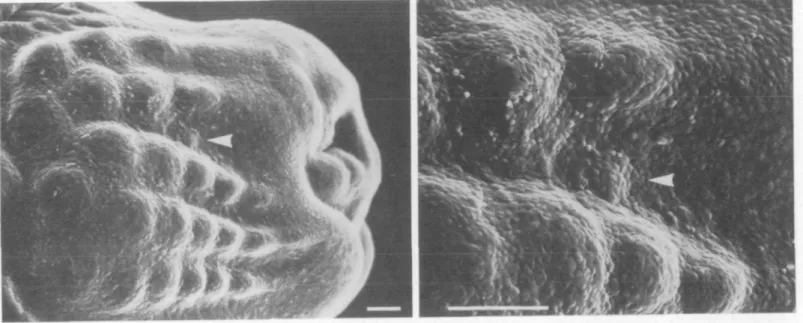
FIGURE 6 Scanning electron micrographs from right muzzle taken from a mouse fetus of 13 days gestational age (conception is on day 0). Rostral is to the right; dorsal, up. Right micrograph is detail from center of pad, showing the rudiment of a supernumerary whisker at site C3' (arrowheads), situated between row C—the middle row of follicle rudiments—and row B. Fetus was obtained through
hys-terectomy performed under deep Nembutal (i.p.) anesthesia of die pregnant female, fixed in giutaraldehyde 2 percent in 0.1 M phosphate buffer at pH 7.2, critical point dried and sputter-coated with gold. Ban: 0.1 mm. (Micrographs courtesy of Dr. F. Andres.)
Our one animal outside the ICR strain (which had SWs in all listed sites) that had an A' was from the DBA/2J(a) strain, while an A5 was seen in a C3H/HeJ mouse. NMRI had no SWs at all. We agree with Yamakado and Yohro29 that the preferential occurrence of
certain SWs in certain populations of mice speaks for a genetic component in determining whether or not a mouse may bear SWs. But we do not agree with them when they deduce that SWs are determined epigenetically on the grounds that they only occur at fusion lines (the "intermediate zones between growth centers" 29) and can occur unilaterally (see
last paragraph of Discussion). They studied 5
dd/y, a BALB/c (nu/+), 7 BALB/c (nu/nu),
and 5 hairless (hr/hr) mice, of which the first and the last are of unknown origin. In the first set there were no SWs; in the second, 3; in the third, 3; and in the fourth, 5. Their ratio SWs/mice screened, for BALB/c, is compa-rable to ours for BALB/cByJ, but not for BALB/c?r(d), which had a higher ratio.
Yamakado and Yohro29 also used ICR
mice, but those were part of an analysis of the development of vibrissae by scanning electron microscopy (SEM). Their ICR mice seem not to have borne SWs for if they had, some of the SEM specimens—particularly those of ges-tational day 13 and older—would have shown them and, if they had, the authors certainly would have seen them. Figure 6 is a scanning electron micrograph from a descendent of the ICR group described in the present paper, showing the primordium of a C whisker.
There seems to be much variation between subgroups belonging to the same strain, or to the same stock of mice. But the variation ap-pears to be in the relative number of animals with SWs and not in the site of the SWs with respect to BALB/c: their and our strains had their C's in the 3,4 place! SWs must have been rare in Japan; the authors report having ex-amined more than 100 individuals of an ad-ditional 11 strains with negative results.
While it may not be surprising that highly inbred strains have SWs at a particular loca-tion, or lack whiskers at particular locations, it is unexpected that within one strain some animals have SWs and some do not; obviously, there is interindividual variability. Possibly, a SW may be considered a threshold charac-ter28 with expression based on residual
ge-netical heterogeneity10. In addition,
environ-mental factors may play a role; in fact they must be of prime importance if the population is homogeneous. The limited degree of varia-tion in sites of SWs within the different inbred strains, and the wide variation in the outbred ICR stock, speak in favor of a genetic basis for these variations and, thereby, for the existence of SWs. With respect to the variation within the ICR stock, it is striking that there appears to be a clustering of given phenotypes in cer-tain litters: there are litters with a high number of C whiskers; there are those with a high number of A5 and B5 whiskers; and there are even litters that show a strong left-side pref-erence for the occupancy of the A5 site.
We have tried to estimate the probability of
"clustering" occurring by chance by com-paring a hypothetical population in which certain phenotypes were randomly distributed with the observed one. We took as an example all the 34 C whiskers, divided over 27 animals. There are 597 animals in our population and 45 litters (mean size 13.22). Our null hy-pothesis was that these SWs are randomly distributed over the 45 litters whose mean size was rounded off to 13; such a distribution is binomial. In Table IV we give the expected and observed number of litters with 0 , 1 , 2, and
Table IV. Goodncss-of-fit test (chi-square) of expected and observed numbers of litters in which 0, 1,2, and 3 C whiskers occurred in an average litter of 13 animals. The real population
consisted of 597 mice bearing a total of 34 C whiskers distributed over 45 litters. The
expected numbers follow a binomial distribution with an estimated probability of
34/597. Eight-digit numbers were used for computation N o . C whiskers per litter 0 1 2 3 Exp. freq. 21.00 16.48 5.97 1.55 45.00 Obs. freq. 33 3 4 5 45 X2 6.86** 11.03*** 0.65 7.72** 26.26***
*• Rejection at P <0.01 of null hypothesis that C whiskers follow a binomial distribution
•*•• P <0.005
3 or more C vibrissae. The goodness-of-fit test
(chi-square) showed that the observed
distri-bution would occur by chance only with a
probability lower than 0.005. Hence, we must
reject our null hypothesis. We conclude that
the clustering of C vibrissae within particular
litters is not due to random distribution.
When we consider the unit of analysis not
to be the whisker itself, but an animal with one
or more C whiskers, then, following a similar
analysis, we find that such "enriched" mice arc
clustered within particular litters, now with a
confidence level o f f <0.01.
A final analysis concerned the asymmetrical
distribution of A5 whiskers. As stated, there
were four litters with a high left-right ratio but
taking as units of analysis animals with an A5
whisker to the left as the sole character we had
to accept the null hypothesis, recognizing the
observed distribution of the animals in
ques-tion to be a random event.
The existence of clustering—be it of given
supernumerary whiskers or of animals of given
phenotype—does not form a decisive
argu-ment in favor of genetic or cpigenetic factors
determining the occurrence of supernumerary
whiskers.
In conclusion, we propose that there is a
systematic basis for the occurrence of
super-numerary whiskers, and we presume that
factors involved in the formation of them act
on the fusion of the nasal folds and the
max-illary arch. Beside the localization of their
action, the analysis of the data for the ICR
population leads us to distinguish three groups
of factors. 1) A general factor that determines
the presence of mystacial SWs regardless of
side. It forms the basis for the observation that
the incidence of one S W is associated with an
increased chance for a second one to occur. A
similar, general factor determining the overall
number of vibrissae belonging to a particular
group of "secondary" vibrissae has been
pos-tulated
16. 2) Factors that specifically act on
the different lines of fusion, again regardless
of side. They underlie the interaction between
the occurrence of several SWs (Figure 5), and
also the clustering of C whiskers in some
lit-ters (Table IV). 3) A third factor deals with
laterality. See the left-right differences in the
occurrence of SWs at a particular site (Table
I) and the mode of interaction between the
occurrence of two SWs for several whisker
combinations that is not the same for the left
and the right side (Figure 5).
We suggest a genetic basis for these factors.
Starting from the population of mice described
in this paper, we succeeded in selectively
breeding animals (over an average of 15
gen-erations) for particular whisker patterns,
nonstandard and standard. The results of these
ongoing experiments will be the subject of
subsequent articles. For a preliminary report
see Van der Loos et al.
24.
References
1. ANDRES, F.L. and H. V A N DER LOOS. Whisker patterns form in cultured non-innervated muzzle skin from mouse embryos. Neurosd. Lett. 30: 3 7 - 4 1 . 1 9 8 2 .
2. and . Cultured embryonic non-inner-vated mouse muzzle is capable of generating a whisker pattern. Int. J. Devi. Ncuroscicnce 1: 319-338.1983.
3. DANFORTH, C. H. Hair in its relation to questions of homology and phylogeny. Am. J. Anat. 36: 47-68. 1925.
4. D A V I D S O N , P. and M. H. H A R D Y . The
develop-ment of mouse vibrissae in oioo and in oitro. J.
Anat. 86:342-356. 1952.
5. DORFL, J. The musculature of the mystacial vi-brissae of the white mouse. J. Anat. 135:147-154. 1982.
6. D U N , R. B. Growth of the mouse coat. VI. Distri-bution and number of vibrissae in the house mouse.
Austr. J. Biol. Sci. 11:95-105. 1958.
7. . The development and growth of vibrissae in the house mouse with particular references to the time of action of the tabby (Ta) and ragged (Ra) genes. Austr. J. Biol. Sci. 12:312-330. 1959. 8. and A. S. F R A S E R . Selection for an
invari-ant character, vibrissa number, in the bouse mouse.
Austr. J. Biol. Sci. 12:506-523. 1959.
9. FALCONER, D. S. Genetic aspects of breeding methods. In UFAW Handbook. A. N. Norden and W. Lane-Petter, Eds. 3rd ed. Livingstone, Edin-burgh and London, p. 72-96. 1967.
10. FeSTtNG, M. F. W. Inbred Strains in Biomedical Research. MacMillan, London and Basingstoke. 1979.
11. F R A S E R , A. S. and B. M. K I N D R E D . Selection for
an invariant character, vibrissa number, in the house mouse. III. Correlated responses. Austr. J.
Biol. Sci. 15:188-206. 1962.
12. G R U N E B E R G , H. Congenital hydrocephalus in the mouse, a case of spurious pleiotropism. J. Genet. 45:1-21. 1943.
13. I B R A H I M , L. and E. A. W R I G H T . The growth of
rats and mice vibrissae under normal and some abnormal conditions. / . Embryol. Exp. Morph. 23:831-844. 1975.
14. J E A N M O N O D , D., F. L. R I C E , and H. V A N D E R
LOOS. Mouse somatosensory cortex: alterations in the barrelfield following receptor injury at dif-ferent early postnatal ages. Neurosdence 6: 1503-1535. 1981.
15. P A T T E N , B. M. The normal development of the facial region. In Congenital Anomalies of the Face ' and Associated Structures. S. Pruzansky, Ed. Thomas, Springfield, Illinois, p. 11-45. 1961. 16. PENNYCUIK, P. R. and J. M. R E N D E L . Selection
for constancy of score and pattern of secondary vibrissae in Ta/Ta-Ta/Y and TA/+ mice. Austr.
J. Biol. Sci. 30:303-317. 1977.
17. RICE, F. L. and D. ANDERS. A small guillotine to prepare brains for sectioning in defined, odd planes. ,
Neurosd. Lett. 6:157-163. 1977.
18. andH. V A N D E R L C O S . Development of the barrels and barrel field in the somatosensory cortex of the mouse. J. Comp. Neurot. 171:545-560.
1977.
19. STREETER, G. L. Description of age groups XV, XVI, XVII, and XVIII, being the third issue of a survey of the Carnegie Collection. Contributions
to Embryology 32:133-203, Carnegie Institution •"
of Washington Publication 575. 1948. In Devel-opmental Horizons in Human Embryos; Age Groups XI to XXIII, Embryology Reprint Volume II, G. L. Streeter, Ed. Carnegie Institution of Washington, Washington, D.C. 1951.
20. T A M A R I N , A. and A. B O Y D E . Facial and visceral arch development in the mouse embryo: a study by scanning electron microscopy. / . Anat. 124: < 563-580. 1977.
21. V A N DER LOOS, H. and T. A. WoOLSEY. So-matosensory cortex: structural alterations following early injury to sense organs. Science 179:395-398. 1973.
22. and J. DORFL. Does the skin tell the soma-tosensory cortex how to construct a map of the periphery? Neurosd. Lett. 7:23-30. 1978. 23. . The development of topological
equiv-alencies in trie brain. In Neural Growth and Dif-ferentiation. E. Meisami and M. A. B. Brazier, Eds. Raven Press, N Y . p. 331-336. 1979. 24. , ) . DORFL, and E. W E L K E R . Selective
breeding for variation in number of mystacial vi-brissae in mice; consequences for the cortical bar-relfield. Neurosd. Lett, suppl. 14:S384. 1983. 25. WELKER, E. and H. V A N DER LOOS. Genetically
determined supernumerary mystacial vibrissae in albino mice (ICR): association with peripheral inncrvation and with size of barrelfield. Neurosd.
Lett, suppl. 14:S401. 1983.
26. W O O L S E Y , T. A. and H. V A N D E R L O O S . The
structural organization of layer IV in the somato-sensory region (SI) of mouse cerebral cortex: the description of a cortical field composed of discrete cytoarchitectonic units. Brain Res. 17:205-242. 1970.
27. , c . W E L K E R , and R. H. S C H W A R T Z ,
Comparative anatomical studies of the Sml face cortex with special reference to the occurrence of "barrels" in layer IV. J. Comp. Neurol. 164:79-94. 1975.
28. W R I G H T , S. An analysis of variability in number of digits in an inbred strain of guinea pigs. Genetics
19:506-551. 1934.
29. Y A M A K A D O , M. and T. YOHRO. Subdivision of < mouse vibrissae on an embryological basis, with descriptions of variations in the number and ar-rangement of sinus hairs and cortical barrels in BALB/c (nu/+; nude; nu/nu) and hairless (hr/hr) strains. Am. J. Anat. 155:153-174. 1979.